Why are so many Hungarians deported? A look at Canada’s ‘Unwelcome Index’ 

The Globe continues to impress me with some of its serious evidence-based reporting (e.g., unfounded sexual assault cases by police department) with this being another good example of reporting by obtaining and analyzing data and explaining what it means:

The U.S. government’s determined efforts to restrict immigration and the number of refugees entering the country has invited comparisons with Canada, heralded by some (including The Economist) as a last bastion of openness among Western countries. But Canada has its own apparatus for ejecting the unwelcome; the Canada Border Services Agency is charged with removing people who don’t meet entry requirements.

To understand who Canada deports, and why, The Globe and Mail requested data from CBSA showing total removals by year, broken out by citizenship, the destination to which the person was sent and justifications for these removals. The data shows Canada removed Hungarian citizens in disproportionate numbers over the past few years. The story of those thousands of unwelcome people contrasts with international perceptions of Canada’s warm embrace of foreigners.


The unwelcome

The CBSA ejects thousands of people annually. However, the data doesn’t reveal much about why those people were removed: By far the most common official justification was “non-compliance,” a sweeping category. Fewer than 10 per cent of removals cited criminality, the second most common justification.

A clearer picture emerges when one examines the citizenship of removed persons: Hungarians topped the removals list during the five-year period from 2012 to 2016.

It is perhaps unsurprising to discover large numbers of Americans and Chinese on the list: Both countries rank among the world’s most populous, and the United States and Canada share the world’s longest border between two countries. Mexico has been a major source of immigrants, and also refugee claimants: The government of prime minister Stephen Harper responded in the late 2000s by imposing new visa requirements on Mexican visitors; removals surged.

Hungary is less populous than those countries, and distant to boot. What gives?

Hungary stands out even more when one compares numbers of removals with numbers of people of the same citizenship accepted as permanent residents. The result is a crude sort of “Unwelcome Index.” Between 2011 and 2015, more than three removal orders were issued for every Hungarian granted permanent-resident status.


Backstory of an exodus

Most Hungarians removed during this period were Roma, explained Sean Rehaag, an associate professor at Osgoode Hall Law School in Toronto who specializes in immigration law. Studying a random sample of 96 decisions of the Immigration and Refugee Board between 2008 and 2012 involving Hungarian claimants, Mr. Rehaag and his colleagues found 85 per cent involved Roma.

Roma comprise Hungary’s largest ethnic minority. There, they encounter “discrimination and exclusion on a regular basis” concerning education, employment, housing, health and much else, according to a 2014 report by Harvard University’s François-Xavier Bagnoud Center for Health and Human Rights. The late 2000s witnessed the rise of right-wing political parties and paramilitaries, accompanied by increasing rhetoric, rallies and attacks directed at Roma. Many Roma sought asylum abroad; thousands arrived in Canada after it lifted visa requirements on Hungarians in 2008.

Gina Csanyi-Robah, a teacher and human-rights activist with Hungarian Roma roots met many applicants in her capacity as executive director of the Roma Community Centre in Toronto, and also at Toronto schools. They fled Hungary because they were “scared that their home was going to be burned down,” Ms. Csanyi-Robah said. “Tired of their children getting beaten up at school and put into segregated classes. Tired of being subjected to verbal, psychological, physical violence when they left their homes.”
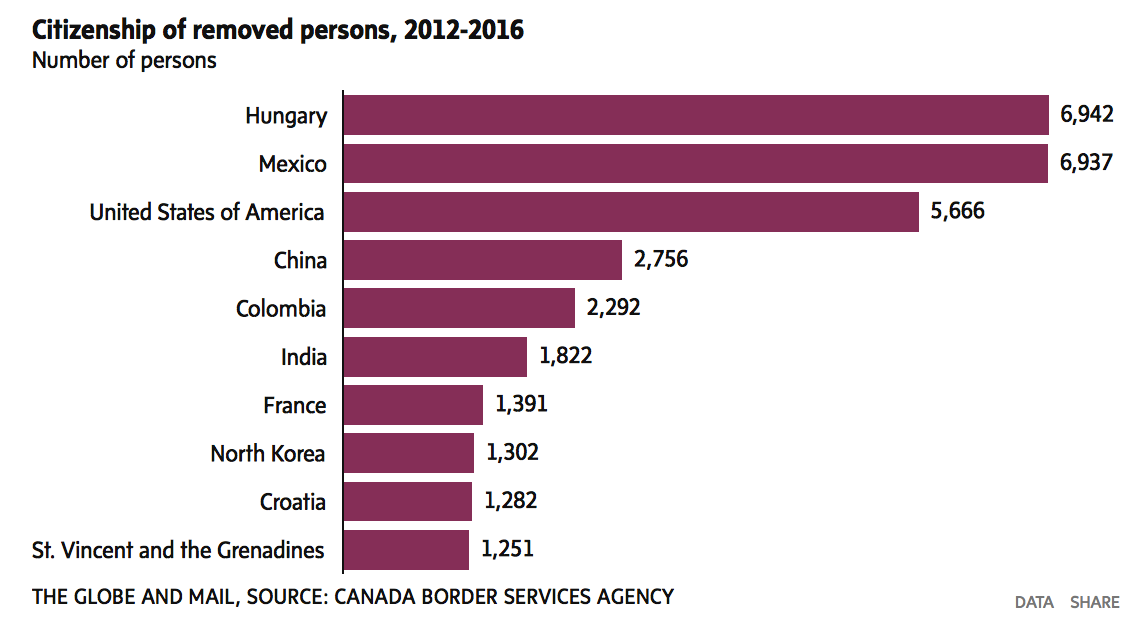
 Source: Why are so many Hungarians deported? A look at Canada’s ‘Unwelcome Index’ – The Globe and Mail

2016 Refugee Claim Data and IRB Member Recognition Rates | Canadian Council for Refugees

This is really an impressive analysis  suggesting (no surprise) that individual decision-makers are not as objective and consistent as desired (as Kahneman and others have demonstrated in different contexts). All Canadian government tribunals should conduct this kind of analysis to improve consistency in decision making:

The following note and the accompanying data are provided by Sean Rehaag, Associate Professor, Osgoode Hall Law School.

8 March 2017

Data obtained from the Immigration and Refugee Board (IRB) through an Access to Information Request reveals vast disparities in refugee claim recognition rates across decision-makers in 2016. This is consistent with similar findings from prior years for Canada’s previous and new refugee determination systems.

Refugee claims referred to the IRB after 15 December 2012 are subject to the new system, whereas claims referred to the IRB prior to that date are legacy cases that are decided under the old system. Legacy and new system cases are not only decided under different rules, but are also decided by different cohorts of decision-makers. Because of these important differences, the data on RPD decision-making for 2016 is separated into legacy cases and new system cases.

In 2016, some Refugee Protection Division (RPD) decision-makers granted refugee status in most of the cases they heard, including R. Tiwari (95.9%, 74 new system cases), I. Singh (92.5%, 53 new system cases) and K. Genjaga (91.8%, 85 new system cases). Others granted refugee protection much less frequently, including B. Lloyd (23.8%, 63 new system cases), R. Gibson (26.0%, 77 new system cases) and M. Beatty (29.8%, 57 new system cases).

Some of the recognition rate variation may be due to specialization in particular types of cases. For example, some decision-makers specialize in geographic regions with especially high or low refugee claim recognition rates. For further possible explanations for variations in recognition rates, please see an IRB explanatory note, which was provided with a response to an earlier Access to Information Request: http://ccrweb.ca/files/7.irb_explanatory_note-2012.pdf

Although some of the recognition rate variation can be explained by factors related to specialization, the tables below suggest that country of origin specialization alone fails to fully account for the variations. The tables show substantial variance for some decision-makers between the recognition rates that would be predicted based on the average recognition rates for the countries of origins in the cases they decided, and their actual recognition rates. For instance, in new system cases B. Lloyd (predicted 57.4%; actual 23.8%), R. Gibson (predicted 53.9%; actual 26.0%) and J. Daubney (predicted 59.7%; actual 32.3%) had much lower recognition rates than predicted, whereas R. Tiwari (predicted 62.6%, actual 95.9%), J. Eberhard (predicted 56.5%; actual 87.4%) and J. Bousfield (predicted 63.6%; actual: 89.3%) had much higher recognition rates than predicted.

This year’s data also includes information about outcomes on appeals at the IRB’s Refugee Appeal Division (RAD). As with RPD decision-making, outcomes at the RAD appear to vary greatly depending on who serves as the decision-maker. For example, in RAD cases decided on the merits, claimants were much more likely to succeed in their appeals before S.S. Kular (56.5%, 46 cases), R. Dhir (50.5%, 32 cases) or L.F. Agostinho (46.6%, 58 cases) than before L. Favreau (5.3%, 94 cases), Stephen Gallagher (17.1%, 35 cases) or D.E. Sokolyk (20.6%, 63 cases). Remarkably, claimants were more than 10 times as likely to succeed on appeals with S.S. Kular than with L. Favreau.

A few implications of this year’s data are worth highlighting:

  • Some countries that are designated as “safe” in Canada’s refugee determination system produced many positive refugee determinations in 2016. Consider for example, Hungary, which had a 66.9% recognition rate, and which produced 184 successful refugee decisions (involving 529 individual claimants) in the new system in 2016. It is difficult to understand how such countries can reasonably be designated as “safe” or what could justify limitations on procedural rights (e.g. expedited processes, limitations on pre-removal risk assessments) that come with such designations. For further analysis, see: http://ssrn.com/abstract=2588058
  • The persistence of unexplained variations in recognition rates across adjudicators in the new refugee determination system, combined with the devastating potential impact of false negative refugee decisions (i.e. refugees being returned to face persecution), make robust oversight mechanisms essential. Unfortunately, many refugee claimants continue to be denied access to the appeal at the Immigration and Refugee Board and are ineligible for automatic stays on removal pending judicial review at the Federal Court. This includes large numbers of claimants who transited to Canada via the United States – even though one’s route to Canada has little to do with whether one has a well-founded fear of persecution. For further analysis, see: http://ssrn.com/abstract=2647638
  • While substantial variation in recognition rates persist, it should be noted that no new system decision-makers in 2016 who made 20 or more decisions denied every single claim they heard. This is in contrast to the old refugee determination system (S. Roy in 2013: 0.0%, 23 decisions; D. McSweeney in 2011: 0.0%, 127 decisions; D. McBean in 2010: 0.0%, 62 decisions; D. McBean in 2009: 0.0%, 72 decisions). It is worth considering whether this change relates to the professionalization of refugee decision-making and the shift to civil servant decision-makers (rather than political appointees as was the case under the old system).
  • The overall success rates on RAD appeals are remarkably high. Indeed, appeals brought by claimants and decided on the merits were granted in almost one third of cases (33.1%). On the one hand, the fact that the RAD is correcting large numbers of claims that were wrongly denied at the RPD emphasizes the importance of this form of oversight. On the other hand, however, it also suggests that there is room for improvement in initial decision-making at the RPD.

For a discussion of the methodology used to obtain the data and to calculate the statistics, as well as an analysis of the implications of similar data for a previous year, see Sean Rehaag, “Troubling Patterns in Canadian Refugee Adjudication” (2008) 39 Ottawa Law Review 335. This article is available via links here: http://ssrn.com/author=404046

Source: 2016 Refugee Claim Data and IRB Member Recognition Rates | Canadian Council for Refugees

Asylum outcomes vary widely among refugee judges, study finds

Good reporting by Nicholas Keung.

The IRB should not be so dismissive of the analysis and may benefit from reading Daniel Kahneman’s Thinking Fast and Slow for similar examples where cognitive bias has resulted in different decisions. No system is completely immune:

Despite recent reforms to the refugee system, whether an asylum claim is approved or denied has remained the luck of the draw, according to a new report.

Based on Immigration and Refugee Board data, Osgoode Hall law professor Sean Rehaag looked at all 7,818 asylum decisions made in 2015 by 92 board members under the new system. He found their decisions vary widely on claims from the same country.

The former Conservative government made these new decision-makers government employees — replacing the old political appointees — with the hope of making the system free from political influence based on the adjudicators’ political affiliation.

“It’s striking that the refugee determination system is making life-and-death decisions and the outcomes of the claims vary depending on who is making the decision,” Rehaag said of his findings in the report to be released Wednesday.

In 2015, a total of 8,268 new claims were processed; 279 were withdrawn and 160 were deemed abandoned with claimants absent from their hearings. Of the 7,818 decisions rendered, 65 per cent of the claims were granted and 35 per cent were denied.

While some decision-makers rarely granted refugee status, Rehaag said others accepted most of the cases they heard.

Member Gloria Moreno, for example, had a grant rate of 27.3 per cent out of 22 decisions, the lowest of all adjudicators, followed by David Young, who only accepted 32.9 per cent in 79 decisions.

At the other end of the spectrum, 98.5 of James Waters’ 65 decisions were positive, with Maria Vega in a close second at 92.9 per cent.

Although some of the differences may be due to the members’ specialization in particular types of cases such as geographic regions with especially high or low refugee claim recognition rates, Rehaag compared decisions by different adjudicators on claims from the same country and found the variations unjustified.

Rehaag said his findings speak to the importance of allowing universal access for failed claimants to appeal to the refugee appeal tribunal.

The IRB, however, said outcomes of decisions vary because decision makers render impartial decisions in accordance with the law based on the evidence presented.

“It’s important to note that there are no ‘expected recognition rates’ at the board . . . each case is unique and determined on the basis of its individual merit,” said IRB spokesperson Anna Pape, adding that failed refugees are entitled to have decisions reviewed by the Federal Court of Canada.

The Liberal government has dropped its constitutional challenge to the designated-country-of-origin regime established by its Tory predecessor, intended to deny appeals by claimants from countries presumed to be safe and capable of protecting their nationals.

Refugee board members’ rulings varied widely in 2014, data suggests

Good and necessary analysis and wonder if the IRB uses this data as a quality control measure. There may be valid reasons for variation, and the sample sizes are relatively small, but generally variation on this scale suggests “automatic thinking” and biases may be playing a role.

The good news is that under the new system and a better selection process for judges, the variation appears to be decreasing:

The data show many decisions by adjudicators fall far below the average rate of acceptance that would be expected based on country of origin, and others far above. And that’s the case in both the old, or “legacy,” system and the new system, which is supposed to be more fair.

As examples, Rehaag pointed to some judges least likely to grant refugee status:

In the legacy system, Edward Robinson (2 claims granted out of 65 total decisions, or 3.1 per cent) and David McBean (1 out of 21 decisions, or 4.8 per cent).

In the new system, Teresa Maziarz (15 of 53 decisions, 28.3 per cent) and Brenda Lloyd (25 of 64 decisions, 39 per cent).

He also pointed to others on the other end of the scale, who granted refugee status in most of the cases they heard:

In the legacy system, Barry Barnes (59 of 77 decisions, 76.6 per cent) and Kevin Fainbloom (53 of 75 decisions, 70.7 per cent).

In the new system Nina Stanwick (35 of 38 decisions, 92.1 per cent) and Rabin Tiwari (104 of 117 decisions, 88.9 per cent).

In a written response, a spokesperson for the IRB noted there are many factors that can cause variations in acceptance rates.

“Each refugee protection claim is unique and is determined by members on its individual merit,” Melissa Anderson wrote.

Anderson cited as factors the region or city in which claimants lived, their ethnicity or nationality, their gender, whether they spent time in a third country without making a refugee claim before coming to Canada, and the evidence they or their lawyer presents to the refugee protection division.

Analysis of data on Immigration and Refugee Board decisions shows a wide variance in outcomes depending on who is hearing a case.

She also noted that the credibility of the claimant can be a key factor in the decision.

Still, immigration lawyers who regularly appear before the board say those factors don’t explain the extreme discrepancies among some decision-makers.

Immigration lawyer Lorne Waldman says he’s always worried if he has to argue a case before certain judges.

Waldman added, that while there is still inconsistency among adjudicators in the new system, he believes the variation is “less extreme” for cases post-2012.

He attributes the change to a new selection process for board members that includes people from outside the IRB.

Refugee board members’ rulings varied widely in 2014, data suggests – Politics – CBC News.