Ottawa appointing more female judges, but bench still short of gender parity – The Globe and Mail

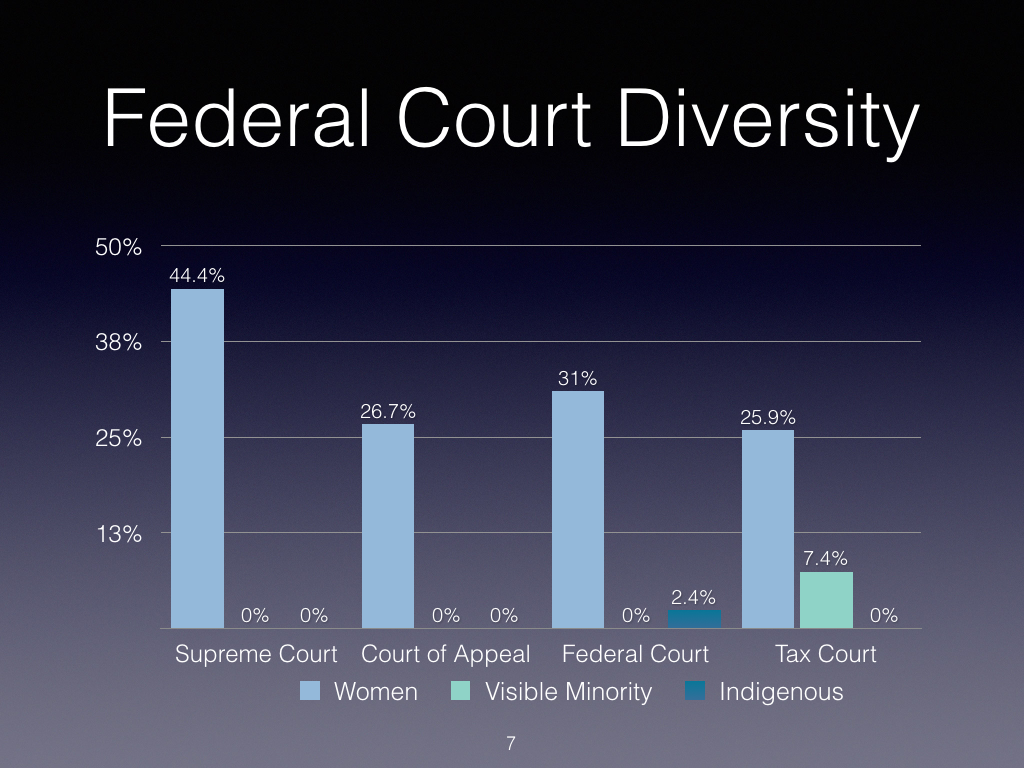
Good overview with the latest numbers. My tracking of women, visible minorities and Indigenous judicial appointments since 2016 is above:

The federal Liberal government has been naming women to the bench at an unprecedented rate this year, with nearly three women chosen for each man, government figures show. Of 37 judges named to federally appointed courts in 2018, 27 are women.

The boost in the appointment rate of women has been helped along by historic levels of female applicants, who make up 45 per cent of the 1,169 applicants since the Liberals established a new appointment process in October, 2016, according to the Office of the Commissioner for Federal Judicial Affairs, which collects data on the process. That’s up from 30 per cent during the 10 years the Conservatives were in power. (Federally appointed courts include the superior courts of provinces, the Federal Court, Tax Court and the Supreme Court of Canada.)

The rapid rate of female appointments still leaves the bench well short of gender parity. The 866 full-time positions are now 39.6 per cent women, up from 36.6 per cent when the Liberals took office in November, 2015, according to figures supplied at the request of The Globe and Mail.

The government has put into effect its stated policy of having a 50-50 gender split in Cabinet. But it has never publicly stated a target for the appointment of women to the judiciary.

If it has set numerical targets for achieving a 50-50 split, it is not saying.

“All judicial appointments are made on the basis of merit, taking into account the needs of the court,” Dave Taylor, a spokesman for Justice Minister Jody Wilson-Raybould, said in an e-mail. “As we move forward, we are confident that our Government’s goal of a balanced, meritorious and diverse bench will be realized.”

Members of the legal community interviewed for this story said they believe the Liberals are stepping up efforts to bring about gender parity on the bench. Several lawyers said they welcome that effort. “As a middle-aged white guy, I’m not concerned about what might be interpreted as a disproportionate number of women who are appointed to the bench,” Halifax privacy lawyer David Fraser said in an interview. “If it takes a little bit of corrective action to get us close to a properly representative judiciary, I think it’s fine.”

During the Conservatives’ period in office, from 2006 to 2015, women made up 30 per cent of judicial appointments. The Liberals made several changes to the appointment process in 2016, including asking applicants to fill out questionnaires describing what equity and diversity mean to them. And for the first time, they asked applicants their race, ethnicity, sexual orientation and disability status, promising to make the data public. (The judicial affairs office says it will make these more detailed figures for the second year of Liberal appointments under this process public in October. Several of the 2018 appointees are members of racial minority groups.)

The appointment process has two main stages. Applicants are screened by one of 17 judicial advisory committees made up of federal and other representatives. Then the government chooses from the list of candidates recommended or highly recommended by the committees.

Some lawyers stressed the importance of merit in judicial appointments. “I certainly support gender equity but the overriding factor has to be choosing the best candidates, as far as I’m concerned,” Andrew Rouse, a litigator in Fredericton, said in an interview.

Heather Treacy, a lawyer in Calgary, said she applauds the trend “provided it is balanced with ensuring top-quality candidates are appointed. This is less of a current concern given the increased numbers of very able females engaged in the legal profession.”

Others offered unqualified praise. “I think it’s terrific movement in the right direction,” said Brian Facey, who practices competition law in Toronto.

Rosemary Cairns Way, who teaches law at the University of Ottawa and monitors diversity in judicial appointments, said the jump in the overall proportion of women on the bench is noteworthy. It “demonstrates that achieving gender parity requires action (as opposed to faith in a ‘trickle-up’ process),” she said in an e-mail.

As for the greater proportion of women applying for the federal bench, she said, “I suspect it is because potential women applicants are more confident that the skills, experience, and expertise they present are more likely to be valued.”

via Ottawa appointing more female judges, but bench still short of gender parity – The Globe and Mail

Liberal government not always appointing top recommended judges

Good analysis by Sean Fine. Greater transparency leads to more questions, but commendable that the government is releasing this data. Will do more analysis once I have reviewed the report but relieved that I will no longer have to review judicial announcements and compile my own data:

The Liberal government is not always appointing judges from a pool of “highly recommended” candidates, raising questions about whether partisan political considerations or diversity concerns are trumping merit.

Under a ranking system brought back last October by the Liberals – who said it would “highlight truly outstanding candidates” – advisory committees identify the best as “highly recommended.” Second best are “recommended.” A third group is “unable to recommend.” The Conservatives had dropped the “highly recommended” category in 2007, drawing criticism from the legal community.

But the Liberals have appointed a number of judges from the “recommended” list, according to a federal agency that supports the appointment process. Justice Minister Jody Wilson-Raybould would not reveal how many when contacted by The Globe and Mail. Neither would the Office of the Commissioner for Federal Judicial Affairs, which collects data on the process.

New statistics released as part of Ms. Wilson-Raybould’s stated effort toward transparency and diversity show a large surplus of the truly outstanding: 129 highly recommended candidates, for just 74 appointments made since last October. The rankings come from 17 non-partisan advisory committees across the country, who review the candidates’ applications and check each individual out with lawyers they know in the community.

Ms. Wilson-Raybould, who had instructed the judicial affairs commissioner to collect and publish the statistics, says it is her prerogative to appoint from the recommended list.

“I take care to consider a number of factors, such as each candidate’s expertise, the needs of the court, and the strength of their application,” she said in an e-mail to The Globe. “Whether someone is recommended or highly recommended is one factor that I take into account, among many important considerations, in exercising my prerogative to appoint the best candidates to the judiciary.”

The highly recommended category is the key to a merit system of appointments, says Peter Russell, a political science professor emeritus at the University of Toronto. “If you just appoint people who are merely qualified, that is not looking for the best-qualified people for the positions.”

In an interview, he questioned whether some appointed from the recommended group were chosen for their affiliation with the Liberals. “I think we should know – is it politics?”

The return of the “highly recommended” category was part of the Liberals’ new appointments process in which candidates are now asked to self-declare their sexual orientation, ethnicity and other background factors. That information is kept private.

On Friday, for the first time in Canadian history, the judicial affairs commissioner published data on the diversity of candidates and appointments.

Commissioner Marc Giroux’s office said revealing the number of appointees from the “recommended” list could be damaging to the legal process.

“We have considered whether providing a further breakdown regarding appointees and the ‘rating’ of recommended or highly recommended should be provided,” spokeswoman Caroline Masse said. “However, if such were disclosed, litigants or others could determine whether or not a particular judge was recommended or highly recommended by simply referring to their biography and comparing it to these statistics.

“This prevents our office from distinguishing between the number of appointees that were highly recommended vs. recommended,” Ms. Masse said in her e-mail.

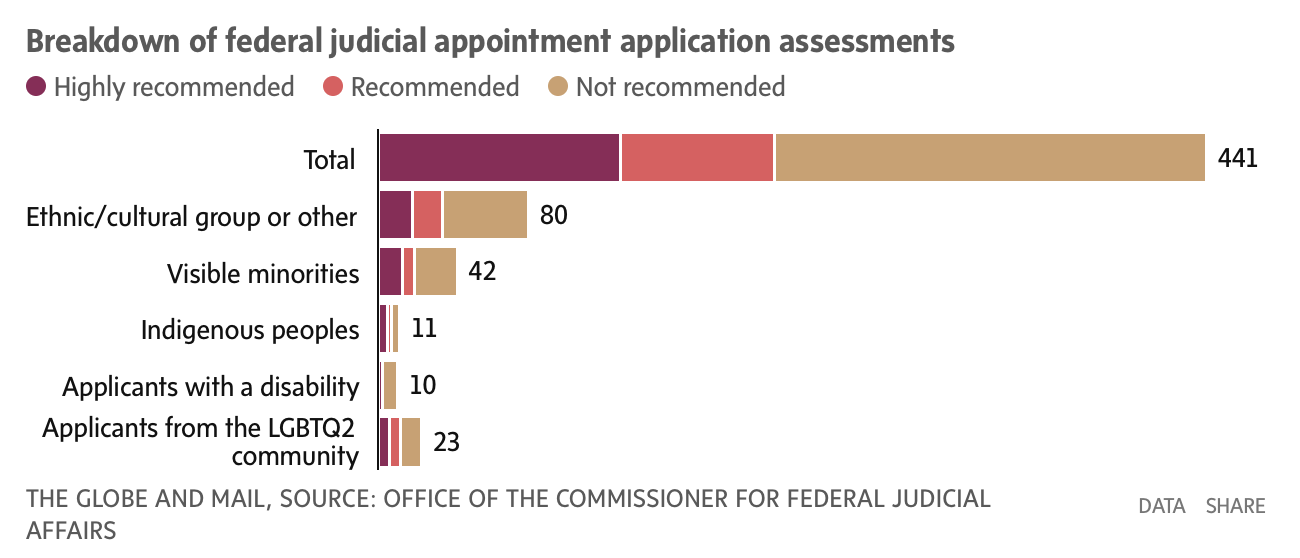
Just short of 1,000 applications have been received since last October, of which the committees got around to assessing 441. Of those 441, 129 candidates were highly recommended, 82 were recommended and 230 were not recommended.

The data also show that, of the 74 appointments under the new process, 37 were men and 37 were women. (An additional 12 were of judges who moved from trial courts to appeal courts; of these, five were men and seven women.) Men, however, made up a much larger proportion of assessed and highly recommended candidates; there were 75 highly recommended men compared with 54 highly recommended women.

For years, the federal government had been urged by lawyers’ groups to collect data on applications and appointments by race. The new data show that, in the “visible minority” category, 97 applied (or roughly 10 per cent of all applicants) and 42 were assessed. Thirteen were highly recommended, six recommended and 23 not recommended. The government appointed nine visible minority judges.

Toronto lawyer Ranjan Agarwal, past president of the South Asian Bar Association, said the numbers show that there is more work to be done in mentoring and encouraging visible minority lawyers to apply. “Maybe there’s just not enough candidates applying from minority communities, which I think was the point of having the data – we could then focus in on the problem areas.”

There were 36 Indigenous candidates who applied and 11 who were assessed. Five of the 11 were ranked highly recommended, two were recommended and four not recommended. Three Indigenous judges were appointed.

f those lawyers who described themselves as belonging to an “ethnic/cultural group or other,” there were 190 applications, and 80 assessed; of those, 18 were highly recommended, 16 recommended and 46 not recommended. Fifteen were appointed.

There was one person with a disability appointed out of 10 assessed candidates (two highly recommended and eight not recommended). There were four judges appointed from the LGBTQ2 community, out of 23 candidates assessed. Six were highly recommended.

There were more “highly recommended” candidates in every category of diversity (women, ethnic minorities, LGBTQ, Indigenous and disabled) than judges appointed from each group.

Source: Liberal government not always appointing top recommended judges – The Globe and Mail

Liberal appointments signal intent to diversify Canadian judiciary

More analysis by Sean Fine on the Government’s first batch of judicial appointments:

The Liberal government has begun to change the face of the Canadian judiciary, appointing an aboriginal judge, an Asian-Canadian judge and a prominent member of the LGBT community in its first set of 15 appointments – of which just three were white males.

Justice Minister Jody Wilson-Raybould also signalled the government’s intention to take a different approach from its Conservative predecessors by promoting two human-rights specialists, including one who fought for gay rights in a landmark case, to Alberta’s highest court.

The Liberals waited more than seven months to name a single judge to the federally appointed courts (provincial superior and appeal courts, the Federal Court and Tax Court), even as vacancies swelled to nearly 50 from about a dozen last summer before the election was called.

The first group indicates a shift in who sits as a judge in federally appointed courts – and who gets promoted. It includes Jonathon George of the Kettle and Stony Point First Nation in southwestern Ontario; like the Justice Minister herself, he is a second-generation lawyer. He was promoted to the Ontario Superior Court from the Ontario Court of Justice.

Douglas Mah, an Asian-Canadian, joins the Alberta Court of Queen’s Bench.

Lucy McSweeney, the Children’s Lawyer of Ontario, was named to the Ontario Superior Court. She received a professional leadership award in 2013 from Out On Bay Street, a group that helps LGBT law graduates transition to working life.

“I think it’s sending a strong signal that for [the Liberals], merit involves considering the diverse perspectives that people bring to the law, and that includes the backgrounds and the communities they identify with,” said Paul Saguil, a Toronto lawyer and board member of Pride Toronto, who described Ms. McSweeney as a mentor to him. “That signal is important in instilling public confidence in the judiciary.”

Sheila Greckol, one of the two appointees to the Alberta Court of Appeal, represented Delwin Vriend, a teacher who was fired because he was gay, and fought all the way to the Supreme Court of Canada to establish that Alberta’s human-rights code discriminated by excluding gays from its protections. Justice Greckol was a labour lawyer who represented unions. Ms. Wilson-Raybould promoted her from the Court of Queen’s Bench to replace Russell Brown, who was an irreverent right-wing blogger as an academic.

Sheilah Martin, the other Alberta appeal court appointee, was the law dean at the University of Calgary with a long list of publishing credits to her name focused on the equality section of the Charter of Rights and Freedoms. She, too, was promoted from the Court of Queen’s Bench.

During the decade-long tenure of prime minister Stephen Harper, that court became home to small-c conservative judges such as Justice Brown, who referred to Justin Trudeau in a 2008 blog as “unspeakably awful,” and Thomas Wakeling. (Mr. Harper later promoted Justice Brown to the Supreme Court of Canada.) And new judges appointed by Mr. Harper across Canada included barely a handful from visible minorities.

“The Liberals are back to doing what they’ve always done, which is to appoint people who are obviously left-wing,” Tom Flanagan, an adviser to Mr. Harper when he was opposition leader, told The Globe and Mail. He disputed that the conservatives appointed conservative judges. “The Conservatives were afraid to play the game,” he said.

Another observer said the Liberals were playing the same game as the Conservatives, but in reverse. “Individuals with those kinds of backgrounds [as Justices Greckol and Martin] were not being appointed under the Harper appointment process,” University of Alberta law professor Eric Adams said in an interview.

He said the Trudeau government’s first appointments, like those made during Mr. Harper’s decade in power, show “there is more than simply pure merit that’s at play. These aren’t appointments that are being made without consideration for candidates’ previous ideologies. And that’s not a criticism – I want to make that clear. In exercising its power of appointment, governments look for judges who, yes, are talented and fair-minded, but also align with the particular worldview of the government of the day.”

In all three promotions from superior courts to appeal courts, Ms. Wilson-Raybould shut out judges appointed by the Harper government, reaching back each time to the Liberal era of Paul Martin and Jean Chrétien. (The third of the three promotions put Judith Woods, a member of the Tax Court of Canada, on the Federal Court of Appeal.)

Source: Liberal appointments signal intent to diversify Canadian judiciary – The Globe and Mail

Federally appointed courts grow restive as Ottawa slow to fill vacancies

Judicial Diversity 2016 - DRAFT.001Good piece by Sean Fine of the Globe on the questions around new processes of judicial appointments.

I am currently in the process of analyzing the diversity of current federally and provincially appointed judges (preliminary federal court numbers in above chart) and hope that as part of the process review, the Government will commit to diversity statistics for visible minorities and Indigenous Canadians (some provinces already do this with respect to provincial court judges):

Ms. Wilson-Raybould would not commit to a starting date for appointments when she spoke to the judicial council, said an Alberta lawyer with knowledge of the meeting. “The government is considering the full scope of the appointments process, including the composition and operations of the Judicial Advisory Committees,” a spokeswoman for the minister said in an e-mail to The Globe.

“Any potential changes will be examined in light of the government’s objectives to achieve transparency, accountability and diversity in the appointments process and they will be carefully considering how best to achieve this goal, taking into account views of key stakeholders and interested Canadians in this regard.”

The appointments process is not up and running yet. And Ms. Wilson-Raybould has made little progress toward putting a new process in place – having not even begun consultations with the legal community and leaving a critical position unfilled.

At the system’s foundation are 17 judicial advisory committees – eight-member groups that screen candidates for federally appointed courts such as provincial appeal and superior courts, the Federal Court and the Tax Court. Several of these committees have no members at all – two of Ontario’s three committees, both of Quebec’s, plus all four committees in Atlantic Canada.

The Alberta committee, however, has all eight of its members, and met as recently as mid-March to recommend candidates for the bench, Chief Justice Wittmann said.

“Nobody is against reform if it betters the system,” he said, “but you can’t change locomotives and stop the train; the train’s got to keep running while you’re doing it.”

Criminal and civil trials that need more than five days are being scheduled for “well into 2017,” Chief Justice Wittmann said. “If the public through their elected representatives say that’s fine, well, I guess it’s fine. But there seems to be an expectation that it’s not fine.”

For the court’s judges, “it increases their stress and their sense of helplessness, because they can’t handle everything they’re asked to do. The public thinks they’re not getting the access they’ve come to expect. We cannot sacrifice quality to increase the quantity of cases that we process. It just can’t work that way.”

Ms. Wilson-Raybould has yet to discuss the system’s pressing questions with the legal community: what to do about the changes to the process that the former Conservative government put in place, whether to commit to gender parity in judicial appointments, and whether to begin tracking the numbers of visible minority and aboriginal applicants.

Source: Federally appointed courts grow restive as Ottawa slow to fill vacancies – The Globe and Mail

How law to strip terrorists of citizenship fits into global picture

Good piece by Sean Fine in the Globe comparing revocation practices in other countries:

What other democracies allow citizenship to be revoked?

Twenty-two countries in Europe allow denaturalization for terrorism or other behaviour contrary to the national interest, according to a 2014 paper by University of Ottawa law professor Craig Forcese. These include Britain, Belgium, Denmark, France, Germany, Greece, Spain, Switzerland and the Netherlands. Australia introduced a new law in June to revoke the citizenship of dual nationals who engage in terrorism. Britain has broadened its revocation powers; the government may now make an individual stateless.

Why does the United States, with its well-known ‘war on terror,’ not revoke terrorists’ citizenship?

The U.S. Supreme Court has expressed abhorrence: In a 1958 case, chief justice Earl Warren called it “a form of punishment more primitive than torture, for it destroys for the individual the political existence that was centuries in the development.” In a 1949 case, the court deplored the removal “of a right no less precious than life or liberty.”

What does the Canadian Charter of Rights and Freedoms say about citizenship?

Section 6 says, “Every citizen of Canada has the right to enter, remain in and leave Canada.” But Section 1 says rights and freedoms are subject to limits that government can justify as reasonable in a free and democratic society. However, Section 6 is not subject to the Charter’s “notwithstanding” clause (Section 33); government cannot opt out of a court ruling on citizenship rights.

Source: How law to strip terrorists of citizenship fits into global picture – The Globe and Mail