How police became the enemy in Toronto schools: Cohn

Good insightful column by Regg Cohn. Activists have the right to opinions and protests but ultimately the democratic process and accountability must decide:

Uniformed police have now been banned from participating in Toronto’s Pride parade.

Will they next be barred from fraternizing with students in our schools?

Anti-police protests have become a recurring theme in Toronto. Black Lives Matter led the charge at last year’s Pride, blocking the parade and out-organizing the organizers until they won the day.

Now, however, the protesters may have met their match in parents and principals who don’t view all police as perennial enemies in all places.

At a raucous meeting of Toronto’s Police Services Board this month, BLM protesters found themselves being challenged by people of colour who are taking a more colour-blind view of security, safety and pedagogy.

Critics describe the School Resource Officer (SRO) program as a “school to prison pipeline,” arguing that police pick on marginalized — read, racialized — students. But when police board member Ken Jeffers suggested last week that it be suspended or terminated like a truant student, the reaction may have surprised him.

One woman in the audience shouted back that he should ponder the blood shed by Blacks because of violence in our schools. As my colleague Andrea Gordon reported, a procession of principals, teachers and students from diverse racial backgrounds expressed strong support for the police presence — though it didn’t seem to influence BLM’s view.

The SRO program is not unique to Toronto but it is uniquely controversial here. Vancouver, Ottawa, Mississauga and other big cities have embraced the idea of placing police in schools, where it remains popular.

That’s not to say the program is perfect. But we should remember that the perfect is the enemy of the good — even if the police are sometimes seen by many as the enemy.

Whatever its flaws, the program has indisputably benefited many students and teachers in the trenches. An independent study of a similar SRO program in Peel suggests the presence of cops is an “overwhelmingly positive” confidence-building and relationship-building measure.

Measuring its impact is undoubtedly difficult. To its credit, the police board ultimately decided to defer any suspension until the Toronto program is properly evaluated. That didn’t stop Black Lives Matter from dismissing any review as a “dangerous side tactic.”

BLM is entitled to its protests, which had a cascading effect on the Pride parade — a private (albeit publicly subsidized) group that can make its own decisions in its own ways. Unlike Pride, the police services board — like our Toronto-area school boards — is a democratically constituted entity answerable to our elected councillors, who are accountable to the broad public and especially parents. Pressure tactics are part of our civil discourse, but representative democracy ought not to be held hostage to protests weighed down by historical grievances about police raids on gay bathhouses three decades ago.

It’s easy to forget the impetus for police in our schools. A decade ago, Grade 9 student Jordan Manners, 15, was fatally shot in the hallway of C.W. Jefferys Collegiate. In the aftermath, Toronto’s two publicly funded school boards teamed up with the police to introduce the SRO program.

The C.W. Jefferys school initially resisted the idea, but later embraced it after another teen was stabbed and yet another caught with a loaded handgun. Its current principal, Monday Gala, is a strong supporter:

“If you come into Jefferys today and see the positivity that is going on organized by this partnership with the police, you can’t deny the fact that there is a place for the police in the school,” he told the Star.

Some feel frustrated that the SRO program isn’t comprehensive but perhaps unfairly selective, rotating 36 uniformed cops through 75 schools across the city. Other SRO programs, such as in Peel and Ottawa, cover all schools.

That has led to the perception that only at-risk Black kids are targeted at schools like C.W. Jefferys. But at-risk — and rich — kids of all colours are just as likely to be watched over by cops at the posh Etobicoke School of the Arts, Riverdale Collegiate or Northern Secondary School.

Would an even larger program that puts cops in every single school appease everyone? It hardly seems like the solution sought by protesters, who sometimes sound as if they don’t want to see any cops anywhere at any time — whether on a Pride parade ground or a Toronto school ground.

Protesters have every right to their anti-police perspective. Especially in the wake of a long battle against carding that disproportionately affected people of colour.

Minority voices, whether held by minority groups or believed by bastions of white privilege, are part of our democratic discourse. But they cannot be the last word in a democratic process.

Source: How police became the enemy in Toronto schools: Cohn | Toronto Star

How School Administrators Are Dealing With Incidents Of Hate : NPR

Good article with number of telling examples, along with a description of an ADL program in action:

One of the gold standards in teaching tolerance is a program run by the Anti-Defamation League called “A World Of Difference.” The number of schools calling and asking for the program has jumped five-fold recently. Brookline High School reached out after being hit with two incidents of racist and anti-Semitic graffiti. Administrators recruited 30 students to go through three full days of training — to learn to run tolerance workshops for their peers.

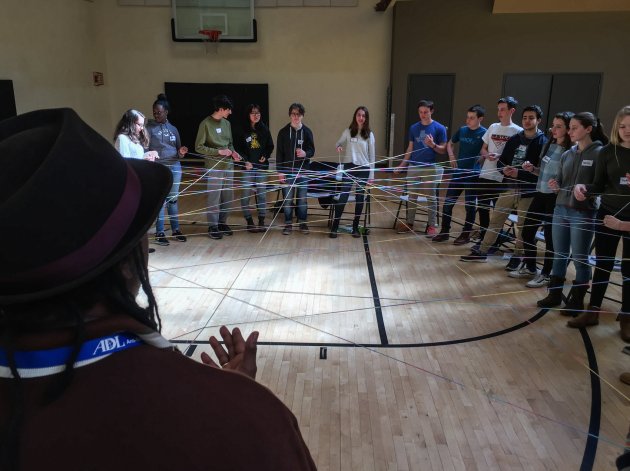
“Ok, folks! Showtime!” bellows the ADL’s New England Senior Training Consultant Rob Jones from the front of a gymnasium. His dreadlocks swinging out from under a felt fedora, Jones bounces around the circle of students, grilling them on what they’ve learned from the exercises they’ve done so far and getting them ready to be leaders instead of participants. They begin by practicing how they will introduce themselves to classmates when they run a workshop.

Rob Jones, a training consultant with the Anti-Defamation League, leads Brookline High School students in building a “web of unity.”  Tovia Smith /NPR

“My name is Josh Gladstone,” starts one. “I’m doing this program because I have seen many issues at the high school, and even though we attempt to have a couple of assemblies, I don’t think it’s enough.”

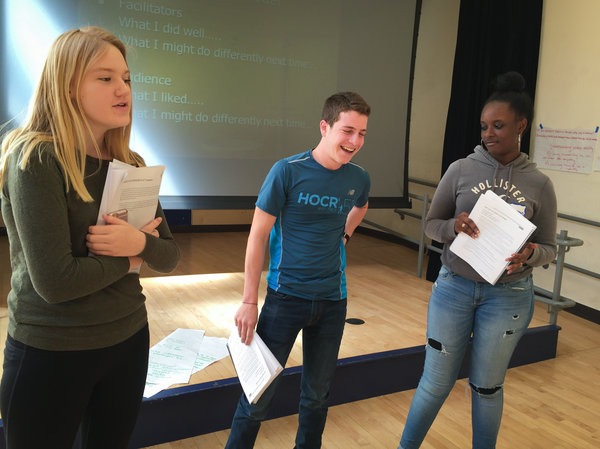
The students role-play and rehearse everything from ice-breakers to exercises meant to encourage empathy and bystander intervention. Jones coaches and corrects. “You don’t wanna preach,” he tells one. “You do not wanna come off as better than [them]… like you really need to help them. We’ve all laughed at jokes we shouldn’t have laughed at and made comments we shouldn’t have made. We’re all trying to learn together.”

After participating in tolerance workshops for two days, Maddie Kennedy (left), Josh Gladstone and Raven Bogues practice being presenters before they run the same workshops for their peers.  Tovia Smith /NPR

Indeed, even in their left-leaning “bubble” — as some Brookline students call it — they’ve seen an uptick in hate.

Junior Talia Vos, who moved to Brookline from Mexico, says she felt it the day after the election. She was in the hallway between classes and yelled out to a friend –- in Spanish — to save her a seat.

“A group of boys behind me, they started chanting, ‘build a wall!'” she recalls. “It’s just these new social norms of how we treat each other.”

After 30 years of doing this work, Rob Jones worries that many of the communities that need these programs the most are also in denial.

“Certain populations just won’t talk about it because they don’t get it — they don’t get it,” he says. “They’re like, ‘we don’t have any issues.’ But boy, they have a lot of bigoted behavior.”

Along with prevention, many schools these days are also quickly learning the art of “the healing response.”

In Brookline, after the hateful graffiti was found, students banded together to re-paint the table that was vandalized to “reclaim it from hate.” Other schools have called in professional facilitators to moderate a “community conversation.”

Following the KKK graffiti in Attleboro, dozens of students mobilized to counter the hate with kindness. They wrote “love notes” to each of the high school’s nearly 2000 students, staffers and teachers.

Source: How School Administrators Are Dealing With Incidents Of Hate : NPR Ed : NPR

Canadian schools abandoning U.S. trips because of Trump ban

Multiculturalism, inclusion and solidarity – making a conscious choice to avoid exclusion:

Toronto parent Katie Lynes said she has heard disappointment among families about the cancellation of school trips, but there is also unease about events in the U.S. and elsewhere.

The TDSB travel ban mostly affects music students at her daughters’ school in north Toronto. The music teacher usually organizes trips to New York and Chicago, and is now considering options within Canada.

“Our board, and our school, is multicultural and inclusive, so the idea of certain kids potentially being stopped at the border or turned away does not sit well,” Ms. Lynes said. She added: “Disappointment over cancellation of trips is something that kids and families should be able to handle, especially when they realize that it’s in the service of larger principles, such as equity, inclusiveness and fairness.”

At Westmount, Ms. Jafralie, an ethics and religion teacher, said discussions about changing the itinerary allowed for a learning opportunity for her students. She and her students were disappointed that they wouldn’t visit the American sites, but not upset enough to leave classmates behind.

“We have a diverse population and we embrace our diversity. We’re just not willing to take the risk. We’re just not willing to break us all up,” she said.

Source: Canadian schools abandoning U.S. trips because of Trump ban – The Globe and Mail

ICYMI: How a country gets forged in the classrooms: Salutin

Good piece on the integrative role of the public school:

My friend and neighbour Rob Vipond, who’s a political science prof and whose daughter Susanna looks after our cat and turtle when we’re at the lake, has written a neighbourhood book brimming with love. It’ll be out this spring. He says it’s the “biography of a school” — Clinton Street Junior Public, where both our kids went. It’s a nonacademic book, full of academic rigour and insight.

He had the great idea of focusing on public schools as incubators of citizenship. Private schools can teach about citizenship but can’t ever embody it, since people go there in a private role, vs. as taxpaying members of society. Public schools are labs, not just for studying citizens but for growing them.

As a poli-sci guy, Rob is also chronically fascinated by the place of the state and formal political structures, and schools are an ideal field for study since, as he says, they are “the one state institution with which many citizens have daily and recurring interaction.” In a downtown school in The Six, like Clinton, those interactions for about a century have revolved around dealing with newcomers.

So he tells three stories. One is about “Jewish Clinton,” during the first half of the last century, when Clinton was largely Jewish. Canada still saw itself as a “Christian country,” making it hard for Jewish arrivals to feel like full citizens. Then in 1944, Ontario’s Tory premier made religious i.e., Christian, instruction mandatory, like math or science.

Clinton’s response was basically to ignore the law without kicking up a fuss. It was brilliant, a subtle form of civil disobedience, which made it possible for Jewish families to gradually acquire a full sense of being Canadian rather than having second-class quality thrust upon them.

The eras of Italian Clinton and Global Clinton followed, during which Canada groped its way toward “multiculturalism” while governments added laws and bureaucracies. But at Clinton, the effort to construct “multicultural citizenship” was “all part of the daily routine.” The meaning of multicultural got sorted out right there — in classrooms and at recess. The challenge was “to pay respect to the country’s … legacy” while adapting it to “the needs and aspirations” of newcomers.

Could you integrate them without stigmatizing their heritage as “an obstacle course to overcome?” Could they contribute as themselves? “A real sense of belonging” is hard to attain if it means betraying your own identity, which you brought with you. These issues are still unresolved, as Tory leadership provocateur Kellie Leitch reminds us. But practically speaking, at Clinton, it meant “Toronto’s students might well learn something from their newly arrived classmates.”

Let me add a footnote here, based on my own teaching of a half course in the Canadian studies program at U of T over several decades. The names on my class lists have changed mightily, as Clinton’s did over a longer time. When I started, the program seemed more or less designed for people from north Toronto. The courses were basically variations on Atwood (for culture) and Innis (for social science/history): two Canadian academic staples, like timber or the beaver.

But over the years, Canadian studies added Asian-Canadian, Chinese-Canadian, Jewish-Canadian, aboriginal, etc., courses and “chairs” — the lively mélange would probably have been unimaginable to those who set it up in the late 1970s. The north Toronto contingent still attends but, as Rob says, they learn something in return from their more recently arrived classmates.

In fact, we all win. For those of us teaching, we can’t just toss out headings (federal-provincial relations, Rocket Richard, the nativity story). We can toss them out, but we also have to fill them in. It’s good for us, it reveals our assumptions, especially to ourselves, and leads to treatment of glossed-over issues.

We, in turn, learn about, oh: Model Minorities and Cooking in Madeleine Thien’s Simple Recipes; The Critical Role of Cultural Beliefs in Shaping the Perceptions of Mental Health by Chinese-Canadians; The Emergence of Queer Punk in Toronto; along with old friends like, An Appraisal of the War of 1812 and, BlackBerry: Canadian or Not? (All covered in the CanStudies student journal, IMAGINATIONS.)

This doesn’t just reflect what Canadian studies has become, it’s what Canada has become, despite the urgent efforts of Leitch and others to dictate our meaning to us, from the top down. Maybe she should sign up for some courses.

Source: How a country gets forged in the classrooms: Salutin | Toronto Star

Where to find school bullies? Not where you might expect: Saunders

Interesting study noted by Doug Saunders on the positive correlation between number of immigrant children and lower levels of bullying (and higher levels of academic achievement). End comment on Fraser Institute studies and real estate agents pushing the opposite view of note:

A few years ago, I found myself in the vice-principal’s office at a Toronto elementary school with a majority of recent immigrants and refugees from Africa, Asia and the Middle East in its student body. I was struck by all the posters in her office, and in the hallway outside, devoted to anti-bullying campaigns. “I guess schoolyard bullies are a big problem at a school like this,” I said.

“Oh no,” she said, visibly surprised, “not here – we’re required to run those campaigns, but bullying is really something for the white schools. You don’t get much of it at schools like this.”

I later heard similar remarks from teachers and education experts in other cities: that it’s the “white” schools with mainly non-immigrant populations where bullying and psychological distress are serious problems.

I assumed, for a while, that this was a matter of perception. After all, bullying is a current obsession of middle-class white parents. New-Canadian parents, lacking fluency and time to monitor their kids, might not be able to perceive or report schoolyard abuse when it takes place, I guessed.

And then I ran into Kathy Georgiades, a clinical psychologist at McMaster University’s Offord Centre for Child Studies, who happened to be conducting a series of large-scale studies of exactly this question, and finding surprising results.

In 2007, she and her team of researchers conducted a study based on interviews with 14,000 primary-school students, their parents and their teachers. They found that children living in neighbourhoods with higher immigrant populations experienced “lower levels of emotional-behavioural problems” – including those problems that are usually classified as “bullying” and “being bullied” – than those in mainly non-immigrant neighbourhoods.

That study had its limits: The interviews were only conducted in English and French, leaving out non-fluent families who might be more vulnerable. And they were classified by neighbourhood makeup, not by actual school experience. Her results had doubters among education officials, who had always classified non-fluent immigrant kids as “at-risk” – extra vulnerable to emotional and behavioural problems. Her results suggested the opposite.

So Dr. Georgiades assembled a larger, better-funded team and spent the past couple of years conducting a more comprehensive study. It held lengthy, structured interviews with students, parents and teachers at 36 primary schools in the Hamilton area’s public and Catholic boards, in nine languages, on the details of their experiences, feelings and actions; and cross-tabulated the interviews with the students’ academic, standardized testing, counselling and disciplinary records.

She told me that the study results (to be published later this year) show conclusively that more immigrant-heavy schools have a lot less bullying, as reported by students, teachers and parents – especially if more than 20 per cent of the students are foreign-born.

“In schools with a higher concentration of first- and second-generation migrant students, immigrant students are less likely to report bullying other kids, and less likely to report being bullied,” she said.

This extends to all emotional and behavioural problems. The more immigrants in a school, the better the mental-health outcomes for the newcomers. It appears to be an example of what some scholars call the “protective effect of migrant density” – newcomers and their children are more likely to help each other out than to turn against others.

If immigrant-heavy schools are good for mental health, it appears they may also be good (or at least no worse) for educational results. Research in the United States and in Britain has shown that the introduction of significant numbers of immigrants and students not fluent in English tends to improve educational outcomes in schools – not just for the immigrants themselves, but for the native-born students, who appear to have better grades and higher graduation rates than they would if they attended a school with mainly native-born students.

This may be because immigrant-heavy schools have more resources, such as teaching assistants, and because they’re forced to abandon front-of-class lecturing and offer lessons at multiple levels and tailored to multiple learning styles and paces – which is good educational practice for everyone.

Given such findings, it may be time to rethink the way we judge schools. School rankings, such as the Fraser Institute database popular with real estate agents, tend to rate schools higher if they have fewer foreign-born students. It appears that they may have it backward.

Source: Where to find school bullies? Not where you might expect – The Globe and Mail

A Danish school now separates children by ethnicity – The Washington Post

Unlikely to help integration and reflective of a broader trend in Denmark:

Nearly a year after the influx of migrants into Europe reached its peak, the repercussions can now be felt in thousands of classrooms across the continent as a new school year begins.

Whereas most other schools are focused on assimilating migrant children, one Danish school in the city of Aarhus has decided to separate them. The idea has drawn criticism from human rights advocates who question the legality of segregating children based on their ethnicity.

The Danish school’s approach, however, is somewhat different because it was not originally designed to integrate migrant children better. Instead, it seeks to allow children to avoid classes with more migrants than ethnic Danes, according to the Jyllands-Posten newspaper, which first reported the story. There are now four classes for migrant children and three mixed classes in which the ratio between migrants and ethnic Danes is equal. The policy does not only apply to refugees or children born abroad, but also to pupils who grew up in Denmark but have parents who migrated from abroad.

The case of the Aarhus school is considered isolated. About 25 percent of the school’s pupils were either migrants or the children of migrant parents in 2007, but that number has since risen to 80 percent.

Some critics of the plan say it reflects a deeper trend within a society that has grown opposed to more immigration. Denmark made headlines last year with a law that allowed police officers to seize valuables from refugees as a way to help defray the costs of hosting the new arrivals — many from war-ravaged countries such as Syria and Iraq. Opponents of such policies say that Denmark is increasingly isolating itself and portraying the country as unwelcoming to refugees and others. The number of refugees coming to the country has decreased significantly as a result.

 “It is pure discrimination when you sort people according to whether they are white or brown Danes,” Jette Møller, the president of the nongovernmental organization SOS Against Racism, was quoted as saying by Jyllands-Posten. The school headmaster has rebutted such criticism, saying the measures were necessary to prevent ethnic Danes from leaving the institution.

Source: A Danish school now separates children by ethnicity – The Washington Post

How integrated schools are offering Israel an ‘Iron Dome against hatred’

An alternative positive example, albeit small-scale:

The news from Israel is often bad: attacks on Jews by young Palestinians and reprisals by Israeli forces. Expanding settlements in the West Bank. Escalating fear and hostility. Plummeting prospects for peace.

But a group of dedicated educators is working to bring the two sides together — not at the bargaining table, but in the school room.

“We’re giving hope where leaders have failed,” says Mohamad Marzouk, director of the community department for the bilingual and bicultural Hand in Hand schools.

“Fear and mistrust develops over years when people are separated,” he says. “A kindergarten child goes to an Arabic or Hebrew school and never experiences the existence of children on the other side. This ignorance of the other creates mistrust and fear.”

Marzouk and Rebecca Bardach, Hand in Hand’s director of resource development and strategy, are in Toronto on a speaking tour.

“Hand in Hand is my Iron Dome against hatred,” says Bardach, referring to Israel’s missile defence system. “I can’t change what is happening politically, or the minds of people who hate each other. But I believe we can overcome that sense of helplessness with understanding.”

Hand in Hand, boasting some 1,320 Jewish and Arab Israeli students, and a lengthy waiting list, was founded in 1998 with one school in Jerusalem. It has now expanded to six, from Jaffa to the Galilee. Arab Israelis make up 20 per cent of Israel’s 8.5 million population and many identify as Palestinian Israelis.

The security wall between Israel and the Palestinian territories — Israel’s “separation barrier” — is physically and psychologically divisive, says Bardach. But the two separate language streams of the Israeli school system are a “huge contributing factor” to mutual misunderstanding between Jews and Arab Israelis.

“Children aren’t growing up learning about differences, what we have in common and building common ground,” she says. Parents must make a choice that cuts their children off from one or the other group.

Not so in Hand in Hand schools, where children are taught by Hebrew and Arabic-speaking teachers.

They partner with children who speak the other language, and study together. They also learn the missing links in mainstream curriculums — the other’s religion, culture, food, daily life and history. Elements that allow them to see their counterparts as fellow humans rather than enemies.

Outside the classroom they play together at sports, picnic together and celebrate each other’s holidays.

They and their parents have weathered nearly two decades of anger, violence, war and political outbursts in the world around them, including a 2014 firebombing of the Jerusalem school by Jewish extremists.

That brought even more support for Hand in Hand, from the media, thousands of demonstrators, Israel’s President Reuven Rivlin and Jerusalem Mayor Nir Barkat.

The traumatic event shook parents and children. But they were helped through it by the school’s tradition of unflinching dialogue on the events around them, however painful. It held true even in the past two years, when Jewish parents were afraid to drive on main roads for fear of being attacked, and Palestinian parents feared gangs of extremists who targeted Arabs for beatings.

The success of the Hand in Hand community has led to expansion, but on a shoestring. Its $9 million-a-year budget is financed by the Israeli government and private donations. Scholarships are available, but fees are $1,200 a year. “Not easy to afford” in Israel, Bardach admits.

Source: How integrated schools are offering Israel an ‘Iron Dome against hatred’ | Toronto Star

Citizenship put on hold for ‘no-handshake’ Muslim boys – SWI swissinfo.ch

Another example of an accommodation issue (in this case, I would side with the authorities):

The family of the two teenagers, who refused to shake their female teachers’ hands for religious reasons, have had their application for citizenship suspended. Shaking hands with the teacher before and after class is often standard practice in Switzerland.

A spokesperson for the local security authorities said that the office for migration in canton Basel Country would be speaking to family members individually, and that it was not unusual for an application to be suspended while additional information was gathered.

The spokesperson said that the interview would be open-ended, and that the family’s immigration status would only be decided based upon their answers to the questions posed during the interview process. After this it would be decided how the application process should proceed. Precise appointment dates are not known.

The 14- and 16-year old brothers are Muslim, and do not want to touch women in general, for religious reasons. The younger of the two said in a newspaper interview that he had discovered this rule in an internet sermon.

The head teacher of the school attended by the two boys arranged that they would not shake hands with any of the teachers. However, this led to a public outcry as news spread in the Swiss press, and justice minister Simonetta Sommaruga publicly criticised the decision, arguing that the handshakes are part of Swiss culture.

Clarification

The decision to suspend the application process for citizenship and summon all family members for individual interviews was said to have been taken last week. It is not known how many of the children are applying to become Swiss, along with their parents.

The cantonal education authorities have meanwhile ordered a legal opinion on how and if etiquette can be enforced. Several motions have been filed in the local parliament that focus on banning special arrangements made for religious reasons.

Source: Citizenship put on hold for ‘no-handshake’ Muslim boys – SWI swissinfo.ch

Sex ed protest leaves 1 Toronto school almost empty

If memory serves me correctly (School prayer debate creates unlikely allies), this is the same school that allowed the Muslim Friday prayers at the school to combat Friday afternoon absenteeism among Muslim students, with gender-separate seating (girls at the back, not at the side):

A public elementary school in Toronto was left nearly empty on Monday as parents protested against the province’s new sex ed curriculum.

Between 200 and 300 protesters voiced their concerns with changes to the current sex ed system outside Thorncliffe Park Public School, said the CBC’s James Murray. Toronto District School Board spokesman Ryan Bird said 1,220 of the 1,350 Grade 1 to Grade 5 students are not currently in class.

Meanwhile, across the city, the Toronto District School Board recorded 34,762 elementary school absences.

That’s an increase of 144 percent compared to last Monday when there were 14,191 absences reported.

The board did not provide a breakdown of reasons for the absences, such as illness, etc.

In total, there are approximately 171,800 active elementary students at the TDSB.

A Thorncliffe parents’ group is currently running a Facebook campaign called Parents & Students on strike: one week no school is encouraging parents who oppose the 2015 sex ed curriculum to keep their kids at home.

“We are sending them to have their science, math and English and whatever … we are not sending them for sex education,” said parent Fatima Haqdad.

Sex ed protest leaves 1 Toronto school almost empty – Toronto – CBC News.

ICYMI: In Britain, School Report Cites Division Over Islam

I think the issue is not that this ‘turns’ students to or from terrorism, but the overall message it sends to students about acceptable behaviour in a multicultural and diverse society, based upon equality (see also UK: Michael Gove (Education Sec’y) accused of using ‘Trojan Horse’ row to push anti-Islam agenda):

British education inspectors investigated 21 schools after claims that Islamic fundamentalists had taken over leadership of schools in Birmingham, home to a significant Muslim population.

The inquiry found that the influence of hard-line school board governors sometimes left staffs polarized between those who favored a more Islamic approach and others who did not. In British state schools many governors are elected by parents or staff members.

Some teachers, for example, “actively discourage girls from speaking to boys,” the report said, adding that in one school “boys and girls are also taught separately in religious education and personal development lessons.”

At one school, Oldknow Academy, “governors have used the academy’s budget to subsidize a trip to Saudi Arabia for only Muslim staff and pupils,” the document said.

Among the striking details to emerge from the report was that a senior figure in one school was so scared of being seen talking to school inspectors that a meeting had to be arranged in a supermarket parking lot. Another school hired private investigators to check staff email, the report said.

Ofsted’s chief, Michael Wilshaw, described some of the findings as “deeply worrying and, in some ways, quite shocking.”

But the findings were criticized by the Muslim Council of Britain, which says it has more than 500 affiliated national, regional and local organizations, mosques, charities and schools. It argued that “extremism will not be confronted if Muslims, and their religious practices are considered as, at best, contrary to the values of this country and at worst, seen as ‘the swamp’ that feeds extremism.”

“There is scant evidence that the education system or the Muslim community are the reasons for why people turn to terrorism,” it added in a statement.

In Britain, School Report Cites Division Over Islam – NYTimes.com.