Always good to know history:
Intolerance of satire is not intrinsic to Islamic civilization. In fact, Islamic history bears its own tradition of irreverent writing on religious imagery. One of the most influential and lauded (though not uncontroversial) Arabic poets of all time, Abu Nuwas, regularly employed sexually graphic and borderline blasphemous imagery in his own brand of “Islamic satire” that resonates to this day.
Writing from Baghdad during the zenith of the Abbassid period — the Islamic empire that lasted from roughly the mid-8th to mid-13th centuries — Abu Nuwas drew on profane and offensive imagery as a way to subvert the authority of the caliph and mock the excesses of the court. Despite his critique of those in power, he himself was a court poet, providing him with an elite audience.
Often, his words directly targeted the institutions of Islam. In one colorful verse, for example, he calls sodomy the “true jihad.” Playing on the meaning of the word “Islam” as submission (to God), he draws on the word’s sexual connotations to suggest that Muslims should get non-Muslims to “submit” through sex.
In another of his verses, two young boys fall in love, and in lieu of praying five times, they fornicate five times a day when the Muslim call to prayer. Such a perversion of the religious pillars makes Charlie Hebdo’s cartoons tame by comparison.
A few centuries later, an Andalusian poet and disciple of Abu Nuwas, Ibn Sahl, composed a poem describing his conversion from Judaism to Islam as the choice to take a new lover. Seeming to violate the sanctity surrounding profane depictions of the Prophet, he writes, “I abandoned the love of Moses, to adore Muhammad.”
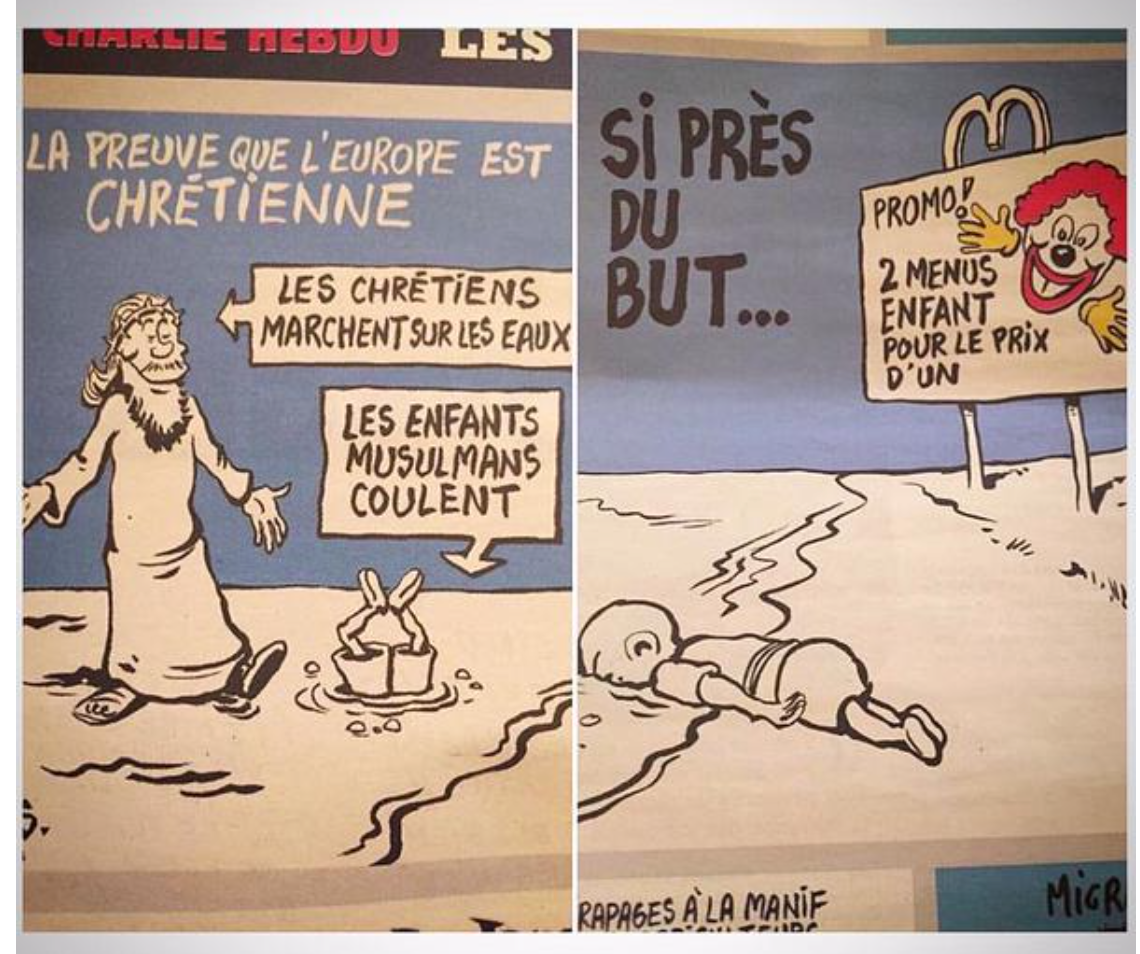
Is this depiction of prophet as lover less offensive than a cartoon promising readers “100 lashes if they don’t die of laughter”? Or a drawing of a woman running nude with a Burqa protruding from her rear? Both juxtapose religious imagery with the irreverent and profane in order to comment on the status quo.
Islamic poets wrote their own crude irreverent satire, centuries before Charlie Hebdo – The Washington Post.

 Multicultural Meanderings