Combat birth tourism by changing immigration law, B.C. mayor says

From twitter commentary, seems like he is a bit late to the discussion. But nothing is more frustrating to the public when each level of government points to the other rather than working more closely to assess and discuss the options (which of course, include doing nothing given the small provincial and national numbers):

Richmond Mayor Malcolm Brodie is calling on Ottawa to change immigration law to stop pregnant women travelling to Canada and giving birth to babies who are automatically granted citizenship.

The law says anyone born in Canada is automatically a Canadian citizen. According to the latest statistics, nearly 5,000 babies were born to non-residents in 2018-19.

A recent story by The Fifth Estate revealed that non-residents make up nearly a quarter of all births at the Richmond Hospital, which has led to complaints that birth tourists are compromising care for locals and putting strain on staff.

“People are abusing the system and we will pay a price right now with our medical system, but we’ll pay a bigger price in the long term with a number of people coming here who haven’t gone through any qualifications or procedures and they just come to our shores and will live in Canada,” said Brodie on The Early Edition on Tuesday.Brodie suggests changing federal law so that least one parent must be a Canadian citizen in order for a child to also become a citizen.

City ‘helpless’ to stop birth tourism: mayor

According to Brodie, the city has limited power to do anything about the issue because the medical system is the province’s jurisdiction and the federal government is in charge of the immigration system, which he said is the root of the problem.

All the city can do, said Brodie, is enforce short-term rental bylaws at so-called “birth houses,” where many of the women are known to stay, but often the women stay longer than a month and the city can only regulate rentals of 30 days or less.

“We are really helpless to do a lot about it. We can check a business licence if there is a business being run out of a home, but that’s about all,” said the mayor.

No federal action

He said Richmond has seen people abusing the system for years and, despite local members of Parliament raising the issue in Ottawa, there has been no federal response.

‘This is a law and this law can be changed and I don’t have any idea why they haven’t done it,” said Brodie. “The optimist in me says they simply haven’t gotten around to it.”The Early Edition requested an interview with Marco Mendicino, the newly appointed federal minister of immigration, refugees and citizenship, but the minister was unavailable.

Source: Combat birth tourism by changing immigration law, B.C. mayor says

‘Birth tourism’ could become election issue in B.C. riding considered ‘ground zero’

Not seeing much resonance outside of Richmond and it does not appear that the CPC is wedded to its policy resolution given their immigration critic Michelle Rempel’s comments (Michelle Rempel Garner on Twitter: “3/ I would hope that all …https://twitter.com › michellerempel › status):

On the streets of Richmond, an immigration topic on people’s lips for years has been “birth tourism.”

The practice — where pregnant women travel to a foreign country to give birth, thereby guaranteeing their baby automatic citizenship — has been rising steadily in the city, whose hospital is considered “ground zero.”

Under Canadian immigration law, birthright citizenship is law. But some in the city say people are increasingly taking advantage.

One woman, Kerry Starchuk, has made it her mission to bring an end to birth tourism. She has submitted two online petitions to the federal government since 2016, arguing more needs to be done to clamp down on the practice.

“It is undermining our citizenship,” she said. “Everyone comes through the front door and they work very hard to come here. This is undermining the system.

“People are lying to border guards and not saying why they’re coming here, and coming to stay at places that are unregulated. If we want a healthy community, everyone needs to contribute to being on board.”

Starchuk says several homes in Richmond are being advertised on Chinese websites and Instagram accounts as so-called “baby houses,” where families can rent rooms in advance of their hospital visit.

“We have given the wrong messages by not addressing the issue, so now there are even more operators bringing birth tourism into Richmond,” she said.

Starchuk’s first petition was sponsored by Alice Wong, the longtime Conservative MP for Richmond Centre, and gained more than 8,800 signatures — 5,100 of which came from B.C.

A second petition in 2018 was signed over 10,800 times, again with a majority coming from B.C.

That petition’s sponsor was Liberal MP Joe Peschisolido, whose riding of Steveston-Richmond East sits just east of Richmond Hospital and contains several neighbourhoods where “baby houses” have popped up.

“Birth tourism undermines both the integrity of our immigration system, as well as the integrity of our health care system,” he said. “It’s a business, but it’s an illegitimate business.

“What you have are unscrupulous businesspeople who are making money off our generosity … and that has to stop.”

The petition called on Ottawa to not only declare it doesn’t support birth tourism and study its full extent and effects, but also move towards policies that would dismantle businesses that promote the practice.

Peschisolido says the government in the process of adopting all three of those requests, but admits it’s taking time.

“We have to quantify it and come up with numbers to see what it is, what’s occurring, what kind of problems are involved,” he said. “Then we have to come up with a plan to shut down the industry, and that’s what we’re in the process of doing.”

Numbers increasing

While Statistics Canada data has reported relatively small numbers of births by nonresidents based on birth registrations — just 313 across Canada in 2016 — new studies have shown birth tourism could be much more widespread.

A 2018 Policy Options study that looked at the number of births through hospital discharge data from the Canadian Institute for Health Information (CIHI) found 3,223 cases that same year, more than five times the number from Statistics Canada.

Andrew Griffith, a fellow of the Canadian Global Affairs Institute who was behind the report, says that number has only continued to increase, to 3,628 in 2017 and 4,100 in the last fiscal year, which ended in March.

“That represents a 13 per cent increase year over year, which is quite significant,” he said, while noting the number still represents less than two per cent of all births in Canada.

Griffith acknowledged the data includes all births to nonresidents, including those temporarily living in Canada on student visas, and it’s difficult to tell in each case whether birthright citizenship was a motivating factor.

The CIHI information shows while B.C. may actually lag behind Ontario in the number of births to nonresidents — 689 in 2017, compared to more than 2,000 in Ontario — Richmond Hospital continues to outpace all other hospitals in the country.

In 2017-18, the B.C. hospital saw 469 births to nonresident mothers, accounting for more than 21 per cent of all births there. The next closest figure comes from Scarborough and Rouge Hospital in Ontario, with 163 nonresident births, representing 9.5 per cent of total births at the hospital.

Griffith’s report recommended financial action against nonresidents attempting birth tourism to discourage it, such as hospitals requesting substantial deposits from nonresidents.

Peschisolido says all options are being considered, but pointed to a $52-million government investment meant to help RCMP crack down on “baby houses” as a “good first step.”

Campaign issue

An Ipsos poll conducted in January for Global News found more than half of Canadians surveyed either tend to agree or strongly agree that Canada is too welcoming to immigrants.

In March, an Angus Reid Institute poll suggested 64 per cent of Canadians disagree with the country’s birthright citizenship laws, with 60 per cent calling for stricter laws against birth tourism.

But responses to Starchuk’s two petitions have suggested Ottawa has no plans to get rid of the law, despite admitting birth tourism is a problem that needs addressing.

“While there may be instances of expectant mothers who are foreign nationals who travel to Canada to give birth, requiring that a parent be a citizen or permanent resident in order for their child to acquire citizenship through birth in Canada would represent a significant change to how Canadian citizenship is acquired,” then-immigration minister John McCallum said in response to the 2016 petition, which was ultimately rejected.

Current Minister of Immigration Ahmed Hussen made similar points in response to the 2018 petition, but pledged to study the issue more closely.

Peschisolido, who was first elected to the new Steveston-Richmond East riding in 2015, says he plans to make the issue a key promise in his re-election bid.

“If I’m blessed and fortunate enough to be re-elected … I’m going to be pushing very hard to not only undermine birth tourism, but ultimately stop it and eliminate it,” he said.

Conservative candidate Kenny Chiu and Green candidate Nicole Iaci did not make themselves available for interviews.

At their most recent convention, Conservative Party members vowed to bring an end to birth tourism.

In a statement, NDP candidate Jaeden Dela Torre said the problem is concerning as it related to the health care system, but said any policies that crack down on birth tourism must come with careful considerations.

“We must not use this issue as a way to divide Canadians and fan the flames of racism and xenophobia,” she said.

“We’re reviewing all facts to come up with a fair and compassionate solution that protects health care services for all Canadians.”

Starchuk says she’s been in touch with many of the candidates, but has yet to see the action that Peschisolido has promised.

“I don’t trust anyone right now, because nothing has been resolved,” she said. “It’s a growing issue, but I haven’t seen anyone do anything.”

Source: major issue in the lead up to the Canadian elections

In search of ‘cultural harmony’ in Richmond, B.C. — North America’s most Asian city

Interesting long read regarding some of the tensions (the Mayor was just re-elected):

Mayor Malcolm Brodie likes to boast that his city — home to Canada’s largest immigrant population — is a “model for cultural diversity and harmony.”

At the annual Richmond World Festival this summer, there seemed to be ample evidence to support the claim: colourful Bhangra dancers charmed the crowds as onlookers sampled Syrian sweets, Indigenous bannock burgers and Brazilian cheese rolls. The music ranged from Celtic folk-rock to Cantonese opera.

But behind the veneer, this Vancouver suburb of 200,000 is locked in a perpetual state of intercultural disharmony, some say. Among the flashpoints: What to do about businesses that advertise mostly, or — in exceptional cases — entirely in Chinese characters? How to clamp down on a thriving underground ride-hailing industry that caters only to Chinese speakers? And how to respond to birth tourists — non-resident expectant mothers who come here to secure Canadian citizenship for their babies?

The tension has been manifest in the municipal election campaign that concludes Saturday, with accusations that certain activist groups are lobbying residents to vote only for Chinese candidates. And it can be seen in the dozens of vitriolic emails received by the city clerk’s office over the past year, some decrying the “invasion” of the city by Asians.

One racially charged letter was so hateful the city’s intercultural advisory committee questioned whether the clerk’s office’s practice of not responding “may be seen as legitimizing these perspectives,” committee minutes show.

In an effort to bring the community together, Richmond is developing a strategy for what it calls “cultural harmony.” It’s a still-vague concept that seems to aspire to the elusive sweet spot between cultural accommodation and American-style assimilation.

But there isn’t a lot of consensus about how to get there, and whoever voters elect to city council Saturday will be pressed to figure it out. Ideas so far include everything from throwing more neighbourhood block parties and intercultural festivals to giving more money to immigrant settlement agencies to providing more diversity training at city hall. Some incumbent city councillors have been accused of not helping matters by fomenting an us-versus-them mentality.

What is clear is that as Canada’s visible minority population grows, handwringing over what municipalities can do to ensure residents of all backgrounds not only get along but engage meaningfully with one another, will only intensify.

“This is a challenge for our communities,” said Andy Yan, director of The City Program at Simon Fraser University. “Are they going to dissolve into tribal villages or are they going to unite into a transcultural metropolis?”

***

Though Chinese, Japanese and South Asian settlers have been part of this community’s storied agricultural, fishing and canning past since the mid-1800s, its reputation as a “gateway” to the Asia-Pacific really began to take off in the 1990s when the British handover of Hong Kong to China fuelled a surge in migration.

While Vancouver and several surrounding suburbs have achieved “majority minority” status, nowhere has the demographic shift been more pronounced than here.  According to an analysis by Yan, Richmond has the distinction of being the “most Asian” city in North America; 71 per cent of the population is of Asian descent. Census figures show Richmond also boasts the highest proportion of immigrants in Canada — at 60 per cent. The largest minority group — at 53 per cent — is Chinese, also the highest in Canada, followed by South Asian and Filipino.

Richmond’s city centre now teems with Asian-themed shopping centres, strip malls and karaoke bars and some 400 Asian eateries catering to every palate.

But Asian-American scholar Wei Li, who teaches at Arizona State University, says we should resist the temptation to think of Richmond as a “suburban Chinatown.”

Unlike ghettos or enclaves of the past, which were the result of forced segregation and in which Chinese wielded little economic power, today’s “ethnoburbs,” Li writes, are linked to the globalization of capital and set up voluntarily to maximize personal and social networks, as well as business connections.

And like ethnoburbs outside Los Angeles and Toronto, Richmond has seen its share of clashes between long-term and newer residents.

Last September, amid persistent complaints about Chinese-language business signs, city council put into writing a policy of encouraging businesses to have at least 50 per cent English on signs.

That didn’t satisfy residents who favoured a stricter approach.

“My wife and I understand that the world is changing. However, when our ancestors came over and took on Canadian citizenship, they took on the customs, languages and day-to-day Canadian practices,” one person wrote to Brodie. “We are losing what Canada was — and longstanding mayors such as yourself are letting it happen.”

Another person, who identified himself as a 50-year resident, wrote: “The last time I looked, Richmond is in Canada, not China. Why do you not stand up for the rights of the White minority.”

The language debate isn’t limited to signs. This week the B.C. Human Rights Tribunal had been set to hear the case of a Richmond townhouse complex strata council (condo board) that started to carry out its official business exclusively in Mandarin. But the parties reached a last-minute confidential settlement.

The man behind the complaint, Andreas Kargut, who has since moved out of the city, had written on a GoFundMe page that the council “destroyed our ability to live together respectfully in a multicultural environment.”

Ray Arnold, who attended high school in Richmond in the 1950s and came back in the mid-1990s to retire, compares the state of community relations to tiles in a mosaic: combined, they create a nice picture, but individually they merely co-exist.

“They don’t meld together,” says Arnold, whose name appears often in the letters section of the local paper. “One of the things about multiculturalism … is it gives people who are not particularly eager to assimilate to a new culture too many excuses not to do that.”

Arnold’s biggest beef is the rise in “affluent ghost towns” — offshore investors building “pseudo-mansions” and leaving them deserted much of the year.

“When you have a community that is unoccupied or mostly deserted, it no longer qualifies as what we traditionally have called a neighbourhood.”

***

Some of Richmond’s longtime Chinese-Canadian residents don’t disagree.

Hong Kong native Amelia Ho, owner of the busy Bridgeport Sports Club tennis table centre and a Richmond resident for nearly four decades, says she sees too many newcomers who constantly fly in and out of Canada  and who don’t really engage with the rest of the community.

“If you want to be a citizen you should have loyalty to your country,” she said.

Henry Beh, a retired accountant who recently stepped down as executive director of the Richmond Chinese Community Society, moved to the city from Malaysia in the mid-1970s. In his opinion, recent immigrants, who hail mostly from mainland China, have been slower to integrate than previous generations from Hong Kong or Taiwan.

Because many stores and banks are staffed by Mandarin speakers, a lot of newcomers don’t think they need to learn English, he says. “I think they should learn to speak. … You won’t get the local people here upset.”

Some of Richmond’s newer immigrants told the National Post they just need time.

Sitting in a boardroom at Richmond Multicultural Community Services, an immigrant settlement agency, Jennie Chen, who moved to Richmond from Wuhan two years ago, says new residents “want to integrate, become a part of Canada” but just don’t know how.

“I think the government should provide more information,” she said.

Flora Jiao, who came to Richmond from Beijing a decade ago, acknowledges the city is “very convenient for those who don’t speak English fluently.” Speaking in Mandarin, Jiao told the Post she was surprised when the local hospital provided a translator during a check-up.

That’s not to say she isn’t trying. “I have recently been reading stories and some simple newspaper articles,” she said.

Jiao added she would like to see more cultural exchanges and “more people — people from here — learning Chinese too.”

When it comes to the sign debate, Jessie Wang, manager of Venus Furniture — a high-end retail store whose windows are covered with posters describing, in Chinese characters, brands and deals inside — takes a pragmatic view. The decision to advertise primarily in Chinese is to give customers — especially those with limited English — a sense of familiarity.

“When they feel familiar, they come to your store. It’s that simple,” she said in Mandarin.

Justin Tse, a long-time Richmond resident and researcher specializing in Asian-American studies, wonders if outrage over Chinese-language signs isn’t just a “manufactured crisis” that stems from frustration over the lack of affordable housing.

“As an observer it seems to me the real flashpoint is the housing crisis and that the real scapegoats are ‘Chinese money,’” he says, referring to the purported link between the flood of capital from China and skyrocketing house prices.

***

Whatever the reason, some city councillors have been candid about the state of intercultural relations.

At a January council meeting, Councillor Chak Au said immigrants need to know what’s expected of them, “how do we expect them to integrate … and do their part, such as acquiring the language, knowing the culture and become part of us.”

Asked what he meant by “us,” Au told the Post someone who has put down roots in the community, as opposed to someone who is always “looking back, as if (they) have another alternative.”

Councillor Carol Day told the same meeting too many newcomers were “imposing self-segregation.”

Asked what proof she had, Day told the Post she could tell by the people who “hold their head down and only perk up when they see someone from their own ethnic background.”

“We want to open the door to possibilities. Yes, you can just play table tennis with only Chinese people or you can come to the seniors’ centre to learn wood-carving, come to a social media class and learn to do videos.”

But there are fears some of the rhetoric could be sowing greater discord.

“Dark undertones” are pervading discourse at city hall, said Councillor Derek Dang. He pointed to a meeting of the city’s community safety committee during which Day wondered whether a spike in property crimes in a neighbourhood might be because wealthy Chinese residents with expensive cars were attracting thieves.

“I think it’s blatantly identifying one group as a cause for concern when really the whole issue isn’t that simple. … She’s ignoring all the people who have contributed to this community and brushing over everybody with one thoughtless comment,” Dang said.

Day insists she saw nothing wrong with the question and was simply expressing concern for residents in that area. Enough with the political correctness, she said.

Councillor Harold Steves was also scolded earlier this year for something he tweeted during debates over whether to build a temporary modular housing project for homeless people and whether to limit the size of homes that can be built on agricultural land.

“500 Asian people go to a Public Information meeting. The librarian gets Karate Kicked by an opponent to housing for homeless people. South Asian landowners are campaigning for 10,764 sq ft houses … Is this multiculturalism?” he wrote.

Records showed the person who kicked the librarian was not part of the meeting. Steves initially stood by his remarks, telling the Richmond News he was merely pointing out that “we have certain culture groups with different beliefs than others.”

He later apologized.

That heated rhetoric is of a piece with what motivated Kerry Starchuk’s decision to run for a council seat. She is one of the loudest agitators on the issue of Chinese-language signs and is behind a petition to end birth tourism, saying it has “debased the value of Canadian citizenship.”

In an interview, Starchuk recounted how her activism started years ago.

“I went to the Sears shoe department. A whole bunch of people were speaking Mandarin, I guess, they were just yelling. I asked them to speak quietly and if they could speak English. They got mad at me.”

What gets her now, she said, are “the noveau-riche that have come with a ton of money.”

“When I was growing up, all the corner stores were run by the Chinese families. They were humble, grateful, nice. My best friend is fourth-generation Chinese. I couldn’t ask for a nicer friend. … But the ones that have come from mainland China have been very difficult to carry on conversations with them from a neighbourly point of view. It’s been very hard. I’ve tried. I’ve brought flowers, cookies.”

Speaking to a women’s church group recently on the theme of “loss of community,” Starchuk said she is sometimes accused of being racist but insisted she is not anti-immigrant.

“I love Richmond, but I don’t like what’s happened to Richmond,” she said.

It’s not just white residents who have been accused of stirring up division. In June, the Richmond News reported that mayoral candidate and lawyer Hong Guo held a campaign launch that was entirely in Mandarin and outside the view of mainstream media.

A narrated video shown at the event stated that the voice of Chinese residents had been “ignored” and their rights “obliterated,” the newspaper reported.

“Only Chinese people can understand what Chinese people want. …Today, Richmond politics has finally heard a Chinese voice, Hong Guo.”

An editorial in the Richmond News said Guo had engaged in dangerous race-based politics.

In an email, Guo told the Post that like many residents, she is a native Chinese speaker, and she has to “choose the best means of communicating my message to as many voters as possible.” Guo, whose campaign literature calls for an end to the “politics of division,” noted many of her campaign videos are delivered in English.

The argument the Chinese community’s voice has been ignored isn’t without merit, says Ivan Pak, who is running for school trustee. Earlier this year, he was part of a vocal group opposed to the temporary modular housing project, which was ultimately approved by council.

“People from China or Hong Kong, they have less sympathies for people who become homeless and addicted to drugs,” Pak said. “In the Chinese culture, we think this is your personal responsibility to take care of yourself, to be less burden to society.”

Pak says parents were also not adequately consulted when the Richmond school board voted to support a Sexual Orientation and Gender Identity program aimed at bullying prevention.

Of most Chinese parents, he says: “They want traditional values.”

***

City staff face a daunting challenge to find a path to “cultural harmony.”

A report setting out the strategy’s guiding principles contains a lot of feel-good phrases like “intercultural interaction,” “cultural inclusion” and “community engagement,” but details are scant.

The Post filed an FOI request for some of the initial findings, but they were withheld entirely.

Internal emails and interviews suggest the city’s goal is two-fold: enhance the way the city welcomes new immigrants and their perspectives, while also educating new immigrants about their community and integrating them to civic life.

“Definitely we’re not looking at assimilation as a goal, but I do think inclusiveness is a two-way street,” Ted Townsend, the city’s spokesman, said. “One way is making sure people don’t feel isolated in their community but also making sure that people are part of the community and not isolating themselves.”

Brodie, the mayor, whose campaign ads in the ethnic press adopt the first part of a Chinese folk saying (“A long road tests the strength of a horse; a long time tests the nature of a person’s heart”), stressed the city is not looking to force immigrants into doing anything they don’t want. “I wouldn’t say it’s a push to get involved but certainly making it apparent to them there is every opportunity for them to be involved.”

He added: “I don’t want a series of small communities in Richmond. I want one community.”

But the strategy, which was supposed to be done by now, is not expected until next year. That’s because a Winnipeg consulting firm the city contracted for $44,000 was dropped in February.

The firm had been asked to examine best practices in other Canadian cities, review Richmond’s policies and programs, interview community leaders, and deliver recommendations.

“Our needs weren’t being met,” said Kim Somerville, the city’s manager of community social development.

Some wonder why the city chose a firm based in Manitoba. It would’ve made more sense to choose consultants “who live here and have a stake in the community,” said Tse, a visiting professor at Northwestern University.

The city has now hired Connie Baxter, former director of Richmond’s museum, to complete the project.

One of the things under review is the extent to which the city should accommodate newcomers who are not fluent in English. The city produces a newcomers’ guide in multiple languages, but decisions about translating other city documents are made on a case-by-case basis.

When the city notified residents in February about an information session concerning the proposed temporary modular housing project, it was written in English — except for a message at the top in Chinese that read: “THIS IS AN IMPORTANT NOTICE. PLEASE HAVE SOMEONE TRANSLATE IT FOR YOU.”

Tse says such translations should be automatic because it fosters inclusivity.

In California, state law requires public agencies serving a substantial number of non-English speakers must ensure they have access to government information and services through the use of bilingual speakers, interpreters and translated materials.

Tse says it’s noteworthy the city doesn’t use its own staff to assist with translation or interpretation work. Instead, records show, the city often turns to a downtown Vancouver firm, Chinese Informedia.

“If Richmond is 55 per cent Chinese, there’s something called hiring people who can read and write Chinese — it should not be difficult,” he said.

Maybe, he quipped, it’s city hall that needs to integrate into Richmond.

In 2014, Eliana Chia, then a master’s candidate at UBC’s school of community and regional planning, wrote a report on civic engagement in Richmond. Among her conclusions: city hall, for some immigrants, can be an  unwelcoming and intimidating place due to a perceived lack of staff from their racial background; staff struggle to provide translations due to a lack of resources and clear corporate guidelines; and when engaging immigrants in planning decisions, staff lack facilitation skills to carry out meaningful discussions.

While claiming a “large increase” in staff diversity over the last decade, the city could not provide the Post with a breakdown of ethnicities or languages spoken. Townsend said the city hires based on merit and, besides, setting diversity goals can be tricky.

“We’ve got Filipino staff who are of Chinese descent who might identify themselves as Filipino, as Chinese, as Canadian or all of the above. So if you’re going to set a goal of hiring based on culture, who’s going to define who fits those goals?” he said.

Townsend noted some community members are adamant that city business be carried out only in English or French. “Even some leaders in the Chinese community say the more you do (to accommodate other languages), the more you promote isolation. What we’re trying to determine is: what is the happy medium?”
***

Music composer Chris Ludwig, who’s lived in the city 15 years and moderates community roundtables, doesn’t get what the fuss is about.

On the proliferation of Chinese–language signs? Let the free market sort it out, he says. On lack of integration by newcomers? The government can’t force it; let it evolve organically.

“When I’m in the playground, say there’s another mom there and my son is playing with them, and let’s say they’re from Beijing or wherever. (I might say), ‘What’s your husband doing over there? Oh, he’s doing that.’ You hear about why they’re here, why they love Canada. You really get to understand that people are just people, right? I think that’s the way we connect is person to person.”

The notion of community building through one-on-one engagement seemed to hold promise during a community roundtable this spring at the Richmond library.

Among the participants was Diann McGrath, 78, a longtime resident who admits she is frustrated by all the foreign languages spoken in the city.

“I found that when the people come here from other countries, they don’t speak to us. They speak in their own language … and we have no communication. They seem to be very unfriendly,” she said.

“I feel like I don’t really belong here anymore because I’m outnumbered by all these Asian people.”

Sitting next to her was Vivian, a recent immigrant from China. She wondered if there were any informal meet-ups in the community so she could practice her English.

It seemed like Vivian and Diann had hit it off and they exchanged phone numbers.

Months later, the Post asked McGrath if they stayed in contact. They hadn’t.

“To pal around with somebody you don’t know is difficult,” she confessed. “What am I going to talk to them about?”

Source: In search of ‘cultural harmony’ in Richmond, B.C. — North America’s most Asian city

Yet another petition on birth tourism

Likely a political response to the tensions in Richmond, where over 20 percent of live births are to non-resident mothers and positioning given the Conservative party resolution calling to limit birthright citizenship to offspring of Canadian citizens or permanent residents.
Working on an article with more accurate and. spoiler alert, higher numbers which should be out later this month or early November:

Richmond Hospital reports more “non-resident, self-pay” births than the provincial government reports “non-resident” births, due to birth registration discrepancy

An older article from June 29 this year that was brought to my attention following the CBC article thanks to Ian Young of the SCMP that helps explain the discrepancy between the vital statistics data collected by Statistics Canada and local reports:

The frequency by which birth tourism may be occurring in B.C. and across Canada is significantly underreported, however health officials in this province are near to closing a glaring reporting loophole.

For instance, a discrepancy between how births by non-residents are reported at Richmond Hospital and how they are reported to the B.C. Ministry of Health could soon be rectified by provincial health officials, according to a ministry spokesperson.

“In the past, the Ministry of Health has tracked non-resident births by the address listed by parents on a baby’s birth registration, which could be local or international. Hospitals will typically go by whether or not patients are paying out-of-pocket for services to determine if someone is a resident of British Columbia,” stated spokesperson Laura Heinze, via email last week, to the Richmond News.

“We are currently in the process of aligning these reporting methods in order to get a more accurate picture of non-resident births across British Columbia,” Heinze added.

The existing reporting system can create significant discrepencies in tracking because many of the non-resident women who give birth at the Richmond Hospital list their address as the “birth house” where they may be living at the time.

In Richmond, Chinese nationals are known to stay at such houses, of which there are dozens identified by the provincial government and numerous advertised online both in China and Canada. As part of advertised month-to-month accommodation packages, birth house operators typically assist women with anything from tour guides, passport applications, doctor appointments, some pre- and post-natal care as well as hospital registration.

And so, should the birth house operator list the address of their home business at the hospital’s registration desk, the ministry would not count the baby as a non-resident. Only when the true address of the mother is registered, does the birth become a non-resident in the eyes of Vital Statistics B.C., noted Heinze.

Whereas Richmond Hospital reported 299 “self-pay” births from non-resident mothers in the 2015-16 fiscal year and 379 in the 2016-2017 fiscal year, Statistics Canada only reported 99 births in B.C. in 2016 where the “Place of residence of [the] mother [is] outside Canada.”

Across Canada there were only 313 such births reported in 2016.

Statistics Canada told the News the Canadian Vital Statistics Birth Database collects demographic data annually from all provincial and territorial vital statistics registries on all live births in Canada.

“To the best of our knowledge, there is currently no government department or agency tasked with identifying and collecting data on births to non-resident mothers,” noted Statistics Canada spokesperson France Gagne.

From 2004 to 2010 the hospital helped birth, on average, 18 new Canadians per year from non-resident mothers. Numbers rose dramatically in 2014 and have risen steadily since, to the point where one in five births in Richmond are to foreign nationals.

While immigration lawyer Richard Kurland notes not all non-resident births are necessarily a result of birth tourism, Richmond may be at the epicentre of a burgeoning, and legal, birth tourism industry, whereby visiting foreign nationals seek to have “anchor babies,” who automatically become Canadian citizens under Canada’s citizenship laws.

Kurland said the key to good data is determining immigration/visitor status of the mom.

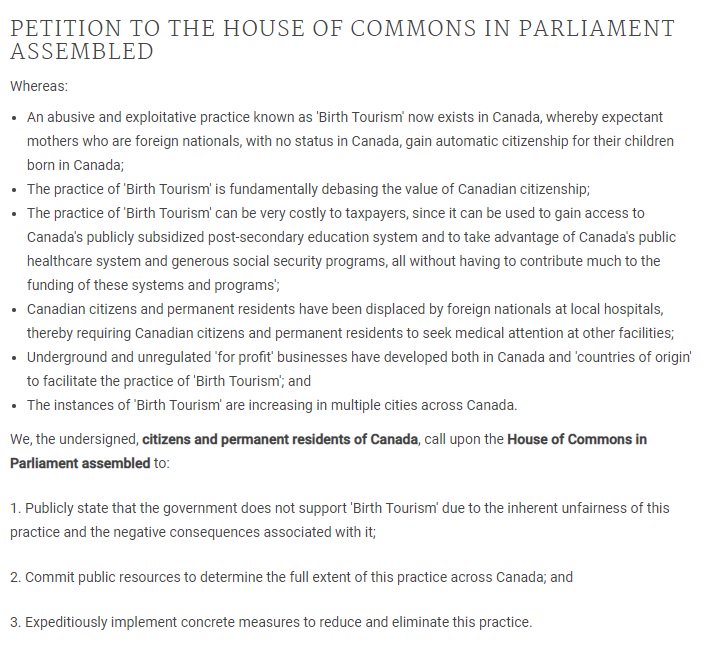
A national, public petition penned by Richmond resident Kerry Starchuk and sponsored by Steveston-Richmond East Liberal MP Joe Peschisolido aims to officially condemn birth tourism and study remedies to what Peschisolido describes as an abuse of the immigration system.

“Underground and unregulated ‘for profit’ businesses have developed both in Canada and ‘countries of origin’ to facilitate the practice of ‘Birth Tourism’; and the instances of ‘Birth Tourism’ are increasing in multiple cities across Canada,” the petition notes online.

Peschisolido disagrees with Conservative counterparts who have called for an end to birthright citizenship.

As birth tourism climbs in B.C., health authority files $312,595 lawsuit over one unpaid childbirth bill

Although the overall number of birth tourists is low compared to the total number of births in Canada (see What happened to Kenney’s cracking down on birth tourism? Feds couldn’t do it alone | hilltimes.com), appropriate to ensure that any unpaid bills are collected. “Birth houses” at a minimum need to be regulated if not banned given this is clearly an abuse, even if relatively small, of our immigration and health systems:

Record numbers of  so-called birth tourists, mainly from China, are expected at Richmond Hospital this year. Yet the Vancouver Coastal Health Authority has no plans to deter women from having their babies at the hospital to give them Canadian citizenship, despite suing a woman for nonpayment of $313,000 for her delivery.

The lawsuit filed in April relates to a birth in 2012 that involved complications and kept the lawsuit defendant, Yan Xia, and her infant, in the hospital for an extended time. Xia has not yet filed a statement of defence.

Although the hospital reserves the right to add interest charges of two per cent a month to unpaid bills, a spokeswoman said that is not the plan at this point. If such interest were to be added, the bill would exceed $1 million.

There has been a steady increase in the number of babies born to non-resident mothers at Richmond Hospital, to 384 in 2016-17 from 18 in 2010. Halfway through the 2017-18 fiscal year, there were 189 non-resident births, according to VCH spokeswoman Carrie Stefanson.

While all pregnant women are asked to register well in advance of giving birth so that hospital resources can be planned, there have been no measures taken by the hospital to deter birth tourism, which now accounts for 20 per cent of its deliveries. That is believed to be the highest proportion in the province, if not Canada. B.C. Women’s Hospital discourages birth tourism through various policies and practices. At times, Richmond Hospital has to send local women in labour to other hospitals when it is too busy.

The birth tourism phenomenon is tied to several factors, including Richmond’s demographics, a preponderance of “birth houses” for pregnant Chinese women in the city, the large number of doctors and nurses who speak Cantonese or Mandarin, and an industry fuelled by brokers who charge high fees to make the arrangements for women wanting to have so-called “anchor” babies in Canada.

Stefanson said she believes the Xia case is the only maternity lawsuit over $100,000 so far. Typically, the health authority uses other means to collect unpaid bills.

“VCH has invoiced non-residents for approximately $43 million in (all kinds of medical) services in the past year, and has collected about 80 per cent of that amount,” she said.

In the Xia case, such efforts have been unsuccessful, and with a six-year deadline for legal action approaching, the health authority decided it was time to take that action. Xia’s whereabouts are unknown.

Stefanson said the hospital exists to provide health care and will never deny urgent hospital care to anyone based on their ability to pay or where they are from.

She said the health authority expects foreigners will have travel insurance or some other means of paying. Non-resident pregnant women who go to any hospital in B.C. are expected to pay a deposit of $8,200 for a vaginal birth and $13,300 for a caesarean delivery. If they stay in the hospital for at least a night, there may be additional charges. In the past year, VCH has invoiced non-resident maternity clients $6.2 million, and 82 per cent of that amount has been recovered.

An article posted on the “Hongcouver” blog in the South China Morning Post says Richmond is at the centre of the birth tourism phenomenon. It highlighted one “birth house” called the Baoma Inn and its Instagram account showing photos of smiling expectant or post-delivery Chinese mothers enjoying touristy outings around Vancouver. Also pictured are newborns asleep, next to their new Canadian passports. In addition to pre- and post-partum accommodation, the inn is said to be able to arrange birth certificate and passport services plus getting newborns enrolled in the B.C. Medical Services Plan so they can receive publicly funded health care after they’ve resided in the province for three months.

The Baoma Inn is one of the dozens of so-called birth houses in Richmond. It is not known what birth house the defendant in the VCH case used, or even if she stayed in one.

The South China Morning Post article pointed out that Canada is one of a few countries (including the U.S.) that offers citizenship to babies born in the country, regardless of the nationality of parents. By contrast, in China, nationality is acquired upon birth only if one parent is a Chinese national, similar to policies in Australia and Britain.

David Georgetti, the Mandarin-speaking lawyer retained by VCH to litigate the case, could not be reached for comment.

Source: As birth tourism climbs in B.C., health authority files $312,595 lawsuit over one unpaid childbirth bill

Richmond woman’s petition calls for end of birth tourism in Canada

While the overall national numbers are, this has been an ongoing issue in Richmond. The call for better national data makes sense as does regulation (provincial medicare data could likely capture this – see ICYMI: Petition to Parliament calls for end to automatic citizenship to end ‘birth tourism’):

A petition by a group of Metro Vancouver residents is demanding Ottawa crack down on birth tourism in Canada.

Richmond resident Kerry Starchuk started the electronic petition. She has been campaigning on this issue for the last two years since discovering a neighbouring house was a so-called “birth house,” which caters to pregnant women who come to Canada to give birth so their child is automatically granted Canadian citizenship.

“It’s wrong. It’s jumping the queue,” said Starchuk of the practice, an increasing trend in Richmond where the majority of birth tourists hail from China.

In 2016-2017, 384 babies were born to non-residents at Richmond Hospital, said Vancouver Coastal Health — a significant jump from 18 cases in 2010. Between 2014 and 2017, 1,020 newborns were born to non-residents.

The rise in birth tourism has spawned an underground economy with unregulated agencies and brokers offering services to pregnant clients, including airport pickups, room and board, and assistance with obtaining documents such as a Canadian passport for the infant.

For Starchuk, birth tourism undermines the value of Canadian citizenship by essentially buying a lifetime’s privilege for the price of a hospital procedure, housing costs, and a return plane ticket.

“It’s not truthful, it’s deceitful and it’s short-sighted,” she said. “We don’t know what the consequences are going to be in 18 years. Are we prepared for it?”

The petition, identified as E-1527 in the House of Commons, is sponsored by Liberal Richmond MP Joe Peschisolido. It calls on the federal government to denounce birth tourism; determine the extent of the practice in Canada; and implement measures to reduce and eliminate it. It has received more than 620 signatures as of Tuesday.

Gary Liu, whose family immigrated to Taiwan when he was a teen, said most immigrants are also against birth tourism.

“Almost all of them despise this kind of practice,” said Liu, a Burnaby resident. “This is a very unfair practice to all immigrants.”

The petition is Starchuk’s second attempt to get the federal government to take action.

Her first petition in 2016, sponsored by Conservative MP Alice Wong, urged the government to end jus soli, or automatic birthright citizenship.

It received more than 8,800 signatures and was presented to the House of Commons, but went nowhere because the government felt revoking birthright citizenship would require a major overhaul of how Canadian citizenship is granted.

Liu said the rejection of that petition in 2016 was seen by some as an endorsement by the federal government of birth tourism. He hopes this second petition will gain more traction.

Starchuk said birth tourism happens across Canada, but are most prevalent in Richmond and Toronto, where the women are usually from Russia or Nigeria.

In 2016, the B.C. government said it was aware of 26 birth houses in the province.

Starchuk said more data is needed to get a grip on the extent of the practice in Canada.

“We’re hoping to have Canada-wide statistics,” she said. “We don’t know if it could be happening in West Vancouver or Langley.”

Vancouver Coastal Health spokeswoman Carrie Stefanson said figures for babies born to non-residents in other hospitals in the region are not immediately available, but said those numbers would be small.

The health authority “does not endorse or support marketing of maternity tourism and we are concerned about the impact it is having on our ability to provide quality services to every resident maternity patients,” Stefanson said.

Women who intend to use Richmond hospital to give birth are asked to pre-register six to eight weeks before their due date in order to enable to hospital to plan ahead.

Stefanson said Vancouver Coastal Health is committed to collecting payment from non-residents who use medical services, but wouldn’t deny urgent care based on a person’s ability to pay.

Peschisolido, who is in Ottawa, denounced birth tourism in a statement issued to media on Tuesday.

“Birth tourism is wrong,” he said. “Women are being exploited by organized efforts to take advantage of the system.”

Source: Richmond woman’s petition calls for end of birth tourism in Canada

Douglas Todd: Forgotten struggle for Canadian ‘unity’ leads to ‘silos’

The language-related tensions in Richmond have been simmering for some time, whether over Chinese-language signage only or this disturbing example of condo board proceedings (even if private bodies are not required to use English or French).

In terms of how widespread these kinds of issues are, Dan Hiebert’s various studies indicate Canada’s ethnic enclaves more diverse than you think, study finds. And overall, I don’t find the government’s message only being about diversity given the common values language that it also uses.

This may be more of an issue in Richmond (that should be taken seriously) than widespread, which is, accordingly to the 2011 NHS, 53 percent of East and Southeast Asian origin:

Andreas Kargut moved out of Richmond forever on the weekend that Canada marked its 150th anniversary.

The effort that Kargut, his immigrant wife and others put into fighting for the right to have their strata council meetings conducted in English, not Mandarin, had caused too much grief.

Kargut and six others filed a complaint last year with the B.C. Human Rights Tribunal because they couldn’t participate in the Mandarin-only meetings in their 54-unit complex.

Former B.C. premier Ujjal Dosanjh lamented how the strata council’s discrimination against Kargut illustrated the rise of ethnic and language “silos” in Canada. But Kargut said local politicians ignored their plight.

The language battle in Richmond, where half of residents are ethnic Chinese, is one of many challenges to Prime Minister Justin Trudeau and many small-l liberals who proclaim that diversity can only be celebrated.

While creativity definitely can emerge within the many manifestations of diversity, liberal platitudes censor questions about the real tensions that can also be provoked by diversity, a word that means difference.

Trudeau is among those heading into dangerous territory because he is not following the example of his prime minister father, Pierre, in standing up for English and French — and for the ideal of unity.

“When my parents immigrated from Germany, they knew there was an expectation for them to learn English so they could join the workforce and earn a living to provide for their family,” Kargut said in a posting on a Facebook page called Richmond’s Changing Neighbourhoods.

“Why is it then if a person immigrates from China they don’t need to learn English and can discriminate against English-speaking Canadians to the point of causing financial hardship?”

Many Canadians are asking similar questions. The Pew Foundation discovered only 21 per cent of Canadians believe place of birth is important to whether one is an authentic citizen (one of the lowest rates in the world).

But Canadians do care about English and French. Three in five Canadians agreed “being able to speak our national language(s) is very important for being truly Canadian.”

The dispute over language barriers is not only worrying whites. Longtime resident Ken Tin Lok Wong told Richmond News many of the city’s controversial Chinese-only signs are in a dialect known mainly to newcomers from the People’s Republic of China, which Wong says signals many are not willing to integrate.

Yet it’s Kargus’s departure from Metro Vancouver that is one of the more stark illustrations of self-segregation in this city, in Toronto and in Montreal, which are becoming increasingly defined by ethnic and language enclaves, whether South Asian, Chinese or European.

The kind of frustration felt by Kargut is something liberals in the U.S. are finally starting to note — as they try to come to terms with why the diversity-celebrating Democrats are constantly losing election campaigns.

Atlantic magazine has two articles in this month’s edition exploring why Hillary Clinton alienated former supporters among the white suburban and working classes, while methodically wooing Hispanic and black voters.

In “How the Democrats’ Lost Their Way on Immigration,” Peter Beinart notes one of Clinton’s prominent campaign images showed her surrounded by Spanish-language signs.

“Americans know that liberals celebrate diversity. They’re less sure that liberals celebrate unity,” says Peter Beinart, who credits Barack Obama with the ability to do both. Justin Trudeau doesn’t perform the balancing act, but his father stood up for ‘national unity.”

Barack Obama would not have done that, Beinart says. The former president once said he felt frustration when he’s “forced to use a translator to communicate with the guy fixing my car.”

With the National Academies of Sciences recently reporting new immigrants to the U.S. are learning English more slowly than their predecessors, Beinart maintains Democrats should put teaching immigrants English at the centre of their immigration agenda.

“Americans know that liberals celebrate diversity. They’re less sure that liberals celebrate unity. And Obama’s ability to effectively do the latter probably contributed to the fact he — a black man with a Muslim-sounding name — twice won a higher percentage of the white vote than did Hillary Clinton.”

Source: Douglas Todd: Forgotten struggle for Canadian ‘unity’ leads to ‘silos’ | Vancouver Sun

Nothing illegal about birth tourism at B.C. hospitals

More on birth tourism – numbers cited still small in relation to overall live births (about 44,000 in British Columbia 2014/15 ) but the local impact on the Richmond Hospital and residents being turned away should raise some concerns (according to the reporter, Pamela Fayerman, Richmond has the highest numbers of such births).

The relatively small numbers involved do not support the elimination of birthright citizenship but it is valid to question whether governments should regulate or prohibit birth tourism agencies or brokers.

For the overall numbers, see my earlier piece, What happened to Kenney’s cracking down on birth tourism? Feds couldn’t do it alone | hilltimes.com:

Federal authorities say foreign nationals coming to Vancouver to have babies aren’t breaking any laws as long as they can show they have money to pay for their medical care.

Birth tourism is becoming increasingly popular, especially in Richmond, where non-resident births are steadily rising, from just 18 in 2010 to 339 in the past fiscal year. Women primarily from China are seeking labour and delivery services at Richmond Hospital. Canada Border Services spokeswoman Sarah Lawley-Wakelin said pregnancy is “not a reason in itself to not admit a tourist.

“But if a foreigner is seeking entry to Canada for the express purpose of undergoing medical treatment and can’t show they have the money to pay for it, then that could be deemed by a CBSA officer as a potential excessive demand on health service, thus making that individual inadmissible.”

Chinese nationals must have a temporary (tourist/visitor) resident visa (TRV) to enter Canada and must state the purpose of travelling to Canada, said Nancy Caron, spokeswoman for Immigration, Refugees and Citizenship Canada (IRCC).

“People should always be honest about the purpose of their visit when applying to come to Canada. It is a serious crime to lie or to provide false information or documents when dealing with (IRCC). Lying on an application or during in an interview with an IRCC officer is fraud and it is a crime,” Caron said.

 Asked if there have been any investigations, charges or convictions against foreigners who didn’t admit they were coming to Canada to have a baby, she said:

“Immigration, Refugees and Citizenship Canada isn’t aware of any investigations into foreigners who didn’t admit they were entering Canada solely for the purpose of giving birth to a baby.”

Vancouver immigration lawyer Steven Meurrens said the increasing popularity of birth tourism would appear to be so mothers can obtain Canadian citizenship, passports, birth certificates and other documents for their newborns. “You’ve got women who do it to help their child and those who think it will give them a leg up on their own immigration efforts. So these are so-called anchor babies, yes.”

Since 1947, the Citizenship Act has guaranteed Canadian citizenship for those born here, Meurrens said, and although the previous Conservative government under Stephen Harper explored changes to the Act, nothing was done.

Meurrens said while birth tourism may “leave a bad taste in some people’s mouths” Canada has forever been a “settler society” and birth on soil citizenship is “central to our laws.”

“Where the real problems arise is when people skip out on their medical bills,” he said.

Freedom of information documents supplied to Postmedia by the B.C. government show that half of non-resident bills related to births are paid. Meurrens said since there are agencies or birth tourism brokers running birth houses — 26 at last count that the government is aware of — it may be possible for authorities to collect funds from them.

Meanwhile, more than a dozen pregnant Richmond residents were turned away from their local hospital in the past 18 months because it was too full to accommodate them.

Source: Nothing illegal about birth tourism at B.C. hospitals | Vancouver Sun

Richmond moves to require English on bus shelter ads

Reasonable approach:

Many Richmond bus shelters ads for everything from real estate agents to Crest toothpaste, mouthwash, Visa cards and, more recently, Budweiser beer have been exclusively printed in Chinese.

But now, the City of Richmond has tweaked rules so that these ads must now be predominantly in English.

The change comes as the city’s contract with Pattison Outdoor Advertising expired at the end of 2015 and it is currently negotiating terms for a new one.

“In the (request for proposals), we inserted a requirement,” said city spokesman Ted Townsend. It is “an extension of what we tell (private) businesses about signage. It’s our preference that at least 50 per cent (of the text) is in English, but (with private businesses) this is not required by law.”

He said Chinese-only signs have led to complaints from the community, and the rule change is in response to these.

Richmond will not similarly regulate business signs that are on private property, but Townsend said the city is able to make a case for requiring English on bus shelter ads.

“This is in keeping with our desire to be an inclusive community with signage that all people can understand and support,” said Townsend.

Source: Richmond moves to require English on bus shelter ads