Birth tourism dad from China suing B.C. hospital, doctors and ‘birth hotel’

First case like this that I have heard of. Not totally unexpected given the pre-pandemic numbers at Richmond Hospital mean that such disputes could have been expected:

The father of a child born in B.C. via Canada’s controversial “birth tourism” route is suing the doctors who delivered the baby and the so-called “birth hotel” which brought the family from China.

Peng Chen, on behalf of his now four-year-old son Stephen, alleges that two doctors — Brenda Tan and Balbinder Gill — as well as Vancouver Coastal Health (VCH), were negligent in the provision of medical care to Stephen and his mother, Rang Heng, at Richmond Hospital.

His lawsuit makes references to complications at the time of Stephen’s birth, resulting in his son being in the intensive care unit for several days afterwards.

Chen, a resident of China, claims that, as a result of their negligence in 2018, his son suffered brain damage, seizures, delayed growth and development, cerebral palsy and cognitive impairment.

He further alleges that Jie Zheng and a Ms. Liang — who operated or worked at ABC, a birthing house on Ash Street in Richmond — misrepresented the level of antenatal and/or perinatal care and expertise that his wife and child would receive in Canada.

Chen claims that, because he had “little or no knowledge of the health-care system in Canada” he was “particularly vulnerable” to the alleged misrepresentations from Zheng and Liang.

He alleged that ABC was negligent in misrepresenting the level of care, both in its adverts in China and to the family when they arrived in Canada.

Chen said he entered into an agreement with ABC for Stephen to be born in Canada and that they arrived at the Richmond birth house in January of 2018, three months before the birth at Richmond Hospital.

Two other unnamed doctors and two unnamed nurses working at Richmond Hospital on the day of Stephen’s birth are also named in the suit.

All named defendants in the lawsuit have denied any negligence.

The allegations are more than four years old, but Dr. Tan’s legal team recently won a court application to have a video conference with Stephen’s mother, because her husband has, thus far, been unable to answer any questions with regard to Tan’s care of his wife and child.

Child suffered ‘hypoxia, ischemia’ to brain, father claims

With regard to the specifics of the day of the birth, Chen claims his wife attended Richmond Hospital in the early hours of April 18, 2018, but was discharged with instructions to return when labour had progressed.

Later that day, according to the lawsuit, Heng returned to the hospital and, at some point not specified, was given oxytocin – which promotes the progress of labour.

Chen claims that, between his wife being given oxytocin and the actual birth, Stephen “suffered hypoxia and ischemia to his brain.”

He said his son required resuscitation and several days of intensive care.

Chen claims that the unnamed nurses failed to ensure timely medical intervention to prevent brain damage and they failed to properly investigate, assess or evaluate his wife’s medical history prior to the birth and failed to alert other health professionals of fetal distress in a timely fashion.

He alleges that doctors Tan, who he says was the family’s assigned GP, and Gill and the two unnamed doctors failed to provide adequate prenatal care to his wife and failed to assess the risk factors in view of his wife’s medical history and “physical presentation.”

Chen claims that the doctors also failed to properly advise his wife of the risks of vaginal delivery or discuss the options to it.

And he alleges that, as a result of his son’s injuries, he, his wife and family members have to provide care above and beyond what would be reasonable out of “natural love and affection.”

Chen, on behalf of Stephen, is seeking unspecified general and special damages and health-care costs.

Vancouver Coastal Health denies negligence

VCH, which runs Richmond Hospital, has denied any negligence on its part or that of its employees and is disputing many of Chen’s claims, including Stephen’s injuries.

In its version of events, VCH claims Chen’s wife was admitted to hospital at around 12:15 a.m. on the day of the birth and that the second stage of labour started at around 7 p.m, almost two hours before the birth.

It states in its response to the claims that all care of Chen’s wife was “appropriate” and “in accordance with a reasonable standard of practice and procedure,” adding that nothing it or its employees did or failed to do contributed to the alleged injuries to Stephen.

VCH is seeking a dismissal of the lawsuit and seeks its costs associated with defending itself.

Birth doctors claim they did their jobs

Dr. Tan, in her response to the claim, denies that she was an agent of Richmond Hospital or that of the birthing house business ABC and is also disputing the alleged injuries suffered by Stephen.

She said she became Chen’s wife’s GP two months before the birth for the purposes of providing antenatal care and met with her several times in her office.

Tan has denied negligence and that the care she provided to Chen’s wife and son was appropriate and in accord with standard medical practice.

She added in her response that Chen’s wife was informed of the risks associated with the treatment received and gave consent.

Dr. Gill, meanwhile, denies that he assisted with the delivery of Stephen, claiming that he only helped Chen’s wife push the baby out, when it became apparent there was an emergency.

In response to Chen’s claims that Stephen suffered hypoxia and ischemia to his brain prior to being born, Gill said the child was born with “no respiratory effort and no heart rate detected.”

He said that, once the baby was delivered, “best efforts were made to provide resuscitation” until the child was transferred to a “higher level of care.”

Similarly to Dr. Tan, Gill said the care and assessment given to Stephen were “reasonable in the circumstances and consistent with that expected of pediatricians practicing” in B.C. and that nothing he did or did not do contributed to any alleged injuries or loss to the child.

And if there were any injuries to the child, Gill said it was not his fault and could have been caused by other defendants or unknown parties.

Gill further alleges that the injuries in question could have been caused by the negligence of Chen and his wife by failing to take reasonable care of their own health and failing to seek medical attention at the “onset of signs or symptoms,” failing to provide a complete and accurate history of health-care providers and failing to follow the advice of health-care providers.

Both Tan and Gill are asking for the claims against them be dismissed and they be awarded costs.

What is ‘birth tourism?’

So-called “birth tourism” is when pregnant, non-Canadian women fly to Canada in order to give birth and secure citizenship for their babies.

In addition to receiving benefits, like healthcare and education, when the children become adults, they can also sponsor their parents to immigrate to Canada.

The Canada Border Services Agency has said previously that pregnancy is not a reason in itself to refuse entry to the country to a tourist.

However, if a foreign national is seeking entry to Canada for the purpose of undergoing medical treatment and can’t show he or she has the money to pay for it, then that person could be deemed as a potential excessive demand on health service.

The practice has been a hot topic for many years, especially in Richmond, due to its Chinese population and proximity to Vancouver International Airport.

Earlier this week, the Richmond News’ parent company Glacier Media reported how birth tourism rates — which plummeted during the pandemic — are expected to spike again when the Chinese government lifts pandemic travel restrictions.

Between April 2021 and March 2022, B.C. hospitals recorded 110 non-residents of Canada who paid to give birth, based on data obtained from the Canadian Institute of Health Information (CIHI). Last year, 194 such births were recorded.

However, in the year prior to the pandemic, a record 868 self-paying non-residents — the vast majority of whom are understood to be Chinese nationals on tourist visas — garnered automatic citizenship for their newborns.

Richmond Hospital has been, for many years, at the epicentre of the industry, with 502 non-resident births in 2019-2020.

And the so-called “birth hotels” in the city are not breaking any laws.

Source: Birth tourism dad from China suing B.C. hospital, doctors and ‘birth hotel’
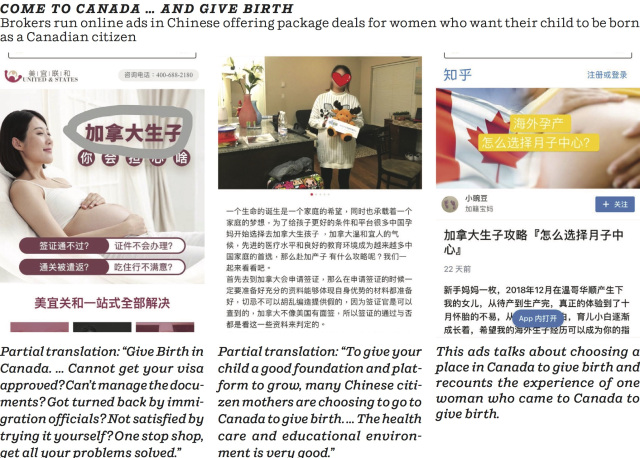
Ads promote Canada’s benefits to would-be birth tourists

More on birth tourism and the related “industry:”

Ads urging women to come to Canada to give birth tout the value of providing their child with Canadian citizenship.

“Go to Canada to vacation and give birth to a child,” says one online ad targeting Mainland Chinese mothers. “U.S. rejected your visa? No problem! In fact, Canada is better!”

Ads tell women that going to Canada for automatic citizenship is a “gift” for their babies since their children will be able to get free education, cheap university tuition and student loans, according to translations provided by Liberal MLA Jas Johal and verified by Postmedia.

Under Canadian law, a child born in this country is entitled to Canadian citizenship.

The ads are being run by brokers offering “one-stop shopping” for women, with offers to put together packages including transportation, housing, meals, contracts, pre- and postnatal medical appointments, shopping and checking in at hospitals. The ads generally do not mention the broker’s fees.

Some of the ads tell women their offspring can sponsor their parents under family reunification plans once they are adults: “You want to retire in Canada, but you don’t meet the requirements?” asks one such online ad. “You can give birth to your child in Canada. When your child turns 18, your child can apply for the parents.”

Ads tout monthly government subsidies, Canadians’ visa-free entry to 200 countries, unemployment benefits, and that “Canadian passports mean immigration to the U.S.,” Johal said.

Others say birth tourism is ideal for people who “care about their children’s education.”

And in a reference to China’s long-standing policy that limits most couples to a single child, some of the ads suggest birth tourism is ideal for “people who would like to have several kids.

Johal, the Richmond-Queensborough MLA, said birth tourism offends a large proportion of his constituents who want the practice banned. And Health Minister Adrian Dix is looking for Ottawa to take a stand on the issue.

Johal said the latest numbers of births by non-residents, reported by Postmedia, are a wake-up call to all levels of government. There was a 24 per cent increase in births by non-resident mothers in B.C., to 837 babies in 2017-18.

“At its core, birth tourism debases the meaning of citizenship,” Johal said. “As a son of immigrants, and an immigrant to this country, let there be no doubt those of us who have come emigrated to Canada by following the rules are the ones who are most offended by this practice.”

Johal finds the content of many of the ads downright offensive: “When you come to this country and strive and sacrifice, you strengthen this country and the value of Canadian citizenship. Allowing affluent foreigners to essentially purchase a passport is not what this country is about.”

In a legislature committee this week, Johal asked Dix about birth tourism. Dix acknowledged his concerns about the growing numbers of foreign women coming to B.C. to have babies.

“I don’t agree with it. I don’t support it,” Dix stated. But it’s an issue, he said, that comes under federal jurisdiction since it’s a citizenship and immigration matter.

“I mean it’s time, if they want to act, that they should act,” he said of the federal Liberals. “Or alternatively, say they don’t want to act.”

Birth tourism is expected to become a federal election issue this fall.

The Conservatives want the law changed so that one parent must either be a landed immigrant or a Canadian citizen before a baby can gain citizenship.

Postmedia asked the federal immigration minister for comment about birth tourism and any possible changes to policies. But a spokeswoman said the federal government can’t “speculate” on that.

Nancy Caron, a spokeswoman for Immigration, Refugees and Citizenship Canada, said the birth-on-soil policy for citizenship has existed since 1947.

The 2019 federal budget has allocated $51.9 million over five years to improve oversight of immigration advisers, including those who deal with birth tourists. Some of the funds will be used to ensure that they aren’t telling women to misrepresent the purpose of their visitor visas.

Mathieu Genest, press secretary to Ahmed Hussen, minister of immigration, refugees and citizenship, said that the Conservatives had once proposed ending the citizenship-on-soil policy but that was “roundly rejected by Canadians.” Now the Conservatives have “backtracked” on their policy, he said.

Source: Ads promote Canada’s benefits to would-be birth tourists

Richmond Hospital leads the way as birth tourism continues to rise

No new data in this report:

The number of pregnant foreigners coming to B.C. hospitals so their newborns can get automatic Canadian citizenship continues to rise.

Births by non-residents of B.C. increased 24 per cent from the 2016-17 fiscal year to 2017-18, from 676 babies to 837 the following year, according to records obtained through freedom of information requests.

About two per cent of all births in B.C. hospitals are now by non-residents, just as the birthrate among B.C. residents is dropping.

Richmond hospital continues to be at the forefront of the phenomenon, with the total number of babies born to non-residents of B.C. at the hospital rising from 337 in the 2014-15 fiscal year to 474 by 2017-18. Four years ago babies born to non-residents accounted for 15.4 per cent of all births at Richmond Hospital, compared to 22.1 per cent in the last fiscal year.

By comparison, St. Paul’s Hospital and Mount Saint Joseph Hospital — both operated by Providence Health Care — had a combined 132 babies born to non-residents of B.C. in the 2017/18 fiscal year.

While non-resident births account for about two per cent of all babies delivered in B.C., at Richmond Hospital, that proportion is 10 times higher. Indeed, as a New York Times article reported, the hospital is now perceived around the world as a coveted destination for so-called anchor babies, a term to describe children born here to non-residents to gain citizenship.

Health minister Adrian Dix is concerned by the numbers.

“The immigration issues are in federal jurisdiction. This is where concerns must be addressed, not by turning health professionals and skilled health care workers into immigration officers. That is not their role,” said Dix.

Richmond Mayor Malcolm Brodie agreed with Dix that birth tourism is a federal issue but said there are significant local impacts as well.

“As a city council, we haven’t discussed this but there are individuals who have concerns about the impacts on our already crowded hospital resources,” said Brodie, referring to the aging facilities and to situations when local women are diverted to other hospitals when Richmond Hospital is full.

Brodie said he supports a change to federal laws because he doesn’t believe anchor babies should get automatic citizenship.

“The practice of birth tourism should be curtailed,” he said.

Birth tourism is not illegal and a report by the Institute for Research and Public Policy showed that the numbers are climbing year after year. In 2017, there were at least 3,628 births, mainly in B.C., Alberta, and Ontario, by mothers who live outside Canada.

In 2016, Postmedia reported 295 of the 1,938 babies born at Richmond Hospital for the year ended March 31 were delivered, largely to foreign Chinese mothers. And dozens of birth houses were cropping up across the municipality, catering to women who need housing, meals, transportation and help with documents like birth certificates and passports.

As Dix has said, the provincial government has taken the approach that it doesn’t endorse the marketing and provision of birth tourism services but at the same time, patients needing urgent care can’t be turned away. 

While hospital staff cannot refuse care when women in labour arrive at the front door, Dix said measures have been put in place to help ensure taxpayers aren’t subsidizing the costs of non-resident hospital care.

For instance, late last year the ministry and Vancouver Coastal Health decided to raise fees charged to non-residents when they go to the Richmond Hospital. The cost for a vaginal birth increased to $8,200 from $7,200 and the cost of a caesarean section rose by $300 to $13,300. If their medical care becomes more complicated patients are assessed higher fees.

In 2017, Vancouver Coastal Health billed non-residents of B.C. about $6.22 million for maternity services at Richmond Hospital.

For maternity cases at Richmond Hospital … the majority of non-residents pay their bills in full,” said Vancouver Coastal Health spokesperson Carrie Stefanson. Approximately 80 per cent of billing to non-residents is recovered, she added.

But sometimes, as in the case of Yan Xia, a birth tourist from China, patients leave Canada after giving birth and leave behind a healthy bill.

Vancouver Coast Health has filed a lawsuit against Xia, who gave birth at Richmond Hospital in 2012. The bill for an extended stay in hospital due to complications totalled $313,000.

The case remains in legal limbo as Xia’s exact whereabouts are unknown and the bill may eventually have to be written off by Vancouver Coast Health.

Stefanson said the Xia case is believed to be VCH’s only maternity debt lawsuit over $100,000.

Richmond Liberal MP Joe Peschisolido has sponsored a petition calling on the federal government to end birth tourism. The petition garnered 11,000 signatures and denounces the practice as “abusive and exploitative” for “debasing” the value of Canadian citizenship. The Peschisolido petition was presented to Parliament last fall.

“The Government of Canada is committed to protecting the public from fraud and unethical consulting practices and protecting the integrity of Canada’s immigration and citizenship programs,” said Ahmed Hussen, minister of immigration, refugees and citizenship in response to the Peschisolido petition.

“To this end, (we) are currently undertaking a comprehensive review, with a view to developing additional information and strengthened measures to address the practices of unscrupulous consultants and exploitation of our programs through misrepresentation.”

Birth tourism will likely be an issue in the upcoming federal election as the Conservatives have vowed to withhold citizenship unless one parent is a Canadian or a permanent resident.

Source: https://vancouversun.com/news/local-news/richmond-hospital-leads-the-way-as-birth-tourism-continues-to-rise

Richmond Hospital reports more “non-resident, self-pay” births than the provincial government reports “non-resident” births, due to birth registration discrepancy

An older article from June 29 this year that was brought to my attention following the CBC article thanks to Ian Young of the SCMP that helps explain the discrepancy between the vital statistics data collected by Statistics Canada and local reports:

The frequency by which birth tourism may be occurring in B.C. and across Canada is significantly underreported, however health officials in this province are near to closing a glaring reporting loophole.

For instance, a discrepancy between how births by non-residents are reported at Richmond Hospital and how they are reported to the B.C. Ministry of Health could soon be rectified by provincial health officials, according to a ministry spokesperson.

“In the past, the Ministry of Health has tracked non-resident births by the address listed by parents on a baby’s birth registration, which could be local or international. Hospitals will typically go by whether or not patients are paying out-of-pocket for services to determine if someone is a resident of British Columbia,” stated spokesperson Laura Heinze, via email last week, to the Richmond News.

“We are currently in the process of aligning these reporting methods in order to get a more accurate picture of non-resident births across British Columbia,” Heinze added.

The existing reporting system can create significant discrepencies in tracking because many of the non-resident women who give birth at the Richmond Hospital list their address as the “birth house” where they may be living at the time.

In Richmond, Chinese nationals are known to stay at such houses, of which there are dozens identified by the provincial government and numerous advertised online both in China and Canada. As part of advertised month-to-month accommodation packages, birth house operators typically assist women with anything from tour guides, passport applications, doctor appointments, some pre- and post-natal care as well as hospital registration.

And so, should the birth house operator list the address of their home business at the hospital’s registration desk, the ministry would not count the baby as a non-resident. Only when the true address of the mother is registered, does the birth become a non-resident in the eyes of Vital Statistics B.C., noted Heinze.

Whereas Richmond Hospital reported 299 “self-pay” births from non-resident mothers in the 2015-16 fiscal year and 379 in the 2016-2017 fiscal year, Statistics Canada only reported 99 births in B.C. in 2016 where the “Place of residence of [the] mother [is] outside Canada.”

Across Canada there were only 313 such births reported in 2016.

Statistics Canada told the News the Canadian Vital Statistics Birth Database collects demographic data annually from all provincial and territorial vital statistics registries on all live births in Canada.

“To the best of our knowledge, there is currently no government department or agency tasked with identifying and collecting data on births to non-resident mothers,” noted Statistics Canada spokesperson France Gagne.

From 2004 to 2010 the hospital helped birth, on average, 18 new Canadians per year from non-resident mothers. Numbers rose dramatically in 2014 and have risen steadily since, to the point where one in five births in Richmond are to foreign nationals.

While immigration lawyer Richard Kurland notes not all non-resident births are necessarily a result of birth tourism, Richmond may be at the epicentre of a burgeoning, and legal, birth tourism industry, whereby visiting foreign nationals seek to have “anchor babies,” who automatically become Canadian citizens under Canada’s citizenship laws.

Kurland said the key to good data is determining immigration/visitor status of the mom.

A national, public petition penned by Richmond resident Kerry Starchuk and sponsored by Steveston-Richmond East Liberal MP Joe Peschisolido aims to officially condemn birth tourism and study remedies to what Peschisolido describes as an abuse of the immigration system.

“Underground and unregulated ‘for profit’ businesses have developed both in Canada and ‘countries of origin’ to facilitate the practice of ‘Birth Tourism’; and the instances of ‘Birth Tourism’ are increasing in multiple cities across Canada,” the petition notes online.

Peschisolido disagrees with Conservative counterparts who have called for an end to birthright citizenship.