President Trump Isn’t Breaking Immigration Arrest Records

Cato Institute does some of the better analysis of US immigration policies and practices:

President Trump has made no secret about his intentions to deport illegal immigrants. His statements as well as administrative actions to remove certain guidelines that focused enforcement efforts on criminals has understandably caused a lot of concern among illegal immigrants, their American families, and those concerned with their plight. They should take comfort that the Trump administration’s efforts to boost arrests, the necessary precursor to a deportation, are stymied by limited local and state law enforcement cooperation with the federal government when it comes to identifying illegal immigrants.

Recently released data on the number of arrests by Immigration and Customs Enforcement (ICE) shows that they are arresting many fewer illegal immigrants under Trump’s administration than under President Obama’s, at least through June of 2018.  During the first full 17 months of the Obama administration, from February 2009 through June 2010, ICE arrested 437,671 illegal immigrants.  For the same first full 17 months of the Trump administration, ICE arrested 226,138 illegal immigrants, about half the number arrested during the same period in Obama’s administration.

Relative to the last full month of the previous administrations, the number of ICE arrests under Trump is up by a whopping 37 percent (Figure 1).  Over the same time, President Obama’s ICE was arresting 25 percent more people than under the last full month of the Bush administration, quite a significant increase on its own.  The increase under Trump is larger as a percentage because it started from a low base, but the increase in the number of arrests under Obama was larger.  For instance, the number of arrests under Obama was 5,803 greater in June 2010 than in December of 2008.  At the same point in the Trump administration in June of 2018, the number of arrests was up 8,965 over December 2016.

There are two broad categories of arrests by the ICE.  The first is called custodial arrests, which is when ICE picks up an illegal immigrant arrested by another law enforcement agency such as state or local police departments.  The second is called ICE arrests, which is when ICE itself arrests illegal immigrants on the streets.  Figure 2 shows that the number of custodial arrests have fallen dramatically since October 2008 while the number of ICE arrests has stayed relatively constant.  This means that local and state non-cooperation with ICE works to reduce the number of ICE arrests as between 70 percent and 90 percent of those arrests are custodial over the entire time.

Some states, like Texas, are fully cooperating with ICE when it comes to immigration enforcement while others like California are resisting mightily.  In Texas, there were 3,963 ICE arrests in May 2018 compared to 2,584 in December 2016, a 53 percent increase.  In California, there were 1,587 ICE arrests in May 2018 compared to 1,356 in December 2016, a 17 percent increase.  ICE is more active everywhere in the country, in sanctuary states and non-sanctuary states, but the difference is stark across such jurisdictions.

The federal government under Presidents Bush and Obama convinced virtually every locality in the United States to sign up for the Secure Communities program that essentially turned over the vast majority of the arrested illegal immigrants to ICE for deportation.  Since President Obama was a Democrat, there was little initial political opposition to the massive increase in states and localities cooperating with the feds via Secure Communities – especially in Democratically controlled states with large numbers of illegal immigrants.  However, political reluctance to cooperate via Secure Communities built rapidly.  In 2011 Massachusetts, Illinois and New York requested to opt out of the program.  States like California then limited statewide cooperation with ICE and then President Obama replaced Secure Communities with a less punitive version called the Priority Enforcement Program that targeted criminals, which was in effect from 2015 to 2017.  Today, most states and localities with large numbers of illegal immigrants are not cooperating with President Trump’s ICE nearly as much as they cooperated with President Obama’s ICE – which is preventing Trump from arresting and, eventually, deporting large numbers of illegal immigrants.

There are other, lesser reasons why the Trump administration is unlikely to reach President Obama’s deportation record.  One is bureaucratic incompetence in the Department of Homeland Security, the Department of Justice, and other executive branch chaos that has so far prevented an orderly and organized deployment of law enforcement resources.  As a partial result of those administrative problems, they are incapable of convincing states and localities to enforce federal immigration laws.  Another reason is that illegal immigrants in 2018 are savvier than they were in the past, are better able to avoid law enforcement, and the few who were criminals were deported over the years, fewer new illegal immigrants have taken their place, and those remaining are less likely to come into contact with law enforcement.

State and local government reluctance to enforce federal immigration laws and cooperate with the Trump administration has limited its ability to arrest and, eventually, deport large numbers of illegal immigrants.  At the current rate, ICE under the Trump administration will be able to arrest about half a million fewer illegal immigrants relative to the Obama administration even if President Trump serves two full terms.  Those who are dispirited by the Trump administration’s efforts to deport large numbers of otherwise law-abiding illegal immigrants should take some solace that their efforts to block full local and state cooperation with ICE is bearing fruit.

Source: President Trump Isn’t Breaking Immigration Arrest Records
Britain’s immigration detention: how many people are locked up?

Some interesting background and numbers:

Immigrants can be detained at any time. The Home Office casts its net widely: anyone deemed not to have the right to reside in the UK can be detained and deported. Those who do not have legal representation, who do not speak English and who are newly arrived in the UK are least able to challenge a Home Office decision to detain them.

More than 27,000 people were detained in 2017, according to the most recent figures. Detention is now a significant part of the UK’s immigration enforcement efforts, but locking up immigrants without a time limit is a relatively recent phenomenon.

https://interactive.guim.co.uk/charts/embed/oct/2018-10-08T13:55:19/embed.html

The power to detain was created in the 1971 Immigration Act – however, it was not until the Labour government under Tony Blair that the detention estate expanded to become what it is today.

In 2000, detention centres could hold 475 people, with another 200 or so held under immigration powers in prisons. Capacity has now expanded to about 3,500 spaces.

How does it happen?

Some people are detained as soon as they arrive by Home Office officials stationed at airports and ports. Others can be detained after living in Britain for many years when they try to renew work, family or study visas.

The Guardian survey found 15% were detained at a Home Office reporting centre, where immigrants must attend regular appointments while their applications are processed. They can find themselves starting the day queuing to see a bureaucrat and ending the day in a small cell with a stranger.

Others were apprehended during dawn raids at their home addresses, after rough sleeping, found working illegally or while making applications for leave to remain.

The 2007 UK Borders Act introduced “automatic deportation” for some ex-offenders, which has been an important factor in the expansion of the detention population. Guardian research found more than half of respondents were detained at the end of a prison sentence.

Where does this happen?

Detainees are held in eight detention centres and two ‘short-term holding facilities’, where they can stay for up to a week. One is run by Her Majesty’s Prison service, but the rest are contracted out to outsourcing firms G4S, Mitie, Serco and US-owned GEO Group.

https://interactive.guim.co.uk/uploader/embed/2018/09/deportation_centres/giv-3902kLLugVLHtE4f/

Most are exclusively for men, while Yarl’s Wood in Bedfordshire is the only centre designed to hold women.

Foreign national offenders can also be detained in mainstream prisons, typically after serving their criminal sentence. In 2017, 1,691 people were held under immigration powers in prisons.

Less than a quarter of those held in prison have access to legal representation, according to research by Bail for Immigration Detainees, a charity which assists with detainees’ bail applications.

A spokesperson from BiD said: “If any British citizen, anywhere in the world, was kept – without warning – in prison after they had finished serving a criminal sentence there would, rightly, be uproar. Yet the British government routinely holds foreign nationals in exactly that manner.”

Who are the detainees?

The nationality of those held in detention changes over time, depending on global migration flows. The Guardian survey found Nigeria and Algeria were most commonly represented among our responses, while Home Office open data for the second quarter of 2018 showed that South Asian countries made up the largest proportion of detainees.

Detainees are overwhelmingly male – women made up just 15% of the total detention population in 2017.

The government announced it would end indefinite detention of immigrant families with children in 2010, while detaining unaccompanied children for more than a day was banned in 2014. As a result, the number of children in the system fell from 240 at the start of 2010 to just 22 in the most recent Home Office figures.

However, unaccompanied children may still be detained during criminal cases and escorted during returns. Families are still detained together in “exceptional circumstances”. The Guardian survey uncovered multiple examples of children being detained in adult facilities.

How long do they stay locked up?

The UK is the only country in Europe with no statutory time limit on detention. While most are held for days or weeks, the Guardian survey uncovered several cases where a detainee was held in excess of two years.

Indefinite detention has been a key criticism of UK immigration policy. In 2015, the first ever parliamentary inquiry called for a 28-day time limit on detention. The Guardian survey found the vast majority of detainees are not told how long they will be held for or when they will be deported.

https://interactive.guim.co.uk/charts/embed/oct/2018-10-08T13:44:49/embed.html

The Shaw report found that more than half of detainees were ultimately released back into the community, posing questions about the use of taxpayers’ money to pursue lengthy periods of detention.

How much does it all cost?

The Home Office has paid a handful of private contractors hundreds of millions of pounds to run the UK’s immigration removal centres, but no one knows for certain just how profitable the industry is.

The Home Office’s annual report and accounts for 2017-18 states detention costs of £108 million in the year ending 31 March 2018, while the Shaw report says it costs £85.92 per day to hold someone in detention.

Commercial confidentiality agreements mean the Home Office and outsourcing companies are not obliged to publish detailed financial information about immigration detention centres in the UK.

Earlier this year Mitie won what is believed to be the largest immigration detention contract ever awarded, valued at more than half a billion pounds. The contract will cover a range of services and it is not known how much of this is for management of removal centres.

The profitability of detention facilities has proved to be a contentious issue for the contractors.

A Guardian investigation last year pointed to a 20.7% profit margin at G4S-owned Brook House in 2016, while at Tinsley House, the margin was 41.5%.

Source: Britain’s immigration detention: how many people are locked up?

Canadian border agency has deported 398 ‘illegal migrants’ out of 32,000

The latest numbers:

Nearly 400 people who crossed the U.S. border illegally for asylum in Canada have been deported since authorities began tracking irregular migration in April of last year.

That number is a small fraction of the 32,173 so-called “irregular migrants” who came through unguarded land borders from the United States during the period ending in late August. Most are still waiting for their asylum claims to be heard.

Of the 398 failed refugee claimants Canada has deported, 146 were sent back to the U.S., where 116 of them have citizenship, according to data provided to the Star by the Canada Border Services Agency. The rest were deported to 53 countries, with most sent to Haiti (53), Colombia (24), Turkey (19) or Iraq (15).

The deportees, 48 of whom were under the age of 17, included 238 males and 160 females, said the border enforcement agency.

“What happens is people come to the U.S., establish themselves and have children while they try to regularize their immigration status,” said Ottawa immigration lawyer Betsy Kane.

“The number of deportees captures these American-born children who accompanied their parents to Canada for asylum.”

The Canadian border agency said the decision on where an individual is deported depends on from where they came into Canada, their last permanent residence, their citizenship and country of birth. All deportees have seen their asylum claims rejected by the refugee board and exhausted all legal avenues of appeal and due process.

All 32,173 irregular migrants have been declared inadmissable simply for crossing the Canadian border illegally, including six who failed the criminal checks, said border agency spokesperson Nicholas Dorion.

Queen’s University immigration law professor Sharry Aiken said she was not surprised by the low number of deportations as the majority of asylum claims by border-crossers are still to be determined by the refugee board. That board has long been underfunded and only recently got the money from Ottawa to hire additional decision-makers.

Of the 12,190 overall claims processed in the first six months of this year, 64 per cent were granted asylum.

“When removal orders become effective and are not enforced, it undermines the integrity of the system and the confidence in the system,” said Aiken. “But due process does take time with other legal remedies when a claim is refused. We shouldn’t say something must have gone awry because only 400 people have been removed.”

The latest refugee board statistics show it still had 55,567 new claims in the backlog by the end of June after 13,687 had been processed and finalized — 7,831 claims being accepted, 4,359 rejected, and the rest either abandoned or withdrawn. The backlog includes claimants from other countries who didn’t come through unguarded land borders via the U.S.

Source: Canadian border agency has deported 398 ‘illegal migrants’ out of 32,000

Why are so many Hungarians deported? A look at Canada’s ‘Unwelcome Index’ 

The Globe continues to impress me with some of its serious evidence-based reporting (e.g., unfounded sexual assault cases by police department) with this being another good example of reporting by obtaining and analyzing data and explaining what it means:

The U.S. government’s determined efforts to restrict immigration and the number of refugees entering the country has invited comparisons with Canada, heralded by some (including The Economist) as a last bastion of openness among Western countries. But Canada has its own apparatus for ejecting the unwelcome; the Canada Border Services Agency is charged with removing people who don’t meet entry requirements.

To understand who Canada deports, and why, The Globe and Mail requested data from CBSA showing total removals by year, broken out by citizenship, the destination to which the person was sent and justifications for these removals. The data shows Canada removed Hungarian citizens in disproportionate numbers over the past few years. The story of those thousands of unwelcome people contrasts with international perceptions of Canada’s warm embrace of foreigners.


The unwelcome

The CBSA ejects thousands of people annually. However, the data doesn’t reveal much about why those people were removed: By far the most common official justification was “non-compliance,” a sweeping category. Fewer than 10 per cent of removals cited criminality, the second most common justification.

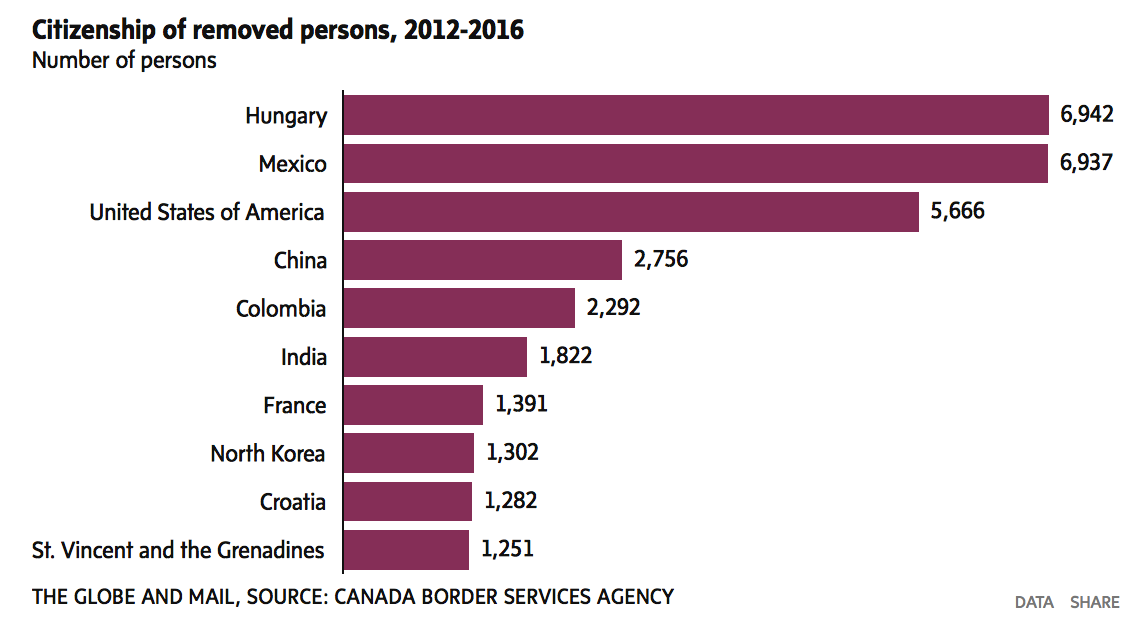
A clearer picture emerges when one examines the citizenship of removed persons: Hungarians topped the removals list during the five-year period from 2012 to 2016.

It is perhaps unsurprising to discover large numbers of Americans and Chinese on the list: Both countries rank among the world’s most populous, and the United States and Canada share the world’s longest border between two countries. Mexico has been a major source of immigrants, and also refugee claimants: The government of prime minister Stephen Harper responded in the late 2000s by imposing new visa requirements on Mexican visitors; removals surged.

Hungary is less populous than those countries, and distant to boot. What gives?

Hungary stands out even more when one compares numbers of removals with numbers of people of the same citizenship accepted as permanent residents. The result is a crude sort of “Unwelcome Index.” Between 2011 and 2015, more than three removal orders were issued for every Hungarian granted permanent-resident status.


Backstory of an exodus

Most Hungarians removed during this period were Roma, explained Sean Rehaag, an associate professor at Osgoode Hall Law School in Toronto who specializes in immigration law. Studying a random sample of 96 decisions of the Immigration and Refugee Board between 2008 and 2012 involving Hungarian claimants, Mr. Rehaag and his colleagues found 85 per cent involved Roma.

Roma comprise Hungary’s largest ethnic minority. There, they encounter “discrimination and exclusion on a regular basis” concerning education, employment, housing, health and much else, according to a 2014 report by Harvard University’s François-Xavier Bagnoud Center for Health and Human Rights. The late 2000s witnessed the rise of right-wing political parties and paramilitaries, accompanied by increasing rhetoric, rallies and attacks directed at Roma. Many Roma sought asylum abroad; thousands arrived in Canada after it lifted visa requirements on Hungarians in 2008.

Gina Csanyi-Robah, a teacher and human-rights activist with Hungarian Roma roots met many applicants in her capacity as executive director of the Roma Community Centre in Toronto, and also at Toronto schools. They fled Hungary because they were “scared that their home was going to be burned down,” Ms. Csanyi-Robah said. “Tired of their children getting beaten up at school and put into segregated classes. Tired of being subjected to verbal, psychological, physical violence when they left their homes.”

 Source: Why are so many Hungarians deported? A look at Canada’s ‘Unwelcome Index’ – The Globe and Mail

About 1,400 immigrants a year ordered removed from Canada for residency non-compliance

While the number is relatively small compared to the average 260,000 immigrants (0.5 percent), it is nevertheless significant and part of ensuring overall credibility and support for immigration, another legacy of the Conservative government that should continue.

Hard to understand the regional differences between Montreal, Toronto and Vancouver. Do these represent the different source countries or are there some CBSA management differences?:

An average of about 1,400 Canadian immigrants are intercepted at the border each year and ordered removed from the country for not fulfilling their residency obligations, the Star has learned.

Although these newcomers can appeal to a tribunal to restore their permanent resident status under humanitarian considerations, only one in 10 succeeds in the process, according to government data.

“The tribunal is supposed to be immigrants’ last resort as the Parliament has given it the discretionary power to give immigrants a second chance if they breach the law,” said immigration lawyer Lawrence Wong, who obtained the data through an access to information request.

“But that second chance in reality is hard to come by. The national sentiment is pretty much the same. If you are an immigrant, don’t make a mistake. If you do, we want to see you kicked out.”

It’s believed to be the first time data about the loss of permanent residency at ports of entry has been made public, revealing the extent of residency noncompliance among immigrants trying to get back to Canada after lengthy stays overseas, said Wong.

Canada’s immigration law requires permanent residents to be physically present in Canada for at least 730 days in every five-year period in order to maintain their status. Otherwise, their residency will be revoked.

According to the Canada Border Services Agency, on average 1,423 permanent residents a year were stopped at the border for failing the requirement from 2010 to 2014, the most recent statistics available. During the period, Canada accepted some 260,000 newcomers annually.

The number of removal orders issued against these individuals had risen sharply to 1,413 in 2014 from 605 in 2008, when former Conservative Immigration Minister Jason Kenney took over the department and cracked down on fraud.

Across Canada, Quebec had the highest detection rate; more than a third of the removal orders were issued in the province against the non-compliant immigrants returning to Canada.

Between 2008 and 2014, a total of 3,575 immigrants were slapped with removal orders for residency non-compliance at Pierre Elliot Trudeau airport in Montreal, dwarfing the 439 and 972 people respectively intercepted at Toronto’s Pearson airport and the Vancouver International Airport.

The numbers do not include those who had their permanent residency revoked due to criminality and misrepresentation, who were refused travel documents to return to Canada or who applied to voluntarily relinquish their permanent residence.

While all these immigrants who lost their status can appeal to the immigration appeal division based on errors in law or humanitarian and compassionate grounds such as hardship from separation with family in Canada, the border services agency data show their success rate hovers at about 10 per cent — and has declined in the past few years.

Those who successfully restored their permanent resident status dropped significantly from 127 or 17 per cent of 746 appellants in 2008 to 78 or 7.7 per cent of 1,008 people in 2014.

“Once you are issued a removal order, the chances of saving your permanent status are really very limited,” said Wong.

 Source: About 1,400 immigrants a year ordered removed from Canada for residency non-compliance | Toronto Star