Quebec wants to expand religious symbol ban, blocking Muslim garments in civil service

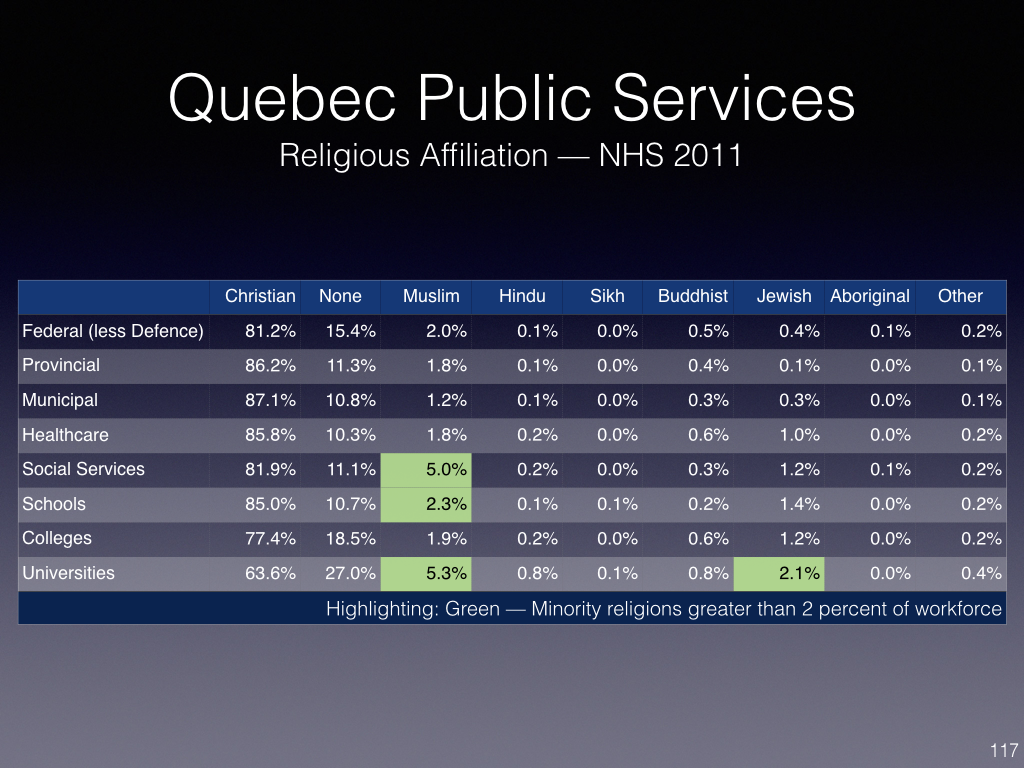
The 2011 National Household Survey, indicated a very small number of Muslim Quebecois in the public service (along with other religious minorities):
Quebec’s new government is planning to block Muslim women who work in the civil service from wearing the chador, a shawl-like piece of clothing that covers the head and body, and the niqab, which also covers the face.

Coalition Avenir Québec ​Premier François Legault has already made clear his intention to prohibit those who hold positions of authority including teachers from wearing religious symbols, such as the hijab, a Muslim headscarf.

The ban on the chador and niqab, however, would extend to all employees in the public sector. A representative from the CAQ couldn’t say how many people such a ban would affect.

Immigration Minister Simon Jolin-Barrette, the government’s point person when it comes to ensuring the secularism of the state, said Wednesday the government plans to “move quickly” to introduce a law.

“It was always our position to prohibit the chador in the public service,” said Jolin-Barrette, in response to questions following a report in the Journal de Montréal about the government’s stance.

There is no mention of banning the garments in the CAQ’s online platform, but the party has played up its commitment to such a policy in the past.

In 2016, the CAQ said on Twitter that it would “defend Quebec values” by banning the chador, unlike its rivals, the Liberals and the Parti Québécois.

Jolin-Barrette said it was too early to provide details on exactly how and when the law would be implemented.

Later on Wednesday, Legault said a law prohibiting religious symbols isn’t “a priority” for the CAQ, which created some confusion about the issue.

“One important value is equality between men and women, so we want to protect that. Now, is this a priority? No,” he said.

‘Surreal’ debate

Montreal lawyer Shahad Salman, who wears a hijab, said she is discouraged the new government — and the media —  continues to focus on identity issues “rather than talking about real issues.”

“It’s so surreal that we’re talking about this again, honestly,” she said. Salman said such debates are counterproductive if politicians want minorities to become more integrated into Quebec society.

As it stands, when it comes to minorities in Quebec’s civil service, the percentage doesn’t reflect the overall population.

Visible minorities made up 9.4 per cent of the province’s public workforce in 2017, although they constitute 13 per cent of the overall population, according to a study by the Institut de recherche et d’informations socio-économiques,

The chador, which covers the head and body but leaves the face exposed, is a garment commonly worn in Iran, where this photograph was taken. (Hasan Sarbakhshian/Associated Press)

The CAQ’s planned ban on religious symbols has been criticized by civil rights advocates who contend the policy will further marginalize vulnerable minorities.

Charles Taylor, author of a landmark 2008 report on the accommodation of religious minorities in the province, called the proposal “either very ignorant or very intellectually dishonest.”

In a recent interview, he pointed out that his report explicitly recommended against including teachers in a ban on the wearing of religious garb.

“We meant it to apply only to people with functions that we called ‘coercive authority’ — police and judges. Functions that can put you in jail,” Taylor said.

Lacking ‘coherent plan,’ Liberals say

The CAQ won a decisive majority in the Quebec election earlier this month, beating out Philippe Couillard’s Liberals.

Pierre Arcand, the interim leader for the Liberals, said the CAQ doesn’t appear to have a “coherent plan” when it comes to religious symbols.

The new government appears to be floating a new trial balloon every day, he said.

Arcand said he would reserve comment until a bill is tabled.

Source: Quebec wants to expand religious symbol ban, blocking Muslim garments in civil service

The CAQ wants to create two tiers of Quebeckers: Sheema Khan

Khan looks at the individual impact. Will be interesting to see the actual legislation and whether some of the initial backtracking – existing employees would be grandfathered – continues or not:

Imagine having a job that you love. You believe you can make a positive difference to society through your chosen career. You have invested heavily in education to arrive at your current position. You can’t imagine yourself elsewhere. Then one day, you are threatened with dismissal.

Not due to a bad performance review – in fact, quite the contrary. Not because of downsizing. Not for lack of qualifications. No, the reason is your expression of faith – although you have never proselytized at work. In fact, you have contributed towards a respectful, inclusive workplace. Your co-workers are like family; you’re closer to some than others. Along the way, you’ve collectively shared life’s burdens and joys, as you try to build a stable life for you and your family.

But your new employer has decided that you are no longer welcome. Is it a foreign multinational, eager to impose its own vision at the expense of local workers?

No. It’s a new provincial government making good on its promise to impose an exclusionary brand of laïcité. And it is willing to fire individuals from certain professions whose attire falls outside its definition of state “neutrality.” Unfortunately, through no fault of your own, your chosen career is a central target. The government is even eager to trample on your individual Charter rights. And there is nothing that you – a law-abiding, tax-paying, individual – can do about it. What’s more vexing is that some of your co-workers and neighbours have voted for this government and its policies that are harmful for you.

It doesn’t matter if you’re a recent immigrant or if you’ve lived here for generations. It doesn’t matter that you believe in the future of this province, having made the conscious decision to build roots here. It is either your faith or your job.

Welcome to Quebec, where the preceding scenario is a distinct reality. The recently elected Coalition Avenir Québec announced that it would invoke the notwithstanding clause to ban religious symbols for employees in “positions of authority” – including teachers, police officers and prison guards. Examples of offending attire include kippahs, turbans and hijabs.

Following a huge outcry against its plan to fire teachers who wear religious symbols, the CAQ backtracked, offering a kinder, gentler version of discrimination: It will only ban new hires from any expression of faith. Imagine putting yourself through teacher’s college or a police training program, preparing to dedicate yourself to a profession you hold in high esteem – only to be told to discard an integral part of your identity, or choose a different career path.

The CAQ is the third consecutive governing party to threaten a ban of religious attire in the public service. The PQ proposed its infamous Values Charter in 2013, while the Liberal Party’s restrictions on face-coverings were suspended by a provincial court in June.

These efforts reflect the wider debate of defining laïcité, which is distinct from secularism – partly due to the different philosophies of Jean-Jacques Rousseau and John Locke. According to Rousseau, the individual gains freedom through the state, which has the right to regulate the public sphere of religion. Locke, on the other hand, placed freedom of conscience as the cornerstone of individual rights, which guarantees freedom from the state. These opposing views have permeated societies with French and British roots.

The CAQ’s approach will create two unequal classes of citizens. An overwhelming majority will be free to choose any field of employment, while a minority will have its choices restricted. There was a time not too long ago when women were barred or discouraged from certain professions. Why is the government repeating the folly of denying employment based on an individual’s identity, while ignoring a worker’s abilities and qualifications?

Furthermore, employment restriction is a slippery slope. What’s next? Use of the notwithstanding clause to override the suspension of Bill 62, thus denying niqab-wearing women access to library privileges, public transportation and health-care clinics?

However, the larger question is: Why create two tiers of Quebeckers in the first place? It sends a dangerous message of fundamental inequality enshrined as government policy. No wonder the CAQ has been lauded by European xenophobic parties.

The people of Quebec have an opportunity to forge a distinct version of laïcité, shaped by cultural heritage, linguistic identity and the contemporary reality of living in a fully anglicized North American milieu shaped by Lockean roots. The question is whether it will be inclusive or exclusionary.

Opinion The CAQ wants to create two tiers of Quebeckers: Sheema Khan

Coyne and Yakabuski contrasting views on the CAQ and the notwithstanding clause in relation to religious symbols

Two very different takes, starting with Andrew Coyne:

Be careful what you wish for. Quebec’s election may have signalled a turning away from separatism — the mad, doomed project to wrench apart the country on linguistic and ethnic lines that consumed so much of the province’s energy and wealth over the last 50-odd years. But it has been accompanied by a turning toward other forms of zealotry and intolerance.

The Liberal Party and Parti Québécois may have gone down to their worst defeats in their respective histories, dispatched by voters tired of the ancient existential stalemate and the entrenched/corrupt elites that thrived upon it. But into the vacuum have surged parties peddling other fantasies.

Quebec Solidaire campaigned on a platform that might have been stolen from a student union at one of the less prestigious universities, and probably was. It was rewarded with a doubling of its share of the popular vote and a tripling of its seats in the assembly.

And the “conservative” Coalition Avenir Quebec surged to power on a mix of unfunded tax cuts, warmed-over 1970s-style dirigisme and enriched daycare subsidies. Oh, and beating up on immigrants.

The party will protest at that description, but it is not for nothing that they were feted with victory congratulations from Marine Le Pen, the French far-right leader. The party vows not only to slash immigration to Quebec — this at a time of growing labour shortages, in a province where population aging is a particular concern — but to expel those who fail a test of “values” and French language proficiency after three years.

How it would do so, or where they would be deported to, or under whose constitutional authority are among the many questions raised by this odious proposal, to say nothing of the obvious Charter issues. Party leader Francois Legault struggled to explain it during the campaign. But when a voter in Rimouski asked him whether he would fight for “us” against “these immigrants who are erasing us,” Legault was quick enough to reply: “Bien oui!”

If deporting thousands of immigrants was too much for the other parties, on the other great question of the day, whether members of religiously observant minorities should be allowed to work in the public sector, the parties were more in accord than otherwise.

While the Liberals’ Bill 62 would have banned, in the name of “religious neutrality,” covering one’s face, not only for providers but recipients of public services — those wishing to attend school, say, or ride the bus — the other parties would in some ways have gone further.

The CAQ, for example, proposes to ban anyone in a position of authority — police officers, judges, even teachers — from wearing any “conspicuous” religious symbol at work. The party has been admirably clear about what this means: those whose faith requires them to wear such symbols will not only be precluded from being hired for these jobs, but dismissed from such positions as they currently hold.

So to go with mass expulsions of ethnic minorities, add mass firings of religious minorities: the platform, not of some creepy fringe party, but of the newly elected government of Quebec. If Canadians outside Quebec think they can look the other way at this latest manifestation of the province’s famous distinctness, as they did earlier measures banning the display of English in public, they should think again. For it is about to explode in all of our faces.

Bill 62 was already tied up in the courts, the ban on face coverings suspended while its constitutionality is under review. The CAQ’s more sweeping religious bar, should it be passed into law, will quite certainly meet the same fate. But while the Liberals had never indicated they would do anything but accept the courts’ findings, the CAQ leader has again been clear: it will invoke the notwithstanding clause to override any Charter objections.

Perhaps, in the event, we will be treated to the same circus as surrounded Ontario’s recent flirtation with suspending constitutional rights: squadrons of law professors explaining again that this latest demonstration of the clause’s malevolent potential should not be held against it; elderly veterans of the constitutional wars re-emerging to protest that this was not what they intended, either; people who’ve never liked the Charter pointing out, as if it were either new or relevant, that the Charter override is in fact part of the Charter; and so on.

But in one crucial respect this time cannot fail to be different. The federal government could afford to take a pass on the Ontario fight: the override threat came in response to a particularly wonky court decision, soon set aside by an appeals court, after which it was withdrawn; it was far from clear how far the law in question, redrawing municipal election boundaries, offended against rights, as opposed to common sense; and the use of the clause was opposed by every opposition party — and, polls showed, wildly unpopular.

None of these are likely to apply in the present case. The threat to rights is obvious, and serious; it involves no arcane dispute between different levels of government, but blatant discrimination against vulnerable minorities; and yet it is likely to have the support of at least three of the four parties — and perhaps a majority of the Quebec public.

Can the federal government stay out of this? The immediate response from the prime minister was not encouraging. Invoking the notwithstanding clause, he said, is “not something that should be done lightly.” To suppress “the fundamental rights of Canadians” is “something one should be very careful about.” Stop, or I’ll shout ‘stop’ again.

No, sorry, that will not do. The question he will have to confront, the question confronting us all, is this: do we want to live in a country in which people can be fired from their jobs because of their religious beliefs? In which important positions in the public service are off limits to members of religious minorities? How can we possibly?

Source: Andrew Coyne: Quebec situation is too serious for Trudeau to stay out of notwithstanding debate

In contrast, Konrad Yakabuski is downplays the initial language and says wait to see the actual legislation:

The international headlines referencing Monday’s Quebec election left little to the imagination.

In France, where Quebec politics get more attention than anywhere outside Canada, Le Monde spoke of a “crushing victory by the right.” At the more downmarket Le Parisien, the verdict was even more sensational: Quebec Elects a Nationalist and Anti-immigration Government.

The beleaguered Marine Le Pen, leader of France’s truly anti-immigration Rassemblement national, could hardly believe her luck. She tweeted that Quebeckers had “voted for less immigration,” demonstrating “lucidity and firmness in the face of the migration challenge.”

That is hardly the message premier-designate François Legault hoped his victory would send to the four corners of the globe. But Mr. Legault is learning the hard way that what he says now carries repercussions far beyond the tiny bubble of Quebec politics and can influence his province’s reputation not just in the rest of Canada, but around the world.

For a seasoned politician, Mr. Legault was shockingly undisciplined on the campaign trail. His daily press conferences could go on ad infinitum and Mr. Legault would venture answers to reporters’ questions that a more scripted politician would not touch with a 10-foot pole. It got him into plenty of trouble and, were it not for Quebeckers’ overwhelming desire to punish the Liberals and Parti Québécois alike, it might have cost him the election.

So, it is mind-boggling why Mr. Legault chose to waste his first postvictory news conference on Tuesday by answering a double-hypothetical question about what he would do if courts strike down a law that his government is in no hurry to pass. He should have known that nothing productive could come of his outburst, which left exactly the opposite impression that he intended to make.

While the official program of the Coalition Avenir Québec that Mr. Legault leads favours prohibiting persons in a position of authority from wearing conspicuous religious symbols, passing legislation giving effect to this policy is not high on Mr. Legault’s agenda.

Yet, on Tuesday, the premier-designate was already musing about invoking the notwithstanding clause to override a non-existent court decision that nullifies the currently non-existent legislation, whose shape and form remains a matter of pure conjecture.

This is not to say some form of legislation regulating religious symbols in the public sphere won’t eventually show up on the order paper of a CAQ government. The issue of religious accommodation has dogged successive Quebec governments for more than a decade, as rising Muslim immigration has forced the province to grapple with questions of religious diversity.

Francophone Quebeckers’ idea of state secularism may not correspond with the dictionary definition of the concept, given their desire to grandfather the blatantly Catholic symbols of their past, right up to the crucifix that hangs in the National Assembly. But that doesn’t mean the new CAQ government will be able to indefinitely ignore demands to regulate other religious symbols.

There is a large consensus among Quebec’s political class that the best way to settle the debate once and for all is to follow the recommendations of the 2008 Bouchard-Taylor commission on religious accommodation. The commission, led by sociologist Gérard Bouchard and philosopher Charles Taylor, concluded that “agents of the state” (such as judges, Crown prosecutors and police officers) should be prohibited from wearing religious symbols.

In 2017, Prof. Taylor dropped his support for the proposal, saying that it had been misunderstood. Indeed, the Bouchard-Taylor report explicitly excluded teachers, civil servants and health-care professionals from the list of public employees it said should be prohibited from wearing religious symbols. But that detail seemed to have been lost on many politicians.

The official CAQ policy would include teachers among those banned from wearing the Muslim hijab or Jewish kippa. But whether a CAQ government would legislate to include teachers in the mix remains highly speculative. What’s more, any legislation regulating when and where police officers or judges could or could not wear religious symbols would likely be limited in scope.

On Wednesday, the CAQ MNA who served as the party’s justice critic in opposition moved to clean up the damage Mr. Legault created on Tuesday. Simon Jolin-Barrette insisted that the new government intends to ensure that any future legislation on religious accommodation would stand up in the courts. He added that invoking the notwithstanding clause, while an option, would never be the CAQ’s first course of action.

The CAQ has brought in Carl Vallée, who served as a press secretary to former Conservative prime minister Stephen Harper, to help the new government find its communications footing. It likely signals tighter messaging and less freelancing by Mr. Legault in the future.

After all, those headlines outside Quebec can be killers.

Europe’s high court rules workplace headscarf ban is not ‘direct discrimination’

Hard to see how this policy helps integration. Not as neutral as the Court ruled given that main focus was with respect to the hijab.

Will companies now also police any employee wearing a small crucifix?:

Private businesses in Europe can forbid Muslim women in their employ from wearing headscarves if the ban is part of a policy of neutrality within the company and not a sign of prejudice against a particular religion, the European Court of Justice said Tuesday.

Such a ban doesn’t constitute what Europe’s high court calls “direct discrimination.”

The conclusion by the highest court in the 28-nation European Union was in response to two cases brought by a Belgian and a French woman, both fired for refusing to remove their headscarves. It clarifies a long-standing question about whether partial bans by some countries on religious symbols can include the workplace.

The court’s response fed right into the French presidential campaign, bolstering the platforms of far-right leader Marine Le Pen, a leading contender in the spring election who wants to do away with all “ostentatious” religious symbols in the name of secularism, and conservative François Fillon, who hailed the court’s decisions. France already bans headscarves and other religious symbols in classrooms as well as face-covering veils in streets.

However, critics quickly voiced fears that the decision risks becoming a setback to all working Muslim women.

“Today’s disappointing rulings … give greater leeway to employers to discriminate against women — and men — on the grounds of religious belief,” said a statement by Amnesty International. “At a time when identity and appearance has become a political battleground, people need more protection against prejudice, not less.”

The Open Society Justice Initiative, which submitted a brief supporting the women, expressed disappointment.

“The group’s policy officer, Maryam Hmadoum, contended that the decision “weakens the guarantee of equality that is at the heart of the EU’s antidiscrimination directive,” which the Court of Justice cited in weighing the cases.

The European Court of Justice made separate decisions on the cases, but linked them.

In the Belgian case, Samira Achbita, a receptionist at a security firm, was fired in June 2006 for wearing an Islamic headscarf, banned in a new set of internal rules by her company that prohibited visible signs of their political, religious or philosophical beliefs. Belgium’s Court of Cassation sought guidance from the Luxembourg-based European court which rules on cases involving EU law, which applies to all EU members.

While the cases were linked by the European court, the French case differs and offers Asma Bougnaoui a reason for optimism because the reasons for her dismissal as a design engineer were based, not on internal rules, but on the complaint of a customer unhappy with her Islamic headscarf.

The court said that an employer’s readiness to take into account the wishes of a customer, not internal policy, don’t qualify for the measure set out by the European Union: a “genuine and determining occupational requirement.”

Source: Europe’s high court rules workplace headscarf ban is not ‘direct discrimination’ | Toronto Star

Signes religieux chez les élus: le PLQ dénonce un message «d’exclusion»

Consistent yes, but wrong also, banning PQ candidates from wearing religious symbols. “Harmony” indeed, according to Premier Marois. Quebec Liberal Party calling this one correctly, as they have been throughout the Charter debates and discussions.

Signes religieux chez les élus: le PLQ dénonce un message «d’exclusion» | Martin Ouellet | Politique québécoise.

And a reminder of the xenophobic current behind the third party in Quebec (CAQ, formerly ADQ), which provoked the original reasonable accommodation debate over 5 years ago and the Bouchard-Taylor Commission.

«L’islam, une religion de violence», selon le fondateur de l’ADQ | DENIS LESSARD | Politique québécoise

Québec et le crucifix – Mais savent-ils ce qu’ils font? | Le Devoir

A good piece by Jean-Claude Leclerc in Le Devoir about the mixed history of religious symbols, and how it is important to understand that for the current debate, and how times have changed.

Québec et le crucifix – Mais savent-ils ce qu’ils font? | Le Devoir.

Federal Multiculturalism Minister concerned about Quebec religious-symbols ban – The Globe and Mail

A bit less strong than his tweet earlier this week, but recognition that the federal government cannot sit on the sidelines on this one.

My upcoming book, Policy Arrogance or Innocent Bias, has a section that covers the multiculturalism/interculturalisme debates and some of the earlier challenges at both the political and official levels in deciding how and what level to respond.

Federal Multiculturalism Minister concerned about Quebec religious-symbols ban – The Globe and Mail.