Immigration is religion’s only hope – UnHerd

Of interest (similar trend in Canada):

When my father was going through the process of becoming an Elder in the United Methodist Church, he was required to take courses on Diversity, Equity and Inclusion. One course involved a presentation on how white people needed to make room for, and amplify the voices of, “people of colour”. My father is an immigrant from China. He, like other immigrant preachers, was confused about who the term “person of colour” referred to, and why a faith founded on the idea that there is “neither Jew nor Greek” is so obsessed with racial divisions.

Who can blame them? The progressive ideology that in recent years has swept through mainstream American Protestantism is often impenetrable to those from non-Western countries.

And yet, it is just such immigrants who are keeping Christianity alive in our secular world — everywhere from France’s Afro-Caribbean megachurches to London’s Black Majority Churches. In America, the number of citizens identifying as Christians has fallen from 90% to 64% in the last 50 years, while immigrants are becoming more influential: more than two thirds of them are Christians.
American progressives are increasingly stoking fears of an incipient “white Christian nationalism” bringing about a Cromwellian theocracy. But white Americans have actually been secularising at a slightly faster rate than other ethnicities. While black Americans have also experienced secularisation, they are still more likely to go to church and pray than the average American. And African immigrants to the US are more religious than American-born black people. The rise of Latino evangelicals in America has also been receiving mainstream coverage.

“Conservative Christians”, the bogeyman for white progressives, are therefore increasingly likely to be people of colour — the very people whose voices progressives apparently want to amplify. Christians of African origin are far more likely to hold conservative views on sexuality, while Latino evangelicals are quickly becoming a Republican bloc.

White conservatives, meanwhile, have a tendency to bemoan the secularisation of the West and the decline of traditional values, while supporting restrictive immigration processes — perhaps not realising that non-Western immigrants are more likely to be socially conservative than American-born citizens, or perhaps because their economic or tribal instincts trump their religious ones. Both progressives and conservatives are therefore mired in contradiction.

Despite the fact that liberals are secularising faster than conservatives, for the last decade, the leadership of the United Methodist Church has been adopting views on sexuality and gender identity that are in line with those of secular progressives, triggering a slow-motion denominational schism. Some years ago, I attended a UMC conference with my parents at which some attendees wore rainbow armbands in support of a movement to ordain gay clergy. Almost all of them were white. None of the representatives from immigrant congregations, and few from black congregations, wore the armbands. “Before I came to America, I thought this was a nation built on Christian values,” commented one attendee. “Why are these people going against God’s will?”

A progressive Christian might see this as a contradiction: if Jesus came from Heaven to help the marginalised, why do these marginalised Christians antagonise a fellow marginalised group? Liberal white people, who usually preach multicultural ideals, cannot answer this question honestly without making it sound like Western culture has the “correct” view on sexuality — the major irony being that progressives dismiss Western culture for what they see as regressive views.

While progressives blame “the Christian Right” for society’s ills, religious conservatives often complain about “woke Christianity”. They point to examplessuch as Allendale United Methodist Church, which had a “non-binary” drag queen deliver sermons and bills itself as “a church that is committed to anti-racism and radical solidarity with folx on the margins”. They argue that such acts are based on ideology stemming from the secular world rather than theology based on Biblical exegesis.

A similar dynamic can be observed in the UK. Earlier this year, the Church of England floated the idea of using gender-neutral pronouns for God, and allowed prayers of blessing for gay couples. The backlash was swift. Many bishops in Africa and Asia rejected the authority of the Archbishop of Canterbury — and criticised the Anglican church’s (largely white) leadership. But even within the UK, there was fierce opposition to progressive Christianity from ethnic minorities, who are keepingBritain’s Christian population from declining.

However, the religious conservatives probably have less to worry about than the progressives, in the long run. If progressive Christian churches align themselves more closely to the values of secular society than to religious ones, they will cease to exist. A similar phenomenon can be seen in American Judaism. Orthodox Jews, who take their faith seriously, and mostly vote Republican, are currently in the minority, but they are estimated to grow to become the dominant branch of American Judaism by 2050. This is partly due to birth rates, but also because non-Orthodox Jews, who mostly vote Democrat, are secularising quickly; they are far more likely to partner with non-Jews, stop observing Jewish traditions, or to cease to identify as Jewish altogether. Christianity, too, looks set to depend on the most orthodox sustaining the faith.

It is ironic that Christianity is now seen as “problematic” by progressives, because the roots of liberalism, which opened the door for progressivism, partially derive from Christianity — or Protestantism, to be specific. It was the Reformation that shifted religious practices away from a central authority to that of individuals. As Tom Holland has pointed out, almost every country that has legalised gay marriage has been shaped by centuries of both liberalism and Protestantism.

It is also ironic that white progressives support multiculturalism over assimilation, because it is the latter that would align the beliefs of immigrant communities with the values of the utopia dreamed of in Diversity, Equity and Inclusion trainings. In other words, though liberalism paved the way for immigration and multiculturalism, immigration and multiculturalism actually weaken liberalism; though Christianity paved the way for liberalism, Christianity could prove liberalism’s downfall.

The tension between a multicultural utopia pushed by secular progressives versus the socially conservative, religious-inflected attitudes many non-white groups hold has led to quite a few awkward skirmishes. While most black people vote for the same party as white liberals, 37% of black Democrats say their religious views influence how they think about transgender topics, compared to only 11% of white Democrats. While 66% of black Democrats say a person’s gender is their sex determined at birth, only 27% of white Democrats say the same.

Conservatives in America are also tying themselves in strange knots. A common refrain is that Islam is incompatible with Western civilisation. And yet, some conservative Christians find themselves allied with Muslims against what they both see as America’s decadent hyper-individualistic secular culture. In a number of American cities, Muslims have joined conservative Christiansto protest the inclusion of explicitly LGBT-themed books in elementary schools, leading to accusations that “some Muslim families” are “on the same side of an issue as White supremacists and outright bigots”. To progressives, a “bigot” is a stereotypical white Christian conservative; to see non-white Muslim families standing beside them in droves caught many off guard. An all-Muslim city council in Michigan was once held up by liberals as a symbol of diversity, until it voted earlier this year to ban Pride flags being flown on city property, to the delight of many social conservatives. Slate has gone so far as to call Muslim voters “the new Republicans” — an unexpected twist after two decades of Republican fear-mongering against Islam.

At the same time, presidential candidate Vivek Ramaswamy, a Hindu, has gone from a virtual unknown to third place in the Republican primary, by picking up the support of many conservative Christian voters. Ramaswamy does not shy away from his faith, but rather emphasises the similarities between certain schools of Hindu and Christian thought. Many conservative Christians, it seems, would rather ally with conservatives from other religions than Christians on the other side of the political divide.

It has taken a cosmic convergence of contradictions to get to this point. White progressives, with their absolute devotion to immigration, have inadvertently championed immigrants from cultures that outrightly reject progressivism. With their just-as-absolute devotion to multiculturalism, those same white progressives have created a trap for themselves where they are unable to criticise a non-white person’s culture, values or beliefs — even when they actively go against sacred progressive views on gender and sexuality. Meanwhile, white conservatives find themselves forging alliances with people they never thought they’d work with — people whose entry into the country they might have objected to. Old alliances are dissolving — and battle lines are drawn anew.
New Canadians more religious than their natural-born counterparts: study

Of note. Earlier studies have also shown this. Not much new here given same observations 10 years ago by Pew Research, Canada’s Changing Religious Landscape:

Newcomers to Canada tend to be more religious than their natural-born counterparts, a new study suggests.

The study, released Thursday by think tank Cardus, suggests many new immigrants to Canada hold deeper religious beliefs than those born in this country, attend religious services more often, and say those in public positions should be free to integrate their faith into their words and actions.

“We’re now anticipating about 1.5 million new immigrants coming into the country by 2025,” said Rev. Dr. Andrew Bennett, Cardus’ faith communities program director.

“If you look at the the data for new immigrants, disproportionately they’re coming from countries where religion is a much more public reality than in most western democracies.”

The report, Bennett said, suggests that religion plays a larger role of in the lives of newcomers compared to those born in Canada.

“New immigrants are more likely to express their religion publicly than non-immigrant Canadians,” he said. “They’re more likely to attend religious services, they’re more likely to desire to have their children educated according to their religious tradition.” 

Data published by Immigration, Refugees and Citizenship Canada points to India as this country’s top source of immigrants in 2022, with 118,095 new people arriving from that nation last year.

That was followed by China (31,815), Afghanistan (28,735), Nigeria (22,085) and the Philippines (22,070).

Rounding out the top 10 were France, Pakistan, Iran, the United States and Syria.

The government’s 2023-2025 immigration plan, which was released last November, aims to bestow permanent residency status upon 465,000 new immigrants in 2023, 485,000 in 2024 and an even 500,000 in 2025.

The Cardus report, which used survey data gathered in partnership with the Angus Reid Institute, focused on the differences between contemporary Canadians’ religious beliefs and those of newcomers, and how recent arrivals view the role of faith in everyday life in Canada.

The study’s authors used the poll’s responses to drill down the results into a “spectrum of spirituality” index — classifying respondents into four categories: those who are religiously committed, privately faithful, spiritually uncertain and non-religious.

Among those who consider themselves “religiously committed,” only 14 per cent were born in Canada, while 28 per cent were born outside of the country.

Those who say they are “privately faithful” were a bit more evenly spread — 18 per cent of natural-born Canadians compared to 22 per cent of those born outside of Canada. Nearly half of those born in Canada self-identify as “spiritually uncertain,” compared to 36 per cent of those born elsewhere.

For those who consider themselves non-religious, 15 per cent of foreign-born Canadian residents fell into that category compared to 20 per cent of Canadian-born citizens.

As for those who say they believe in a higher power, 72 per cent of Canadian immigrants say they believe in God, compared to 64 per cent of non-immigrant Canadian citizens.

While data suggests most Canadians consider passing their religious beliefs on to their children to be important, foreign-born Canadians tend to hold this view more frequently than those born here.

A little over a quarter of those who strongly agree with the importance of teaching religion to their children were born outside of Canada, compared to 18 per cent of those born here.

Of those who strongly disagreed, 20 per cent were born in Canada compared to 16 per cent who weren’t.

Immigrants are also more likely to read sacred texts such as the Bible, Adi Granth or Qu’ran — around 20 per cent of immigrants say they consult their holy books between every day or a few times per week, a three-fold increase compared to Canada-born citizens who hold the same beliefs.

Just under 60 per cent of Canadian-born respondents say they never read sacred texts, compared to 36 per cent of those born outside of the country.

A growing number of foreign-born residents also see more importance in public figures integrating their faith into their work.

When asked if Canadians who hold public office should feel free to both speak and act based on their religious beliefs, 44 per cent of respondents who agreed with that sentiment were born outside of Canada, compared to 33 per cent who were born in Canada.

Maintaining a firm separation between church and state is a sentiment shared by 67 per cent of respondents born in Canada, while 56 per cent of those born outside of Canada agreed.

Canada’s ambitious immigration targets are sparking concern over the strain these new residents will put on our country’s already stretched infrastructure.

“The population (growth) is positive, but our infrastructure has to catch up and has to be able to keep pace, or else all of the types of frustrations and issues that we’re seeing today are only going to be magnified,” University of Toronto’s School of Cities’ Matti Siemiatycki told National Post in December.

Source: New Canadians more religious than their natural-born counterparts: study

Study: Religiosity in Canada and its evolution from 1985 to 2019

Interesting findings from the GSS. Census 2021 will include religious affiliation data which will allow for detailed socio-economic analysis:

A new study finds that Canada’s religious landscape has undergone significant changes in recent decades, including a decline in religious affiliation and a decrease in participation in individual and group religious activities.

The study “Religiosity in Canada and its evolution from 1985 to 2019” uses data from the General Social Survey to profile different patterns of religiosity in Canada and examine how they have changed since 1985.

A clearer understanding of how Canadians’ relationships with religion have evolved provides better insight into the country’s cultural and social history of the country and the diversity of today’s population. New data from the 2021 Census will soon update the portrait of religious diversity in Canada by providing detailed information on religious affiliations and the people with these affiliations.

Around two-thirds of Canadians report having a religious affiliation

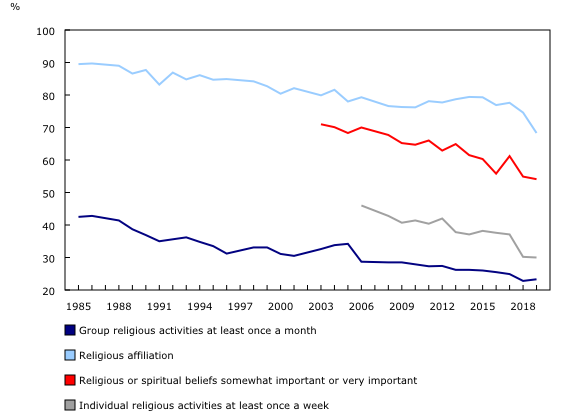
In 2019, just over two-thirds (68%) of the Canadian population reported having a religious affiliation, and over half (54%) said their religious or spiritual beliefs were somewhat or very important to the way they live their lives. 

More than one-third of Canadians (37%) reported engaging in religious or spiritual activities on their own at least once a month, and almost one-quarter (23%) reported participating in a group religious activity at least once a month in the previous year. 

Women were more likely than men to report having a religious affiliation (72% compared with 64%) or to consider their religious or spiritual beliefs somewhat or very important to how they live their lives (61% vs. 47%). They were also more likely than men to participate in religious or spiritual activities on their own at least once a week (36% vs. 24%) and in group religious activities at least once a month (26% compared with 21%). The same types of results are found by gender and age. Women are more likely than men to report having a religious affiliation, to participate in group or individual religious or spiritual activities, and to place a high value on their religious or spiritual beliefs, regardless of age.

Dynamics vary across regions

The diversity of regional dynamics has long been a fundamental characteristic of Canada’s religious landscape. For example, high proportions of non-affiliation have distinguished British Columbia for several decades and still characterize the province, with 40% of the population reporting no religious affiliation from 2017 to 2019.

In Quebec, religious affiliation is relatively high. However, more often than elsewhere, it goes hand in hand with low importance given to religious or spiritual beliefs. From 2017 to 2019, 40% of Quebec residents reported both a religious affiliation and low importance of religious or spiritual beliefs, compared with 15% to 25% in other provinces.

Trends in religion in the Atlantic provinces have generally been more stable than in other regions, particularly with respect to religious affiliation. However, the most recent data show particularly sharp contrasts between generations, suggesting that significant changes in the religious landscape have begun in these provinces. For example, from 2017 to 2019, those born between 1940 and 1959 were twice as likely to report both having a religious affiliation and considering their religious or spiritual beliefs somewhat or very important (74%) than those born between 1980 and 1999 (37%).

Participation in religious activities varies widely across religious affiliations 

Among those who reported having a religious affiliation between 2017 and 2019, nearly one-third (32%) had participated in group religious activities at least once a month. However, the frequency of participation in religious activities varied widely across religious affiliations.

For example, a majority of Jehovah’s Witnesses (86%), Latter Day Saints (80%) and Anabaptists (75%) participated in group religious activities monthly. In contrast, Buddhists (15%), Anglicans (19%) and those affiliated with the United Church (19%) had proportions of monthly group participation well below average.

There is also some variation in the importance given to religious beliefs by religious affiliation. Nevertheless, a majority of people of each affiliation reported that their religious or spiritual beliefs were somewhat or very important, ranging from 62% for Catholics to 98% for Jehovah’s Witnesses.

Declines in religious affiliation and participation in religious activities

Both religious affiliation and frequency of participation in group religious activities have trended downward in recent decades. For example, the share of people who reported having a religious affiliation fell from 90% in 1985 to 68% in 2019. Meanwhile, the share of those who attended a group religious activity at least once a month fell by almost half, from 43% to 23% over the same period.

Similar trends were also observed with respect to the practice of individual religious or spiritual activities and the importance given to religious and spiritual beliefs. For example, in 2003, 71% of people reported that their religious or spiritual beliefs were somewhat or very important, compared with 54% in 2019. Finally, the proportion of people who engaged in religious or spiritual activities on their own at least once a week fell from 46% in 2006 to 30% in 2019.

Chart 1  
Evolution of the different religiosity indicators, 1985 to 2019

Chart 1: Evolution of the different religiosity indicators, 1985 to 2019

Religious affiliation and participation are less common among younger generations

In general, recent generations were less likely than the generations that came before them to report a religious affiliation, to participate in group or individual religious activities, or to place a high value on religious and spiritual beliefs in how they live their lives.

For example, at the same age, when they were 20 to 30 years old, those born between 1960 and 1969 were significantly more likely to report a religious affiliation (82%) than those born between 1990 and 1999 (54%). They were also more likely to participate in group religious activities (24%) than their counterparts born between 1990 and 1999 (14%). Similar trends were also observed for participation in individual religious or spiritual activities and the importance of religious beliefs.

The succession of generations displaying these forms of religiosity less and less often accounts for much of the decline in religious affiliation, practices and importance among the Canadian population over the past few decades.

In terms of religiosity, people born outside Canada differ more from those born in Canada among the younger generations

In general, people born outside Canada are more likely than those born in Canada to report a religious affiliation, to consider their religious and spiritual beliefs important to how they live their lives, and to participate in group or individual religious activities. However, this difference is more pronounced among members of younger generations.

For example, among those born between 1980 and 1999, those born outside Canada were much more likely than those born in Canada to report a religious affiliation (71% vs. 59%) or to consider their religious beliefs to be somewhat or very important (62% compared with 39%). In comparison, those born outside Canada between 1940 and 1959 were about as likely as their Canadian-born counterparts to report a religious affiliation (85% vs. 87%) and only slightly more likely to consider their religious beliefs to be somewhat or very important (74% compared with 66%).

Given that immigration is an important factor in Canada’s population growth, these trends could have an impact on the evolution of the various religiosity indicators examined in this study.

In addition, information from the 2021 Census will soon provide an updated picture of religious diversity in Canada. This information will provide a more detailed picture of religious affiliations and the people with these affiliations.

Source: https://www150.statcan.gc.ca/n1/daily-quotidien/211028/dq211028b-eng.htm?CMP=mstatcan

Turkish students increasingly resisting religion, study suggests

Perhaps as a reaction against Erdogan’s efforts?

Twenty-two-year old Esra, from Mersin, is even more bored than usual this Ramadan. Universities are shut and Turkey has taken the unusual step of placing under-20s, as well as over-65s, under a curfew, because many Turkish families live in intergenerational households.

As a result, Esra can’t see any of her friends. And a few days into the Muslim month of fasting, like many young people, she is now feeling even more suffocated by the religious restrictions imposed by her pious parents.

“They normally don’t know how I dress when I’m not there but even in the house now wearing tight jeans bothers them and they’re commenting on it,” she said. “They think I am fasting but I’m not. I have water in my room.”

Despite more than a decade of efforts by Recep Tayyip Erdoğan’s ruling Justice and Development party (AKP) to mould a generation of pious Turks, the country’s youth appears to be turning away from religion.

Source: Turkish students increasingly resisting religion, study suggests

Ground shifts in Indonesia’s economy as conservative Islam takes root

Of note:

Arie Untung, a former video jockey for the Indonesian offshoot of MTV, says he used to drink alcohol regularly and – back then – was a jeans-clad, spiky-haired rocker who was only a nominal Muslim.

But he says his religious fervor was rekindled by online preachers promoting more conservative interpretations of Islam, which are gaining ground in the world’s most populous Muslim-majority country and bringing profound changes in its economy.

Untung has now reinvented his career by linking up with other celebrities to run a sharia (Islamic law)-friendly entertainment business in Southeast Asia’s biggest economy, including hosting popular Muslim prayer festivals.They are part of a growing body of “born-again” Muslims driving social changes that are also having an economic impact, encouraging everything from Muslim-targeted housing to sharia banking.

“We have become some sort of like endorsers, the endorsers of Allah,” said Untung, who now sports a beard and a more restrained hair style, referring to his celebrity colleagues.

The celebrities, who jointly have over 20 million followers on Instagram and Twitter, are part of what has become known as the “hijrah” movement in Indonesia and, according to Untung, aim to make an Islamic economy more mainstream.

Hijrah, Arabic for migration, is used to refer to Prophet Mohammad’s journey from Mecca to Medina to escape persecution, and represents the beginning of the Muslim era.

Indonesia’s 215 million Muslims have traditionally been moderate and their beliefs often included elements of mysticism and local customs.

The number of conservatives is now growing and more companies have embraced Islamic branding and marketing, said Edy Setiadi, secretary general of the non-profit Shariah Economy Society.

Restaurants have raced to secure halal certification, which means they comply with Islamic law. There are now hospitals where drugs are halal compliant and shampoos claiming to be suitable for headscarf wearers. Japan’s Sharp sells refrigerators labeled halal.

“PEACE OF MIND”

Many born-again Muslims are young, earn regular salaries and prepared to go the extra mile to feel they are living an Islamic lifestyle, said Setiadi.

“They don’t think about how much they spend, they just want peace of mind,” he said in an interview at his office in Jakarta.

Conservative Islamic groups were largely repressed during the 32-year rule of strongman Suharto, but since his downfall in 1998, they have emerged as a growing force, although officially, Indonesia remains secular.

During April elections, President Joko Widodo, a moderate Muslim, picked elderly conservative cleric Ma’ruf Amin as his running mate, a move seen as helping him secure more Muslim votes for his re-election.Amin, chairman of the Ulema Council of Indonesia, a group of clerics, has promoted laws for Islamic banking and mandatory halal certification and his vice presidency may usher in more incentives for the Islamic economy, analysts say.

A report by Thomson Reuters, the parent of Reuters News, estimated Indonesians spent more than $219 billion on halal food, tourism, fashion and cosmetics in 2017, compared to $193 billion in 2014.

Islamic banking assets were 486.9 trillion rupiah ($34.26 billion) by June 2019, representing more than 300% growth in the last nine years, even though they remain less than 6 percent of total banking assets at around $580 billion.

There has been particularly rapid growth in demand for halal food, modest fashion and Islamic travel, Dody Budi Waluyo, a deputy governor of Bank Indonesia (BI), told Reuters.

“BI sees a potential growth in the sharia economy amid demand for products certified halal and a halal lifestyle,” said Waluyo. He said the central bank and the government were trying to pin down the sharia economy’s share of GDP, and could not vouch for the accuracy of some estimates of the sector accounting for 40%.

MUSLIM HOUSING

Some housing developments now target Muslims, like the Az Zikra gated community near Jakarta, which offers 400 households “the chance to follow in the footsteps of Prophet Muhammad.”

At its center is a mosque, built using a grant from late Libyan dictator Muammar Gaddafi, and it hosts an archery range and horse riding, both pastimes regarded as favored in Islam.

In 2014, Indonesia adopted measures to make companies label whether products are halal, although the deadline was pushed from last year by as much as 7 years amid concerns from industry that the move could cause chaos and threaten supplies.

Still, marketing of halal products is becoming mainstream.

At a halal exhibition held in Jakarta last month, a foundation cream from Korean cosmetics line SOS Beauty was being offered to women in colorful headscarves.

“This doesn’t close your pores, so when you go to wudu, this will let the water come through,” said Lisa, a company representative, referring to the Islamic ritual washing of parts of the body, including the face, before prayers.

At Thamrin City, a popular 10-storey mall in central Jakarta, Muslim fashion stalls have taken over space in areas once occupied by sellers of traditional Indonesian batik.

Yesi, who runs a shop there called “Al-Fatih”, said her popular products were khimars, headscarves that go down to the stomach, and niqabs, veils that cover most of the face, at prices ranging from 20,000 rupiah to 200,000 rupiah ($1.40-$14).

Media Kernels Indonesia, a data consultancy, said its research showed words like “hijrah” and “halal” were mentioned on social media over 5,000 times in the past 30 days indicating Islamic phrases were being used more in product marketing.

“This wouldn’t happen without the demand or trend in society,” said company founder Ismail Fahmi.

Source: Ground shifts in Indonesia’s economy as conservative Islam takes root

The Irony Of Conservative Christians’ Opposition To Immigration

Interesting take:

President Donald Trump’s base simultaneously cares deeply about defending Christianity and restraining immigration.

It’s a stance we’ve come to expect, but there’s an irony to this. At a moment when more and more Americans are unaffiliated with religion, immigration is providing a counterbalance.

In fact, nothing would do more to strengthen Christianity than embracing undocumented immigrants. Most undocumented immigrants come from Latin America, so 83 percent are Christian. If they were all expelled, the United States would lose 9 million Christians. By contrast, legal immigrants tend to come from countries like India, Pakistan and China, with majority non-Christian populations.

Beyond that, it is well known that for the past few decades Latino immigration has energized, and in some ways saved, the Catholic Church in the United States. About 40 percent of American Catholics are Hispanic, and they’re more likely to say religion is “very important” in their lives than white Catholics.

What’s less acknowledged is that Latinos have also bolstered evangelical communities. Some 16 million evangelicals are Hispanic, and about 15 percent of all immigrants are evangelical.

Beyond the specifics, I’d argue that immigration has been a key factor in strengthening religious freedom in the U.S. New immigrants are more likely to be religious and to say it’s important in their lives than the general population.

Going back through history, immigration has repeatedly injected energy and piety to the American religious landscape.

From our country’s founding, diversity has been important to ensuring religious liberty. When James Madison guided the creation of the First Amendment, he believed that a “multiplicity of sects” would be more important than “parchment barriers.” Having a variety of religions or Christian denominations would prevent one religion from dominating the others, and therefore help create a fluid religious marketing place that would encourage religious vibrancy.

In the United States, religious diversity has flowered in three different ways: homegrown religious entrepreneurship (American-created religions like Mormonism, Seventh Day Adventism or Jehovah’s Witnesses); denominational splintering, and finally, immigration.

In the case of immigration, the positive effects may not be evident right way. Throughout American history, the arrival of new immigrants practicing minority religions has often prompted backlash, as happened throughout the 19th century with Irish Catholics. In 1835, Samuel Morse, who would later invent the telegraph, warned that foreign countries were sending us “their criminals” because America hadn’t erected the right “walls.” He also complained that he and his allies were being unfairly attacked by a liberal media that was “on the side of your enemies.”

But the Catholic influx not only enriched American life in countless ways, it strengthened religious freedom by making it impossible for Protestant majorities to impose their faith approach on others. For instance, until Catholics objected, public schools in the 19th century had insisted on teaching the Protestant translation of the Bible to children. Catholics demanded that if the Bible were to be taught, their translation had to be included too. This established the idea that religion can only live in public places if other religions are invited to participate too.

At another point in the 19th century, Protestants became worried about a different group of immigrants flooding across the border – Mormons coming from Canada. Horrible persecution ensued. In 1838, the governor of Missouri proclaimed that “the Mormons must be treated as enemies, and must be exterminated or driven from the State if necessary for the public peace.” Over time, the growth and persistence of the Mormons forced Americans to expand their definition of religious freedom.

In the 1920s, efforts to restrict immigration were driven in part by the fear that too many Jews had arrived from Eastern Europe. By World War II, though, America decided that Jews needed to be incorporated as full partners in the pluralistic model and that their presence demonstrated something inspiring about the nation. Presidents Roosevelt, Truman and Eisenhower cast religious freedom and pluralism as a sign of America’s moral superiority over fascism and communism.

Eisenhower became the first president to use the term “Judeo-Christian.” He explained, “Our form of government has no sense unless it is founded in a deeply felt religious faith, and I don’t care what it is. With us of course it is the Judeo-Christian concept, but it must be a religion that all men are created equal.”

In 1993, Congress proposed the Religious Freedom Restoration Act, which more deeply enshrined key modern principles of religious liberty. Tellingly, the bill’s main sponsors were religious minorities with immigrant ancestors: Charles Schumer and Stephen Solarz, both Jewish, in the House, and Ted Kennedy, an Irish Catholic and Orrin Hatch, a Mormon.

Over America’s history, immigration has helped fuel a virtuous cycle for religious freedom. Immigration has brought energy to religious institutions – and has prevented just one denomination from becoming powerful enough to squelch liberty.

Madison didn’t argue explicitly for immigration as a lubricant for religious freedom’s mechanisms. But he did argue for variety. It turns out that immigration has been a major reason this system has worked so well.

Source: The Irony Of Conservative Christians’ Opposition To Immigration

Young immigrants to Canada passionate about spirituality: Todd

Will be interesting to track this religiosity over time and see which of the experts quoted proves to be more accurate in their predictions:

Between 2001 and 2011, about 39 per cent of the people who came to Canada arrived as Muslims, Hindus, Sikhs and Buddhists,” Bibby writes in the new book, Canada’s Catholics (Novalis), co-written with Angus Reid. “However, 44 per cent arrived as either Protestants (23 per cent) or Catholics (21 per cent). The remainder (17 per cent) had no religious affiliation.”With people outside the West becoming more religiously committed than ever, Bibby believes Canada’s unusually high immigration intake will prove a “windfall” for religion and some forms of Christianity, particularly Catholicism and evangelical Protestantism.

Father Rob Allore, priest at St. Mark’s Catholic parish at UBC, says the immigrants and foreign students who predominate at his church generally “stress the importance of community” more than Canadian-born British Columbians, who tend to be more individualistic.

Immigrants are also typically more socially conservative than Canadian-born people, particularly in regards to sex, marriage and relationships, said Allore, echoing research studies.

Farida Bano Ali, a prominent Vancouver Muslim, agrees that most immigrants are fairly religious in their early years in Canada.

“But once they become accustomed to freedom here, it’s a different story. Many drift away with their friends. And some are drawn to anti-social behaviour. Or just to making money.”

John Stackhouse, a Canadian professor specializing in Christianity and culture, believes many immigrants find practical value in joining a religious organization when they first arrive in Canada. It provides a sense of identity, plus job-market connections.

Unlike Bibby, Stackhouse questions whether most of the influx of immigrants — who account for 70 per cent of Canada’s population growth — will remain loyal to their faith groups long enough to have a lasting impact on religious attendance in Canada.

http://vancouversun.com/opinion/columnists/young-immigrants-to-canada-passionate-about-religion