Canada’s limits on immigration targets will cost billions in lost revenue over next five years: RBC report

Underlines just how much the government relied on its expansionist immigration policies that increased GDP and related tax revenues but weakened GDP per capita growth:

The federal government’s plan to scale back Canada’s annual immigration targets will lower revenues by billions of dollars over the next five years, according to a new RBC report that urges Ottawa to take a cautious approach to new spending.

Royal Bank of Canada economists Cynthia Leach and Rachel Battaglia’s release Tuesday, which looks ahead to Finance Minister Chrystia Freeland’s coming fall economic statement, says fewer immigrants will translate into lower consumption and employment growth for the economy as a whole – resulting in a significant negative impact on federal finances.

Ms. Leach, a former economist with the federal Finance Department, said in an interview that Ottawa should stay within its self-imposed targets to control the deficit and debt-to-GDP ratio.

“I do think it’s important for the government to stick to its fiscal anchors‚” she said.

Ms. Leach said the government is facing several sources of economic volatility, including the immigration changes and talk of higher tariffs from U.S. president-elect Donald Trump.

The economists project that revised immigration policies will lower federal revenues by about $50-billion over five years, which is only partly offset by a $30-billion fiscal improvement tied primarily to lower-than-anticipated interest rates. The overall fiscal landscape has worsened by about $20-billion over five years compared with the 2024 budget estimates, according to the RBC report….

Source: Canada’s limits on immigration targets will cost billions in lost revenue over next five years: RBC report

Canada needs 300,000 new rental units to avoid gap quadrupling by 2026: report [the Achilles heel of Canadian immigration policy]

Housing is the Achilles heel of Canadian immigration policy and levels:

Canada’s rental housing shortage will quadruple to 120,000 units by 2026 without a significant boost in stock, Royal Bank of Canada said in a report Wednesday.

In order to reach the optimal vacancy rate of three per cent, the report suggested Canada would need to add 332,000 rental units over the next three years, which would mark an annual increase of 20 per cent compared with the 70,000 units built last year.

The research analyzed vacancy rate data released in January by the Canada Mortgage and Housing Corporation (CMHC).

Canada’s vacancy rate fell to 1.9 per cent in 2022, its lowest point in 21 years, from 3.4 per cent in 2020 and 2021.

Competition for units also drove the highest annual increase in rent growth on record, by 5.6 per cent for a two-bedroom unit.

Canada’s rental housing stock grew by 2.4 per cent in 2022, led by Calgary at 7.4 per cent and Ottawa-Gatineau at 5.5 per cent, while Toronto and Montreal saw the smallest percentage increases at 2.1 per cent and 1.4 per cent, respectively.

“We haven’t seen that many additions to the purpose-built inventory in almost a decade, so you would think that added supply of units would ease some of the competition, but what the CMHC rental market data revealed to us was that it didn’t,” said RBC economist Rachel Battaglia.

Slow growth in Canada’s two most populous cities has been outpaced by rapidly increasing demand, partly fuelled by high immigration levels, she said. Annual federal immigration targets are set to grow eight per cent by 2025, meaning demand is unlikely to let up.

Battaglia also pointed to affordability and behavioural preferences for the influx of rentals sought. She said more Canadians are choosing to live alone, meaning fewer incomes per household.

“You have a lot of people being funnelled into the rental market who maybe would have liked to own something but it’s just not financially in the books for them right now,” said Battaglia.

The report estimated an existing deficit of 25,000 to 30,000 units of rental stock across Canada. In addition to building more supply, it recommended turning condo units into rentals, converting commercial buildings and adding rental suites to existing homes to help ease the pressure.

Without such measures, Battaglia said the market could “become infinitely more competitive.”

“Which is not something that we want to realize given the competition we’re already seeing,” she said.

“You’re already seeing rents increase dramatically.”

Source: Canada needs 300,000 new rental units to avoid gap quadrupling by 2026: report

RBC Proof Point: Canada is failing to put immigrant skills to work

Bit strange that given the main barrier cited is foreign credential recognition that the authors do not mention or address that this is largely under provincial jurisdiction. And striking that a note from Canada’s largest bank is silent on GDP per capita and productivity:

  • Canada leads the G7 in attracting immigrants, with newcomers now driving 90% of population growth.
  • Immigrants to Canada are better educated and younger than the domestic workforce.
  • But they are much more likely to work in jobs requiring less education.
  • Better utilization of immigrant skills will be key to economic prosperity, as immigration continues to drive Canadian workforce growth.
  • The bottom line: Poor recognition of foreign credentials is the primary obstacle to better utilization of immigrant skills. Eliminating this barrier will be critical to ensuring the Canadian workforce is not only larger—but more productive.

Canada is leading peers in the race to attract immigrants

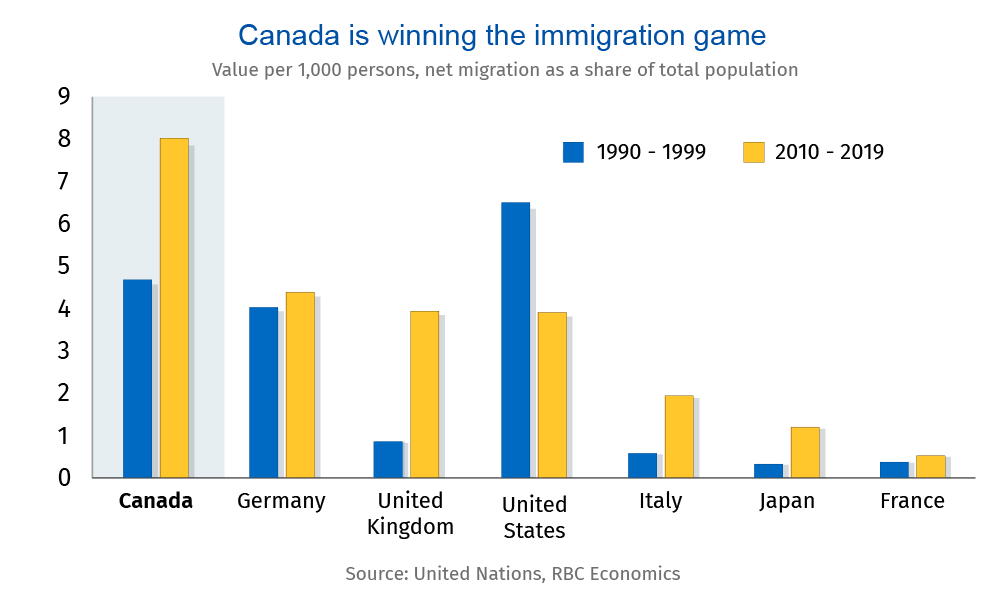
Few countries are doing a better job of attracting immigrants than Canada. On average, for every thousand people in Canada there were ~8 migrants (when emigration is accounted for) between 2010 and 2019. That’s the highest level among G7 countries—and considerably higher than the U.S., which held the top rate for net migration a couple of decades ago.

Canadian immigration slowed sharply in 2020 due to a variety of COVID-related drawbacks. But its post-pandemic rebound has been powerful. In 2021, nearly 90% of all population growth was driven by higher immigration. And Statistics Canada expects that to reach 100% by 2050. Immigration alone will offset declines from lower birth rates and population aging.

Amid persistent labour shortages, these immigrants are bringing valuable skills. Indeed, of the 1.5 million newcomers that the federal government will target in the next three years, over half will be economic immigrants. That share is considerably higher than in the U.S. or the U.K. (where it sits at about a quarter).

These skilled newcomers (and the stronger workforce growth they’ll bring) are also the main reason we expect Canada’s GDP growth to outpace that of other advanced economies in the coming years thanks to stronger workforce growth.

Breaking barriers to immigrant skills recognition will bear fruit

Higher levels of immigration alone won’t ‘fix’ longer-run structural labour supply issues—but they’ll help. They could help even more if immigrant skillsets were better utilized.

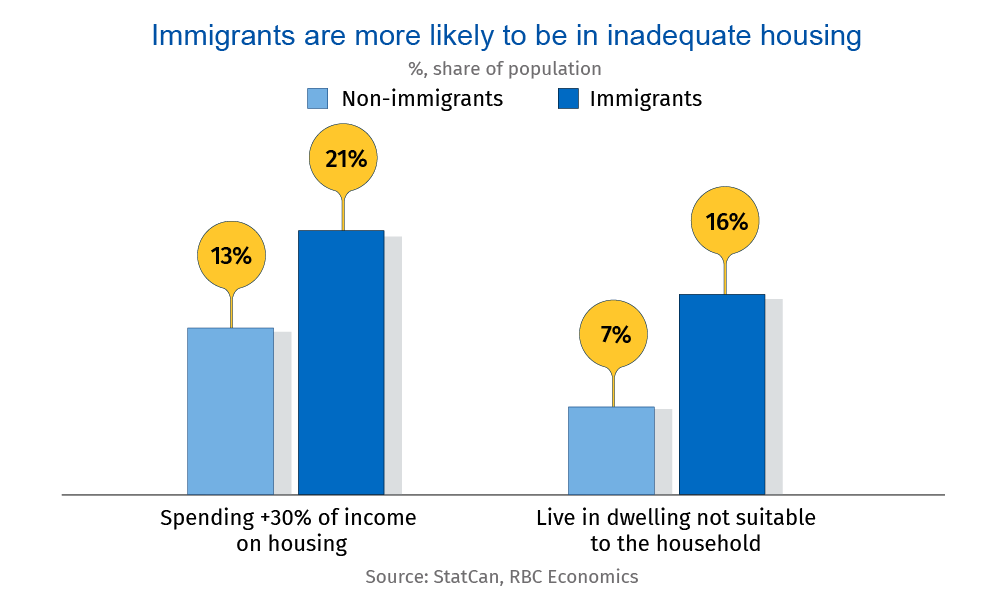
And there are a range of reasons to put them to use. Indeed, new immigrants can fill open positions, but they also increase demand for housing and consumer goods which in turn raises demand for labour. They’re also more likely to live in homes that are not suitable to the size or composition of their household. Better use of skills can offset all of those pressures by making the economy more productive.

As the economy enters a mild downturn due to aggressive interest rate increases and higher inflation, some easing of the labour squeeze is likely in 2023. Job vacancies in Canada have dropped since last summer. And more Canadian businesses were expecting a weaker outlook in Q4 2022, according to the Bank of Canada’s Business Outlook Survey. As a result, concerns about insufficient consumer spending have risen sharply and intentions for investment and hiring have moved lower.

But labour shortages will return as the population continues to age. Those issues are structural rather than cyclical. Having a younger, better educated inflow of immigrant workers could help immensely.

New Canadians don’t fare as well in the jobs market

Immigrants tend to be younger. The share of the “working age” population – or those that are aged between 25 to 64 years old – is 5% higher among immigrants compared to non-immigrants. That should help partially turn back the clock of an aging work force.

New Canadians also tend to be better educated. Over one third have advanced degrees, i.e. a bachelor’s degree or higher, compared to just over a fifth for non-immigrants. Immigrants with higher educations are also more likely to have majored in STEM-related fields (science, technology, engineering and math) than their non-immigrant peers.

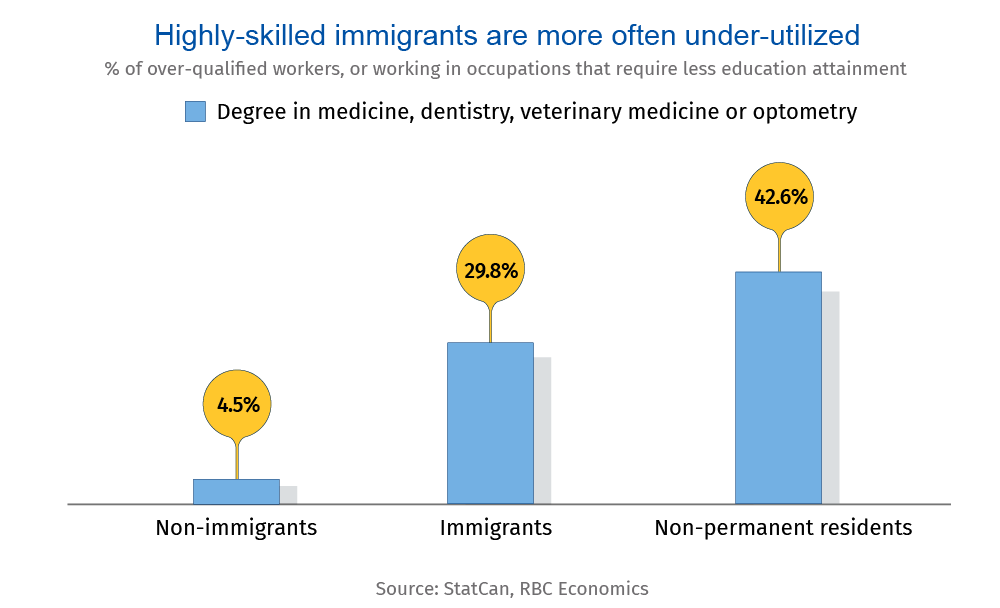
Yet despite being younger and more academically accomplished, immigrants tend to do worse when it comes to finding a suitable job. In other words, more of them tend to work in occupations that require education that’s below their current level.

This challenge, present in all sectors, is particularly daunting for those with degrees in medicine, dentistry, veterinary medicine or optometry. By our count, immigrants with a degree in those fields are six times more likely to work in jobs that do not require related training. Their skills are thus “under-utilized” compared to non-immigrants with similar degrees.

That gap however, goes away completely when the location of study is controlled for. Immigrants that trained to be doctors, veterinarians and optometrists within Canada are equally as likely to work in related fields as their non-immigrant peers.

In other words, poor recognition of foreign credentials is the primary obstacle to better utilization of immigrant skills. Moving forward, eliminating those barriers will be critical to ensuring Canada’s success in attracting immigrants continues. Proper integration of their skills could help address worker shortages, add to a more productive labour force and offset increased pressure on inflation and housing.


Nathan Janzen is an Assistant Chief Economist, leading the macroeconomic analysis group”. His focus is on analysis and forecasting macroeconomic developments in Canada and the United States.

Claire Fan is an economist at RBC. She focuses on macroeconomic trends and is responsible for projecting key indicators on GDP, labour markets as well as inflation for both Canada and the US.

Source: RBC Proof Point: Canada is failing to put immigrant skills to work

How Canada can fix its ‘predatory’ relationship with international students

Good long read on the university and college cash cow and a program that has increasingly deviated from an education to a labour program, with some interesting insights from Australia.

While bit over the top, this money quote has an inconvenient truth:

“The whole objective of international education is just to make money and to grow the economy. It has really little to do with education,” says Kahlon. “If we’re honest about what the international education strategy is, it is just to raise Canada’s GDP.”

Canada’s international education strategy has been an undisputable success — the envy of other nations — attracting foreign students to come and study with the promise of work opportunities and the prospect of permanent residency and citizenship.

Over the years, the campaign has injected billions into the economy, created a pipeline of immigrants and fuelled a post-secondary education sector that struggled with declining public funding and falling domestic enrolment.

But that successful formula and unfettered growth seems to have reached a tipping point.

Students who are falling through the cracks are starting to question whether their investment of time and money, by way of hefty tuition fees, is paying off.

And Canada doesn’t need a crystal ball to see what lies ahead.

“A CASH cow is all very well, and a fine thing when it is happily chomping in the field. But what happens when it grows horns, turns nasty and demands that you feed it more and look after it better?”

That was a question raised in an article published in The Age, one of Australia’s oldest and most reputable newspapers, back in 2008. At the time, Australia was seeing an exponential growth in international enrolment that made the then-$12.5 billion international education sector its third-largest export after coal and iron.

“There is pressure on the industry from without and within. Increasing competition from foreign universities in the global race for market share, Australian universities at capacity, and a growing perception that Australia’s international students have been exploited on one hand, and neglected on the other, are biting hard,” the story continued.

There were other reports about international students in Australia being “underpaid and exploited” as a labour underclass, of students struggling with social isolation, feeling unhappy with the immigration prospects and facing “severe overcrowding” in rooming houses, including one extreme case where 48 students were living in a six-bedroom property.

Canada has been following a similar trajectory, some say.

The pandemic has further exposed international students’ precariousness and our country’s disjointed education and immigration systems, which leave students disillusioned amid a patchwork of support that relies on the goodwill of the schools, employers and local communities.

More and more international students in Canada are publicly complaining about exploitation and wage thefts by bad employers and landlords, the financial and emotional hardship of the journey, and the unfulfilled immigration dream sold to them by unscrupulous education recruiters.

Increasingly, there’s a recognition that what they have been promised is not exactly what they’re getting. while studying in Canada is not a guaranteed pathway for permanent residence that many expect.

It’s led to a growing chorus of voices calling on the Canadian government to refresh its strategy to ensure its international enrolment growth is sustainable and its appeal as a destination of choice will last.

But what would a reset, recalibrated international student program look like in Canada?

There is some no shortage of possibilities.

Resetting Canada’s international education strategy

The Canadian government launched an aggressive campaign in 2014 to boost its annual number of international students to more than 450,000 by 2022.

The country has long surpassed that goal.

Last year, there were 845,930 valid study permit holders in Canada, which rose to 917,445 as of Sept. 30 of this year.

International students, through their spending and tuition, contribute $22 billion to the Canadian economy and support 170,000 jobs in the country.

Those international students, who typically pay up to four times more in tuition than their domestic counterparts, are a godsend to many Canadian colleges and universities to help fill classroom seats and keep courses open for domestic students who otherwise would’ve had fewer options from which to choose. They are also embraced by employers desperate for temporary help at gas stations, restaurants and factories to keep businesses running.

Yet there have been increasing public calls for the federal government to better align academic goals, Canada’s economic needs and the interests of students.

The RBC has recently recommended Ottawa to be more strategic in leveraging and expanding its international student pool in the global race for skilled workers post-pandemic; the Conference Board of Canada in a separate report urged better co-ordination to ensure the number of international students admitted are in line with thelevel of permanent residents admitted each year to avoid further “friction.”

Australia moved to reset its own system.

International enrolment there had blossomed from 256,553 in 2002 to 583,483 in 2009 as migrants were drawn by the opportunities to work and stay in the country permanently before Canberra decided to rein in an unruly sector by “desegregating education and immigration.”

Australian officials began asking education institutions to register international education agents who worked for them and to review their performances based on student enrolment outcomes.

The bar for permanent residence was raised and limited to those who completed degree-level programs, postgraduate programs and regulated professions such as nursing, engineering and social work.

All applicants must submit a statement detailing their personal circumstances and why they pursue a particular program in Australia. Each is assessed based on the study plan, as well as factors such as the economic situation, military service commitments and even political and civil unrest in the person’s home country to make sure they are “genuine temporary entrants.”

Today, international education is still worth about $34 billion (Canadian) to Australia’s economy, with 418,168 in higher education out of 882,482 students in international enrolment in 2020. The rest were mainly in language training and vocational schools.

International students, meanwhile, go where the opportunities are. Experts say students traditionally turn to other jurisdictions with fewer perceived barriers when countries such as Australia restrict the pipeline.

Students “are using commercial agents to find the cheapest, most affordable routes there are,” says Chris Ziguras, a professor at RMIT University in Melbourne, who studies the globalization of education.

“At the moment, I think there’s a lot of students clearly voting with their feet and choosing that pathway into Canada over other pathways which are more expensive, more difficult and more restrictive. And that’s why we’re seeing the bulge there.”

A patchwork of settlement supports for foreign students

Noor Azrieh didn’t know anyone in Canada when she came to Carleton University in 2018 for a four-year journalism and human rights program. The 22-year-old Lebanese says she has had issues finding housing and skilled jobs because of her temporary status.

Landlords would often ask for six-to-eight-month rent deposits and demand a Canadian guarantor, while employers lost interest in hiring her once they found out she was here on a time-limited post-graduate work permit.

“It feels like you are doing this entirely alone. And maybe that’s just how it is,” says Azrieh, who works full time as an associate producer at CANADALAND. “Maybe I wasn’t ready to move across the country, across the globe, to a country that I didn’t know. But it felt like I was doing everything alone.”

.Colleges and universities are educational institutions, and some don’t have the capacity to properly support international students, who lack access to the kind of settlement services designed exclusively for permanent residents.

In light of the service gaps, immigrant agencies in B.C. now provide support for international students and temporary foreign workers through one-on-one information and referral, workshops and support groups.

Nova Scotia also launched a pilot program recently that offers international students in their final year help with career development opportunities and community connections to successfully transition to permanent residence.

However, these supports are piecemeal and it’s unclear who is responsible for the costs and the students’ well-being, says Lisa Brunner, a University of British Columbia doctoral student, whose research focuses on immigration, higher education and internationalization.

“If you’re coming from an institution’s perspective, my goal is to support students in their education and their experience in Canada, versus the government saying, ‘OK, we want to support this person because they’re a future immigrant and we want to retain them,’ ” she says.

“Those are two different types of services.

“The way it’s structured now works well for the government, because essentially the students themselves are responsible for the settlement process. Either they acquire the capital that’s necessary to succeed in the labour market to qualify for permanent residence or they don’t. In this way, the government doesn’t have to fund the services.”

“We all acknowledge giving access to students to those (settlement and support) services from the beginning of their journeys would be a tremendous return on investment for Canada,” says Larissa Bezo, president and CEO of the Canadian Bureau for International Education, a not-for-profit organization that aims to promote and advance Canadian international education.

“There’s a shared responsibility that we have … And in a federation like ours, that’s complex. I’m under no illusion. But we need to do a better job of connecting these dots.”

Coming out of the pandemic, Bezo says, Canada’s global brand has remained strong as Canadian governments and the sector pivoted in supporting international students through the crisis as other countries such as Australia asked their students to go home.

Clear messaging to international students

Balraj Kahlon, who co-founded One Voice Canada in British Columbia in 2019 to support and advocate for international students, says Canada’s international education strategy has been “ruthlessly” successful.

“The whole objective of international education is just to make money and to grow the economy. It has really little to do with education,” says Kahlon. “If we’re honest about what the international education strategy is, it is just to raise Canada’s GDP.”

He says the country’s international enrolment has increasingly been coming from the working poor in developing countries, lured by Canada’s relatively low tuition fees, the chance to work and make money to pay off family loans for the studies, and sometimes misinformation by unscrupulous education agents about the direct pathway for permanent residence.

He says many international students these days are pursuing the cheaper and shorter programs at colleges with the sole intent of immigration, even if they know they can’t afford the tuition fees and their courses won’t get them beyond a warehouse, factory or retail job.

Yet, he says many can’t resist the allure of the opportunity for permanent residence and a life toiling in low-wage, low-skilled jobs in Canada that still pay more than what they would earn back home.

If the international education strategy really aims to attract the best and the brightest, he says, permanent residency should be limited to the students who are at the top in their fields by lowering their tuition and making schooling affordable to them.

“Until you get rid of the profit motive, problems are going to keep coming, because the incentive is always just more numbers,” says Kahlon.

Sixty per cent of international students do plan to apply for permanent residence in Canada, but only three in 10 international students who entered the country in 2000 or later ended up obtaining permanent residence within 10 years.

While some fail to complete their education or secure employment for immigration, others find opportunities elsewhere and leave.

“Higher-education admission policies and procedures have a very different goal than the admission criteria for economic immigrants,” says Grunner, the UBC researcher. “That difference is not always clear to students before they come to Canada.

“The message they get is that Canada wants international students. That’s the policy message that gets communicated. International students are desired by Canada for their labour. We got that message very clear because it says that international students can now work for the next year with unlimited hours. And international students are desired as potential immigrants.”

Diversifying where and what students choose to study

Paul Davidson, president of Universities Canada, says there is capacity to absorb more international students, though that capacity isn’t evenly distributed across the country.

Governments, education institutions, immigrant settlement agencies, local communities and employers all have a stake in ensuring international students’ experience and well-being, he says.

“It’s really important that international students get credible information and are supported in every step of their training,” says Davidson, whose organization is the voice for 93 Canadian universities. “There are people making false claims about what their experience in Canada will be and we need to call that out.”

Denise Amyot, his counterpart at Colleges and Institutes Canada, says the federal government not only needs to diversify the source of international students here (currently 35 per cent from India; 17 per cent from China; and four per cent from France), but also where and what they choose to study.

Her organization released a report last year, calling for new permanent residency streams and supports for colleges to improve their labour market outcomes.

“I would be in favour of accelerating permanent residency for students that are in the areas of skills that we need,” says Amyot, who also would like to see international students be eligible for government-funded co-op and job programs.

“It’s important that students do their homework (and ask), ‘How I will be integrated into the community,’ where they look at the best possible scenario for what they want to do and what’s their intentions moving forward.”

Global Affairs Canada says the government has aimed to diversify the countries of origin of its international students, promote study opportunities, especially outside of major urban centres, and showcase sectors to highlight areas of labour shortages and encourage study in those fields through digital marketing initiatives.

Several targeted international ad campaigns will be carried out to promote programs in STEM, artificial intelligence and quantum technologies, the department says. Consultations are underway to renew the country’s international education strategy.

Striking a balance

Sana Banu, an international student from India, can’t say enough about the amazing experience she’s had at Kitchener, Ont.-based Conestoga College, despite all the challenges her peers face and a pathway to permanent residence that’s full of pitfalls.

It has given her experience that has pushed her out of her comfort zone, says the 29-year-old, who came here in 2018 to study marketing and communication with an undergrad degree and eight years of work experience in advertising back home.

International students are a diverse group, each with their expectations and intentions, and it’s impossible to generalize everyone’s experience.

To Banu, the issues come down to equity — whether it’s about the hefty and uncapped international tuition fees or job opportunities that usually favour permanent residents and citizens.

“The relationship shouldn’t be predatory,” says Banu, president and CEO of Conestoga’s student association, who was recently invited to apply for permanent residence. “It’s a mutually beneficial relationship that international students provide to Canada and Canada provides to international students.

“It’s important that everybody sees the human side of an international student rather than just as a resource to fill your economic gaps and contribute to your economy exclusively. They are humans, who are coming here with expectations, dreams and hopes. And you could do a lot more in treating them with more dignity, equity and compassion.”

Source: How Canada can fix its ‘predatory’ relationship with international students
Canada’s international education strategy has been an undisputable success — the envy of other nations — attracting foreign students to come and study with the promise of work opportunities and the prospect of permanent residency and citizenship.

Over the years, the campaign has injected billions into the economy, created a pipeline of immigrants and fuelled a post-secondary education sector that struggled with declining public funding and falling domestic enrolment.

But that successful formula and unfettered growth seems to have reached a tipping point.

Students who are falling through the cracks are starting to question whether their investment of time and money, by way of hefty tuition fees, is paying off.

And Canada doesn’t need a crystal ball to see what lies ahead.

“A CASH cow is all very well, and a fine thing when it is happily chomping in the field. But what happens when it grows horns, turns nasty and demands that you feed it more and look after it better?”

That was a question raised in an article published in The Age, one of Australia’s oldest and most reputable newspapers, back in 2008. At the time, Australia was seeing an exponential growth in international enrolment that made the then-$12.5 billion international education sector its third-largest export after coal and iron.

“There is pressure on the industry from without and within. Increasing competition from foreign universities in the global race for market share, Australian universities at capacity, and a growing perception that Australia’s international students have been exploited on one hand, and neglected on the other, are biting hard,” the story continued.

There were other reports about international students in Australia being “underpaid and exploited” as a labour underclass, of students struggling with social isolation, feeling unhappy with the immigration prospects and facing “severe overcrowding” in rooming houses, including one extreme case where 48 students were living in a six-bedroom property.

Canada has been following a similar trajectory, some say.

The pandemic has further exposed international students’ precariousness and our country’s disjointed education and immigration systems, which leave students disillusioned amid a patchwork of support that relies on the goodwill of the schools, employers and local communities.

More and more international students in Canada are publicly complaining about exploitation and wage thefts by bad employers and landlords, the financial and emotional hardship of the journey, and the unfulfilled immigration dream sold to them by unscrupulous education recruiters.

Increasingly, there’s a recognition that what they have been promised is not exactly what they’re getting. while studying in Canada is not a guaranteed pathway for permanent residence that many expect.

It’s led to a growing chorus of voices calling on the Canadian government to refresh its strategy to ensure its international enrolment growth is sustainable and its appeal as a destination of choice will last.

But what would a reset, recalibrated international student program look like in Canada?

There is some no shortage of possibilities.

Resetting Canada’s international education strategy

The Canadian government launched an aggressive campaign in 2014 to boost its annual number of international students to more than 450,000 by 2022.

The country has long surpassed that goal.

Last year, there were 845,930 valid study permit holders in Canada, which rose to 917,445 as of Sept. 30 of this year.

International students, through their spending and tuition, contribute $22 billion to the Canadian economy and support 170,000 jobs in the country.

Those international students, who typically pay up to four times more in tuition than their domestic counterparts, are a godsend to many Canadian colleges and universities to help fill classroom seats and keep courses open for domestic students who otherwise would’ve had fewer options from which to choose. They are also embraced by employers desperate for temporary help at gas stations, restaurants and factories to keep businesses running.

Yet there have been increasing public calls for the federal government to better align academic goals, Canada’s economic needs and the interests of students.

The RBC has recently recommended Ottawa to be more strategic in leveraging and expanding its international student pool in the global race for skilled workers post-pandemic; the Conference Board of Canada in a separate report urged better co-ordination to ensure the number of international students admitted are in line with thelevel of permanent residents admitted each year to avoid further “friction.”

Australia moved to reset its own system.

International enrolment there had blossomed from 256,553 in 2002 to 583,483 in 2009 as migrants were drawn by the opportunities to work and stay in the country permanently before Canberra decided to rein in an unruly sector by “desegregating education and immigration.”

Australian officials began asking education institutions to register international education agents who worked for them and to review their performances based on student enrolment outcomes.

The bar for permanent residence was raised and limited to those who completed degree-level programs, postgraduate programs and regulated professions such as nursing, engineering and social work.

All applicants must submit a statement detailing their personal circumstances and why they pursue a particular program in Australia. Each is assessed based on the study plan, as well as factors such as the economic situation, military service commitments and even political and civil unrest in the person’s home country to make sure they are “genuine temporary entrants.”

Today, international education is still worth about $34 billion (Canadian) to Australia’s economy, with 418,168 in higher education out of 882,482 students in international enrolment in 2020. The rest were mainly in language training and vocational schools.

International students, meanwhile, go where the opportunities are. Experts say students traditionally turn to other jurisdictions with fewer perceived barriers when countries such as Australia restrict the pipeline.

Students “are using commercial agents to find the cheapest, most affordable routes there are,” says Chris Ziguras, a professor at RMIT University in Melbourne, who studies the globalization of education.

“At the moment, I think there’s a lot of students clearly voting with their feet and choosing that pathway into Canada over other pathways which are more expensive, more difficult and more restrictive. And that’s why we’re seeing the bulge there.”

A patchwork of settlement supports for foreign students

Noor Azrieh didn’t know anyone in Canada when she came to Carleton University in 2018 for a four-year journalism and human rights program. The 22-year-old Lebanese says she has had issues finding housing and skilled jobs because of her temporary status.

Landlords would often ask for six-to-eight-month rent deposits and demand a Canadian guarantor, while employers lost interest in hiring her once they found out she was here on a time-limited post-graduate work permit.

“It feels like you are doing this entirely alone. And maybe that’s just how it is,” says Azrieh, who works full time as an associate producer at CANADALAND. “Maybe I wasn’t ready to move across the country, across the globe, to a country that I didn’t know. But it felt like I was doing everything alone.”

.Colleges and universities are educational institutions, and some don’t have the capacity to properly support international students, who lack access to the kind of settlement services designed exclusively for permanent residents.

In light of the service gaps, immigrant agencies in B.C. now provide support for international students and temporary foreign workers through one-on-one information and referral, workshops and support groups.

Nova Scotia also launched a pilot program recently that offers international students in their final year help with career development opportunities and community connections to successfully transition to permanent residence.

However, these supports are piecemeal and it’s unclear who is responsible for the costs and the students’ well-being, says Lisa Brunner, a University of British Columbia doctoral student, whose research focuses on immigration, higher education and internationalization.

“If you’re coming from an institution’s perspective, my goal is to support students in their education and their experience in Canada, versus the government saying, ‘OK, we want to support this person because they’re a future immigrant and we want to retain them,’ ” she says.

“Those are two different types of services.

“The way it’s structured now works well for the government, because essentially the students themselves are responsible for the settlement process. Either they acquire the capital that’s necessary to succeed in the labour market to qualify for permanent residence or they don’t. In this way, the government doesn’t have to fund the services.”

“We all acknowledge giving access to students to those (settlement and support) services from the beginning of their journeys would be a tremendous return on investment for Canada,” says Larissa Bezo, president and CEO of the Canadian Bureau for International Education, a not-for-profit organization that aims to promote and advance Canadian international education.

“There’s a shared responsibility that we have … And in a federation like ours, that’s complex. I’m under no illusion. But we need to do a better job of connecting these dots.”

Coming out of the pandemic, Bezo says, Canada’s global brand has remained strong as Canadian governments and the sector pivoted in supporting international students through the crisis as other countries such as Australia asked their students to go home.

Clear messaging to international students

Balraj Kahlon, who co-founded One Voice Canada in British Columbia in 2019 to support and advocate for international students, says Canada’s international education strategy has been “ruthlessly” successful.

“The whole objective of international education is just to make money and to grow the economy. It has really little to do with education,” says Kahlon. “If we’re honest about what the international education strategy is, it is just to raise Canada’s GDP.”

He says the country’s international enrolment has increasingly been coming from the working poor in developing countries, lured by Canada’s relatively low tuition fees, the chance to work and make money to pay off family loans for the studies, and sometimes misinformation by unscrupulous education agents about the direct pathway for permanent residence.

He says many international students these days are pursuing the cheaper and shorter programs at colleges with the sole intent of immigration, even if they know they can’t afford the tuition fees and their courses won’t get them beyond a warehouse, factory or retail job.

Yet, he says many can’t resist the allure of the opportunity for permanent residence and a life toiling in low-wage, low-skilled jobs in Canada that still pay more than what they would earn back home.

If the international education strategy really aims to attract the best and the brightest, he says, permanent residency should be limited to the students who are at the top in their fields by lowering their tuition and making schooling affordable to them.

“Until you get rid of the profit motive, problems are going to keep coming, because the incentive is always just more numbers,” says Kahlon.

Sixty per cent of international students do plan to apply for permanent residence in Canada, but only three in 10 international students who entered the country in 2000 or later ended up obtaining permanent residence within 10 years.

While some fail to complete their education or secure employment for immigration, others find opportunities elsewhere and leave.

“Higher-education admission policies and procedures have a very different goal than the admission criteria for economic immigrants,” says Grunner, the UBC researcher. “That difference is not always clear to students before they come to Canada.

“The message they get is that Canada wants international students. That’s the policy message that gets communicated. International students are desired by Canada for their labour. We got that message very clear because it says that international students can now work for the next year with unlimited hours. And international students are desired as potential immigrants.”

Diversifying where and what students choose to study

Paul Davidson, president of Universities Canada, says there is capacity to absorb more international students, though that capacity isn’t evenly distributed across the country.

Governments, education institutions, immigrant settlement agencies, local communities and employers all have a stake in ensuring international students’ experience and well-being, he says.

“It’s really important that international students get credible information and are supported in every step of their training,” says Davidson, whose organization is the voice for 93 Canadian universities. “There are people making false claims about what their experience in Canada will be and we need to call that out.”

Denise Amyot, his counterpart at Colleges and Institutes Canada, says the federal government not only needs to diversify the source of international students here (currently 35 per cent from India; 17 per cent from China; and four per cent from France), but also where and what they choose to study.

Her organization released a report last year, calling for new permanent residency streams and supports for colleges to improve their labour market outcomes.

“I would be in favour of accelerating permanent residency for students that are in the areas of skills that we need,” says Amyot, who also would like to see international students be eligible for government-funded co-op and job programs.

“It’s important that students do their homework (and ask), ‘How I will be integrated into the community,’ where they look at the best possible scenario for what they want to do and what’s their intentions moving forward.”

Global Affairs Canada says the government has aimed to diversify the countries of origin of its international students, promote study opportunities, especially outside of major urban centres, and showcase sectors to highlight areas of labour shortages and encourage study in those fields through digital marketing initiatives.

Several targeted international ad campaigns will be carried out to promote programs in STEM, artificial intelligence and quantum technologies, the department says. Consultations are underway to renew the country’s international education strategy.

Striking a balance

Sana Banu, an international student from India, can’t say enough about the amazing experience she’s had at Kitchener, Ont.-based Conestoga College, despite all the challenges her peers face and a pathway to permanent residence that’s full of pitfalls.

It has given her experience that has pushed her out of her comfort zone, says the 29-year-old, who came here in 2018 to study marketing and communication with an undergrad degree and eight years of work experience in advertising back home.

International students are a diverse group, each with their expectations and intentions, and it’s impossible to generalize everyone’s experience.

To Banu, the issues come down to equity — whether it’s about the hefty and uncapped international tuition fees or job opportunities that usually favour permanent residents and citizens.

“The relationship shouldn’t be predatory,” says Banu, president and CEO of Conestoga’s student association, who was recently invited to apply for permanent residence. “It’s a mutually beneficial relationship that international students provide to Canada and Canada provides to international students.

“It’s important that everybody sees the human side of an international student rather than just as a resource to fill your economic gaps and contribute to your economy exclusively. They are humans, who are coming here with expectations, dreams and hopes. And you could do a lot more in treating them with more dignity, equity and compassion.”

Source: How Canada can fix its ‘predatory’ relationship with international students
ICYMI: How can Canada get the international students it needs for the jobs it has? A new report calls for a ‘course correction’

Somewhat amusing, as all such reports say “Canada should do more,” with less discussion of trade-offs and relative effectiveness of existing programs. Addition is always easier than subtraction for governments and advocacy groups.

Not sure how a wage-subsidy program for international students, even in high demand fields, would be received by the Canadian public.

And more fundamental questions remain regarding international students and immigration pathways remain, not only with respect to study areas but also the type of institution (university, college, private), as others have noted:

Canada needs to do a much better job of targeting and supporting international students in order to deal with this country’s specific labour shortages — such as the recent “wake-up call” in health care — a new report says.

While foreign students are well-represented in STEM and business administration, their numbers need to go up in health care, some trades and services to meet Canada’s future labour market needs, says the report from RBC Economics & Thought Leadership.

Tweaking immigration selection to favour international students with a background in STEM, health care and in trades, and providing these students more work-integrated learning opportunities through co-ops or internships would go a long way, the researchers say.

Getting a Canadian education and work experience has increasingly become the pathway to permanent residence for many newcomers.

Every year, about 17 per cent of all new permanent residents and almost 40 per cent of immigrants in the economic category — newcomers chosen for their job skills and education — have studied in Canada.

However, a lack of networks and relevant work experience have been the primary barriers keeping some from finding a related job after they graduate, according to the report Course Correction: How international students can help solve Canada’s labour crisis.

Of the international students who have started studying in Canada since 2010, about one third later successfully acquired permanent residence. Migrating to Canada through the student pathway is an expensive route, with international tuition fees in universities averaging $33,000. “For many, a Canadian education may not yield the desired return on investment,” the report cautioned.

“We need to do more than just stamping a study permit and saying, ‘Figure it out on your own and we can’t wait to see you on the other side.’ There needs to be better collaboration and better support from start to finish,” says Ben Richardson, the report’s co-author.

“The international student cohort can be a very productive source of future immigrants and citizens to Canada, but we need to ensure that the variety of stakeholders … working in this space are working together.”

Richardson said Canada has done a lot of things right in attracting international students, by offering them postgraduate work permits for as long as three years and pathways for permanent residence based on the Canadian work experience they acquire.

Those policies have helped make Canada an international education powerhouse, surpassing the United Kingdom and becoming the third most common destination for international students behind the United States and Australia.

Enrolment of international students at Canadian post-secondary institutions has grown from 7.2 per cent in 2010 to almost 20 per cent of the overall enrolment in 2020.

Enrolment in short-cycle post-secondary programs, which can be as short as eight months, in colleges has notably grown twice as fast as other programs since 2016, as it’s viewed as a fast-track for immigration, said the report.

“Canada needs college-educated students to address labour shortages across the economy. But some students in short-cycle programs have a longer route to the labour market and permanent residency, and some may not have a path at all,” noted the report.

“With colleges now taking in 40 per cent of Canada’s post-secondary international students, versus 24 per cent in 2010, their admission choices are material to Canada’s foreign talent pipeline.”

While many colleges and universities are working with employers and governments to create training and bridging programs to meet changing labour market needs, the report calls for a more “concerted policy shift” to narrow the skills gap.

Getting international students to stay often hinges on what happens as school ends and they set their eyes on the pathways to careers and permanent residence.

“Almost all the countries that compete directly with Canada, whether it is the UK, the U.S. and Australia, they’re all raising their game and new competitors, such as India, Singapore and China, are looking to attract these same students,” says Yadullah Hussain, the study’s other co-author.

“So, how do we, from a place of strength, improve and upgrade the policies that we have?”

During the pandemic, the federal government prioritized immigration processing for international students and temporary residents in selected jobs through special measures, the report said.

These changes in selection criteria not only help serve Canada’s labour market needs but also inform prospective international students about where the country’s priorities are when choosing their fields of study.

The U.K., U.S. and Australia have already made plans to target STEM students to make it easier for them to enter and stay in those countries.

The report recommends Canada invest in a wage-subsidy program for international students in high-demand fields and ease their access to work-integrated learning, exempting them from additional work permits for co-op terms and internships.

“We’re operating from a position of strength, but we can’t take that for granted and rest on our laurels,” said Richardson.

Source: How can Canada get the international students it needs for the jobs it has? A new report calls for a ‘course correction’

Immigration likely to miss targets again in 2021: RBC

Not a great surprise. RBC also called relatively early the decline in 2020, estimating a decrease of 170,000 compared to 2019 https://bit.ly/covid-immigration-rbc :

Immigration, a key driver of the Canadian population and economic growth, is likely to remain stalled in 2021, says RBC Economics in a new report.

In 2020, Canada only managed to meet just over half of its pre-pandemic immigration target of 341,000 new residents, RBC said, as 184,000 people settled in the country amid an array of border restrictions caused by Covid-19.

The government is aiming to add 1.2 million new residents over the next three years to help make up for the shortfall in 2020, the report noted.

However, RBC projected that the ongoing effects of the pandemic will see immigration totals fall short again in 2021, with 275,000 new permanent residents predicted for the year ahead.

Continued border restrictions, significant quarantine requirements and substantial processing delays are all weighing against strong immigration totals for the current year, the report noted.

Additionally, the number of new applicants for permanent residency has dropped notably, and there isn’t much of a backlog of immigrants who have been approved but haven’t yet moved to Canada. This suggests that “even if borders open up soon, it will still take time to increase the flow of new immigrants back to pre-pandemic levels,” the report said.

“In the long-run, Canada does have the capacity to hit the ambitious targets set out last fall and population growth from new immigration will again return as the main driver. However, with the effects of the pandemic looking more likely to remain into the spring and summer, the headwinds listed above will keep immigration into Canada low throughout most of 2021.”

Source: https://www.investmentexecutive.com/news/research-and-markets/immigration-likely-to-miss-targets-again-in-2021-rbc/

RBC report: https://thoughtleadership.rbc.com/canadian-immigration-interrupted-a-look-ahead-into-2021?_ga=2.80358033.760756181.1613593885-1292850278.1613593885

RBC report says immigration slowdown due to COVID-19 threatens Canadian economy

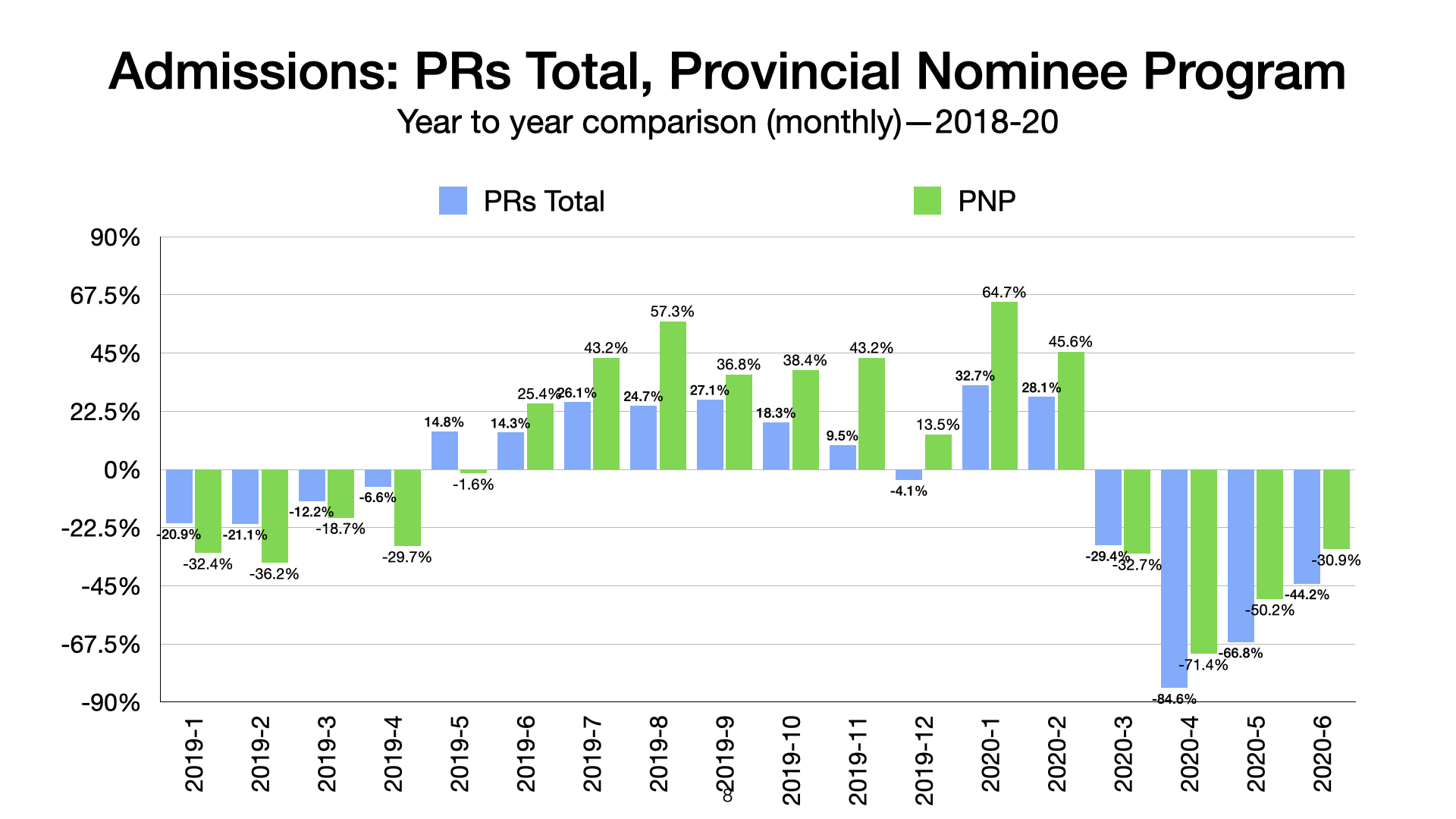
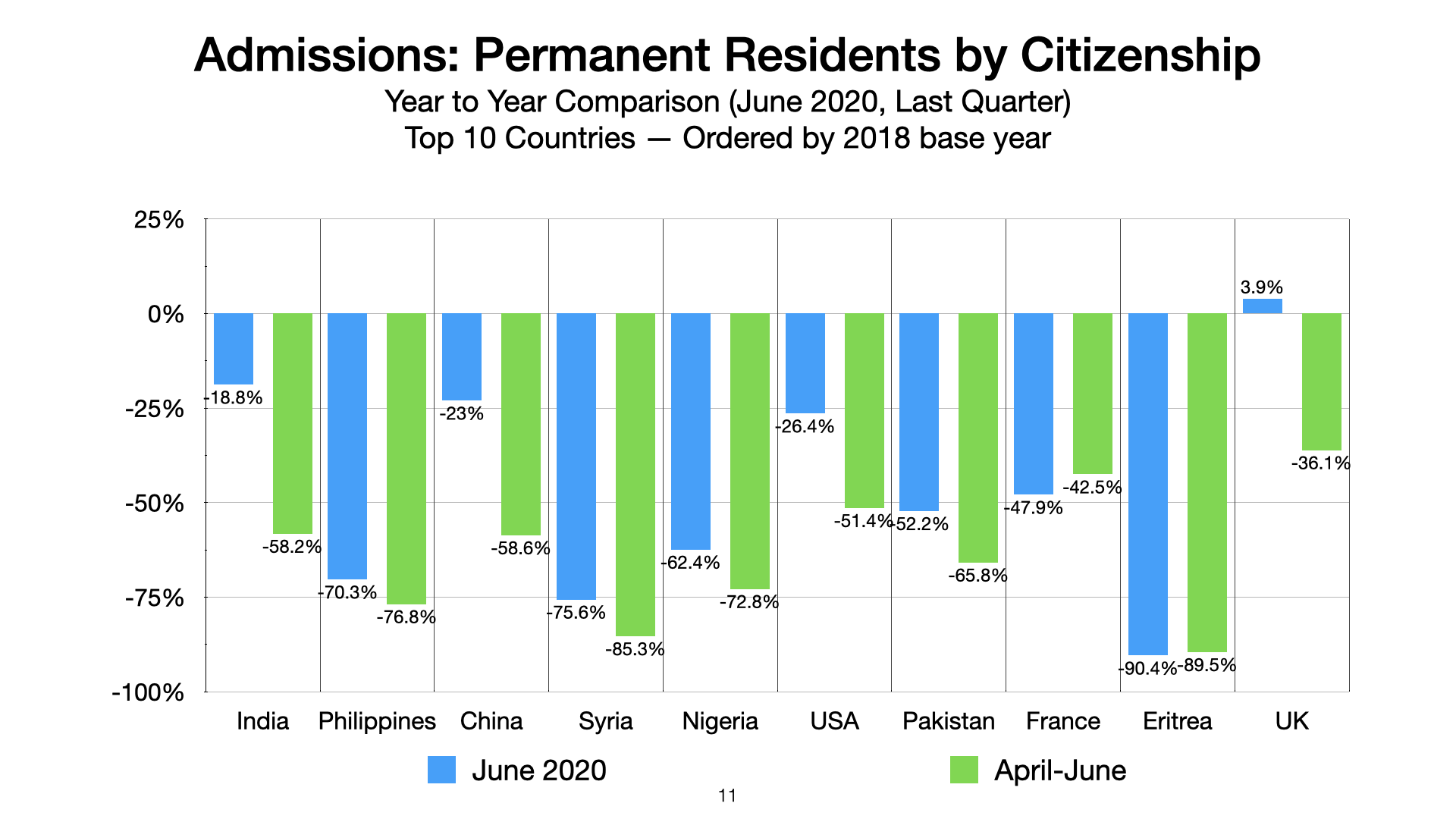
Not much new, but still a reckoning for Canada. The charts below show the year over year for immigrants (economic, family and refugees) as well as the subset coming under the various Provincial Nominee Programs, along with the top 10 countries:

A slowdown of immigration to Canada due to the COVID-19 pandemic threatens to derail a major source of economic and labour force growth, according to a report from the Royal Bank of Canada.

The shortfall jeopardizes the ability of the country to find employees needed in sectors such as health and elder care as the baby boom generation moves into retirement over the next few years, the report says.

It calls on the federal government to find new ways to encourage more immigrants to move to Canada.

“Canada does rely on having large numbers of people coming to the country to fuel growth and, if we see these large declines, one concern could be that people may decide maybe they don’t want to come to Canada anymore,” said report author Andrew Agopsowicz, a senior economist for RBC who studies labour trends.

“I think it’s really important for Canada to ensure the process is clear and that we still put out this attitude that we are open and we want people from the rest of the world to come to our country.”

Canada added 34,000 permanent residents in the second quarter, down 67 per cent from the same period last year, the RBC study said.

Meanwhile, new permanent residency applications to Canada were down 80 per cent and just over 10,000 new study permits were processed, down from 107,000 a year earlier.

Despite a recent recovery in the pace of immigration, the bank expects to see only 70 per cent of the originally targeted 341,000 new permanent residents at the end of the year, a decline of about 100,000 people.

The shortfall is particularly bad news for elder care as labour shortages have gotten worse in the wake of the pandemic’s deadly sweep through the country’s nursing homes, said Dr. Samir Sinha, director of health policy research at the National Institute on Ageing at Ryerson University and director of geriatrics at Mount Sinai Hospital.

“We’ve been having a huge struggle finding workers and retaining workers in this sector for years … and we were only keeping it afloat by often recruiting immigrants who are willing to take on these jobs that we as Canadians didn’t want to do,” he said.

“The fact it’s low paid and not valued also speaks to one of the reasons it’s been incredibly hard retaining (staff).”

Sinha said higher wages are needed not only to recruit Canadian-born workers but also to keep ambitious immigrants on the job longer.

Canada’s ability to attract immigrants with meaningful work as the economy struggles to rebound from the pandemic may be difficult.

A Statistics Canada report published Thursday finds that recent immigrants were harder hit by pandemic-related job losses, with 17 per cent becoming unemployed from March to April compared with 13.5 per cent of workers who are Canadian-born or immigrants who have been in Canada more than 10 years.

The percentage was higher, almost 20 per cent, for recent female immigrants.

The difference is significant, said Statistics Canada analyst Feng Hou, adding it is attributed mostly to recent immigrants having less work experience and earning lower wages.

“From past experience, when immigrants come during hard times, they tend to have a hard time finding jobs,” he said, adding there’s no data as yet to tell if that will happen in the current environment.

Travel restrictions that began in March and continue today make it difficult for people to physically come to Canada, Agopsowicz said.

At the same time, the lockdowns in the early days of the pandemic slowed processing of applications in Canada and prevented potential immigrants from accessing programs to ease application in their home countries.

An unknown is whether the COVID-19 virus, which hits senior citizens hardest, will have a dampening affect on the desire of foreigners to come to Canada and leave behind their vulnerable elderly relatives, Agopsowicz said.

“There’s a lot of uncertainty, I think, when people arrive already during normal times, so I think people are starting to work through what that means,” he said.

“This may be somewhat of a lost year (but) is this going to be easy to recover from next year in terms of bringing increased numbers back?”

Only about 20 per cent of new permanent residents are former students or temporary workers, he pointed out, suggesting Ottawa could do more to try to convince those people to permanently reside in Canada to bolster numbers.

Source: RBC report says immigration slowdown due to COVID-19 threatens Canadian economy

Canada immigration intake expected to fall by half due to COVID-19

RBC report is getting some well-deserved attention. Will have better sense of likely numbers once we have a few months data but estimates appear reasonable, as well as regions and programs more affected:

Canada’s annual immigration intake is expected to decline in 2020 by half from last year’s levels as a result of the global pandemic, raising concerns over the impact on the country’s newcomer-fuelled economy.

Canada welcomed 341,000 permanent residents in 2019 and was set to usher in another 370,000 this year, but that number is forecast to be down by as many as 170,000, according to a RBC report released Friday.

First-quarter immigration data on arrivals all indicated drastic decreases in the number of permanent residents, migrant workers and international students.

“The disruption will reverberate across the economy, given our reliance on immigration for labour-force growth and to offset Canada’s aging demographic,” warned the analysis by RBC senior economist Andrew Agopsowicz.

“Among the potential casualties: industries with labour shortages, urban rental and housing markets, and university budgets. Canada will need a younger and growing population to maintain growth and support the unprecedented expansion of the fiscal deficit that came in response to the crisis.”

In March, Ottawa had set a target to bring in 370,000 new permanent residents this year, up from 341,000 in 2019. Just days after the announcement, concerns about the spread of COVID-19 prompted the federal government to impose travel restrictions.

Although these health and safety measures only started in Canada in mid-March, the impacts of the pandemic on immigration had already been felt in other parts of the world, resulting in the disruption of visa services and travels.

These early immigration numbers may be an indication of what is to come as the global pandemic is expected to last through at least this fall, if not longer:

  • Permanent resident entries were down 30 per cent in March versus a year earlier.
  • Temporary foreign worker admission in the agricultural sector fell 45 per cent in March from a year earlier.
  • The number of students entering on study visas fell 45 per cent in March from a year earlier.

“If these restrictions last all summer, we expect to see 170,000 fewer permanent residents entering the country in 2020 than planned — all in a year in which Canada was supposed to welcome a record number of newcomers,” said the report.

“While temporary foreign workers are exempt from entry restrictions, fewer are coming. The overall number of TFWs entering Canada in March was down 35 per cent versus the same month last year. In the agriculture sector — where they represent a key source of labour — the drop was an even sharper 45 per cent.”

Agopsowicz cautioned that Canada’s international education sector is also taking a huge hit, with fall enrolments expected to be down sharply amid travel restrictions and a broad, possibly permanent shift to remote learning.

In 2018 alone, international students pumped $21.6 billion into schools, communities and the broader Canadian economy.

At University of Toronto, for instance, international enrolments has doubled since 2010 to 25 per cent of the student body. If just one-fifth of its foreign students opt not to study in Canada this year, said the report, it could mean a shortfall of around $200 million on a $3 billion budget.

“That reduction could also hurt the small businesses and landlords who depend on these students for revenue,” it said. “A decline in foreign students could also affect what’s been an important source of new permanent residents.”

Canada’s immigration selection system has increasingly favoured international students, with their Canadian academic credentials and work experience. In 2019, some 11,000 new permanent residents had previously studied in Canada.

Last year, Canada’s population grew by 1.6 per cent or 580,000 people, with immigrants accounting for more than 80 per cent of the growth, said the report. While 30 per cent of the overall population is at least 55, only 8 per cent of immigrants are.

“Even before the pandemic, Canada relied on immigration to offset the fiscal challenge posed by an aging population,” the report noted. “With the tab of fighting COVID-19 already nearing $160 billion, Canada needs a growing labour force more than ever.”

Source: Canada immigration intake expected to fall by half due to COVID-19

Differences of Opinion: How Canadian and US business leaders think about gender diversity

RBC continues to do interesting research and reports on diversity issues. This Canada-United States comparison being the most recent example (and it challenges Canadian smugness about our diversity policies in the corporate sector). These two charts are particularly revealing, report recommendations follow:

1. Be aware that diversity mandates can backfire.

Surprisingly, mandatory diversity training can often have the opposite effect, increasing bias rather than eliminating it. Research over several decades has shown that corporate leaders and managers are less motivated to increase diversity if they are forced to do so. In one study, Harvard Business Review researchers who analyzed data from hundreds of US firms found that “companies get better results when they ease up on the control tactics.”

Similarly, national policies that promote gender parity, diversity, and gay rights may be viewed as controlling or policing people’s personal opinions and actions. Equal opportunity or pro-diversity legislation may make organizations “check the boxes” to advertise their compliance with the requirements, but may also make them less likely to make practical efforts to reduce gender or other types of discrimination. Rather, engaging leaders and managers to become advocates for change is more effective. Voluntary training to raise awareness, along with mentoring and coaching efforts, participation in task forces or councils, or leadership of affinity groups, works best.

2. Try more innovative solutions.

The most appropriate measures vary across industries and firms, and a decision not to adopt any specific approach cannot be interpreted as a failure. Still, our study shows that companies in both the US and Canada are using only a subset of all the potential strategies. Canadian companies tend to take fewer risks and are less likely to try innovative solutions than their US counterparts. Solutions that have been adopted less frequently in Canada than in the US may provide ideas for further action by Canadian firms. They include:

  • Job auctions or trial hiring (37% vs 43%)
  • On-the-job development activities that provide opportunities to generate business impacts (38% vs 44%)
  • Support for working parents (34% vs 43%)
  • Flex time (48% vs 52%), part-time (31% vs 35%) and childcare subsidies (27% vs 31%)
  • Assessing performance relative to gender diversity targets (37% vs 44%)

3. Build a strong business case for women in senior management.

“Fundamentally, having a workforce and a senior management team that represents the clients and communities an organization serves is both an asset and a competitive advantage,” says Jennifer Tory, Chief Administrative Officer at RBC. “Diversity of gender, thought, and background creates inclusive teams that generate better ideas and solutions. Inclusive teams are strong teams, and strong teams make better business decisions.”

4. Invest in retraining and reintegrating women into the workplace.

One of the biggest challenges in both the US and Canada is the issue of parental leave and how it affects women’s careers. The two countries differ markedly with respect to national policies. In the US, women who take maternity leave do not receive guaranteed payments from the federal government. The Family and Medical Leave Act protects their job for up to 12 weeks; some individual companies and states may offer more generous policies or a short-term disability policy that pays women during their leave of absence. By contrast, Canada is far more generous; its mandated 12-month parental leave is expected to stretch to 18 months in 2018.

In a way, that could “create unintended consequences” for women’s advancement in Canada, says the University of Toronto’s Dart. She notes that although both parents can share the leave, men are often reluctant to take time off. “In many Scandinavian countries paternity and maternity leave are mandatory. Both men and women leave the workplace for a time when they have children, so there is less of an opportunity for gender bias. It has to be mandatory. You have to make it an equal playing field.”

In Canada and other countries where equal parental leave is not mandated, being away from the job for so long could be detrimental to women’s careers, she adds. “Women step out, often because of family pressure, and find it very difficult if they want to come back later on. They have lost their professional networks and they don’t know if their skills are up-to-date. Many companies don’t actively work on bringing women back to work; it is easier to advance the women who have stuck it out.”

5. Make a concerted effort to change societal perceptions.

Here’s where male role models, influencers, pressure groups, and governments play a big part. “With regard to progressing in their career, women are working really hard, but they need networks and sponsorship much earlier in their career,” says Jennifer Reynolds, CEO of the Toronto Financial Services Alliance (TFSA), a public-private partnership that supports the financial services industry. “We need to actively challenge senior management on that, and we have to have men in this dialogue.”

Dart advocates going even further. “There is a very large gap in the middle part of the pipeline,” she says. “There’s always more commitment that we need to see in senior leaders. We need more CEOs and board chairs to advance their support of women. But this battle is not lost at the corporate front. This battle is lost at the home front. The expectations of women, the roles they are supposed to play, are different in different cultures. That’s where we need to start: changing role expectations.”

Source: Download Here

Promoting diversity and inclusion, and how to tell the difference: RBC Neil McLaughlin

McLaughlin, head of personal and commercial banking for the Royal Bank of Canada, on how to leverage and benefit from diversity:

Canada is one of the world’s most diverse countries. Business gets it.

Diversity and inclusion are part of our values. They’re critical to the future prosperity of our country. They’re a business imperative and key for growth and innovation.

We know this. So what are we doing about it?

That’s a growing challenge for Canadian businesses as we come to grips with twin revolutions in the technology we use and the society we serve.

This summer, Royal Bank of Canada (RBC) and the Institute for Canadian Citizenship surveyed 64 leading organizations – from hospitals to technology firms – that collectively employ 1.2 million Canadians to ask them about diversity and inclusion: how they define it, how they go about promoting it and how they measure it.

The survey results will be released at the 6 Degrees Conference in Toronto on Sept. 26, and the findings are both encouraging and concerning. Canadian business gets diversity, but we’re struggling with inclusion – an imprecise and ambiguous word that most employers don’t know how to approach. Diversity is often considered to be what we see. It’s a fact. Inclusion is what we hear – how we value, respect and involve everyone. It’s a choice.

Nearly 90 per cent of organizations in the survey strongly believe diverse and inclusive teams make better decisions. And, as we deal with whipsaw changes in the digital revolution, we realize we need more diverse perspectives than ever.

Here’s the rub. Where the majority of organizations see themselves as diverse, and go to great lengths to foster diversity, few have found a way to come to grips with inclusion strategically.

The numbers tell the story: 65 per cent strongly agree that leveraging diversity is fundamental to organizational performance, but only 10 per cent say they’re taking full advantage of a diverse work force. Only 20 per cent tie diversity and inclusion results to performance objectives and only 10 per cent measure the effects of diversity and inclusion on innovation.

In roundtables across the country, we heard shared concerns from different and diverse companies. A mining giant saw attracting more women as an answer to the problem of an aging work force – and then realized at its mine sites it didn’t have goggles or helmets that fit them properly. A state-of-the-art hospital in a low-income neighbourhood discovered that many of the residents its serves view it as the “castle on a hill” rather than a health-care partner or potential employer.

These firms recognized that while they’re surrounded by diversity, they’re not harnessing it and, therefore, are not moving at the pace of change of the communities around them. We all know we have more talent, more ideas, more passion, more perspectives than we use. In business, we’d call it a stranded asset.

When you consider that Canada accepts 300,000 immigrants annually, that one-fifth of Canadians are visible minorities and that 60 per cent of Canadian females between the ages of 25 and 64 have post-secondary degrees, the survey numbers tell us we need to do better. Add to that the fact global talent is highly mobile, and it’s clear: We need to do better now.

At RBC, we’ve seen incredible creativity and innovation through a co-op program, Amplify, that encourages students – two-thirds of whom were born outside Canada – to solve some of RBC’s most complex business challenges. We’re taking that diversity of thought and trying to leverage it for better business results. That’s inclusion.

It’s not about relying on the “smartest person in the room” but the talent of many. It’s about the whole being greater than the sum of the parts. As our Amplify program shows, a diverse group of engaged people is more likely to solve a challenge than a genius lone wolf. This diversity of thought is where you get innovation.

If we are to tackle challenges such as climate change and health care, we need to cultivate the talents of all our best minds. We need to see inclusion not as an employee-engagement tool, but a core part of corporate strategy and a way to build stronger communities.

So, how can Canadian employers leverage the country’s diversity to come up with new ways of thinking and working? Here are some ideas we heard in conversation with organizations across the country: Get the strategy group to make diversity and inclusion their own priority. Adopt innovation metrics to see how inclusion is paying off. Make it a central part of every leadership discussion. Promote a questioning culture, to engage the minds of the many, not just those who think they’ve got it figured out. Measure, measure, measure. Compensate accordingly. Repeat.

Canadian business gets it. Now we need to act on it.

Source: Promoting diversity and inclusion, and how to tell the difference – The Globe and Mail