Fighting for more diversity at the top: Hepburn

More on DiverseCity onBoard:

And the latest Annual Report Card by the Canadian Board Diversity Council shows the proportion of visible minorities on corporate boards fell from 5.3 per cent in 2010 to 2 per cent in 2013.

So why isn’t there widespread outrage over these troubling statistics? Why do our leaders, especially in public agencies, tolerate such situations?

Is it a question of a lack of talent in minority communities, which is hard to believe? Or are we missing something here?

“We have to see more diversity at our decision-making tables,” Toronto Mayor John Tory admitted this week at an event showcasing a small program that identifies, trains and helps place talented ethnic and minority candidates with boards of public and voluntary agencies.

The event, attended by political, business and community leaders, marked the national launch of DiverseCity onBoard, a successful made-in-Toronto program that traces its roots back to 2005.

This unique project was started by the Maytree Foundation with the goal of addressing the lack of diversity on boards of directors at public agencies, boards and commissions in the GTA.

Operating without much fanfare, DiverseCity onBoard has recruited more than 1,700 candidates, registered 650 organizations and successfully matched some 720 people from visible minority groups and under-represented communities to boards of directors with such bodies as hospitals, museums, local agencies and voluntary community associations.

The program staffers pre-screen candidates, teach them about how governance boards operate, and try to match qualified people with board openings.

Indeed, the program is so successful that it’s now being launched in six other major cities across Canada, including Hamilton, London, Vancouver, Calgary, Montreal and Ottawa.

At the same time, the program is unveiling a new online training program that will let residents learn about corporate governance practices at home, at work or anywhere they have access to a computer.

If the program can succeed in Toronto, then there is little doubt it will work in these other urban centres, said Ratna Omidvar, executive director of the Global Diversity Exchange at Ryerson University, which now oversees the DiverseCity onBoard program.

Fighting for more diversity at the top: Hepburn | Toronto Star.
Program aims for greater ethnic diversity on boards

Good to see expansion of this program to improve diversity of public institution boards beyond Toronto:

This week Ms. Omidvar announced the national launch of a program aimed to break down the barriers of the old-boy network by identifying, training and selecting qualified board candidates who are also either immigrants or members of a visible minority group.

“Public institutions that are created to serve the public good make better decisions for their clients and customers if the boards are diverse,” Ms. Omidvar said. “We are going to close the gap between those who live in these cities and those who serve on these boards.”

The program is called DiverseCity onBoard, and it will expand from Toronto, where it has placed more than 700 candidates on boards over the past several years, to Montreal, Vancouver, Calgary, Ottawa, Hamilton and London. The program works by matching candidates with vacancies. If a board has an opening, the program looks to connect it with a suitable match, someone with the training and expertise they require who might never have come to their attention otherwise.

“When we did our research in Toronto we asked organizations, ‘Why is it that your board still looks like old Canada?’ They said, ‘We agree completely, we want to be more reflective of the community, but we don’t have the networks,’” Ms. Omidvar said. “By putting real-life candidates in front of them, we try to dispel that myth that, ‘Oh, we don’t know any body.’”

Program aims for greater ethnic diversity on boards – The Globe and Mail.

Changing the rules on immigration changes Canada’s narrative – Omidvar

Good commentary by Ratna Omidvar on some of the likely longer-term implications of Express Entry to the Canadian integration and citizenship model, and noting how the selection by employers of immigrants will reflect the same biases as Canadian recruiters:

Enter the Canadian employer who has a job at hand and has permission from the federal government to troll through this pool for a candidate because there is no one else in Canada who can fit the particular bill. The employer picks this one candidate from a pool of many, based on an assessment of the candidate’s profile which includes education, competencies, experience etc. A bit like a blind date, but not quite, because the employer knows where the applicant went to school, where he graduated and where he worked. And so the employer lands on Nigel, because Nigel appears to fit the bill. Whether the employer acknowledges this or not, the fact that Nigel happens to be from a jurisdiction similar to Canada’s, the fact that his mother tongue is likely English, plays a role in the selection. And so apparently does his name.

We know this from research on Australia’s express entry system on which Canada’s model is based. Two researchers, one in Melbourne and one in Waterloo, Ont., found that Australia screened in more immigrants who were strong English speakers. The researchers concluded that the reason express entry immigrants perform better in Australia appears to be because they are Anglophone and because the Australian work force, like Canada’s, is structured to favour the language proficient. Other research from Phil Oreopoulos and Diane Dechief of the University of Toronto, a study titled “Why do some employers prefer to interview Matthew, but not Samir?”, found that English-speaking employers in Montreal, Toronto and Vancouver are about 40 per cent more likely to choose to interview a job applicant with an English-sounding name than someone with an ethnic name, even if both candidates have identical education, skills and work histories.

Let’s get back to Nigel. We know from the evidence that someone like Nigel will hit the ground running and will contribute more quickly to our economy, his own independence and the needs of his employer. But after some time, let’s say six years, Nigel begins to consider whether he really wants to stay. After all, in his own country (likely the U.S., U.K., Australia or New Zealand), he has access to a relatively similar basket of public goods: good schools for his future children, relative peace, security, law and order, and public health care. He is now a citizen of both Canada and country X and so has the freedom of making a choice. Maybe he decides for Canada, and maybe not. If he decides for Canada, bully for us. But that option of returning for him and for his children is always there for him to exercise.

Now let’s get back to our young candidate from Bangladesh and let’s assume he is allowed to stay in Canada because of his Canadian education. He has a more difficult time finding the first job and struggles to get accepted. But over time, and primarily because he does have a Canadian degree, he finds a job and starts to settle in. When he becomes a Canadian citizen roughly five years later, there is not an attractive “return ticket.” The standard of living in Canada is far and away higher. He commits himself to this country fully. He marries, and has children, and if we are to follow trends from the past, his children go on to become successful students at university and join the professional world.

The question is: who serves our needs better, Nigel or Sarmad?

With one we get immediate success and the least amount of pain. With the other, we get long term attachment. The narrative of Canada’s success and exceptionalism in immigration has always been the narrative of success over time. While immigrants struggle in the short term, be it when they came from Eastern Europe in the early 1900s to settle the West or more recently from countries like India, China and Philippines to work in a variety of jobs, it is the long term that is their friend. They become citizens, buy homes, their children go on to become successful and in time many of these children find partners from other ethnicities and races to create a whole new Canada. To a large extent, the hardships they endured in the early years makes their ultimate success as Canadians that much sweeter. They acknowledge in many different ways that it is Canada that has made them successful. And so a new middle class is born in one of many, as Doug Saunders called them, “arrival cities” in Canada.

Changing the rules on immigration changes Canada’s narrative – The Globe and Mail.

Meet Toronto’s disenfranchised non-citizens

Further to my post on the declining number of immigrants taking up citizenship (Ottawa hiking citizenship fees for second time in a year | various), Myer Siemiatycki and Ratna Omidvar on how it plays out in Toronto and the links to poverty and precariousness:

Imagine a city the size of Halifax and then superimpose it onto the map of Toronto. Now imagine a wall surrounding that city state — a wall that divides its residents from the rest of the metropolis.

That’s perhaps the best way to think of the roughly 380,000 residents who live in Toronto who are without Canadian citizenship, says Myer Siemiatycki, professor of politics and the founding director of Ryerson University’s graduate program in immigration and settlement studies. And that number, from the 2006 Census, could be even higher today.

Some estimates suggest the number could be even higher if you include undocumented migrants, whose exact numbers are unknown. Some are foreign temporary workers; some are here on two-year work permits; some are live-in caregivers; many are permanent residents; others are refugee claimants. Some may one day achieve status or citizenship; others will remain underground eking out a living, always looking over their shoulder, perhaps not even able to speak English.

Critics say it’s a lost opportunity for them and for Toronto.

A deep divide separates non-citizens from most of the city’s residents, says Siemiatycki. They work here; pay property taxes; use the TTC. Their children go to school here; some use recreational facilities, community centres and libraries. But they are detached, disengaged, without a voice or a vote. Some are able to get only precarious or low-paying work. Many stay under the radar by working for cash and not paying taxes. Others live in constant fear of being deported. They pay for health care out of pocket.

“Imagine if you did not have papers,” says Ratna Omidvar, executive director of the Global Diversity Exchange at Ted Rogers School of Management at Ryerson University. “Imagine if you could only work for cash. Imagine if you were always in fear that someone would come and get you. Imagine you’re paying a premium for rent … of course they’re disengaged. They can’t not be disengaged.”

Meet Toronto’s disenfranchised non-citizens | Toronto Star.

Don’t cut social assistance for newcomers to Canada: Omidvar

Ratna Omidvar correctly calls out the Government on the omnibus budget bill provision allowing provinces to deny social assistance to refugee claimants:

Future citizenship is both policy and public philosophy. There is a clear and relatively quick pathway to citizenship for immigrants to Canada, although the waiting time is set to get longer in 2015. As for public philosophy, immigrant children learn in public schools from a young age that “you’re just as Canadian as anyone else.” Because this message is in our books and infused in our day-to-day, the idea that immigrants are future citizens actually becomes lived expression.

In the last of her Massey Lectures on citizenship, Adrienne Clarkson explains why the Canadian mindset works using the theory of Hans Vaihinger, who thought that to act “as if” something is true is a practical way to get there.

Because we treat newcomers as future citizens, serious investment is made in their health, well-being and skill level from the start, often regardless of immigration status. Canada has a robust settlement sector, we pay for language courses, we extend health care and social services to non-citizens, and some cities invite non-citizens to sit on local boards. The Canadian mindset is why our school boards and police services follow a “don’t ask, don’t tell” policy, so that status does not determine access to essential services. When we act as if newcomers are citizens, they truly are citizens in the making.

But this core trait that makes us work — and that’s exportable to countries like Germany where the citizenship laws are under revision — is being chipped away by policies introduced by this government. I alluded to one of these changes already: the coming increase in residence time from three to four years before applying for citizenship.

But there is another change buried in a thick new omnibus bill and it is far worse. It would allow provinces to restrict refugee claimants and others without permanent status from accessing social assistance by lifting a ban on minimum residency requirements — a ban that said we don’t care if you’ve been here for two years or 24 hours, if you’re a refugee claimant or other temporary resident, you will be treated humanely. In the worst-case scenario if this law is passed, people without permanent status would lose social assistance, which for some is their only source of income.

Don’t cut social assistance for newcomers to Canada | Toronto Star.

Interview with Ratna Omidvar – Flight and Freedom

Good interview between Dana Wagner and Ratna Omidvar on their forthcoming book, Flight and Freedom, recounting the experiences and personal stories on refugees taking refuge in Canada:

Dana: You’re describing something that’s very intimate, because you and your husband fled Iran in 1981 as refugees. What do you want Canadians to know about the experience of flight?

Ratna: Yes, these stories are close to my heart. My husband and I made our own escape from Iran when it became clear our lives were not safe under Tehran’s new rulers. We couldn’t raise a family the way we wanted, and war with Iraq threatened to call my husband to the frontline. So we boarded a bus to Turkey with our young daughter, found our way to Germany, and ultimately decided on Canada. Our escape does not approach the danger and hardship so many others face fleeing countries worldwide including Iran. But a few of the most vivid moments of my life occurred on that journey. One was in a cold customs room at the border crossing with Turkey, when our future was uncertain. Forward, or back? What punishment would we face for attempted escape? The second was in a plane, over a vast land of forests broken by silver lakes. In Canadian skies, I began to breathe again.

This glimpse of the terror involved in escape, and the unparalleled exhilaration of freedom, does not fade fast. It’s in everything, a permanent imprint behind my eyelids. There has been a deep link for me between the personal and the professional from my family’s experience. I embraced this country, and because of what it gave me – its protection and opportunities – I will always strive to change it for the better. After a time, I gave myself license to start rearranging the furniture in my new home. The desire to thrive and to give back is palpable in refugees who come to Canada. We think of refugees taking and needing, but they enrich our communities in incredible ways.

Well worth reading the complete interview as well as checking out their site, Flight and Freedom.

Interview with Ratna Omidvar – Flight and Freedom.

Maytree New Ryerson-Maytree initiative set to advance the inclusion of immigrants and visible minorities » Maytree

Should provide further leadership on diversity and inclusion issues:

The initiative will be housed at the Ted Rogers School of Management’s Diversity Institute at Ryerson University and led by Ratna Omidvar as its founding Executive Director who will be relocating to Ryerson. It builds on the long-standing relationship between Maytree and Ryerson, including its research partnerships on the DiverseCity and DiversityLeads projects.

Under Ratna’s leadership, the Ryerson Maytree Global Diversity Exchange will develop a program of academic and applied research, identify evidence-based leading practices and promote policy and solutions that strengthen the case for diversity and inclusion.

In addition, it will become the new home for a suite of successful Maytree programs: Cities of Migration, DiverseCity onBoard, the Flight and Freedom book project and hireimmigrants.

Cities of Migration and DiverseCity onBoard have had impact both in Canada and abroad. Flight and Freedom, due for publication in 2015, will tell the stories of Canadians who have fled their home countries, often under threatening conditions, to find their way to Canada. The book will highlight the contributions they have made to their new country. Hireimmigrants has a solid track record of working with Canadian employers to enhance their skills in attracting, employing and retaining skilled immigrants.

Maytree New Ryerson-Maytree initiative set to advance the inclusion of immigrants and visible minorities » Maytree.

Don’t throw the nanny out with the bathwater – Omidvar

Ratna Omidvar of Maytree on the live-in caregiver program, and the need for more regulation and regularization of status to address the Government’s confer over abuse:

But she (the caregiver) bears costs in the interim. She must live in someone else’s home, loving and caring for another family while missing her own. The hours of work are long and isolating. We acknowledge these costs by offering permanent residency.

There are other costs we don’t acknowledge: Exploitation, in the form of unpaid overtime, psychological or physical abuse. In theory, she can report it, but won’t because it could jeopardize her becoming a Canadian as fast as she can.

This abuse is the cost of temporary status. If a conditional form of permanent resident status was offered on arrival, it would serve the needs of both employers and caregivers. The current system basically sanctions conditions of potential abuse against a reward of permanence.

Don’t throw the nanny out with the bathwater – The Globe and Mail.

Maytree Flight and Freedom: Stories of Escape to Canada

Maytree’s newest project, writing a collection of refugee stories:

What does escape look like up close? Why do people choose Canada? And once they land in a safe country, what happens next?

In Flight and Freedom, Maytree’s Ratna Omidvar and Dana Wagner draw on 30 astonishing interviews with refugees to Canada to document their extraordinary journeys of flight, and to transform a misunderstood group into familiar, human stories.

Each of the 30 stories documents an escape that is sometimes harrowing and always remarkable. The narrative then turns to contemporary lives and careers, and the impact of refugees-turned-Canadians in the communities they call home, from Halifax to Vancouver.

Stories focus on Canadians who arrived as refugees from notable conflicts around the world, from the War of 1812 to the ongoing War in Afghanistan. Beyond conflict zones, other stories profile people from persecuted groups like gay men and women. At the time of escape, some refugees were children, others were parents, and others got out alone. Notwithstanding the diverse events of a story, the single overriding imperative for all characters can be summed up in one sentence: “We have to run.”

Closing the book is a question: Would they get in to Canada today? Peter Showler, lawyer and former chairperson of the federal Immigration and Refugee Board, answers the hypothetical question by analyzing how the cases would be handled under Canada’s new refugee system.

You can sign up for updates (book out in 2015) at the link below:

Maytree Flight and Freedom: Stories of Escape to Canada » Maytree.

Maytree Lessons for and from Toronto » Maytree

open-uri20140701-27920-t13my

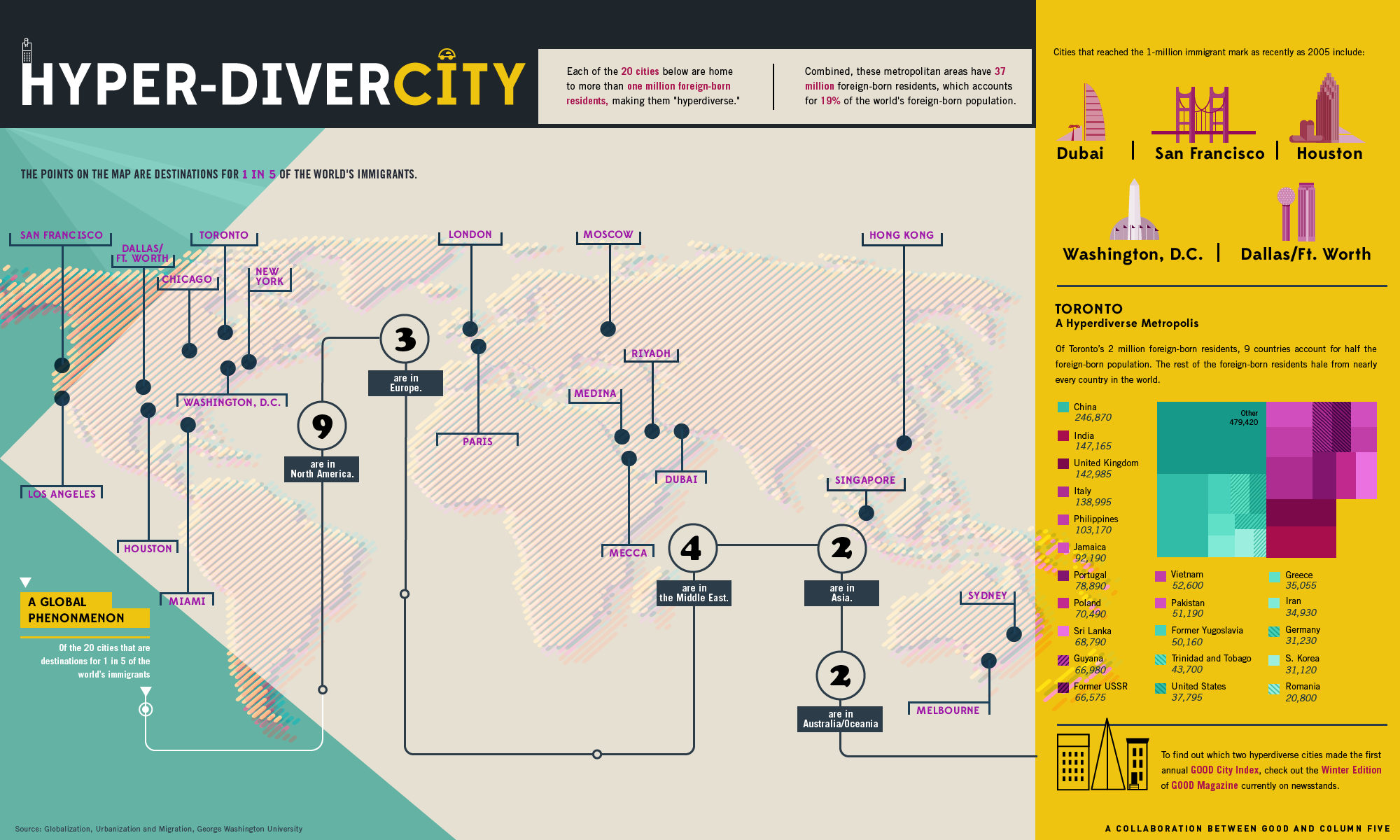
Graphic from Good Magazine

Ratna Omidvar’s report of the recent Cities of Migration Berlin conference. Worth reading:

For all the self-criticism that we Torontonians like to inflict on ourselves, we secretly know that our city is admired all over the world as a place that works well with its diversity. But lest we feel too smug, let’s remember that world leaders don’t keep their titles without continuous learning and innovation. They should, in the words of Hamburg Mayor Olaf Scholz, “Oppose the idea that there’s nothing to change any more.”

At the international Cities of Migration conference in Berlin convened by Maytree in June, practitioners, policy makers and private sector leaders shared lessons on good practice in immigrant inclusion from their own cities: Helsinki, Nashville, Tokyo, Lisbon, Auckland, Sao Paulo, Athens, and many more. From this global hub in Berlin come many ideas for and a few from Toronto.

One of the founding principles of Maytree’s Cities of Migration project is that good ideas can travel. That a smart policy working in Seattle can be tweaked to also work in Halifax. That a successful initiative from San Francisco can be replicated in London. This is because cities are often better placed to address immediate needs that are local in nature, such as employment, home ownership, success in school, and neighbourhood inclusion. As Khalid Koser of the Geneva Centre for Security Policy said in his keynote, “While states are building walls, cities are building bridges.”

Maytree Lessons for and from Toronto » Maytree.