Heintzman and MacQuarrie: Dialogue on public service more important than ever

Of note:

Given the state of the world these days, the recent announcement by Clerk of the Privy Council John Hannaford creating a “task team” of deputy ministers on the values and ethics of public service may seem frivolous. 

But we believe the clerk’s initiative is significant with the potential to influence the quality of our democracy for a generation.  

Canada’s public service is an important national institution, one of the key pillars of our parliamentary democracy. As we watch the erosion of democratic institutions elsewhere, the condition of our federal public service, and the quality of its democratic vocation, should concern all of us.

The clerk’s initiative recognizes that recent events show the federal public service faces some major performance challenges that call for a new effort of renewal. To make wise choices for renewal, you must know who you are, what a public service is for, and what it should be. Without this conscious awareness, a public service can easily fall short of its distinct standards of professionalism and service

The clerk’s initiative recognizes that recent events show the federal public service faces some major performance challenges that call for a new effort of renewal. To make wise choices for renewal, you must know who you are, what a public service is for, and what it should be. Without this conscious awareness, a public service can easily fall short of its distinct standards of professionalism and service.

Hannaford’s announcement comes exactly 30 years after the creation of a celebrated task force on public service and ethics under the leadership of John Tait, the former federal deputy minister of justice. The “Tait Report” set the agenda for public service values and ethics for a generation.

But times change. Every decade brings its own issues which challenge a public service to rediscover its distinctive identity as a “compass” (the clerk’s word) to guide direction for the future. He has asked the new task team to lead a “broad conversation” on how to bring the public service’s values and ethics “to life within a dynamic and increasingly complex environment.”

We think there are three conditions for the team’s success.

First, the “conversations” with public servants and others must take the form of what the Tait Report called “honest dialogue” about problems like these, among other things:

  • Performance: the federal public service has recently lost its reputation for providing timely, citizen-centred service to Canadians;
  • Trust: the civil service no longer enjoys the automatic trust and legitimacy that is essential to our democracy;
  • Boundaries: the public service has not yet acquired or sought the tools for drawing a line between the values and accountability of elected and non-elected officials, as recommended by the Gomery Report and others;
  • Accountability: public service leaders do not appear to take accountability for their own shortcomings, including the enormous expansion of the public service over the last decade and declining efficiency, and; 
  • Technology: the civil service has notoriously mismanaged implementation of digital technology, and has not yet brought public service values seriously to bear on public servants’ use of social media and artificial intelligence.

These are the kinds of real problems the task team’s “conversations” with public servants and others should openly confront if its work is to have legitimacy. 

Second, this dialogue should not be rushed. Nothing will be accomplished by simply repeating the public service’s stated core values. To recover their motivating power and urgency, public service values must reemerge from honest dialogue, modelled by the task team itself, about the problems at hand.

Third, the “conversation” must go beyond the public service to include parliamentarians. This is the unfinished business from the Tait Report. Tait recommended a dialogue about public service values should engage ministers and MPs, leading to a new “moral contract between the public service, government and Parliament of Canada.” The state of the federal public service is not just a concern for the government of the day. The quality and honesty of its advice and its ability to deliver programs and service efficiently and effectively are important to us all.

The current federal political context makes this kind of dialogue—about the kind of public service we need to support our parliamentary democracy—more urgent than ever. Now is the time. And the Clerk of the Privy Council has just set the table.

Ralph Heintzman and Catherine MacQuarrie are former senior public servants, and both served as head of the federal government’s Office of Public Service Values and Ethics.
Source: Dialogue on public service more important than ever

Terry Beech’s tall order: revamping service delivery

Count me among the sceptics on this one. My experience with Service Canada 2004-7 and efforts to implement a citizen-centred approach ran into resistance from the policy hierarchy and its original vision of being a one stop shop shrunk into remaining service delivery of ESDC services. The one non ESDC service, passports, was poorly managed by the policy centre, IRCC, and ESDC service delivery, with the large backlogs when predicted travel resumes.

Given the complex nature of government responsibilities and accountabilities, not to mention the concrete challenges in any modernization effort, I wouldn’t expect any significant results before the election:

Terry Beech claims his new job as Canada’s first ever minister of citizens’ services shows the government means it this time. Delivering services to Canadians is a longstanding weakness of government, and he says a big problem is that politicians have had little interest in it.  

“I think first and foremost, we just haven’t focused enough of our attention and time on it,” Beech said in an interview.  

“This is an opportunity for us to better understand all the systemic challenges that exist, but also to say our government and prime minister is committed to high-quality service delivery. We are so committed, in fact, that we are setting up a new ministry.” 

Service delivery has been an Achilles heel of government for 30 years. It’s why Service Canada – which Beech is now responsible for – was created as a one-stop shop for all government services to focus on delivery and citizen satisfaction.    

Service has always taken a back seat to policy. Prime ministers, ministers and even deputy ministers pay little attention until a crisis hits. That approach was on full display as Canadians eased out of the pandemic and faced shambolic lineups for passports, immigration and air travel.   

Beech acknowledges cabinet ministers haven’t kept a close enough eye on the “end-to-end customer experience.” Cabinet puts all its effort into making policy decisions and assumes they will be implemented and delivered the best way possible.  

As minister, he will make sure delivery will be part of policy discussions from the start. That way, ministers will have a better handle on what government does well and what it doesn’t, which will reduce snags or setbacks when services are rolled out.  

“Without cabinet ministers having an eye to potential constraints or opportunities to provide exceptional levels of service, those opportunities get missed. Now those opportunities will be front and centre in the discussion.”  

Beech founded the company HiretheWorld.com. He understands tech and is customer-oriented, and sees his new job as a natural fit. “This is really an entrepreneurial opportunity.”  

He said Canadians’ user experience is his priority, making sure their needs are first and at the centre of all services. (Critics have long argued departments tend to design services around what government does rather than what Canadian want.) 

And what do citizens want?  

Canadians live digitally when they shop and work and expect the same when dealing with their governments. They want single IDs, digitally issued permits, applications, approvals and information. And they want it fast on their personal devices, 24/7.  

They roil when they can’t get the same service ordering a passport as they do when buying from Amazon. Why can’t government track Canadians’ interactions with departments and use that information to improve or customize services?  

Beech wants to do all that and more.  

“My number one priority probably goes back to my vision for this role, which is waking up every day thinking about how I can improve customer service and the customer service experience for every Canadian,” he said. “That’s literally what’s going to be on the piece of paper that I pull out of my desk every morning and think about as I go into every meeting,” he said.   

Waiting to see 

All this should be music to the ears of critics who have long pressed for government to put the customer back into service and bring it into the digital age.  

So far, reaction is mixed. Public servants are waiting to see what levers and authority Beech will have. The pieces of this new portfolio have started to come together, but there are more to come, including ministers’ mandate letters. 

Service Canada opened in 2005 with the vision of a one-stop shop for all government services. It is housed at Employment and Social Development Canada (ESDC) and most of the services it offers are bundled around the benefits ESDC provides – EI, OAS, CPP and disability benefits.  

Service Canada also includes the team that runs Canada.ca, the government’s website and digital home. A new order-in-council transferred the Canadian Digital Service (CDS), a swat team of tech geeks, from Treasury Board to ESDC.  

A chief service czar with access to the government’s digital swat team, “could be a pretty big deal,” according to Aaron Snow, the former CEO at the digital service.  

But the devil will be in the details, tweeted Ryan Androsoff, founder and CEO of Think Digital, a consulting firm on digital transformation.  

“I think even the most well-intentioned person is being set up to fail if they don’t actually have the authority to make change across that entire service spectrum,” he said in an interview.  

It’s unclear whether Beech will have authority to direct departments, such as Canada Revenue Agency, Parks Canada or the Canada Border Services Agency, which also provides services. As services improve, Beech hopes other departments will want Service Canada to deliver its services.  

The growing fear among digital-government advocates is that CDS, created to help all departments improve their services, will move to ESDC and die.  

The big question is whether CDS will remain independent and report to Beech or be folded into ESDC’s IT branch – which one IT expert called the most risk-averse and “slowest moving IT division of any department I know.” (Beech says ESDC is a department that jokes its archaic computer system is nearly old enough to collect old-age benefits and uses so much paper it has to be stored in the basement because it’s too heavy to be stored on the floors above.) 

Looks like 1998 

Ralph Heintzman, a former senior bureaucrat, said many of the problems with service delivery are the same as in 1998, when he first presented Treasury Board ministers with a plan for Service Canada.  

On top of disinterest among politicians and senior bureaucrats, there are all the systemic reasons – chronic underfunding, old technology systems that need replacing; outdated procurement, poor trained and disengaged staff, lack of planning and little accountability for poor service.  

The Service Canada rollout was billed as the single biggest operational reform in federal history. It was the first agency to cut across the government, creating much debate over how traditional ministerial accountability squares with the way government works – a conundrum that continues today. 

The Trudeau government took several stabs at fixing service delivery, including a ministerial task force to deal with fallout over passport delays. But the government is now in its third term with trust falling like a stone and Conservative leader Pierre Poilievre jumping on any botched service as another sign that government is broken. 

Former Treasury Board president Scott Brison took a big step to fix things when he pressed to have digital minister in his title and to have departments use technology to change the way government does business and serves Canadians.  

He pitched it as central to making government relevant and restoring Canadians’ confidence. He set up the Canadian Digital Service, modelled after a service in the U.S. The American service recruited top Silicon Valley talent and embedded its own start-up in government, known as 18F, to help improve services. 

Beech’s appointment also comes at a time when some Liberals feel the public service dropped the ball on service and let them down in executing their policies. Former top bureaucrat Janice Charette said in her annual report that the public service is focused on upping its game.  

“I know there were moments when the public service fell short of Canadians’ expectations on service. In these instances, we faced the situation humbly and adjusted how we did things to improve results. We remain steadfast in our commitment to learn from these experiences and continually improve how we deliver,” she wrote.

Ambition exceeded capacity 

Sahir Khan, executive vice-president at the University of Ottawa’s Institute of Fiscal Studies and Democracy, said the Liberals’ activist agenda was simply too ambitious for the capacity and capability of the public service.  

“The Liberals count on the state being able to deliver. The Harper government did not. It was trying to shrink the state, but a progressive ideology that enlarges the state depends on that state being able to deliver, and it is difficult to do.”   

Michael Wernick, a former clerk of the Privy Council Office and now Jarislowsky Chair in Public Sector Management at University of Ottawa, said the Liberals “lost their focus and traction on public service capability” and “if you don’t invest in capability, you can’t deliver.” 

But Androsoff worries the cultural and organizational changes needed to improve services, from the way it hires, recruits, manages and procures, are getting lost.   

The service conundrum is wound up in the way the government is organized, its structures and rules. It’s built on a Westminster principle of ministerial accountability, in which ministers are responsible for their departments, but policies and services straddle all departments.  

Some argue the heart of the passport fiasco is that the program is run by three departments with no one ultimately responsible.  

“You’ve got a bunch of very complex governance arrangements shared between a variety of actors across boundaries,” said Androsoff. “That situation makes it almost impossible to drive change. That’s the core structural piece that has to change if we really expect government to make dramatic progress on service delivery.”  

Many argue that Beech’s success could hinge on what kind of role Treasury Board takes under its new president, Anita Anand.   

Anand holds many of the cards. She oversees spending, has the chief information officer reporting to her and has all the policies governing digital and service, people management and information. Beech didn’t land a seat as a member or an alternate on the powerful Treasury Board cabinet committeethat Anand chairs.  

“She can be the gigantic rubber stamp of a cabinet committee or be air traffic control that keeps a third-term government out of trouble,” said Khan. “You’ve got to figure out which one you want to be. (Treasury Board) has all the tools, legislative and otherwise, to do it. It’s a matter of capacity and will.” 

Source: Terry Beech’s tall order: revamping service delivery

Noël: Quand les gouvernements trébuchent [call for policy and program modestly]

Echoes the calls by others but nevertheless important.

Money quote: “le gouvernement fédéral devrait probablement modérer ses ambitions dans ses propres sphères de compétence, en adoptant des objectifs plus réalistes en immigration par exemple, afin d’éviter les échecs récurrents de gestion.”

Je n’étais pas en avance, c’est vrai, mais au début juillet, tard en soirée, je faisais des réservations pour un séjour de camping à Terre-Neuve et en Nouvelle-Écosse. Les réservations pour le traversier entre les deux provinces, opéré par Marine Atlantique, une société d’État fédérale, se sont avérées plutôt simples, tout comme celles pour des parcs provinciaux dans chaque province. Mais pour réserver des sites au parc national du Gros-Morne et à celui des Hautes-Terres-du-Cap-Breton, c’était un peu plus stressant. Avant de pouvoir réserver, il fallait créer une « CléGC (Service de gestion des justificatifs du gouvernement du Canada) », avec un nom d’utilisateur (toutes les variantes de mon nom ont été refusées), un mot de passe, et des réponses à une panoplie de questions. Pas un obstacle majeur, mais un processus un peu lourd pour une si petite tâche. À Ottawa, les missions les plus simples semblent souvent devenir complexes.

Tout ne va pas mal au Canada. Une étude parue à la fin juin dans le Canadian Medical Association Journal montre que, pour les deux premières années de la pandémie, le pays s’est classé parmi les meilleurs pour le nombre de cas, le taux de vaccination et la mortalité excédentaire, avec un bilan économique somme toute satisfaisant. Au Canada, ce sont les provinces atlantiques et le Québec qui ont connu les plus faibles taux de mortalité excédentaire.

Mais quelque part sur l’interminable voie de sortie de la pandémie, le bilan du gouvernement fédéral s’est détérioré. Cafouillage dans l’émission des visas et des passeports, congestion dans les aéroports, délais inacceptables à l’assurance-emploi, accueil difficile des réfugiés, traitement déficient des dossiers d’immigration, les échecs semblent s’accumuler.

Tout ne va pas nécessairement mieux dans les provinces. Il y a même des domaines où les ratés sont habituels, voire pérennes. La gestion des soins de santé constitue un cas patent. Mais dans ce cas, c’est largement une question de ressources. En 2019-2020, les soins de santé représentaient 41,4 % des dépenses de portefeuilles des provinces, comparativement à 31 % en 1981-1982. La même année, la contribution fédérale, par le biais du Transfert canadien en matière de santé, était tombée à 22,4 %. Si les provinces ne font pas mieux en santé, c’est largement parce que d’une année à l’autre elles doivent faire plus avec moins.

Dans d’autres domaines, comme en environnement, il s’agit plus clairement d’un manque de volonté politique. Si le ministre de l’Environnement du Québec « avait les convictions, la volonté, le courage et l’autorité morale nécessaires pour relever le défi de l’urgence climatique », écrivait récemment le chroniqueur Michel David, François Legault ne l’aurait pas choisi pour ce poste.

Mais émettre des visas et des passeports, acheminer des prestations d’assurance-emploi, traiter des demandes à l’immigration ? Le gouvernement fédéral a sûrement les ressources pour accomplir ces tâches et il devrait même être capable de marquer des points dans des secteurs qu’il contrôle depuis toujours, qui sont visibles et significatifs pour les citoyens et ne demandent pas des ressources faramineuses. « Il ne fallait pas être un génie », déplorait récemment l’ancien greffier du Bureau du Conseil privé Paul Tellier, « pour prédire qu’il y aurait une hausse des demandes de passeport » au sortir de la pandémie.

M. Tellier attribue les difficultés du gouvernement Trudeau à la centralisation excessive de la gestion autour du premier ministre et à la méfiance qui en découle entre élus et fonctionnaires. D’autres auteurs blâment le jeu politique, qui amène les élus à négliger les conseils et les actions des fonctionnaires.

Plus plausible, à mon avis, est le constat de l’ancien haut fonctionnaire Ralph Heintzman selon lequel le gouvernement fédéral se désintéresse des services aux citoyens depuis au moins trente ans. Dans la fonction publique fédérale, le prestige est associé aux conseils et à la stratégie, pas à la gestion compétente des programmes en place. Une carrière ascendante se caractérise par des sauts rapides d’un ministère à l’autre, pour appliquer à des niveaux supérieurs des méthodes de gestion largement indifférenciées. Consacrer trop d’années à maîtriser un domaine d’intervention gouvernementale semble manifester un manque d’ambition. Les hauts fonctionnaires voient ainsi les choses de haut. Quant aux élus, ils préfèrent annoncer des programmes plutôt que de veiller à leur bon cheminement.

Mais pourquoi ces travers semblent-ils plus prononcés à Ottawa ? Pour le comprendre, il faut considérer le fonctionnement de la fédération canadienne. Un rapport récent de l’Institut sur la gouvernance rapporte les propos d’un haut fonctionnaire qui note que « nous ne sommes pas un pays cohésif. Nous sommes une grande fédération ». On pourrait interpréter ce constat comme un appel de plus à davantage de collaboration entre les ordres de gouvernement. Mais il semble plus juste d’y voir une caractéristique structurelle, une condition d’existence du Canada.

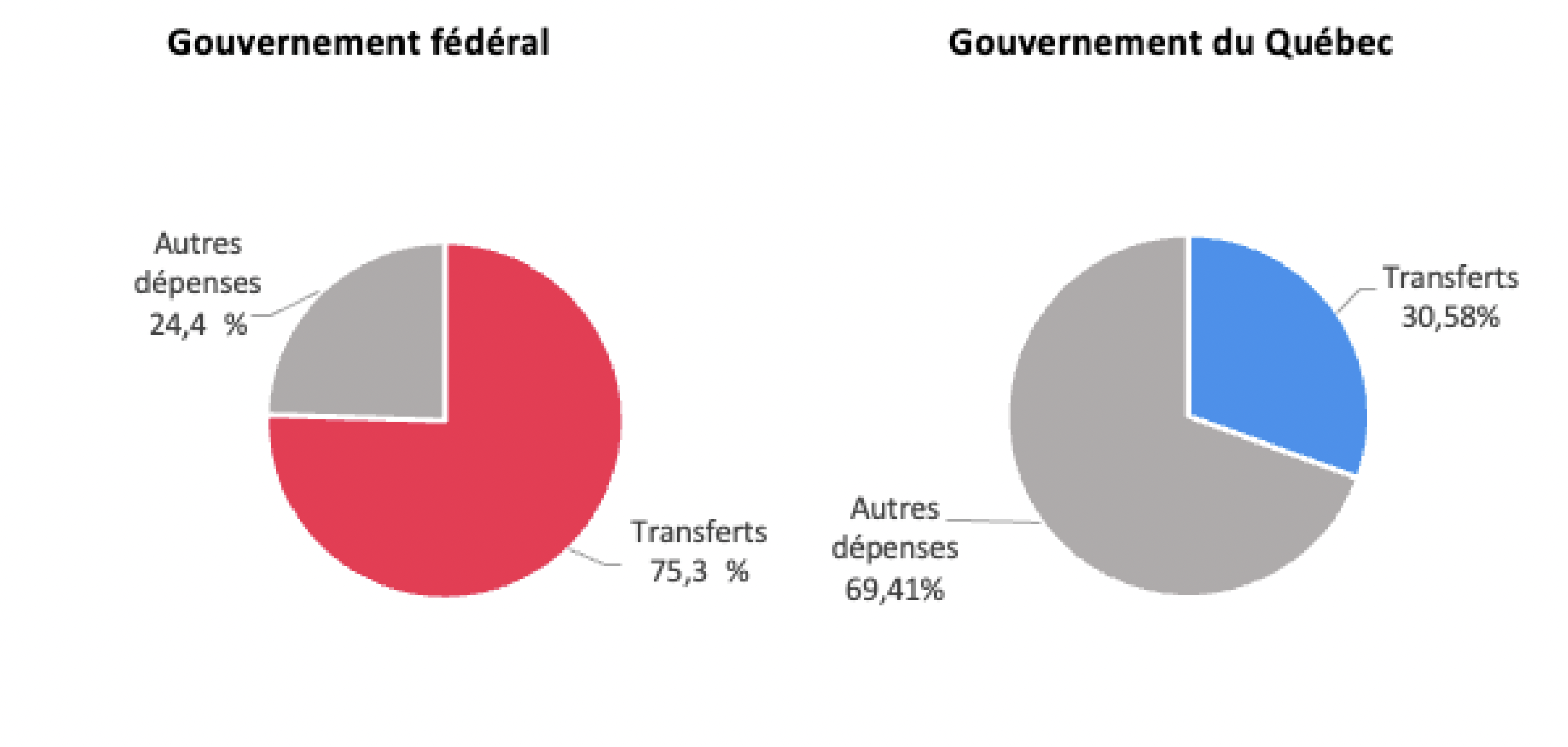
La figure 1 ci-dessous montre bien pourquoi la gestion quotidienne de services aux citoyens n’est pas le fort du gouvernement fédéral.

Figure 1 : Dépenses du gouvernement fédéral et du gouvernement du Québec, 2021Sources : Comptes publics du Canada ; Comptes publics du Québec

Le gouvernement fédéral est un animal particulier, plus habitué à émettre des transferts aux individus, aux entreprises et aux gouvernements, et à énoncer des normes associées à ces transferts, qu’à livrer des services à la population. L’année 2021 exagère un peu le trait, puisque la pandémie a engendré son lot de transferts exceptionnels. Mais la logique générale ne change pas. Il y a plus de vingt ans, le rapport de la Commission sur le déséquilibre fiscal faisait état de proportions assez semblables.

Les difficultés actuelles du gouvernement Trudeau ne sont donc pas si exceptionnelles. Le gouvernement fédéral demeure principalement une machine à récolter et à distribuer des ressources fiscales et il a tendance à se perdre quand il s’agit de gérer des programmes concrets.

La solution réside donc moins dans une réforme additionnelle de la fonction publique fédérale que dans une meilleure compréhension du fonctionnement de la fédération. En premier lieu, il faudrait améliorer l’équilibre fiscal en laissant davantage de ressources propres aux gouvernements provinciaux, dont la tâche principale consiste justement à livrer des services à la population.

Ensuite, pour des raisons évidentes, il conviendrait de prendre avec un grain de sel les volontés de leadership fédérales sur des questions de compétence provinciale. Notant dans une formulation bien à lui qu’en santé « ce n’est pas juste pitcher de l’argent vers le problème qui va le résoudre », M. Trudeau invitait récemment les provinces à des « conversations » afin de réduire les délais d’attente. Compte tenu de l’état de ses services, il devrait se garder une petite gêne.

En fait, le gouvernement fédéral devrait probablement modérer ses ambitions dans ses propres sphères de compétence, en adoptant des objectifs plus réalistes en immigration par exemple, afin d’éviter les échecs récurrents de gestion.

Mais les difficultés actuelles ne sont pas nouvelles, et elles ne se résorberont pas facilement.

Source: Quand les gouvernements trébuchent

My latest: Disconnect between political priorities and service delivery [focus on passports and immigration]

Article below as behind a paywall:

The disconnect between government commitments and its ability to deliver on targets and service levels has never been clearer as the immigration and passport backlogs attest.

Immigration Minister Sean Fraser indicated that the 2023-25 plan will likely include a target of 500,000 new permanent residents by the end of the plan. The number of temporary foreign workers will also increase significantly following relaxation of eligibility requirements (length of permits; increase in the cap allowed from 10 to 30 per cent; no longer refusing applications in low-wage occupations in regions with unemployment higher than six per cent), and the large number of Ukrainians arriving in Canada due to the war.

These current and planned increases are happening against the backdrop of large backlogs in permanent and temporary resident, citizenship and passport applications.

The resulting public and political outrage has prompted a mix of short-term measures, both symbolic such as the formation of a task force to improve government services as well as substantive, to alleviate applicant frustration (e.g., triage of passport applications, more online application tracking tools for immigration-related programs).

Why the disconnect?

Public service expert Ralph Heintzman focuses on the comparative neglect of service in relation to policy and program development (“poor cousin”) and how Service Canada never lived up to its promise to overturn that hierarchy in favour of citizen-centred service. As someone who has worked at Service Canada to implement that vision during the early days, we developed tools like score cards to maintain focus on service. Heintzman notes that departments do not focus on citizen and applicant satisfaction as current service failures illustrate.

Donald Savoie, a Canadian public administration expert, looks at the more fundamental issue of the relationship between the political and bureaucratic levels, and the need for the latter to have clear goals in order to implement effectively. The political level generally has conflicting goals, reflecting different stakeholder interests, and has a bias for the shiny and new, rather than program management, as any party platform will illustrate. Senior public servants are more akin to “courtiers,” rising through policy rather than service-delivery ranks, and have a “limited understanding of how best to help frontline managers deliver programs and public services.”

While his argument that government cannot be managed by using private-sector practices is valid at the policy level, I would argue that private-sector measurement and service practices are needed for the reasons outlined by Heintzman.

When service delivery is essential, as in the case of pandemic-related financial supports, the political and bureaucratic levels focus accordingly, and address the trade-off between speed of delivery and program integrity.

It is unclear the extent to which the public service advised the government that its focus on meeting its political objective of increased immigration would mean a surge in backlogs across programs, given reduced capacity during the pandemic.

The need for digitalization, modernization, and renewal of IT infrastructure was driven home during the pandemic. In the short-term, the IRCC has delivered online applications and updates for some programs. For the longer term, the challenges are greater, given the complexities of programs and government structures, the time involved and the need for effective management, as the Phoenix pay system debacle illustrates.

While the government is ultimately accountable, stakeholders, with some rare exceptions, bear some of the responsibility. Businesses complain about backlogs, but press for higher levels that exacerbate pressures, as do other levels of government, immigration lawyers, and consultants, settlement agencies, academics, and activists. While the general support for immigration across all these groups is laudable and exceptional compared to other countries, it also reveals an unhealthy group think that is unwilling to consider seriously trade-offs between addressing backlogs and increased levels.

Air Canada’s announcement that it is trimming capacity in order to ensure meeting their on-time performance service standards contrasts with the inability of the government to manage immigration and passport demand and related expectations. While I disagree with the government’s overall approach to increased immigration, a more responsible government would engage with stakeholders to explain the constraints and institute a partial and temporary reduction in immigration levels to reduce the backlog.

Politically, it is harder for governments to be open about service delivery issues than the private sector. However, being up front avoids the inevitable drip-drip of revelations of problems that result in greater public and media attention and prolonged controversies.

The challenge for the public service is to “provide stronger advice to the political level on the constraints and trade-offs inherent in public administration” on service delivery issues, always tricky to carry out in practice.

Canadians may not appreciate the abstraction of large numbers, but they do understand the many personal stories of those who are waiting for decisions, whether in passport lineups or applications in the system. As Heintzman, Savoie, and others have noted, government failure to deliver on services or communicate in advance of service delivery issues undermines overall trust in government.

Source: Disconnect between political priorities and service delivery

May: The Achilles heel of the federal public service gives out again with passport fiasco

Agree. Service delivery unfortunately the poor cousin compared to policy and program development. Previous governments missed opportunity with Service Canada to transform government around service delivery.

Valid risk concerns yet here we are again with service failures, driven in part by governments more interested in new policy and program initiatives, as our senior public servants most who rose through the ranks on their policy work:

Delivering services to Canadians has been an Achilles heel of the federal government for 30 years because of political disinterest and a senior management of “travelling salesmen,” who hop from job to job and barely know the business of the departments they lead, says the former senior bureaucrat who proposed the creation of Service Canada.

“You have deputy ministers and senior executives … who very rarely have deep experience and knowledge of departments, operations and services for which they’re responsible. They haven’t worked their way up in that department and are flying blind to a significant degree,” said Ralph Heintzman, who also launched the Institute for Citizen-Centred Service and the Public Sector Service Delivery Council.

This constant churn of executives moving in and out of jobs has created a public service with “little learning experience, no constancy of purpose or corporate memory.”  That makes it very hard for the government to “maintain a focus on service improvement or anything for a long period of time,” he said.

But Heintzman says those are foundational reasons for why service has never been given the attention it deserves. Then come all the operational problems: underfunding, old technology systems that never get replaced, poorly trained and disengaged employees, lack of planning and little accountability for poor service.

Passport and immigration backlogs with long lineups of frustrated and fuming Canadians at Service Canada offices across the country in recent weeks prompted the government to create a new ministerial task force to find ways to improve service.

The 10-member task force is expected to make recommendations outlining short and longer-term solutions that would reduce wait times, clear backlogs and improve the overall quality of services provided.

Big barriers to improving service are investment in technology and recruiting the right people. That’s money and, notably, the minister of finance is not a member of the task force. The task force also comes as the government is launching a strategic review to find $6 billion in savings.

“They now have two conflicting objectives and can’t have it both ways. Which objective will trump the other? If they want to improve service, they will have to spend some money on technology, training and staffing levels,” said Michael Wernick, a former clerk of the Privy Council and the new Jarislowsky Chairin Public Sector Management at the University of Ottawa.

But Heintzman says many of the problems with service delivery are the same as in 1998 when he first presented Treasury Board ministers with a plan for Service Canada, a single one-stop agency to focus on delivery and citizen satisfaction. When the plan was rolled out in 2005, it was billed as the single biggest operational reform in federal history.

And it was all built on putting citizens first, or what he calls serving Canadians “outside in” rather than “inside out.”

“The whole idea of Service Canada was to help increase the standard of service and citizens’ satisfaction with government service.  So, when I see those photos of people lined up around Service Canada offices, there’s a pang in my heart,” said Heintzman.

But what’s different now is trust in government is falling like a stone and a wave of populism is exploiting those backlogs to drive the message that government isn’t working.

Heintzman says the research is clear. The satisfaction of Canadians with service is directly tied to citizens’ trust in government.

“One of the reasons why governments should invest in and pay attention to the quality of service is citizen trust,” said Heintzman.

“It makes me even more anxious now, when there are people eager and willing to seize upon the failures of the government to use them as an excuse for attacks on democracy and on the public sector.”

Public servants have two jobs. They offer policy advice and deliver programs and services to Canadians.

Service delivery has long been the poor cousin to policy. The way services are designed and delivered is often dictated by the internal needs of public servants and all the processes and rules they must follow. That means users and frontline workers — who know the ins and outs of how programs work — aren’t always heard.

Frontline managers also rarely make it to the top and ambitious public servants opt for the policy jobs. Executives typically manage up and into ministers’ offices and the Privy Council Office, rather than “manage down to line operations and out to citizens,” said Heintzman.

Prime ministers, ministers, even deputy ministers, pay little attention to operations or service delivery until there’s a crisis. The focus is all policy and “announceables,” not execution.

Knowing politicians aren’t that interested, senior bureaucrats are reluctant to bring up operational problems or push for technology projects to help improve services – especially after the disastrous Phoenix pay system.

“Three-quarters of the responsibility for performance in service delivery rests with the public service,” said Heintzman. “It has to be a public service issue, not only for execution, but in making it a political issue by including it in their priorities to ministers and for funding.”

The government has pinned its efforts to improve services and trust on digital technology. But Heintzman worries the emphasis on technology loses sight of citizens and how to improve service. In many departments, service is rolled into the responsibilities of the Chief Information Officer where the focus is on the latest software, hardware and apps.

“There should be a chief service officer of the government to whom the people responsible for information [management] and IT report, but the tail should not be wagging the dog. The objective is promising a proper service to people of Canada not running an IM-IT operation,” said Heintzman.

A focus on technology brings an “inside-out” approach to service, which means services are built around the priorities of the managers and department, not citizens.

Departments also don’t pay enough attention to service satisfaction – tracking how Canadians view a service and rate it – which Heintzman argues is the only way to improve service.

Rather than measure satisfaction, the government focuses on results and inputs. The Liberals created a “results and delivery unit” modelled after the deliverology theory of Britain’s Michael Barber that did little to improve service.

Heintzman says departments don’t plan enough. They don’t set targets or deadlines built around how they want to improve a service over the long run.  Service standards are set “inside out” with promises to answer a call, fix a complaint or provide a service within a certain time, which are “set to suit the people inside and have nothing to do with what people want or need in the way of delivery.”

They also don’t study the drivers of customer satisfaction, which varies by type of service and whether accessed by phone, in-person or online. Timeliness is the big one, but competence, courtesy, fairness, outcomes and value all influence satisfaction.

Heintzman argues managers should be held accountable for the quality of service, perhaps by linking their annual performance pay to client satisfaction. Central agencies such as Treasury Board and the Privy Council Office abdicated leadership in service delivery by turning it over to departments.

And finally, the government should professionalize service delivery. The Institute of Citizen-Centred Service was created to train and certify public servants, at any level, who manage services. Service delivery needs a “holistic approach” that reinforces how the pieces connect; happy and engaged employees are the key to customer satisfaction, which in turn fosters trust in government.

“Service delivery is part of the proper functioning of a democratic government. If we can’t do that properly, we’re undermining our democracy,” said Heintzman.

Source: The Achilles heel of the federal public service gives out again with passport fiasco

Perception of politicization of the public service is a problem for Liberals | Ottawa Citizen

Not unexpected to hear this kind of criticism from the opposition, as well as the more-balance assessments from others:

The appointment of Matthew Mendelsohn, who helped write the Liberal election platform, as a senior-ranking bureaucrat is a “clear, unprecedented and blunt” politicization of Canada’s non-partisan public service, says former Conservative cabinet minister Jason Kenney.

Kenney said the previous Conservative government — which had a rocky and sometimes hostile relationship with the bureaucracy — would have been vilified if it “plunked” such a key election player into the top ranks of the Privy Council Office (PCO).

“The real shocker here is his appointment to a No. 2 position in the PCO, the summit of the entire public service,” said Kenney in an interview. “A fellow who worked as a partisan political Liberal on the election campaign … I don’t think there is any precedent for this.”

That perception has dogged the Liberals since Mendelsohn was appointed in December as a deputy secretary in the PCO to head a new “results and delivery” secretariat to ensure election promises are tracked and met.

Results and delivery are big priorities for the Liberals and the public service has a lousy track record at both. By all accounts, Mendelsohn is working hard to get buy-in from ministers, deputy ministers and departments on creating a “delivery culture” in government.

And there seems little debate Mendelsohn is qualified. He is an academic, founding director of the Mowat Centre, an Ontario think-tank, a former deputy minister of several provincial portfolios; an associate cabinet secretary in Ontario and a one-time public servant.

But his bona fides include a leave from the Mowat Centre to work on the Liberal platform and help pen Prime Minister Justin Trudeau’s mandate letters for ministers.

He is also part of the Dalton McGuinty-Kathleen Wynne brain trust that has joined the Trudeau government.

He worked with Queen’s Park veterans Katie Telford, now Trudeau’s chief of staff, and Gerald Butts, his principal secretary. (Mendelsohn’s wife, Kirsten Mercer, was Wynne’s justice policy adviser who moved to Ottawa to become chief of staff for Justice Minister Jody Wilson-Raybould but has since been replaced.)

“The closer you fly to the action the bigger the risk of being branded,” said David Zussman, who holds the Jarislowsky Chair in Public Sector Management at the University of Ottawa. He was recruited into PCO to help lead the Jean Chrétien government’s massive program review.

Zussman also cautions the government has to be careful about the perception that it is too Ontario-centric when staffing ministers’ offices.

“They need a national perspective in ministers’ offices and they have to be careful about that. They could all be meritorious appointments but if they all come from the same place they are not as valuable to ministers as people who come from across the country,” he said.

Ralph Heintzman, a research professor at University of Ottawa, was a harsh critic of the Tory government for politicizing the public service particularly for using government communications to promote party interests.

Heintzman, a key player in writing the public service’s ethics code, feels Mendelsohn’s appointment is within bounds. He was tapped as a policy expert for the platform but wasn’t a candidate or campaign worker.

But perception is reality in politics and Heintzman said Mendelsohn had “sufficient involvement” with the Liberals that the government will now have to be sensitive to all future appointments.

“The very fact the appointment created a perception, fair or not, creates a new situation for the Liberals in the future because it will have to be very sensitive about any future appointments from outside the public service to make sure those impressions aren’t reinforced,” said Heintzman.

That could pose a problem for a government that is anxious to renew the public service and bring in new talent and skills to fill many policy and operational gaps.

The public service has long been criticized for monastic and a “closed shop.” In fact, former PCO Clerk Janice Charette made recruitment, including bringing in mid-career and senior executives, one of her top three priorities.

Source: Perception of politicization of the public service is a problem for Liberals | Ottawa Citizen

From a different angle, Geoff Norquay, a former staffer to former PM Mulroney, argues for greater movement between the two spheres:

We learned this week that a significant number of public servants have been joining ministerial offices in the new Liberal government.

The knee-jerk reactions of some Conservative commentators were predictable enough: “It absolutely feeds into the perception that the civil service favours the Liberals, and that the public service is becoming more political,” said Michele Austin, a former chief of staff to two Harper government ministers.

I believe these reactions are wrong, for several reasons.

Canada has a non-partisan public service, but people have been crossing back and forth between the public service and political offices for many years. It used to be a normal process and it’s not necessarily a bad thing. Actually, it’s a good thing.

Until the Harper era, these movements were openly acknowledged and positively sanctioned, because people from ministers’ offices wishing to cross over to the public service were given a priority for hiring in the bureaucracy.

As part of his effort to close “revolving doors,” Stephen Harper put a stop to the priority system. That was a mistake. Once it has worked through its top priorities, I hope the new government considers bringing the priority system back.

Ministers’ offices are the nexus where the public service and politics meet. They are the place where political judgments are applied to bureaucratic recommendations, where political desires meet practical realities, and where executive decision-making confronts the art of practical execution.

Far too often, these two sides operate as non-communicating solitudes. When relationships between ministers’ offices and the public service become strained, it’s usually because they don’t understand each other’s motivations, priorities, imperatives and constraints.

Many of these tensions and frustrations can be made more manageable if public service recommendations to ministers are more politically sensitive, and if requests and instructions from the political level are tempered by respect for bureaucratic considerations.

open quote 761b1bCreativity comes from your ability to see the different and conflicting sides of complex issues, and apply what you’ve learned from one field to the challenges of another.

The odds of this happening are much better if at least some people making these calls, and negotiating the interface, have experience on both sides. That’s certainly been my experience through more than forty years of working in and around provincial and federal governments.

Trudeau’s blurring the line between ministries and the public service. Good for him.

Top bureaucrats met to resist partisanship imposed on public service #cdnpoli

Encouraging sign that senior levels appear not to have remained in denial mode (the change in government makes this all the more pertinent as the incoming government and the public service need to establish trust):

As a new Liberal government takes the reins this week, Canada’s top bureaucrats are looking for ways to purge partisan politics from the shell-shocked public service.

The highest echelon of the bureaucracy met in the spring, before the election was called, to discuss ways to insulate public servants from intense pressure to be “promiscuously partisan” instead of neutral in carrying out the government’s agenda.

The May 13 meeting of deputy ministers was asked by Canada’s top civil servant to consider how Canada’s Westminster parliamentary system needs to be “re-set and if medium-term planning could provide the opportunity.”

The group was provided with one paper for backgrounding — dating from 2010, by the late scholar Peter Aucoin — describing how partisanship has damaged Westminster systems in Canada, Britain and Australia.

The new reality “is characterized by integration of governance and campaigning, partisan-political staff as a third force in public administration, politicization of appointments to the senior public service, and expectation that public servants should be promiscuously partisan,” says a summary provided for the meeting by the Privy Council Office, the central organ of government .

The group was urged to consider how the damaged system could be fixed “during periods of transition and government formation.”

One proposal called for clarifying the job description of Canada’s top public servant, the clerk of the Privy Council.

‘Confusion and mistrust’

“Without a set of guidelines to clearly determine which of the clerk’s roles should be given primacy in situations where duties may conflict, confusion and mistrust can arise during periods of government formation.”

Meeting documents, some heavily censored, were obtained by CBC News under the Access to Information Act. They represent a candid acknowledgment by the bureaucracy that partisan politics have radically changed the nature of their work, especially under the Harper government.

A spokesman for Janice Charette, appointed clerk just last year, declined to respond to questions, including what actions were taken arising from the meeting. “We are not able to provide details of meetings of senior executives,” Raymond Rivet said in an email.

The so-called “creeping politicization” of the public service dates as far back as the 1970s, under Liberal governments, but the Harper administration has come under special criticism from some scholars.

Ralph Heintzman, a research professor at the University of Ottawa, has cited the example of a communications directive requiring bureaucrats to refer to the “Harper government” in news releases, rather than the government of Canada.

Other examples include a request last year that departments send retweets promoting a family-tax measure not yet passed by Parliament, including a hashtag with the Conservative slogan #StrongFamilies, and public servants working overtime to create promotional videos about child benefits, spots that prominently featured Pierre Poilievre, the employment minister.

“For anyone who cares about the condition of our federal public service, this is a very depressing story,” Heintzman wrote about the “Strong Families” tweets last April, a month before the deputy ministers’ meeting.

“It seems to confirm the widely reported slide of too many senior public service leaders from their traditional and proper role as non-partisan professionals to a new and improper role as partisan cheerleaders for the current political administration.”

Source: Top bureaucrats met to resist partisanship imposed on public service – Politics – CBC News

Union wants top bureaucrat to help restore public service ‘neutrality’ | Ottawa Citizen

Various commentary on the decision by unions to play a partisan role in the election. I agree with the overall message that this harms the overall public service-political relationship:

This wasn’t the first election in which unions opposed the government of the day but many say it was the most aggressive.

“The decision of unions to campaign against Harper … was unfortunate and harmful because it legitimizes the Conservative view that the public service is a partisan institution. I don’t think it is, but the actions of unions certainly makes it appear to be,” said Ralph Heintzman, a University of Ottawa professor who has proposed various reforms to restore public service neutrality.

He said a Liberal or NDP government would have to wonder about whether the public service could turn on them.

“No party can rejoice in public servants becoming actively involved in electoral politics against the government,” said Heintzman. “Mulcair and Trudeau … can’t be thrilled with unions campaigning against the Conservative government because it suggests that if unions don’t like what you do, they will become partisan again.”

That trust was further called into question when a secret policy briefing, prepared by the Department of Foreign Affairs for deputy ministers on Canada’s shrinking international clout, was leaked during the election campaign. Charette called in the RCMP to find the leak. In a separate incident, the deputy minister at Citizenship and Immigration called the Mounties to track down who leaked that the Prime Minister’s Office had directed bureaucrats to stop processing Syrian refugees pending an audit.

Donald Savoie, a Canada Research Chair in Public Administration and Governance at Université de Moncton, said leaking information to embarrass the government in an election is such a breach of the public service’s ethos that the clerk had to play hardball and call the Mounties.

“They hurt the institution they service. What is the opposition supposed to think if they do this to the government of the day; what will stop them from leaking when we’re the government?” said Savoie.

But Daviau is convinced the public service will have the trust and respect of the Liberals or NDP because both parties were “forthright” in their promises and consulted with unions on their proposed reforms months before the election.

“I feel confident that with the declarations of the other parties to revert back to the traditional way of doing business, that the genie can be put back in the bottle, but now comes the work to get us back to where we were,” said Daviau.

But Heintzman said the eroding neutrality of the public service goes much further than unions’ electoral activism and the system needs a structural overhaul.

He said the Conservative government “exploited all the ambiguities of the parliamentary system for its own partisan advantage,” pushing public servants over the line that used to be drawn between politics and public service.

A big problem, he said, is that deputy ministers didn’t challenge this politicization of the public service, particularly “turning the PCO into a partisan communications machine.” The most talked-about example was a video Employment Minister Pierre Poilievre had public servants produce with department funds to promote the Conservatives’ universal child-care benefit.

“The clerk is part of the problem. (Her) role corrupts the public service by creating a hierarchy of power that no deputy minister will challenge. The deputy minister is appointed by the clerk, looks to the clerk as boss and won’t challenge directions from PCO,” said Heintzman.

David Zussman, the Jarislowsky Chair on Management in the Public Sector at the University of Ottawa, has written a book on transitions from one government to another called Off and Running. He said questions about neutrality will have to be dealt with but they won’t be on the priority list of a new government.

But the public service is the key player in managing a transition, giving it a “chance to shine” – which can go a long way to rebuilding trust, Zussman said.

Source: Union wants top bureaucrat to help restore public service ‘neutrality’ | Ottawa Citizen

Ralph Heintzman: Creeping politicization in the public service

Heintzman on the Finance Department’s crossing the line and calling for stronger action by the Clerk:

But we don’t need to wait for action until the next Parliament. The arrival of a new clerk gives her an opportunity to provide the kind of leadership for which the rest of the public service yearns.

It’s time to stand up for a professional, non-partisan public service, as described in all the official laws, regulations and policies of the government of Canada. But too often betrayed in practice.

It’s not enough to reaffirm, verbally, “the principles of a non-partisan professional public service,” as the clerk did in a recent interview (Canadian Government Executive, 2 February 2015). Words like these are only hot air if they’re contradicted by public service behaviour. The walk has to match the talk.

If the clerk wants her words to be taken seriously, she should start by doing something about the unaddressed and still uncorrected case of the department of finance. And she should tell us what’s being done to prevent public servants from crossing the line, from non-partisan to partisan communications, in future.

Ralph Heintzman: Creeping politicization in the public service | Ottawa Citizen.

How public servants support democracy: a response to latest Canada 2020 study | hilltimes.com

More reaction from Maryantonett Flumian to Ralph Heintzman’s Canada 2020 report:

But doesn’t there come a point where a public servant—whose ethical code requires that he or she act “in the public interest”—must say no? Indeed there does. But the threshold is high, and the public servant’s responsibility to act in the public interest does not mean the public service determines the public interest.

For an unelected official, acting in the public interest essentially means three things:

  1. not acting in one’s private interest or in the special interests of those one personally favours;
  2. bringing one’s best professional expertise to bear on the tasks one performs; and
  3. acting consistently with the agenda and direction set by one’s minister, provided it is consistent with the law, with formal government policies, and with public service values and ethics.

So, yes, a public servant could and should refuse, say, to provide support for a partisan event. But he or she could not decline to implement a policy because he or she judged it not in the public interest….

Heintzman’s concerns here are fair enough, but the public service doesn’t operate in an ivory tower. Policies and practices that embarrass governments have never been matters of indifference for public servants. What has intensified in recent years is the pressure of the public environment. Instantaneous digital technology and 24/7 media are undercutting the deliberative, process-driven way in which governments have traditionally responded to issues. “Issues management” has emerged as a growing government need and perhaps the most in-demand skill for an up-and-coming public servant. This reality makes for fine lines that demand vigilance, but it does not mean that the public service has gone political.

Interesting relative lower emphasis on “fearless advice” (from someone who was fearless!) in favour of the softer “bringing one’s best professional expertise,” a not insignificant nuance in the current context of sometimes fraught government public service relations.

How public servants support democracy: a response to latest Canada 2020 study | hilltimes.com.