Rahim Mohamed: National Muslim group demands MPs denounce Israel or face wrath

We shall see the extent the relevant priority that this issue has in 2025 in relation to other issues, and what percentage of Muslim voters decline to vote or vote NDP (CPC harder pro-Israel line). Seen some analysis of the Michigan results that the absolute number of uncommitted not out of line with traditional numbers.

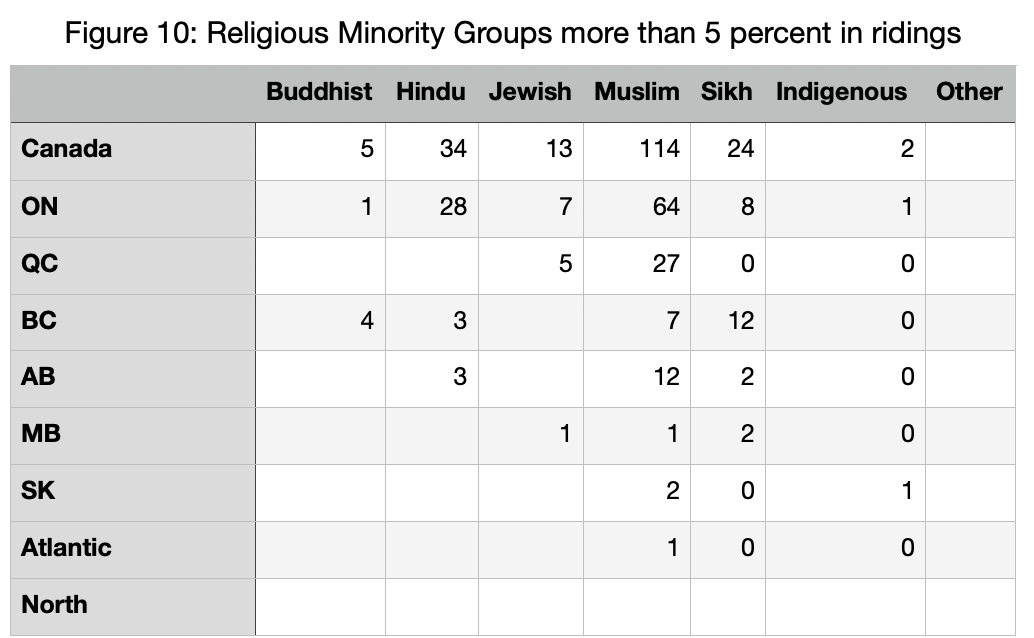
That being said, there are 114 ridings where Muslims form more than 5 percent of the electorate.

… Liberal party insiders were no doubt looking at the Michigan primary results with trepidation. The backlash among Muslim voters to the Stephen Harper government’s niqab ban for citizenship ceremonies and “barbaric cultural practices” hotline likely played a role in helping the Justin Trudeau-led Liberals secure a surprise majority in 2015. Since then, the party has made relations with the community a priority. Trudeau himself stages regular photo-ops at mosques, no doubt savouring every chance he gets to flex his sock game in a setting where shoes are prohibited.

But Trudeau, who appeared to be losing his touch with Muslim Canadians even before Oct. 7, now looks to be in freefall with the community. His multiple calls for a “sustainable ceasefire” in Gaza haven’t been enough to placate intransigent pro-Palestinian activists, who’ve even mobbed the prime minister in public settings. Trudeau has likewise found mosques to be less receptive to him than normal in recent months.

For now, Trudeau doesn’t appear to be too worried about the prospect of a Ramadan mosque ban. When asked on Thursday about the open letter, Trudeau said he’d visit any mosque that would extend him the invitation and gave no indication that he’d publicly commit to the terms enumerated in the statement. Yet Trudeau can’t be overjoyed about the prospect of having to keep his socks firmly in shoe during Islam’s holiest month, especially after seeing Biden’s humiliation in Michigan.

The results of Michigan’s just-held Democratic primary hint that the war in Gaza has triggered a rising tide among Muslim voters in the U.S. Whether electorally vulnerable members of Parliament cede to the demands of the NCCM and its affiliates or risk being shut out of mosques during a critical month for Muslim outreach could be an indication of just how strong the pull of this tide is in Canada.

Source: Rahim Mohamed: National Muslim group demands MPs denounce Israel or face wrath

Rahim Mohamed: Unhinged teacher tells Muslim to support Pride or ‘you can’t be Canadian’

Of note. Teacher went to far with her “you don’t belong (in Canada)!” but most other points were valid. And it is equally valid to point out the lack of consistency in reasonable accommodation arguments:

Administrators were thrust into full damage control mode on Tuesday when an audio recording of an in-class scolding of a Muslim pupil, attributed to a teacher at North Edmonton’s Londonderry Junior High, was leaked to social media.

In the recording, shared on Twitter by the London (U.K.)-based 5Pillars news, the teacher could be heard berating a student, identified as “Mansour”, for allegedly skipping class to avoid ‘Pride Month’ activities:

“You are out to lunch if you think it’s acceptable to not show up because (of) Pride activities going on at school,” the speaker admonished. “But meanwhile, (your LGBT+ classmates), they’re here when we did Ramadan… and they’re showing respect for in the class for your religion…”

“It goes two ways! If you want to be respected for you are… then you better give it back to people who are different from you.”

The speaker then references new anti-gay legislation in Uganda, a country where over eight-in-10 citizens identify as Christian: “In Uganda, literally, if they think you’re gay, they will execute you.” (Uganda’s just-passed Anti-Homosexuality Bill imposes the death penalty for so-called “aggravated” homosexual acts, such as gay sex with an underage partner or infecting a partner with HIV).

“If you believe that kind of thing, then you don’t belong (in Canada)!”

She went on to suggest that those who don’t agree with certain laws in Canada don’t belong in this country.

“We believe that people can marry whomever they want. That is in law. And if you don’t think that should be the law, you can’t be Canadian. You don’t belong here.”

(As of Wednesday morning, the recording had garnered over 100,000 views on Twitter).

5Pillars also shared a letter, dated (Saturday,) June 3, 2023, purportedly written by the school’s principal Ed Charpentier: “Many of you may have heard an audio recording of a teacher at Londonderry School circulating on social media channels,” reads the letter. “I want to emphasize that the views expressed by the teacher do not reflect the values of acceptance, inclusion and belonging that are so strong at Londonderry School.” (a phone number given at the bottom of the letter leads to the school’s central directory). The letter’s date suggests that the incident took place sometime last week.

Edmonton Public Schools added the following on Tuesday in an email to members of the media: “(We are) aware of the audio recording of a teacher at Londonderry School circulating on social media channels. The school and Division are taking steps to address the situation. Due to the Division’s legislated privacy obligations, we are not able to provide any further information.”

While the teacher was clearly out of line, the recording nevertheless reflects a religious tension that’s playing out across Canada over increasingly elaborate in-school Pride celebrations. Evidence is starting to mount that Muslim students are “opting-out” en masse from Pride-related activities — going so far as to skip school on designated Pride days.

London, Ont. (a city where nearly 10 per cent of residents identify as Muslim) has been hit by a wave of absences on school days dedicated to LGBT visibility. Just last month, nearly one-third of students enrolled at London’s largest elementary school stayed home as the district commemorated the International Day against Homophobia, Biphobia and Transphobia. (As the National Post’s Tristin Hopper reported, a majority of students absent that day appeared to be from Muslim families). At least six other schools in the London-area reported higher than usual absences that day. A similar mass absence broke out three months earlier, when the elementary school marked “Rainbow Day”.

A subsequent public statement from the London Council of Imams (LCI) read, “When it comes to activities related to ‘Pride Month’… parents play an integral role in the education of their children and are critical to empowering them to remain steadfast on their faith and beliefs. For this reason, the LCI is not in the position to direct parents on whether to choose to have your child(ren) to attend or be absent from school.” The statement advised parents to “use their discretion” to determine whether to send their children to school on days that included Pride-related activities and programming.

While Pride-related absenteeism among Muslim students has been documented most extensively in London-area schools, the leaked recording from Edmonton indicates that this issue is beginning to crop up in other Canadian cities with large Muslim populations (Edmonton is home to nearly 100,000 Muslims).

Interestingly, the brewing tensions over Muslim students declining to partake in in-class Pride activities recall the “reasonable accommodation” debates of yesteryear — only with the ideological roles reversed. The same progressives who once breathlessly defended the right of Muslim women to don Niqabs in voting booths (and, famously, at citizenship ceremonies) are now claiming that celebrating Pride Month is a sine qua non of being Canadian: “If you don’t believe that, then you don’t belong here!”

Even as they publicly condemned the teacher’s words, it would be unsurprising if many leaders in Edmonton’s ultra-progressive public school system were quietly nodding their heads in agreement with this statement.

Once again, Canada’s Muslim community finds itself at the centre of an ideologically charged debate over Canadian values. This time around, the absolutists are wearing rainbow-coloured clothing.

Source: Rahim Mohamed: Unhinged teacher tells Muslim to support Pride or ‘you can’t be Canadian’

‘Nobody in the Chinese Canadian diaspora was surprised’: Diaspora communities balance fears of foreign meddling with political organizing
Of note:

As revelations continue to surface about interference by the Chinese government in recent Canadian elections, Canada’s diaspora communities say they’ve been warning about this issue for years.

They also insist that their communities have every right to organize politically and influence policy at every level of government and hope the recent revelations don’t cast a pall over these efforts.

Many members of the Chinese community said they had been warning government and security officials about foreign political interference from the Chinese government for years. 

“I can say with confidence that nobody in the Chinese Canadian diaspora was surprised at all when Global News first broke the story,” says Karen Woods, a co-founder of the Canadian Chinese Political Affairs Committee, a Toronto-based non-profit. 

Workers at the Chinese consulate in Toronto helped mobilize Chinese-Canadian voters to vote for Liberal candidate Han Dong in the riding of Don Valley North, according to recent reporting by Global News. Also reported were similar actions on behalf of the Chinese government in B.C. that contributed to the defeats of Conservative incumbents Alice Wong and Kenny Chiu in their Richmond ridings.

A string of stories by Global News and the Globe & Mail paint a picture of an intricate interference network set up by Chinese government actors to influence the 2019 and 2021 federal elections to ensure a Liberal victory. 

Calgary-based political scientist and Hub contributor Rahim Mohamed believes diaspora politics are organized to obtain greater cultural recognition within a country, or to influence a country’s foreign policy towards the “homeland,” which he notes is the right of any Canadian. 

“It may be an unseemly sort of politics to some, but it generally falls within the bounds of legitimate democratic activity,” says Mohamed. “If the recent intelligence leaks are to be believed, this is a clear-cut case of a hostile foreign power meddling in our democratic process, which is a totally different ball game.” 

Nonetheless, Mohamed believes diaspora politics can open the door to foreign interference in democratic elections.

“New Canadians have democratic rights just like all other Canadians. If they want to mobilize organically to influence public policy, I take no issue with that,” says Mohamed. “The challenge for policymakers will be dealing with the opportunities these diaspora networks give interloping foreign powers to meddle in our democratic processes.” 

With over 300,000 Cantonese speakers, 500,000 Mandarin speakers, and families that arrived last year or five generations ago, Woods says the Chinese-Canadian community is far too diverse to ever be fully under the sway of the Chinese government. 

“The Chinese-Canadian diaspora consists of people who have settled in Canada for more than five generations or people like me, who came to Canada at 12,” says Woods, who says most Chinese Canadians do not like the Chinese government. “We are no different than your everyday Canadian…we certainly are part of Team Canada.” 

Within the Chinese-Canadian community, Woods says some fault lines have developed between those whose families have lived in Canada for decades and new arrivals, as well as those born in Hong Kong, Taiwan, the Mainland, or outside China. 

“Based on these factors, your attitude toward Beijing and the CCP is going to be very different. And that is why you now have HK, Taiwanese voters that will never vote for a mainland candidate in elections,” says Woods. 

However, Woods says the Chinese government’s influence has helped silence divergent points of view on Hong Kong’s anti-extradition movement and the treatment of the Uyghur Muslim minority in western China. 

Hong Kong-born Canadians and residents, and pro-democracy activists more generally, are often confronted by supporters of the Chinese government when conducting demonstrations in cities like Vancouver and Toronto.

At the height of the 2019 anti-extradition protests in Hong Kong, crowds of pro-democracy and pro-Chinese government demonstrators at a busy Vancouver intersection had to be physically separated by the police

Kash Heed, a city councillor in Richmond, where over half of the population is of Chinese descent, says that diaspora communities have attempted to influence Canada’s relations with their ancestral homelands for hundreds of years, and this is present in every democracy. He says there is a marked distinction between members of a diaspora community attempting to influence Canadian politics and a foreign government directly interfering in Canadian elections. 

“If I can directly relate it to a foreign government, I don’t have a strong indication that they’re actively involved in it (electoral interference),” says Heed. “If I could relate it to foreigners that have come to Canada (and) that have settled in Canada, trying to influence which way we go, yes absolutely,” says Heed. 

When the Chinese government does target the diaspora in Canada, Woods says it is mostly the Mandarin-speaking community from Mainland China. 

“A large percentage of the Chinese Mainland diaspora certainly still supports Beijing, but I would also like to add that is not necessarily an ideologically driven affinity to the CCP,” says Woods, who notes there are many economic interests at play with China being Canada’s second-largest trading partner. “That adds a lot of weight.”  

Mohamed says one example of diaspora politics was the political shift of the Chinese-Australian community in the country’s 2022 federal election. 

Pointing out that Australian electoral districts with the largest Chinese-Australian populations swung heavily towards the Labor Party, Mohamed says it was reported as a response to the Liberal-National government’s deteriorating relationship with China. 

Labor, which ultimately unseated the Liberal-National government, has pursued a more moderate relationship with Beijing but has not reneged on regional security agreements aimed at countering China’s geopolitical ambitions in the Pacific region.

Source: ‘Nobody in the Chinese Canadian diaspora was surprised’: Diaspora communities balance fears of foreign meddling with political organizing 

Rahim Mohamed: Trudeau has degraded the value of Canadian citizenship 

More commentary opposing the proposed change to the citizenship oath. Overly partisan in its narrative, the 2015 election was not “the niqab election” but driven more by the desire for change, the “barbaric tip line” and the uncertainty that citizenship revocation meant to many.

The usual simplistic mischaracterization of the post-modern comments of Trudeau. Canadian identity is more of a civic identity than one based mainly on ethnic origin, although Canadian institutions were shaped primarily by British and French Canadians, which of course continue to evolve and are influenced by more newly arrived groups (and have been increasingly influenced by the original Indigenous inhabitants).

And equally simplistic is blaming the recent steep decline in citizenship take-up rates on PM language neglects that this trend pre-dated the Liberals, the shutdown and slow recovery 2021-22 of the citizenship program due to COVID and other factors:

The 2015 federal election, which saw the Stephen Harper-led Conservatives fall to defeat after nearly a decade in power, is still known in some circles as “the niqab election.” It was, after all, the Harper government’s protracted legal battle to prevent Muslim women from wearing niqabs at citizenship ceremonies that effectively framed the race.

The drawn-out litigation, which dragged into the campaign, allowed the ultimately victorious Liberals to drive home the narrative that Harper’s team was using the issue to capitalize on latent anti-Muslim sentiment in pockets of the electorate (i.e., Quebec). Liberal Leader Justin Trudeau masterfully cast himself as an inclusive foil to the Conservatives, campaigning on the aspirational (and tautological) refrain, “A Canadian is a Canadian is a Canadian.”

These numbers conveyed a broad national consensus that citizenship ceremonies were not just a mere bureaucratic box-ticking exercise, but rather a meaningful rite of passage for all new Canadians — one that necessitated a certain manner of dress and decorum. The niqab, a restrictive garment rooted in a sexist culture of oppression, was self-evidently improper attire for a ceremony to become a member of a liberal, egalitarian society.

So how, in the years since then, have we reached a point where new Canadians may soon be able to finalize the process of becoming citizens by, quite literally, ticking a few boxes on a government website?

Per a notice published last month in the Canada Gazette, proposed amendments to Canada’s citizenship regulations could allow applicants to “self-administer” their oath of citizenship through a “secure online solution without the presence of an authorized individual.” In other words, new Canadians would log in to a secure government website where they would be directed to click a button to agree to “faithfully observe the laws of Canada.”

In a few months’ time, the process of formalizing one’s Canadian identity could look virtually identical to the process of becoming an ordained minister with the Universal Life Church. What on earth has become of our country?

As has been something of a pattern lately, Canadians have arrived at the bottom of an entirely foreseeable slippery slope. “Click here to become a Canadian citizen” is merely the logical endpoint of the postmodern vision of Canadian identity that Justin Trudeau articulated all the way back in 2015.

Throughout the 2015 campaign, Trudeau held firm to the position that the sole criterium for being a Canadian was holding a Canadian passport — not even taking part in a terrorist plot targeting Canadians could disqualify a passport holder from membership in the national community. Before the year was out, he would tell the New York Times that, “There is no core identity, no mainstream in Canada,” which he claimed was the world’s “first post-national state.”

Given Trudeau’s open (and vocal) nihilism toward the very concept of Canadian identity, it’s hardly surprising that his time as prime minister has coincided with a precipitous fall in national pride. By the end of 2019, more than four-in-10 Canadians said they felt more attached to their province than to the country as a whole. This included majorities in Quebec, Alberta and Atlantic Canada. (In 2013, majorities in all provinces outside of Quebec reported a greater sense of belonging to Canada than to their province).

Following last year’s Freedom Convoy protests, national media outlets ran think pieces debating whether the Canadian flag was a “racist” hate symbol. Just a few weeks ago, Canadian R&B singer Jully Black was widely applauded for changing the lyrics to “O Canada” to “our home on native land” in her rendition of the national anthem at the NBA All-Star Game.

If this is how Canadians themselves view the Great White North, it shouldn’t come as a shock that newcomers aren’t exactly clambering to become citizens. Over Trudeau’s time in office, the percentage of permanent residents who go on to become citizens has fallen by nearly a quarter, dropping below 50 per cent in 2021.

The Trudeau government is looking to reverse this trend with technology. A more enduring solution may be to remind permanent residents why they should want to be Canadian in the first place.

The great niqab debate of 2015 wasn’t just about facial coverings — or even the place of Muslims in Canada. It was, more foundationally, a proxy battle pitting two visions of Canadian identity. Trudeau’s postmodern and tautological vision won out; today, the term “Canadian” is virtually meaningless.

We can’t say we weren’t warned.

Source: Rahim Mohamed: Trudeau has degraded the value of Canadian citizenship

Mohamed: The Line’s Naughty List: The demographic crisis isn’t going away

Another article on the limits of immigration to address weak economic growth although ignoring the productivity issue. But just like increasing immigration is unlikely to significantly counter demographic trends of an aging population, a focus on increasing fertility is, given experience in other jurisdictions, unlikely to move the needle significantly.

Governments and policy makers need to consider alternative scenarios of how to manage an aging population rather than just focussing on semi-effective measures to slow down the trend:

The nearly concluded year of 2022 may well be remembered as the year generational politics finally arrived in Canada, even if nobody wants to talk about the root of our demographic dilemma. 

Saddled for over a decade with stagnating wages, escalating day-to-day living costs, and one of the world’s least-affordable housing markets, Canadians under the age of 40 finally said “enough” in 2022; making generational inequality, for the first time, a major nationwide political issue

Some of Canada’s pissed off young adults have found their messiah in 43-year-old Conservative party leader Pierre Poilievre, a rather cantankerous fellow himself. Poilievre has masterfully used Canada’s housing affordability crisis to tap into a groundswell of support among younger Canadians — recent polling show Poilievre’s Conservative party holding a double-digit leadamong voters between the ages of 18 and 34.

But even if their voices are finally being heard, young Canadians have precious little to look forward to as they start their working lives in earnest. The OECD projects that Canada’s economic growth will be dead last among advanced countries over the next decade. This means that young Canadians entering the workforce in the 2020s can expect the same grim job prospects, stagnant real incomes, and diminished purchasing power as their older cohorts who graduated into the Great Recession (insert James Franco “First time?” meme here). 

Barring a miraculous change of course, Millennial and Gen-Z Canadians will not only be worse off than their parents but will also see their standards of living deteriorate relative to people the same age in other countries. 

Yet for all his bluster and this real opportunity for a political breakthrough, Mr. Poilievre has offered no genuine solutions to this generational slide. 

So what can be done to reverse Canada’s great inter-generational stagnation? For one thing, we can attack the demographic underpinnings of our dismal growth projections.

The biggest challenge will be to mitigate the effect of our aging population on our labour markets. A record 307,000 Canadians retired last year and a further one-in-five workers are nearing retirement age. Retirements are pushing job vacancies to record levels and leaving behind a shrinking workforce to pick up the slack. By 2027, there will be just three working-agedCanadians for each senior citizen.

Policymakers in Ottawa are acutely aware of this problem and are banking on an already overburdened immigration system to provide an easy fix to our labour market woes. Last month, the Trudeau government unveiled an ambitious plan to bring in 500,000 immigrants per year by 2025 (an increase of nearly two-thirds from average annual admissions between 2015 and 2019). Since this announcement, even progressive outlets have voiced concerns about our capacity to absorb such a sharp influx of new Canadians.

As Andrew Potter recently wrote in The Line, the new immigration target places Canada’s fragile pro-immigration consensus at risk. New Canadians may well bear the brunt of intensifying populist anger if they’re seen as contributing to the country’s health-care and housing-affordability crises. (Chinese immigrants, for example, have already incurred a racial backlash for their alleged role in driving up housing prices in British Columbia’s Lower Mainland.)

But even under ideal conditions, immigration would not be a silver-bullet solution to the labour-market challenges created by an aging native-born population. The average Canadian immigrant arrives in their late 20s and may need years to become licensed to work in their chosen occupation. Further, working immigrants often bring both non-working spouses and elderly relatives with them. These are just a few of the frictions that make the economic benefit of large-scale immigration subject to the law of diminishing returns

We also need to weigh the potential economic gains of increased immigration against the challenge some new immigrant communities may pose to our political climate by “importing” combustible ethno-cultural grievances. As I wrote in The Line earlier this year, diaspora politics is becoming increasingly visible in Canada and played a central role in Patrick Brown’s Conservative party leadership campaign.

Large-scale immigration has been a massive economic and cultural boon to Canada over the past half-century but it’s becoming increasingly evident that we’re fast approaching an inflection point. Future increases to immigration are likely to generate diminishing economic returns and escalating political costs. 

This leaves us with a rather simple equation. To reverse our forecasted economic slide, we must increase the supply of young Canadians relative to the number of older ones. To do this, we must find ways to encourage reproductive-aged Canadians to have more children. The arithmetic could not be more straightforward.

Unfortunately, this is the exact opposite of what’s happening. As I wrote back in August, Canada’s birth rate, which has long been the lowest in the Anglosphere, hit a record-low of 1.4 births-per-woman (bpw) during the height of the COVID pandemic in 2020. While it bounced back slightly last year, it still falls well below the OECD average of 1.7 bpw

A quick glance at the average price of a single-family home or daycare space in any major Canadian city should explain why cash-strapped millennials aren’t rushing to bring more children into the world. Indeed, beyond tackling our broader affordability crisis, all orders of government could be doing more to make starting families more affordable for young Canadians — Canada’s level of public spending on family benefits falls well below the average among OECD countries

The Trudeau government’s recently concluded bilateral agreements mark the third attempt at Canada-wide child care. Yet fewer than nine months after the last deal was inked, political will already appears to be faltering.

Part of the problem is that the bilateral agreements were pitched as a mechanism to guide Canada out of the “she-cession” created during the first year of the pandemic. This rationale rings hollow now that women’s labour force participation has bounced back to (and exceeded) pre-pandemic levels. 

Tying new family policies to Canada’s longstanding fertility crisis and, by extension, our future economic vitality, could give these initiatives more staying power.

One thing’s clear: the “f-word” (fertility) can no longer be a forbidden term in Canada’s political lexicon. Until we get serious about that, our demographic and political challenges will only get worse. 

Rahim Mohamed is a master’s student at the University of Calgary’s School of Public Policy. His writing has appeared in The Hub, the National Post, and CBC News Calgary.

Source: The Line’s Naughty List: The demographic crisis isn’t going away