Race and the Standardized Testing Wars – The New York Times

Without data, hard to know where the issues are and what to do about them:

As a counterexample, he pointed to Kaya Henderson, the chancellor of Washington’s public schools, who has made it a requirement that all second graders learn how to ride a bicycle.

Ms. Henderson, in an interview, said she believed that, in the transition to the Common Core learning standards, states and districts had not been “as aggressive as they need to be in terms of changing their curriculum and professionally developing teachers and principals to really understand how to teach differently.”

Her own district, she said, spent four years developing a curriculum in which students hone their reading and math skills while studying a wide variety of subjects, including science and social studies.

She added that it was the responsibility of state and district leaders to emphasize the importance of field trips and extracurricular activities and to tell principals that “holding kids back from those kinds of things doesn’t help them on the test.”

“I’ve had to at some points remind my principals that kids should have a well-rounded experience all throughout the year, and it’s not O.K. to say no field trips until after the test,” she added.

But she also said that doing away with the tests would be most damaging to black and Latino students and those with disabilities. “Before No Child Left Behind, there were lots of schools where parents thought their kids were going to great schools, but after you disaggregated the results, you figured out that black kids and Latino kids or special-ed kids were actually worse off” than similar students in less high-performing schools, she said. “We need to know that kind of information. I don’t ever want to go back to a time when we don’t know.”

Sonja Brookins Santelises, vice president of K-12 policy and practice at the Education Trust, an organization that advocates for high academic achievement for poor and minority students, said she had watched the video produced by the Baltimore Algebra Project and been shaken by the students’ disappointment in their education and feelings of marginalization.

She said it was educators’ responsibility to speak to students about testing in a positive way. Ms. Brookins Santelises recalled an experience from when she was a middle schoolteacher, when she showed a student named Tabitha her test scores and explained to her that she was significantly below grade level in reading.

“She said to me, ‘Oh, my God, nobody told me I couldn’t read,’ ” Ms. Brookins Santelises recalled. “I watched how she started to internalize it, and I immediately said, ‘Wait a minute, hold up, this test is not Tabitha. But what this says is we’ve got some real work to do, and I am here to help you.’ ”

If students are being made to feel inferior, she said, it is because educators — from teachers to district officials — aren’t taking responsibility for their own failures and instead are sending low-income students the message that their poor performance is their fault.

Source: Race and the Standardized Testing Wars – The New York Times
Is ‘racial colour-blindness’ hurting our children?

The risks of colour blindness to identity (US study):

A new study by Social Psychological and Personality Science, When societal norms and social identity collide, asks this question in relation to how minority children living in western countries see both themselves and others. “Their racial background is often integral to their identity and how others perceive them,” stated the study’s authors Kristin Pauker, Evan Apfelbaum and Brian Spitzer. “Yet, talk of race is taboo.”

The study came to this conclusion after gathering 108 American-raised Latino, Asian, Black and Caucasian children between the ages of 9 and 12 and asked them to play a game similar to “Guess Who.” Each child was given 40 photos and told they had to ask as few questions as possible to figure out which card the other person was holding.

Children who come under the “visible minority” umbrella, it seems, were just as likely to avoid the topic of race.

“It is troubling that pressures to adhere to colour-blind norms override talk of race, even among racial minority children,” wrote the authors. In fact, only 40 per cent of the children asked questions like “are they Black?” or “are they White?” in order to win the game.

Afterwards, about 58 per cent said it would have been rude or offensive to ask those types of questions, while 23 per cent insisted it would be extremely racist. “Teachers are particularly important social referents for instilling norms regarding race,” noted the study.

Is ‘racial colour-blindness’ hurting our children? | Globalnews.ca

See How the Wealth Gap Between Whites and Non-Whites Is Getting Wider | TIME

wealthbyrace-avg1Not completely surprising but still striking nevertheless:

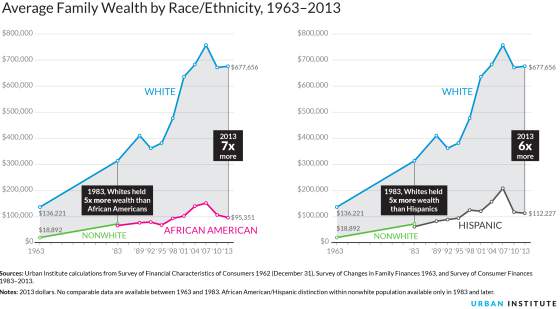
The average white family accumulated $677,656 in total assets in 2013, more than six times that of Latino families and seven times that of African-American families, according to a new study that shows ethnic minorities slipping behind in the post-recession economy.

The Urban Institute released a series of graphics that shows the wealth gap between white and non-white families widening from a multiple of five in the early 80’s to multiples of six and seven by 2013.

See How the Wealth Gap Between Whites and Non-Whites Is Getting Wider | TIME.

ICYMI: White? Black? A Murky Distinction Grows Still Murkier – NYTimes.com

While not based on a random sample, nevertheless interesting results, showing just how much mixing has occurred, and continues to occur, in the US:

In the United States, there is a long tradition of trying to draw sharp lines between ethnic groups, but our ancestry is a fluid and complex matter. In recent years geneticists have been uncovering new evidence about our shared heritage, and last week a team of scientists published the biggest genetic profile of the United States to date, based on a study of 160,000 people

The researchers were able to trace variations in our genetic makeup from state to state, creating for the first time a sort of ancestry map.

“We use these terms — white, black, Indian, Latino — and they don’t really mean what we think they mean,” said Claudio Saunt, a historian at the University of Georgia who was not involved in the study.

The data for the new study were collected by 23andMe, the consumer DNA-testing company. When customers have their genes analyzed, the company asks them if they’d like to make their results available for study by staff scientists.

Over time the company has built a database that not only includes DNA, but also such details as a participant’s birthplace and the ethnic group with which he or she identifies. (23andMe strips the data of any information that might breach the privacy of participants.)

The scientists also have been developing software that learns to recognize the origins of the short segments of DNA that make up our genomes. Recently they used their program to calculate what percentage of each subject’s genomes was inherited from European, African or Native American forebears.

“This year we saw that we were in a great position to do the analysis,” said Joanna L. Mountain, senior director of research at 23andMe.

On average, the scientists found, people who identified as African-American had genes that were only 73.2 percent African. European genes accounted for 24 percent of their DNA, while .8 percent came from Native Americans.

White? Black? A Murky Distinction Grows Still Murkier – NYTimes.com.