Dave Snow: The federal government is spending millions on equity, diversity, and inclusion research

Informative data-based analysis of SSHRC funding for its Race, Diversity and Gender Initiative, revealing an overtly ideological and activist social justice and equity agenda:

…A year before, SSHRC awarded $19.2 million in funding for 46 grants of up to $450,000 for its Race, Diversity, and Gender Initiative to create partnerships to study disadvantaged groups. The program description encouraged projects that seek to “achieve greater justice and equity,” and its list of “possible research topics” included questions such as “How can cisgender and straight masculinity be reinvented for a gender-equitable world?” and “Which mechanisms perpetuate White privilege and how can such privilege best be challenged?” The language used in these new grants denotes the clearest shift yet towards more activist priorities in federal research grant funding.

SSHRC data on EDI

To determine whether the “hard” EDI of social justice activism has had a real effect on the types of projects that received funding for SSHRC grants, I conducted a content analysis of the titles of 680 grants awarded under four programs between 2022-23, the latter two of which are explicitly EDI-focused: 

  1. Insight Grants announced in 2023, which “support research excellence in the social sciences and humanities,” valued between $7,000 and $400,000 over five years. (504 total)
  2. Partnership Engage Grants announced in 2023, which provide short-term support for a partnership with a “single partner organization from the public, private or not-for-profit sector,” valued between $7,000 and $25,000 for one year. (100 total)
  3. Knowledge Synthesis Grants to study “Shifting Dynamics of Privilege and Marginalization” announced in 2023, valued at $30,000 for one year. (30 total)
  4. Race, Gender, and Diversity Initiative grants announced in 2022, which support partnerships “on issues relating to systemic racism and discrimination of underrepresented and disadvantaged groups,” valued at “up to $450,000” over three years. (46 total)

First, I categorized each grant recipient according to whether their project title was clearly adopting a critical activist perspective (if there was any uncertainty, it was categorized as “no”). 

I then categorized each grant according to which EDI identity markers the projects covered—Indigenous Peoples, women/gender, LGBTQ+, race, and disability (including mental health). 

As Table 1 shows, the contrast between the two “traditional” grants and the two new EDI-focused grants was striking. Fully one-third of grants in the Race, Gender, and Diversity initiative focused on Indigenous Peoples, and 30 percent mentioned race or racism (compared with 3 percent and 1 percent of the Insight Grants). 

The disparity is especially pronounced when you compare the Race, Gender, and Diversity grants to the Insight Grants, where there was an 11-1 ratio in the proportion of grants awarded on the topic of Indigenous peoples (33 percent versus 3 percent). There was also a 30-1 ratio in the proportion of grants awarded on the topic of race (30 percent versus 1 percent).

Graphic credit: Janice Nelson

It might seem obvious that the two EDI-focused grants produced so many recipients with explicitly activist titles (63 percent compared with 9 percent of traditional grants). Yet it didn’t need to be this way. Examples of non-activist titles of Race, Gender, and Diversity Initiative recipients included “Understanding Race and Racism in Immigration Detention” and “Open-Access Education Resources in Deaf Education Electronic Books as Pedagogy and Curriculum.” One can study marginalized communities without engaging in social justice activism. 

However, most of the EDI-focused grants awarded left no doubt as to the type of research that would be undertaken. Choice titles included:

  • “‘So what do we do now?’: Moving intersectionality from academic theory to recreation-based praxis” ($450,000 grant awarded)
  • “Queering Leadership, Indigenizing Governance: Building Intersectional Pathways for Two Spirit, Trans, and Queer Communities to Lead Social and Institutional Change” ($446,000 grant awarded)
  • “Carceral Intersections of Gender Identity, Sexual Orientation and Trans Experience in Confronting Anti-Black Racism and Structural Violence in the Prisoner Reentry Industrial Complex” ($400,075 grant awarded)

In addition to grant titles, I also examined SSHRC’s diversity data on grant recipients from “underrepresented groups” for all major grants in SSHRC’s own EDI dashboard. This included Insight Grants, Insight Development Grants, Partnership Grants, and Connection Grants contained in SSHRCs (diversity data for the two new EDI-focused grants described above were not available). 

Table 2 provides these numbers alongside SSHRC’s equity targets for 2024/2025 and the groups’ proportion of Canadian university faculty as of 2019. Numbers in red show “under-performance” in the applicant-recipient ratio and SSHRC’s own targets.
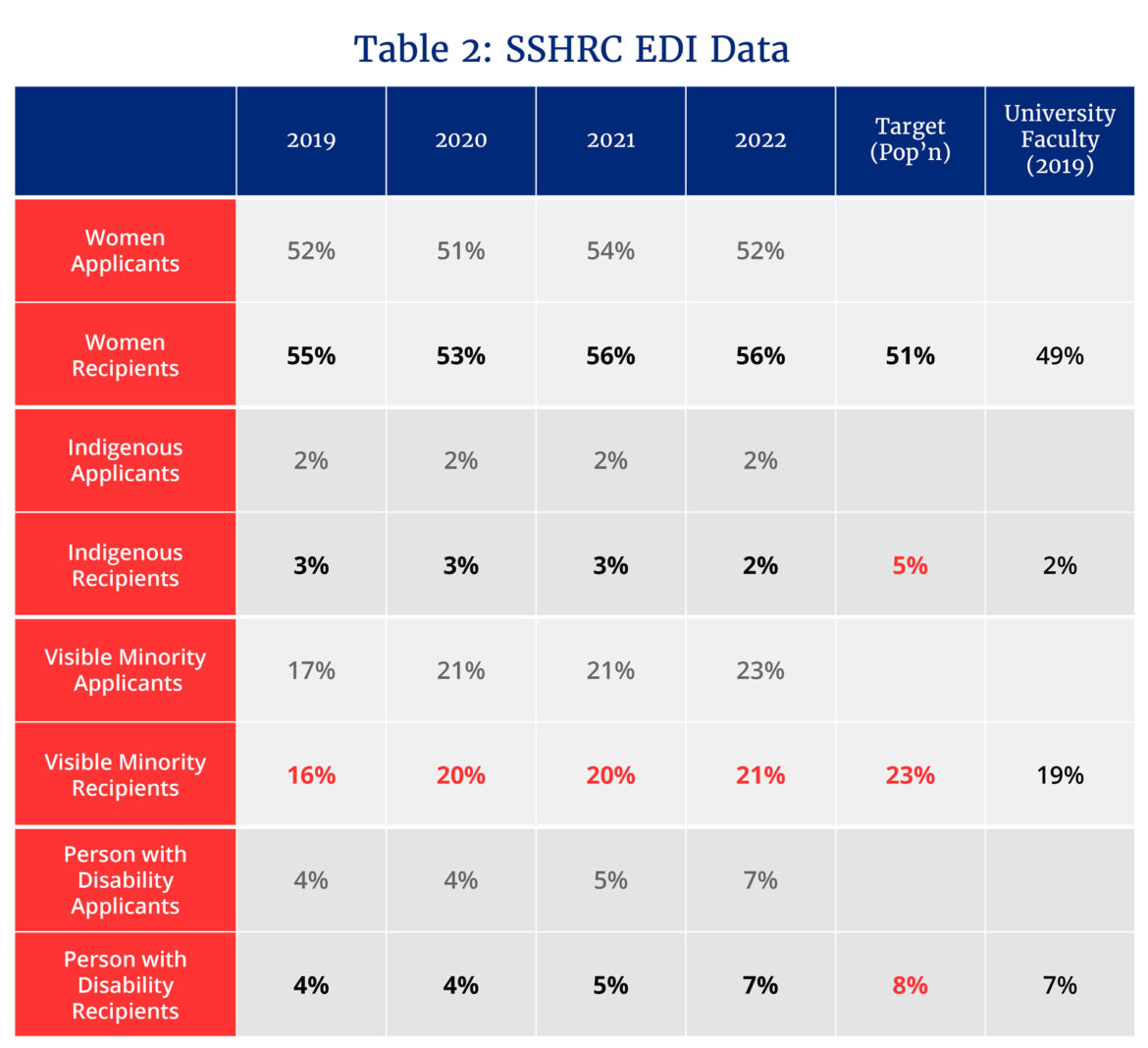
Graphic credit: Janice Nelson

Four things are notable. First, only one of SSHRC’s four target groups (visible minority applicants) has been underrepresented in terms of the applicant-recipient ratio. Second, while women are the only group who have exceeded SSHRC’s equity target, the percentage of recipients has been growing rapidly for visible minority applicants and persons with a disability. Third, no target group is underrepresented relative to its proportion of university faculty members, with women (56 percent of recipients) especially outperforming their faculty proportion (49 percent). Finally, Indigenous grant recipients (2 percent) are underrepresented relative to their proportion of the overall population (5 percent), but not relative to their proportion of university faculty members.

Damaging the pursuit of truth

The above analysis leads me to three broad conclusions. First, while the language of EDI has permeated SSHRC, the federal agency oscillates between the “soft” EDI of affirmative action and the “hard” EDI of critical social justice activism. Most of the time, SSHRC focuses on achieving “equity targets” and frames EDI as complementary to research excellence. However, SSHRC’s new EDI-themed grants explicitly adopt activist language, and it is little wonder that those awards have been dominated by activist projects.  

Second, when it comes to the “soft” EDI of affirmative action, SSHRC’s policies are clearly having their intended effect for all groups except Indigenous Peoples. The number of grants awarded to women, visible minority applicants, and persons with a disability is rising. Grants are being awarded to members of these three groups at a proportion equal to or greater than their share of university faculty, and in the case of women, well above their share of the overall population. At this rate, it will soon be inaccurate for SSHRC to refer to “underrepresented groups” when it comes to prestigious national grants.

Finally, the “hard” EDI of critical social justice activism poses the biggest threat to SSHRC’s commitment to research excellence. While there are important critiques of the effects of “soft” EDI of affirmative action, it does not necessarily pose the same existential threat to research excellence. But the “hard” EDI of critical social justice activism is utterly incompatible with the objective pursuit of truth. One need only skim the titles of grants awarded under SSHRC’s two new EDI-focused initiatives to see how far they have strayed from the objective, empirical knowledge creation that we expect our national granting agencies to fund. Ironically, the more an award is pitched in terms of “diversity,” the less intellectually diverse the recipients seem to be. Thankfully, such activist research remains primarily confined to the new (and for now temporary) EDI-focused grants. 

If the federal government wants universities to keep the public’s trust, it should avoid any future activist-themed grants and ensure that granting agencies eschew social justice priorities. Federal granting agencies using taxpayer dollars should be explicit that their primary commitment is to promote excellence via the creation and dissemination of objective, falsifiable research knowledge. The university is supposed to function as a system of knowledge production. Policies that openly tie research to activist political ends threaten to undermine that very system.

Source: Dave Snow: The federal government is spending millions on equity, diversity, and inclusion research
Next U.S. census will have new boxes for ‘Middle Eastern or North African,’ ‘Latino’

Overdue. Good discussion of some of the issues involved:

On the next U.S. census and future federal government forms, the list of checkboxes for a person’s race and ethnicity is officially getting longer.

The Biden administration has approved proposals for a new response option for “Middle Eastern or North African” and a “Hispanic or Latino” box that appears under a reformatted question that asks: “What is your race and/or ethnicity?”

Going forward, participants in federal surveys will be presented with at least seven “race and/or ethnicity” categories, along with instructions that say: “Select all that apply.”

After years of research and discussion by federal officials for a complicated review process that goes back to 2014, the decision was announced Thursday in a Federal Register notice, which was made available for public inspection before its official publication.

Officials at the White House’s Office of Management and Budget revived these Obama-era proposals after they were shelved by the Trump administration. Supporters of these changes say they could help the racial and ethnic data used to redraw maps of voting districts, enforce civil rights protections and guide policymaking and research better reflect people’s identities today.

“These revisions will enhance our ability to compare information and data across federal agencies, and also to understand how well federal programs serve a diverse America,” Karin Orvis, U.S. chief statistician within OMB, said in a blog post.

Most people living in the U.S. are not expected to see the changes on the census until forms for the next once-a-decade head count of the country’s residents are distributed in 2030.

But a sea change is coming as federal agencies — plus many state and local governments and private institutions participating in federal programs — figure out how to update their forms and databases in order to meet the U.S. government’s new statistical standards.

Federal agencies that release data about race and ethnicity are required to each turn in a public action plan to OMB by late September 2025 and get all of their surveys and statistics in line with the new requirements by late March 2029.

The “White” definition has changed, and “Latino” is now a “race and/or ethnicity”

OMB’s decision to change its statistical standards on race and ethnicity for the first time in more than a quarter-century also marks a major shift in the U.S. government’s definition of “White,” which no longer includes people who identify with Middle Eastern or North African groups such as Egyptian, Iranian, Iraqi, Israeli, Jordanian, Kurdish, Lebanese, Moroccan, Palestinian, Syrian and Yemeni.

That move sets up “Middle Eastern or North African” as the first completely new racial or ethnic category to be required on federal government forms since officials first issued in 1977 standards on racial and ethnic data that the Census Bureau and other federal agencies must follow.

For more than three decades, advocates for Arab Americans and other MENA groups have campaigned for their own checkbox on the U.S. census and other government forms, and recent research suggests that many people of MENA descent do not see themselves as white, a category that the federal government previously considered to include people with “origins in any of the original peoples of Europe, the Middle East, or North Africa.”

Studies by the bureau show that the government’s previous standards have also been out of step with many Latinos. Those standards required asking about a person’s Hispanic or Latino identity — which the federal government considers to be an ethnicity that can be any race — before asking about their racial identity.

Combining a question about Hispanic origins with a question about race into one question, while allowing people to check as many boxes as they want, is likely to lower the share of Latinos who mark the “Some other race” categoryon census forms, the bureau’s research from 2015 suggests.

Recent research, however, suggests it’s not clear how someone who identifies as Afro Latino is likely to respond to a combined race-ethnicity question. According to the Federal Register notice, about half of participants in a recent study for OMB selected only the “Hispanic or Latino” box when presented with a combined question after previously selecting both the Latino and Black categories.

This new question format, along with the addition of a “Middle Eastern or North African” box, could also decrease the number of people who mark the “White” box.

Other changes coming to federal forms

Among the other proposals OMB has greenlit is a general requirement for federal agencies to ask for detailed responses about people’s identities beyond the seven minimum racial and ethnic categories. This change, advocates say, will produce more insightful statistics about differences in health care outcomes and socioeconomic disparities within the minimum categories.

OMB has also approved removing from its standards outdated language about allowing “Negro” as a term to describe the “Black” category and “Far East” to describe a geographic region of origin for people of Asian descent, which, according to the U.S. government’s revised definition, now includes individuals “with origins in any of the original peoples of Central or East Asia, Southeast Asia, or South Asia.”

The federal government’s new definitions of the seven minimum racial and ethnic categories list the six largest groups, based on 2020 census results, that the government considers to be part of that category. For example, its definition of “Black or African American” now reads: “Individuals with origins in any of the Black racial groups of Africa, including, for example, African American, Jamaican, Haitian, Nigerian, Ethiopian, and Somali.”

For the standards’ official description for “American Indian or Alaska Native,” OMB is removing a phrase about maintaining “tribal affiliation or community attachment.” The revised definition says: “Individuals with origins in any of the original peoples of North, Central, and South America, including, for example, Navajo Nation, Blackfeet Tribe of the Blackfeet Indian Reservation of Montana, Native Village of Barrow Inupiat Traditional Government, Nome Eskimo Community, Aztec, and Maya.”

OMB decided not to move forward with calls to require agencies to gather data to better understand the descendants of enslaved people originally from Africa, which included suggestions to use “American Descendants of Slavery” or “American Freedman” to describe the group. OMB said in the Federal Register notice that “further research is needed,” adding that there was opposition to this proposal from civil rights groups and others because of concerns over “the difficulty of verifying that identification is accurate, the usefulness or necessity of the data, the exclusion of other groups of historically enslaved people, and the creation of confusion that could make the Black or African American community harder to count.”

A changing conversation about race and ethnicity

OMB says it plans to create a standing committee to formally review these standards at least once a decade going forward. Among the key questions OMB says the committee may review is how to encourage people to select multiple categories when appropriate so that there are complete and accurate estimates about groups such as Afro Latinos.

While the revised standards go into many minute details about how surveys and data tables should be presented, there are many unanswered questions.

It’s not clear, for example, how the federal government will consider people who identify as MENA when monitoring and enforcing civil rights. OMB’s previous guidance, which was rescinded Thursday, used the earlier “White” definition, which included people with roots in the Middle East or North Africa and was not categorized as a “minority race” that would face “disparate impact or discriminatory patterns.” The new standards offer no new guidance about which specific groups the government considers to be a “minority race.”

Still, changes to how the government asks about people’s identities could also reset the national conversation about race and ethnicity.

Some critics of using one question to ask about both a person’s race and ethnicity, including researchers behind a campaign called “Latino Is Not A Race,” have raised concerns about blurring the distinctions between the two concepts.

In response to OMB’s decision, the AfroLatino Coalition called for the Census Bureau to do more research about how these changes will affect how Afro Latinos report their identities, including those in Puerto Rico.

“By listing Latino ethnicity as co-equal with racial categories, Latinos are inaccurately portrayed as a population without racial differences despite all the research showing how Black Latinos are treated differently from other Latinos,” the coalition said in a statement. “Separating ethnicity from race is essential for making visible the actual and intersectional racial disparities that exist within a racially diverse ethnic group like Latinos in access to important public goods such as access to education, employment, housing, medical services, etc. Without it, systemic racism, especially when discussing Latino populations, is rendered invisible.”

The introduction of a “Middle Eastern or North African” category may reopen unresolved questions and tensions over the fact that the Middle East and North Africa are regions with no universally agreed-upon borders and with transnational groups.

OMB received public feedback in support of including Armenian, Somali and Sudanese among MENA groups, but it said in its Federal Register notice that the Census Bureau’s research has found that most people who identify with those groups did not select a MENA checkbox when presented with one. “Additional research is needed on these groups to monitor their preferred identification,” OMB added in the notice. Many advocates of a MENA category, including the Arab American Institute, have criticized the bureau’s previous research for not specifically testing “Middle Eastern or North African” as an ethnic category whose members can be of any race.

Maya Berry, the Arab American Institute’s executive director, says after decades of campaigning for a MENA checkbox on federal forms, OMB’s announcement made Thursday “a pretty significant and big day.”

“The fact that Arab-Americans have been rendered invisible and other populations from MENA have been rendered invisible without that checkbox has really been harmful to communities,” Berry says.

But at the same time, Berry says she is concerned that the example groups representing the MENA category in OMB’s new definition for “Middle Eastern or North African” do not represent the full racial and geographic diversity of MENA communities in the U.S., including those from Black diaspora communities. That, in turn, could discourage some people with roots in the Middle East or North Africa from selecting the MENA box, Berry worries.

“I didn’t want to go from being rendered invisible to being undercounted,” she adds.

How OMB decided which groups have to be represented in the checkboxes under the racial and ethnic categories on forms has also drawn criticism from Meeta Anand, senior director of the census and data equity program at The Leadership Conference on Civil and Human Rights.

“We are concerned that the Office of Management and Budget has already specified the required detailed categories prior to engaging in the due diligence, research, and testing as to what would elicit inclusive and accurate responses for those who identify with more than one racial or ethnic category,” Anand said in a statement.

More work is needed, says Arturo Vargas, a longtime census watcher, who is the CEO of the National Association of Latino Elected and Appointed Officials Educational Fund.

“There is going to be a significant need for a public education effort going forward by the Census Bureau and all federal agencies that collect data on race and ethnicity so that all respondents to surveys understand what is being asked,” Vargas adds. “The Census Bureau needs to continue testing to see how people are interpreting this question so that the question can be improved over the short term, so that we have the best ideal question possible when we get to the 2030 decennial.”

OMB announced the last major changes to its standards in 1997, when it approved allowing survey participants to report more than one race and splitting the “Asian or Pacific Islander” category into “Asian” and “Native Hawaiian or Other Pacific Islander,” which OMB has now shortened by removing the word “Other.”

Source: Next U.S. census will have new boxes for ‘Middle Eastern or North African,’ ‘Latino’

A GOP plan for the census would revive Trump’s failed push for a citizenship question

Of note (the usual suspects):

A coalition of conservative groups is preparing for a chance to shape the country’s next set of census results in case a Republican president returns to the White House in 2025.

Their playbook includes reviving a failed push for a citizenship question and other Trump-era moves that threaten the accuracy of the 2030 national head count.

The plan also calls for aligning the mission of the government agency in charge of the next tally of the country’s residents with “conservative principles.” Many census watchers, including a former top Trump administration official, tell NPR they find this position particularly alarming.

The policy proposals — led by The Heritage Foundation, a Washington, D.C.-based think tank — are part of a broader “Project 2025” plan for dismantling aspects of the U.S. government. “For too long, conservative presidents’ agendas have been stymied by liberal bureaucrats who put their own agenda over that of the President, whom they serve,” Paul Dans, a former Trump appointee who is Project 2025’s director, claims in a statement.

Since the plan’s release in April, most public attention has focused on its climate policy and calls to expand the president’s power over federal agencies. But 2025 marks a pivotal year for one particular and often-neglected agency — the Census Bureau.

The federal government’s largest statistical agency is about to start a critical planning period for the upcoming once-a-decade count. Decisions expected to be made during the next administration, including what census questions to ask and how, will have long-lasting effects on the statistics used to divvy up congressional seats and Electoral College votes, redraw voting districts for every level of government, inform policymaking and research, and guide more than $2.8 trillion a year in federal money for public services across the country.

If former President Donald Trump or another Republican candidate is elected in 2024, many census watchers are bracing for a potential sequel to the years of interference that muddled the last tally in 2020.

Why do these conservative groups want a citizenship question?

It’s not clear exactly why these conservative groups want the next census to ask for the U.S. citizenship status of every person living in every household in the United States.

Research by the bureau has shown that including the question “Is this person a citizen of the United States?” on forms is likely to discourage many households with Latino or Asian American residents from getting counted in official population totals.

The bureau’s annual American Community Survey already produces estimates of U.S. citizens, which are used to help enforce the Voting Rights Act.

And a future Republican administration could, as the Trump administration tried to, seek citizenship data from an alternate source — government records. The agency’s researchers said those would be more accurate and less costly to use than people’s self-reported answers. (President Biden stopped that work in 2021.)

Still, Thomas Gilman — a former Chrysler executive who, during the Trump administration, served as chief financial officer for the bureau’s parent agency, the Commerce Department — writes in the Project 2025’s policy guide: “Any successful conservative Administration must include a citizenship question in the census.”

Gilman declined NPR’s interview requests through a Heritage Foundation spokesperson and did not respond to written questions. The Heritage Foundation also did not make any representatives available to be interviewed for this report.

During the Trump administration, a citizenship question was part of a secret strategy to alter a key set of census numbers, the 2020 release of a presidential memo and, later, internal documentsconfirmed. Those numbers are used every 10 years to reapportion each state’s share of seats in the U.S. House of Representatives and the Electoral College.

According to the 14th Amendment, the congressional apportionment numbers must include the “whole number of persons in each state.” But Trump officials wanted to make the unprecedented move of excluding unauthorized immigrants.

In public, however, the Trump administration claimed to want a citizenship question to better enforce the Voting Rights Act’s protections against the discrimination of racial and language minorities — a justification the Supreme Court found appeared to be “contrived.”

In court, groups that sued over the proposed question pointed to another reason that remains a potential motivating factor for a future GOP administration — neighborhood-block level citizenship data that could be used to draw voting districts that a Republican redistricting mastermind said would be “advantageous to Republicans and Non-Hispanic Whites.”

That kind of data would be key to a legal dispute that the Supreme Court left unresolved in 2016: whether it is legal for states to redraw legislative districts based on the number of citizens old enough to vote rather than of all residents in an area.

Would Trump, if reelected, try again for a citizenship question?

It’s an open question whether Trump, if reelected, would make another go for a citizenship question. His campaign did not respond to a request for comment.

Hermann Habermann — a former deputy director of the bureau who testified in court against the Trump administration’s citizenship question push — sees echoes of that failed effort embedded within the Project 2025 plan. It repeats a misleading Trump-era talking point that appears to reference the United Nations Statistics Division’s census recommendations: “Asking a citizenship question is considered best practice even by the United Nations.”

“I don’t think they’ve read properly what it says there,” says Habermann about how Project 2025 interprets recommendations he helped write while serving as the director of the U.N. Statistics Division. “It doesn’t say thou shalt do this. It recommends that citizenship be one of the areas that is looked at. The U.S. does look at citizenship at the block-group level through the American Community Survey. So we do it. We just don’t do it at the block level. And so the question always became, why is that necessary?”

How a Republican administration answers that question could be the focus of another round of lawsuits, says Thomas Saenz, president and general counsel of the Mexican American Legal Defense and Educational Fund, which represented some of the groups that sued the Trump administration over its citizenship question push.

“I’ve never heard articulated a justification for the citizenship question that is not fairly obviously a veil to disguise racial and partisan intent,” Saenz says.

Still, in the Biden years, GOP calls to add a census citizenship question and alter the congressional apportionment numbers have not gone away. In July, House Republicans released a draft funding bill that would have banned the bureau from using the money to include unauthorized immigrants in future counts used to divide up House seats.

These conservative groups also have a “conservative agenda” for the Census Bureau

While the Project 2025 plan also outlines garden-variety presidential transition moves such as reviewing budgets and eliminating duplicative census operations, there are other proposals that many census watchers find troubling.

They call for more political appointee positions at the bureau, which has largely been run by career civil servants.

“Strong political leadership is needed to increase efficiency and align the Census Bureau’s mission with conservative principles,” Gilman, the former Commerce Department CFO, writes, adding there’s a need to have “both committed political appointees and like-minded career employees” in place to “execute a conservative agenda” as soon as the next Republican president takes office.

During its final months in office, the Trump administration installed four additional political appointees without any past experience at the agency or obvious qualifications for joining the highest ranks. In a 2020 email, the bureau’s top civil servant raised concerns that the appointees showed an “unusually” high level of “engagement in technical matters, which is unprecedented relative to the previous censuses.” After an investigation, an official from the Government Accountability Office told Congress that the appointees ultimately “did not have undue influence into the operations of the census.” Their exact responsibilities, however, remain murky.

Habermann, the former deputy director at the bureau, sees any similar return of this Trump-era move as “the first step to having a set of statistics which the people, the nation will not trust.”

“Some of us would believe that the function of statistics is, if you will, the lifeblood of a democracy,” Habermann adds. “The idea of statistics agencies is to produce reliable, unbiased, trustworthy information that the nation can use in making its decisions and in understanding itself. They want the statistics agency to be a mouthpiece, if you will, for the Republican administration.”

Their plan includes delaying potential changes to how the census asks about race and ethnicity

The plan also criticizes an ongoing review by the White House’s Office of Management and Budget of how the census and federal government surveys ask about people’s racial and ethnic identities. Ahead of the 2020 census, Trump officials stalled that process, which has been driven by years of research by the bureau into how to better reflect the country’s ever-shifting diversity.

The bureau has found that many people of Middle Eastern or North African descent do not identify as white, which is how the federal government officially categorizes them. The agency has also been tracking the rise of a catch-all checkbox known as “Some other race,” now the second-largest racial category in the U.S. after “White.” It’s mainly the result of the difficulty many Latinos face when answering a census question about their race that does not include a checkbox for “Hispanic” or “Latino,” which the government considers to be an ethnicity that can be of any race.

Based on their testing, the bureau’s researchers have recommendedcombining the questions about race and ethnicity into one and adding a checkbox for “Middle Eastern or North African.” OMB is expected to announce decisions on those proposals by summer 2024.

Project 2025’s plan, however, calls for a Republican administration to “take control of this process and thoroughly review any changes” because of “concerns among conservatives that the data under Biden Administration proposals could be skewed to bolster progressive political agendas.”

Meeta Anand, senior program director of census and data equity at The Leadership Conference on Civil and Human Rights, says any attempts to modify or roll back changes would be a movement away from accuracy and “truly understanding who we are as a nation.”

“If you were to have a stop and say, ‘Let’s review the questions again. Let’s conduct another research test,’ we would need to see appropriations for the Census Bureau to be able to do that. They would need to mount another test all over again. And there’s no way it would be done in time for 2030,” Anand adds. “Census advocates were trying to get revisions in place for the 2020 census, and that just never happened.”

The plan’s emphasis on a “conservative” approach to the census is raising concerns, including from a former top Trump official

Terri Ann Lowenthal, a former staff director of the House oversight subcommittee for the census who served on former President Barack Obama’s presidential transition team on census issues, sees the plan’s call to get rid of at least one of the bureau’s committees of outside advisers as a way to reduce transparency about how the agency produces the country’s statistics.

“This really is sort of undermining all of the principles and practices that federal statistical agencies should be following. And that is extremely troubling,” says Lowenthal, who is now a census consultant.

For Democratic Sen. Brian Schatz of Hawaii, one of the few vocal census advocates in Congress, Project 2025’s proposals run counter to his attempts to shield the bureau from further interference through new legislation.

“This is a clear partisan effort to force an undercount of communities of color. It’s unlawful and unconstitutional,” Schatz says in a statement.

The plan’s call to carry out a “conservative agenda” at the bureau is also catching public criticism from a less likely source: former Commerce Secretary Wilbur Ross.The former top Trump administration official pushed for a citizenship question while overseeing the bureau, and an investigation by the Commerce Department’s Office of Inspector General found that Ross “misrepresented the full rationale” for adding a citizenship question when testifying before Congress in 2018. During the Trump administration, the findings were presented to the Justice Department, which declined to prosecute Ross.

“I think that the job of the census is to provide data. If the elected officials want to interpret that one way or another, well, that’s OK. That’s their prerogative. I don’t think the census should try to shade things in any political direction,” said Ross, who declined to answer questions about a citizenship question but said he believes it is “a valid question.”

On whether there should be more political appointees at the bureau, Ross said it’s not a question he has “really thought about” but noted: “To the degree that the implication was that the census should be more politicized, I do not agree with that.”

Ross said that until NPR contacted him, he was not aware of Project 2025’s census proposals written by Gilman, who served under Ross as the Commerce Department’s CFO.

“I’m frankly a little bit surprised that he regards himself as an expert on what actually happens in terms of the census. I don’t recall him being that involved in the whole process,” Ross said.

For Lowenthal, the census consultant who is a longtime watcher of the national head count, Project 2025’s census recommendations mark a notable shift in the right wing’s approach.

“I have not seen anything remotely like these proposals in this document coming out of previous Republican administrations,” Lowenthal says. “I think that the author or authors of this document clearly understand that if you control the production and flow of information, you can control how people view their government, the actions their government is taking or not taking and their view of the world around them. These proposals should raise alarm bells, I think, for anyone worried about the future.”

Source: A GOP plan for the census would revive Trump’s failed push for a citizenship question

Malik: France has been laissez-faire on race, the US proactive. Clearly, neither of them has it right

Another call for greater analysis by class, but one that does not ignore identity and race:

Should public policy be “race conscious” or “colour blind”? Should it target the specific inequalities faced by minority groups or treat all citizens equally without any reference to individuals’ racial and cultural backgrounds?

The contrast between these two approaches has often been seen as that between Anglo-Saxon multiculturalism and French assimilationism, the one “based on the right of ethnic minorities, of communities”, the other “based on individual rights”, as Marceau Long, then the president of France’s Haut Conseil à L’Intégration, put it in 1991, adding that the Anglo-Saxon approach, unlike that of the French, was that of “another way of imprisoning people within ghettos”.

Thirty years on, we can see the issues as more complex and less given to simple binary oppositions. Two recent high-profile events illustrate this complexity: the debates around the US supreme court’s decision to strike down affirmative action and those around the riots that ripped through France after the police killing of teenager Nahel Merzouk.

While affirmative action improved prospects for middle-class black people, it left untouched those of the working-class

The supreme court’s verdict that Harvard’s race-based admission policy was illegal has led many to fear that the progress of African Americans in higher education will now stall. Yet, as the African American writer Bertrand Cooper observed even before the decision: “The reality is that for the Black poor, a world without affirmative action is just the world as it is – no different than before.”

Why? Because while affirmative action has improved prospects for middle-class black people, it has left untouched the lives of working-class African Americans. By 2020, the percentage of African Americans admitted to Harvard stood at almost 16% – higher than the proportion of black people within the US population. Black students in Harvard are, though, anything but representative of the African American community.

In most discussions about race, black Americans are regarded as constituting a singular community. However, black America has been, for most of the past half-century, the most unequal racial or ethnic group in the nation. White Americans in the top income quintile possess 21.3 times the wealth of white people in the lowest income quintile. For black people, that figure stands at a staggering 1,382. The poorest black people earn just 1.5% of the median black income.

This disparity shapes everything from education to incarceration. More than 70% of Harvard students come from the wealthiest 20% of families; 3% come from the poorest 20%. There were almost as many students from the wealthiest 1% as from the poorest 60%.

The greatest lack of diversity in America’s elite universities, in other words, is not racial but class-based. It is, though, one that deeply affects black Americans, because that same pattern of elite recruitment applies to African Americans as it does to the population as a whole. Affirmative action is action largely for the black elite.

This is not a new argument. In his seminal 1978 work, The Declining Significance of Race, the sociologist William Julius Wilson noted the changing contours of race and class and the development of a “deepening economic schism” within African American communities, “with the black poor falling further and further behind higher-income blacks”.

The title of Wilson’s book may seem ironic, given the centrality of race in public debate today. In material terms, Wilson’s thesis has proved largely accurate. Politically, though, there has been an increasing fixation with racial identities. This mismatch between material developments and political perceptions has ill-served the majority of African Americans.

It is not that racism does not continue to play an immense role in the lives of black people. It is rather that, as Cooper has observed: “Ignoring class divisions in Black America over the last 40 years has allowed the benefits of racial progress to be concentrated upon the Black middle and upper classes while the Black poor have largely been excluded.”

Many critics of race-conscious policies argue instead for the pursuit of “colour blind” policies that take no account of an individual’s race or culture. Perhaps the nation that most embodies such an approach is France. It is also the one that most reveals the problems with it.

‘Universalism’ has become a weapon with which to point out the ‘difference’ of particular peoples

French policy is rooted in its republican tradition and universalist principles, and a refusal to recognise racial distinctions in policymaking. The universalist belief that one should treat everyone as citizens, rather than as bearers of specific racial or cultural histories, is a valuable principle.

In practice, however, French policy has entailed being blind to racism in the name of being “colour blind”, and of using the demand for “assimilation” as a means of marking out certain groups – Jews in the past, Muslims and those of North African origin today – as not truly belonging to the nation. “Universalism” has become a weapon with which to point out the “difference” of particular peoples and to justify their marginalisation. France, as much as America, too often treats its citizens not as individuals but as members of racial or ethnic communities.

The French state not only refuses to recognise racial distinctions but also bans the collection of race-based data, making it far more difficult to evaluate the extent of racial discrimination, while providing a free pass to deny that such discrimination exists. A host of academic studies, attitudinal surveys and the use of categories, such as parent’s country of origin, that can act as surrogates for race and ethnicity, have exposed the degree to which France’s race-blind ideals are freighted with race-based assumptions, from racial profiling in policing to racial discrimination in employment.

And then there is the brutality of police violence, Nahel’s killing is but the latest example. Police perceptions of minority communities can be gauged by an extraordinary statement put out by two of France’s police unions during the riots, claiming that the police were “at war” with the “savage hordes” and warning that “tomorrow we will be in resistance” to the government.

In France, the refusal to recognise the social reality of racism in the name of “universalism” has helped create the very “ghettos” for which French politicians used to deride the Anglo-Saxon approach. In America, the preoccupation with policymaking by racial categories has neglected the very communities those policies are supposed to have benefited, by ignoring the many other features, such as class, that shape black lives, while also creating new social frictions – witness the tensions between African Americans and Asian Americans. What needs to be forged, beyond these two approaches, is a universalist perspective that embraces equal treatment but does not deny the reality of racial inequality

Source: France has been laissez-faire on race, the US proactive. Clearly, neither of them has it right

Changing how U.S. forms ask about race and ethnicity is complicated. Here’s why

Good explainer. Canada’s visible minority categories provide much richer detail:

The first changes in more than a quarter-century to how the U.S. government can ask about your race and ethnicity may be coming to census forms and federal surveys.

And the Biden administration’s revival of this long-awaited review of federal standards on racial and ethnic data has resurfaced a thorny conversation about how to categorize people’s identities and the ever-shifting sociopolitical constructs that are race and ethnicity.

While this policy discussion is largely under the radar, the stakes of it touch the lives of every person in the United States.

Any changes to those standards by the White House’s Office of Management and Budget could affect the data used to redraw maps of voting districts and enforce civil rights protections, plus guide policymaking and research. They could also influence how state and local governments, as well as private institutions, generate statistics.

Here are a few things to know about this complicated effort that could change OMB’s Statistical Policy Directive No. 15:

Asking about race and ethnicity in a combined question could shrink a mysterious “Some other race” category

The current standards require federal forms that ask participants their identities to inquire about race and ethnicity through two separate questions. That’s why on census forms, for example, before you see the race question, there’s a question about Hispanic or Latino identity, which the U.S. government considers to be an ethnicity that can be of any race.

But for the 2020 census, close to 44% of Latinos either did not answer the race question at all or checked off only the box for the mysterious catchall category “Some other race,” according to data the Census Bureau released last month.

“They provide really important insights to what we’ve seen in our research over the decade — that Hispanics continued to find great difficulty with answering the separate questions on ethnicity and on race,” Nicholas Jones, director of race and ethnic research and outreach in the bureau’s Population Division, says about the data, the release of which the bureau moved up to help inform discussions about OMB’s standards.

The rise of “Some other race” — which is legally required on the census by Congress and is now the second-largest racial category in the U.S. after white — helped drive earlier research by the bureau into alternative ways of asking about race and ethnicity.

Combining those two topics into one question, while allowing people to check as many boxes as they want, is likely to reduce confusion and the share of Latinos who mark “Some other race,” bureau research from 2015 suggests.

And that has led an OMB working group to propose making a single combined question the new required way of collecting self-reported racial and ethnic data.

How would a combined question likely change how many people identify as Asian, Black or Pacific Islander?

The bureau’s research involved comparing how people could respond to a combined question vs. separate questions.

Its testing in 2015 – along with similar testing in 2010 and 2016 – found no statistically significant differences in the shares of participants who reported identifying as Asian, Black or Pacific Islander. (There are conflicting findings about the potential impact on the percentage of people reporting as American Indian or Alaska Native.)

But Howard Hogan, a former chief demographer at the bureau who retired from the agency in 2018, contends that research is inconclusive on the potential effects a combined question could have on those groups, particularly on the Black population.

“We don’t know for sure. It’s possible that it would have no effect or even increase. But it’s also equally possible, and I believe slightly more likely, that it would reduce,” Hogan says about a combined question’s impact on the share of people identifying as Black, adding that not all of the bureau’s experiments were designed to test how people may respond to a combined question when it’s asked by a census worker in person, which is how many people of color have participated in the count rather than filling out a form on their own.

The bureau was able to do a month of in-person interviewing for its testing in 2016, and it found no statistically meaningful differences in the shares of people identifying as Asian, Black or Pacific Islander.

Despite the limitations of the agency’s research, the bureau’s officials continue to stand behind their recommendation that a combined question would be the “optimal” way of asking about a person’s race and ethnicity.

“We’re confident in the sampling methodology as well as the consistent results that we’ve seen across three, large national tests,” says Sarah Konya, chief of the bureau’s census testing and implementation branch.

There are concerns about how a combined question could affect racial data about Latinos

Major civil rights organizations focused on census and data issues have also voiced their support for a combined question.

But a campaign called “Latino Is Not A Race,” which is led by a group of researchers who are part of the afrolatin@ forum, has raised concerns that a combined question would allow some Latinos to answer the question by only checking a box for “Hispanic or Latino.”

“The idea that there are some Latinos who are just Latino is contributing to the myth that Latinos are exempt from racialization. That’s not true. Our history has never been that. If you go back to any country in Latin America, you will see a racial hierarchy where whites were on top, brown-skinned people were somewhere in the middle, and Black people and people racialized as Indigenous have been on the bottom,” says Nancy López, a sociology professor who directs the University of New Mexico’s Institute for the Study of “Race” and Social Justice and is calling for research into an additional racial category that could be meaningful to Latinos who are racialized as “Brown.”

The OMB working group has said it’s looking into doing more testing of the combined question’s effects by this August, and outside advisers to the bureau on its Census Scientific Advisory Committee have recommended additional tests and focus groups on specifically how Latinos would respond to this race-ethnicity question format.

Any follow-up research is running up against a summer 2024 deadline that OMB has set for its review of the standards in order to enact changes before the end of President Biden’s first term and in time for them to be incorporated into 2030 census preparations, which are already underway.

In the meantime, both López and the National Association of Latino Elected and Appointed Officials Educational Fund are calling for the standards to clearly define the difference between the concepts of race and ethnicity, which the OMB working group acknowledges many people understand to be similar or the same.

If there’s no combined question, there may be no new “Middle Eastern or North African” checkbox

Entangled within the discussion about the combined-question proposal is the possibility of a new checkbox for “Middle Eastern or North African” — a category that the OMB working group has proposed to no longer classify as white under the federal standards.

Many people in the U.S. with origins in Lebanon, Iran, Egypt and other countries in the Middle East or North Africa do not identify as white people, and advocates for Arab Americans and other MENA groups have spent decades pushing for a checkbox of their own on the census and other forms.

Including a “Middle Eastern or North African” checkbox would likely reduce the share of participants who mark “White” or “Some other race,” while increasing the shares marking “Black” or “Hispanic or Latino,” the Census Bureau’s 2015 research suggests.

But if OMB does not change the standards to allow for a combined question about race and ethnicity, it’s not clear whether a new checkbox for “Middle Eastern or North African” would be approved. The bureau’s research has not specifically tested treating that category on forms as an ethnicity, which has long been the preference for the Arab American Institute and other advocates for a MENA category.

Source: Changing how U.S. forms ask about race and ethnicity is complicated. Here’s why

Biden Is Reviving An Effort To Change How The Census Asks About Race And Ethnicity

Of note (as Canada continues its review):

President Biden’s White House is reviving a previously stalled review of proposed policy changes that could allow the Census Bureau to ask about people’s race and ethnicity in a radical new way in time for the 2030 head count, NPR has learned.

First proposed in 2016, the recommendations lost steam during former President Donald Trump’s administration despite years of research by the bureau that suggested a new question format would improve the accuracy of 2020 census data about Latinos and people with roots in the Middle East or North Africa.

The proposals also appear to have received the backing of other federal government experts on data about race and ethnicity, based on a redacted document that NPR obtained through a Freedom of Information Act request. The document lists headings for redacted descriptions of the group’s “recommended improvements,” including “Improve data quality: Allow flexibility in question format for self-reported race and ethnicity.”

Stalling by Trump officials, however, sealed the fate of last year’s census forms. With no public decision by the White House’s Office of Management and Budget, the bureau was forced to stick with previously used racial and ethnic categories and a question format that, the agency’s studies show, a growing number of people find confusing and not reflective of how they identify.

That has raised concerns about the reliability of the next set of 2020 census results, which are expected out by Aug. 16 and face a tangle of other complications stemming from the coronavirus pandemic, the Trump administration’s interference with the count’s schedule and the bureau’s new privacy protection plans. That detailed demographic data is used to redraw voting districts, enforce civil rights protections and guide policymaking and research.

The review continues under Biden’s OMB

The proposals, however, may be approved by the White House’s Office of Management and Budget under the Biden administration, which has been calling to change how the government produces and uses data about people of color and other marginalized groups.

“We are continuing to review the prior technical recommendations and public comment, and the extent to which those recommendations help advance this Administration’s goal of gathering the data necessary to inform our ambitious equity agenda,” Abdullah Hasan, an OMB spokesperson, tells NPR.

Hasan did not provide a timeline for the current review of the proposed changes to the government’s standards for data about race and ethnicity, which are set by OMB and must be followed by all federal agencies, including the bureau. OMB had previously planned to announce a decision in 2017, before the bureau had to finalize the 2020 census forms.

Other recommended changes include no longer officially allowing federal surveys to use the term “Negro” to describe the “Black” category. Another proposal would remove the term “Far East” from the standards as a description of a geographic region of origin for people of Asian descent.

Support from Biden’s pick for Census Bureau director

This month, Biden’s nominee for Census Bureau director, Robert Santos, pledged to lawmakers that, if confirmed, he would support one of the major recommendations, which would allow census forms to combine the separate race and Hispanic origin questions into one. A combined question, tests by the bureau’s researchers show, would help the bureau address the problem of increasingly more people leaving the race question unanswered or checking off the box for “Some Other Race”— the third-largest racial group reported in 2000 and 2010.

“The census director doesn’t have the authority to include any specific questions,” Santos said in response to a question from Sen. Alex Padilla, D-Calif., during a confirmation hearing before the Senate Homeland Security and Governmental Affairs Committee. “But I can use my own personal perspective as a Latino and use my research experience and my leadership position to work with OMB to make sure that the proper attention is given to that specific issue.”

An expert in designing surveys and currently the Urban Institute’s chief methodologist, Santos has written about the need for questions and categories on census forms to “evolve and adapt to ensure everyone is fairly represented,” including the Latinx population, one of the country’s fastest-growing groups.

“Racial and ethnic categories are social constructs, defined and designed by those who have historically held positions of influence,” Santos said in a 2019 blog post co-written with Jorge González-Hermoso, an Urban Institute research analyst. “The policy implications of using inadequate methods to collect data on identity are not trivial.”

During the hearing, Santos suggested that if OMB ultimately approves the proposed policy changes, the bureau may not have to wait until the 2030 census to use a combined race-ethnicity question, which Santos said could potentially be incorporated into the bureau’s ongoing American Community Survey.

Diversity and Racism in Canada: Competing views deeply divide country along gender, generational lines

Summary of latest Angus Reid survey, with the usual clever segmentation. Glass half full or half empty?:

These are times of deep reckoning over issues of race and identity, hatred, and violence in Canada.

Against the backdrop of the London, ON, attack that targeted and killed a Muslim family, the deep pain associated with revelations about the hundreds of children buried on the grounds of former residential schools, and ongoing reports of discrimination against Canadians of Asian origin, many are attempting to reconcile the realities of the nation’s attitudes towards diversity and equality with national mythologizing about multiculturalism.

The second report from a comprehensive research series from the non-profit Angus Reid Institute in partnership with the University of British Columbia dives deeply into the sentiments of those living in this country – to illuminate perceptions and attitudes towards diversity and racism.

For 85 per cent of the population, that Canada is home to people from different races and ethnicities betters the nation. Canadians of all regions of the country, age groups, political ideologies and ethnic backgrounds agree on this point.

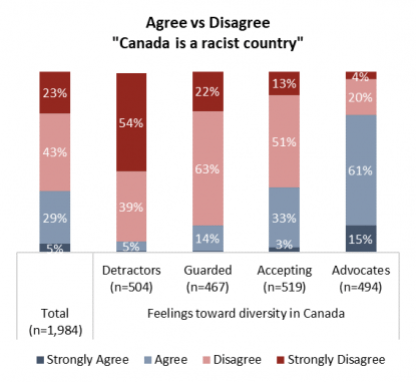
But does everyone feel it? Contradictions abound. Fully one-in-three (34%) say “Canada is a racist country.” Among those who believe this most keenly: visible minorities (42 per cent of whom say so) and women, particularly those under the age of 35, who are much more likely than men to hold this view (54%).

On the other hand, however, fewer than one-in-eight (12%) say they believe some races are superior to others. Further, 41 per cent of Canadians say that people seeing discrimination where it does not exist is a bigger problem for the country than people not being able to see where it does.

These perspectives coalesce to form four mindsets with which Canadians view diversity. This report analyzes each – the Detractors, Guarded, Accepting and Advocates – to better understand the expectations of Canadians heading into the second half century of official multiculturalism.

More Key Findings:

  • Three-quarters of Canadians over the age of 55 disagree that Canada is a racist country, while 54 per cent of women between the ages of 18 and 34 say that it is
  • One-in-five Canadians (21%) say that they feel like they are treated as an outsider in Canada. This proportion is 17 per cent among Caucasians, 30 per cent among Indigenous respondents and 29 per cent among visible minorities.
  • The Advocates, one-quarter of Canadians, are very concerned about racism and discrimination, to the point that they are twice as likely as visible minorities themselves to say that police are prejudiced or racist toward the latter demographic (83% vs 42%)
  • The Detractors, made up of older and more conservative Canadians, are also one-quarter of the population. This group is distinct in that it is more likely than others to say that immigration levels are way too high, and that racism is not a problem in Canada
  • One-quarter of Canadians feel “cold” toward Muslims, more than any other group asked about in the survey. Men over the age of 55 (42%) and Quebecers (37%) are among the most likely to say that.
  • Most Albertans (54%) and Saskatchewanians (57%) believe exaggerating racism is a bigger problem in Canada than not seeing racism where it exists.
  • Yet residents of Saskatchewan (44%) were the most likely to agree that Canada is a racist country. Residents of Quebec (24%) were the least likely.

Source: Diversity and Racism in Canada: Competing views deeply divide country along gender, generational lines

Full survey: click here

State GOP lawmakers try to limit teaching about race, racism

Of note (and of course, the states are preserving existing indoctrination):

Teachers and professors in Idaho will be prevented from “indoctrinating” students on race. Oklahoma teachers will be prohibited from saying certain people are inherently racist or oppressive, whether consciously or unconsciously. Tennessee schools will risk losing state aid if their lessons include particular concepts about race and racism.

Governors and legislatures in Republican-controlled states across the country are moving to define what race-related ideas can be taught in public schools and colleges, a reaction to the nation’s racial reckoning after last year’s police killing of George Floyd. The measures have been signed into law in at least three states and are being considered in many more.

Educators and education groups are concerned that the proposals will have a chilling effect in the classroom and that students could be given a whitewashed version of the nation’s history. Teachers are also worried about possible repercussions if a student or parent complains.

“Once we remove the option of teachers incorporating all parts of history, we’re basically silencing the voices of those who already feel oppressed,” said Lakeisha Patterson, a third-grade English and social studies teacher who lives in Houston and worries about a bill under consideration in Texas.

At least 16 states are considering or have signed into law bills that would limit the teaching of certain ideas linked to “critical race theory,” which seeks to reframe the narrative of American history. Its proponents argue that federal law has preserved the unequal treatment of people on the basis of race and that the country was founded on the theft of land and labor.

Those states include Arizona, Arkansas, Idaho, Iowa, Louisiana, Mississippi, Missouri, New Hampshire, North Carolina, Ohio, Oklahoma, Rhode Island, South Carolina, Tennessee, Texas and West Virginia.

The latest state to implement a law is Tennessee, where the governor this past week signed a bill to ban the teaching of critical race theory in schools.

The legislative debate over that bill caused a stir earlier this month when a Republican lawmaker who supports it, state Rep. Justin Lafferty, wrongly declared that the Constitution’s original provision designating a slave as three-fifths of a person was adopted for “the purpose of ending slavery.” Historians largely agree that the compromise gave slaveholding states more political power.

Some other states have taken steps that fall short of legislative change.

After Utah’s Republican governor blocked a vote on a set of similar bills, the GOP-controlled Legislature passed a symbolic resolution recommending that the state review any curriculum that examines the ways in which race and racism influence American politics, culture and the law.

Georgia Gov. Brian Kemp wrote in a letter to state education board members that they should “take immediate steps to ensure that Critical Race Theory and its dangerous ideology do not take root in our state standards or curriculum.”

Montana’s attorney general issued a binding decision Thursday declaring that certain teachings violate the U.S. and state constitutions and that schools, local governments and public workplaces could lose state funding and be on the hook for damages stemming from lawsuits if they provide critical race theory training or activities.

The National Education Association and the National Council for the Social Studies oppose legislation to limit what ideas can be presented inside a classroom.

“It creates a very chilling atmosphere of distrust, educators not being able to be the professionals they are not only hired to be but are trained to be,” said Lawrence Paska, a former middle school social studies teacher in New York and executive director of the council.

Republicans have said concepts suggesting that people are inherently racist or that America was founded on racial oppression are divisive and have no place in the classroom.

Earlier this month, Republicans in the North Carolina House moved to prohibit teachers from promoting seven concepts that critically examine race and racism, including the belief that a person’s race or sex determines their moral character, that people bear responsibility for actions committed in the past by other members of the same race or sex, and that they should feel guilty because of those two characteristics.

Rep. John Torbett, a Republican who leads North Carolina’s House education committee, said the legislation was intended to promote equality, not rewrite history.

“It ensures equity,” Torbett said during a hearing this month. “It ensures that all people in society are equitable. It has no mention of history.”

Kimberlé Crenshaw, executive director of the African American Policy Forum, was among those who helped popularize critical race theory in the 1970s and 1980s as a response to what she and others felt was a lack of progress following passage of civil rights legislation in the 1960s.

She said Republicans are twisting the concept to inflame racial tensions and motivate their base of mostly white supporters.

“This is a 2022 strategy to weaponize white insecurity, to mobilize ideas that have been mobilized again and again throughout history, using a concept or set of ideas that they can convince people is the new boogeyman,” Crenshaw said.

The boundary between teaching ideas and promoting them has stirred concern among teachers and racial justice scholars.

Uncertainty about that boundary could cause teachers to avoid difficult conversations about American history, said Cheryl Harris, a UCLA Law School professor who teaches a course on critical race theory.

“For anybody who’s ever taught in a classroom, the idea is to get the conversation flowing, and you can’t do that if you’re preoccupied with which side of the line are you going to be on,” Harris said. “That is a chilling effect, and that is every bit as offensive to the First Amendment as a direct ban.”

Opponents of the North Carolina bill say it’s a solution in search of a problem. Tamika Walker Kelly, president of the North Carolina Association of Educators, said the bill’s promoters could not point to any school in the state where students were being indoctrinated in certain racial concepts.

That’s just one reason the bill faces an uphill climb. The press secretary for Democratic Gov. Roy Cooper said the governor believes instruction should be honest and accurate, and that students need to be taught to think critically.

The legislation also faces skepticism from the Republican leader of the state Senate, where it will be considered next.

“I don’t like making it illegal to teach a certain doctrine, as wrong as that doctrine may be, while saying the reason for that ban is freedom of thought,” Sen. Phil Berger said in a statement. “That strikes me as a contradiction.”

Source: State GOP lawmakers try to limit teaching about race, racism

Wells: Who should get a monument? Meet the Canadian man trying to answer the question.

Of interest and relevance given ongoing debates and discussions:

Circumstances have a way of giving meaning to seemingly odd choices. Ten years ago, Ken Lum was an important figure in the Vancouver art scene. Then, without much fanfare, he wasn’t around anymore. But when the long summer of 2020 turned into a global debate about race, memory and commemoration, it turned out Lum was in a vital, important place. In fact, he’d been getting that place ready for years.

In 2012, Lum and historian Paul Farber co-founded Monument Lab, a think tank in Philadelphia that asks what we’re trying to do when we build monuments in public places to historical figures and events.

In the United States in 2012, the political purpose of monuments was already a long-standing debate. It’s just that a lot of people hadn’t noticed. In the years that followed, as controversies over the Confederate flag and monuments to Civil War-era secessionist generals took centre stage in a succession of national controversies, it became harder to ignore the questions Monument Lab exists to raise.

“It started as a pedagogical project,” Lum says in an online interview from his home in the Philadelphia Main Line, a suburb where the 1940 Katharine Hepburn-Cary Grant comedy The Philadelphia Story was set.

“I was teaching a class on observations I had made on my first visit to Philadelphia as a new Philadelphian, regarding the unevenness of the monumental inventory, if I can put that way, of the city.”

Lum had moved to Philadelphia in 2012 to join the faculty of the University of Pennsylvania’s school of design. Over the course of his first summer in the city where the Liberty Bell resides, he had a chance to see many of Philly’s most famous monuments. Ben Franklin, William Penn, Commodore John Barry, all the greats.

Except maybe not all of them? “Philadelphia had over a thousand statues and, at that time, not a single officially sanctioned full-figure African American—in a city that’s 40 per cent African American,” Lum recalls. “And also in the city where John Coltrane, Marian Anderson, Billie Holiday, Paul Robeson”—the legendary jazz saxophonist and three singers, each among the greatest American artists, all Black—“grew up or spent a lot of time. So I became very interested in who gets heeded and who doesn’t get heeded.”

In various ways, Lum has made a career of asking questions about who gets heeded and who doesn’t. If such things can be measured and quantified, Lum was one of Vancouver’s leading artists when he left for Philly. A soft-spoken man with a subtle but persistent mischievous streak, he grew up in Vancouver’s Strathcona neighbourhood and started studying art in his spare time near the end of a difficult undergraduate degree in other subjects. His early experience in art had not been encouraging. “I took art class from Grades 8 to 9 but stopped when the art teacher admonished me for making what he called ‘weird’ images,” Lum writes in the preface to Everything Is Relevant, an essay collection he published in 2020. His teacher “had very strong ideas about what art was and would criticize me harshly for not following his instructions to the letter.” Young Ken would have needed his teacher’s permission to study tenth-grade art, so he gave up.

Eventually he made a career doing the sort of thing that infuriated that middle-school art teacher. Lum’s art is, to some extent, a set of challenges to other people’s strong ideas about what art is. Uninterested in displays of technical skill, he hires tradespeople or buys commercial products to complete his works. His “furniture sculptures” are just that, arrangements of rented furniture. His best-known piece in his hometown is his 2010 Monument for East Vancouver, a neon cross in the form of an image from graffiti art that’s been scrawled on walls and underpasses in the city’s east side since before Lum was born. The A in EAST intersects with the A in VAN, as on a Scrabble board. For a decade the monument has served as a kind of gateway to the neighbourhood.

At times, Lum has seemed to be involved in the design of monuments even without meaning to. In 1990, he was invited to contribute to the opening exhibition of a new contemporary art centre in Rotterdam, Netherlands, the Witte de With Centre for Contemporary Art. One piece he contributed was billboard-sized, a photo of a young woman working an old-fashioned adding machine. The caption is as big as the photo and not subtle: “MELLY SHUM HATES HER JOB.” It was a wry commentary on contemporary workplaces, and its tenure in Rotterdam was meant to be temporary. The museum hung it on the street outside. When the exhibit ended, people called to complain that Melly had vanished. “Every city deserves a monument to people who hate their job,” one caller said. So the museum put Lum’s piece of art back up.

Then, quite recently, things took a surprising turn. The Witte de With Centre was named after the street it is on, which in turn was named after a 17th-century colonial Dutch naval officer who got rich ensuring the Netherlands could efficiently plunder various colonial territories. (As a grim bonus, his name translates as “Whiter Than White.”) The museum decided to change its name, and asked visitors for ideas. The winning suggestion was that it be named after Melly Shum. So since the beginning of 2021, it’s been called the Kunstinstituut Melly, or the Melly Art Institute.

While that entirely accidental process was playing out, Lum and Farber were setting up the Monument Lab. At first the organization was nothing more than a set of questions: what’s a monument? Who decides? Could it be done better? Farber is an academic historian; he wanted to write something. “I was more interested in, ‘Well, how can we make an exhibition out of it?’ ” Lum says. What would the venue be? Lum said the city of Philadelphia itself could be the venue.

In 2015, they set up an office outside city hall and asked visitors, “What is an appropriate monument for the current city of Philadelphia?” Eventually teams of volunteers fanned out across the city to ask the same question. Participants wrote their ideas on file cards. Eventually, more than 4,000 ideas were collected.

Eleven of the proposals were for monuments to soldiers of one kind or another. Sixty-eight proposed monuments to peace, and the word “peace” appeared in 168 proposals. Education was a topic in 173 proposals, the environment in 342. The proposals were sometimes highly specific, and suggested an idea of history at times starkly at odds with the one generations of Philadelphia city elders had promoted. Thirty-five people suggested a monument to commemorate the 1985 firebombing of MOVE, a Black separatist group. During an extended standoff, police helicopters dropped incendiary bombs onto the group’s headquarters. The resulting fire killed 11 people, including five children, and destroyed 65 houses.

To Lum and his colleagues, the desire for a MOVE commemoration suggested people wanted more than a procession of ramrod-straight soldiers in their public squares. “That suggested to us that the citizens, members of a public, which is heeded enough—they have longer memories and a greater sense of decency than the city itself, right?”

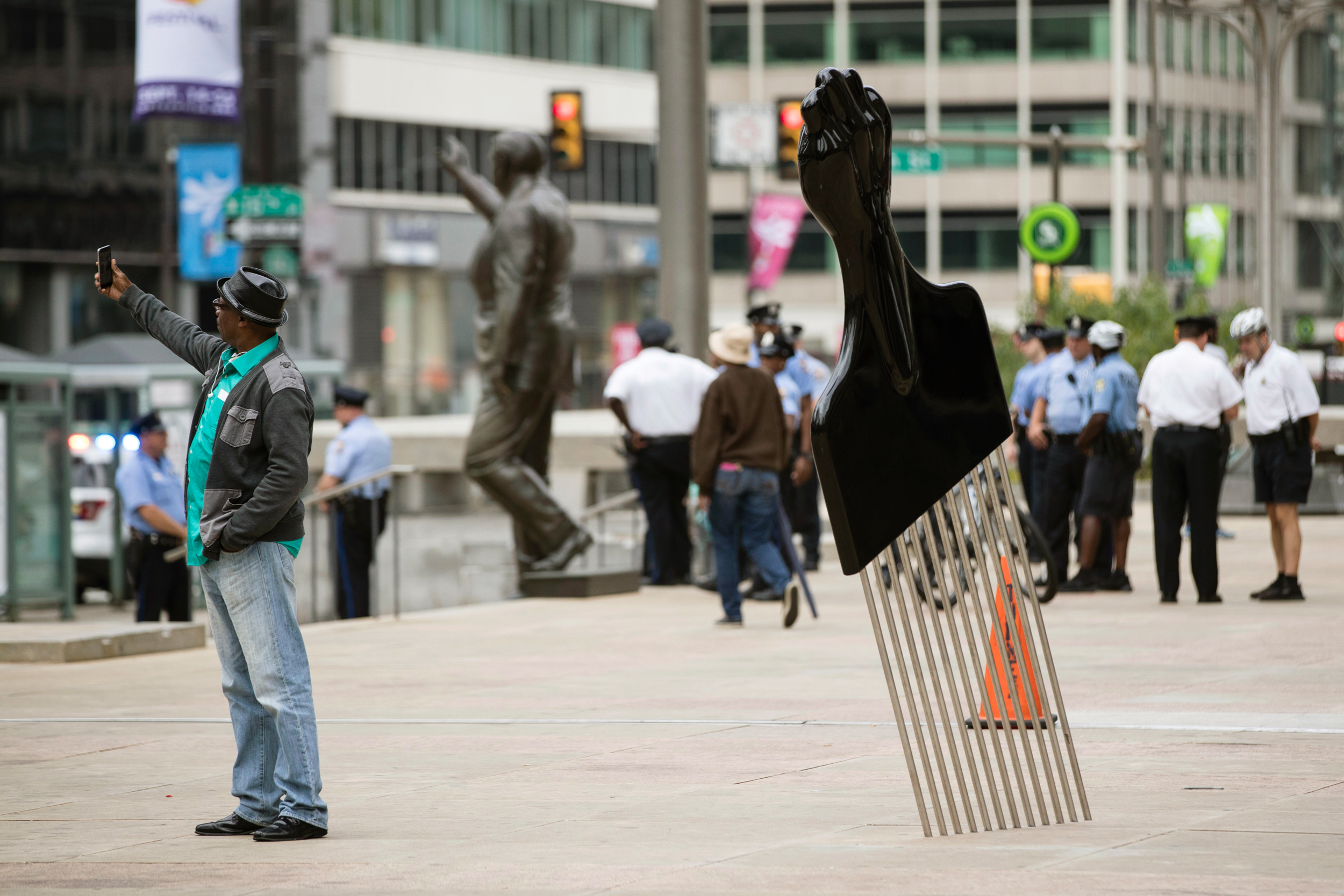
A man takes a selfie in front of Thomas’s sculpture of a 12-foot Afro pick, called All Power to All People, in view of a statue of Philadelphia’s former mayor and police commissioner Rizzo (Matt Rourke/AP/CP)

Monument Lab’s staff published the results of its inquiries as a report to the city. “The way we often talk about existing monuments and public history may severely limit our perception and reinforce the status quo,” they wrote. “We contend that it is not enough to simply say this knowledge is obscure or lost, or that it needs to be discovered or recovered by someone in the future. We must listen and take in what is already common knowledge: an expanded field of history that lives within people and places throughout the city.”

That’s one of the questions you can ask about monuments: who gets heeded, in Lum’s phrase. Another question is how. Big, realistic full-body statues sometimes make sense. There’s been one of those for Joe Frazier in Philly since 2015, an overdue real-life counterpart to the statue of Rocky, the movie boxer, that’s stood in various parts of the city since 1980. But sometimes the depiction can be more oblique or allusive. In 2017, Monument Lab invited 20 artists to build temporary new monuments around the city. Detroit artist Tyree Guyton put dozens of paintings of clocks around every side of a five-storey building: a meditation on time and its different meanings for different people.

Hank Willis Thomas, from Brooklyn, made a 12-foot Afro pick, the distinctive comb that became a symbol of Black pride in the 1970s, and stuck its tines into the ground in front of the Philadelphia municipal services building. For a time it stood within sight of a long-standing statue of Frank Rizzo, a brutal former police commissioner who was Philadelphia’s mayor through the 1970s. Running for a third term, Rizzo urged supporters to “Vote white.” In June 2020, the Rizzo statue came down; the current mayor, Jim Kenney, called his predecessor’s rule “among the worst periods” in the city’s history. Thomas’s giant Afro pick, meanwhile, is part of the permanent collection at the Pennsylvania Academy of Fine Arts.

The debates that fuel Monument Lab’s work have their parallels in Canada. As a Canadian, Lum follows these debates closely. Dundas Street and Yonge-Dundas Square in Toronto are named for a Scottish politician who is viewed by many historians as having delayed the end of the British slave trade. James McGill owned slaves. Egerton Ryerson helped design the residential school system. “Canadians overestimate their benign circumstances,” Lum says, “but there’s a lot of pernicious harm that’s been done.” Should statues come down? Lum isn’t categorical on the question, but whatever happens in every case, there should at least be more discussion and fewer resorts to the notion that monuments, as “history,” are eternal and inviolate.

“I think it’s a testament to a country’s fortitude and character that you can actually say something that is actually true” about the checkered past of previously lionized figures, he says. “It’s not like it’s being made up, or we’re impugning a country for its own sake, right? It’s not like these facts are somehow contrived.”

As most historians would acknowledge, history is about the present as well as the past. Perspectives change. “The whole project” of Monument Lab “is to un-fix the monument, right?” Lum says. “The authority of the monument. I think that’s really important because we tend to bestow this authority upon monuments, as something consensually derived, when in fact it’s particular to certain interests over other people. It’s a reflection of the distribution of power.”

The post Who should get a monument? Meet the Canadian man trying to answer the question. appeared first on Macleans.ca.

The Book That Should Change How Progressives Talk About Race

Helpful suggestions to reduce polarization and build more shared narratives:

When Heather McGhee was a 25-year-old staffer at Demos, the progressive think tank she would eventually lead, she went to Congress to present findings on shocking increases in individual and family debt.

“Few politicians in Washington knew what it was like to have bill collectors incessantly ringing their phones about balances that kept growing every month,” McGhee writes in her new book, “The Sum of Us: What Racism Costs Everyone and How We Can Prosper Together.”

Demos’s explanatory attempts failed. When Congress finally took action in 2005, it made the problem worse, passing a bankruptcy bill that made escaping unsustainable debt harder than ever. For McGhee, the disaster was an education in the limits of research, which is often no match for the brute power of big money. But as she was walking down the hallway of the Russell Senate Office Building, she learned something else.

Stopping to adjust her new shoes near the door of a Senate office, she wrote, she heard “the bombastic voice of a man going on about the deadbeats who had babies with multiple women and then declared bankruptcy to dodge the child support.” She doesn’t know whether the man was a Democrat or a Republican, but when she heard him she realized she and her allies might have missed something. They’d thought of debt and bankruptcy primarily as a class issue. Suddenly she understood that for some of her opponents, it was more about race.

She wondered how, as a Black woman, she’d been caught off guard. “I hadn’t even thought to ask the question about this seemingly nonracial financial issue, but had racism helped defeat us?” she wrote.

McGhee’s book is about the many ways racism has defeated efforts to create a more economically just America. Once the civil rights movement expanded America’s conception of “the public,” white America’s support for public goods collapsed. People of color have suffered the most from the resulting austerity, but it’s made life a lot worse for most white people, too. McGhee’s central metaphor is that of towns and cities that closed their public pools rather than share them with Black people, leaving everyone who couldn’t afford a private pool materially worse off.

One of the most fascinating things about “The Sum of Us” is how it challenges the assumptions of both white antiracism activists and progressives who just want to talk about class. McGhee argues that it’s futile to try to address decades of disinvestment in schools, infrastructure, health care and more without talking about racial resentment.

She describes research done by the Race-Class Narrative Project, a Demos initiative that grew out of her work for the book. McGhee and her colleagues, she writes, discovered that if you “try to convince anyone but the most committed progressives (disproportionately people of color) about big public solutions without addressing race, most will agree … right up until they hear the countermessage that does talk, even implicitly, about race.”

But McGhee, who leads the board of the racial justice organization Color of Change, also implicitly critiques the way parts of the left talk about white privilege. “Without the hostile intent, of course, aren’t we all talking about race relations through a prism of competition, every advantage for one group mirrored by a disadvantage for another?” she asks.

McGhee is far from an opponent of the sort of social justice culture sometimes derided as “wokeness.” But her work illuminates what’s always seemed to me to be a central contradiction in certain kinds of anti-racist consciousness-raising, which is that many people want more privilege rather than less. You have to have an oddly high opinion of white people to assume that most will react to learning about the advantages of whiteness by wanting to give it up.

“Communicators have to be aware of the mental frameworks of their audience,” McGhee told me. “And for white Americans, the zero-sum is a profound, both deeply embedded and constantly reinforced one.”

This doesn’t mean that the concept of white privilege isn’t useful; obviously it describes something real. “What privilege awareness does, at its best, is reveal the systematic unfairness, and lift the blame from the victims of a corrupt system,” McGhee said. “However, I think at this point in our discourse — also when so many white people feel deeply unprivileged — it’s more important to talk about the world we want for everyone.”

So McGhee is trying to shift the focus from how racism benefits white people to how it costs them. Why is student debt so crushing in a country that once had excellent universities that were cheap or even free? Why is American health care such a disaster? Why is our democracy being strangled by minority rule? As the first line of McGhee’s book asks, “Why can’t we have nice things?” Racism is a huge part of the answer.

McGhee describes a “solidarity dividend” gained when people are able to transcend racism. Look at what just happened in Georgia, where the billionaire Kelly Loeffler, in an attempt to keep her Senate seat, waged a nakedly racist campaign against Raphael Warnock, who ran on sending voters $2,000 stimulus checks. He still lost most white people, but won enough to prevail. He did it by appealing to idealism, but also to self-interest. In the fight for true multiracial democracy, counting on altruism will only get you so far.

Source: https://www.nytimes.com/2021/02/19/opinion/heather-mcghee-racism.html