#COVID-19: Comparing provinces with other countries 14 October Update
2020/10/15 Leave a comment


Working site on citizenship and multiculturalism issues.
2020/10/08 Leave a comment
Highlights:
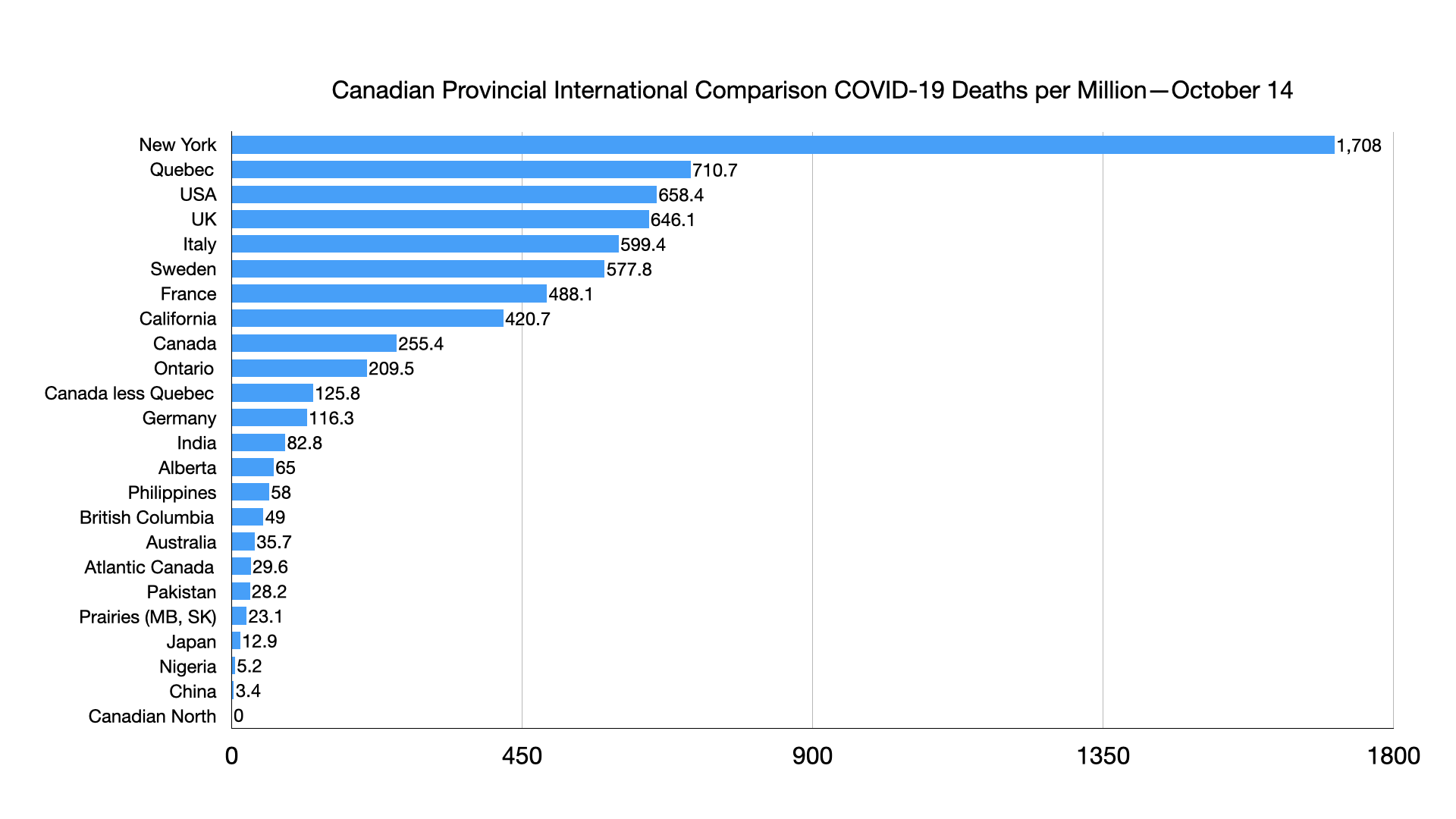
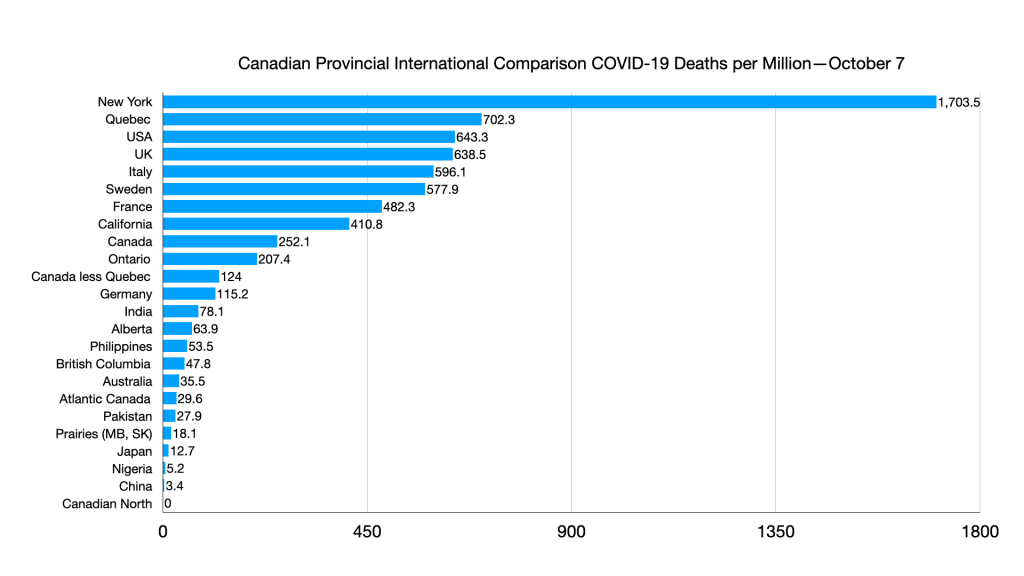
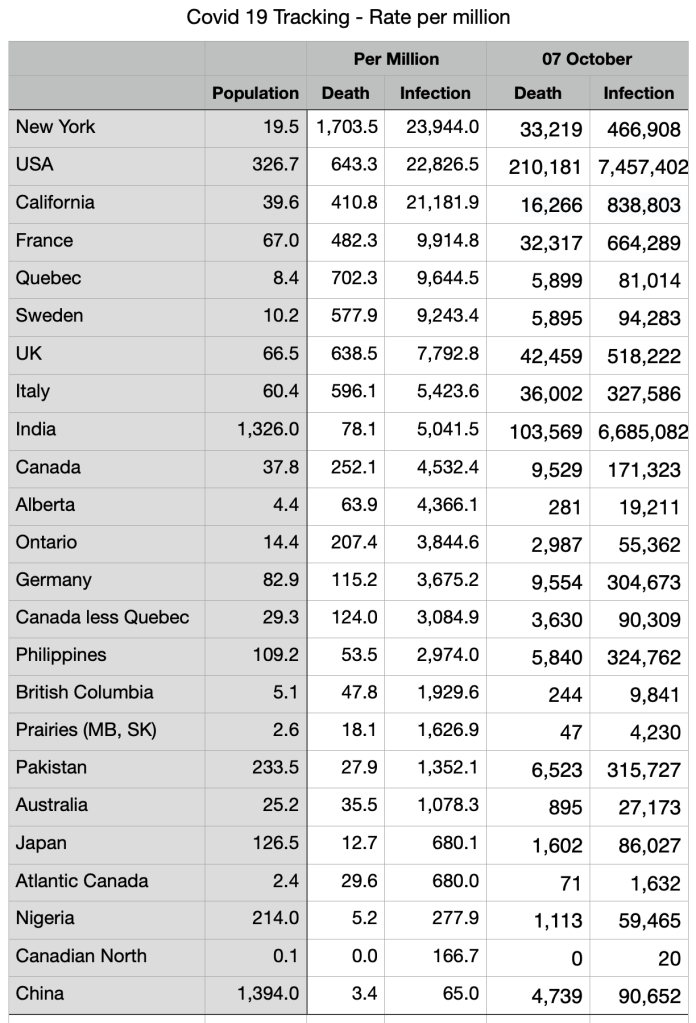
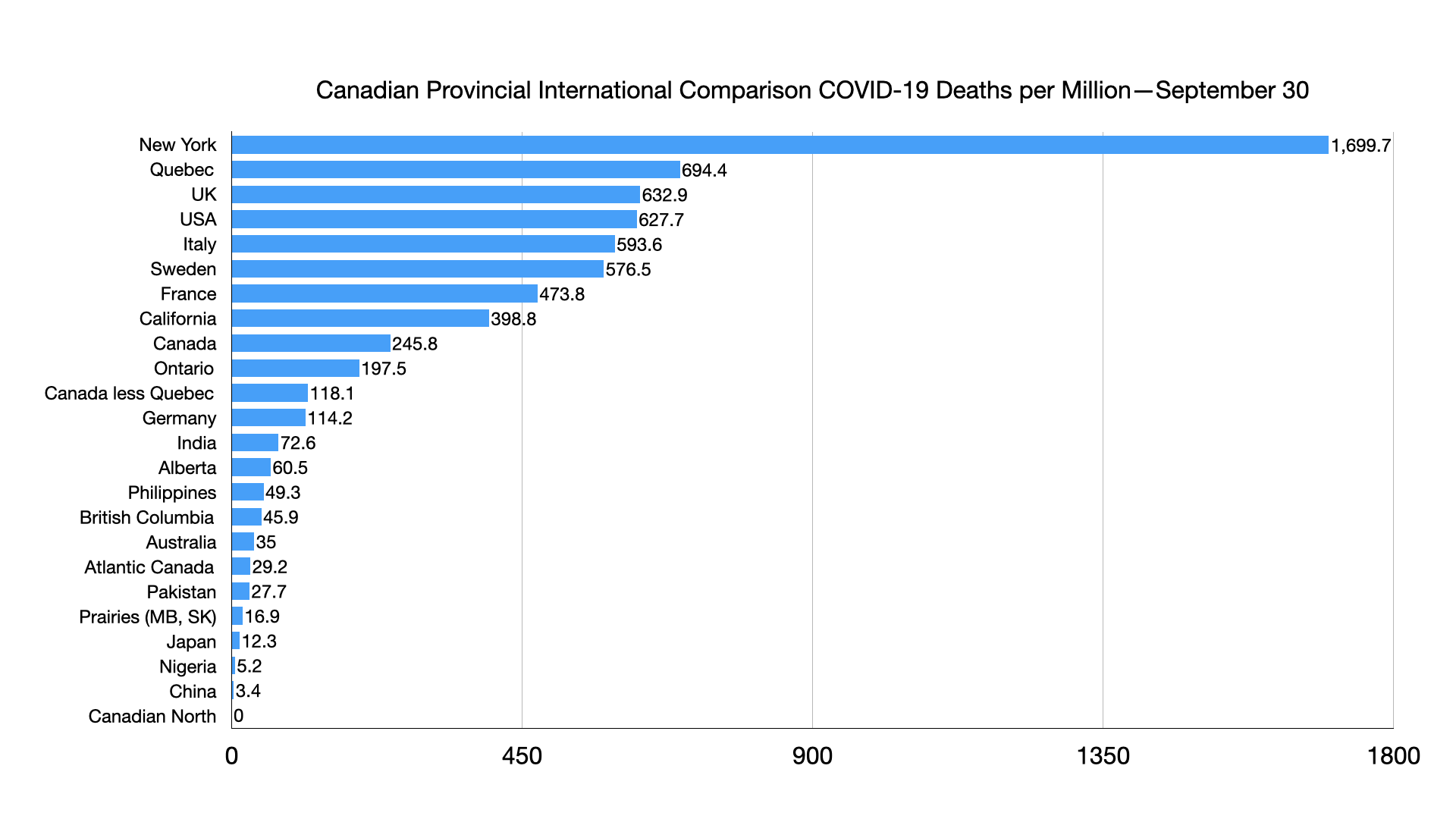
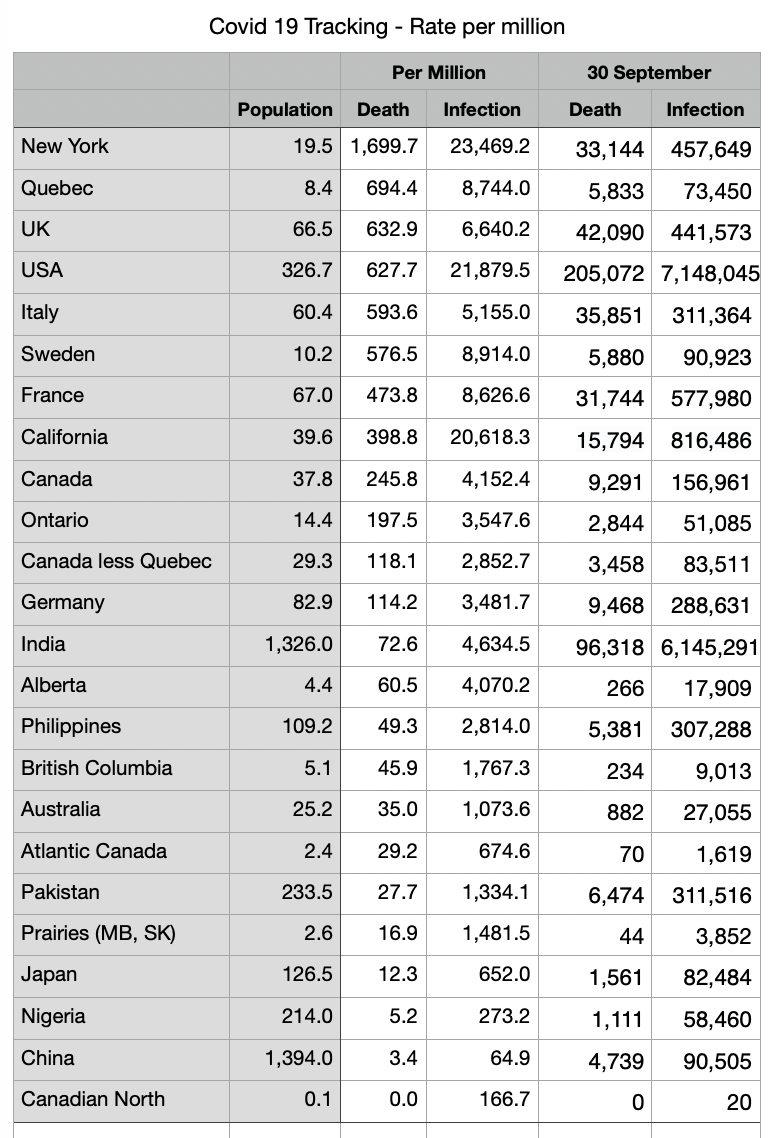
Deaths per million: USA now ahead of UK
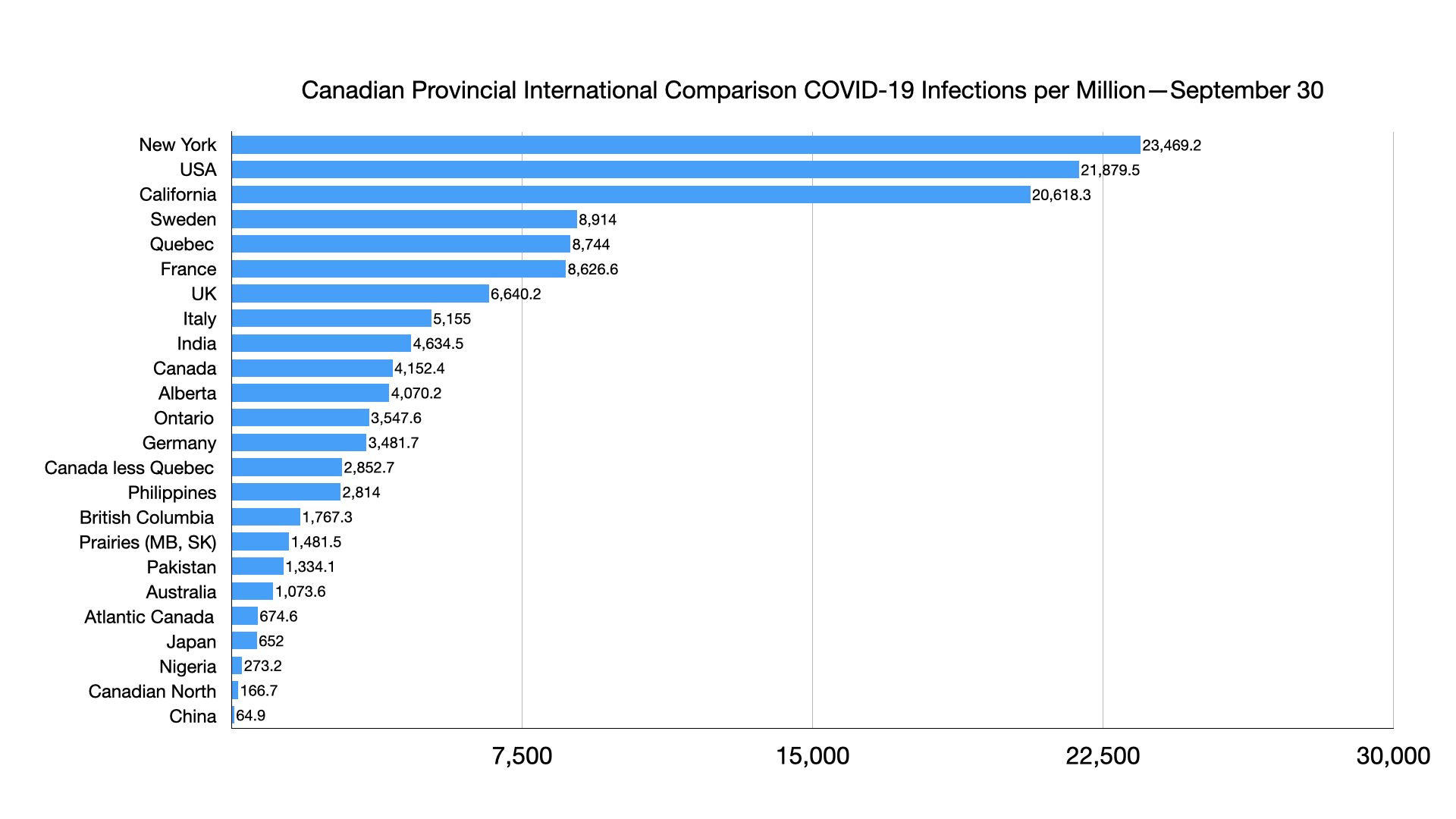
Infections per million: France and Quebec ahead of Sweden, Japan ahead of Atlantic Canada

2020/10/01 Leave a comment
Highlights:
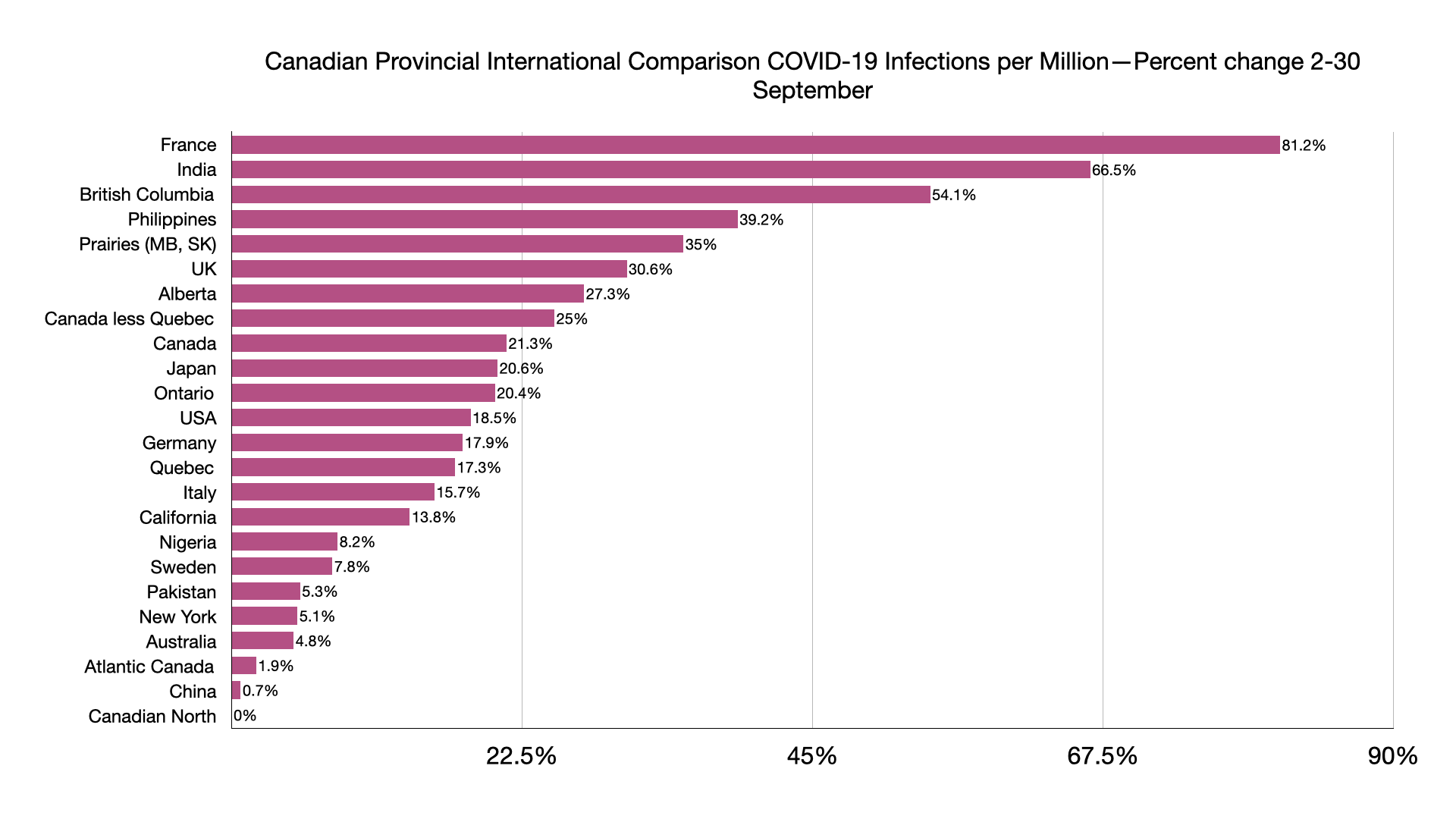
Deaths per million:Canada less Quebec now ahead of Germany
Infections per million: Ontario now ahead of Germany, Canada less Quebec ahead of Philippines
 The Globe has an editorial highly critical of the Ford government:
The German language probably has a word for the state of being surprised by the unsurprising, unprepared for the expected, and caught off guard by the danger you were on guard against. English does not have such a word. But when this pandemic is over, we are going to have to come up with one.
We’ll need it to describe what appears to be happening right now, in Canada.
Governments from coast to coast knew a second wave was coming. It was as predictable as fall. It was as expected as the rising of the sun. It was as surprising as the first snowfall – timing and severity uncertain; occurrence inevitable.
And yet, somehow, many governments have reacted like someone who forgot to set the alarm clock. Leading the parade of those surprised by the unsurprising is Premier Doug Ford’s Ontario government.
On Monday, Ontario reported 700 new cases of COVID-19, a new single-day record. Also on Monday, Ontario casinos reopened their doors to gamblers.
They say timing is everything in comedy and politics. In pandemics, too.
Also on Monday, the Ford government announced that, in response to the second wave, it would be hiring 3,700 more frontline health care workers. It’s a move that should have been made in May or June, not late September.
Still on Monday: Ontario reported processing more than 41,000 tests, but had a backlog of 49,586 waiting to be analyzed. By Tuesday, the backlog was nearly 55,000. The province, like many parts of the country, has recently seen enormous lineups at testing centres; lineups that are – how is this surprising? – driven by the predictable and predicted combination of rising infection rates and people needing to get tested to allow a safe return to school.
Yet again on Monday: The Ottawa Citizen obtained a memo showing that provincial health bureaucrats ordered a reduction in testing in some areas, owing to labs being overwhelmed. It’s another unsurprising result of too little test-processing capacity meeting growing demand for tests.
As of Tuesday afternoon, the pinned tweet at the top of Health Minister Christine Elliott’s Twitter feed still said: “It’s never been more important to get tested for #COVID19.” She’s right. The more people who get tested, the more often, the better. That should include lots of people who have no symptoms. But if everyone takes that advice to heart in the current system, where there are not enough tests or facilities to process them, Grade 3 math points to the inevitability of a surprisingly unsurprising outcome.
For anyone who remembers what Ontario went through last spring, that outcome looks all too familiar. We have lived this movie before.
Yes, Ontario is conducting several times more daily tests than it did back in April. Yes, Ontario has the second-highest provincial testing rate (Alberta is tops). There has been progress. There just hasn’t been enough.
With case numbers rising, as in the spring, and testing not keeping pace, as in the spring, this looks a lot like a sequel. The script has a disturbing amount of consistency. If it were run through plagiarism-detection software, someone would be getting an “F.”
More unsurprisingly surprising findings:
The most recent data from Toronto Public Health, as reported by the CBC, show that most people testing for COVID-19 don’t get results for at least two days. And nearly half of those who test positive are not followed up by contact tracers within 24 hours. Both of those numbers are well below the targets that need to be met for a program of heavy testing and contact tracing – which the province is supposed to have, but doesn’t – to be able to quickly find infected people before they infect others, and even more quickly track down anyone they may have infected.
In an effort to speed things up, the Ford government last week gave the green light for some pharmacies to begin administering tests to some asymptomatic individuals. The province also intends to hire more contact tracers. The mystery is why it didn’t do that months ago.
And last week, the province began rolling out plans for its response to the pandemic’s second wave. But this is like announcing in January that, in response to recent snowfalls, you plan to put out a tender for snowplows. It’s a bit late in the game.
2020/09/24 Leave a comment
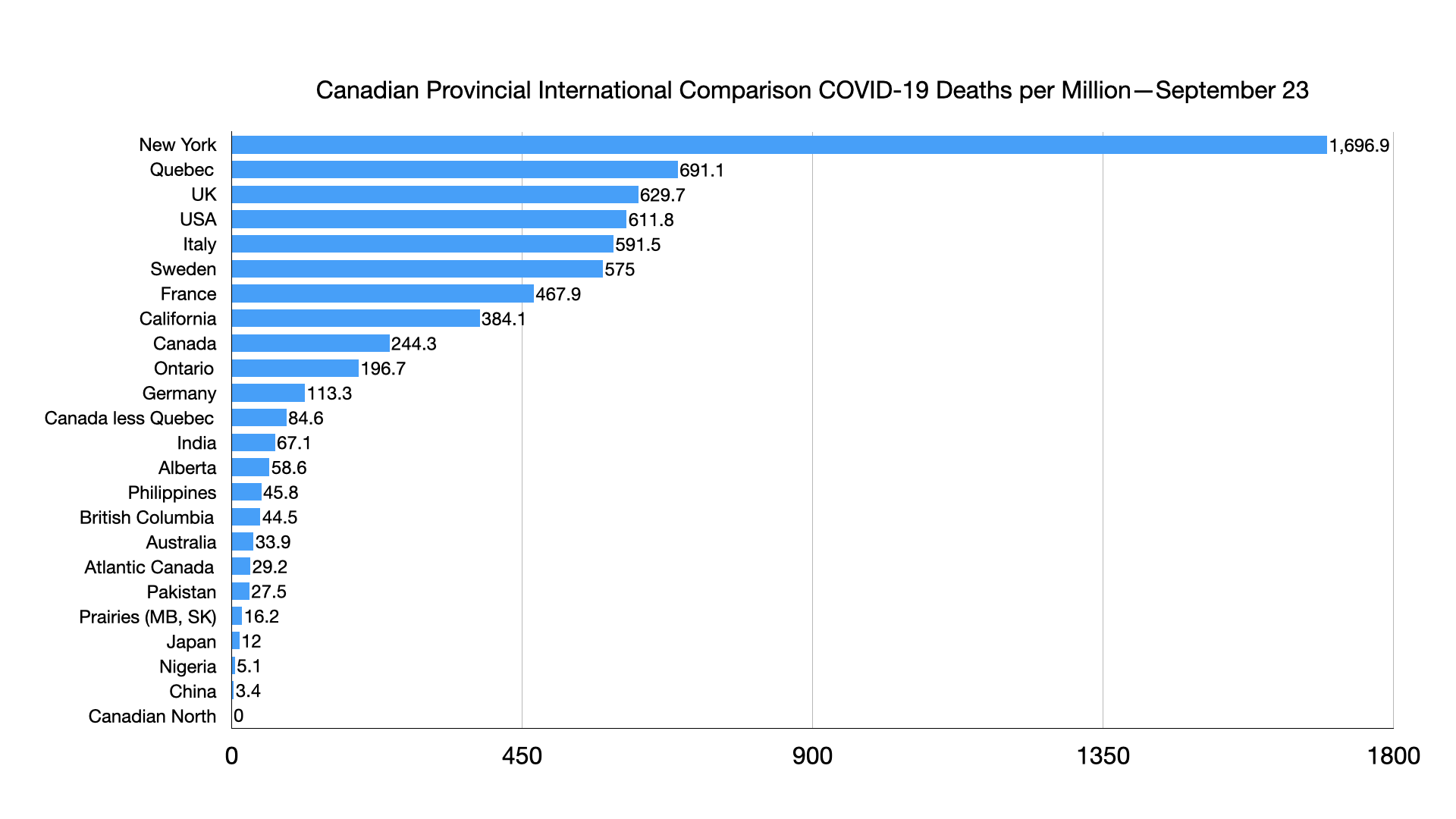
Highlights:
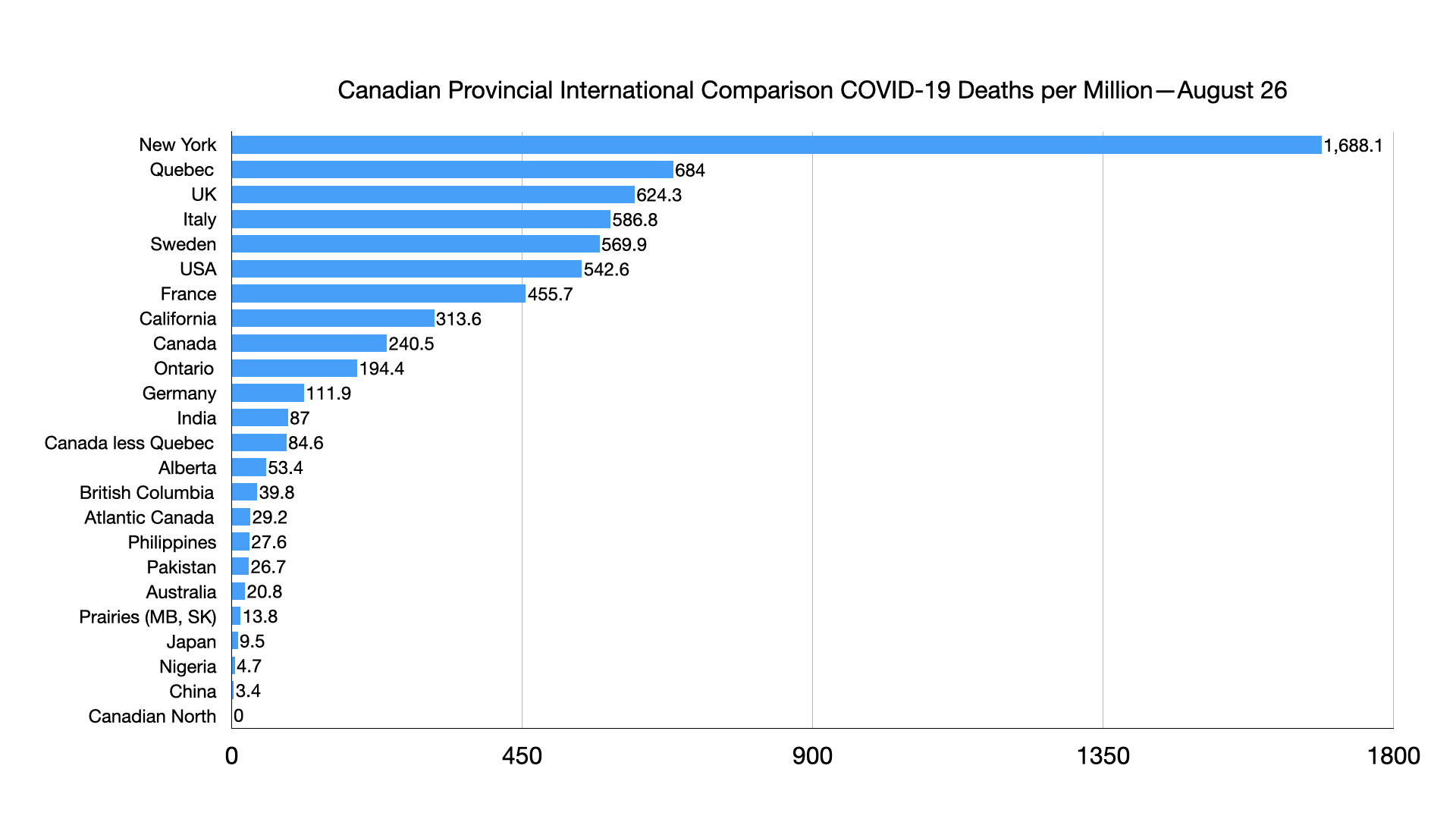
Deaths per million: Philippines ahead of British Columbia
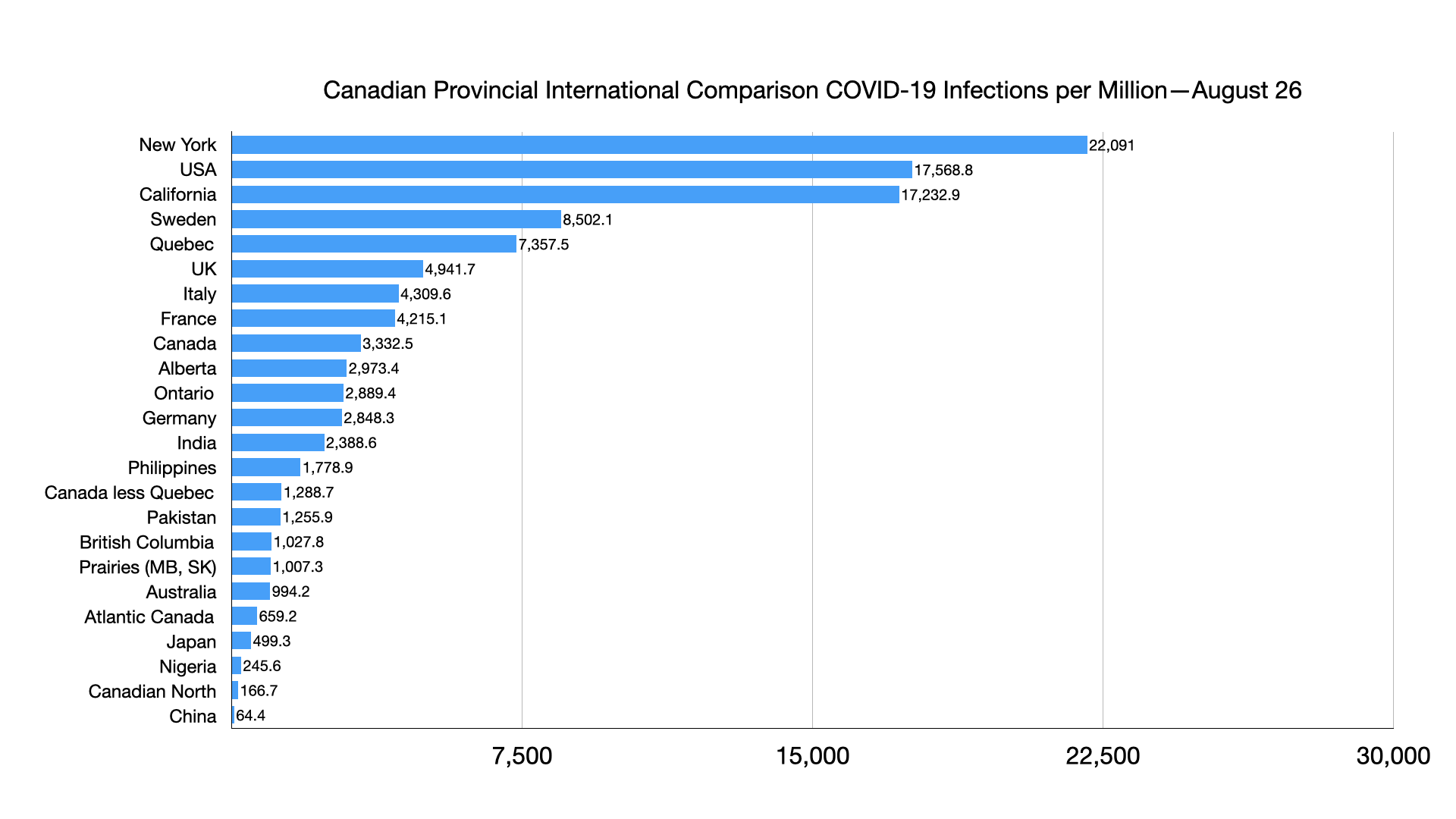
Infections per million: India ahead of Canada, Prairies ahead of Pakistan


2020/08/27 Leave a comment

Lastly, a good Globe and Mail editorial on the failures of the Quebec government in managing the pandemic (Quebec’s COVID-19 death toll is Canada’s highest, and one of the worst in the world. No, that’s not fake news):
There is no province in Canada that has done a perfect job of limiting the spread of the COVID-19 virus. But there is one province that stands out as having done the least perfect job of all, and that is Quebec.
As of Tuesday, Quebec had recorded 724 confirmed cases of COVID-19 per 100,000 people. The national average is 332 per 100,000. The province with the next highest rate, Alberta, stood at 295 on Tuesday.
The same gaps exist in the number of deaths per capita. Quebec has had 67 deaths per 100,000 people – one of the highest death rates in the world, and well above Italy, Spain or the United States. The next highest province, Ontario, is at 19 deaths per 100,000.
It may not be entirely fair to compare across jurisdictions, but Quebec Premier François Legault has invited such scrutiny by resorting to divisive tactics to distract from the painful reality of the crisis in his province.
Last week, he once again accused the veteran health reporter at The Gazette, Montreal’s English-language daily newspaper, of being biased. It was the third time he has claimed that Aaron Derfel is trying to undermine his government with false reporting.
The Premier also said that, if anglophones in Quebec are more worried about catching COVID-19 than francophones, as at least one poll suggests, it must be because they are spending their time reading Mr. Derfel’s tweets and watching CNN and other American news channels.
Attacking journalists and taking cheap shots at a minority group is no way to address a crisis that has claimed the lives of more than 5,700 Quebeckers. Columnists in the province’s French-language newspapers have rightfully pilloried Mr. Legault for trying to shoot the messenger.
Mr. Legault’s tactic has backfired in another way, too, by shining a spotlight on his government’s handling of the crisis. It’s fair to say the Premier has not had a good pandemic.
Not that it’s entirely his government’s fault. Quebec had the misfortune of scheduling its annual school spring break in late February, a week ahead of the rest of the country. Many Quebeckers holidayed in the United States and Europe just as the pandemic was picking up steam. Some experts believe Quebec’s early spike in cases was mostly bad luck.
But the curve of new cases continued to climb after lockdown was imposed in March. And Quebec’s outbreaks in long-term care homes were bigger, longer and deadlier than anywhere else in Canada.
The government’s most glaring misstep occurred on June 24, a provincial holiday, when Quebec’s public-health agency announced it would no longer release data about new cases and deaths on a daily basis – a practice common around the world – and would instead only make them public once a week.
The surprise decision came after Horacio Arruda, Quebec’s chief public-health officer, attended a provincial cabinet meeting at which the issue was discussed, raising concerns that Dr. Arruda had yielded to demands from the Legault government.
Dr. Arruda denied there was any political interference. But three days later, after much criticism from epidemiologists and francophone commentators, the decision was reversed.
In the midst of all that, Mr. Legault demoted his health minister, Danielle McCann, and replaced her with Treasury Board president Christian Dubé.
Firing your lead minister in the middle of a major crisis is never a good look, but Mr. Legault was reportedly fed up with the endless bad news battering his government.
The government has also come under fire for reopening bars in late June, causing a fresh spike in cases, and for raising the maximum number of people at an indoor public gathering to 250 from 50 as of Aug. 3, a move that has backfired in European countries and many American states.
This week it’s the government’s back-to-school plan that is drawing fire. Unlike most other provinces, Quebec students will not have to wear masks or physically distance in classrooms. And parents will not have the option of keeping their children at home to learn remotely, unless they provide a “valid medical note.”
Mr. Legault is not the only premier facing tough questions about their handling of the COVID-19 pandemic. But he’s the only one trying to make a farce of this tragedy, by blaming a reporter for reporting the news.
2020/08/20 Leave a comment
2020/08/13 Leave a comment
2020/08/06 Leave a comment
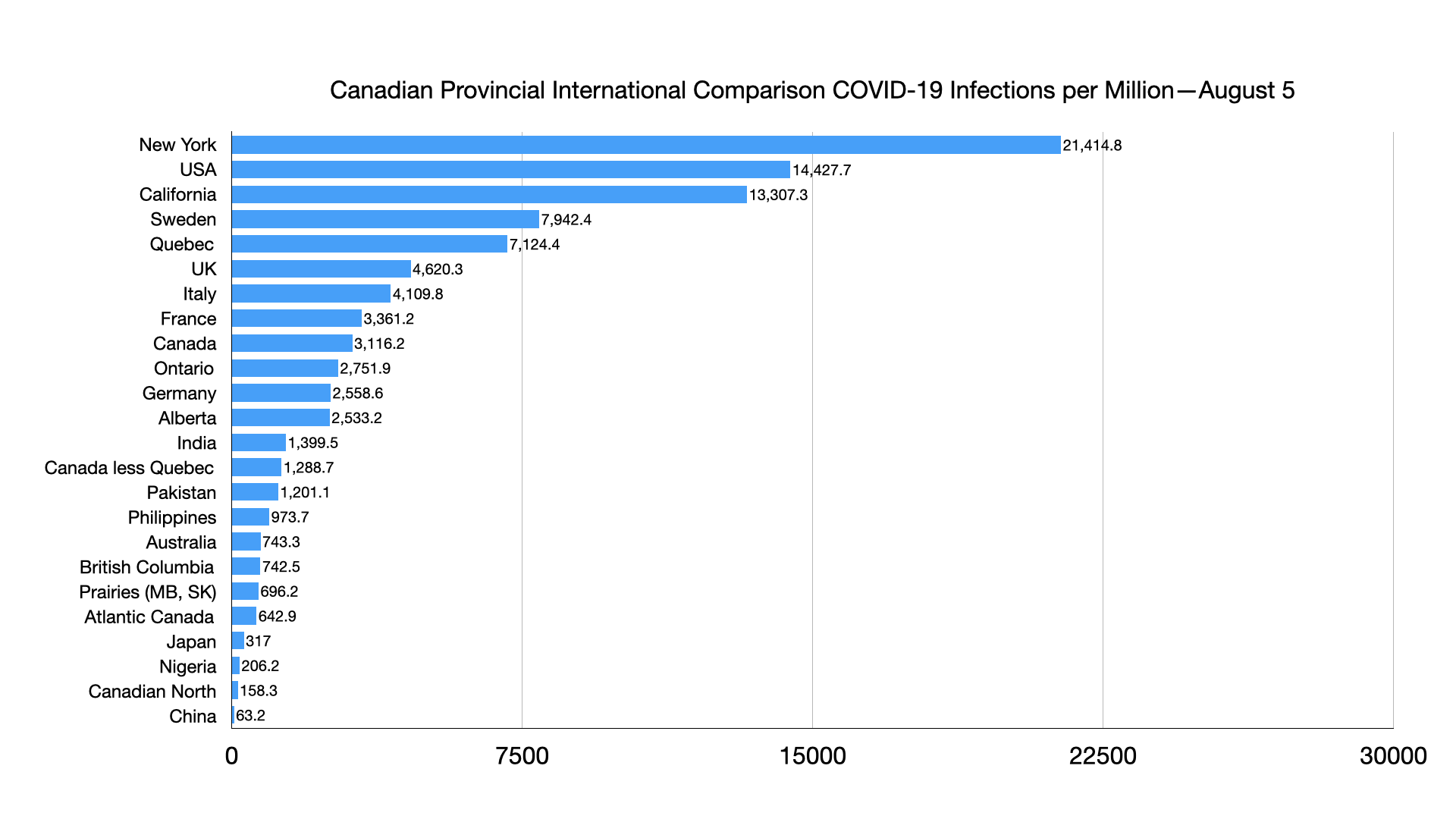
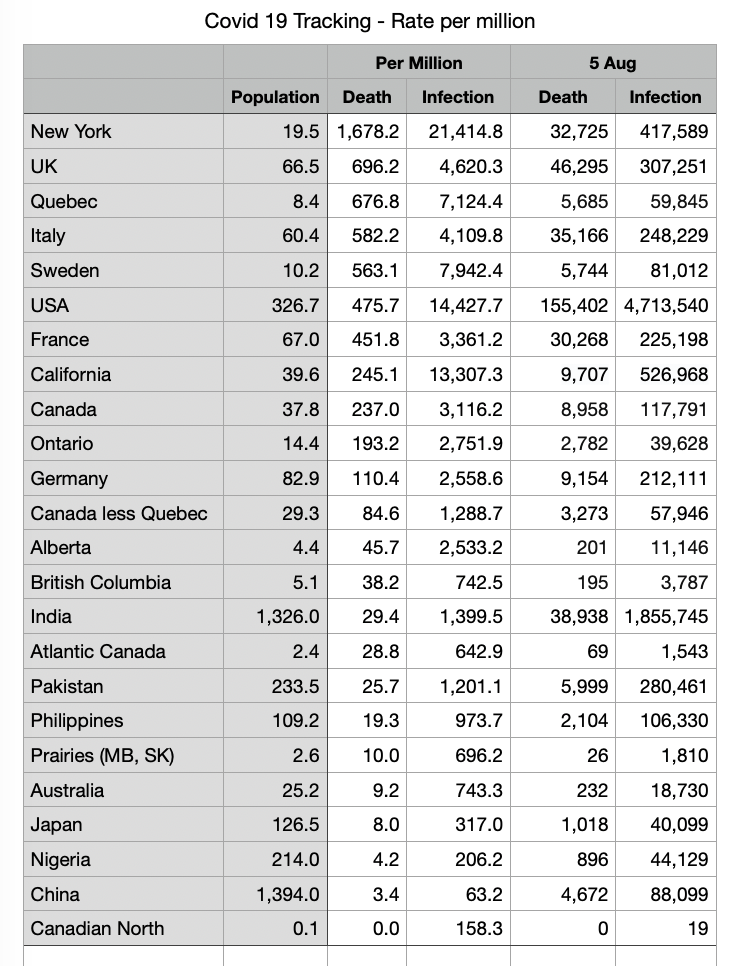
2020/07/30 Leave a comment
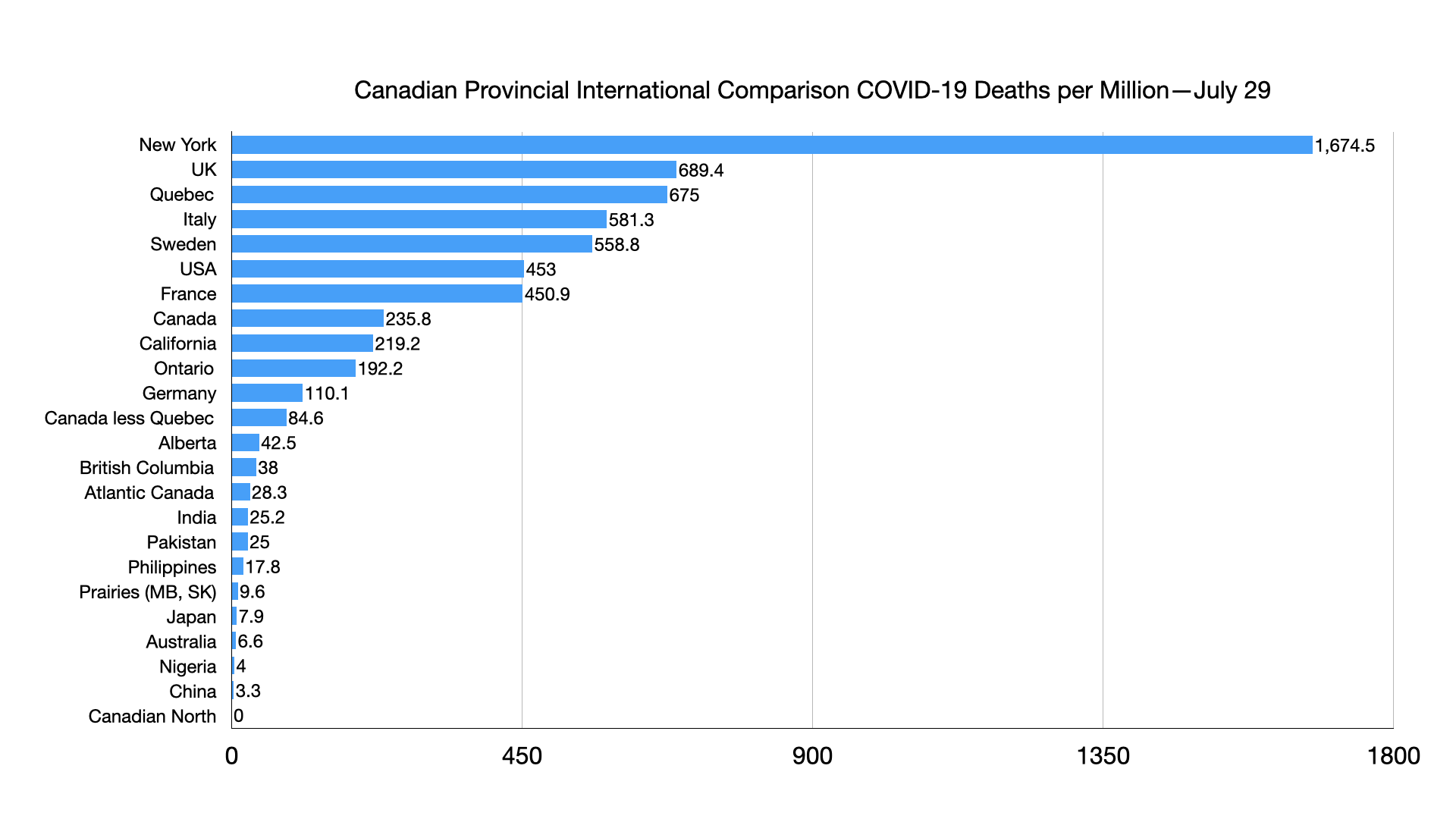
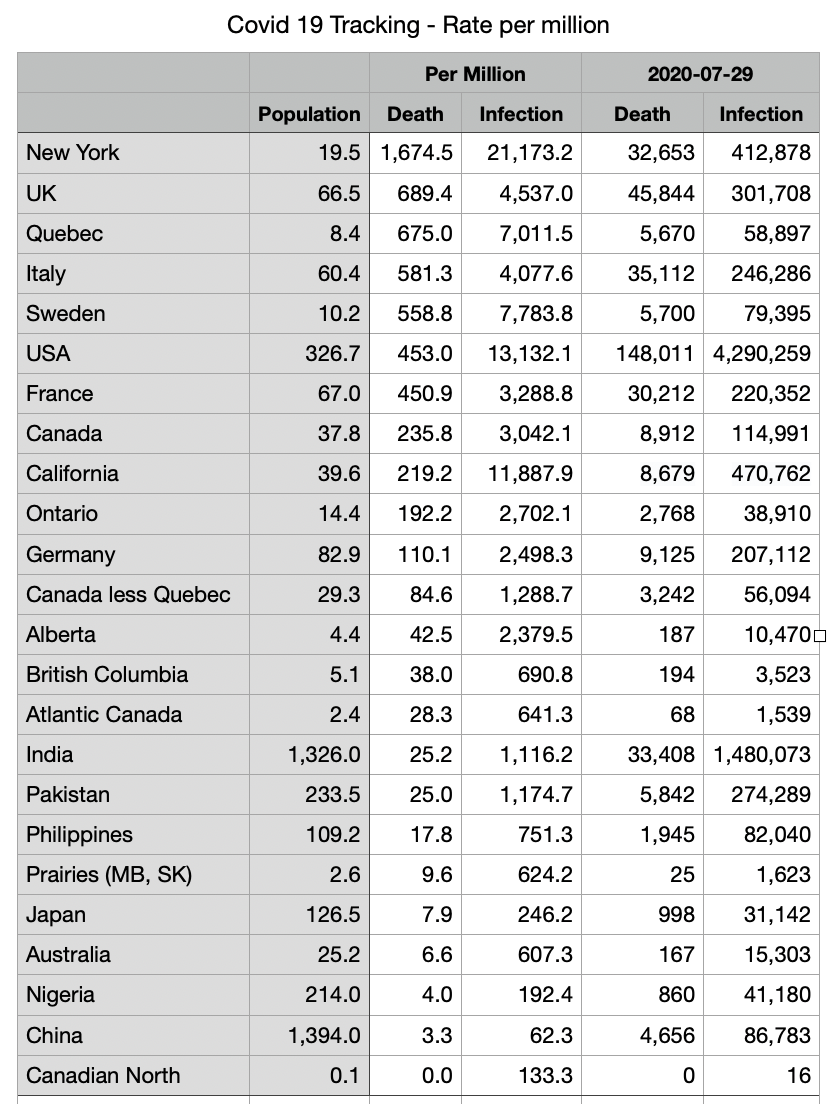

Click image for book purchase


 Multicultural Meanderings