#COVID-19: Comparing provinces with other countries 23 December Update including cumulative data

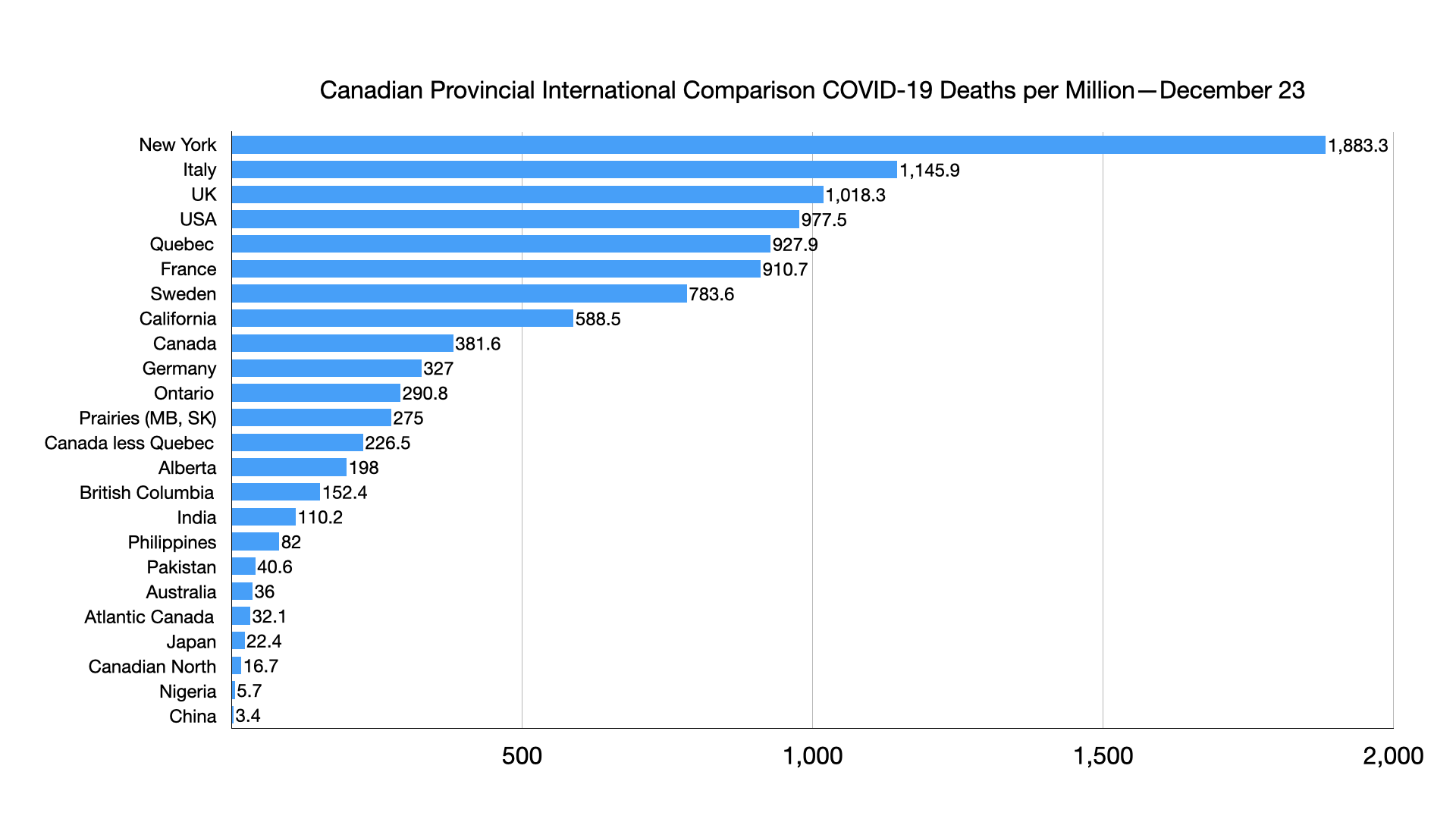
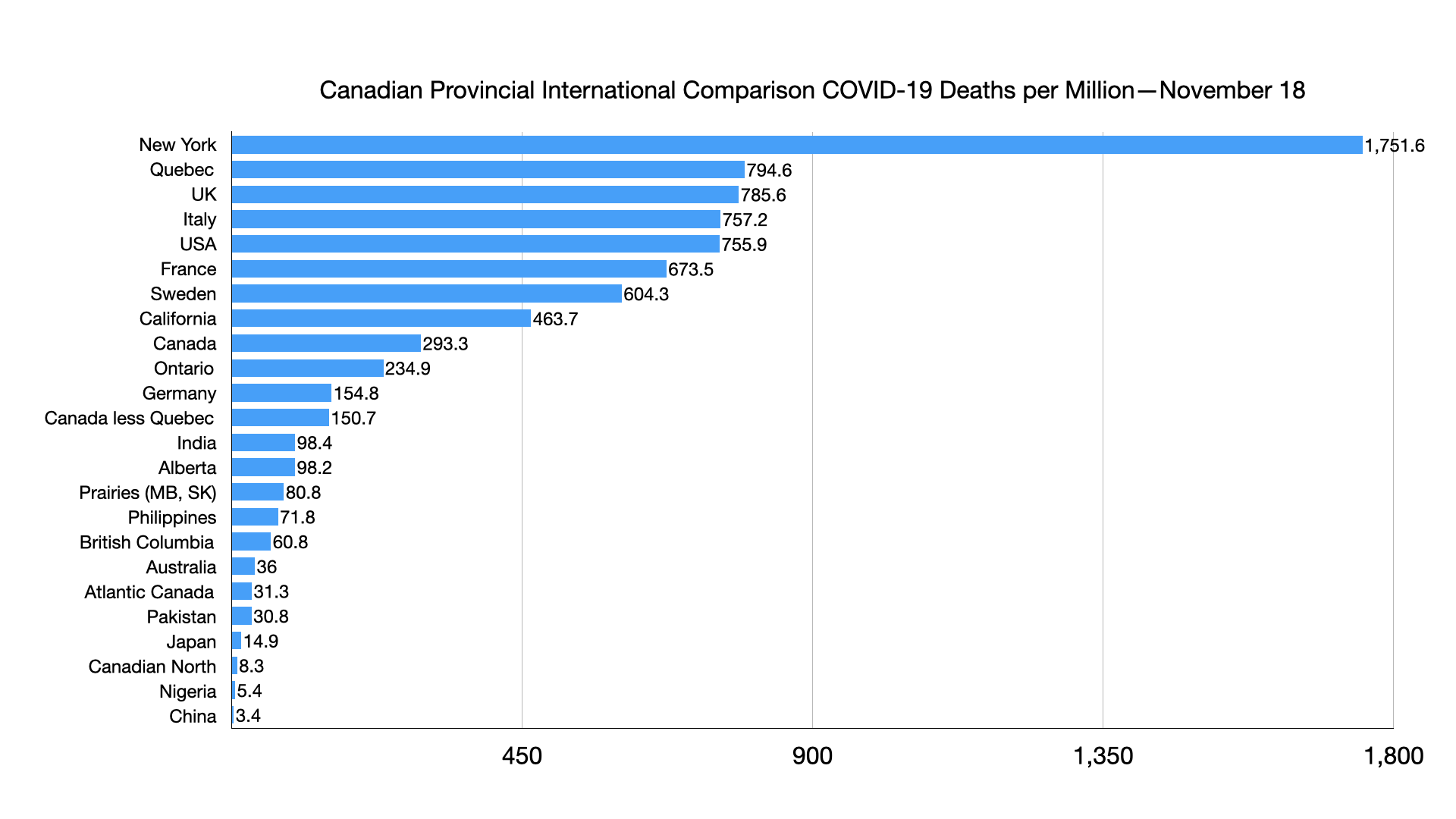
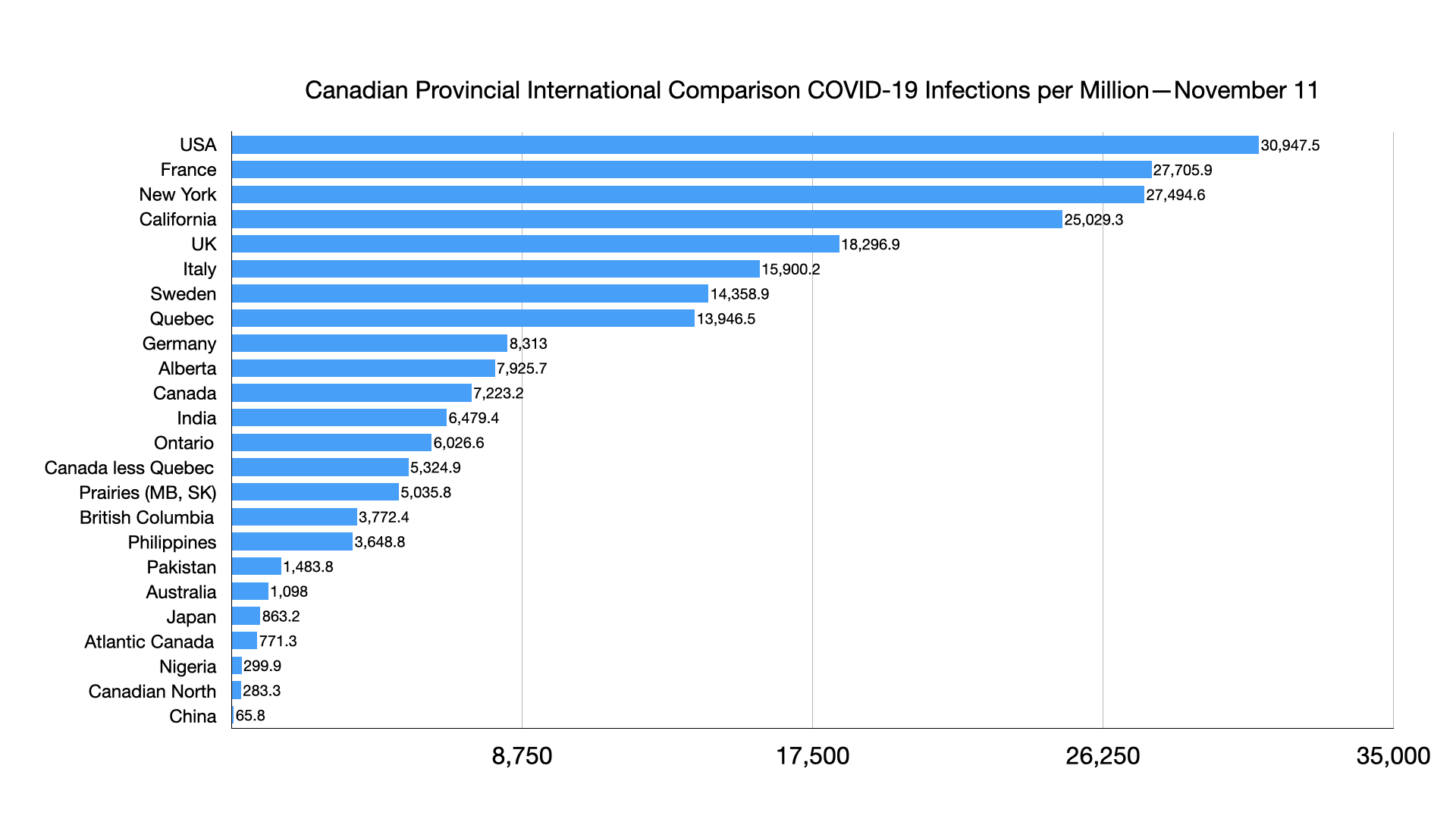
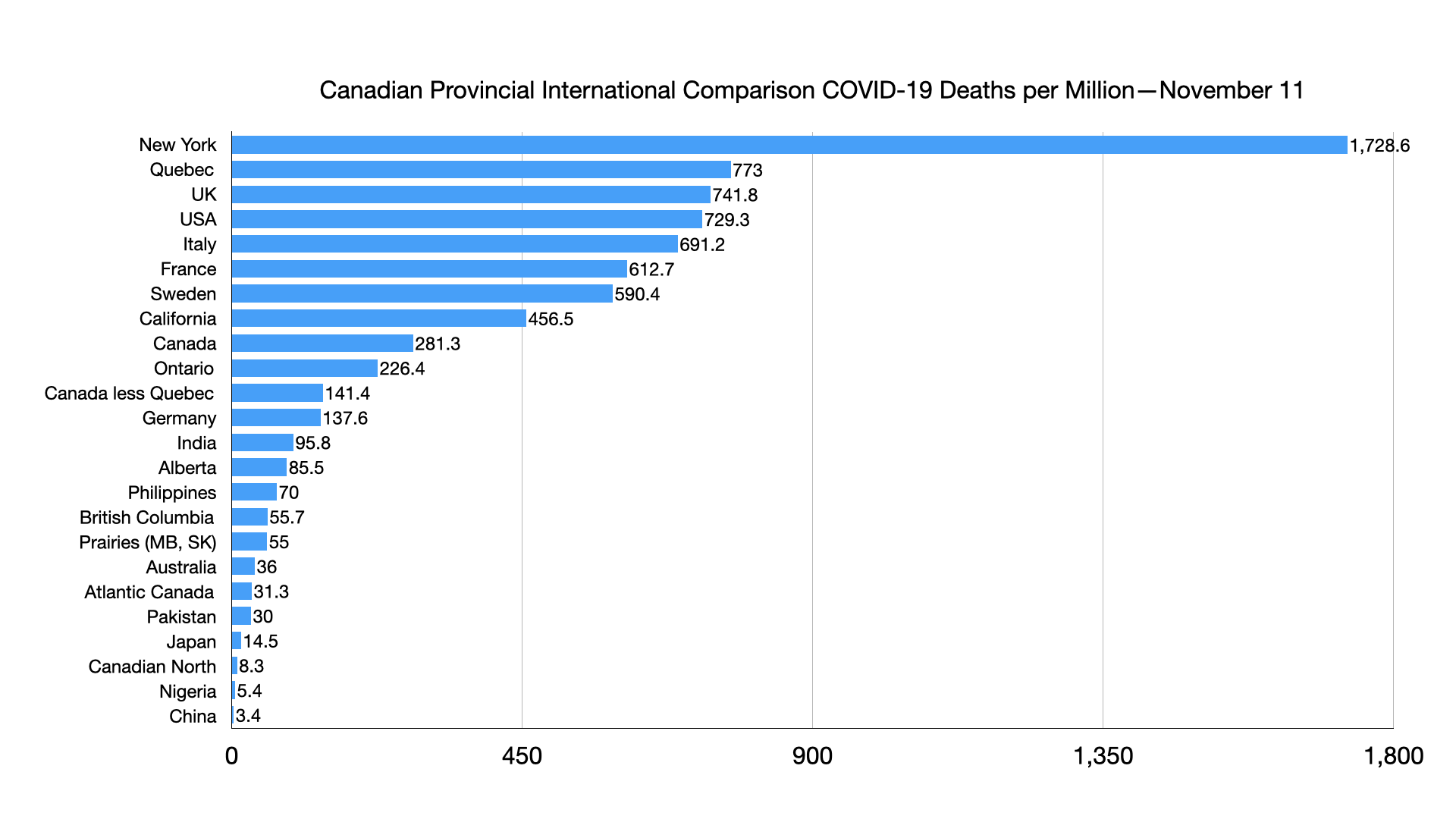
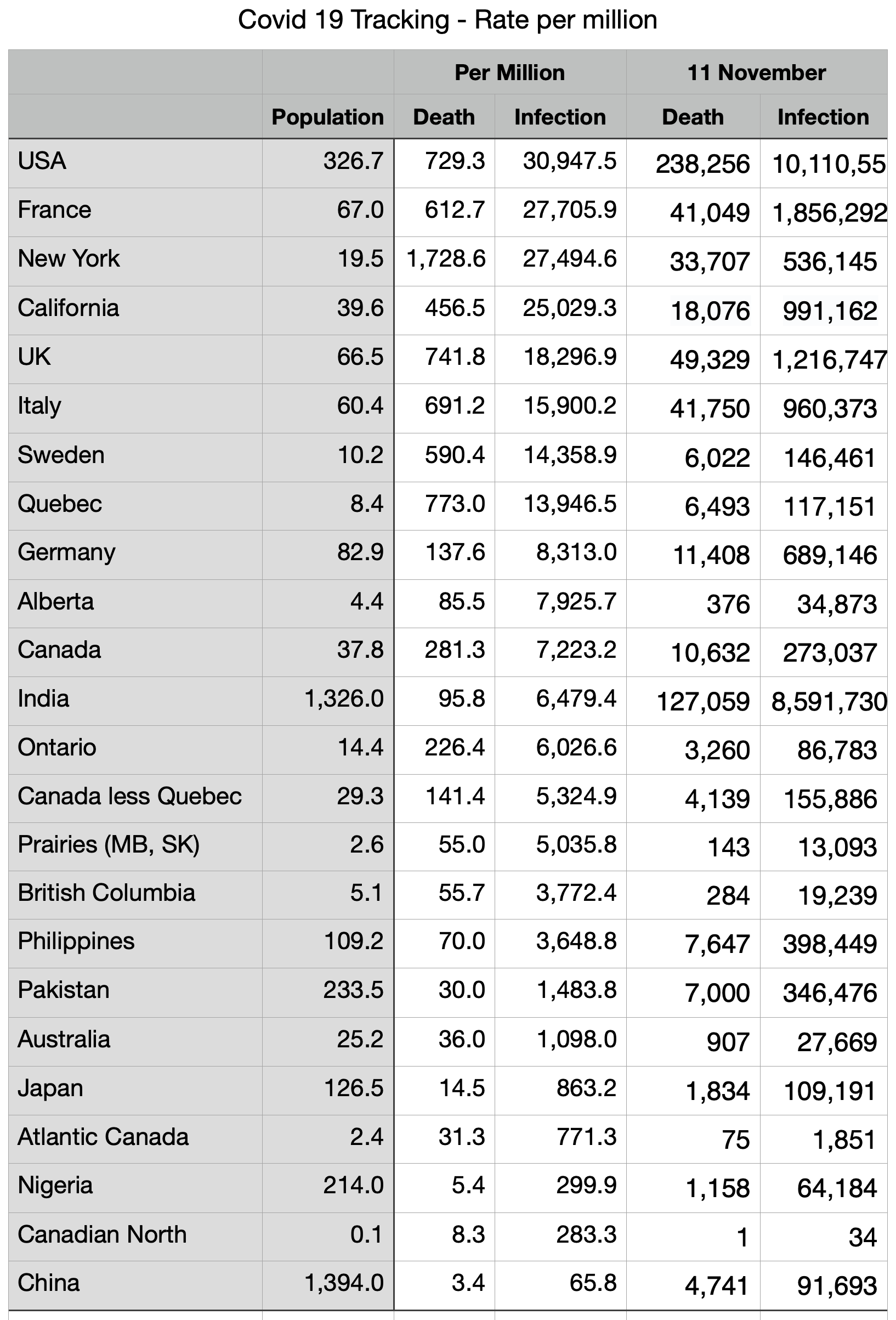
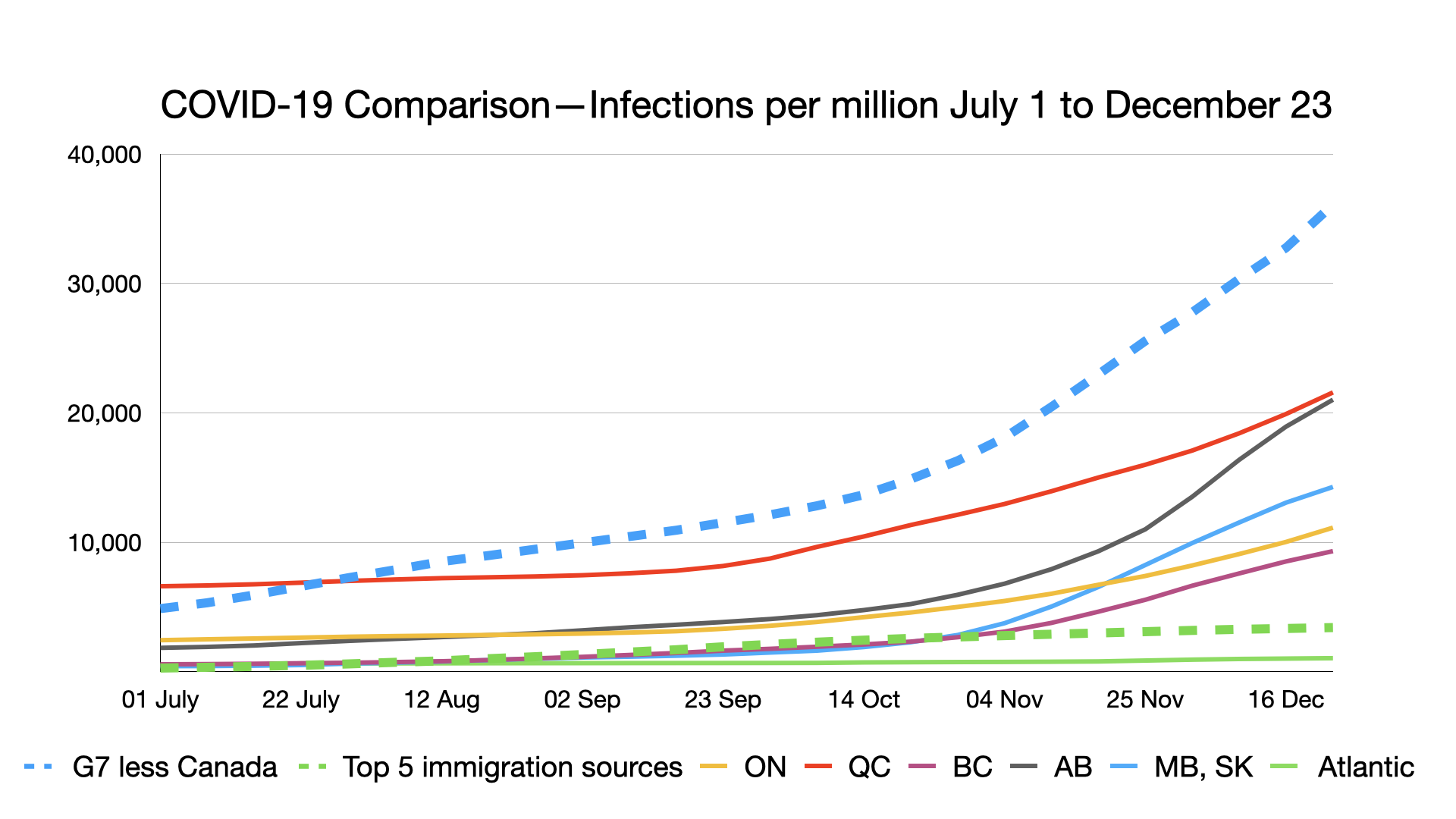
For a change and end 2020, I prepared these charts comparing infection and death rates per million for Canadian provinces with the G7 (less Canada) and top five immigration source countries (India, China, Philippines, Pakistan and Nigeria).

For the G7 average, only Japan is significantly lower. For immigration source countries, the large populations, lower infection and death rates except for India, and perhaps less comprehensive reporting, mean that rates are lower than all provinces save for Atlantic.

The charts compare the overall second-wave increase and particularly the relatively steeper increase in Western provinces for both infections and deaths.

While Canadian provincial infection rates are less than G7 (less Canada), Quebec’s death rate is higher than the G7.
And the standard weekly charts and table.

And in a rare public comment, Swedish King Carl XVI Gustaf “condemned political leaders for their experiment, branding the light-touch strategy a miserable and deadly failure.”

Remember in the early days of the pandemic, when people like Tucker Carlson and Sen. Rand Paul (R-KY) advocated that the U.S. follow the Swedish model of avoiding strict lockdowns and letting life carry on largely as normal amid the highly contagious virus?

Well, as the year ends, Sweden is coming to terms with a death toll that is approximately 10 times higher than neighboring Norway and Finland, and now its king has condemned political leaders for their experiment, branding the light-touch strategy a miserable and deadly failure.

“The people of Sweden have suffered tremendously in difficult conditions,” King Carl XVI Gustaf, who is traditionally tight-lipped on political matters, told the Swedish state broadcaster SVT. He added, “I think we have failed. We have a large number who have died, and that is terrible.”

Although it’s remarkable for a king to comment on policy, his actual comments were a statement of the obvious. Anders Tegnell, the country’s top epidemiologist who designed its anti-lockdown strategy, has himself admitted that too many people have died and the country should have done more to prevent the spread of the disease from the outset.

Throughout the pandemic, Swedes have been allowed to go to restaurants and bars with no social-distancing measures in place and, until recently, were allowed to hit the gym and send their kids to school. The country has also broken with the near-universal guidance of recommending that protective face masks be worn in public, except in hospitals.

The sight of Swedes packing restaurants and bars in the first wave of the pandemic led some commentators in the U.S. to urge their own leaders to follow Sweden’s example. That way, they said, the economy would be protected and the virus could make its way through the population and offer a good level of herd immunity to slow down its spread.

Since then, deaths in Sweden have soared well beyond similar-size neighboring countries, and Tegnell previously said there’s no sign that herd immunity is doing anything to slow down the rate of infection. And the Swedish economy still entered a harsh recession—although it was milder than those seen in most other European nations.

The rapid increase in new infections has even caused Sweden to partially abandon its anti-lockdown strategy, with the government imposing tougher rules to reduce the limit on public gatherings to eight people from 50, asking high schools to do their teaching remotely, and banning late alcohol sales. Finance Minister Magdalena Andersson warned last month that the measures will harm the economy but are necessary.

Speaking to Swedish network TV4 this week, Tegnell said he was shocked by the second wave of the pandemic, saying, “I think many, with me, are surprised that it has been able to come back so strongly.”

A poll published Thursday showed that support for Tegnell and his approach has collapsed over the past two months.

Source: Swedish King Carl XVI Gustaf Brands His Country’s Anti-Lockdown Strategy as a Deadly Failure

#COVID-19: Comparing provinces with other countries 16 December Update

Main news continues to be with respect ongoing sharp spike in infections in most provinces and countries along with consequentdeath rate increases:


Weekly:
 
Infections per million: California ahead of New York, Sweden ahead of Italy (the Swedish model keeps on looking worse by the week)
 
Deaths per million: USA ahead of Quebec, Prairies ahead of Canada less Quebec


And Sun Media’s Brian Lilley painting a slightly more positive picture of Ontario than warranted (Ontario’s relative position within Canada reflects the upsurge in Western Canada):

If you listened to much of the media and the opposition parties, you’d think that Ontario was handling the COVID-19 crisis worse than anywhere in the country — perhaps worse than much of the world.

Despite all the problems that Ontario has faced, and I have written extensively about those, compared to our neighbours and similar jurisdictions, the province continues to perform well in the face of a horrific virus. This thought was brought to mind as I watched the first vaccines being administered. In Ontario, it was a nurse at the University Health Network giving a shot to a personal support worker from a long-term care centre.

Premier Doug Ford was nowhere to be found.

In neighbouring New York State, Gov. Andrew Cuomo actually conducted a live video conference with the nurse getting the first shot, inserting himself into the story in a way that only Cuomo can. The New York governor continues to receive praise for his handling of COVID and recently received an Emmy for his press conferences during the pandemic.

The media and the American establishment love Cuomo and his handling of the pandemic; it’s a shame his record is so abysmal. More on that in a moment.

Listening to opposition leaders here, you would think Ontario was in far worse shape than neighbouring New York.

“Today’s exploding COVID cases should be a wake-up call for Mr. Ford,” NDP Leader Andrea Horwath tweeted.

Ontario Liberal Leader Steven Del Duca said that Ford’s priorities this fall were not looking after the people.

“He was focused on helping his buddies and forgot about the rest of us,” Del Duca said Tuesday.

When it comes to critiquing Ford’s handling of the pandemic, I’ll take a back seat to no one. I’ve been critical of his handling of long-term care, the length and style of his lockdowns and the collateral damage they have wrought, but criticism needs to be based in some kind of reality.

Could Ontario have done better in dealing with long-term care in the first wave? Absolutely. The province though made decisions based on the information before them. After watching emergency rooms be overwhelmed in China, Italy, in New York City, the province put scarce resources into hospitals. COVID-19 hit differently here than elsewhere: the general population was ready, a small portion of our long-term care homes were not.

The majority of homes still have not had an outbreak.

Now, back to that comparison.

On Tuesday, Ontario, with a population of 14.7 million reported 2,275 cases. This was the highest ever, due in part to a change in how cases are counted, but let’s take the number at face value. There were also 921 people in hospital and 20 deaths. New York State, with a population of 19.4 million, reported 10,353 new cases, 5,982 people in hospital and 128 deaths on Tuesday.

Deaths from COVID-19 would be the stat that matters most and while Ontario has 27 deaths per 100,000 of population, New York State has 183 per 100,000.

Within Canada, Quebec is the only province the comes close to Ontario in terms of population, international travel, urban density and other factors. With a population of about 8.5 million, Quebec has recorded 89 deaths per 100,000 of population or 3.3 times the rate of Ontario.

Other neighbours with similar populations fare no better.

Ohio is at 84 per 100,000, Pennsylvania at 98, and Michigan at 113.

In fact, were Ontario an American state, we would be the 45th lowest state in terms of COVID deaths per 100,000 and were we an independent country, we would be below most of the industrialized world. Only Japan would be among the G7 nations that would be lower than Ontario.

The province can always do better, and it must.

That requires targeted and constructive criticisms rather than what the opposition is offering up.

Source: LILLEY: Ontario outperforms much of the world in dealing with COVID

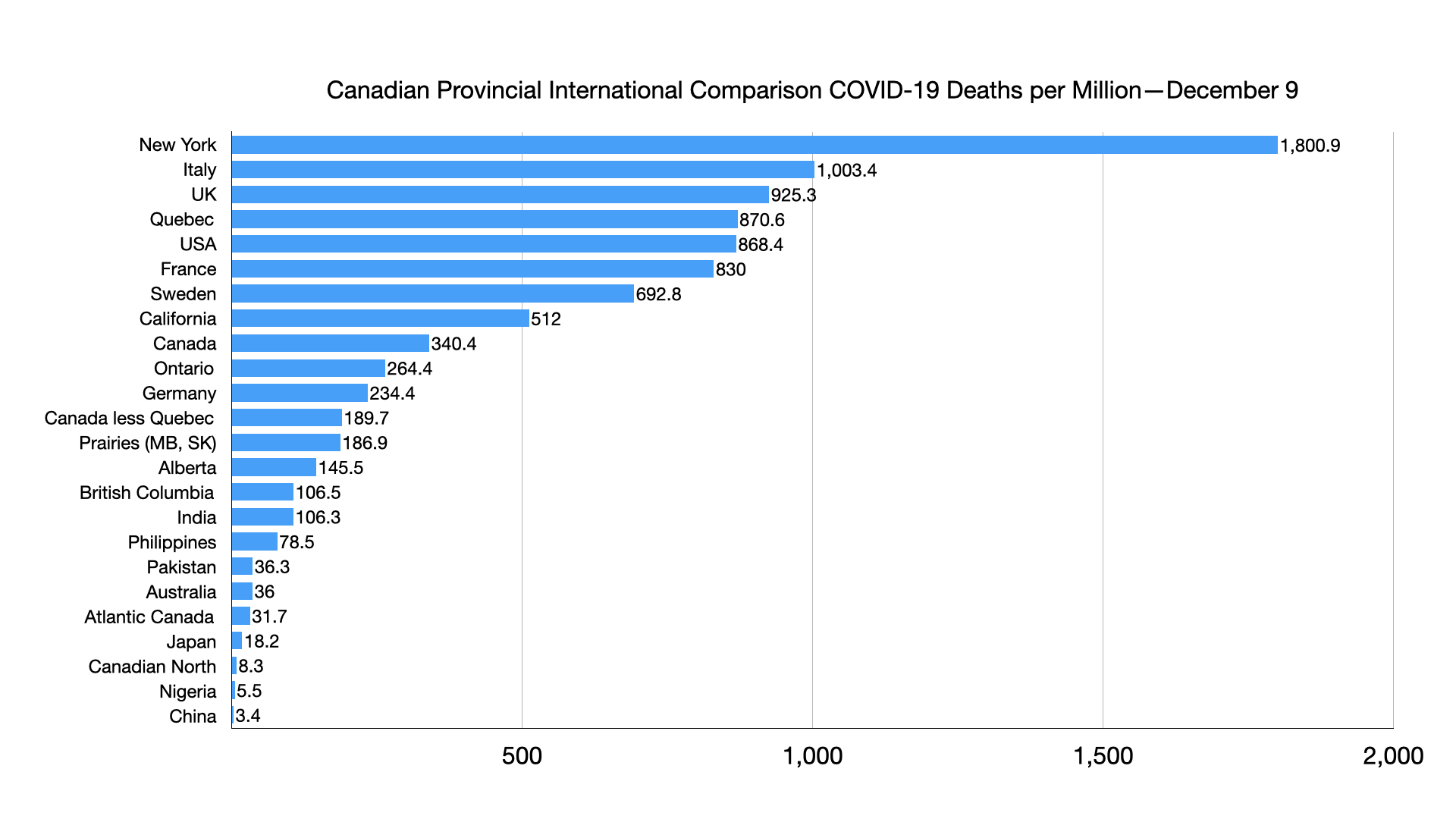
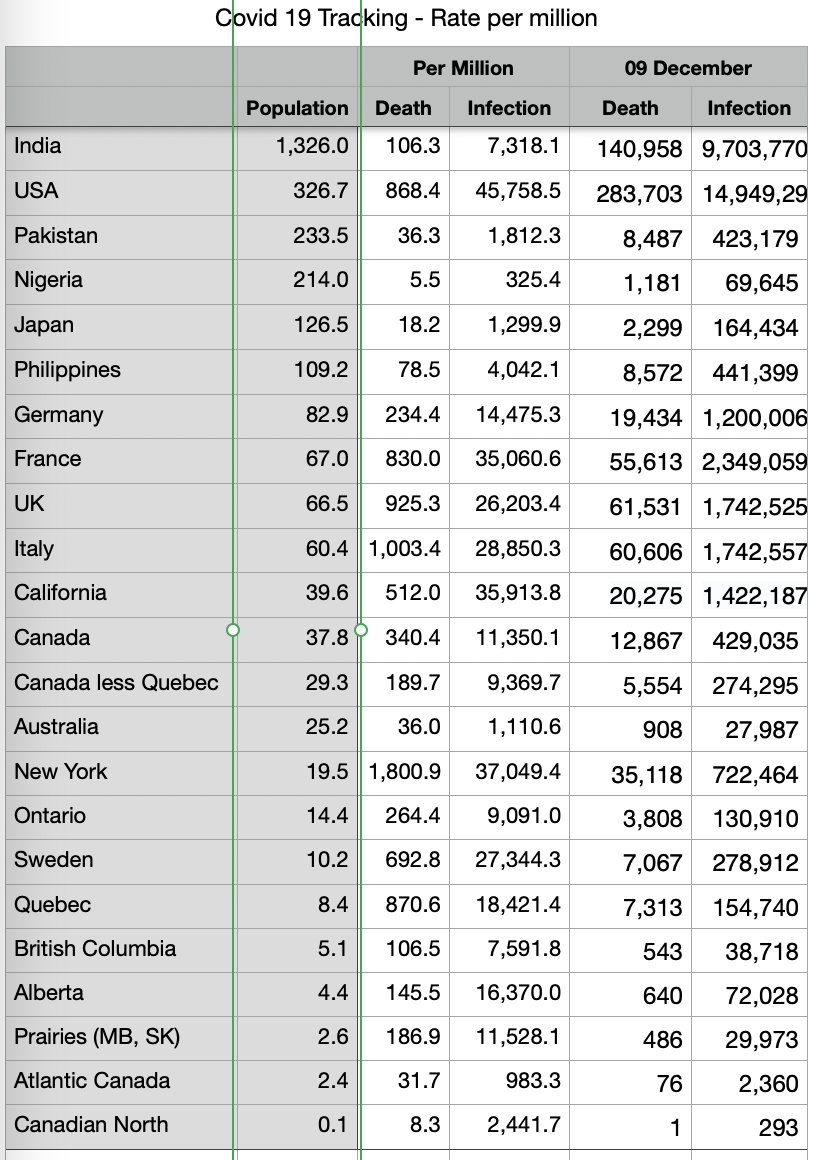
#COVID-19: Comparing provinces with other countries 9 December Update

Main news continues to be with respect ongoing sharp spike in infections along with death rate increases:

 
Weekly:
 
Infections per million: New York and California ahead of France, Sweden ahead of UK, Prairies ahead of Canada, Canada less Quebec ahead of Ontario, British Columbia ahead of India
 
Deaths per million: British Columbia ahead of India, Pakistan ahead of Australia
 
 
COVID Comparison Chart.002COVID Comparison Chart.003

And good commentary on Alberta Premier Kenney’s belated recognition of reality:

After months of pleading with Albertans to take “personal responsibility” to stop the spread of COVID-19, Premier Jason Kenney has finally taken personal responsibility himself.

On Tuesday, he reluctantly announced the kind of sweeping COVID-19 restrictions he had been tersely rejecting for weeks.

He is now ordering everyone to wear a mask in public spaces everywhere in Alberta. And nobody is allowed to hold any social gatherings outside.

You can say “hi” to your neighbour walking the dog but stay two metres apart and don’t dawdle. Starting Sunday, you can only get take-out from restaurants and pubs. No in-person dining. Casinos are closing as are bingo halls, raceways, bowling alleys, pool halls, fitness centres, spas, gym, indoor skating rinks.

Retail stores can stay open but only allow in 15 per cent capacity at a time.

The list goes on. Odds are, if you enjoy doing it, it’s cancelled, postponed or diminished.

As Kenney recited the new restrictions, he must have felt like he was reading the Riot Act to Albertans.

And, in a sense, he was.

As the pandemic grew in the past month from bonfire to wildfire, Kenney had tried to argue his way through the crisis by ignoring pleas from physicians, ridiculing the NDP opposition, and insisting Albertans would bring the crisis under control by taking “personal responsibility.”

In the end he was done in by the might of two factors: freedom-loving Albertans who didn’t take the COVID-19 virus seriously; and the COVID-19 virus that didn’t take freedom-loving Albertans seriously.

Adding those two together gives you the inescapable math of a pandemic.

“The recent surge in COVID-19 hospitalizations will threaten our health-care system and the lives of many vulnerable Albertans unless further action is taken now,” said Kenney.

“With the promise of a vaccine early in 2021, we can see the end of this terrible time. But all Albertans must take this more seriously than ever by staying home whenever possible, and following these new measures.”

Even though Kenney was speaking to all Albertans, he focused particular attention on those who will resent the new measures. They’re more likely to live in rural areas, reject government interference in their lives, and preach self-sufficiency. In other words, United Conservative supporters. By refusing to introduce tougher restrictions for weeks, Kenney was bending over backwards to placate his political base.

But the inexorable math of COVID-19 has forced Kenney to demonstrate he has a spine.

“To many people, these policies, these restrictions seem unjust,” said Kenney. “I’ve made no secret of the fact that Alberta’s government has been reluctant to use extraordinary powers to damage or destroy livelihoods in this way. It is why we have stressed education together with personal and collective responsibility from the very beginning and it’s why we tried to balance the protection of lives and livelihood rather than resorting to damaging measures as a first resort.”

Kenney also announced more money to help small businesses survive the new measures. That is a great idea but it was a great idea when critics suggested it weeks ago, along with the very restrictions Kenney announced Tuesday.

Better late than never?

Understandably, Kenney bristled at questions from journalists about whether he might be responsible for the COVID deaths of Albertans because he didn’t lock down the province sooner. Kenney said it would be a “mistake” to draw simple conclusions during such a complicated time.

But it is a question that will dog him. And NDP MLAs will no doubt be helpfully re-asking the question whenever a microphone or TV camera is within hailing distance.

“The lockdown announced today comes late,” said NDP Leader Rachel Notley after Kenney’s news conference. “We could have acted four weeks ago. Since then, an additional 317 people have died.”

Notley will be wielding this rhetorical knife through the next election.

Kenney might be thinking “better late than never” and while that might be great when talking about filling a pothole or repairing a school roof, it’s not so great when talking about enacting more precautions during a pandemic that’s killing people daily.

Kenney’s new restrictions will last four weeks. That will take us through the Christmas holiday and into the new year.

During Tuesday’s news conference, Doug Schweitzer, the minister of jobs, economy and innovation, happily declared “a vaccine is almost here” as if the pandemic will suddenly end Jan. 5 when Alberta is scheduled to start inoculations against COVID-19.

The reality is that, because of logistics and supply issues, during the first three months of 2021 only about 10 per cent of Albertans will receive vaccinations, mainly health-care workers and the elderly.

The rest of us will have to wait and continue to wear masks, wash our hands, and practise social distancing for many more months. Perhaps by then enough Albertans will know how to practise “personal responsibility” without Kenney having to read us the Riot Act.

Source: https://www.cbc.ca/news/canada/edmonton/opinion-thomson-covid-kenney-blinks-1.5833751?cmp=rss

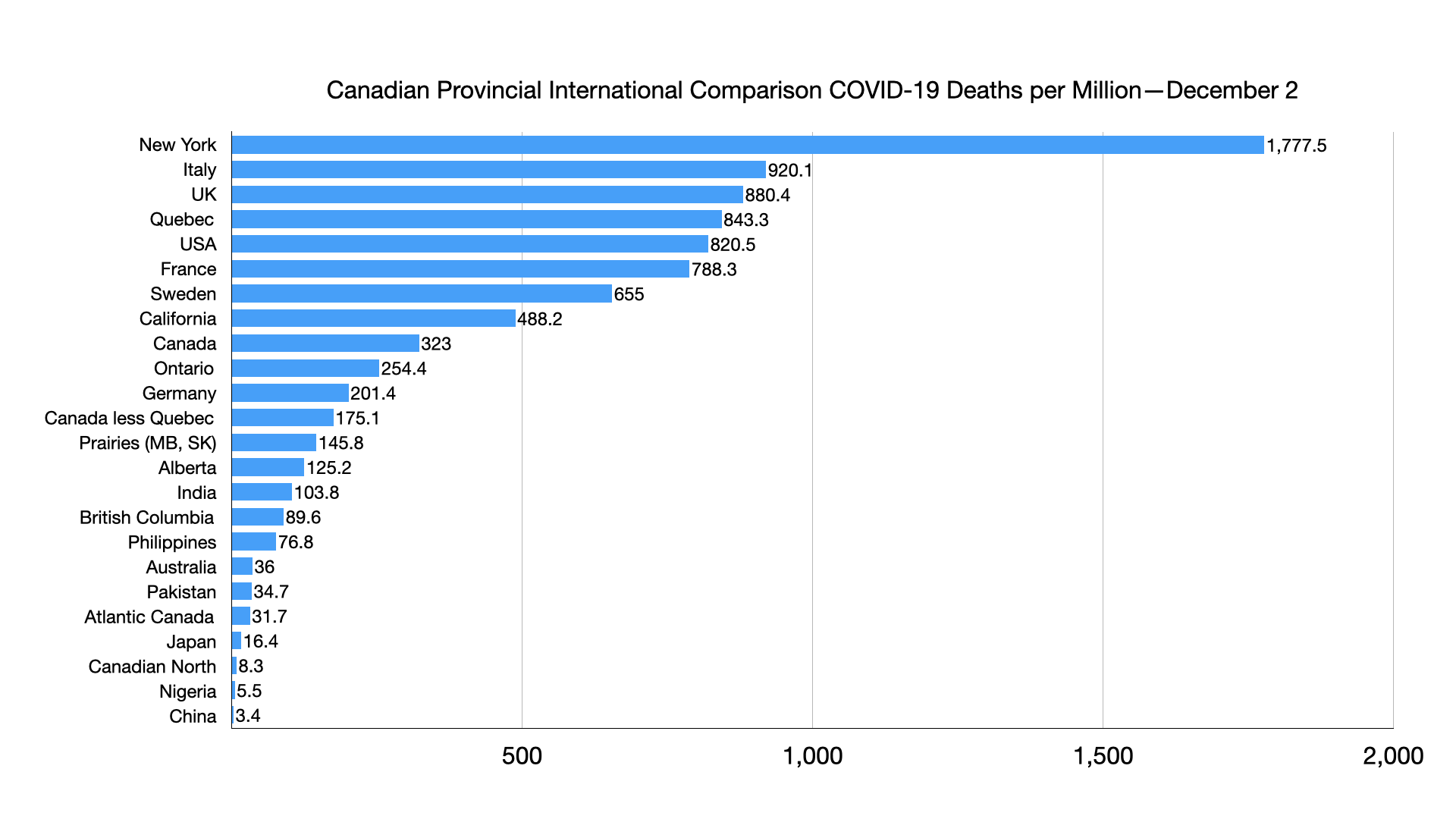
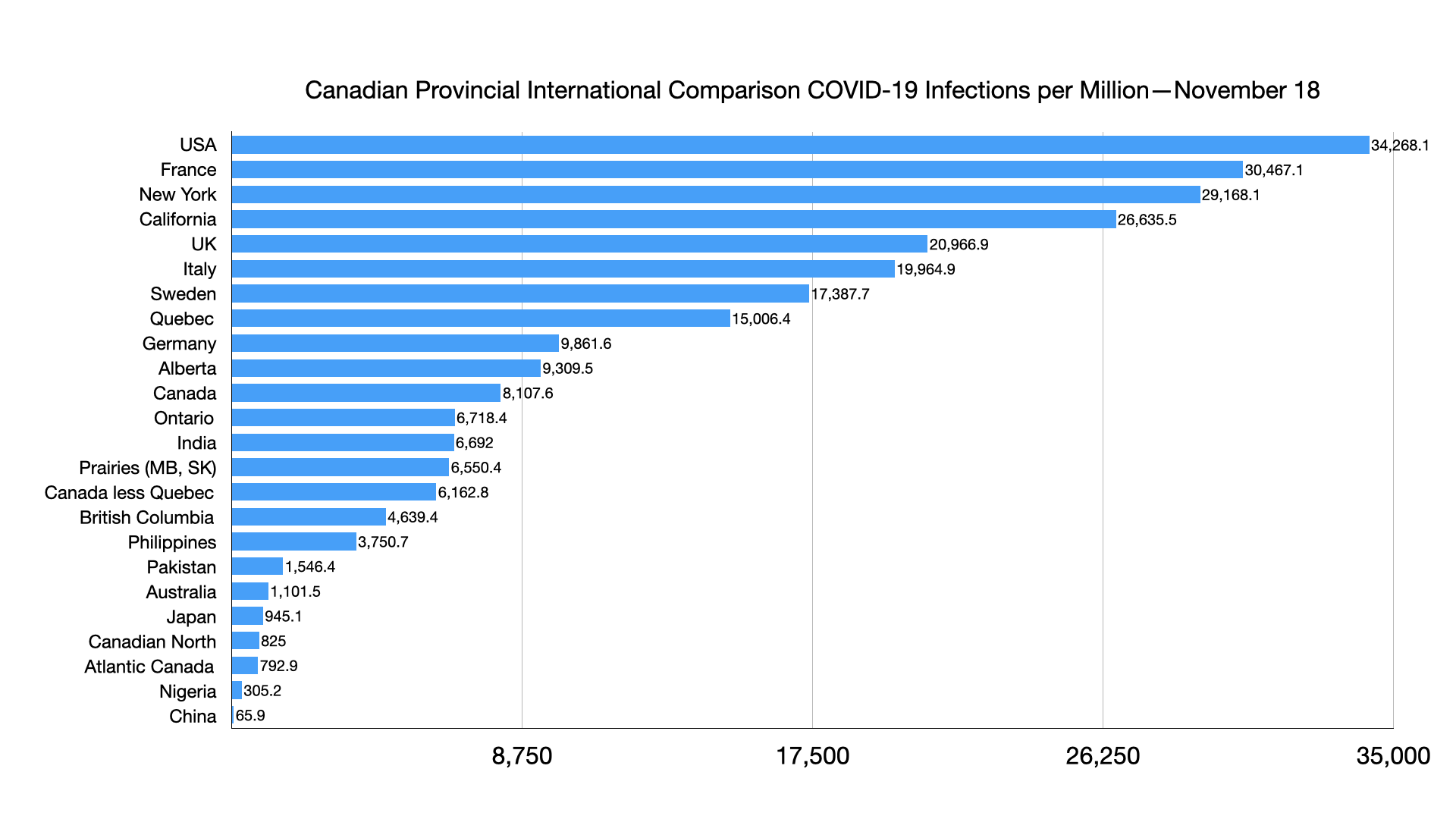
#COVID-19: Comparing provinces with other countries 2 December Update

Main news continues to be with respect ongoing sharp spike in infections along with death rate increases:
 
Weekly:
 
Infections per million: Alberta ahead of Germany, Japan ahead of Australia
 
Deaths per million: British Columbia ahead of Philippines, Canadian North ahead of Japan
 
COVID Comparison Chart.002COVID Comparison Chart.003
 

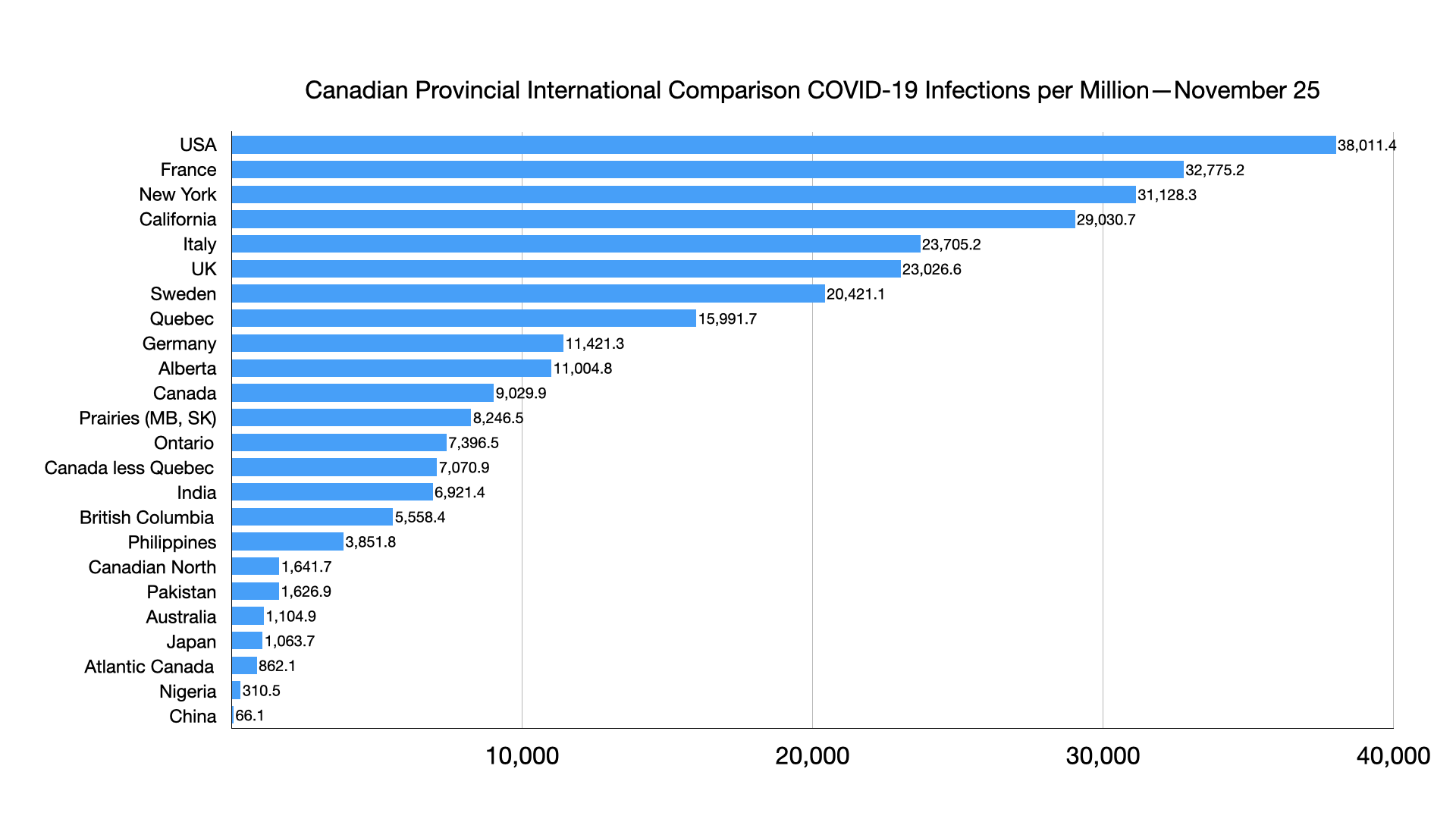
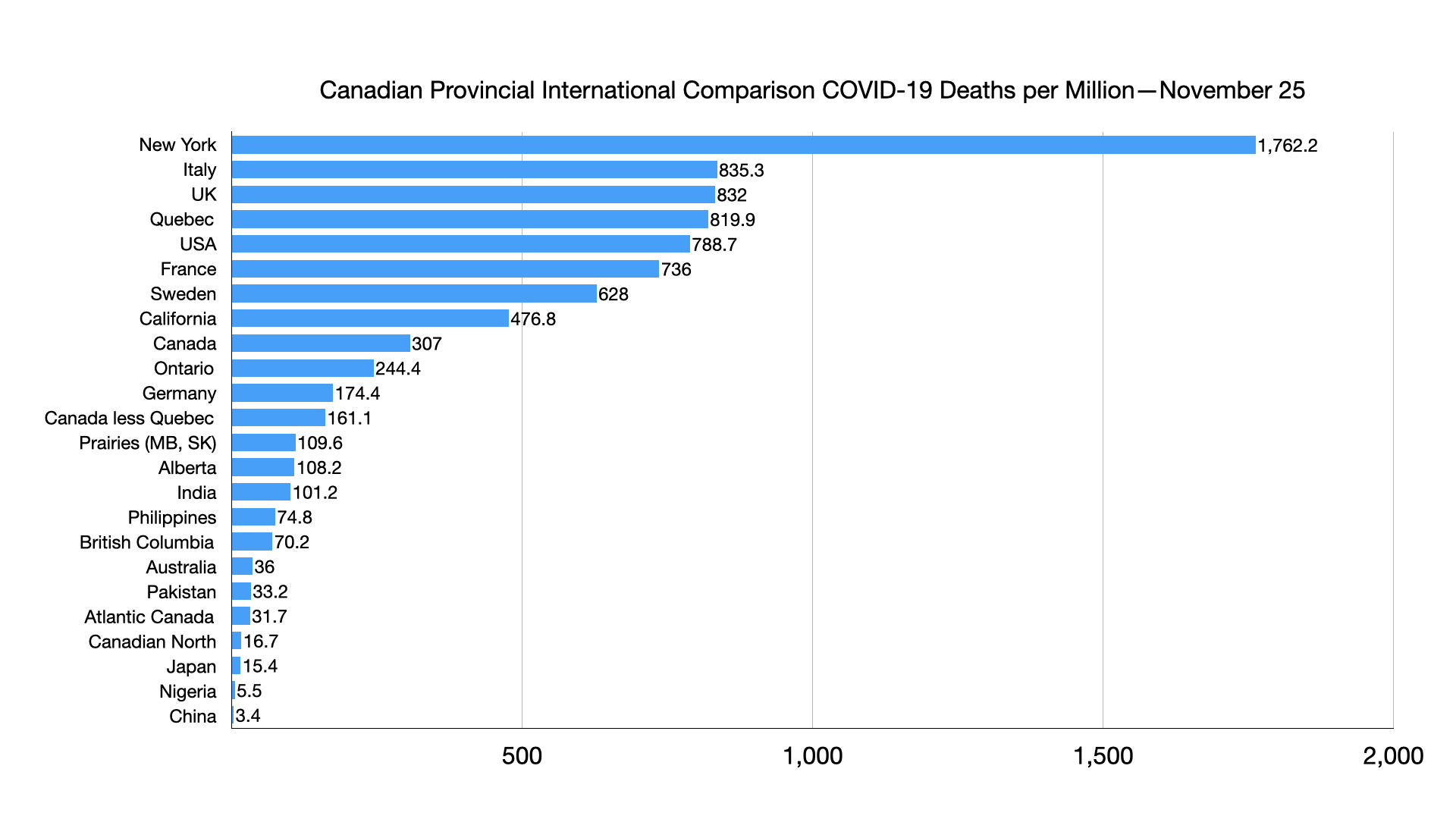
#COVID-19: Comparing provinces with other countries 25 November Update, Picard on Alberta

Main news continues to be with respect ongoing sharp spike in infections along with death rate increases:
 
Weekly:
 
Infections per million: Italy ahead of UK, Prairies ahead of Ontario, Canada less Quebec ahead of India, Canadian North ahead of Pakistan
 
Deaths per million: Italy and UK now ahead of Quebec, Prairies and Alberta ahead of India, Pakistan ahead of Atlantic Canada, Canadian North ahead of Japan
 
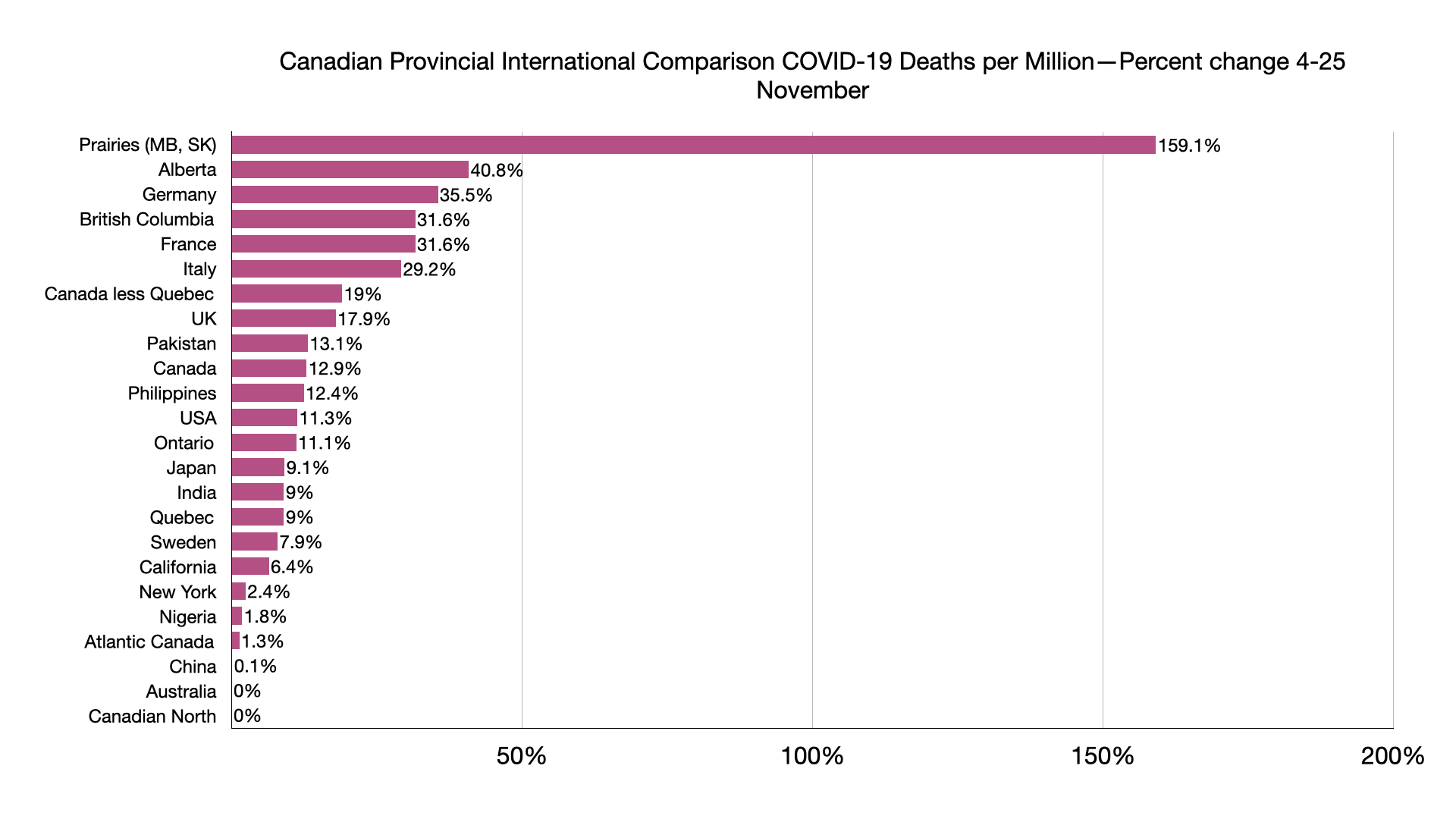
November 4-25 increase:
 
Infections per million: Greatest increase in Canadian North and Western provinces, moving ahead of many European countries
 
Deaths per million: Similar pattern with respect to deaths


André Picard’s critique of Premier Kenney and his government’s response to the pandemic:

Feckless.

That’s the only way to describe Alberta’s “tough” new measures.

In response to the soaring number of COVID-19 cases in the province, Premier Jason Kenney declared a “state of public health emergency” on Tuesday.

He started out with a little muscle flex, saying “no indoor social gatherings will be permitted, period.” Outdoor gatherings will be limited to 10 people.

But then we learned that restaurants will be open for in-person dining, bars will remain open, and so will casinos, gyms, stores, primary schools (Grades 7-12 are going to remote learning).

Heck you would be hard-pressed to find anything that will be closed.

Places of worship are allowed to hold services with one-third of capacity, just as they are now but “we are moving from recommendations to rules.”

Mr. Kenney also earnestly announced that masks would now be mandatory in the province’s two big cities, Calgary and Edmonton. But they already are mandatory because municipal governments have been a lot more pro-active and sensible than the province.

What we saw Tuesday was inaction posing as action, a quasi-libertarian Premier bending over backward to do nothing while pretending otherwise.

But Mr. Kenney’s true nature was revealed when he began prattling on about how he has resisted a lockdown because it would be an “unprecedented violation of constitutional rights.” He once again heralded the importance of “personal responsibility” while, at the same time, announcing rules that clearly suggest people don’t have to be very responsible.

Acting forcefully to protect citizens from the ravages of a global pandemic is not a violation of their rights. Quite the opposite.

Just hours before Mr. Kenney spoke, Nova Scotia Premier Stephen McNeil announced the closing of all restaurants, fitness and recreational facilities, libraries, museums, casinos and more for at least two weeks.

Why? Because the province had a “surge” of 37 cases. Thirty-seven. Business owners actually demanded the lockdown, saying severe rules are the only way to retain consumer confidence.

Alberta recorded 1,115 coronavirus cases on Tuesday, along with 16 deaths. And that was the lowest rate in a while, because testing is way down. In recent days, Alberta has had more cases than Ontario, which has more than three times the population.

The testing system is overwhelmed. The contact tracing system has collapsed. Hospital beds, and all-important intensive care beds in particular, are filling up fast. There are dozens of outbreaks in hospitals and care homes and schools.

Alberta’s pandemic response was great for many months – the Premier was right to underline that fact. But the harsh reality today is that public health and hospitals alike are dangerously close to losing control of the situation.

Mr. Kenney said it himself: “If we don’t slow the ER and ICU admissions, it will threaten our health system.”

But then, in the next breath, he was back to talking about how it’s essential to keep businesses open.

Who knows what the public will make of this Jekyll and Hyde discourse? The between-the-line message seems to be: It’s business as usual.

Yes, the pandemic is a blow to the economy; yes, it’s taking a toll on our mental health; yes, there is a lot of collateral damage.

But if there’s one thing we have learned – or should have learned – is that all that will continue, along with the harm of COVID-19, unless you go all-in to slow the spread of the virus.

Mr. Kenney said the “balanced approach” he has chosen will ensure that the spread of the coronavirus is interrupted while allowing businesses to remain open. But you can’t have it both ways.

The evidence from around the world is crystal clear: This approach is a fast-track to failure. Not only will the virus continue to spread, but the economy won’t flourish because people will still be scared.

Quebec has been in lockdown for more than two months – with rules that are way more strict that what Alberta is imposing – and it’s barely able to keep its COVID-19 numbers static, never mind lower them.

Does anyone seriously believe Alberta will be able to do better by essentially doing nothing?

Albertans should brace themselves because they’re in for a world of hurt in the coming weeks.

Source: https://www.theglobeandmail.com/canada/article-jason-kenneys-balanced-approach-is-a-fast-track-to-failure/

#COVID-19: Comparing provinces with other countries 11 November Update

Overall, infection rates continue to skyrocket with some increase in death rates. Prairies and North numbers particularly noteworthy.
 
Weekly:
 
Infections per million: Ontario ahead of India, Prairies ahead of Canada less Quebec, Canadian North ahead of Atlantic Canada 
 
Deaths per million: Italy ahead of USA, Germany ahead of Canada less Quebec, Prairies ahead of Philippine


#COVID-19: Comparing provinces with other countries 11 November Update

Main news continues to be with respect to rapid increase in infections in most countries and provinces:
 
Weekly:
 
Infections per million: France ahead of New York, Italy and Sweden ahead of Quebec, British Columbia ahead of Philippines
 
Deaths per millionUK ahead of USA, France ahead of Sweden, Canadian North ahead of Nigeria


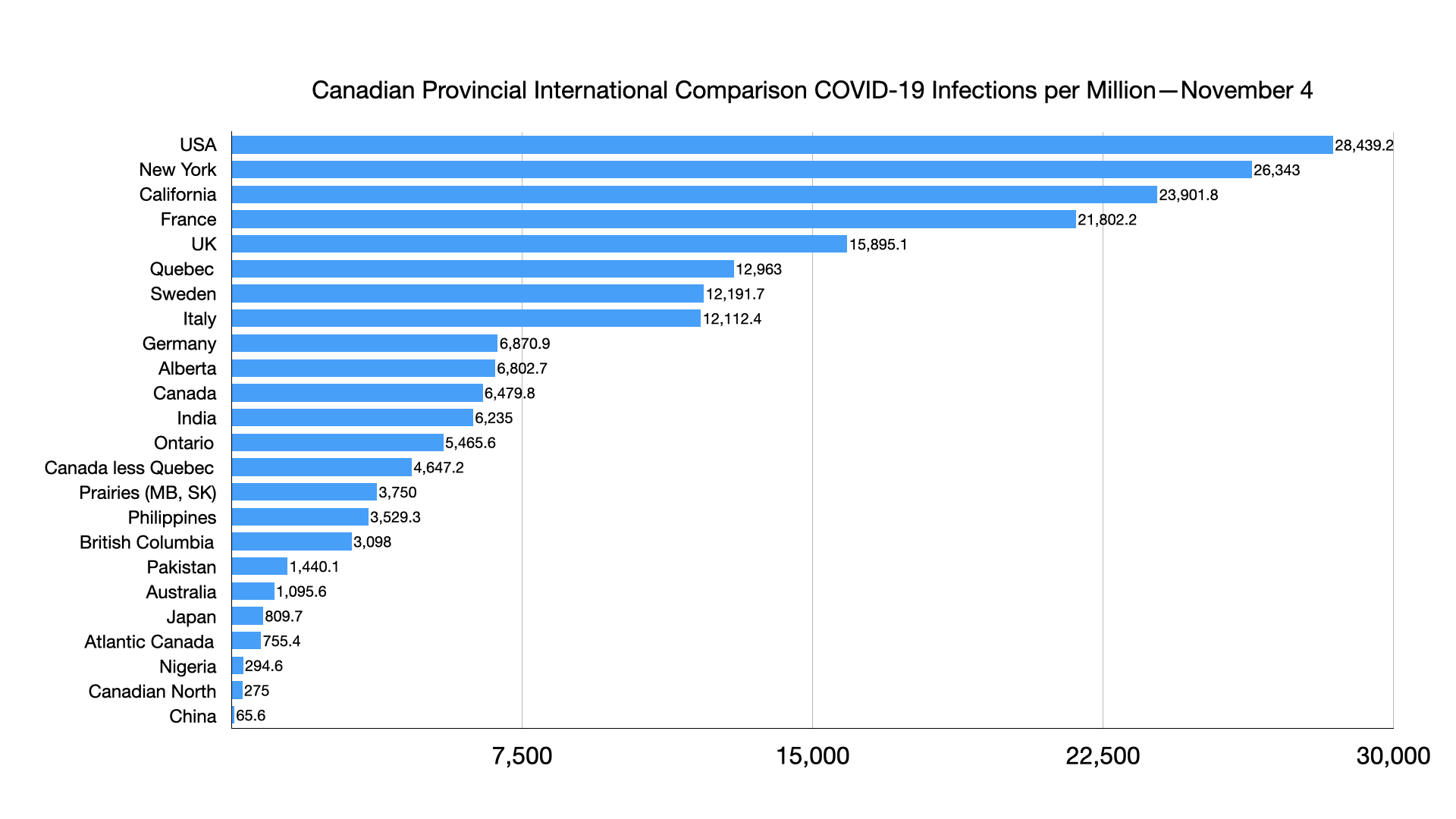
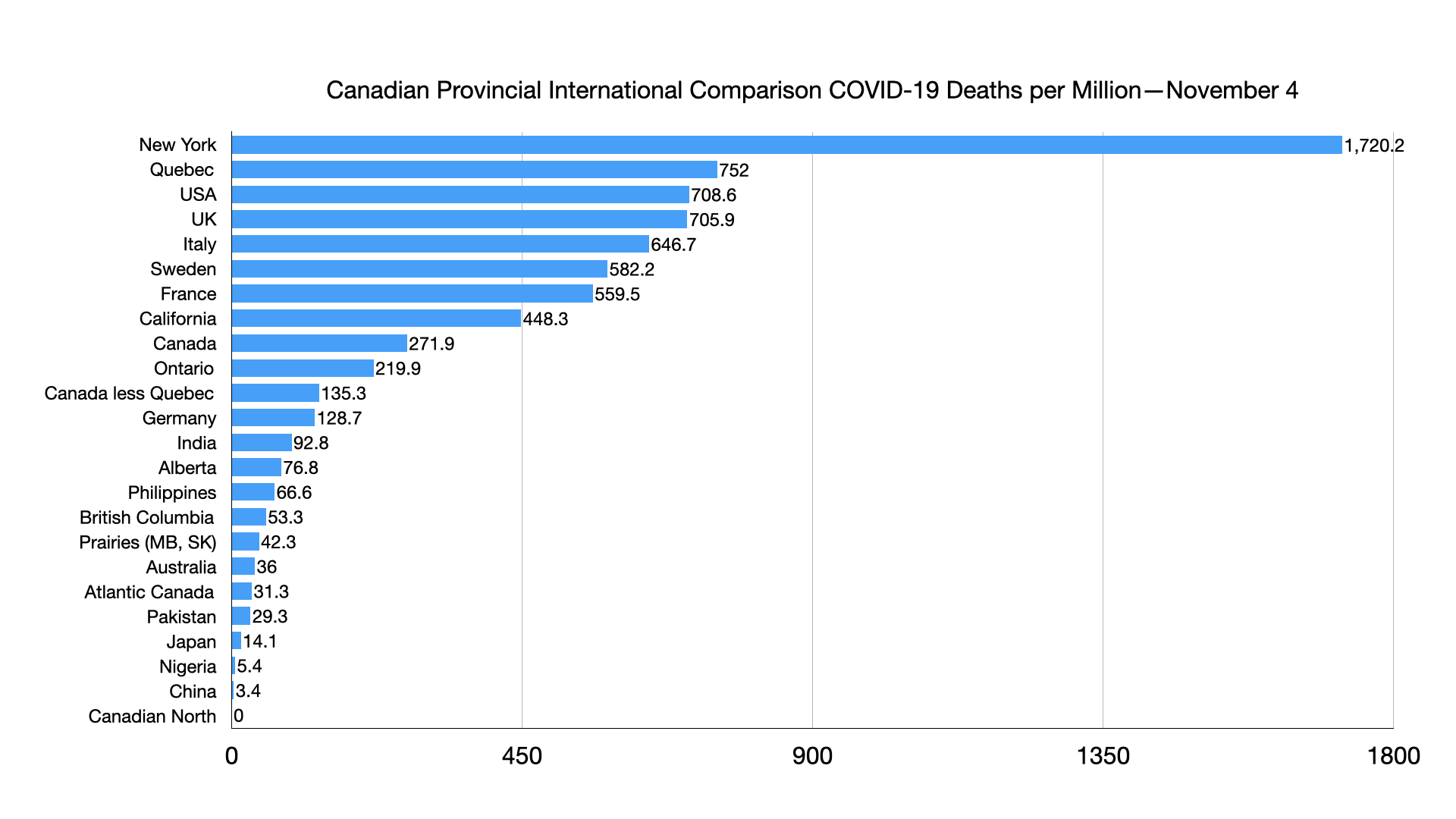
#COVID-19: Comparing provinces with other countries 4 November Update

Main news continues to be with respect to infections and relative increase of COVID cases and deaths in Prairie provinces:
 
Weekly:
 
Infections per million: Germany now ahead of Alberta, Canada, India, Prairies now ahead of Philippines
 
Deaths per million:nPrairies now ahead of Australia


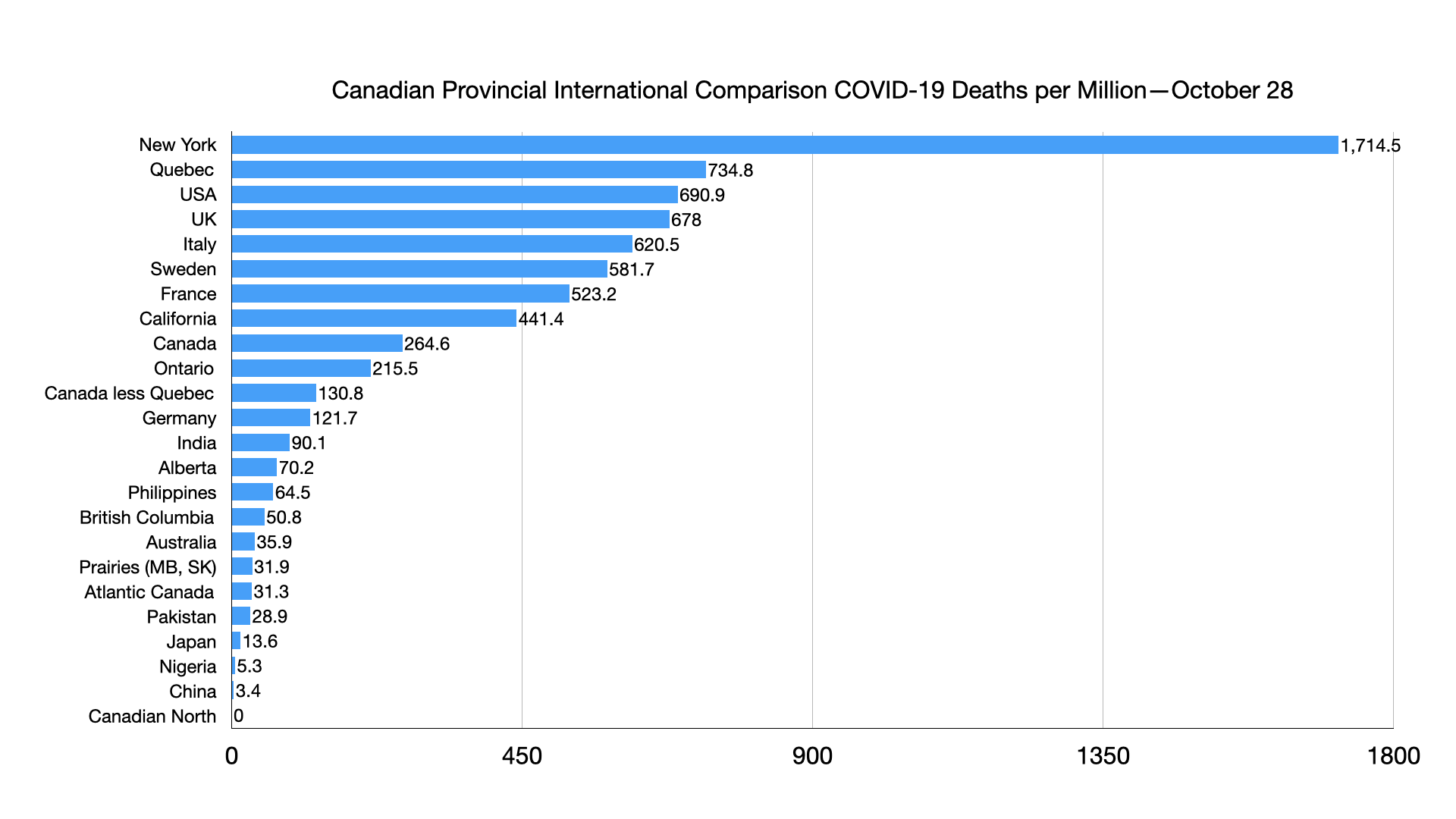
#COVID-19: Comparing provinces with other countries 28 October Update

Main news continues to be with respect to infections:
 
Weekly:
 
Infections per million: UK higher than Quebec, Alberta higher than Canada, Germany higher than Ontario, Prairies higher than British Columbia 
 
Deaths per million: Prairies higher than Atlantic Canada, both higher than Pakistan
 
October 7-28 increase:
 
Infections per million: Prairies (Manitoba, Saskatchewan) join European countries in highest percentage increase
 
Deaths per million: Highest increase in Prairies, particularly Manitoba and Saskatchewan 


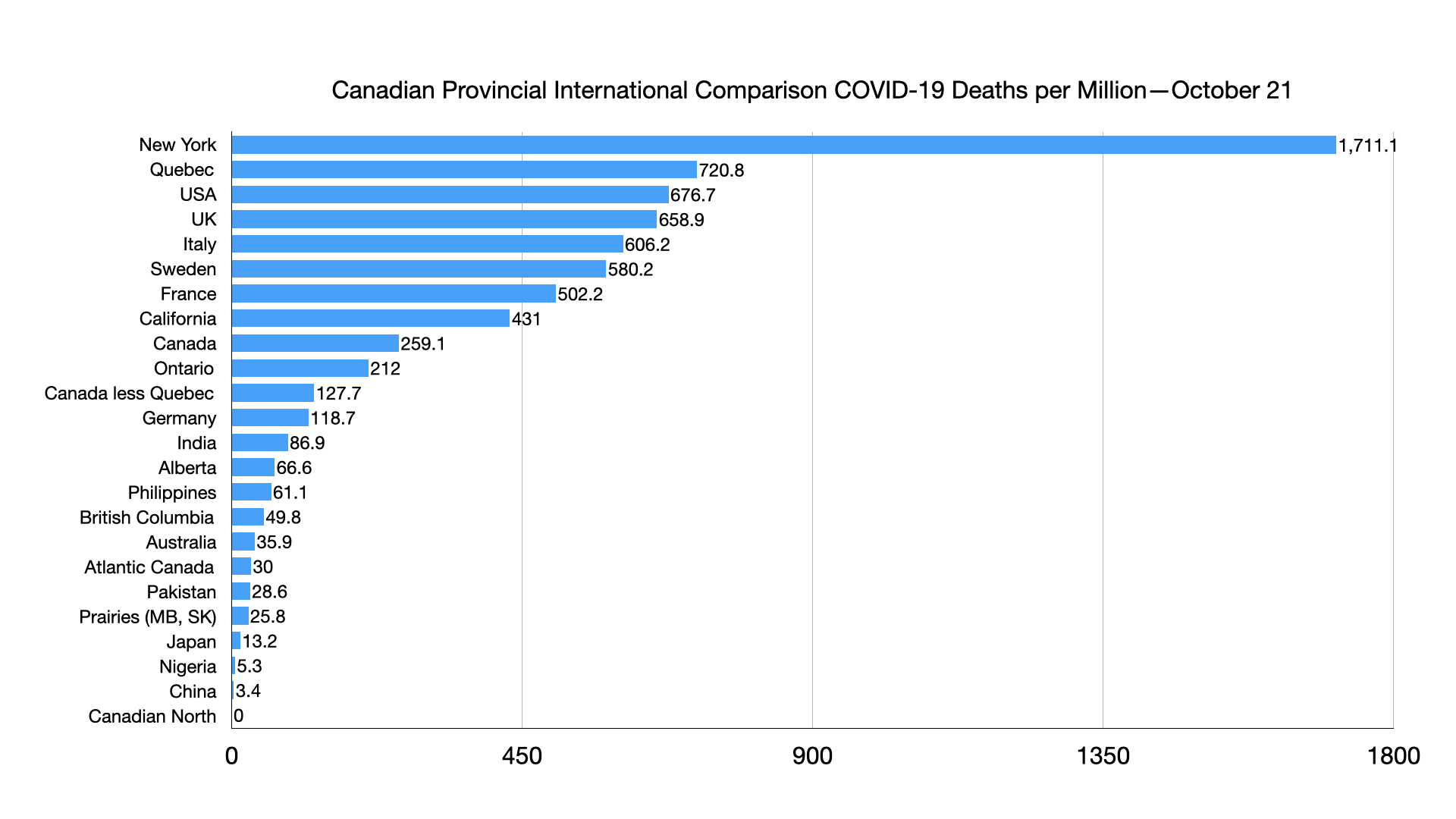
#COVID-19: Comparing provinces with other countries 21 October Update

Apart from overall large increases in infections in most jurisdictions, and corresponding increases in death rates in some, overall country and jurisdiction ranking largely unchanged.

Deaths per million: no change
 
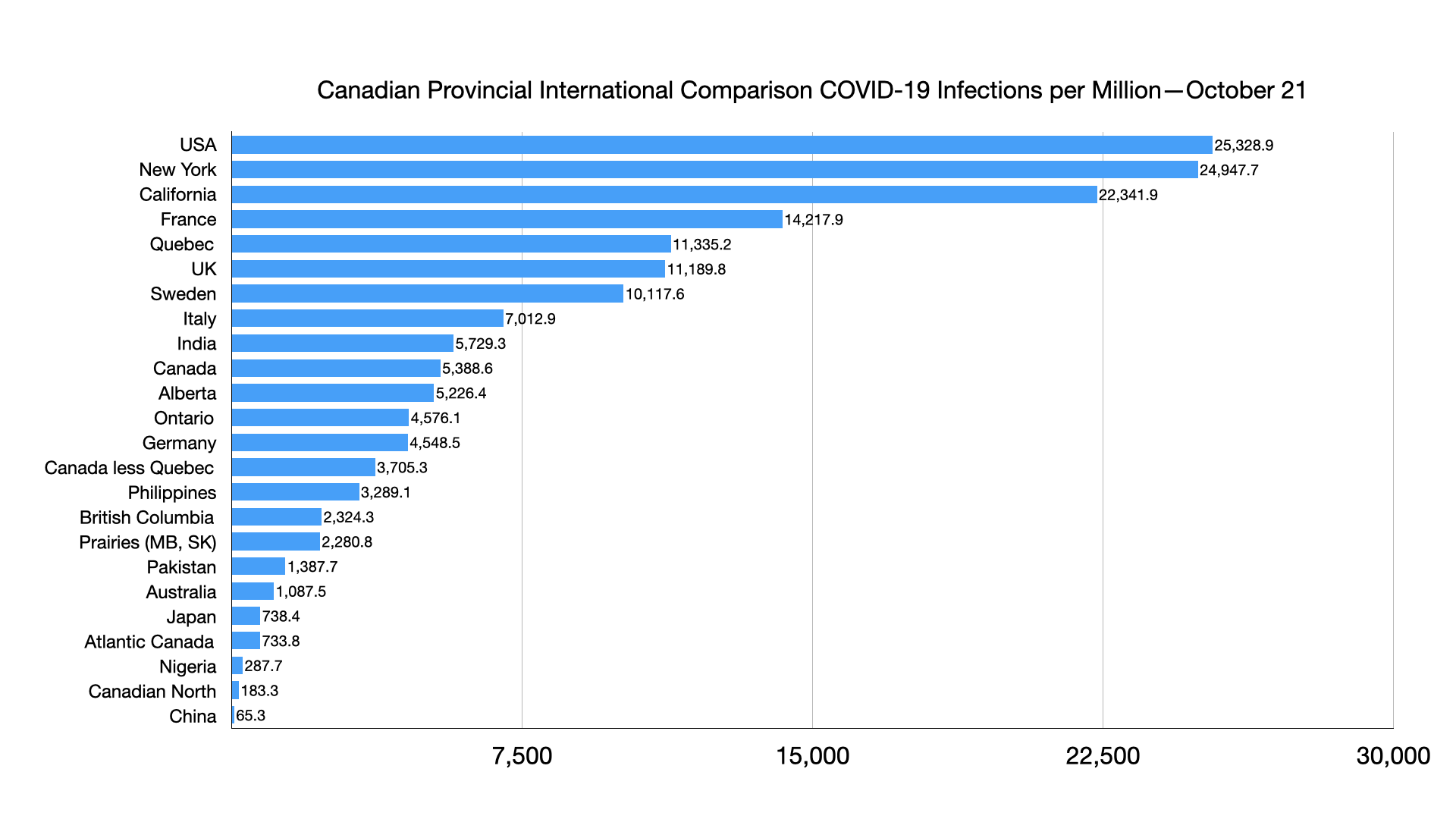
Infections per million: Sweden now higher than UK (so much for herd immunity), Japan ahead of Atlantic Canada
 
Weekly: