#COVID-19: Comparing provinces with other countries 24 February Update

The latest charts, compiled 24 February.

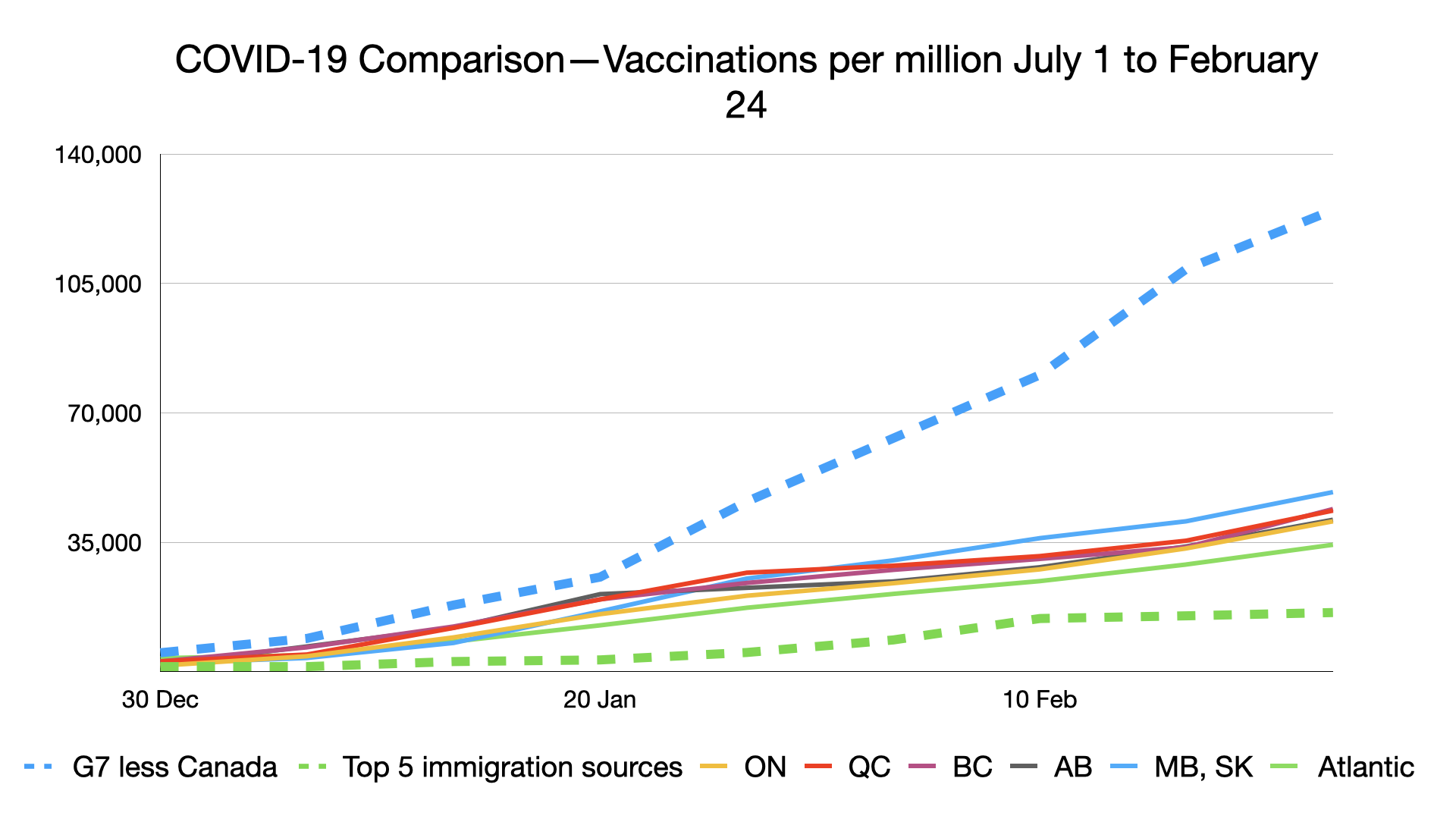
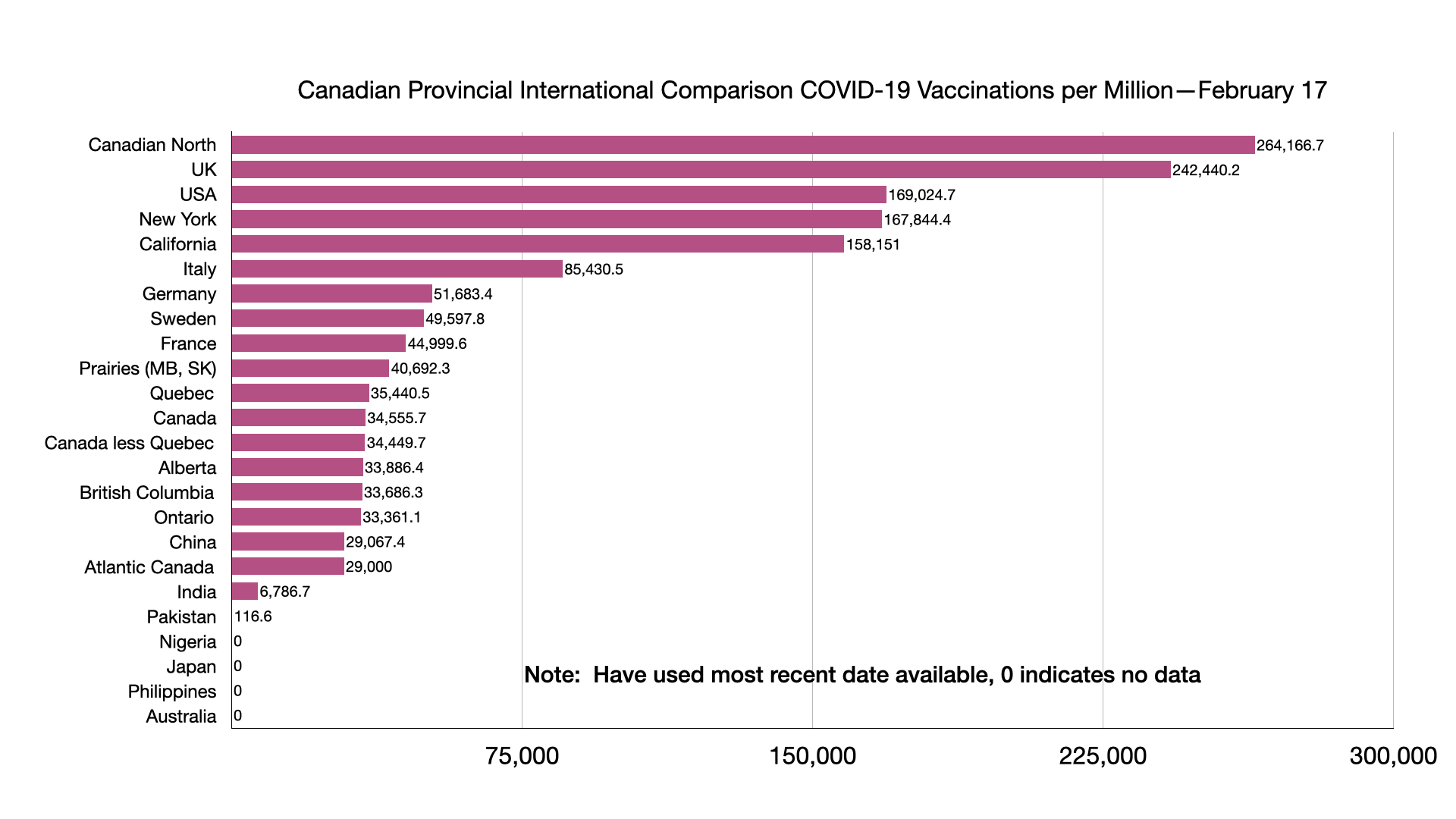
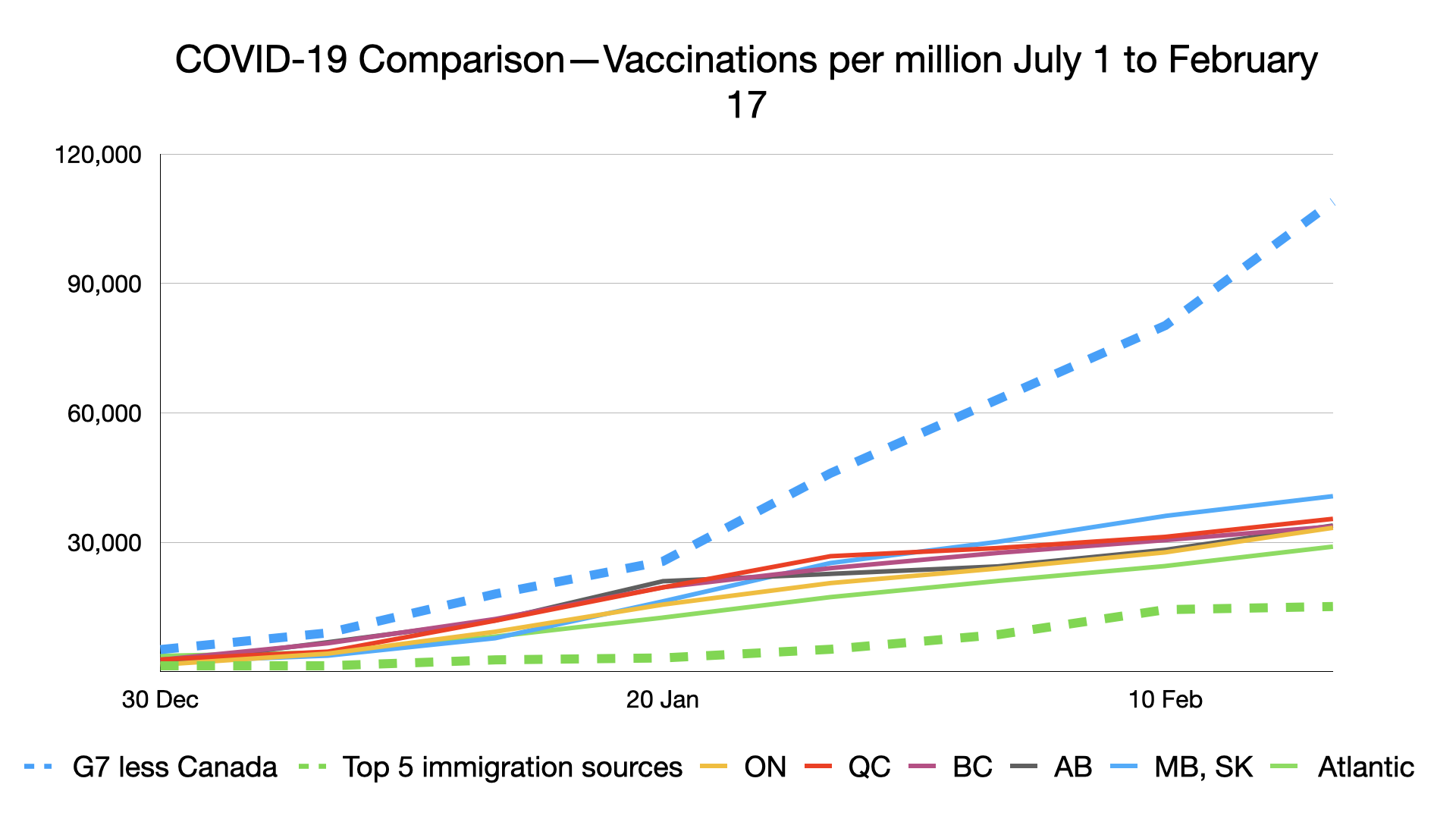
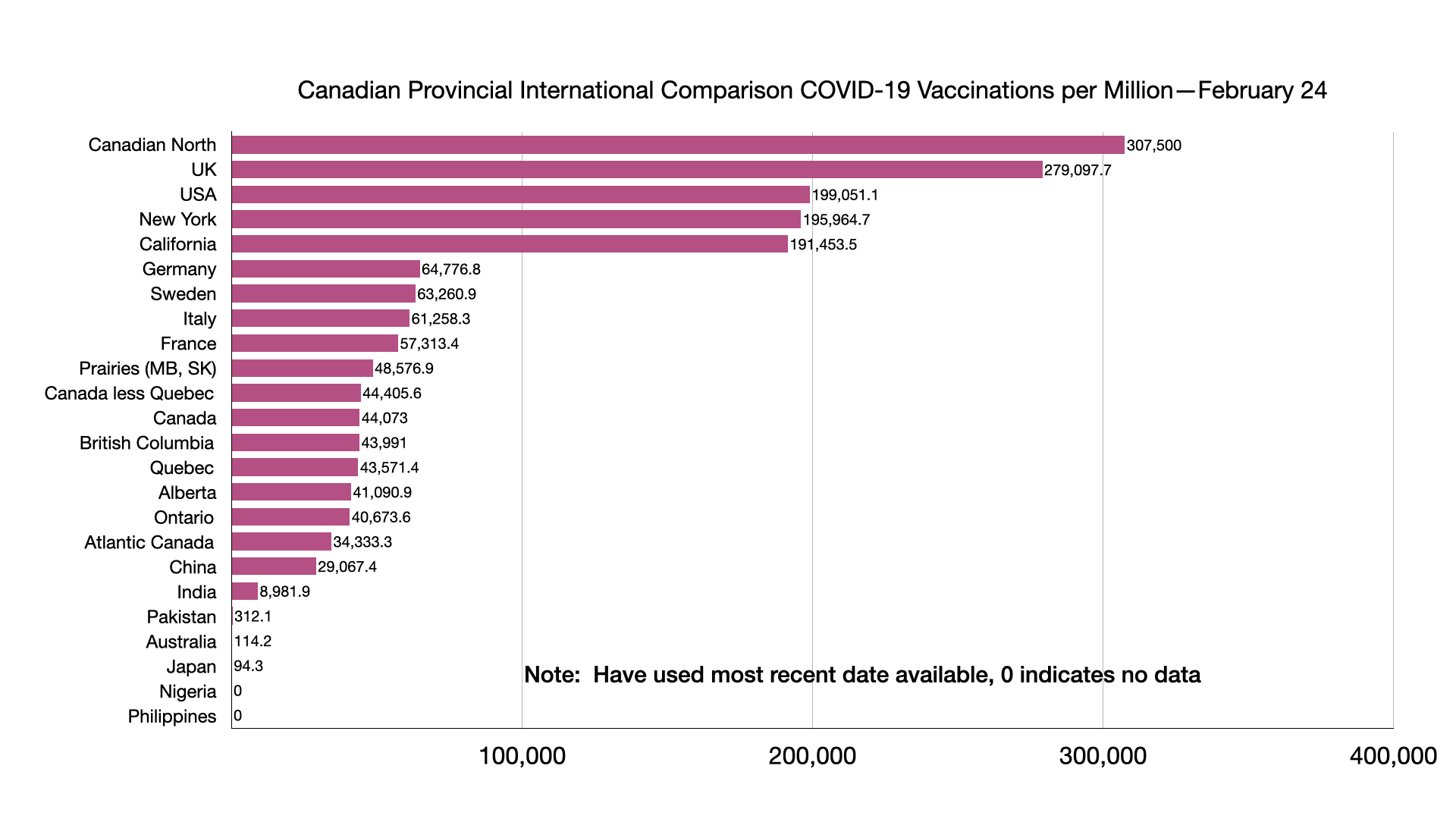
Vaccinations: The gap between all G7 countries save Japan continues to grow with the effect of increased deliveries to Canada not yet apparent.

Trendline charts

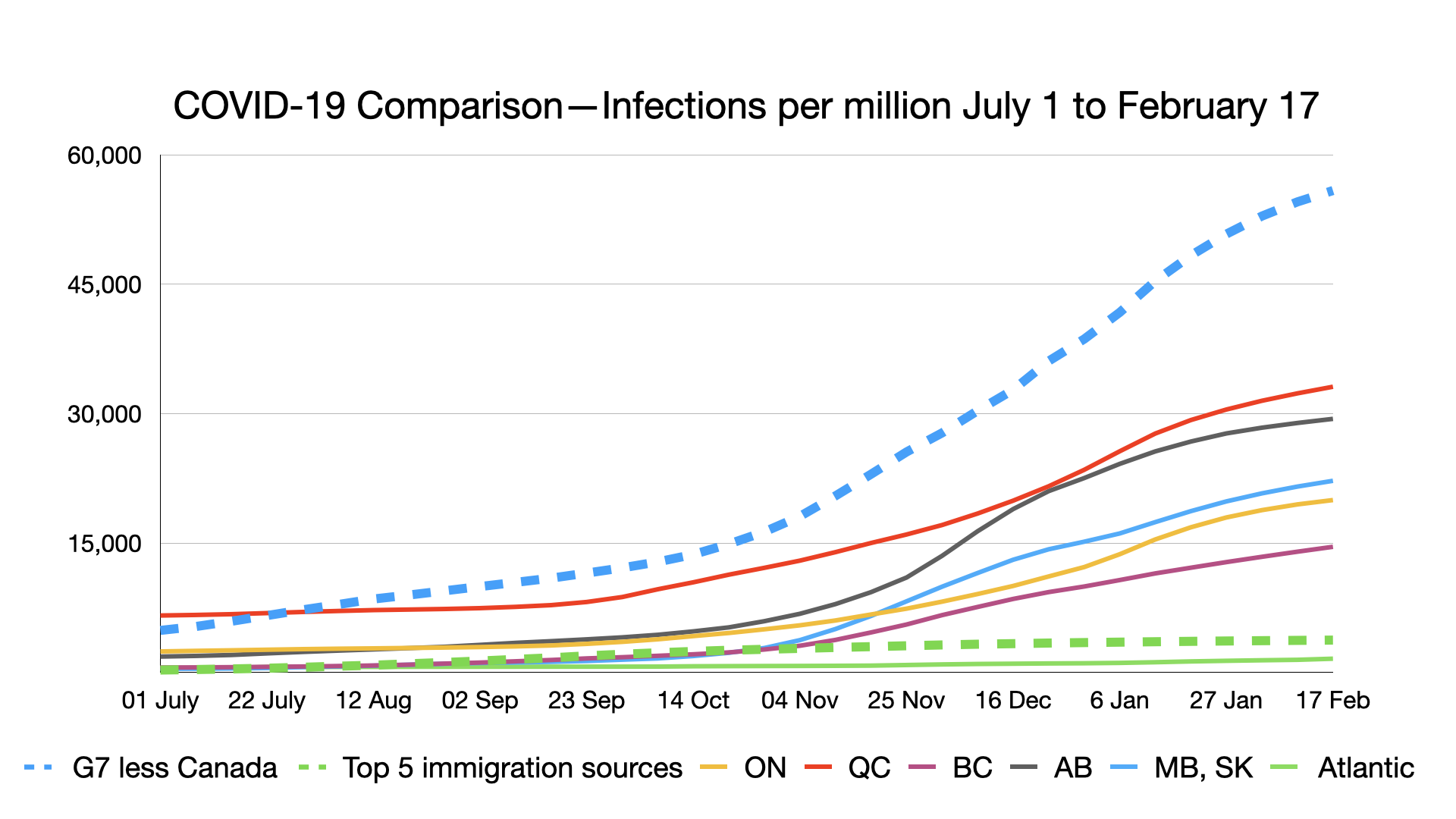
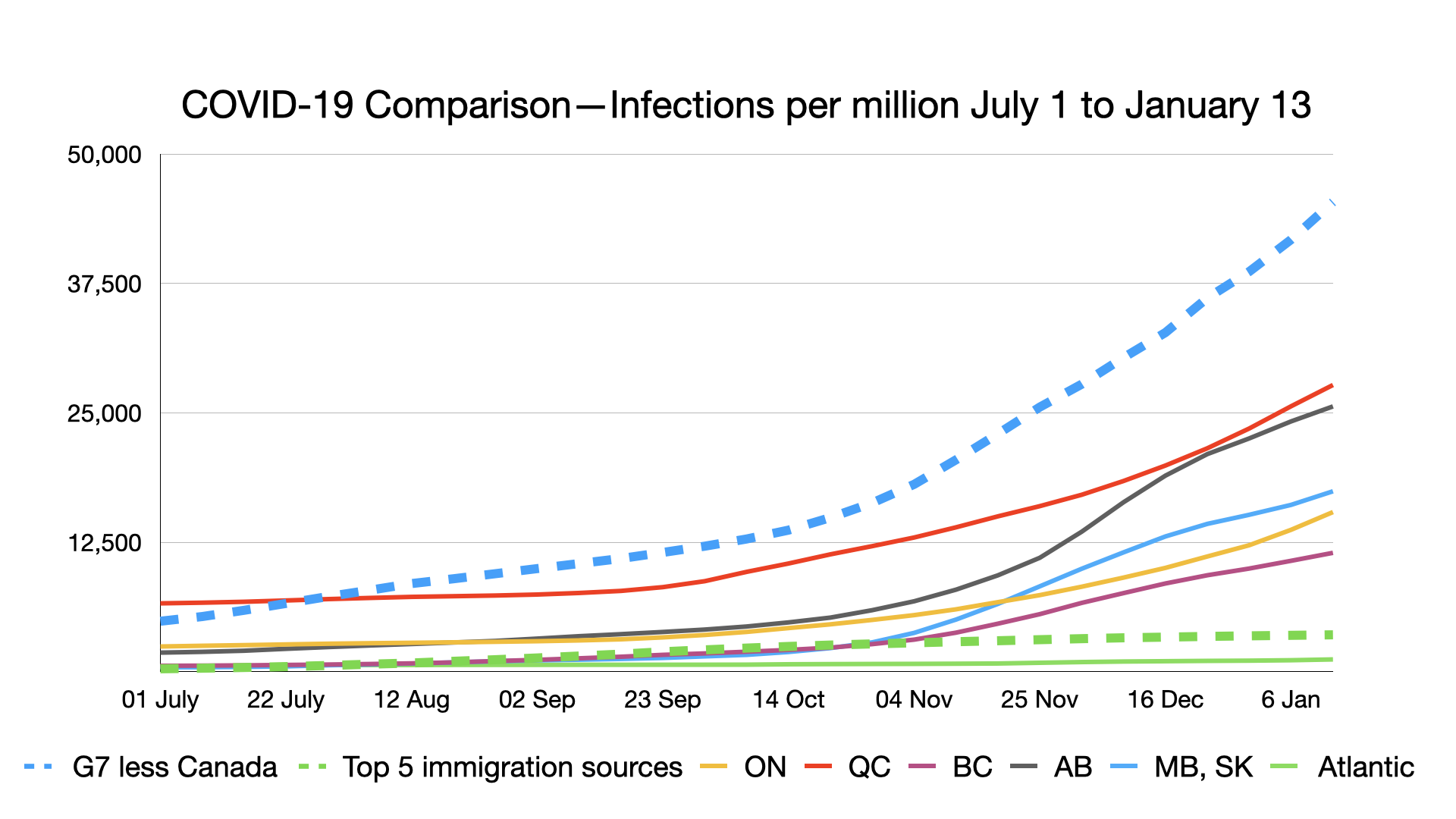
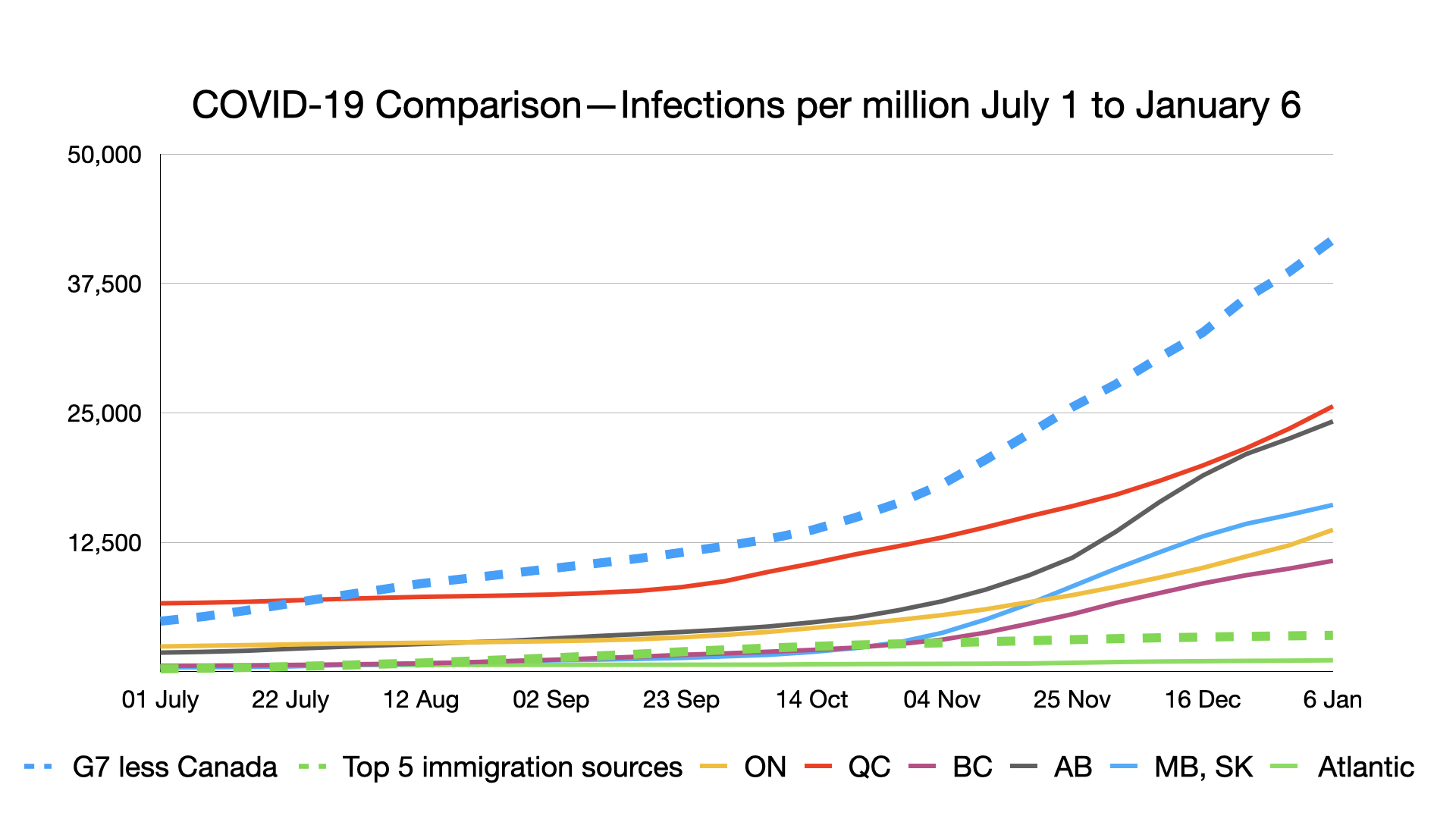
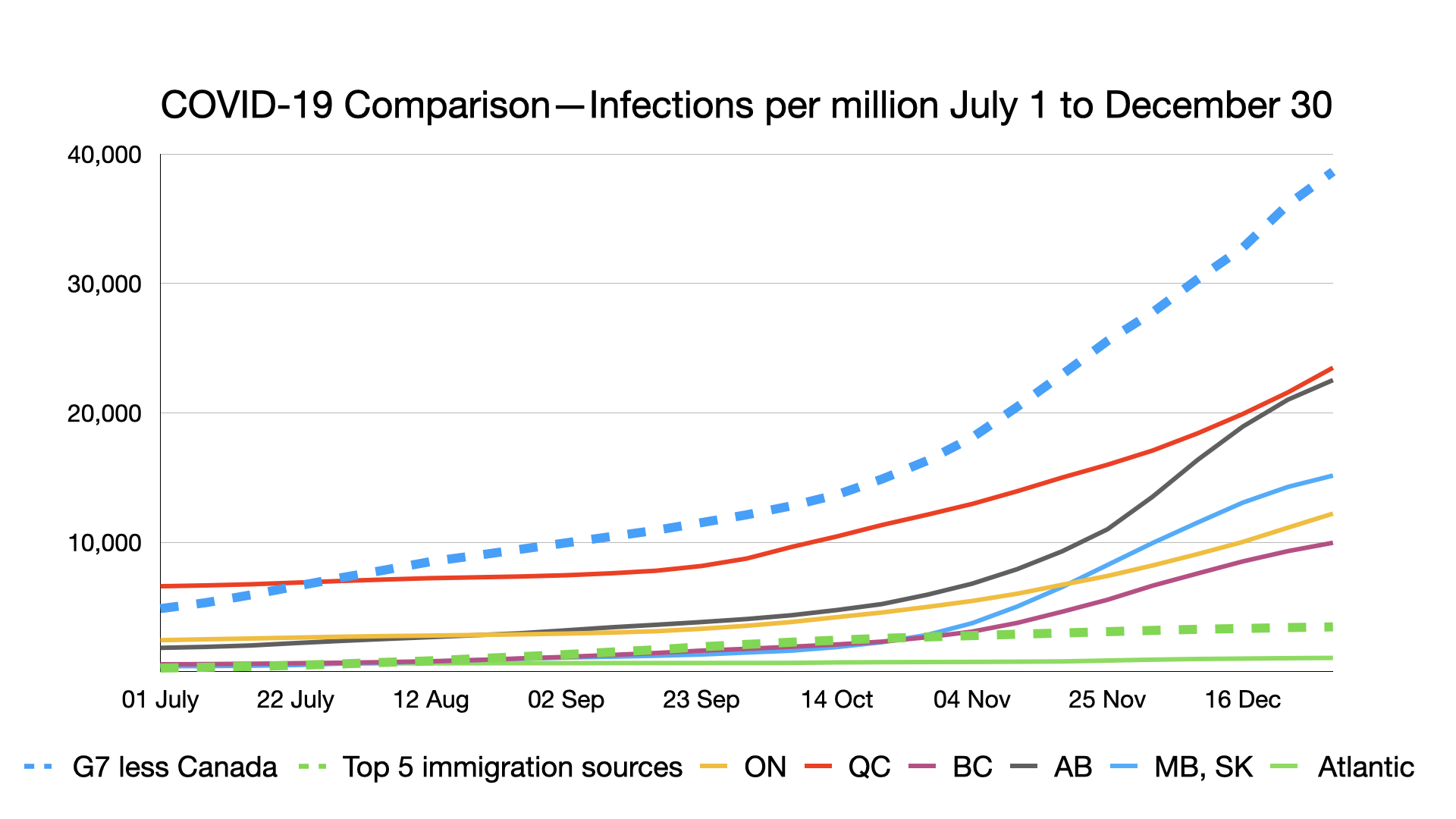
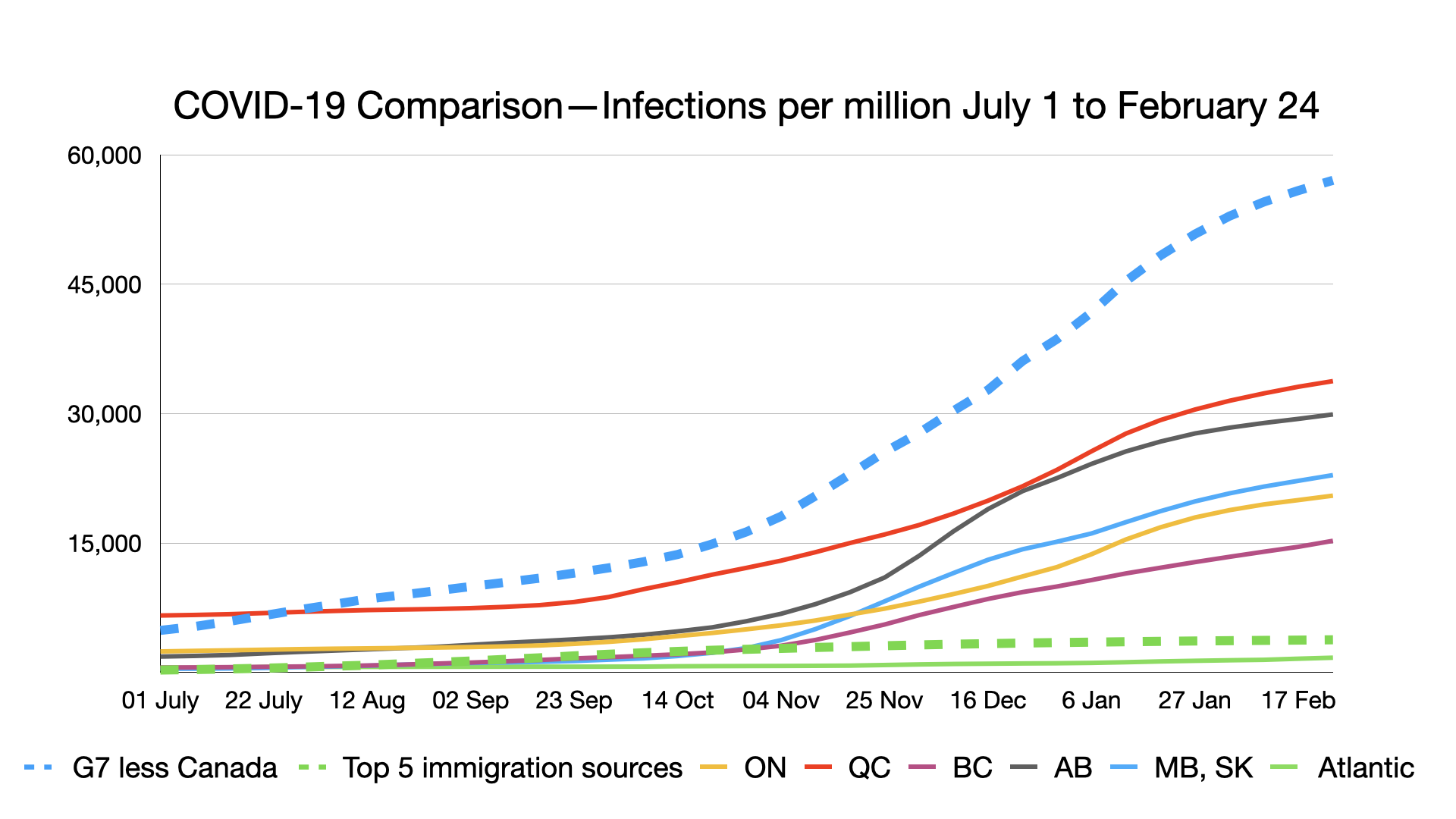
Infections per million: The overall trend of a flattening curve is seen in G7 countries and most provinces save for the Prairies and British Columbia.

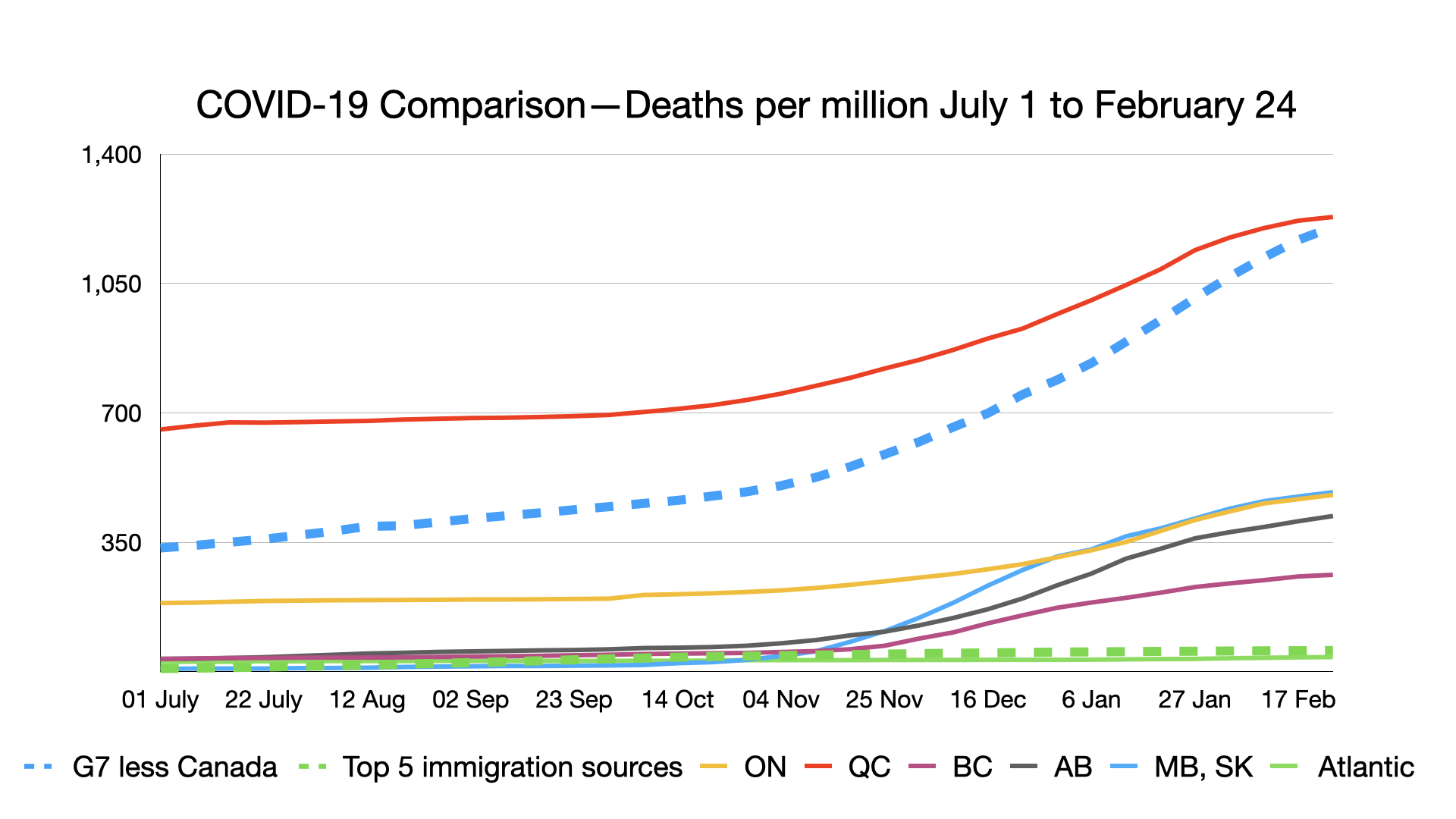
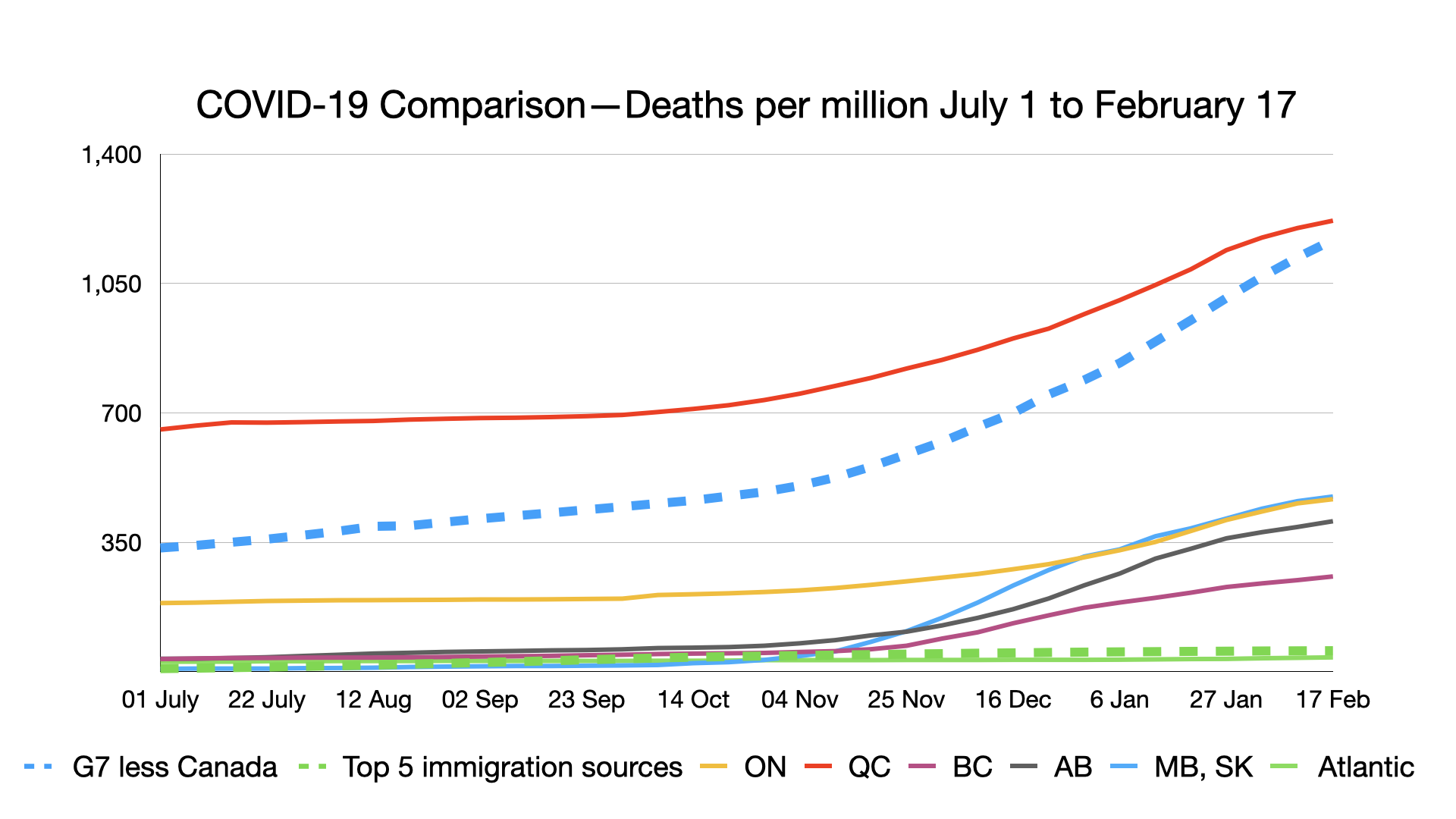
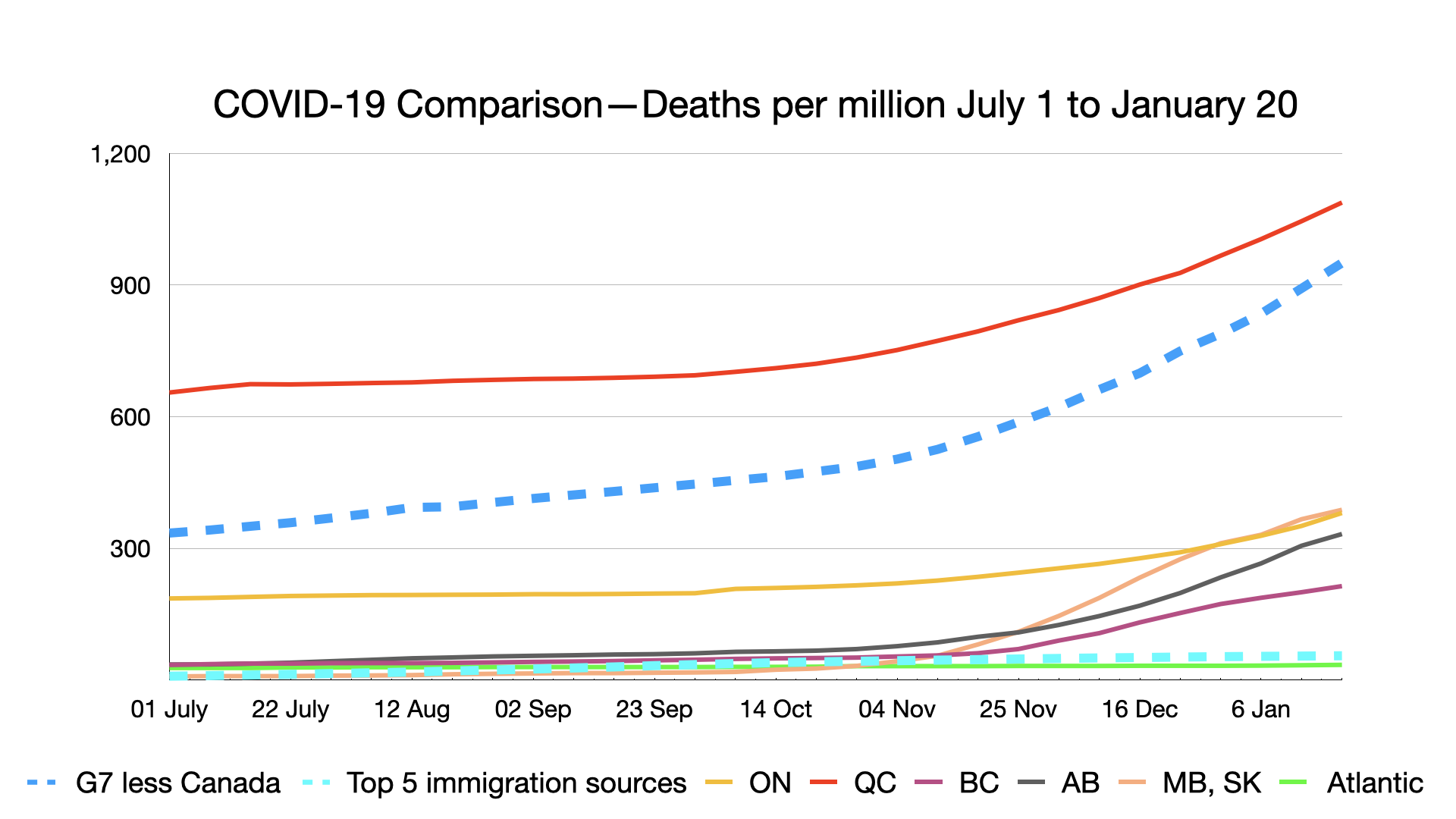
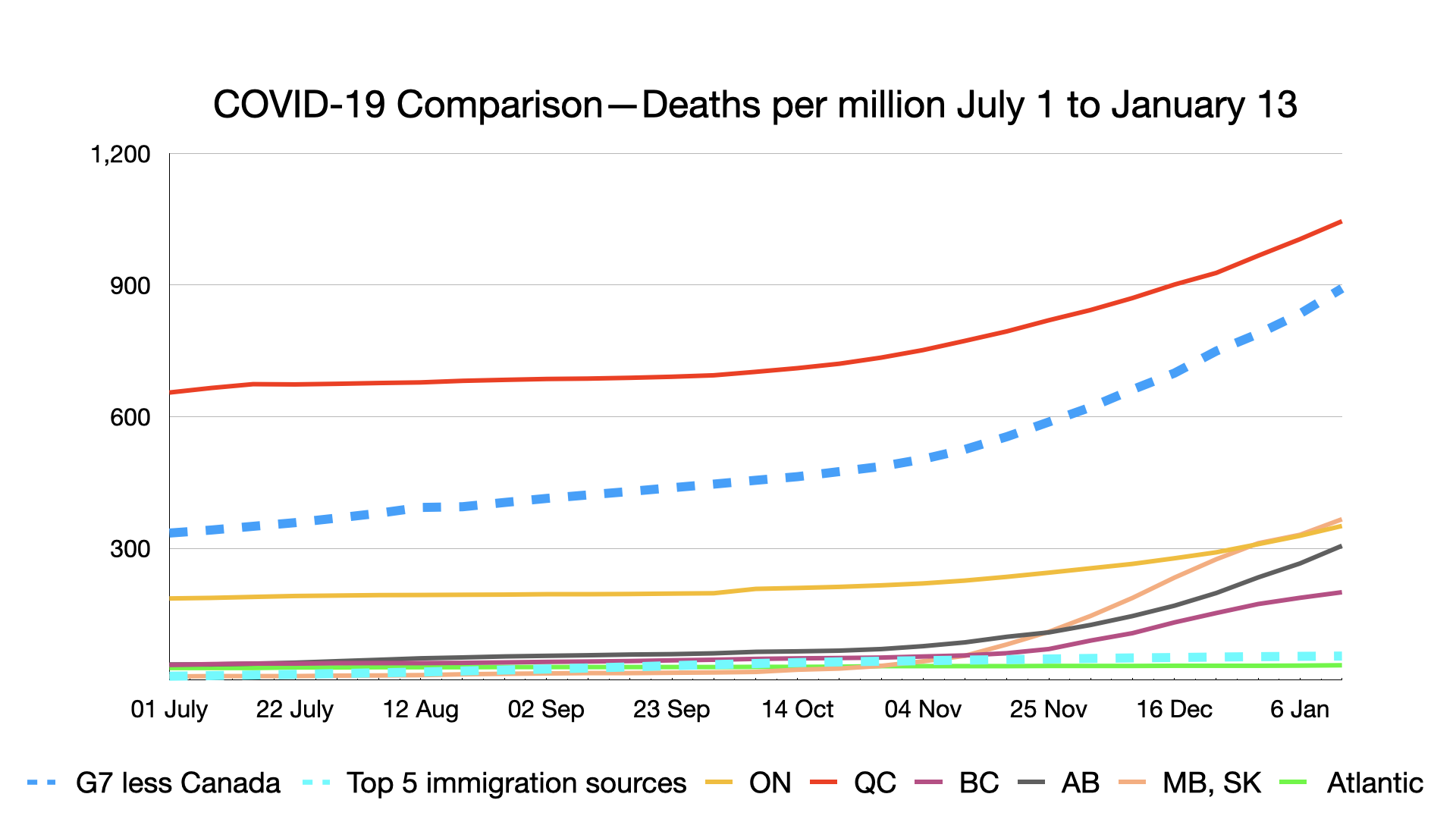
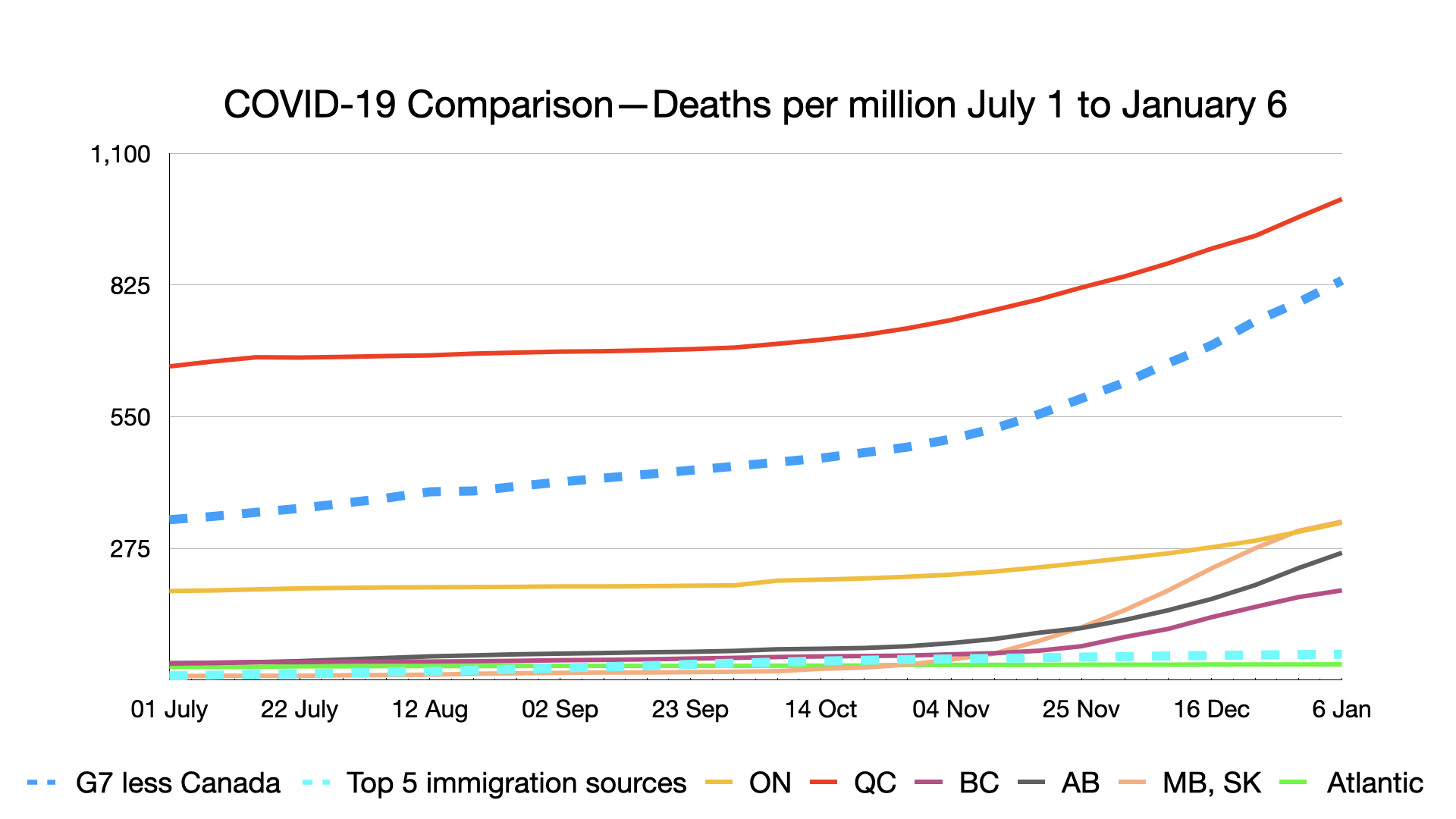
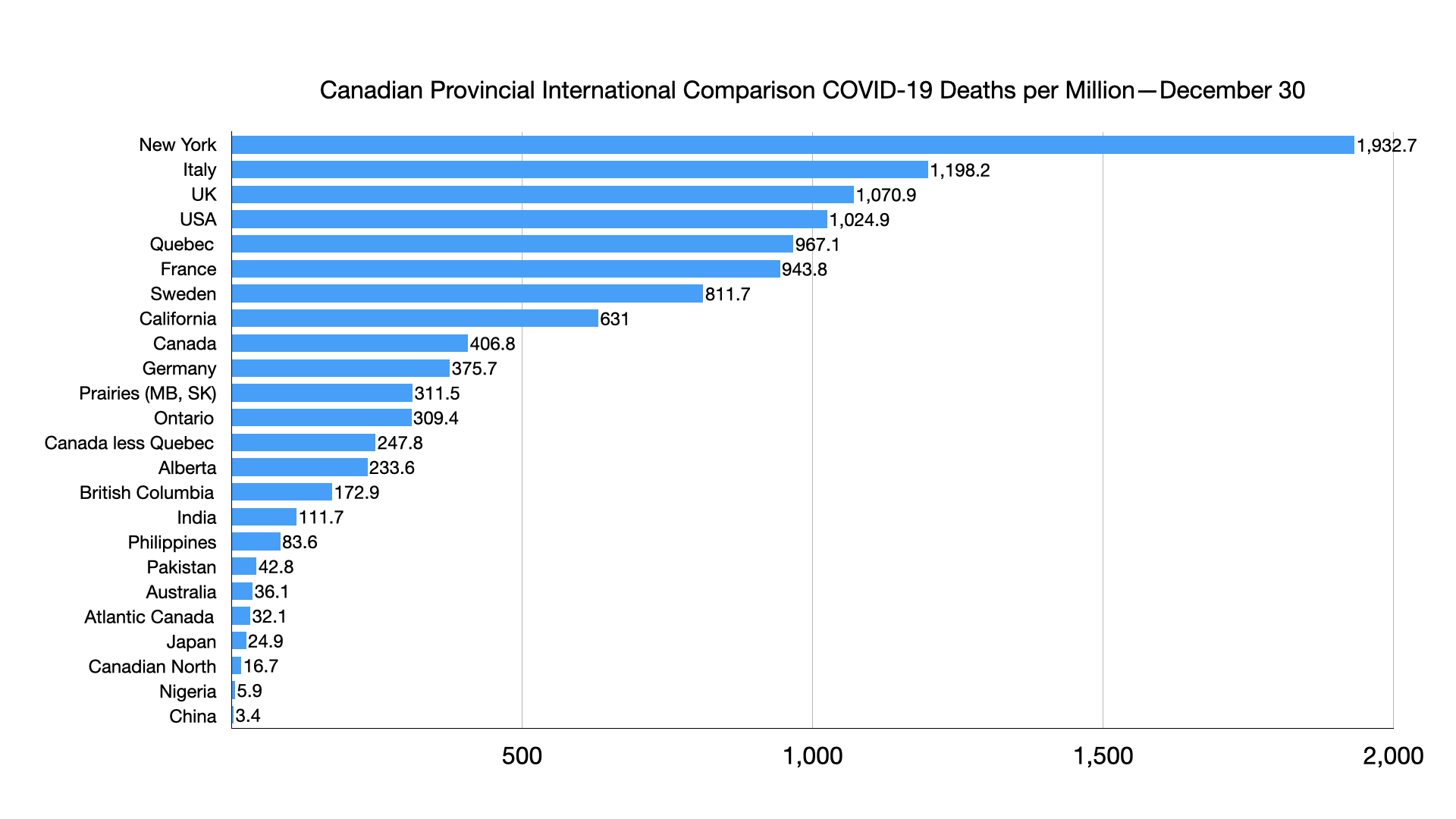
Deaths per million: Most Canadian provinces continue to flatten the curve, Quebec most dramatically. Overall G7 death rate will likely surpass Quebec.

Vaccinations per million: Gap between G7 and Canada, driven not only by the UK and USA, remains largely unchanged.

Weekly

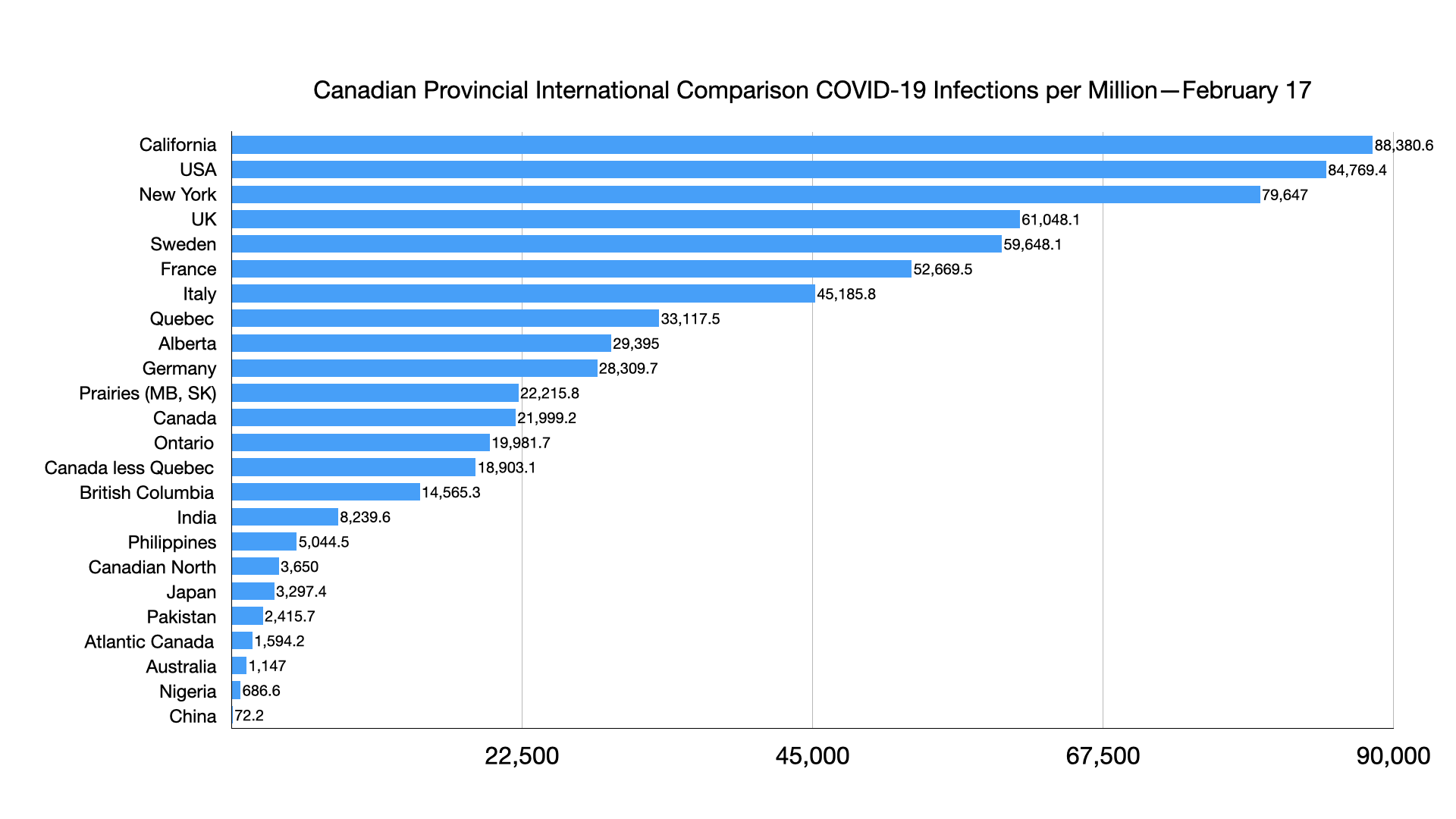
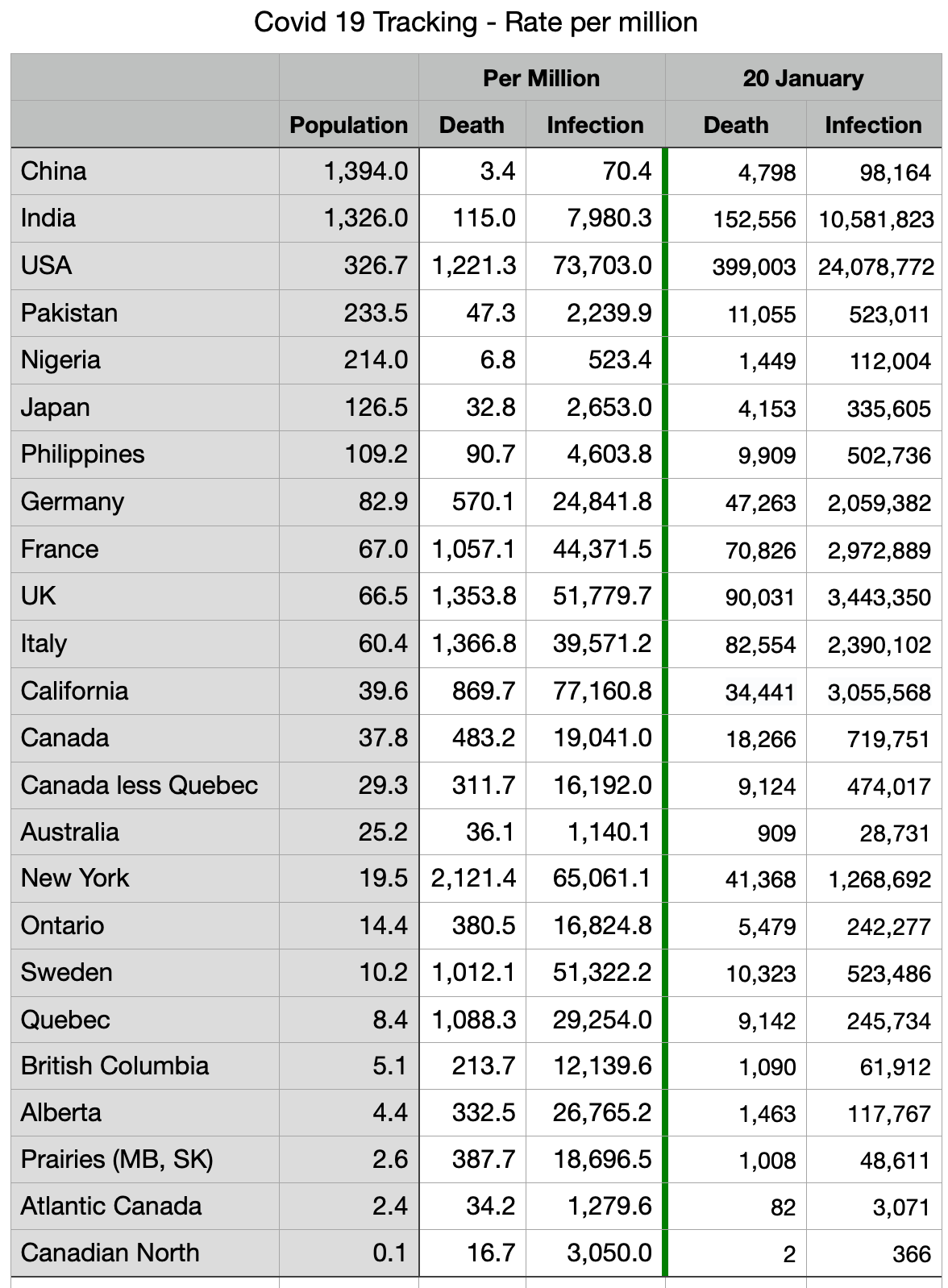
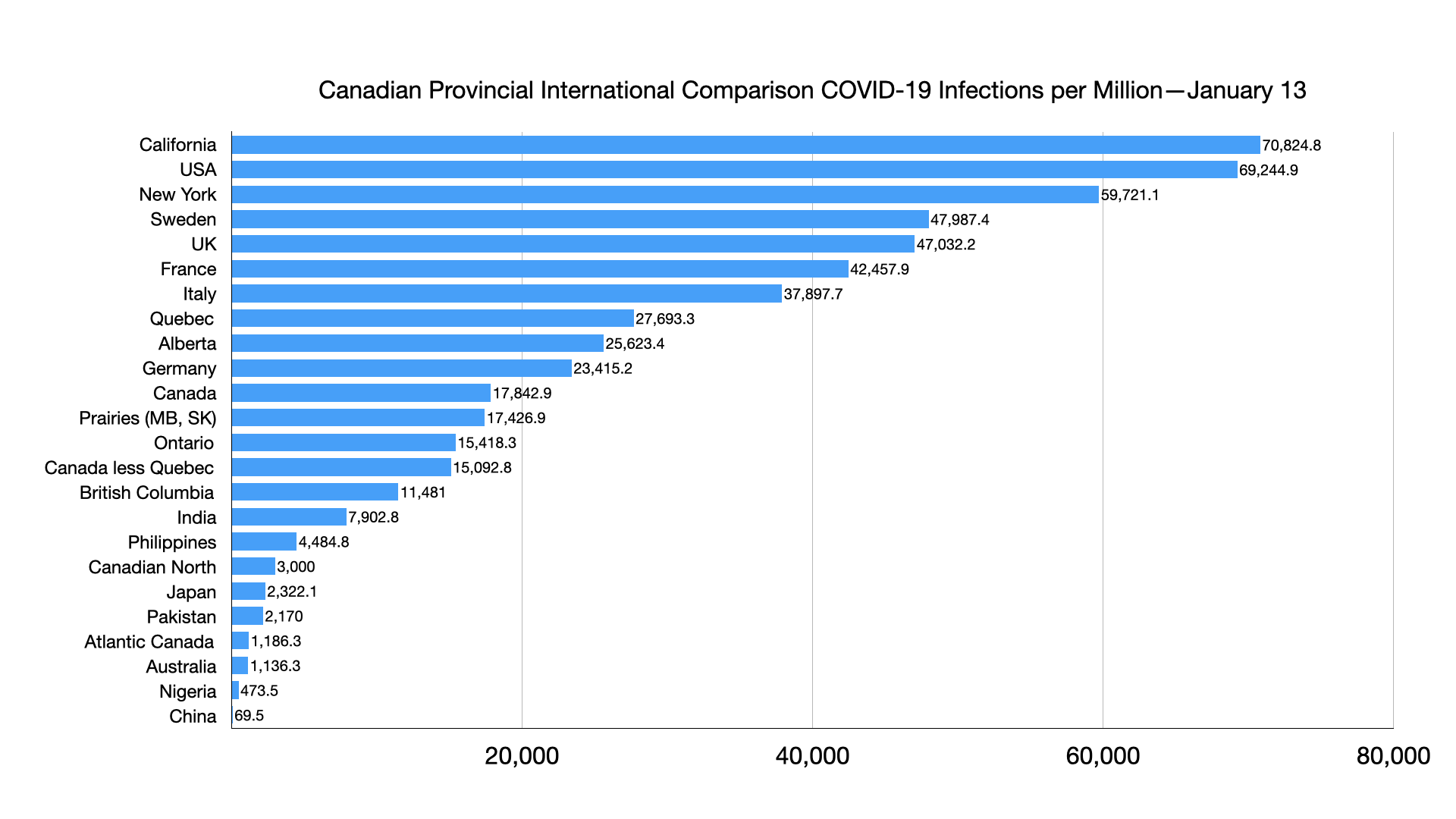
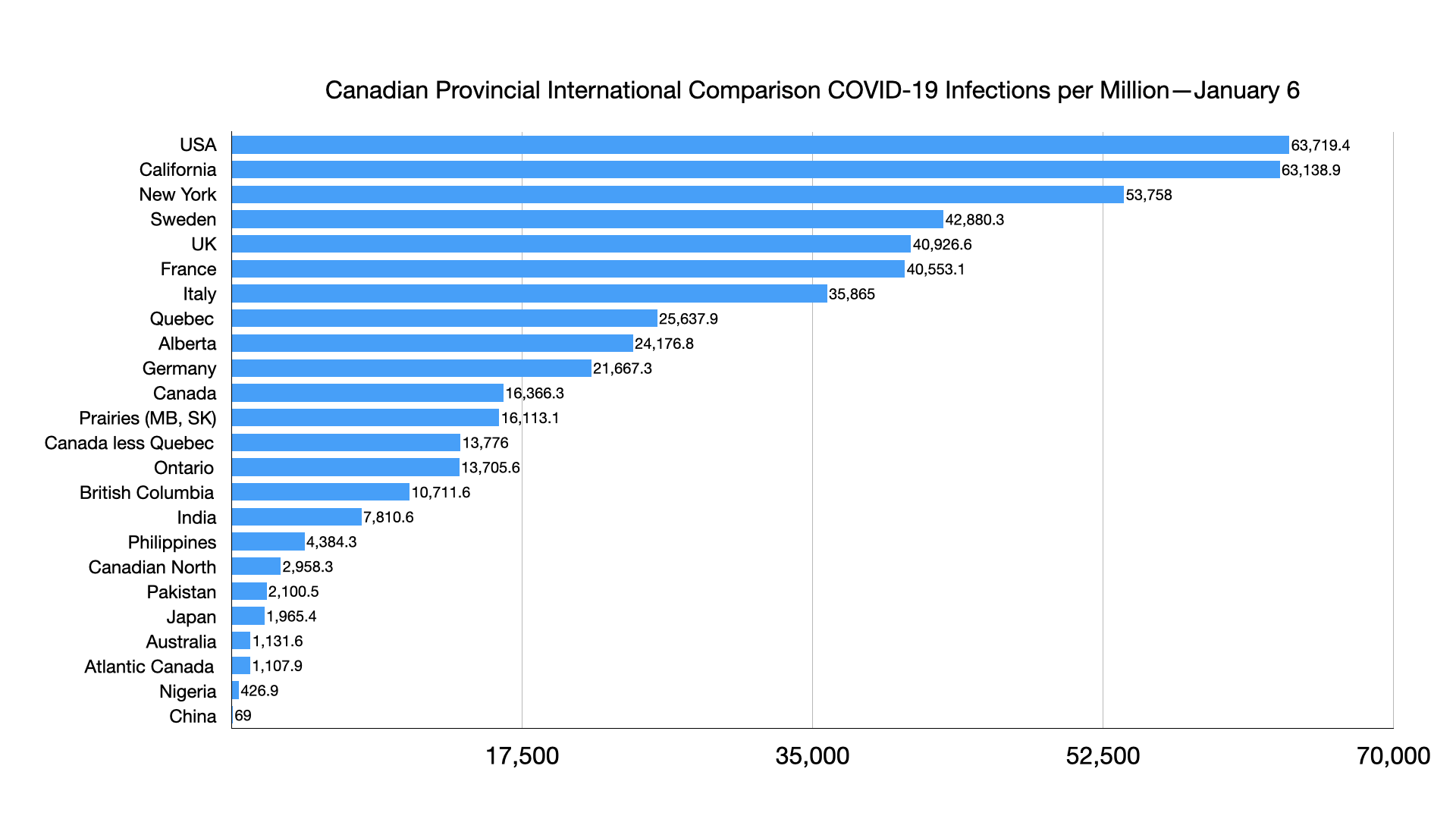
Infections per million: No relative change.

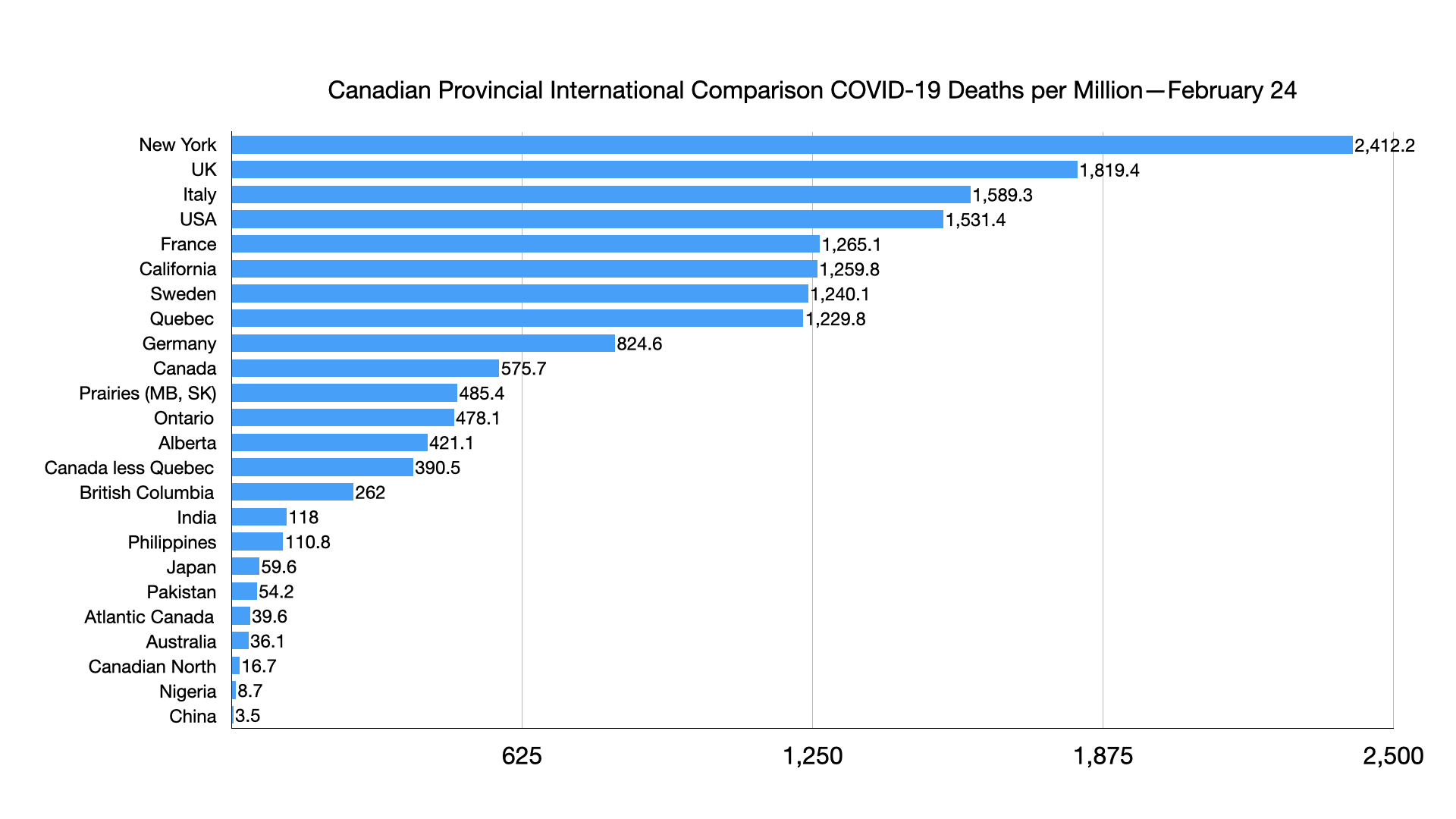
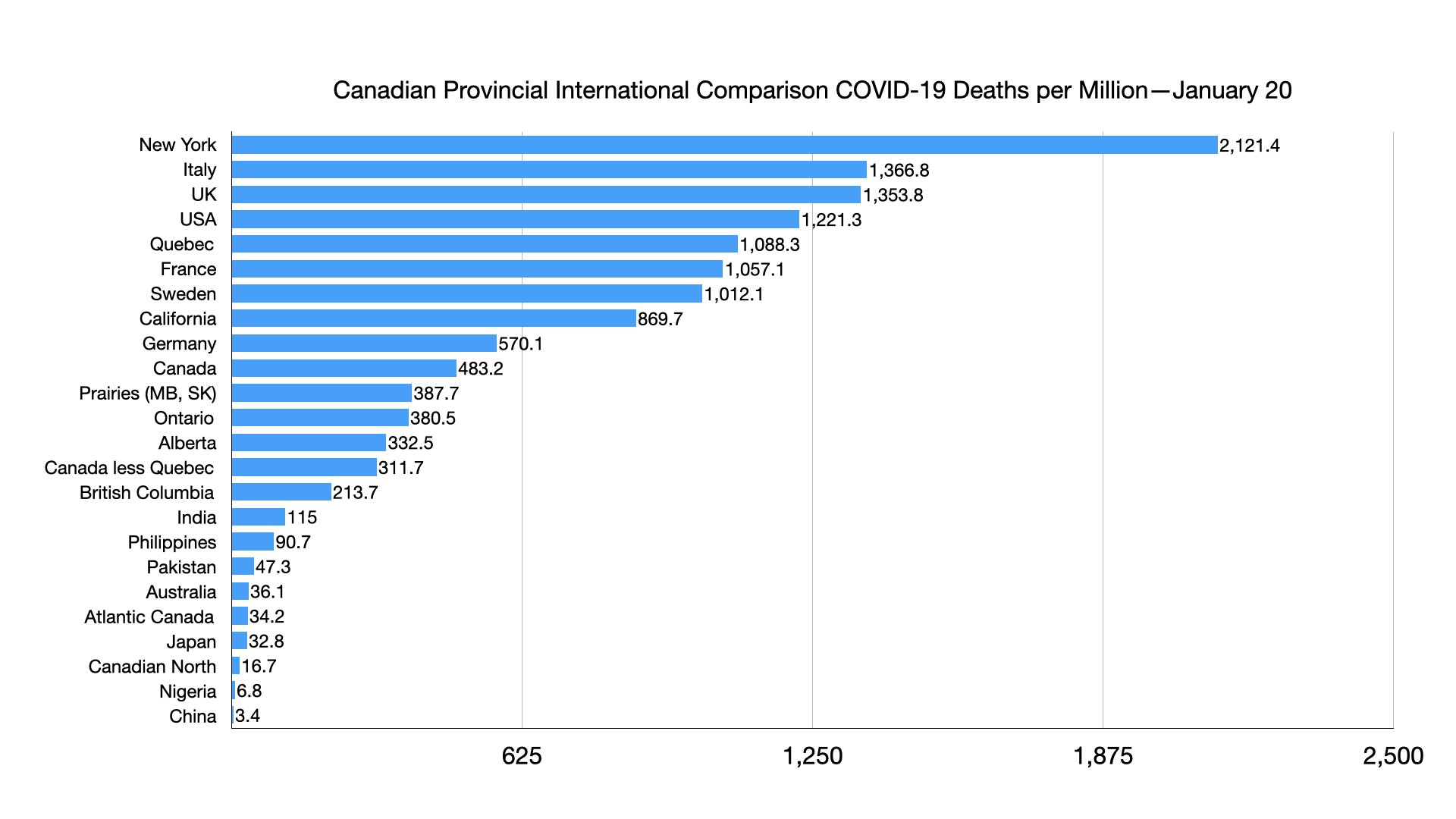
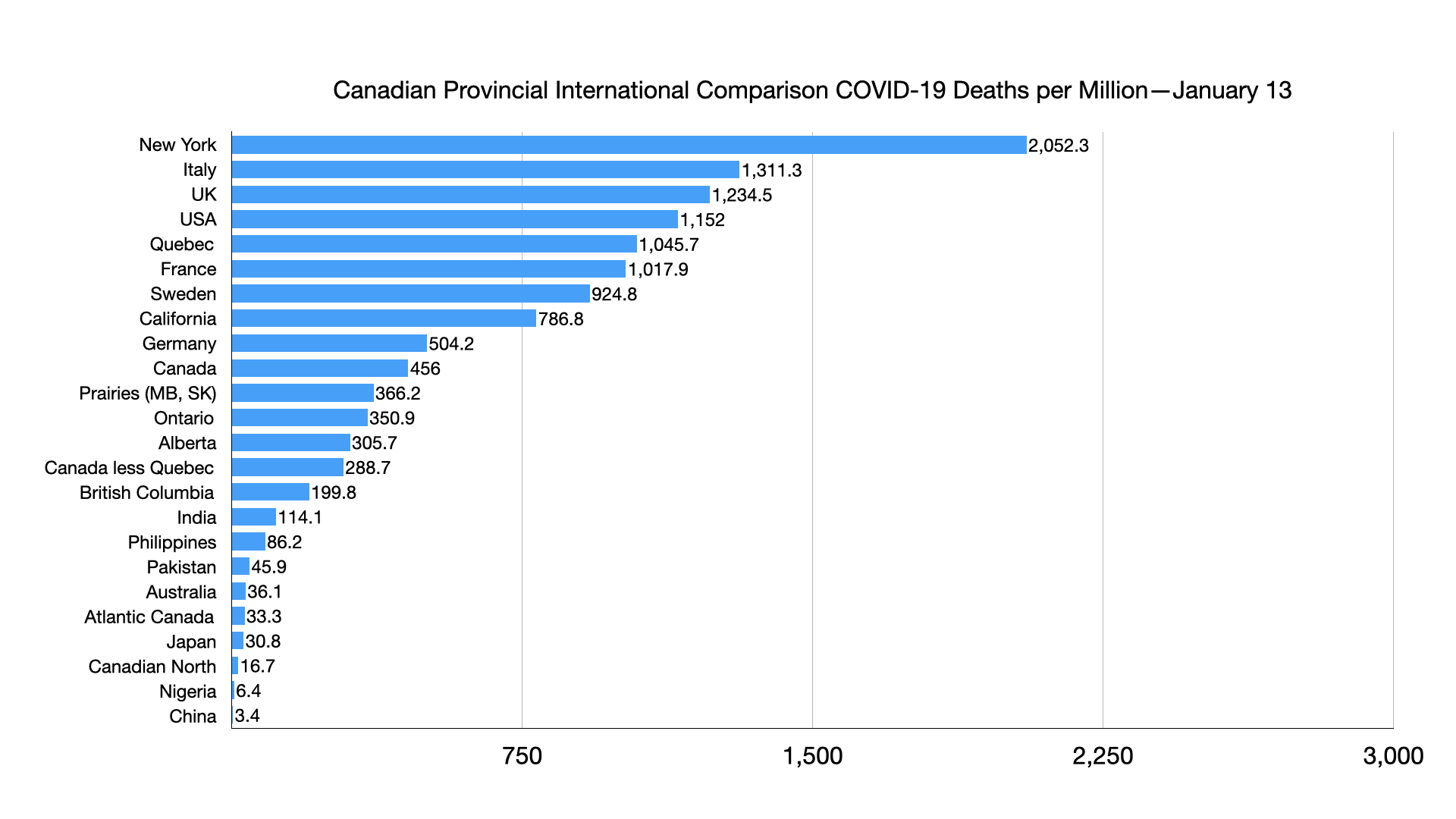
Deaths per million: California ahead of Sweden and Quebec, Sweden ahead of Quebec 

Provinces are working with outdated vaccine tracking systems, hindering national data

Canada’s patchwork system at its worst:

As Canada prepares for a massive increase in vaccine doses from abroad, some provinces and territories are using outdated technology to record their vaccination data and not fully participating in a system Ottawa created to manage infectious disease outbreaks.

The results of a Globe and Mail survey sent to every province and territory found a patchwork of systems for recording vaccine information that will be crucial in monitoring supply, adverse reactions and population immunity across the country, and for booking appointments. Some provinces reported that they had not enabled core pieces of the technology, called Panorama, that the federal government designed for campaigns like this one.

The SARS epidemic of 2003 highlighted the fact that Canada lacked a modern public-health database to manage all the information related to outbreaks of infectious diseases. Ottawa funded the creation of Panorama for all provinces and territories to use. The platform is actually a suite of technologies and databases for vaccine and infectious disease tracking. But more than a decade of delays and the increasing cost of participation led some provinces to opt out of some parts, revert to their previous systems, or adopt other technology platforms.

The end result is 13 different vaccine-tracking systems, many of which do not communicate with each other or Ottawa.

Shannon MacDonald, an adjunct professor at the University of Alberta faculty of nursing and a researcher with the Canadian Immunization Research Network, said the situation gives the federal government an incomplete picture of the national vaccine program.

“We can’t look at immunization coverage nationally,” Prof. MacDonald said. Some provinces and territories, she added, will struggle even to track their own programs.

Panorama has been in use for several years to track immunizations. The federal government obtained new technology in January to address some of the gaps, and that platform came online on Feb. 2.

Every province that responded to The Globe confirmed it has yet to plug in to the new system.

Representatives of some provinces said health officials still use paper or basic Excel spreadsheets to track vaccines and vaccinations.

The Globe survey found that Quebec, British Columbia, Yukon and Saskatchewan use Panorama, or some version of it, for various aspects of the COVID-19 vaccination campaign. Alberta, the Northwest Territories, Ontario and Manitoba have their own systems. Other provinces did not respond or did not indicate what technology they use.

In light of COVID-19, Ontario hired the accounting company Deloitte Canada to develop a new system. COVaxON, once it comes online, will manage “scheduling, client management, recording administered doses, site inventory management, receipt of vaccination” in a platform that is easy to use, Ministry of Health spokesman David Jensen wrote in response to the Globe survey.

Since December, Canada has received just over a million doses of two types of COVID-19 vaccines. In the next six weeks, four million are scheduled to arrive, and tens of millions more before the end of summer.

The shelf life and storage requirements of each vaccine must be closely monitored. Dale Hunter, a spokesperson for Saskatchewan’s Health Ministry, said the state of the province’s vaccine cold storage is “reported and tracked manually,” meaning the data are sent to the ministry via e-mail or fax. Panorama can be used to manage inventory, but several provinces and territories, including Saskatchewan, said they had not enabled that feature.

The Northwest Territories is using Excel spreadsheets and “specially trained logisticians” to ensure that “no dose is wasted,” Health Ministry spokesperson Andrea Nilson said.

Panorama includes a feature that allows health authorities to scan the barcodes on pallets and doses to keep track of the vaccines and who needs a second dose of which one. None of the provinces or territories that responded to the survey said they had enabled that feature, meaning health authorities enter the data manually.

In Ontario, government employees enter lot numbers into COVaxON when vaccine shipments arrive. Nurses and doctors who administer the vaccines can select the identifying serial numbers on their computers from a drop-down list. This helps clinics track doses both used and unused. Quebec does something similar, Health Ministry spokesperson Robert Maranda wrote.

Mr. Jensen wrote that Ontario’s system could be more efficient if the federal government provided lot numbers in advance.

Many provincial and territorial health systems are accessible on only a limited number of hospital and clinic computers, raising the question of whether they could be used more widely, such as in pop-up clinics or pharmacies.

The Globe asked provinces how they would deal with data entry for vaccinations in makeshift clinics or pharmacies. Manitoba, Alberta, Ontario and Quebec said their systems are designed to be accessible in all clinics and pharmacies. Saskatchewan reported that only public health facilities and some First Nations communities have access to Panorama. Data from pharmacies will be entered manually.

Prof. MacDonald said most provinces and territories have “good enough” systems to manage the vaccination programs. But she said that if any continue recording data with pen and paper, “we’re in a lot of trouble.”

There’s also the question of how provinces and territories will book vaccination appointments.

Alberta, British Columbia, and Saskatchewan are finalizing their booking systems. The Northwest Territories is leaving that issue to health authorities and hospitals. Booking systems for Quebec and Ontario are online.

Health authorities will need to monitor for adverse reactions and the possibility that some people who received the vaccine still contract COVID-19 – which could indicate a defective batch, a more potent variant, or that the patient is among the few for whom the vaccine is not effective.

Quebec’s system is designed to identify defective batches based on reports of adverse reactions and to notify those who received doses. Ontario is tracking adverse reactions with a system that has not been integrated into COVaxON. Saskatchewan and the Northwest Territories have not activated Panorama’s adverse-reaction module, and submit their reports manually.

The Public Health Agency of Canada is the main body responsible for monitoring adverse reactions. However, some provinces told The Globe they report to Ottawa on that manually or infrequently.

As the vaccinations continue, provinces will want to know what proportion of their population is immune at any given time. A 2016 study found the majority of provinces and territories lacked the ability to do a complete analysis of a mass vaccination campaign.

New Brunswick spokesman Shawn Berry said the province’s technology can “obtain near real-time immunization data for COVID-19 vaccinations.” Quebec said its system allows good population surveillance for infectious disease outbreaks, which includes vaccination data. While many provinces and territories that responded did not provide much detail, most told The Globe that, even if they can analyze their data, they do not automatically share the results with the federal government.

Most provinces and territories provided complete answers to the Globe survey, but British Columbia spokesman Devon Smith wrote that “confidentiality and safety” issues prevented the province from answering. Manitoba spokesman Brian Smiley said the province was unable to respond to most questions. Newfoundland and Labrador spokesperson Erin Shea indicated the province was still struggling with a recent outbreak of COVID-19 cases and could not fulfill the request. Nunavut, Nova Scotia and Prince Edward Island did not send responses.

Prof. MacDonald said the COVID-19 crisis should inspire provinces to modernize their health infrastructure. “God forbid it takes a pandemic for us to get moving on this,” she said. “But let’s make hay.”
Source: https://www.theglobeandmail.com/canada/article-provinces-working-with-outdated-vaccine-tracking-systems/

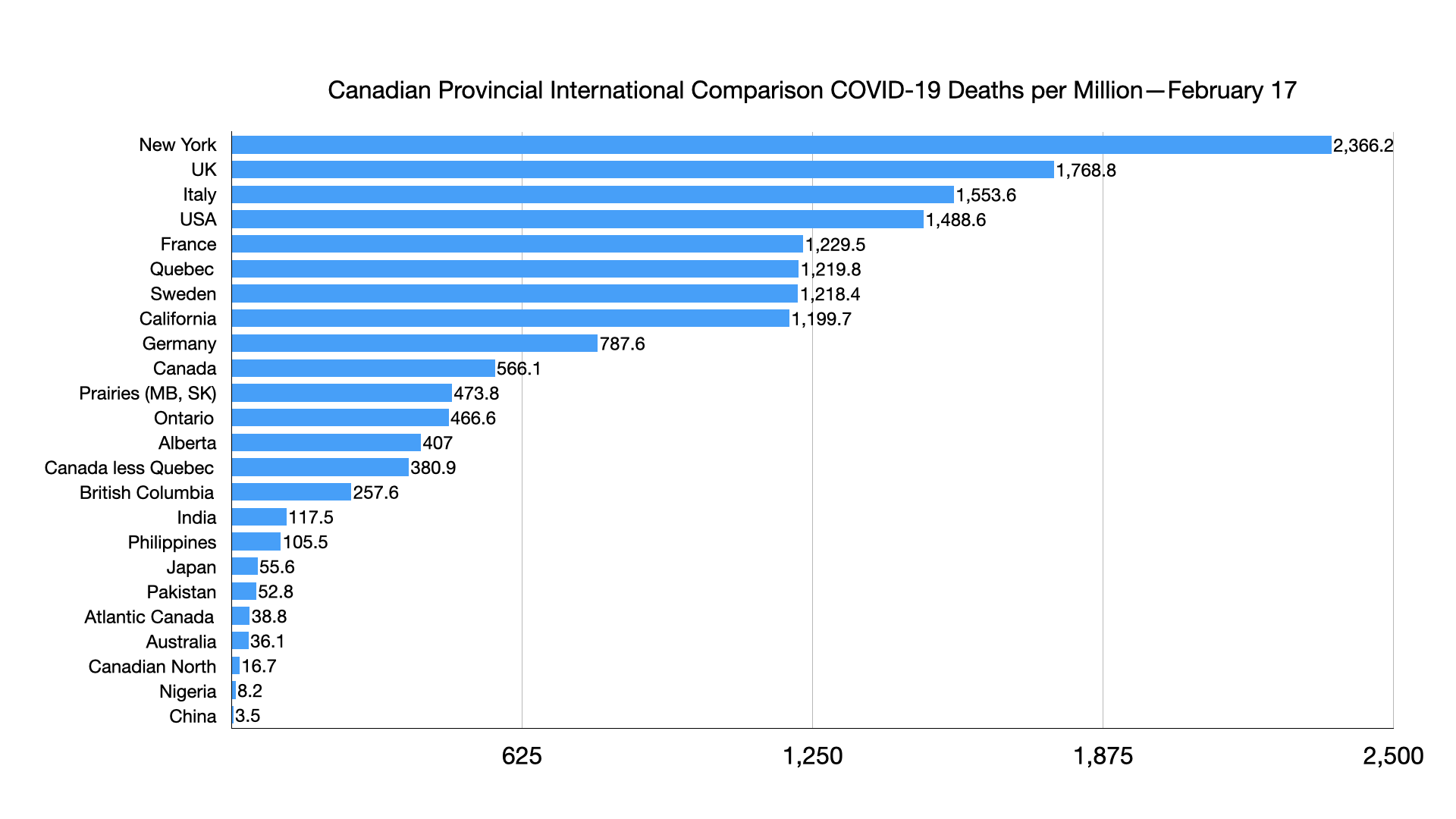
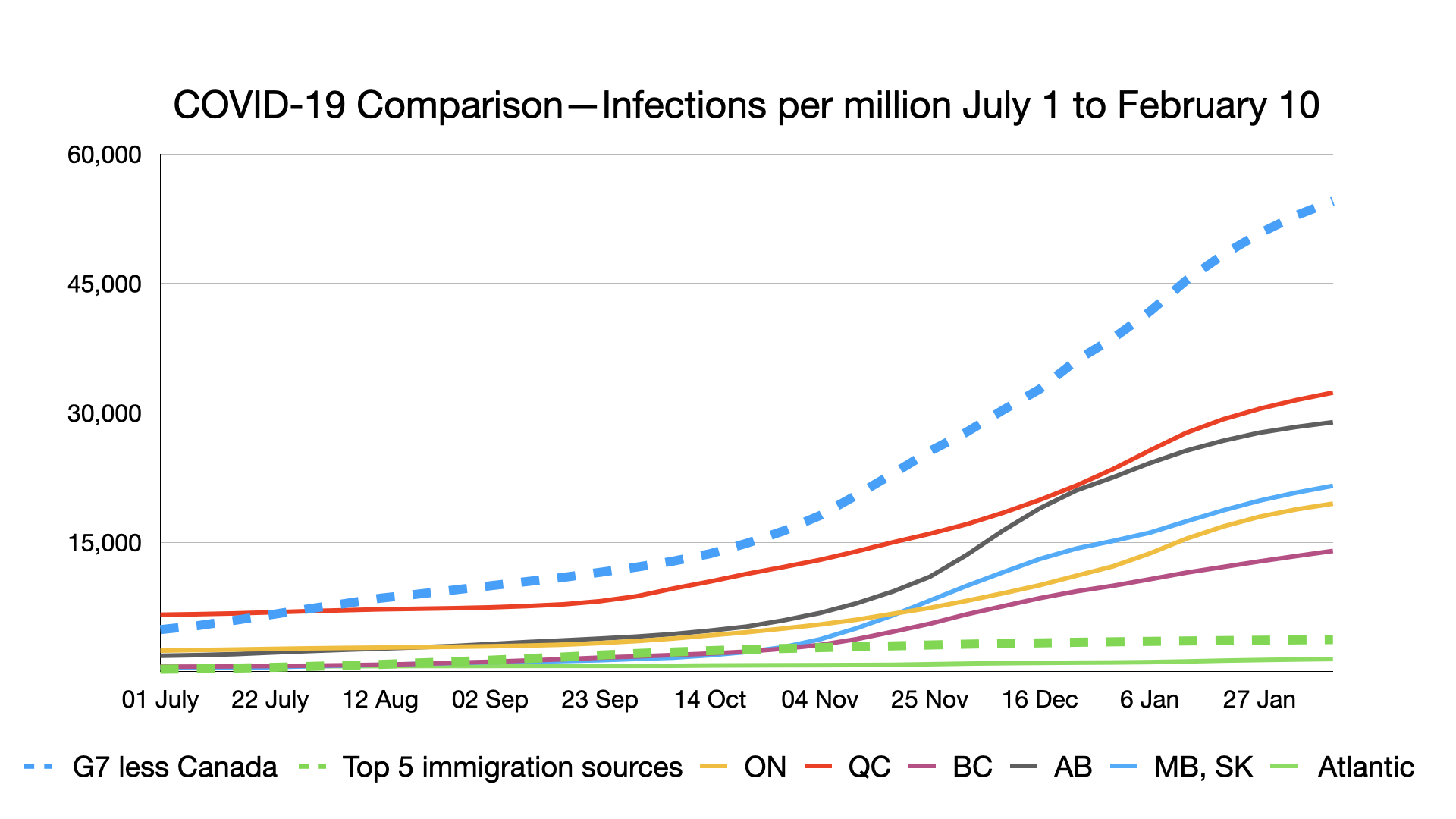
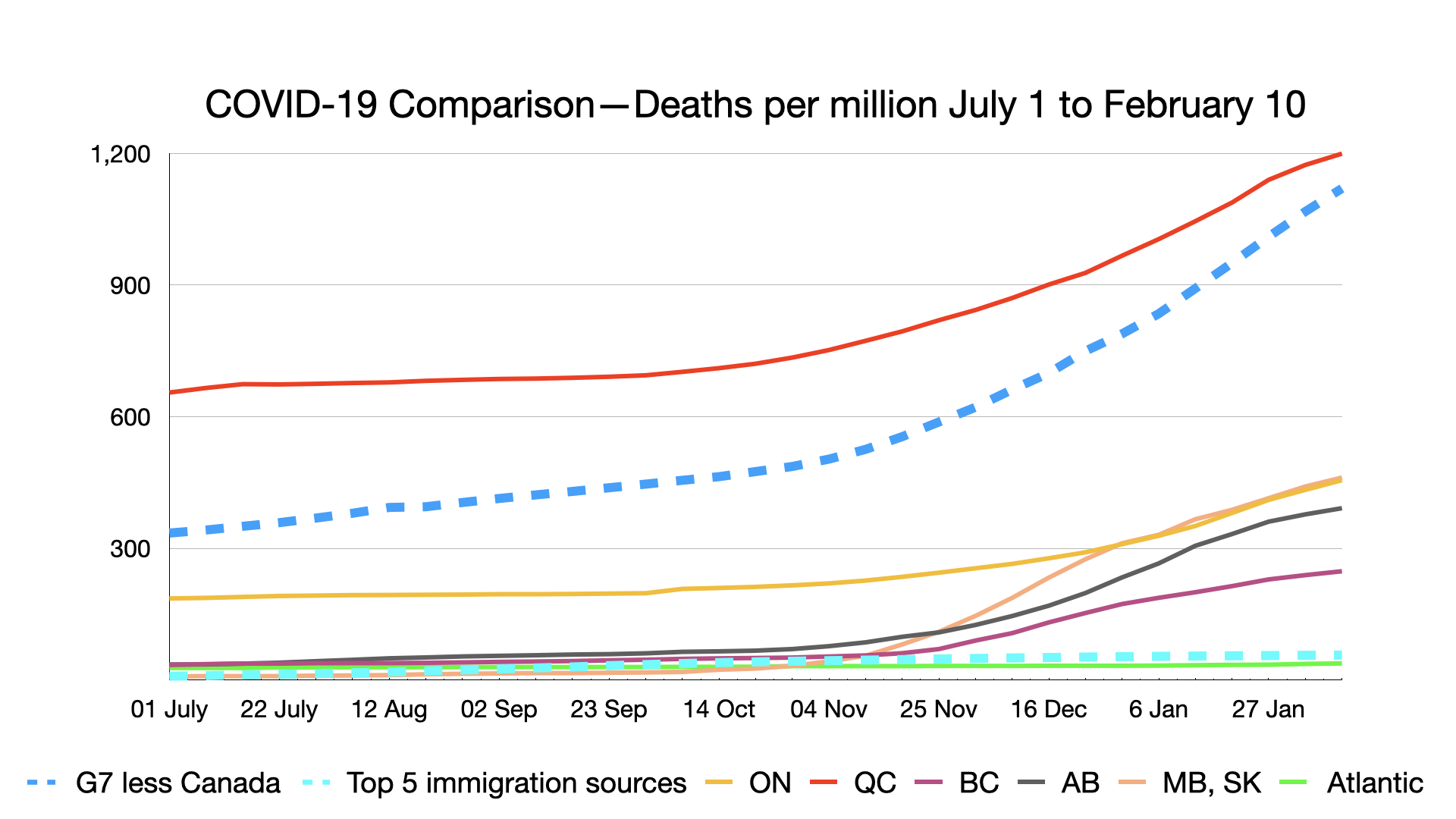
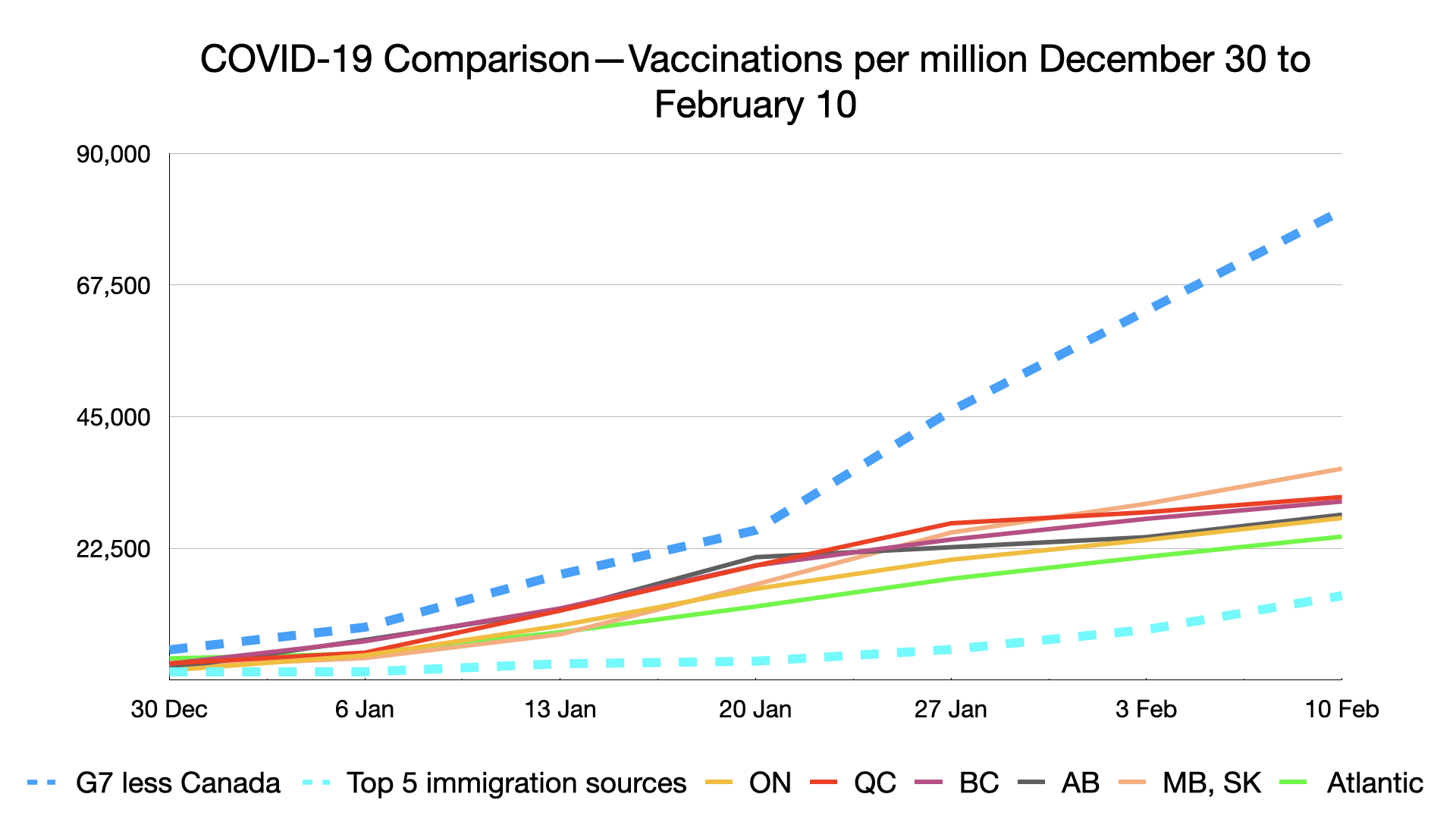
#COVID-19: Comparing provinces with other countries 17 February Update

The latest charts, compiled 17 February.

Vaccinations: The gap between all G7 countries save Japan continues to grow given the pause in deliveries to Canada, with the notable exception of the Canadian North.

Trendline charts

Infections per million: Alberta continues to be controlling the virus better than Quebec with an overall flattening of growth.

Deaths per million: While Canadian provinces are starting to flatten the curve, G7 has yet to see a flattening.

Vaccinations per million: Gap between G7 and Canada, driven not only by the UK and USA, continues to widen.

Weekly

Infections per million: No relative change.

Deaths per million: Quebec ahead of France, Japan ahead of Pakistan.

#COVID-19: Comparing provinces with other countries 10 February Update

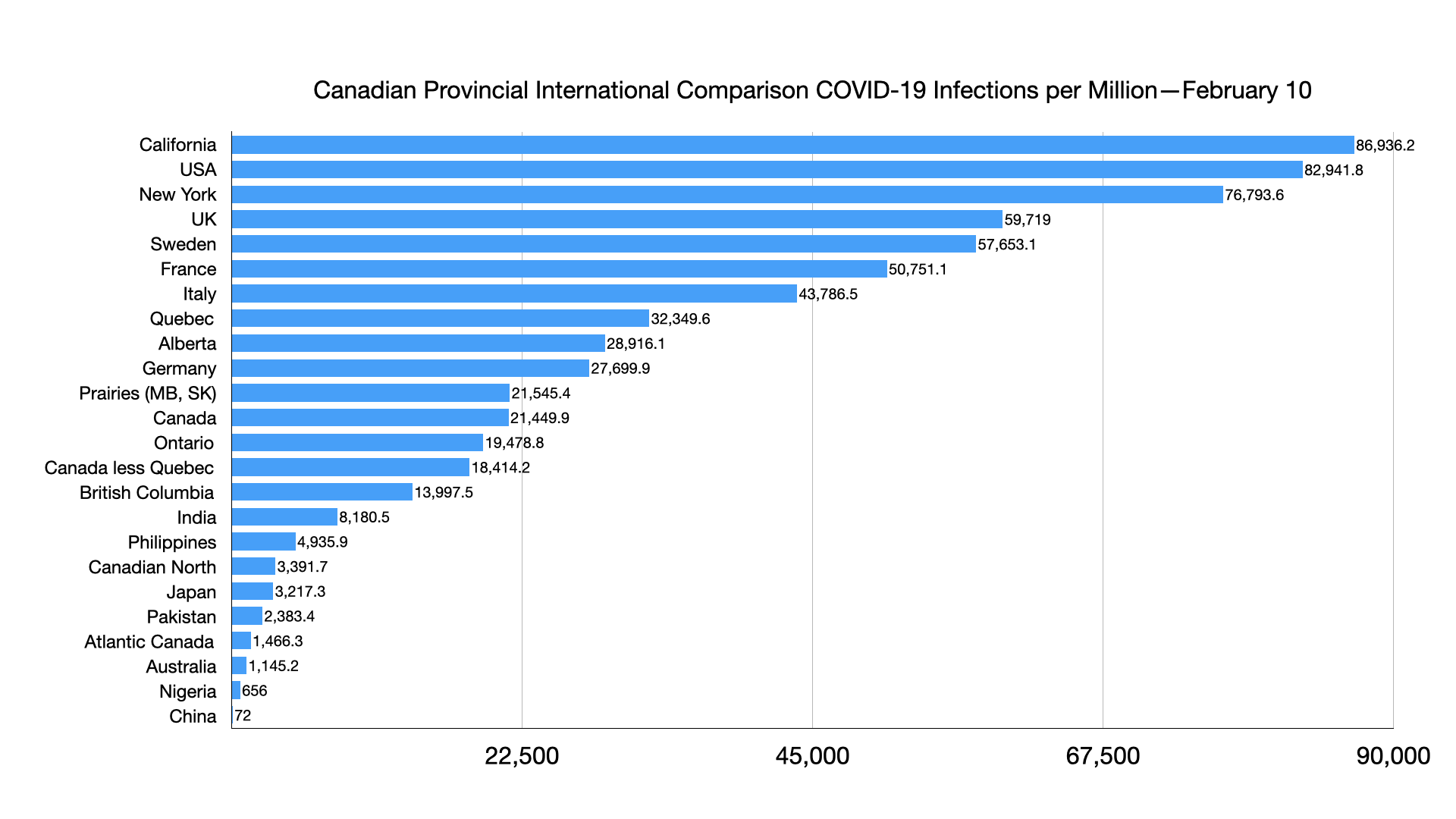
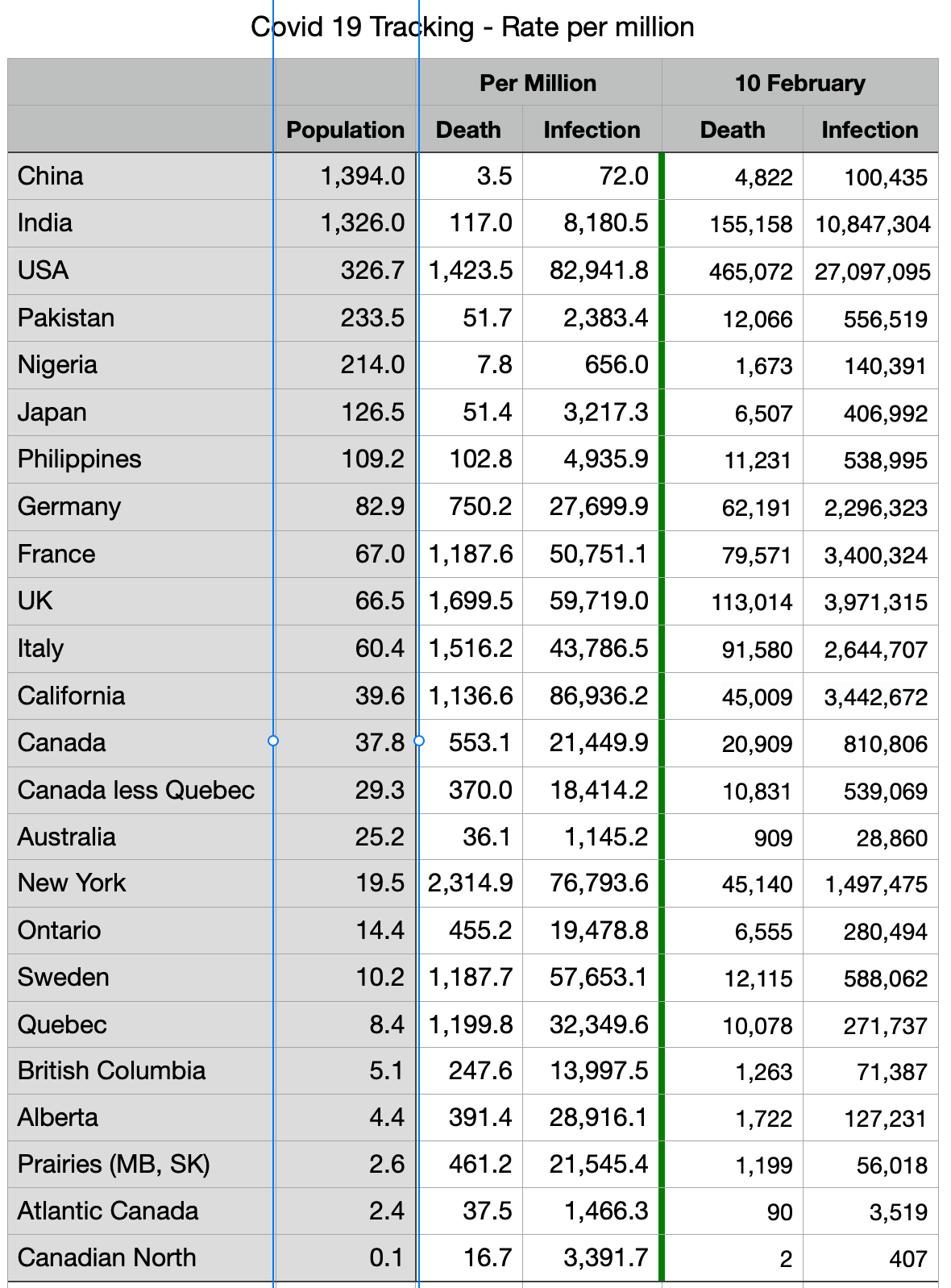
The latest charts, compiled 10 February.

Vaccinations: The gap between the leading G7 countries (UK, USA) and other EU countries continues to grow given the pause in deliveries to Canada, with the notable exception of the Canadian North and the Prairies behind slightly ahead of France.

Trendline charts

Infections per million: Alberta continues to be controlling the virus better than Quebec.

Deaths per million: G7 continues to close in on Quebec, Prairies continue to have similar rates to Ontario with Alberta death rates tapering off compared to Ontario and Prairies.

Vaccinations per million: Gap between G7 and Canada, driven by UK and USA, continues to widen. While not on the chart, Canadian North (NWT, Yukon and Nunavut) have the highest vaccination rates overall.

Weekly

Infections per million: Prairies move ahead of Canada total

Deaths per million: France marginally ahead of Sweden.

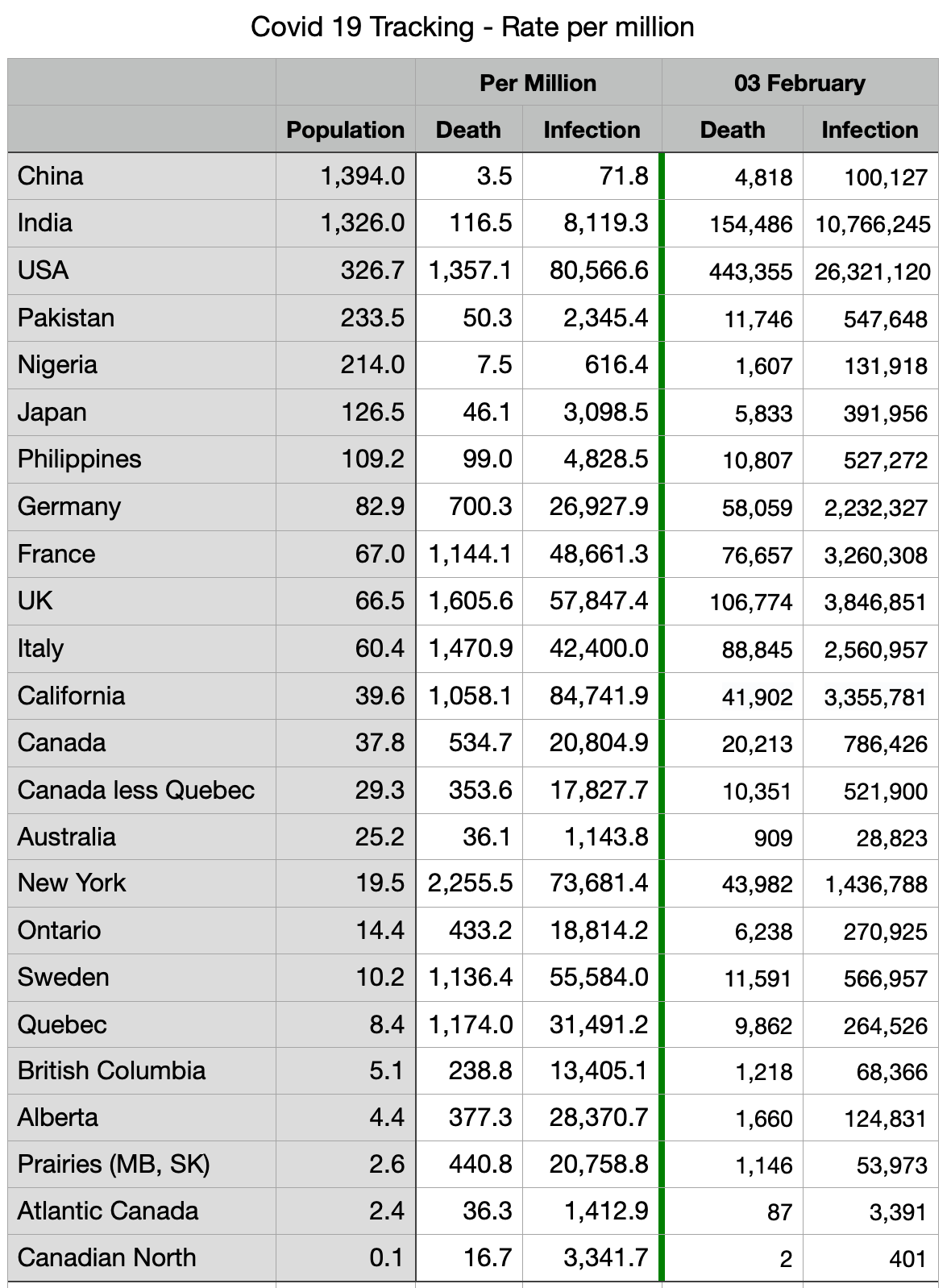
#COVID-19: Comparing provinces with other countries 3 February Update

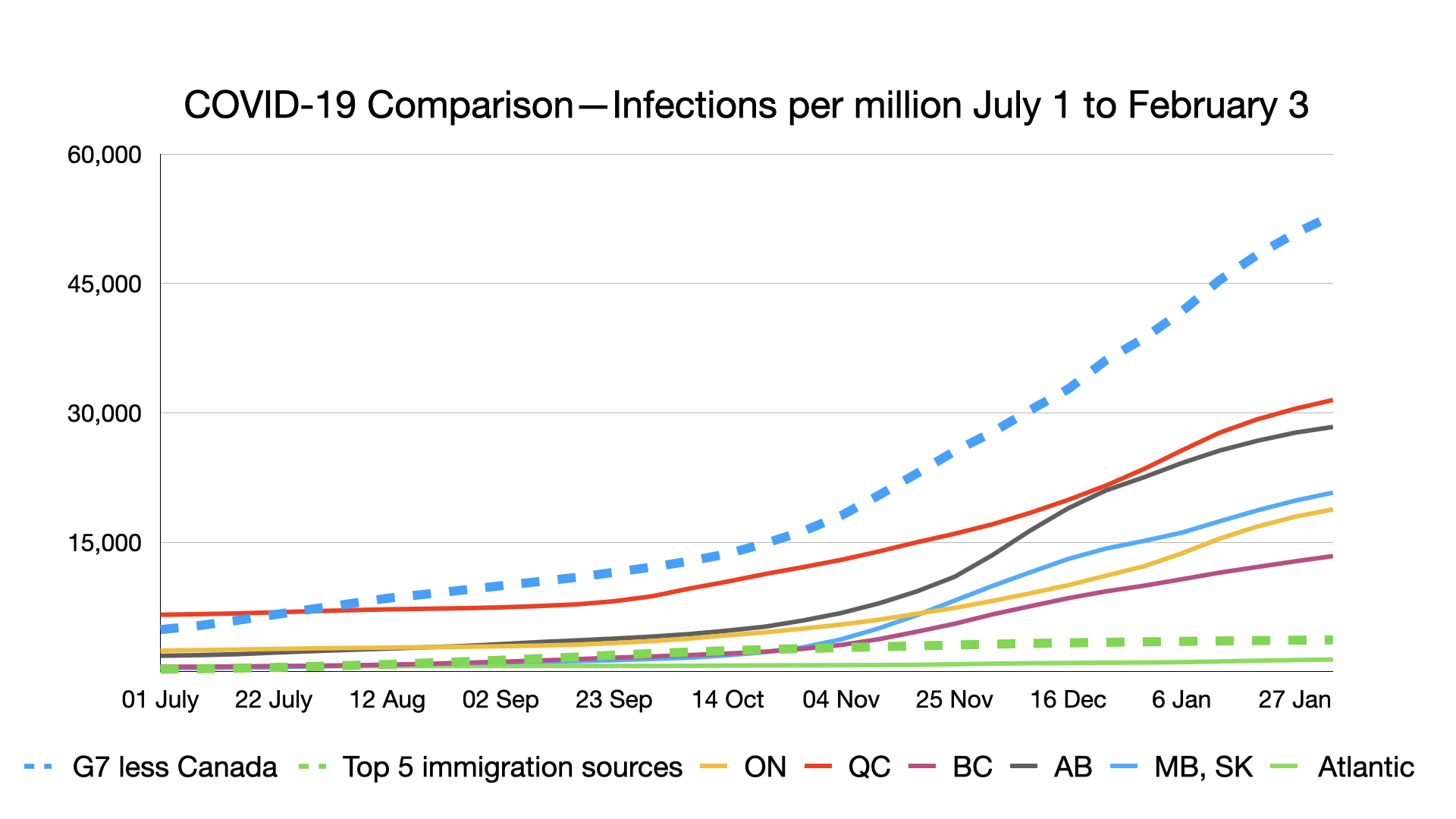
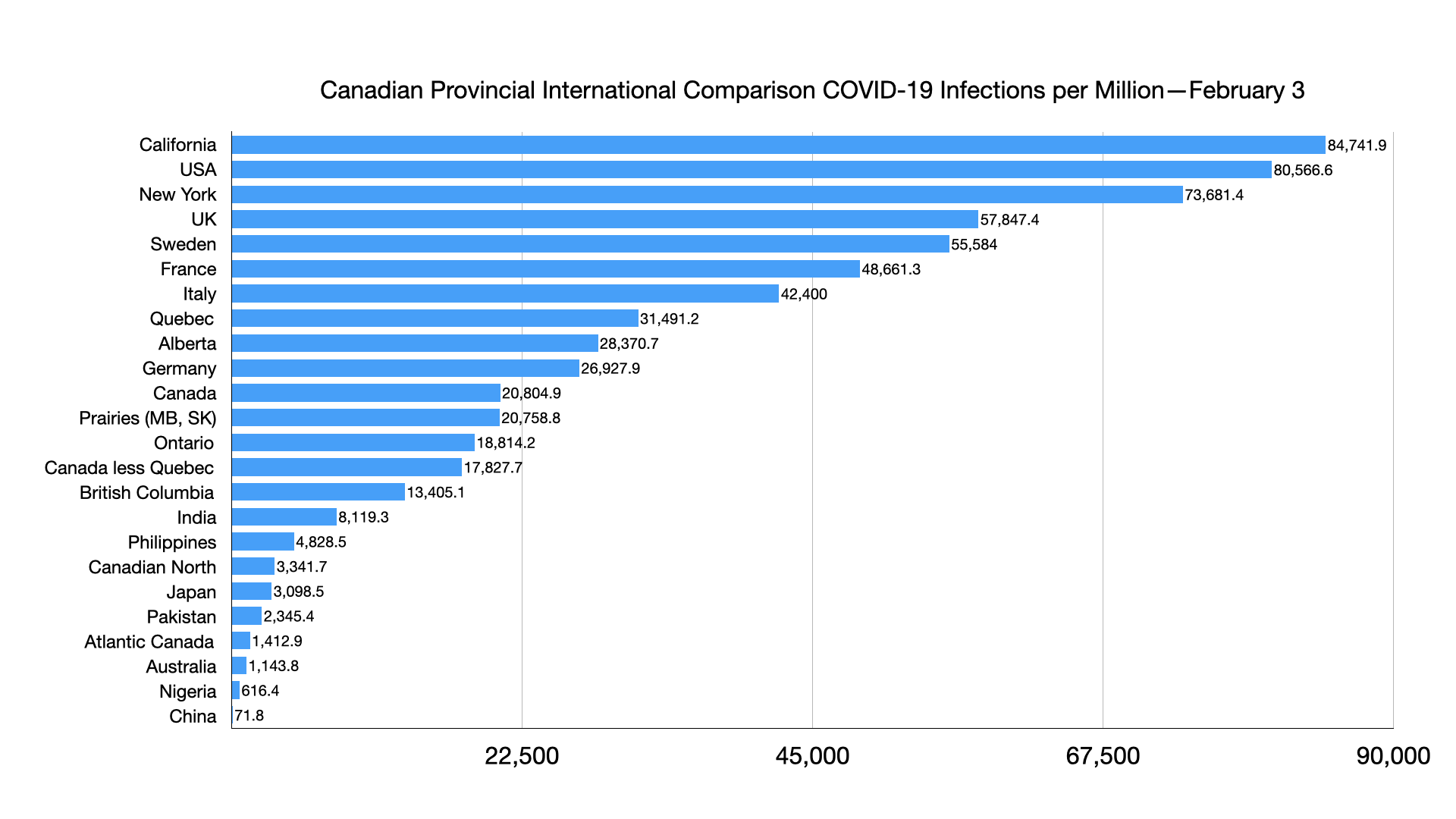
The latest charts, compiled 3 February.

Vaccinations: The gap between the leading G7 countries (UK, USA) and other EU countries continues to grow given the pause in deliveries to Canada, with the exception of France and Sweden.

Trendline charts

Infections per million: Alberta appears too be controlling the virus better than Quebec.

Deaths per million: G7 continues to close in on Quebec, Prairies continue to have similar rates to Ontario.

Vaccinations per million: Gap between G7 and Canada, driven by UK and USA, continues to widen.

Weekly

Infections per million: No change in relative ranking from last week.

Deaths per million: Atlantic Canada now ahead of Australia.

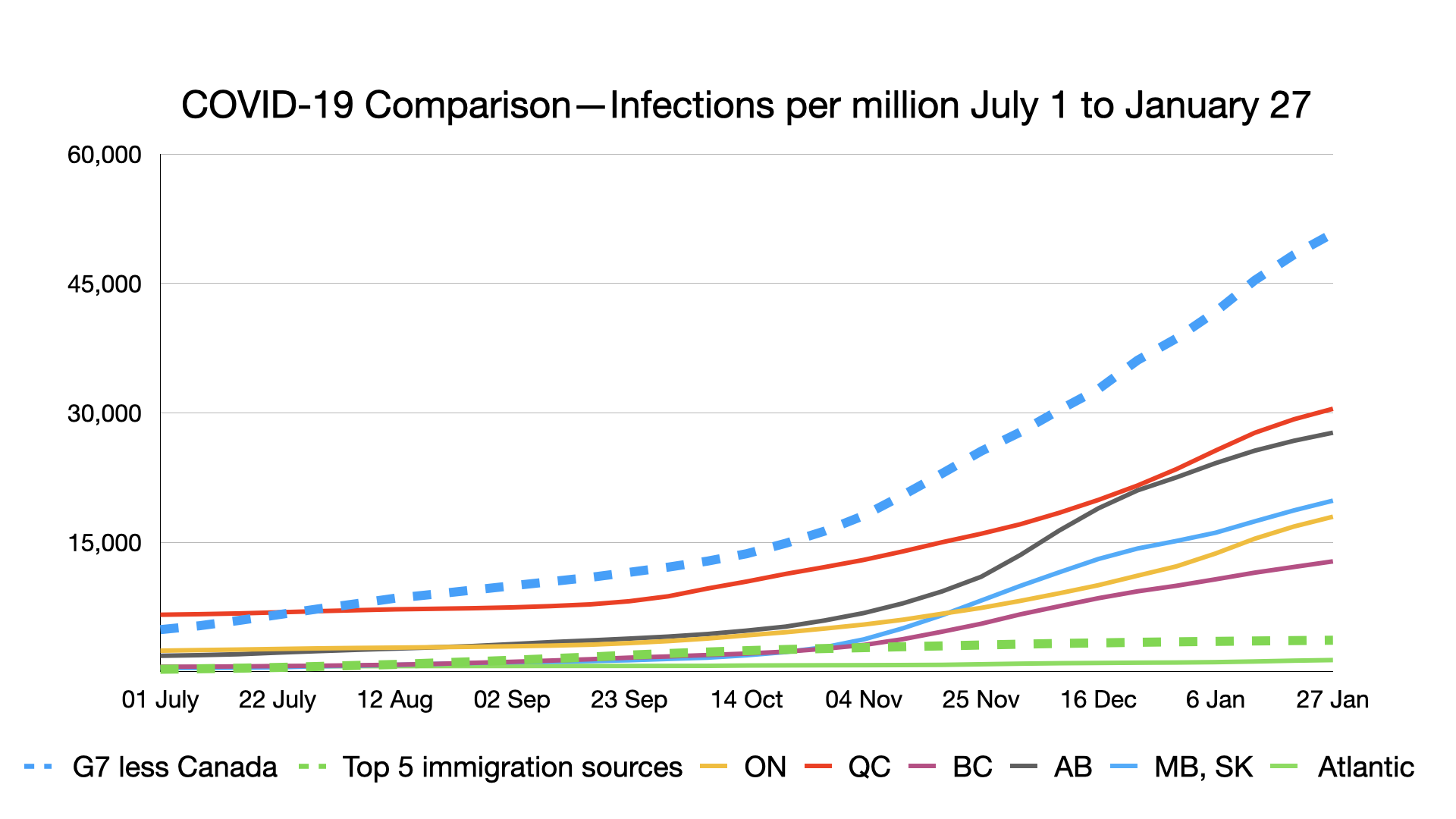
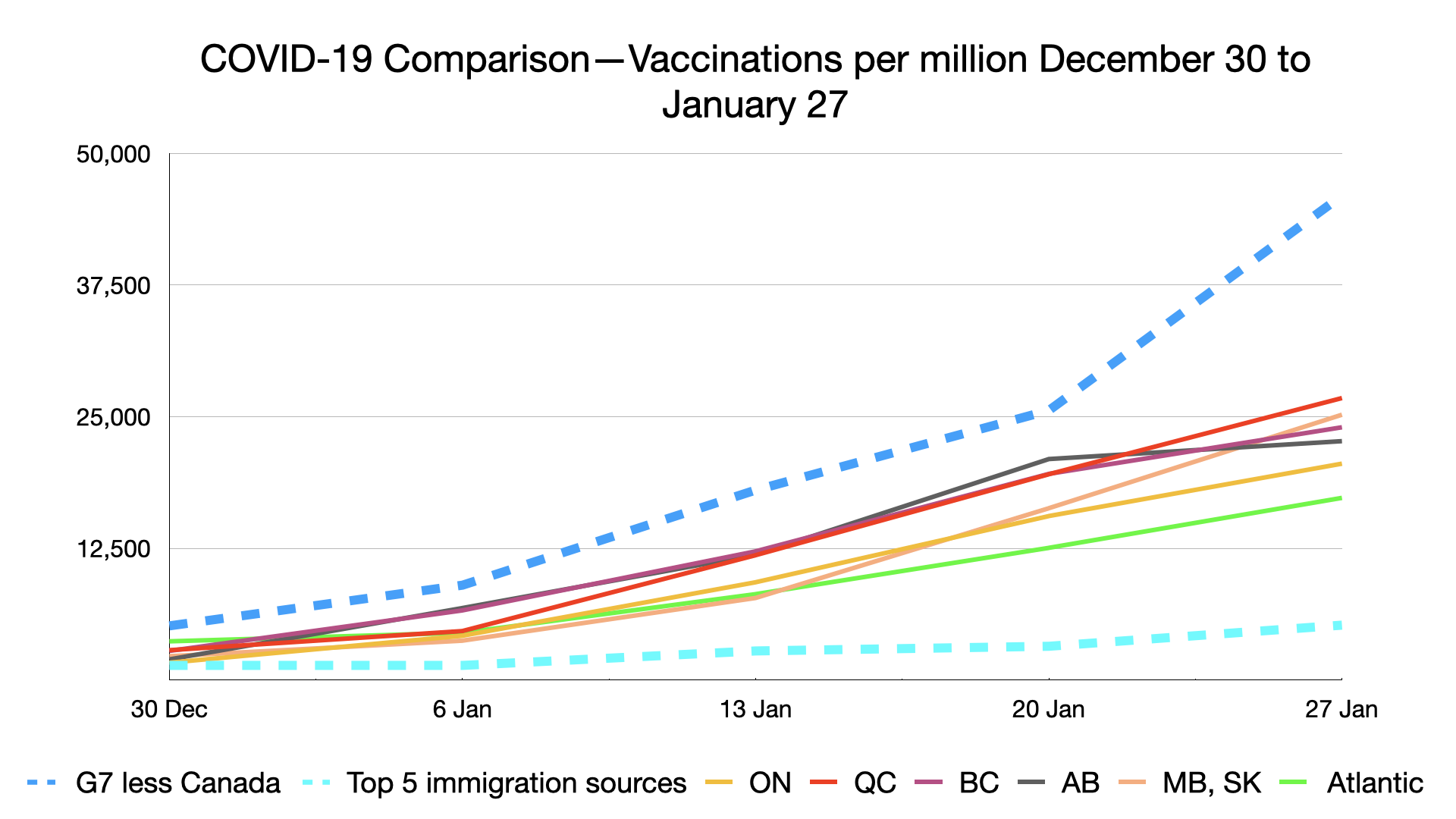
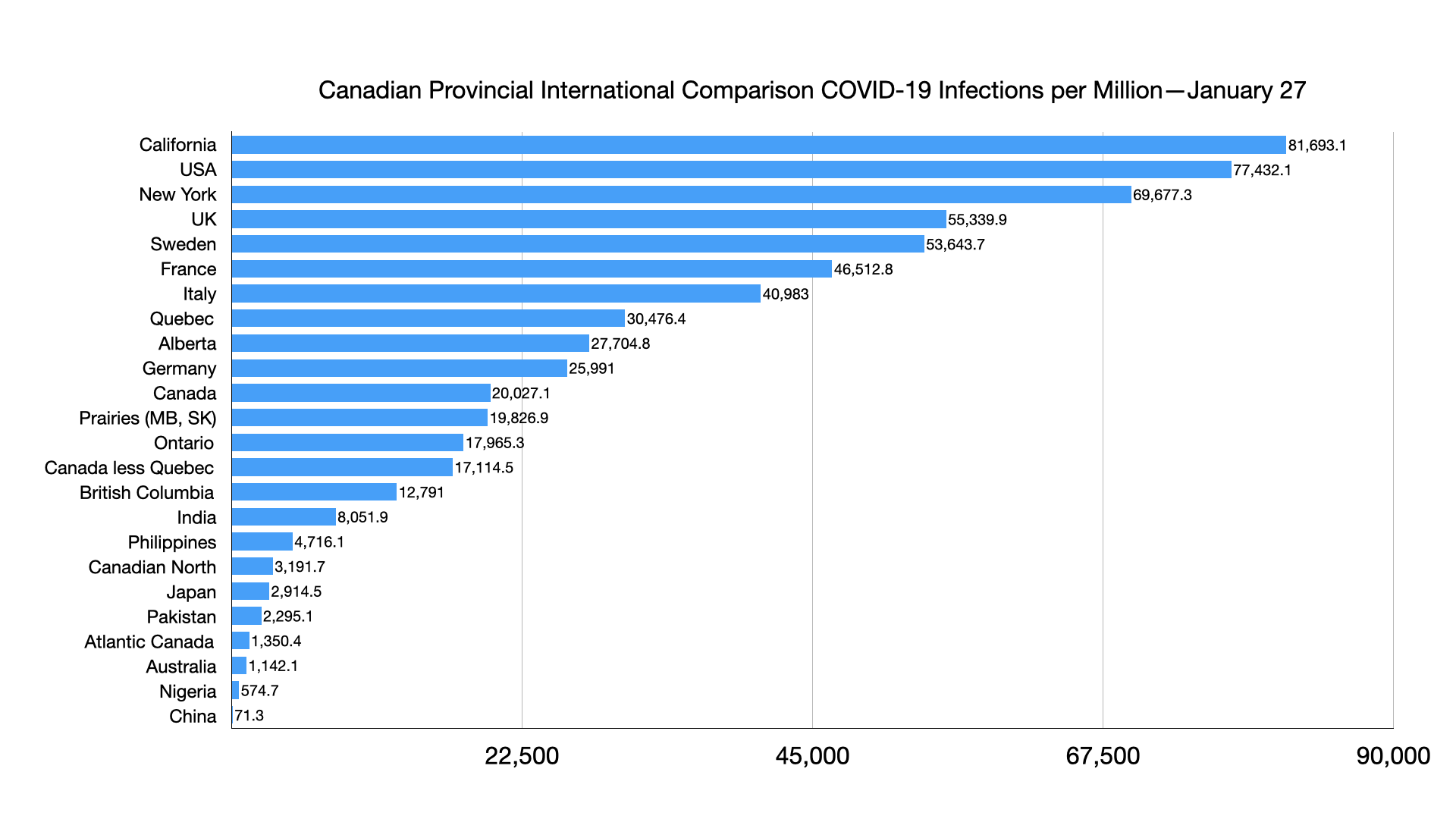
#COVID-19: Comparing provinces with other countries 27 January Update

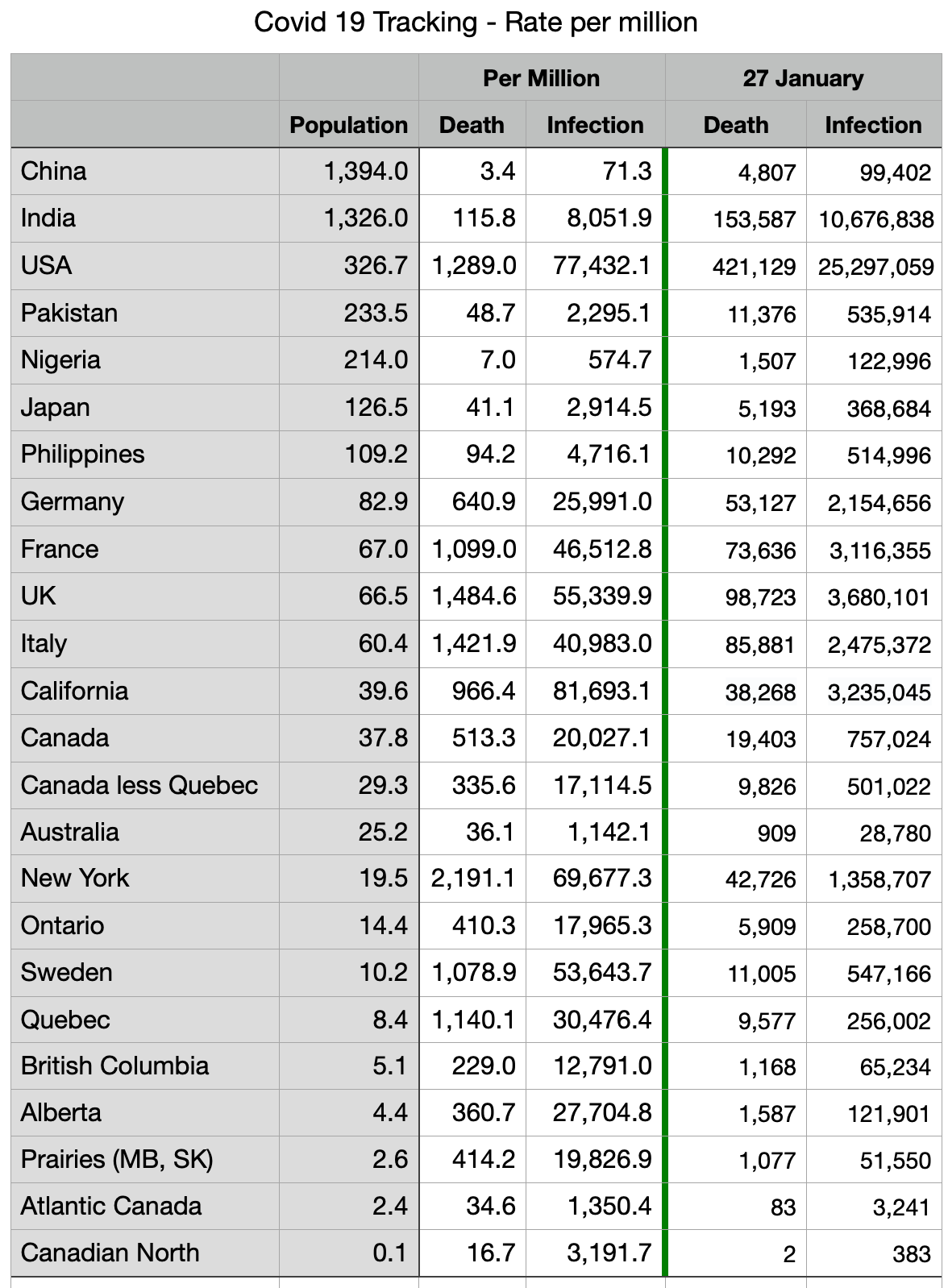
The latest charts, compiled 27 January.

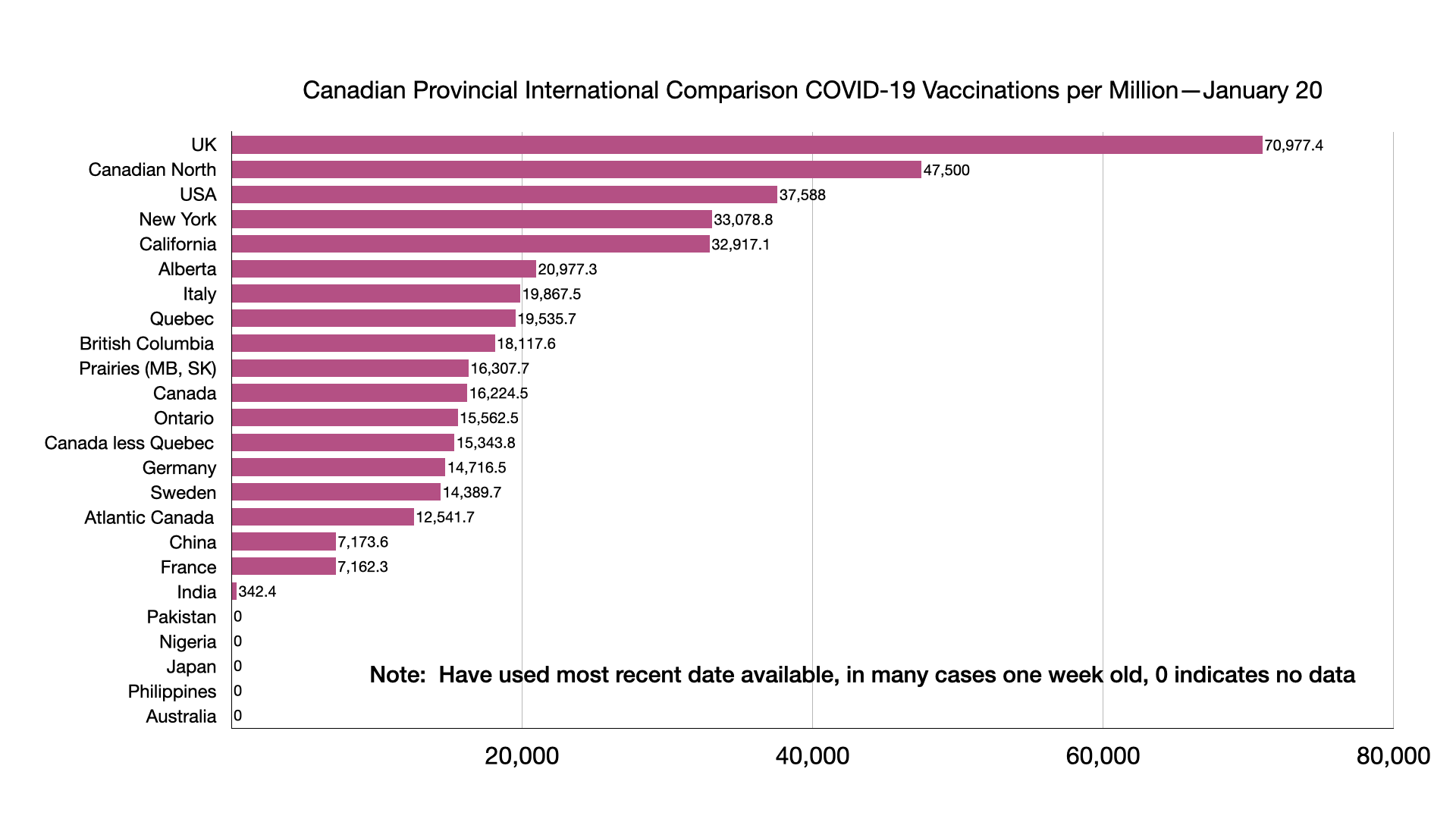
Vaccinations: The gap between the leading G7 countries (UK, USA) and Canada is growing but Canadian provinces still appear to be in the middle of the pack compared to other G7 countries (Japan has not started vaccination). Vaccination rates are the highest, reflecting the small population. We should start to see the impact of the pause in Pfizer deliveries in next week’s update.

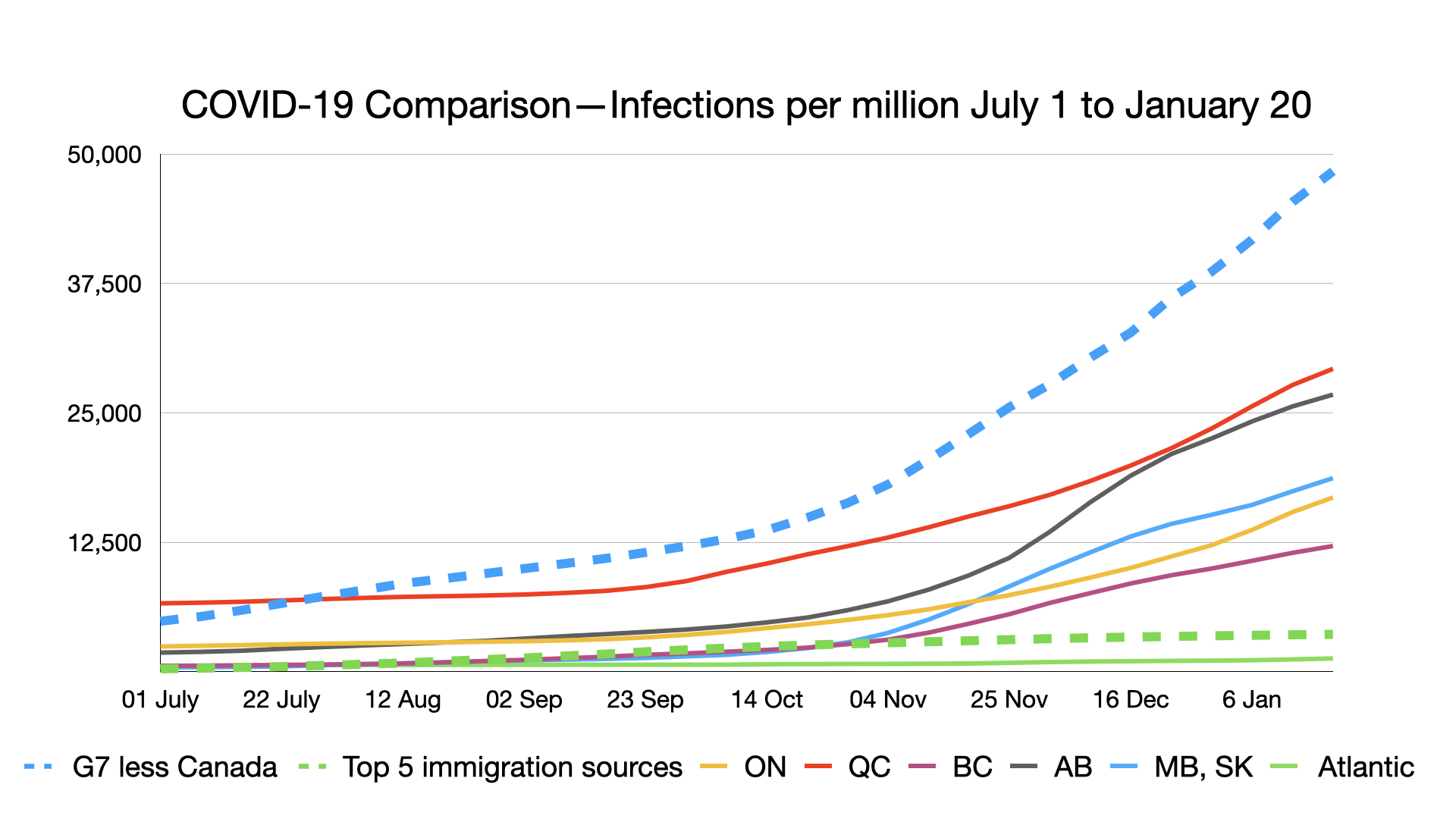
Trendline charts

Infections: Alberta no longer closing in on Quebec

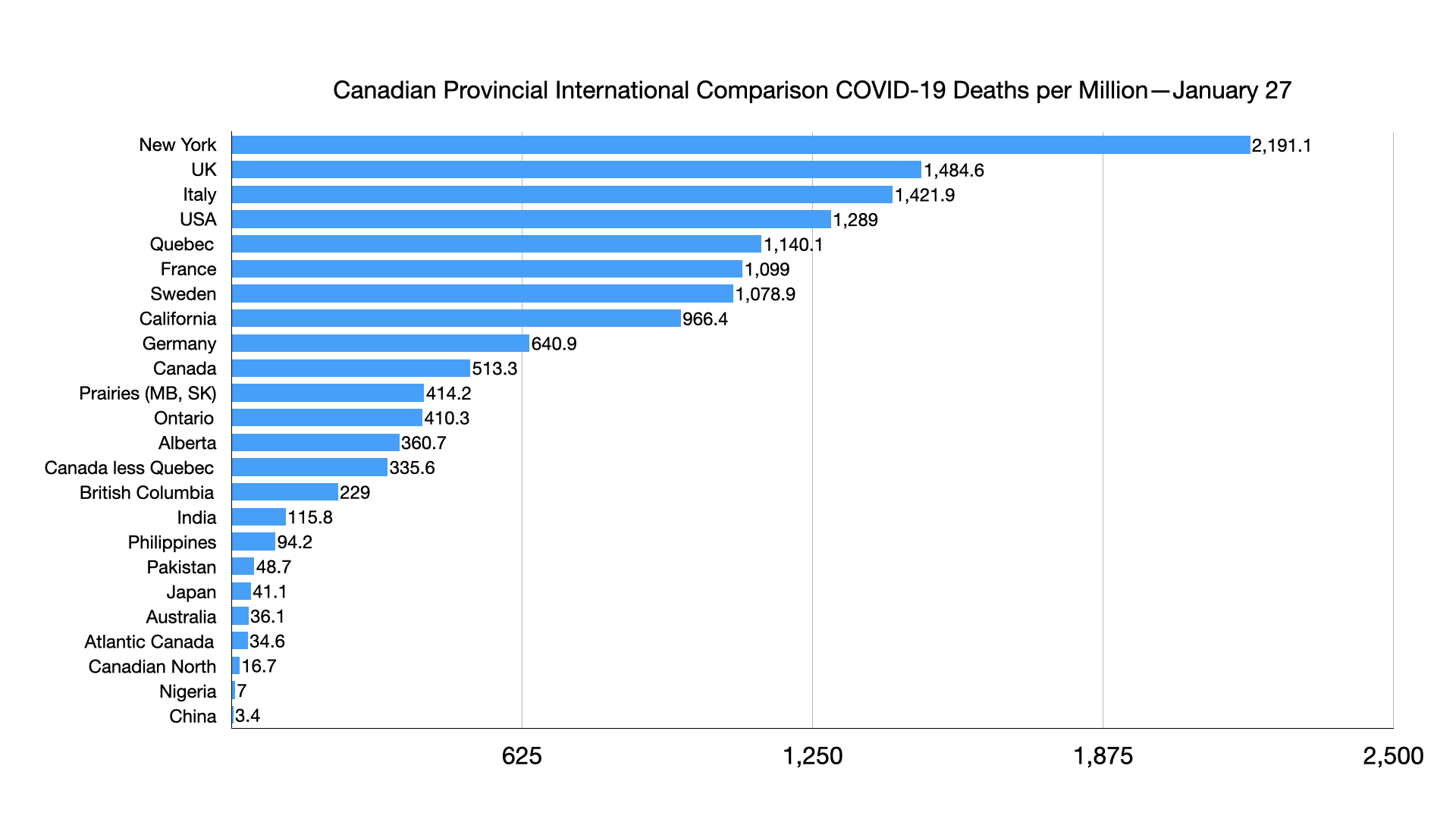
Deaths per million: G7 closing in on Quebec

Vaccinations

Weekly

Infections per million: No change in relative ranking from last week.

Deaths per million: UK ahead of Italy, Japan ahead of Australia and Atlantic Canada.

#COVID-19: Comparing provinces with other countries 20 January Update, including vaccinations

The latest charts, compiled 20 January.

Vaccinations: Canada appears to be in the middle of the pack compared to G7 countries save for the UK and USA. Vaccination rates in the Canadian North are relatively high. The change in the Pfizer delivery schedule will be felt in the coming weeks, likely affecting our relative ranking.

Trendline charts:

Infections per million: Alberta no longer appears to be overtaking Quebec but Ontario appears to be approaching Prairie rates.

Deaths per million: Prairies continue to be slightly higher than Ontario with Alberta slightly behind Ontario.

Minor week to week changes:

Infections per million: UK ahead of Sweden

Deaths per million: No change

#COVID-19: Comparing provinces with other countries 13 January Update, including vaccinations

As vaccination data is becoming available, I have started to compile this data (number of vaccinations administered) by province and my standard list of countries. Some countries have yet to publish vaccination data. While Canada is far behind the UK and USA, it is ahead of China and France:

The standard charts can be found below.

Minor week to week changes:

Infections per million: California ahead of USA, Ontario ahead of Canada less Quebec, Japan ahead of Pakistan, Atlantic Canada ahead of Australia 

Deaths per million: Alberta moved ahead of Canada less Quebec

#COVID-19: Comparing provinces with other countries 6 January Update

The standard charts can be found below.

There has understandably been a “feeding frenzy” regarding federal and provincial parliamentarians who have disregarded public health and their own government’s advice to forego travel, domestic or international, during the holidays.

In some cases, this has been to visit elderly family members (e.g., Sameer Zuberi and Kamal Khera of the Liberals, Niki Ashton of the NDP), in others for holidays (the various Alberta MLAs and Premier Kenney’s Chief of Staff, Quebec MNA Pierre Arcand) along with others.

Responsibility and accountability has been mixed. The federal NDP handled Ashton’s case the best, removing her quickly from her critic responsibilities, setting the tone for the federal liberals to follow sui. Ontario Premier Ford initially botched it being aware of his former finance minister Rod Phillips vacationing in St Barts but recovering quickly by accepting (insisting?) on his resignation. In rare tone deafness, Alberta Premier Kenney initial response not to sanction minister Allard, his Chief of Staff Huckabay and a number of MLAs, for travel during the holidays, that prompted outrage on all sides of the political spectrum and led to belated resignations and discipline.

Highly ironic given Kenney and the UCP reliance of “personal responsibility” and “good judgement” to reduce COVID risks when so many in the government have demonstrated neither.

Some good examples of Alberta commentary:

Rick Bell: Premier Kenney, it’s time to face the music

Don Braid: Kenney fires and demotes to spike scandal, but Albertans will decide if they forgive

And the contrary arguments from C2C’s editor George Koch:

In Alberta, Premier Jason Kenney first avoided meting out Ford-style punishment upon Allard and her fellow travellers. When the news broke, Kenney himself shouldered much of the blame and said he would provide new and crystal-clear “guidelines” covering ministers, MLAs and senior bureaucrats. The opposition, however, gleefully called for Allard’s headwhile the media republished tweets demanding Kenney’s own resignation. It has become fashionable to criticize nearly anything Kenney says or does; his handling of the pandemic is, according to one poll, approved of by just 30 percent of Albertans.

Personally, I found the Alberta premier’s initial response not only courageous but admirable and honourable. Unlike Ford and innumerable politicians, corporate leaders and heads of other organizations in countless analogous situations, Kenney declined to throw Allard under the bus. This is not the first time Kenney has gone to the mat for a subordinate, at considerable short-term political cost to himself. Who would you rather work for? Further, someone who clearly cares about the people who work for him might, just might, also be sincere in his concern for small businesspeople and voters at large.

Sadly, however, Kenney ultimately could not resist the stinking red tide of public opinion; on Monday, he accepted Allard’s resignation from cabinet, as well as that of his chief of staff, who had travelled to the UK, and demoted the other MLAs.

Source: https://c2cjournal.us19.list-manage.com/track/click?u=e8efce716429c34122979e2de&id=cb2f1e50a3&e=4174a59277

Minor week to week changes:

Infections per million: Sweden moves ahead of UK which in turn moves ahead of France, Canada total ahead of Prairies

Deaths per million: Germany moves ahead of Canada

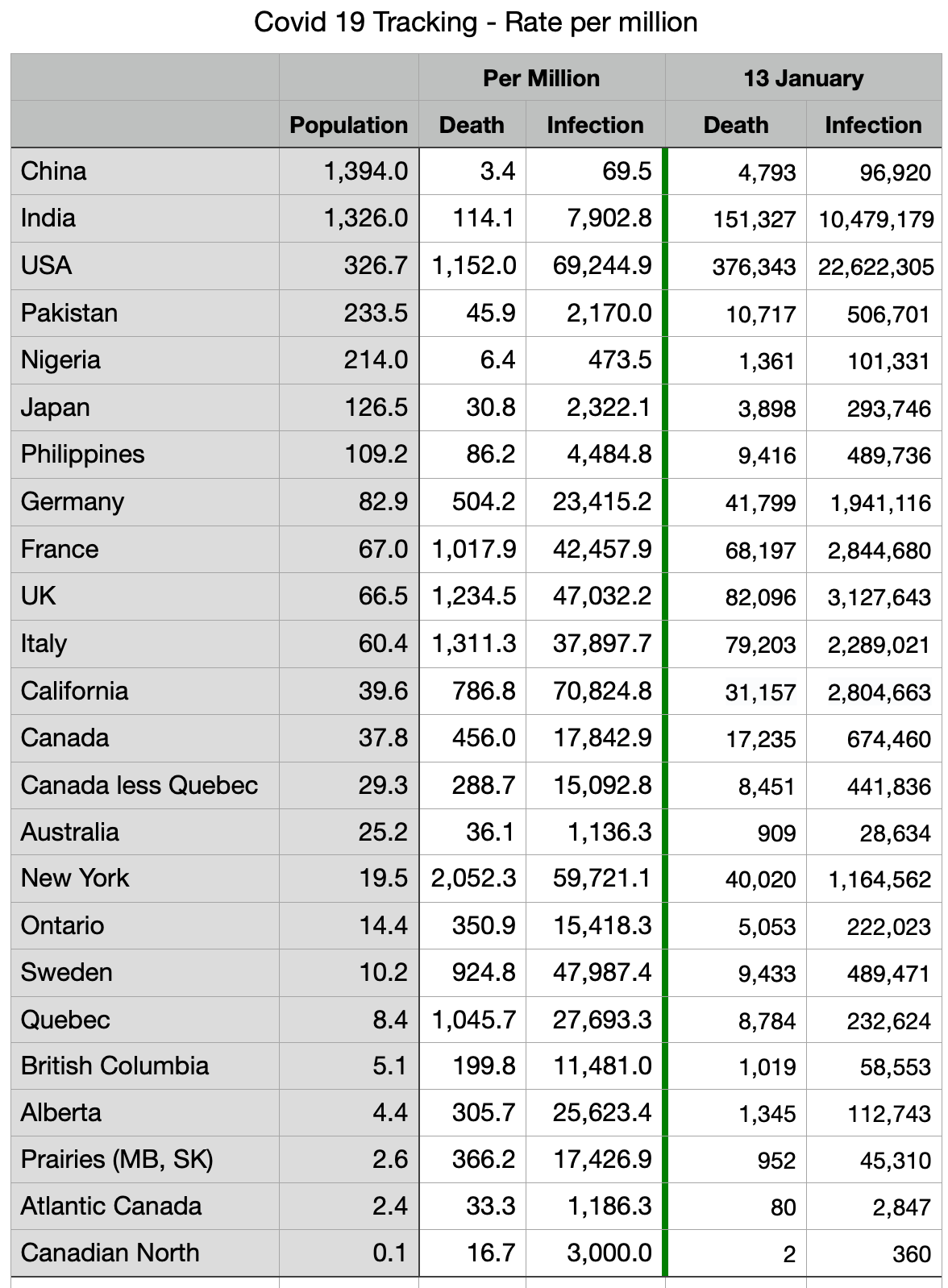
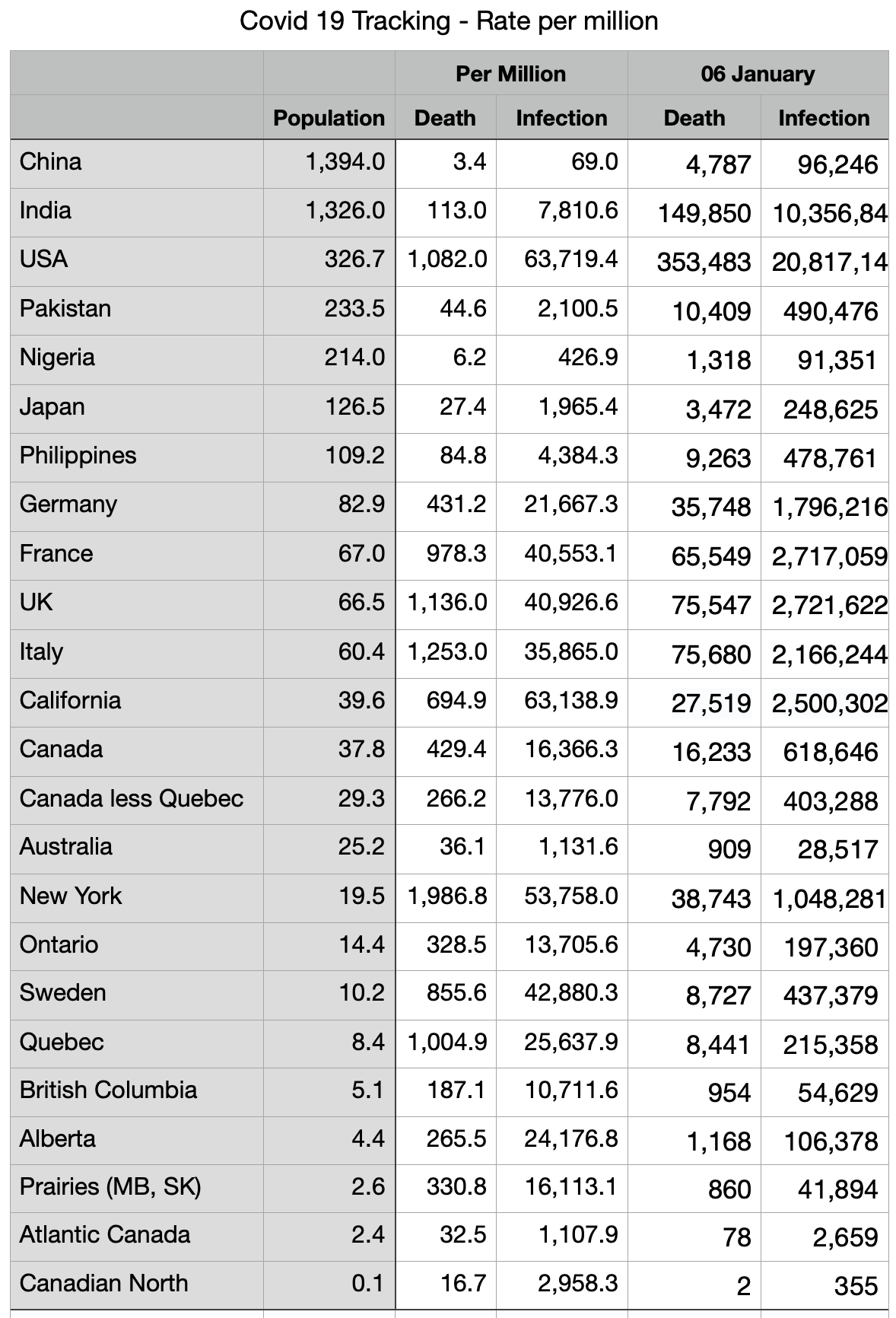
And the standard weekly charts and table.

#COVID-19: Comparing provinces with other countries 30 December Update, including cumulative data

Will now provide the trend line and weekly data to provide a more complete picture. As the charts are self-explanatory (advise me if not), will continue to keep narrative to a minimum.

Alberta’s infection rate maintains its overall convergence with Quebec whereas the death rate of the Prairie provinces (Manitoba, Saskatchewan) have converged with Ontario’s.

The other related news, despite all the warnings and advice from political leaders, the Ontario finance minister was caught “off message” with a trip to the exclusive Caribbean of St Barts. Not the only one, Quebec MNA Pierre Arcand went to Barbados. Not to forget federal health minister Patty Hajdu’s repeated trips home to her riding during the first wave.

One expects better.

Lastly, may I wish you a happier new year.

Weekly updates below. Minor changes only:

Infections per million: UK moves ahead of Italy

Deaths per million: Prairies (Manitoba, Saskatchewan) moves ahead of Ontario

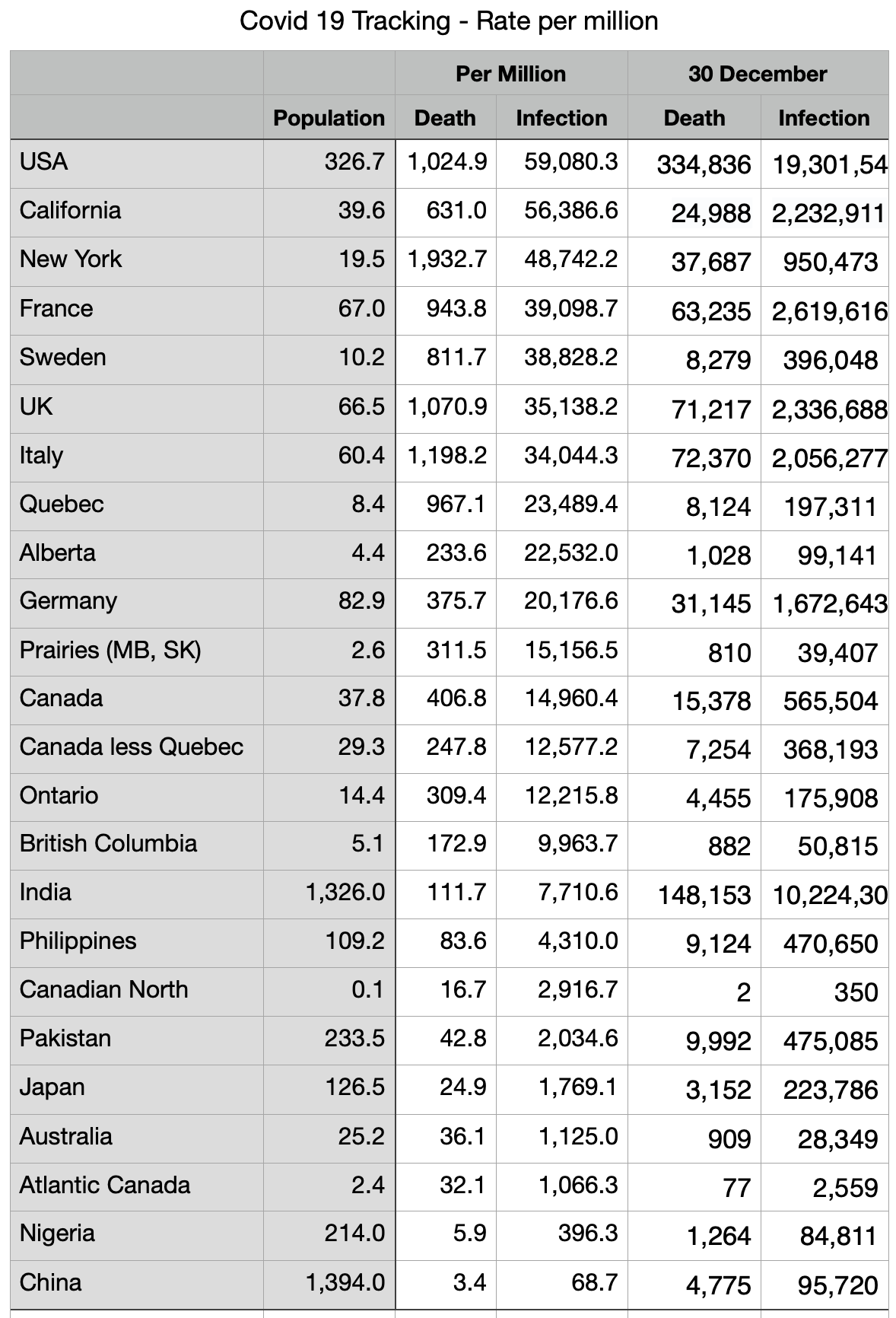
And the standard weekly charts and table.