As premiers push for more immigration power, experts call for a fact-based debate

Please, evidence-based policy, not the reverse…:

Some premiers say they want to have more local control over the immigration system — but experts say what the system really needs is a national conversation on immigration reform that shores up public support.

“Most of the existing policies have been formulated on the fly without any evidence or serious impact evaluations of what the various classes of immigrants are, how they’re performing economically and otherwise,” said Michael Trebilcock, a retired academic and co-author of two books on immigration policy.

“So it’s basically research-free.”

As the premiers and territorial leaders were wrapping up their three-day meeting in Huntsville, Ont., late last month, they called for an increase to economic immigration levels to fill local labour gaps and said they would use their constitutional powers to seize more control over immigration and issue work permits.

Ontario Premier Doug Ford later walked back his vow to issue work permits to asylum seekers.

“Do I want the whole immigration system on the shoulder of the province? No. Would I like to be treated the same way as Quebec? Yes, and so would every other province and territory,” Ford said last Monday.

Quebec has its own distinct immigration system through an agreement with the federal government. The province is able to choose who can immigrate to Quebec based on its own criteria, with French language skills being a significant factor.

David Piccini, Ontario’s immigration minister, said last Monday that the province also wants to see more financial support from Ottawa to help pay for social services strained by a high number of asylum seekers landing in Ontario.

Ninette Kelley, a former United Nations High Commissioner for Refugees official and a former member of Canada’s Immigration and Refugee Board, said that provincial control over immigration has grown significantly over the last two decades.

“They know what their provinces need today, and they want to make sure they get the labour in that is required to meet those demands,” she said.

“But at the same time, there’s been absolutely no evaluation that I can see of how those programs are implemented or what effect they’re having.”

Trebilcock said the premiers’ concerns need to be taken seriously because increased immigration boosts demand for health care and other provincial services.

He said that it’s “disturbing” to see Canadians’ support for immigration decline in multiple public opinion polls. He said current immigration policies lack broad support and he believes a comprehensive, public review is needed to rebuild that support through evidence-based policies.

“What we see at present is often piecemeal, on-the-fly changes in reaction to particular concerns that have surfaced in the media … international students, temporary foreign workers,” he said.

Kelley said that, instead of a multi-year exercise like a national inquiry, a top-to-bottom immigration system review could be conducted quickly with “the right people at the table.”

Saskatchewan Immigration Minister Jim Reiter told The Canadian Press that he and the other subnational immigration ministers have told Ottawa they want to be seen more as partners in immigration, not stakeholders.

“We need more influence in the decision-making of this because so much of the economic stream needs to be targeted depending on the specific needs of each province,” Reiter said.

The federal government last year slashed the number of slots in the Provincial Nominee Program from 110,000 to 55,000 as part of broader efforts to rein in immigration.

The program allows provinces and territories to nominate individuals for permanent residence based on their skills and ability to contribute to the economy. Each province and territory has its own set of program streams targeting different types of immigrants based on factors like skills or business experience.

Reiter said provincial immigration ministers want to see the Provincial Nominee Program return to its previous levels.

He said that while he understands the need to reduce the number of temporary visas, that shouldn’t come at the expense of economic immigrants.

“We’ve had to restrict (the Saskatchewan Immigrant Nominee Program) down to three streams now to a large degree because we just don’t have enough spots anymore,” Reiter said.

Reiter said that of the 3,600 spots Saskatchewan has for its immigrant nominee program, three-quarters have to go to temporary workers, so the province is prioritizing nominees who work in health care and skilled trades.

“We’ve got the largest potash mine in the world being built … just outside of Saskatoon and that company, BHP, every time we meet with them they raise the issue that skilled trades are an issue. So this is having a detrimental effect on economic growth,” he said.

Trebilcock said that if provinces are focused on using immigration to strengthen their local labour markets, steps could be taken to make it easier to recognize immigrants’ foreign credentials in fields like law and medicine.

With federal immigration decisions having provincial consequences, Kelley said, running an effective immigration system requires close collaboration between all levels of government.

“So that speaks to the need for really tight co-operation between the federal government and the provincial government and municipalities, both in the setting of levels and in the housing and medical policies that are currently in place so that we can accommodate those who we’re letting in,” she said.

Source: As premiers push for more immigration power, experts call for a fact-based debate

Premiers push for more power over immigration as Ford takes aim at federal minister 

Best commentary to date below by Campbell Clark:
Premiers say they plan to take more control over immigration as Ontario Premier Doug Ford criticized the federal Immigration Minister and said he would be issuing his own work permits in the province.

At the conclusion of the three-day premiers’ meeting on Wednesday, provincial and territorial leaders called for an increase to economic immigration levels to meet their labour needs and said they would use powers under the Constitution to seize more control over immigration, including to issue work permits.

Mr. Ford, who is wrapping up his time as chair of the Council of the Federation, which comprises all 13 premiers, criticized federal Immigration Minister Lena Diab, accusing her of not being on the same page as Prime Minister Mark Carney on giving premiers more autonomy over immigration.

“We need the Prime Minister to be very, very clear with his minister. She needs to work with the provinces and territories to fix Canada’s immigration system and make it more responsive to economic and market needs,” Mr. Ford said at the closing press conference in Ontario’s cottage country.

Support among the Canadian public for rising immigration has dropped in recent years. To address that and to alleviate pressure on housing and public services, the previous government of Justin Trudeau reduced targets for the number of permanent and temporary residents – including international students – that Canada will accept. 

On Wednesday, the premiers stressed that provinces and territories – and not Ottawa – are best placed to gauge whether migrants are needed to fill jobs. They said they would use a seldom-invoked power under Section 95 of the Constitution, which allows provinces to make laws on immigration, including to issue work permits. 

“I’ll speak for Ontario. We will be issuing our own work permits. We aren’t going to sit around and wait for the federal government,” Mr. Ford said.

At the press conference, Quebec Premier François Legault said there are now consistent demands from each province to have more jurisdiction over immigration. He said that when it comes to processing asylum claims, “it makes no sense that it takes three years to assess a file, whereas in other countries, such as France, it takes three months.”

This puts a strain on public services and housing, and he said he was glad the federal government is “at long last” acting to reduce backlogs in the asylum system. Ottawa has introduced the Strong Borders bill which, if it becomes law, would restrict who could claim asylum and give Ottawa more power to cancel applications.

Mr. Ford said Ontario has a large number of asylum seekers living in hotels who are healthy and willing to work, but unable because work permits take too long. Last year, there were close to 100,000 asylum seekers in Ontario, he said….

Source: Premiers push for more power over immigration as Ford takes aim at federal minister

Regg Cohn’s take:

…After trumpeting his friendship with Carney , Ford made it clear that he wants everyone singing from the same song sheet. Now, after buttering up the PM for months and signing MOUs with his fellow premiers, Ford is calling in his first IOU.

He complained publicly and pointedly that Diab “wasn’t on the same page as her prime minister — we need the prime minister to be very, clear with his minister, she needs to work with the provinces and territories to fix Canada’s immigration system.”

There’s no time to waste — or wait.

“I’ll speak for Ontario — we will be issuing our own work permits,” Ford asserted.

“I have a tremendous amount of asylum-seekers that are up in Etobicoke and in the hotels. They’re healthy, they’re willing to work hard, working people, but they’re waiting over two years, and they’re just sucking off the system, non-stop,” he continued.

Source: Opinion | Being Mark Carney’s buddy won’t release Doug Ford from the pull of political gravity

Campbell Clark and Mikal Skuterud’s excellent critique:

…But Mr. Trudeau’s last immigration minister, Marc Miller, took some strong steps in 2023 and 2024 to repair some of the damage. He capped the number of foreign students and slashed the number of provincial nominees.

That hasn’t fixed all that ails the immigration system, but it was a step forward. 

But on Wednesday, the premiers asked Ottawa to undo it. They want the numbers of provincial nominees to be doubled, to bring them back up to their previous level.

Premiers like to be able to tell local businesses they can deliver workers. Or to tell aging communities newcomers will arrive.

But Waterloo University economics professor Mikal Skuterud notes that it is a bit of a mirage. “There’s no way to restrict the mobility of immigrants, nor should we want to,” he said. That leads to potential immigrants seeking the provincial program with the lowest standards but moving elsewhere.

The premiers’ own justification for asking for bigger numbers of provincial nominees – that they know their own labour markets better – is itself a good reason to reject their request.

Using immigration to try to plug holes in labour markets, by recruiting foreigners to fill current job openings, is a failed approach. By the time they arrive, those occupations might not be in high demand. They might be outdated in a few years. Micromanaging the labour market doesn’t work. Supply and demand, and the adjustment of wages, takes care of that.

That’s why Canada’s economic immigration system turned to a different approach almost 25 years ago to focus on human capital. A system was developed that granted points for criteria such as education, experience and language skills.

That’s one of the things that Mr. Trudeau’s government mucked up. It introduced new categories, often for short periods, that gave more points to certain types of workers who didn’t meet the points standards, including hairdressers and estheticians.

That was on top of the expanding provincial nominee programs. Quebec has had powers to select immigrants since the 1970s, intended as a power to preserve its language and culture. But after 2001, other provinces made agreements with Ottawa for nominee programs. Most have lower criteria that squeezed out applicants with more points for their human capital.

All those things have turned an economic-immigration system that was supposed to be based on predictable scores into a hodge-podge of programs built on the desires of lobby groups. 

To potential immigrants, that made Canada’s immigration system look random.

“The consultants and immigration lawyers love this because it complicates the system and makes it more like a lottery, or something that has to be gamed,” Prof. Skuterud said.

A foreign student or temporary worker might not meet the criteria for permanent residence, but they might one day become eligible under a new category or provincial program. That encourages people who might be ineligible for permanent residence to take a gamble on coming to Canada as a temporary resident – and it doesn’t always work out.

We don’t need more of that complicated mess. We need less of it. …

Source: The last thing Canada needs is premiers mucking up immigration even more


Should international students be capped? Here’s what Canada’s provinces say

Highlighting just how difficult any change will be, no matter how needed, given provincial and education institution opposition. Unclear whether the federal government will have the political courage to impose some form of cap or restrictions.

HESA has a good post on the difficulties (Caps on Student Visas) particularly for the federal government should it try to assess different education institutions etc. A possible way around this would be to manage the granting of study permits like Provincial Nominee Program, with provincial-level caps, declining over time, with provincial responsibility to review DLIs to reduce the visa mills of private colleges and the public colleges that subcontract to them:

As Canada continues to grapple with a housing crisis, the conversation is increasingly turning to international students coming into the country.

But multiple provinces are pushing back on federal suggestions that an international student cap could help solve the problem, and say they haven’t been consulted.

Immigration Minister Marc Miller, Housing Minister Sean Fraser and Public Safety Minister Dominic LeBlanc have all indicated that Ottawa is considering a cap on student intake.

Following their comments over the past two weeks, Global News reached out to provincial and territorial governments about how it would impact them and whether they would support any caps.

Three provinces, British Columbia, New Brunswick, and Newfoundland and Labrador, told Global News they had not been consulted on any proposed cap. Only the government of the Northwest Territories said it had been in contact with Ottawa about a proposed student cap.

“The GNWT has been in discussions with the federal government regarding potential changes around international students and, while not the main focus, a proposed cap has been mentioned,” a spokesperson for the N.W.T. government said.

A B.C. government official on background said, “At this time, Provincial officials responsible for international education have not been contacted by IRCC or any other department with a proposal to cap international student enrolment. We will await and review any international student enrolment policy.”

Angela Picco, a spokesperson for the Newfoundland and Labrador Department of Education, said international students were a crucial part of the province’s strategy to address its demographic challenges.

“We are hopeful that we will have the opportunity for consultation before any cap is implemented to ensure that it does not disadvantage our province, given the demographic challenges facing our province and the role of post-secondary education in attracting newcomers to this province,” she said.

Picco added that the provincial government would support post-secondary institutions increasing their international student numbers.

New Brunswick similarly said international students have been integral to the “province’s economy for a number of years and the attraction and retention of them is critical to our current and future workforce.”

“We have seen the number of international students increase over the past few years and we hope this trend will continue,” Judy Désalliers, a spokesperson for the Post-Secondary Education, Training and Labour Ministry, said.

“The federal government, through Immigration, Refugees and Citizenship Canada, regularly meets with the provinces and territories but has not consulted with New Brunswick about a proposed cap on international students,” the statement added.

The government of Saskatchewan told Global News it thinks the province and its institutions are in the best position to determine the appropriate number of international students since education is an area of provincial jurisdiction.

“As such, we find no justification for implementing such a restriction in our province thanks to the hard work of our institutions ensuring housing and other needs of students are being met,” Sam Sasse, a spokesperson for the Ministry of Advanced Education, said.

“Our government has confidence in the ability of Saskatchewan’s designated learning institutions to manage recruitment and support for both domestic and international students.”

What about Quebec and Ontario?

Quebec, too, said it is working to attract international students, particularly francophone students and those in “priority sectors.”

The Quebec Ministry of Education also indicated it was concerned about the income of higher educational institutions.

“The ministry will closely follow federal government decisions that could have an impact on the income of higher education establishments in Quebec,” a spokesperson said, writing in French.

Ontario, which is home to nearly half of all international students in Canada, said in a statement that while the federal government was responsible for immigration policy, “all levels of government have a role to play in supporting the welcoming of international students.”

The Ontario government did not clearly state whether it would support any kind of a cap.

A Nova Scotia government spokesperson said while it would be premature to comment right now, “Nova Scotia would want to be given the opportunity to be consulted because international students make a positive impact on our province. We want to help them build a life and career here when they graduate.”

The role of international students in provincial labour markets was also raised by provinces and territories. The N.W.T. was among those, saying the region already caps international students at 30 per cent of an institution’s total population.

“It is important that any federal adjustments to the classes of immigrants which may be allowed into Canada each year, including international students, not negatively impact the NWT’s ability to attract and retain international students and talent, which are important to the territory’s labour market and economic development,” a spokesperson said.

Alberta currently has 90,000 job vacancies across sectors, with many employers looking to international students to fill those labour gaps. A spokesperson for the ministry of advanced education told Global News their labour forecasts show “international students will play a key role in complimenting our efforts in broadening and deepening Alberta’s talent pool.”

A spokesperson for P.E.I. said the province was looking forward to hearing the details of any proposed cap on international students, so it can better understand the implications for P.E.I.

A spokesperson for the Yukon said this was an “issue for some of the other jurisdictions in Canada,” since the territory only has Yukon University and three registered private training institutions.

Manitoba and Nunavut did not respond to a request for comment by deadline.

The growing focus on federal immigration and whether targets need to be reviewed comes as the country struggles to cope with a housing crisis.

NDP Leader Jagmeet Singh told reporters on Monday that it would be unfair to blame students.

“I want to be really clear on this. International students are not to be blamed for the housing crisis we’re in. Over the past decades, both Liberals and Conservatives have not built enough homes,” Singh said.

Singh said the NDP, if elected in the next federal election, would require colleges and universities that have international student enrolment to prove that they can provide them housing.

“If you’re welcoming students in, you should be able to house them,” he said.

Singh said that while provinces had a “role to play” in easing the housing crisis for students, he was “not interested in playing a blame game.”

The NDP leader said student housing needed to be a part of any national housing strategy.

Conservative Leader Pierre Poilievre last month called Canada’s immigration system “broken” and said, “I’ll make sure we have housing and health care so that when people come here they have a roof overhead and care when they need it.”

After last month’s cabinet retreat, Prime Minister Justin Trudeau said Canadians should be “very careful” about blaming international students for the housing crisis.

“We have to be very careful. Over the past years, we’ve seen a lot of different people and a lot of different groups blamed for the housing crisis. At one point it was foreign homebuyers. At another point it was developers being super aggressive. Another point, it was under-investments by various orders of government. Now it’s people saying, ‘Oh, it’s international students,’” Trudeau said.

Many of the provinces told Global News they were investing significantly in building student residences. At the same time, Fay Faraday, a law professor at Osgoode Hall Law School and immigration law expert, said Canadian universities depend on international students for a large chunk of their revenue.

She said this is because of declining provincial support for post-secondary education over the last few years.

“The international student population is critical to the functioning of the university because the fees that they pay, which are significantly above domestic fees, fill the gap in the underfunding for the public education system and secondary public education system,” Faraday said.

Last month, Universities Canada also pushed back against a potential cap on international student intake.

“Recent comments conflating international students and the housing crisis are deeply concerning to Universities Canada and our members,” Lisa Wallace, a spokesperson for Universities Canada, said in a statement.

“International students bring important knowledge, diversity and skills to our campuses, communities and workforce. We must continue to welcome them to study at Canadian universities.”

According to a recent survey by the Daily Bread food bank, which was released on Wednesday, Immigration, Refugees and Citizenship Canada’s estimated living expense used during the application process is nearly half of what a student in Toronto typically spends.

Source: Should international students be capped? Here’s what Canada’s provinces say

Diversity lags in provincial and territorial legislatures but is improving

My latest analysis:

How does diversity in the provincial and territorial legislatures compare with diversity in the federal Parliament? Federal Parliament diversity has been tracked systematically since 1993 by Jerome Black, but little comparative analysis has taken place at the level of the legislatures. This analysis aims to fill that gap by contrasting the most recent elections with the previous ones for all provinces and territories, looking at the percentage of women, visible minorities and Indigenous Peoples elected among the total of 772 provincial and territorial legislature members.

Just as diversity in the federal Parliament has increased over time, the last two provincial/territorial election cycles have shown an increase in diversity in most legislatures.

For a benchmark, the percentage of visible-minority citizens from the 2021 census is used rather than the percentage of visible-minority residents. This narrow approach reflects the fact that only citizens can become members of legislatures, whereas the population approach recognizes that non-residents also participate in supporting candidates and political parties. For Canada, visible minority citizens make up 21.4 per cent of the total population, compared to 26.5 per cent for all visible minorities, but there is considerable variation among provinces.

Table 1 compares overall representation to citizens. Underrepresentation of women ranges from almost 30 per cent in Newfoundland and Labrador to only four per cent in Quebec. Underrepresentation of visible minorities ranges from nine per cent in British Columbia to around five per cent or less for other provinces. Nova Scotia is the only province with greater representation of visible minorities (seven per cent) than their share of the population, in part because of a significant African Nova Scotian population. Underrepresentation of Indigenous Peoples ranges from a high of 14 per cent in Saskatchewan to two per cent in Ontario, Quebec and Prince Edward Island, with only Nunavut, not surprisingly, having representation reflecting the population.

https://e.infogram.com/2023-01-griffith-figure-1-1hmr6g7r3vmpo6n?live?parent_url=https%3A%2F%2Fpolicyoptions.irpp.org%2Fmagazines%2Fjanuary-2023%2Fdiversity-lags-in-provincial-and-territorial-legislatures-but-is-improving%2F&src=embed#async_embed

Table 2 contrasts representation at both the member and cabinet levels, highlighting overall representation of women, visible minorities and Indigenous members. Given that governments often factor diversity into cabinet formation, the third set of columns assesses the degree that provincial and territorial governments have compensated for underrepresentation of their caucus. It is clearly the case with Alberta for both visible minorities and Indigenous members, and for Ontario in the case of visible minorities. It is striking that Saskatchewan and Manitoba cabinets have not done so for both visible minorities and Indigenous Peoples, whereas it is less surprising that Quebec has not done so for visible minorities.

https://e.infogram.com/2023-01-griffith-figure-2-1hnq410ejrv0k23?live?parent_url=https%3A%2F%2Fpolicyoptions.irpp.org%2Fmagazines%2Fjanuary-2023%2Fdiversity-lags-in-provincial-and-territorial-legislatures-but-is-improving%2F&src=embed#async_embed

Table 3 contrasts the most recent provincial and territorial elections with the previous election. Representation of women increased in all provinces save Alberta, Ontario, and Newfoundland and Labrador. Similarly, representation of visible minorities remained stable or increased in all provinces save Newfoundland and Labrador. However, Indigenous Peoples’ representation decreased or remained stable in all provinces save Manitoba, Newfoundland and Labrador, and The Northwest Territories.

https://e.infogram.com/2023-01-griffith-figure-3-1h984wor7jl9z6p?live?parent_url=https%3A%2F%2Fpolicyoptions.irpp.org%2Fmagazines%2Fjanuary-2023%2Fdiversity-lags-in-provincial-and-territorial-legislatures-but-is-improving%2F&src=embed#async_embed

Table 4 examines the intersectionality between gender and visible minorities. Visible minority women members made up a larger share of the total number of visible minority members than their respective non-visible minority counterparts, and by 9.5 per cent overall. Notable exceptions are Alberta, Saskatchewan and Yukon. (Provinces with no visible minority members are excluded.) In short, visible minority women were more likely to contribute to greater gender diversity in most provinces.

https://e.infogram.com/2023-01-griffith-figure-4-1h984wor7jeyd6p?live?parent_url=https%3A%2F%2Fpolicyoptions.irpp.org%2Fmagazines%2Fjanuary-2023%2Fdiversity-lags-in-provincial-and-territorial-legislatures-but-is-improving%2F&src=embed#async_embed

While there is no clear political alignment between parties at the provincial/territorial levels, table 5 attempts an approximate ideological lens between left-leaning, centrist and right-leaning parties. Left-leaning parties have the strongest representation of women, visible minorities and Indigenous Peoples followed by centrist parties for women and visible minorities. Right-leaning parties have lower representation for all groups save men.

https://e.infogram.com/2023-01-griffith-figure-5-1h9j6qgery0n54g?live?parent_url=https%3A%2F%2Fpolicyoptions.irpp.org%2Fmagazines%2Fjanuary-2023%2Fdiversity-lags-in-provincial-and-territorial-legislatures-but-is-improving%2F&src=embed#async_embed

Provincial and territorial legislatures, like the federal Parliament, have considerable underrepresentation of women, visible minorities and Indigenous Peoples with the exceptions noted above. In general, greater diversity can be found in parties leaning left compared to parties leaning right. However, compared with the previous election, representation is improving for women and visible minorities in most provinces and territories, with a more mixed record for Indigenous Peoples.

For the four largest provinces, Quebec has the least underrepresentation of visible minorities and Indigenous Peoples while British Columbia has greatest underrepresentation of visible minorities and Alberta has the greatest underrepresentation of Indigenous Peoples.

The 2021 census has highlighted an ongoing increase in immigrants and visible minorities. Parties at the provincial level, like their federal counterparts, are clearly taking this into account in their candidate selection and campaign strategies. The increase in representation, while uneven and partially dependent on which party wins an election, indicates the degree to which this is so.

Methodology

Women, visible minorities and Indigenous Peoples are identified through name, photo and biographical analysis. MLA lists come from provincial and territorial election organizations and legislatures. 

For the ideological lens, we classified parties as follows, recognizing that there is considerable variation among the provinces:

Left-leaning: NDP, Québec solidaire, Parti québécois, Green

Centrist: Liberal, Independent Liberal, Independent

Right-leaning: Conservative, CAQ, UCP, Saskatchewan Party, B.C. Liberal (now B.C. United), People’s Alliance

Source: Diversity lags in provincial and territorial legislatures but is improving

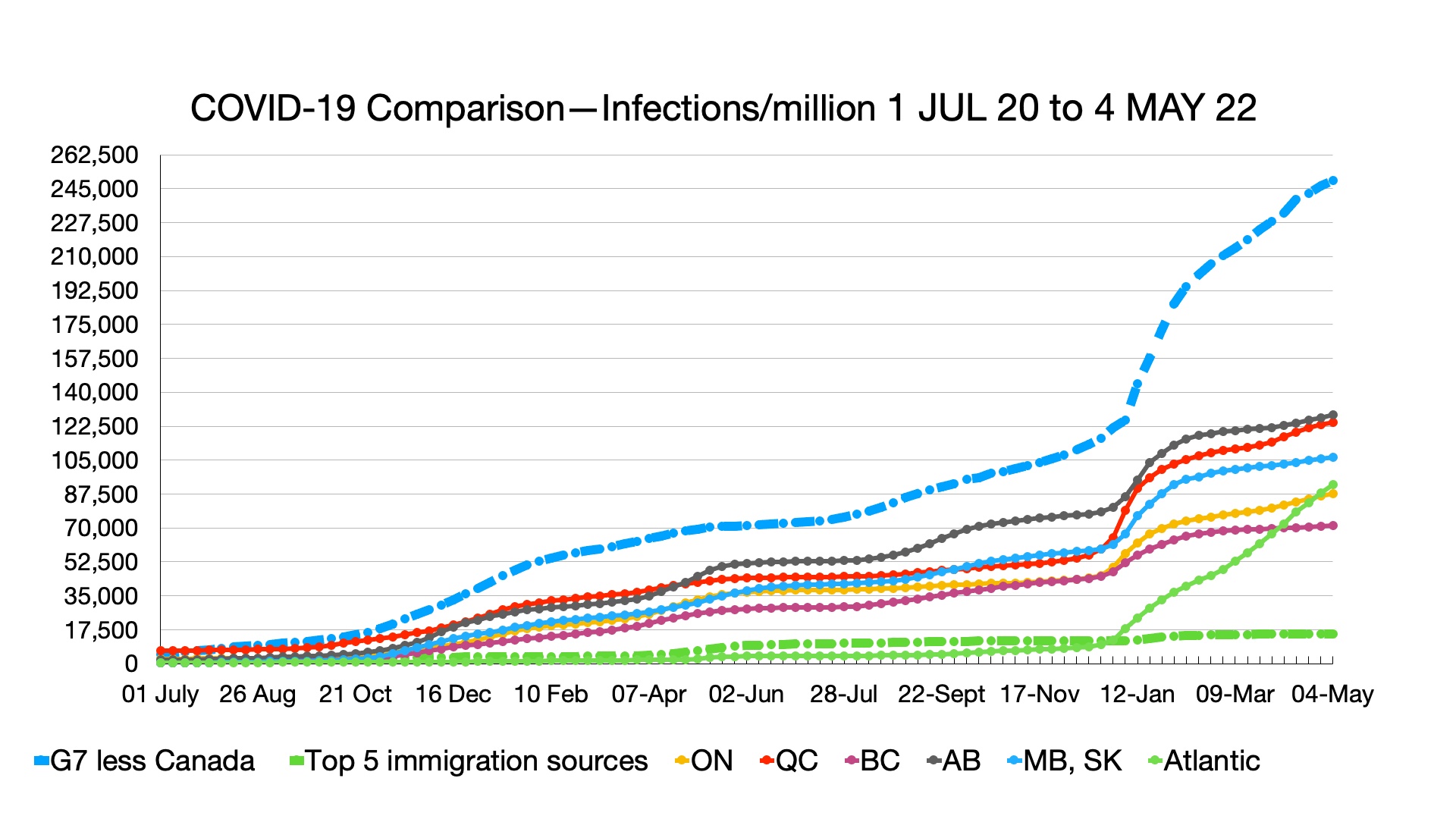
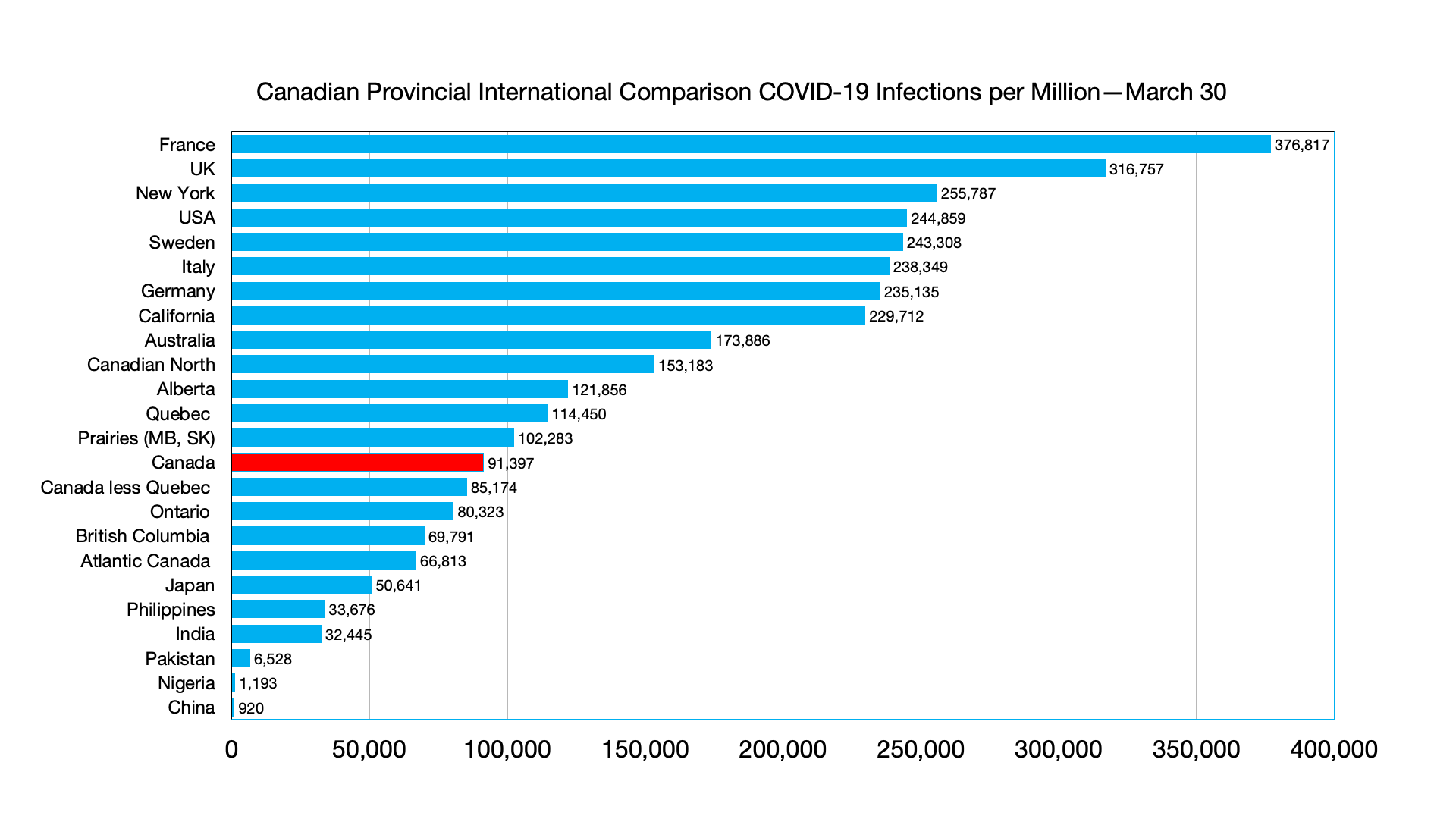
#COVID-19: Comparing provinces with other countries 4 May Update and end of this series

As this note from the Globe notes:

“Due to changes in the prevalence of testing, case counts alone are no longer a reliable indicator of the spread of COVID-19. In part due to this, recovery data is no longer available from all provinces and territories. Some provinces have also shifted to weekly or irregular updates, which impacts the timeliness of data shown below.With some provinces and countries no longer reporting on the number of infections, comparisons between provinces and countries on the omicron variant are imprecise.”

In addition, the data from many of the countries surveyed has remained largely static over the past month, with some revisions downwards. This data has served its purpose in in helping me analyze the effect of COVID on immigration (see my How the government used the pandemic to sharply increase immigration).

One other note, visiting Switzerland, Holland and Germany to visit friends and family, it was striking the differences in COVID restrictions, with Holland the most relaxed (no required masking on planes and transit) and Germany the most strict. Nice to have a sense of normality but disconcerting at the same time (we wore our masks).

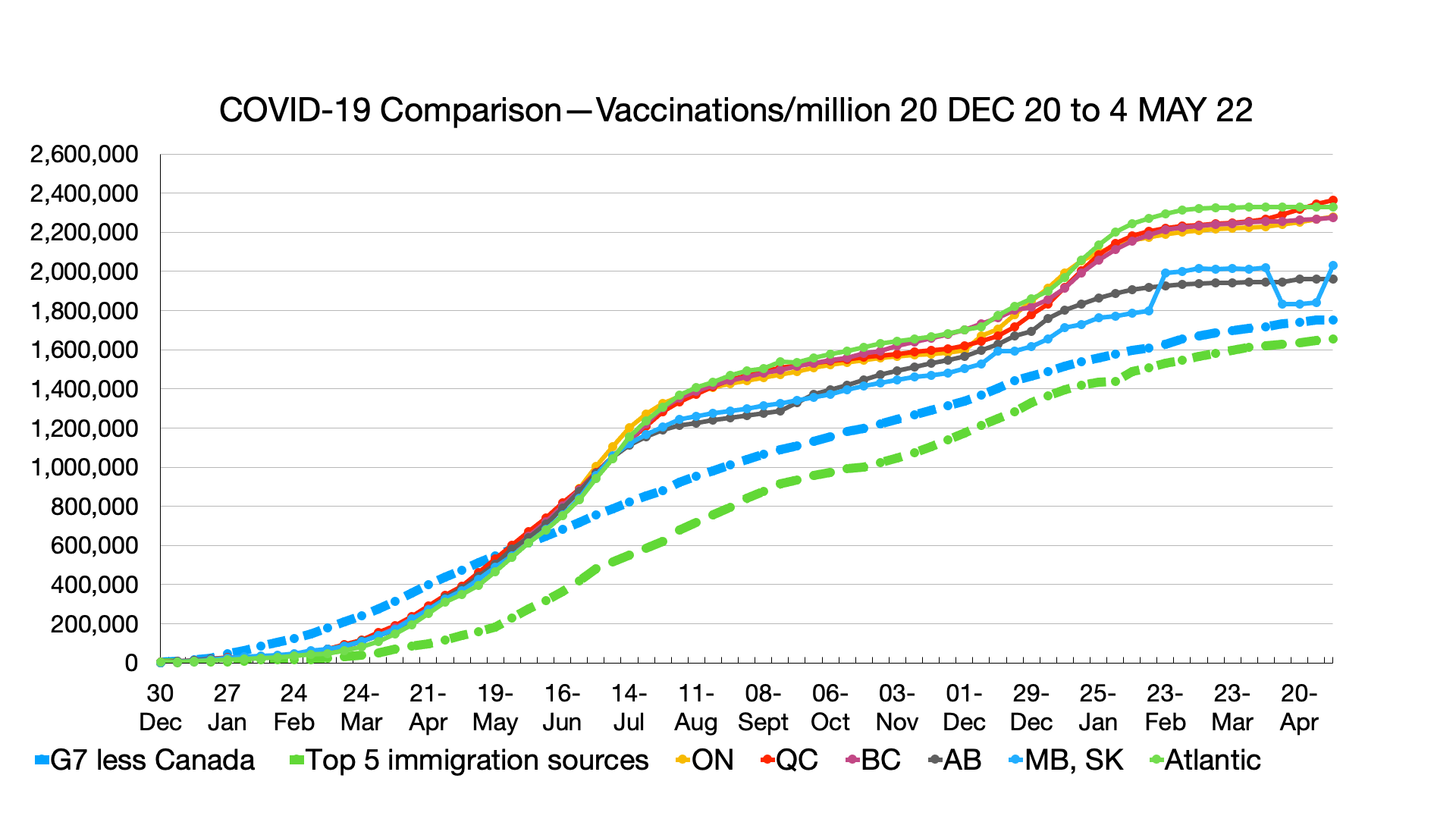
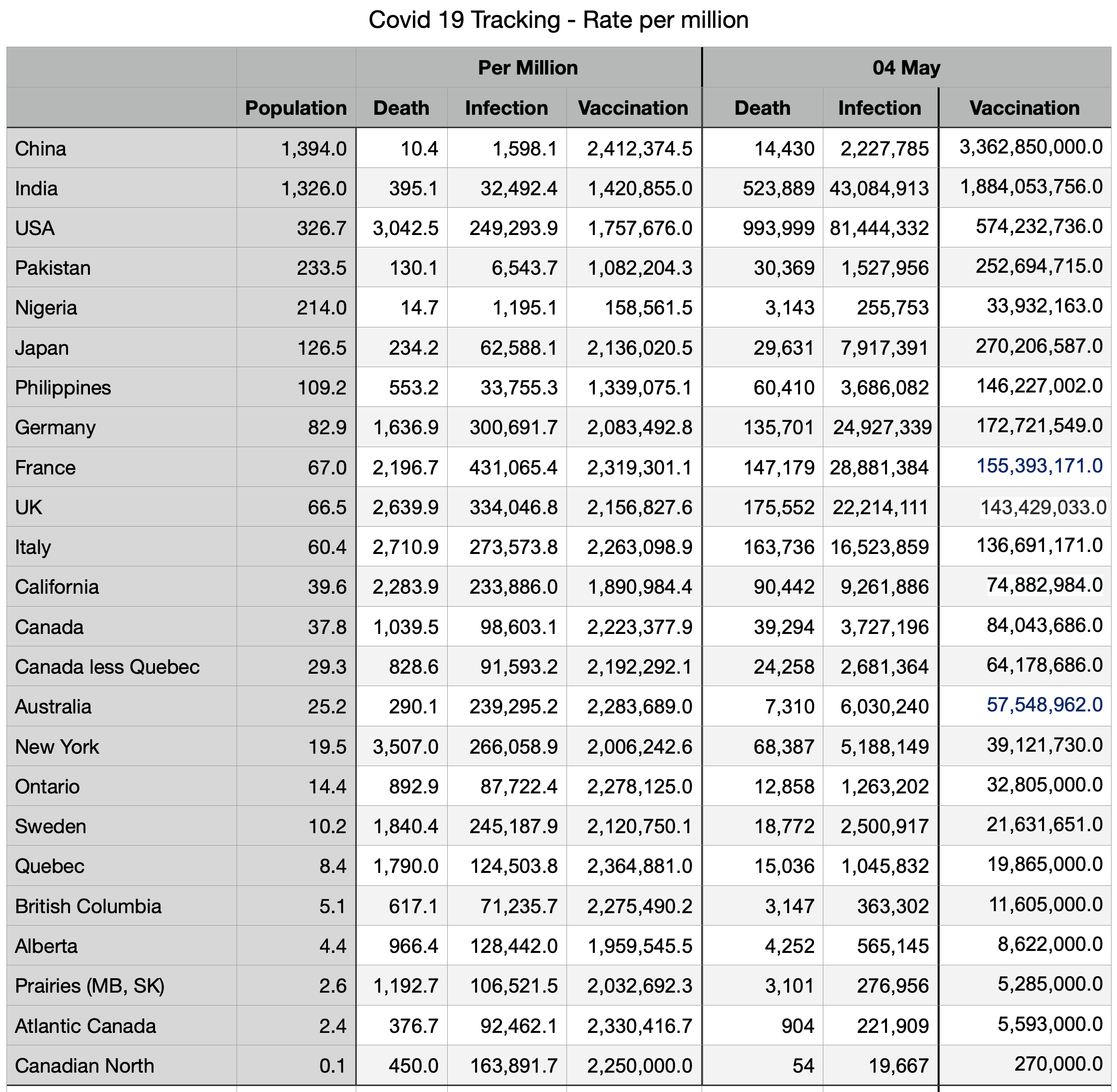
Vaccinations: Ongoing minor shifts and convergence among provinces and countries with plateauing of overall vaccination rates. Canadians fully vaccinated 81.8 percent, compared to Japan 80.2 percent, UK 73.2 percent and USA 66.6 percent.

Immigration source countries: China fully vaccinated 88.3 percent, India 61.8 percent, Nigeria 6.5 percent, Pakistan 55 percent, Philippines 61.7 percent.

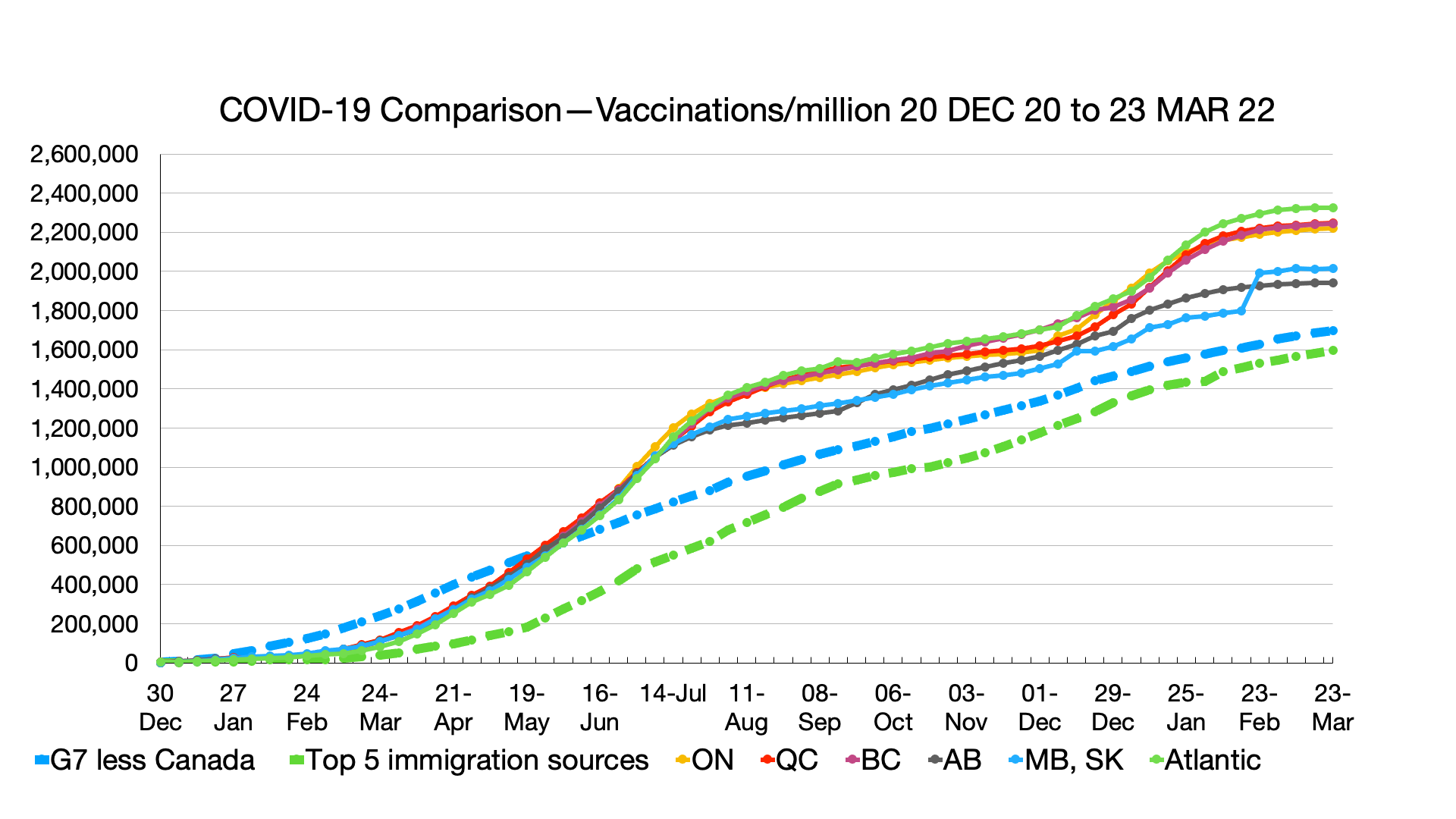
Trendline Charts:

Infections: As noted, variations in reporting make comparisons difficult. Steep increase in Atlantic Canada may reflect more consistent reporting.

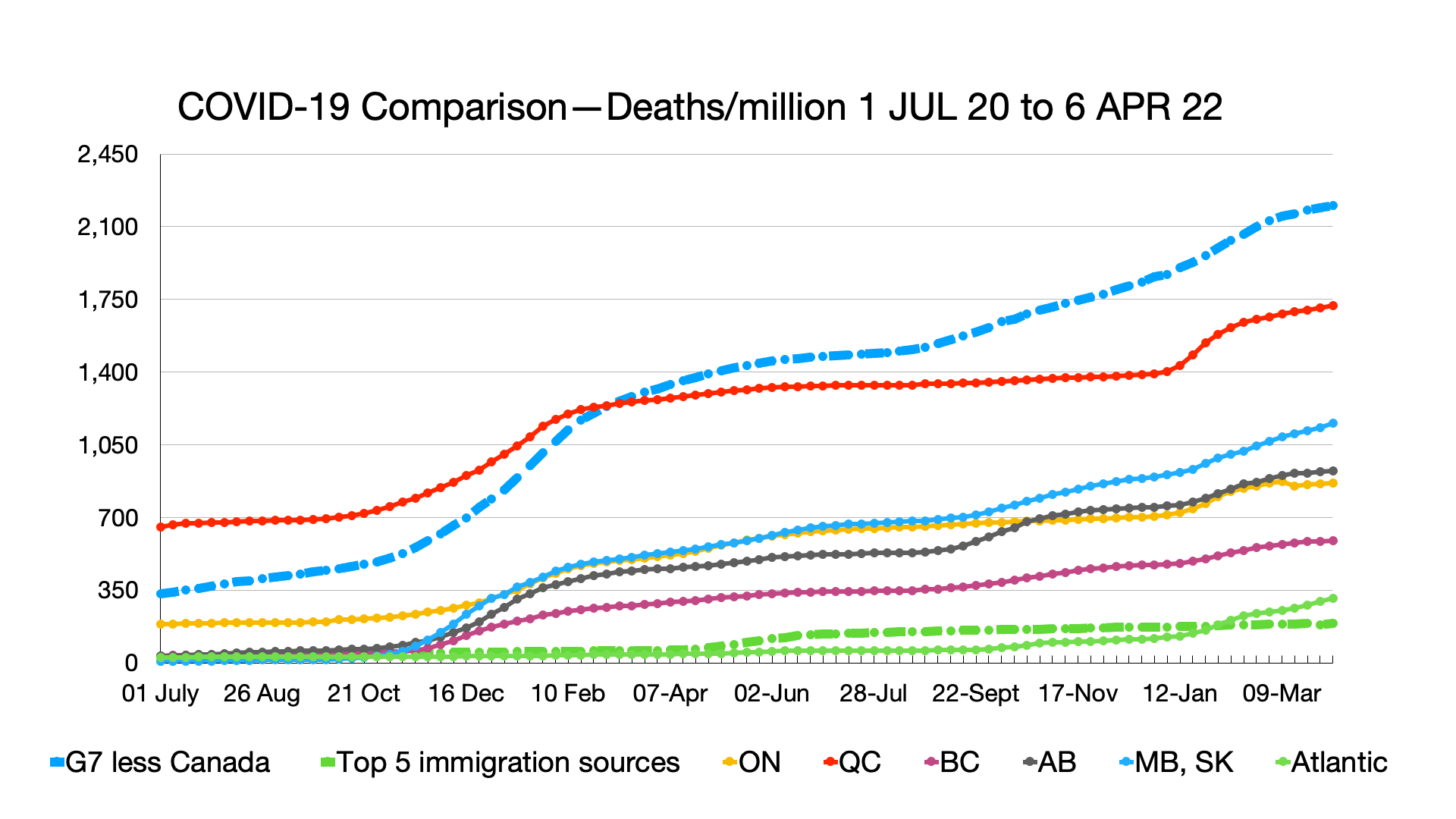
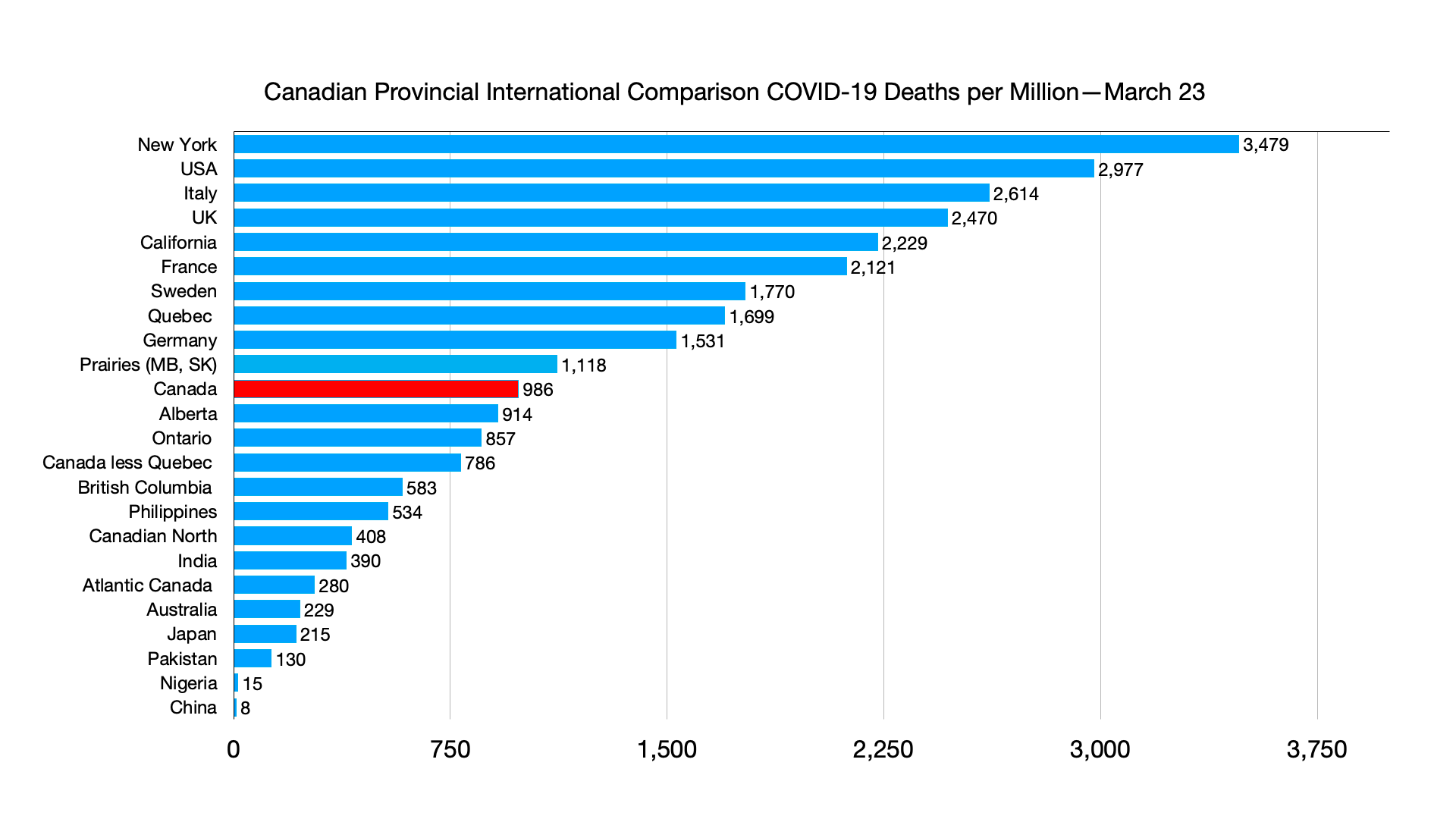
Deaths: No relative changes.

Vaccinations: Minor changes. All provinces have stalled in vaccinations, Saskatchewan reporting gaps account for Prairie fluctuations.

Weekly

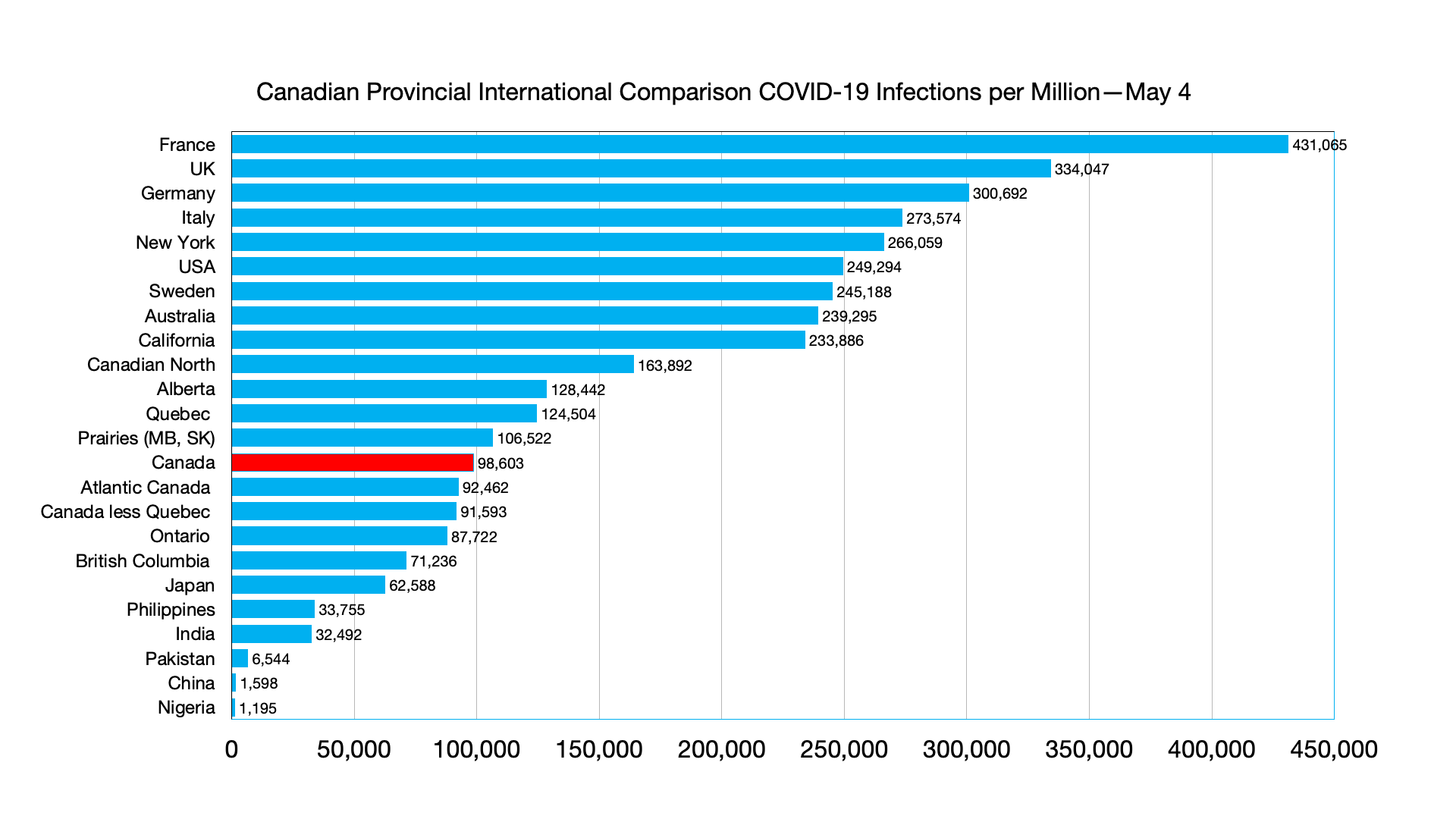
Infections: Italy ahead of New York, Australia ahead of California, Atlantic Canada ahead of Canada less Quebec, China ahead of Nigeria. 

Deaths: No relative change.

#COVID-19: Comparing provinces with other countries 6 April Update

With some provinces and countries no longer reporting on the number of infections, comparisons between provinces and countries on the omicron variant are imprecise.

Vaccinations: Some minor shifts but convergence among provinces and countries but minimal increases to overall vaccination rates. Canadians fully vaccinated 83 percent, compared to Japan 79.8 percent, UK 74 percent and USA 66.4 percent.

Immigration source countries: China fully vaccinated 88.9 percent, India 61 percent, Nigeria 4.8 percent, Pakistan 53.5 percent (significant jump), Philippines 61.4 percent.

Trendline Charts:

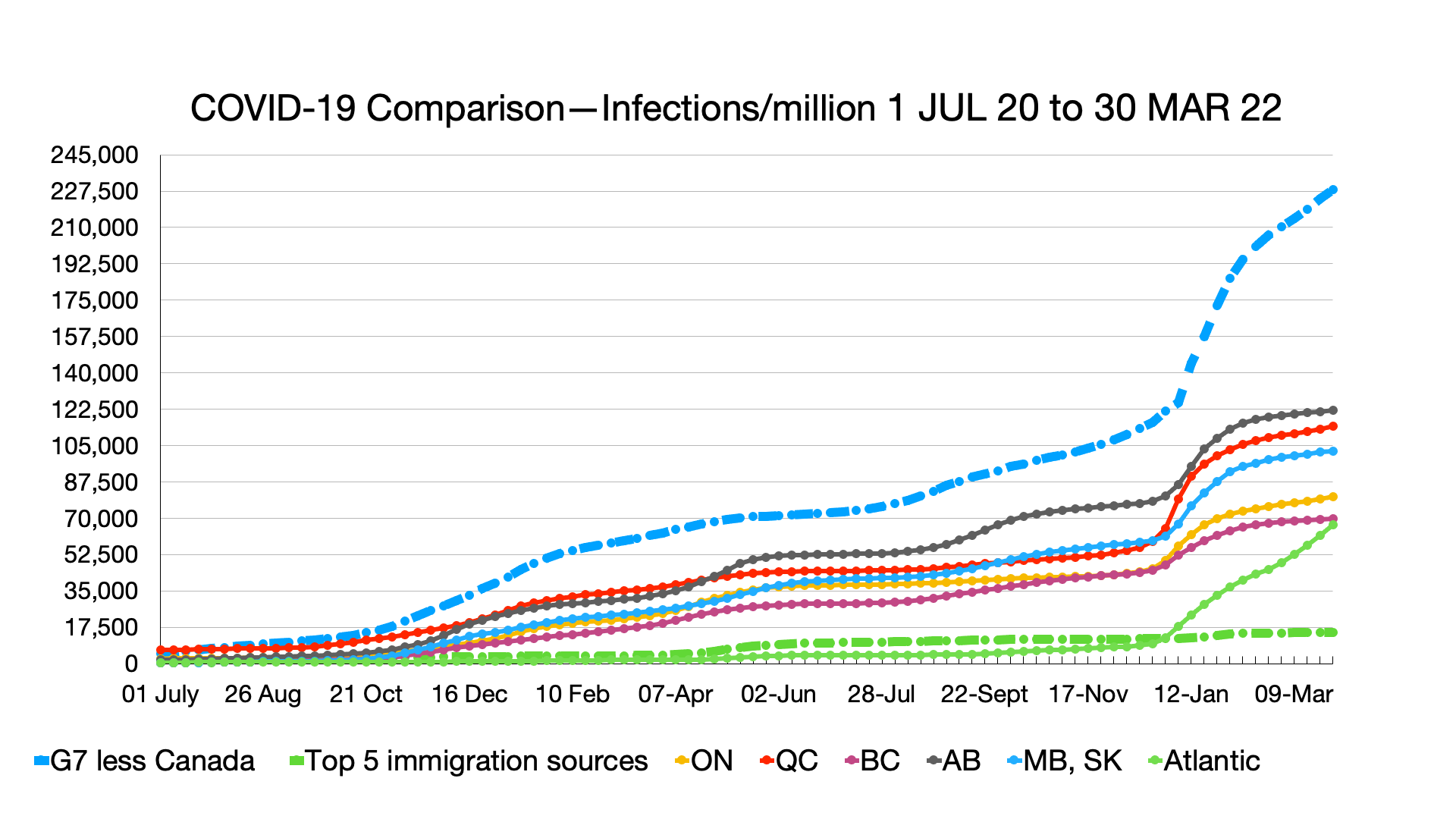
Infections: As noted, variations in reporting make comparisons difficult. Steep increase in Atlantic Canada may reflect more consistent reporting.

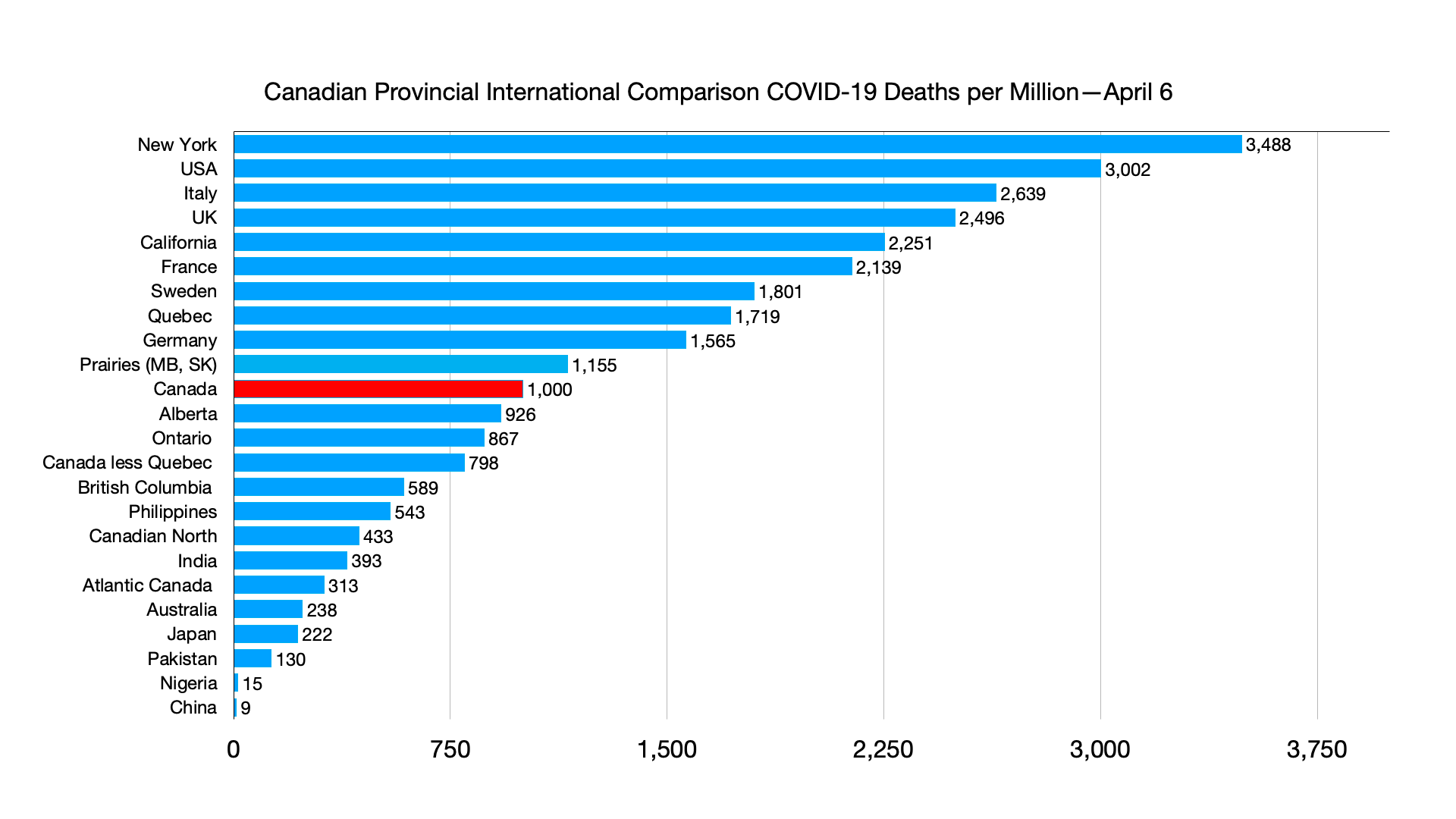
Deaths: No relative changes.

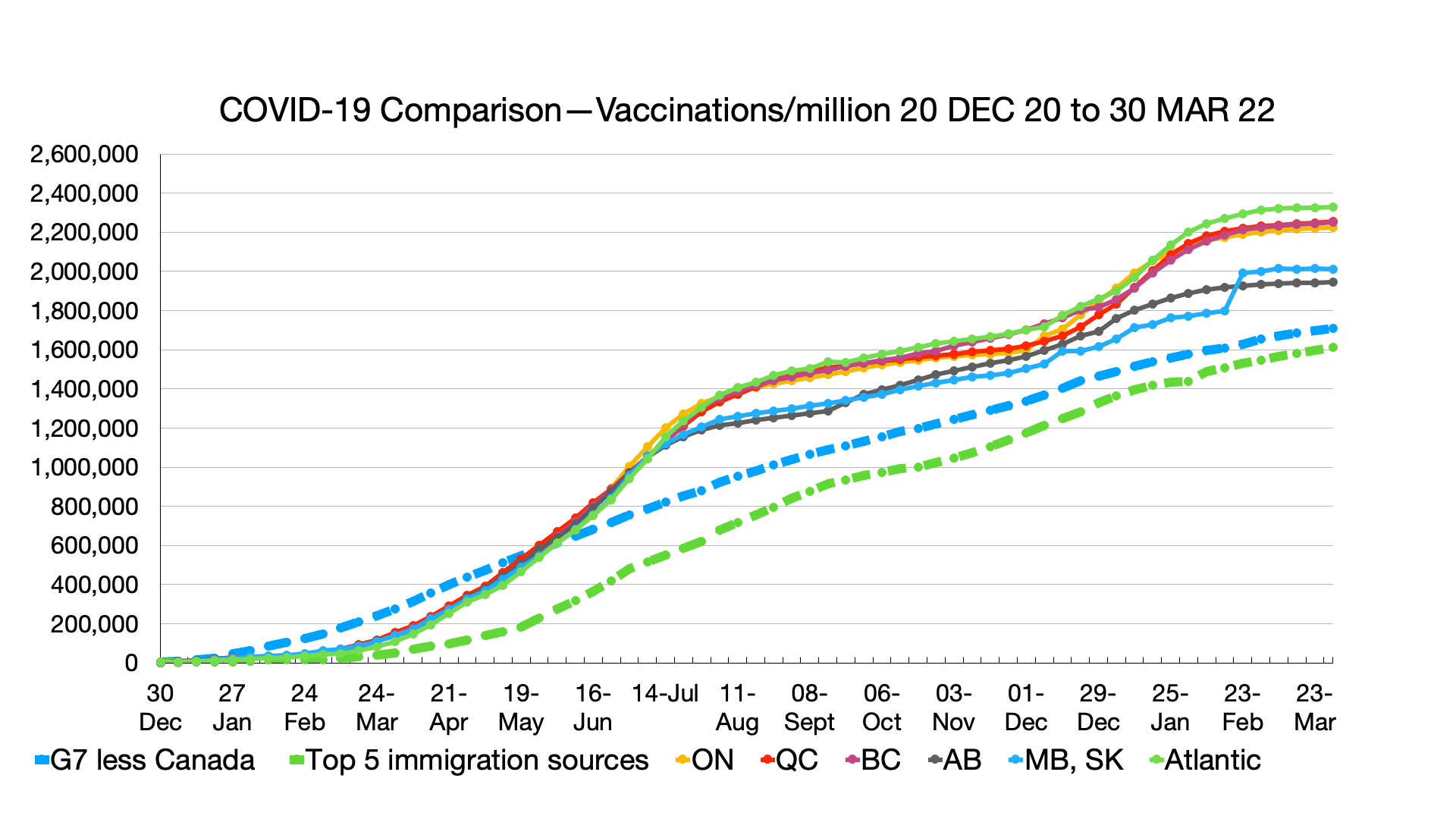
Vaccinations: Minor changes. All provinces have stalled in vaccinations, as have most countries.

Weekly

Infections: Germany ahead of New York, British Columbia ahead of Atlantic Canada.

Deaths: No relative change.

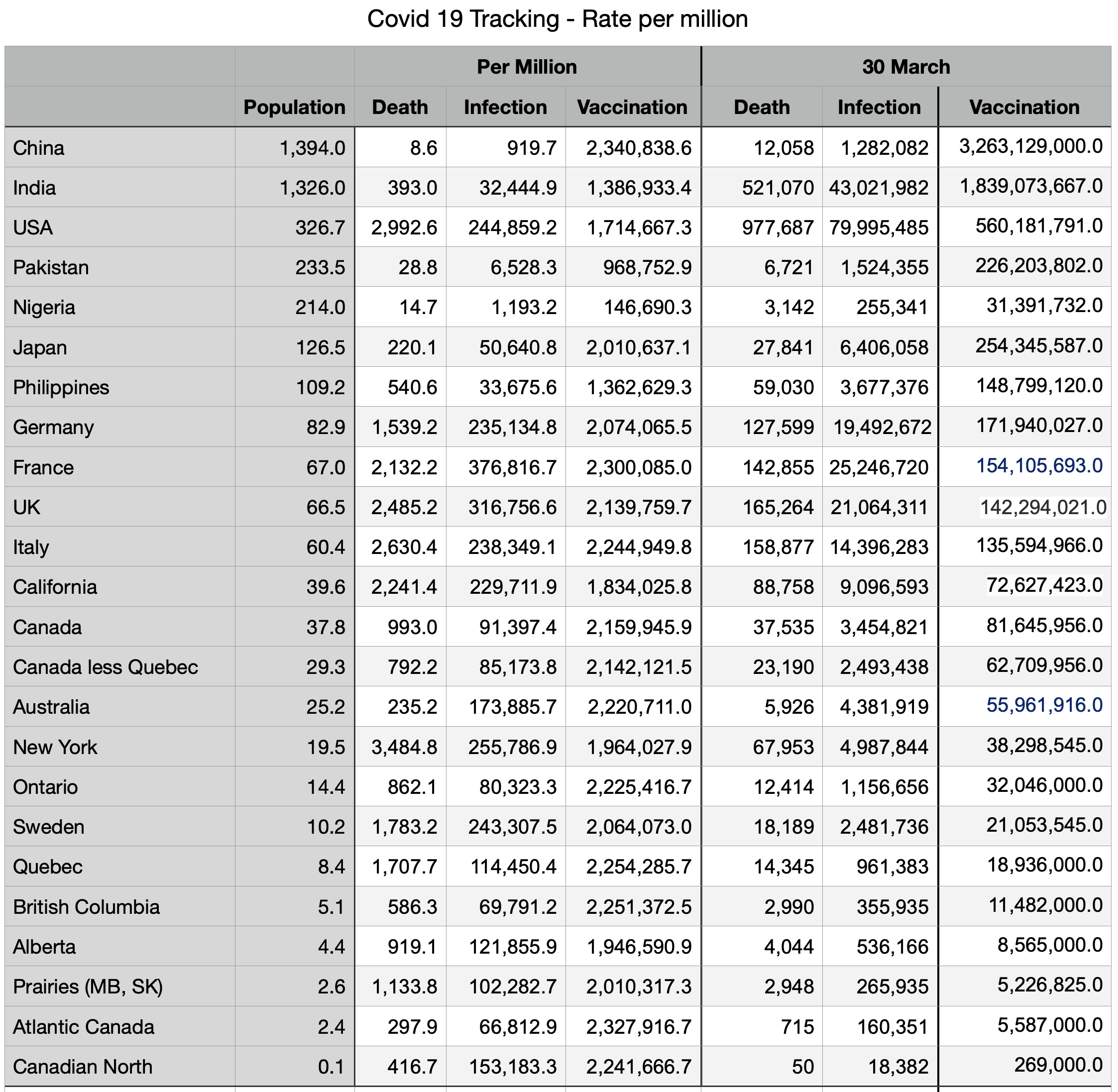
#COVID-19: Comparing provinces with other countries 30 March Update

Numbers from China continue to climb. New omicron variant showing up in increased infections in G7 countries and in some provinces (uneven testing hides some of the change).

Vaccinations: Some minor shifts but convergence among provinces and countries but minimal increases to overall vaccination rates. Canadians fully vaccinated 82.9 percent, compared to Japan 79.7 percent, UK 73.9 percent and USA 66.3 percent.

Immigration source countries: China fully vaccinated 88.8 percent, India 60.6 percent, Nigeria 4.8 percent, Pakistan 47 percent, Philippines 609 percent.

Trendline Charts:

Infections: Increased number of infections due to omicron variant in G7 countries with most Canadian provinces having lower rates of increase save for Atlantic Canada.

Deaths: No relative changes.

Vaccinations: China ahead (again) of Atlantic Canada, Japan ahead of Prairies.

Weekly

Infections: Germany ahead of California.

Deaths: No relative change.

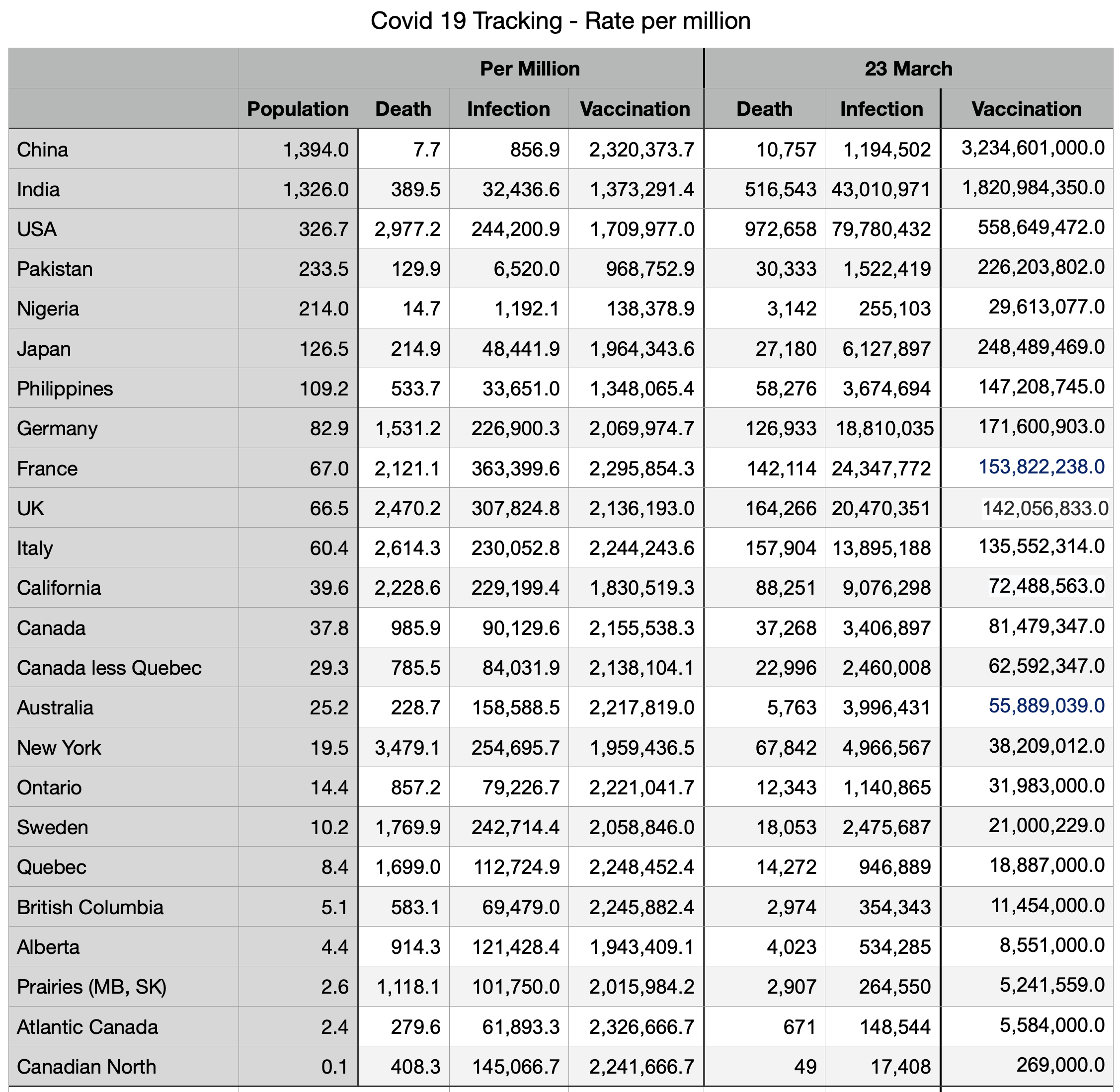
#COVID-19: Comparing provinces with other countries 23 March Update, Vaccinations in African countries

Numbers from China continue to climb with infections up 59 percent and deaths up 21 percent. New omicron variant showing up in increased infections in some countries.

Vaccinations: Some minor shifts but convergence among provinces and countries. Canadians fully vaccinated 82.7 percent, compared to Japan 79.6 percent, UK 73.8 percent and USA 66.1 percent.

Immigration source countries: China fully vaccinated 88.7 percent, India 60.1 percent, Nigeria 4.5 percent, Pakistan 47 percent, Philippines 60.3 percent.

Trendline Charts:

Infections: Limited signs of new omicron variant yet in Canada, with Atlantic Canada infection rates not yet slowing town.

Deaths: No major changes.

Vaccinations: No major relative changes, with Japan ahead of New York and Alberta.

Weekly

Infections: Italy ahead of California.

Deaths: No relative change.

Informative analysis in The Economist:

It is little over a year since the first doses of life-saving vaccines were delivered to Africa under the Covid-19 vaccines Global Access Facility (covax), a scheme aimed at helping poorer countries get inoculated. Yet what should have been a celebration of the region’s fastest-ever vaccine rollout—with 400m doses jabbed into waiting arms—was instead marred by disappointment at how much more could have been achieved.

Listen to this story.

Instead of complaining about not getting vaccines, some countries are now protesting that they are being drowned in a deluge of the stuff and are unable to use it all. Last month Africa cdc appealed to donors to stagger the supply of their shots. “We have not asked them to pause the donations, but to co-ordinate with us so that the new donations arrive in a way so that countries can use them,” said John Nkengasong, the director of Africa cdc.

Increased deliveries are exposing logistical defects in distribution within countries, while weak health-care systems have been unable to jab doses into arms as fast as they get them. Across Africa as a whole just 62% of delivered vaccines have been administered and 29 countries have used less than half of their supplies, says the who. Among the worst laggards are the Democratic Republic of Congo, which has used 15% of its consignments and jabbed less than 2% of its eligible population, and Burundi, which has used less than 2%.

Also hidden in the averages are big gaps in vaccination rates between cities and the countryside. Although continent-wide data are not available, Githinji Gitahi, the chief executive officer of Amref Health Africa, an ngo, says this trend is clear across many countries, including Ghana, Kenya, Rwanda and Tanzania. In Kenya 51% of adults in Nairobi, the capital, had been fully vaccinated by March 16th. But in Mandera county, a poor semi-arid region next to the border with Somalia, only 10% had been fully jabbed.

Part of the reason is logistical. Freezers for storing vaccines are in short supply. But this should be surmountable. Take Uganda. By November just 14% of its eligible population had received their first dose. But in a push supported by donors including the American government, it bumped that rate up to 47% in just six weeks. In Ivory Coast, where many people were nervous about the jab, the government bumped up the vaccination rate from 22% to 36% in the month of December by running radio campaigns to allay people’s fears. These speedy successes suggest that in many places the biggest shortage is not of freezers or nurses, but of zeal on the part of the authorities to go out and get injecting. 

Source: Africa has plenty of covid doses, but it lags in jabs

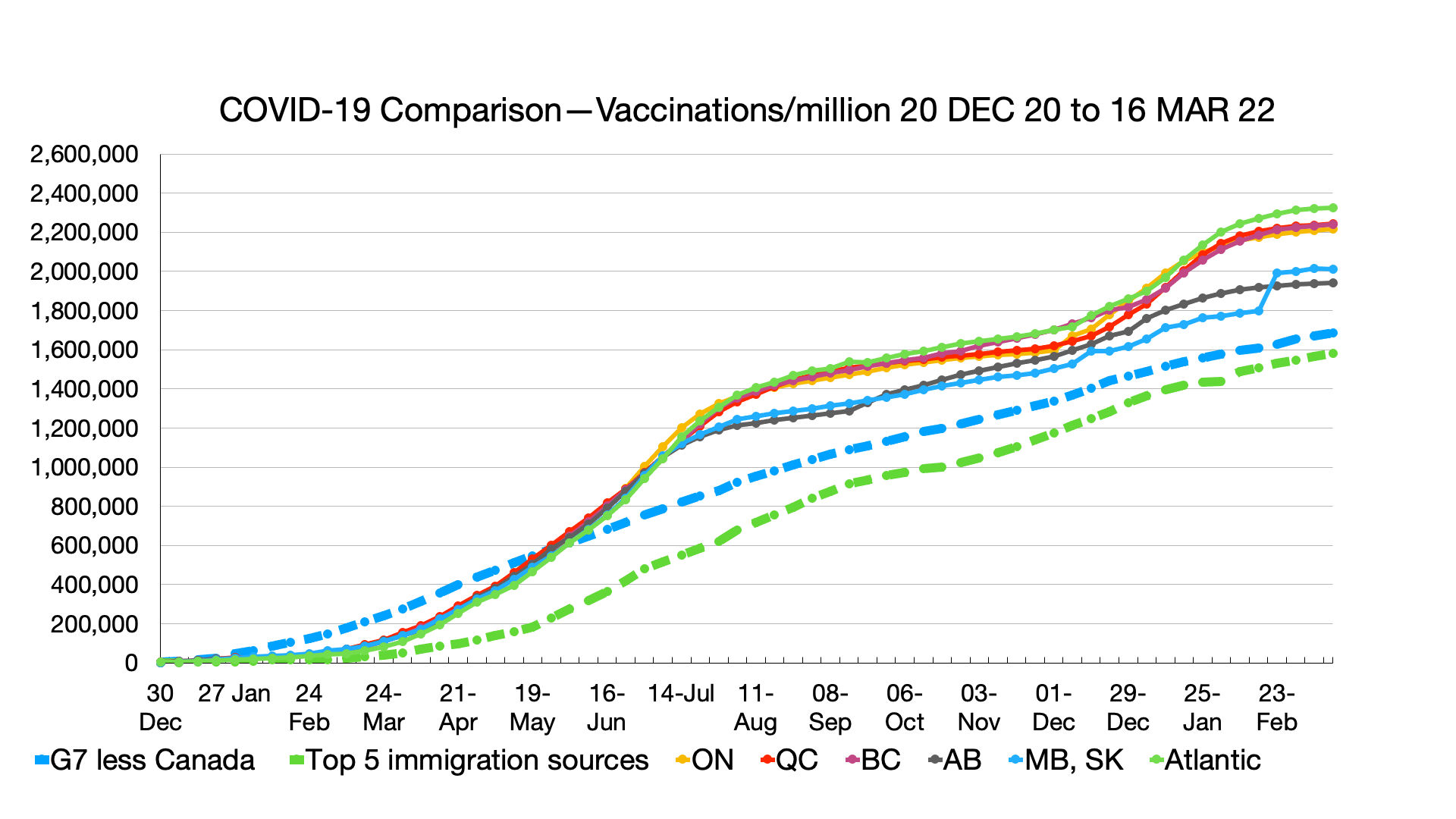
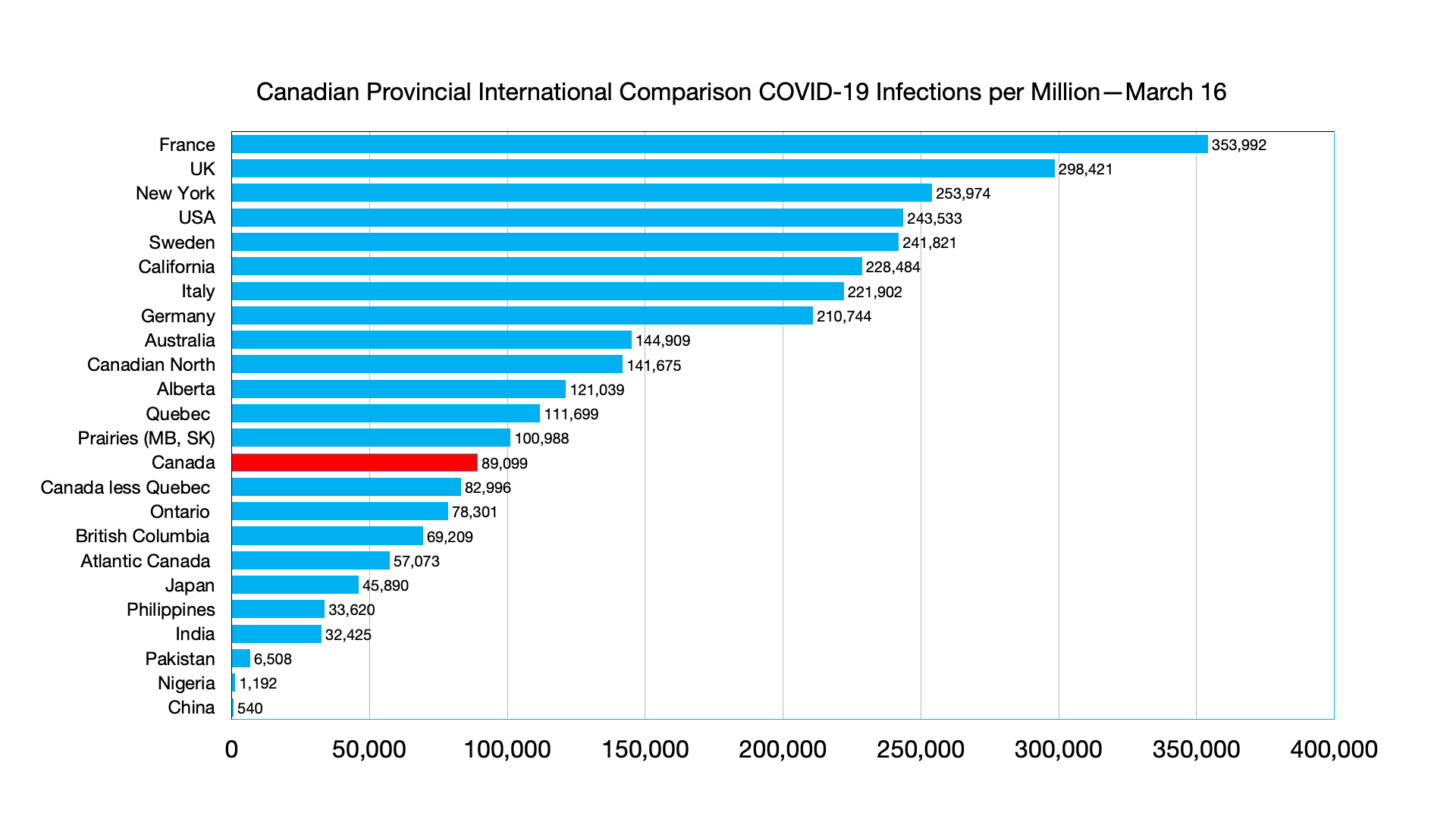
#COVID-19: Comparing provinces with other countries 16 March Update

Numbers from China continue to climb 608,000 to 753,000 infections and from 6,923 to 8,915 deaths. New omicron variant showing up in increased infections in some countries.

Vaccinations: Some minor shifts but convergence among provinces and countries. Canadians fully vaccinated 82.5 percent, compared to Japan 80 percent, UK 74 percent and USA 66 percent.

Immigration source countries: China fully vaccinated 88.3 percent (numbers have not budged over past month, India 60 percent, Nigeria 4.4 percent, Pakistan 47 percent, Philippines 60 percent.

Trendline Charts:

Infections: Ongoing signs of omicron and other variants plateauing, with Atlantic Canada being the notable provincial exception.

Deaths: No major changes. Ontario appears to have revised its count, reflected in the chart.

Vaccinations: No major relative changes.

Weekly

Infections: Australia ahead of Canadian North.

Deaths: Canadian North ahead of India

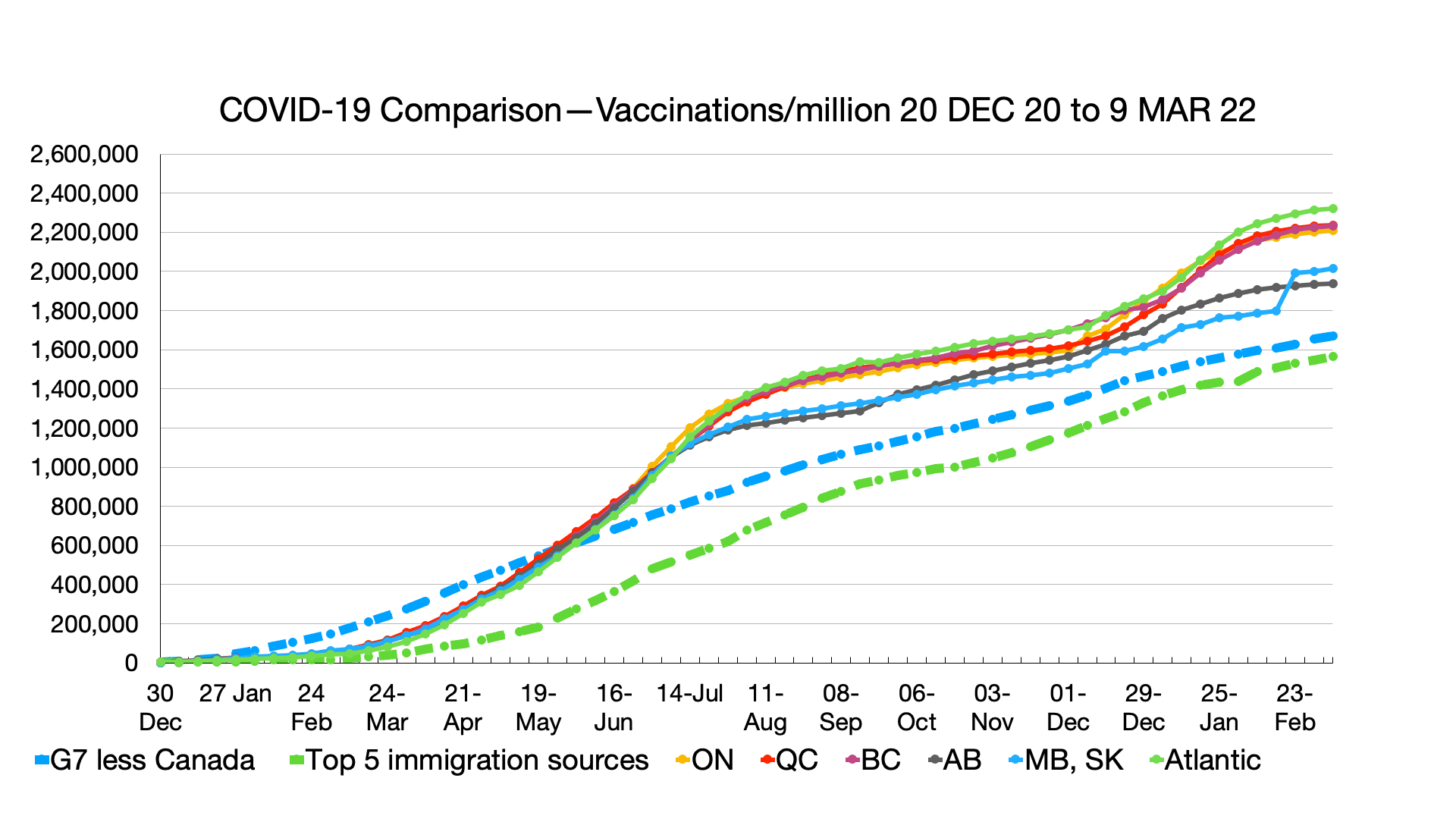
#COVID-19: Comparing provinces with other countries 9 March Update; New Zealand changes its tack on surging COVID-19 cases

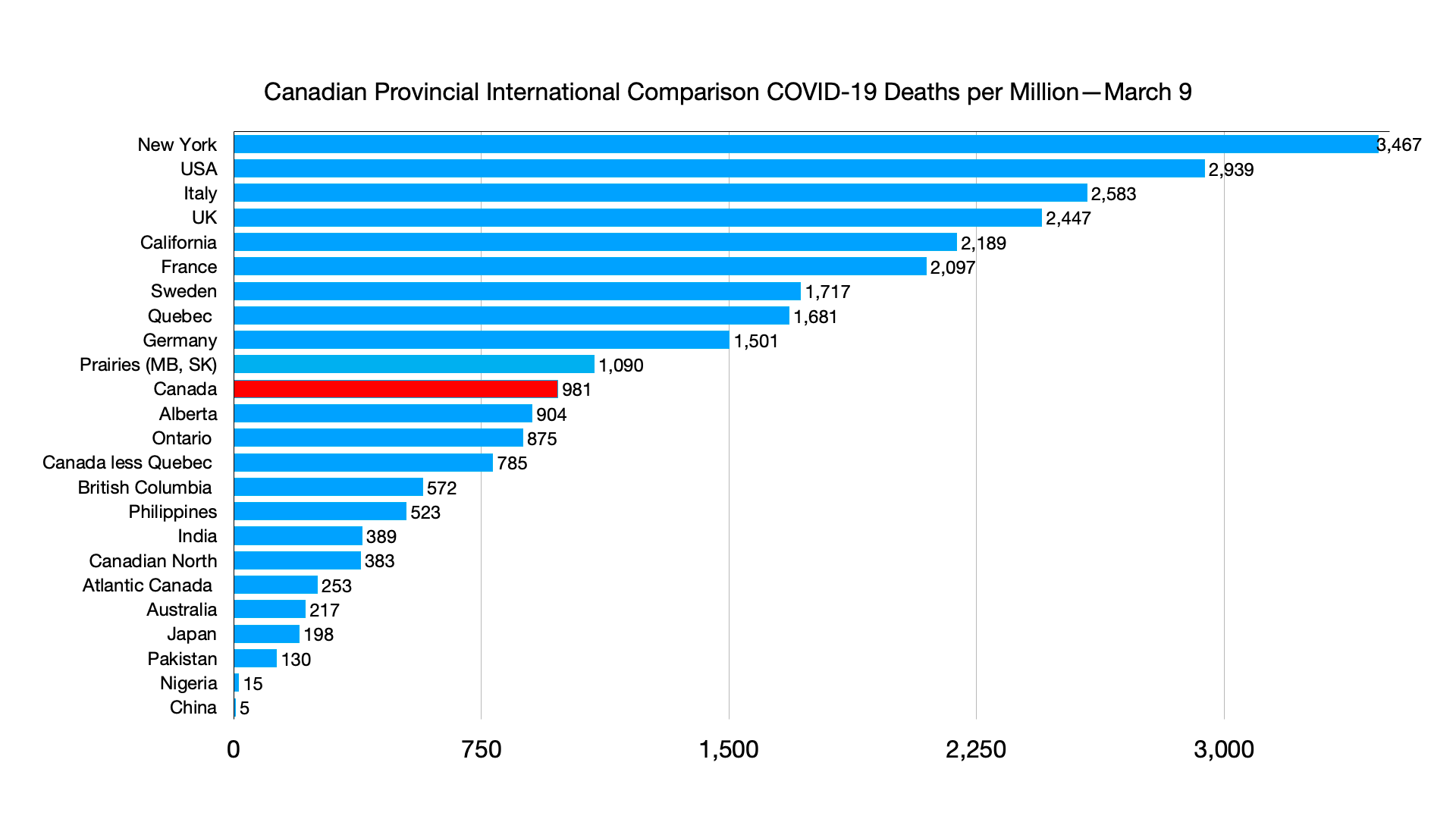
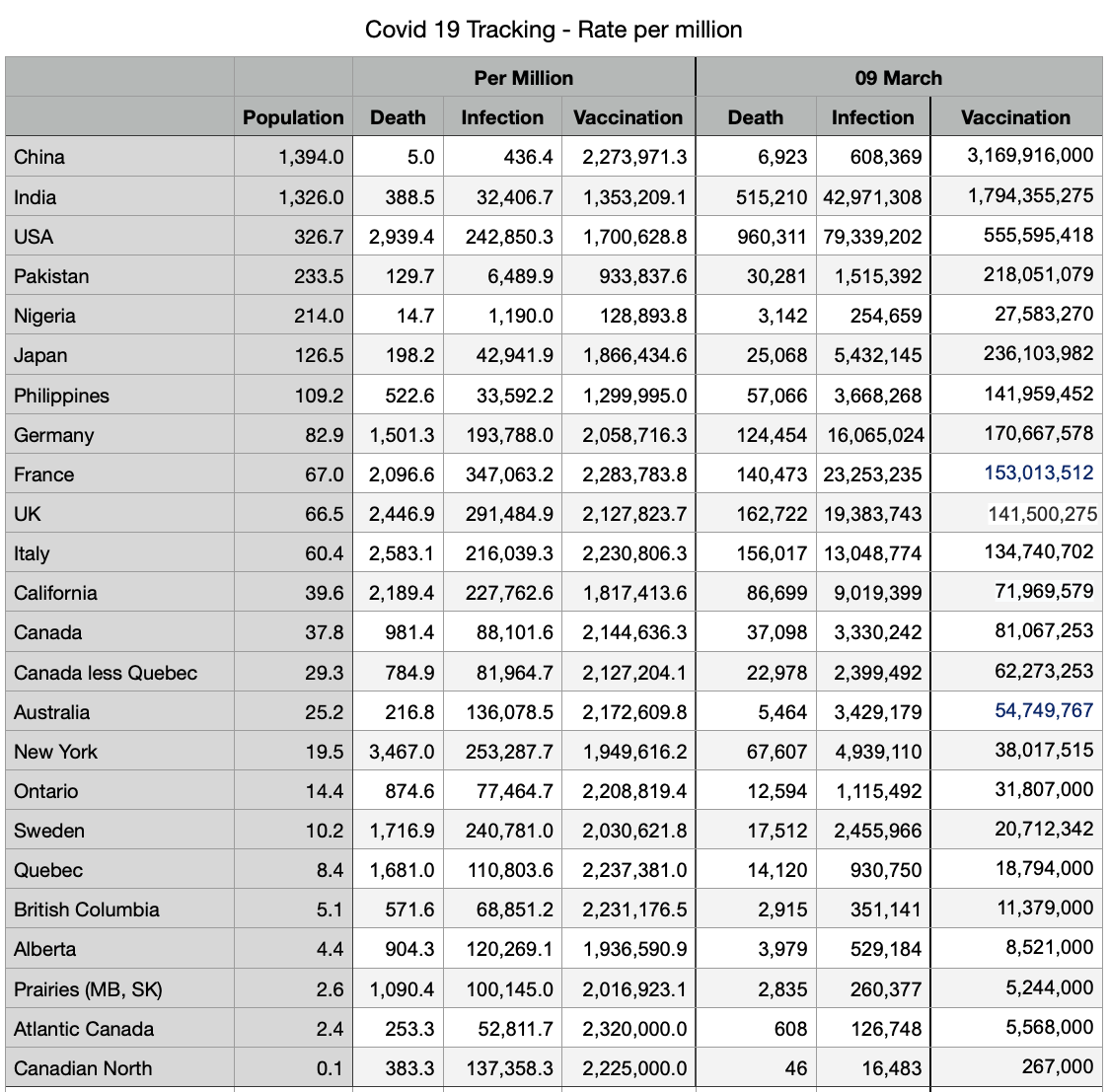
Overall decline in infections and deaths continues. Numbers from China have a further significant increase since last week, from 315,000 to 608,000 infections and from 5,380 to 6,923 deaths.

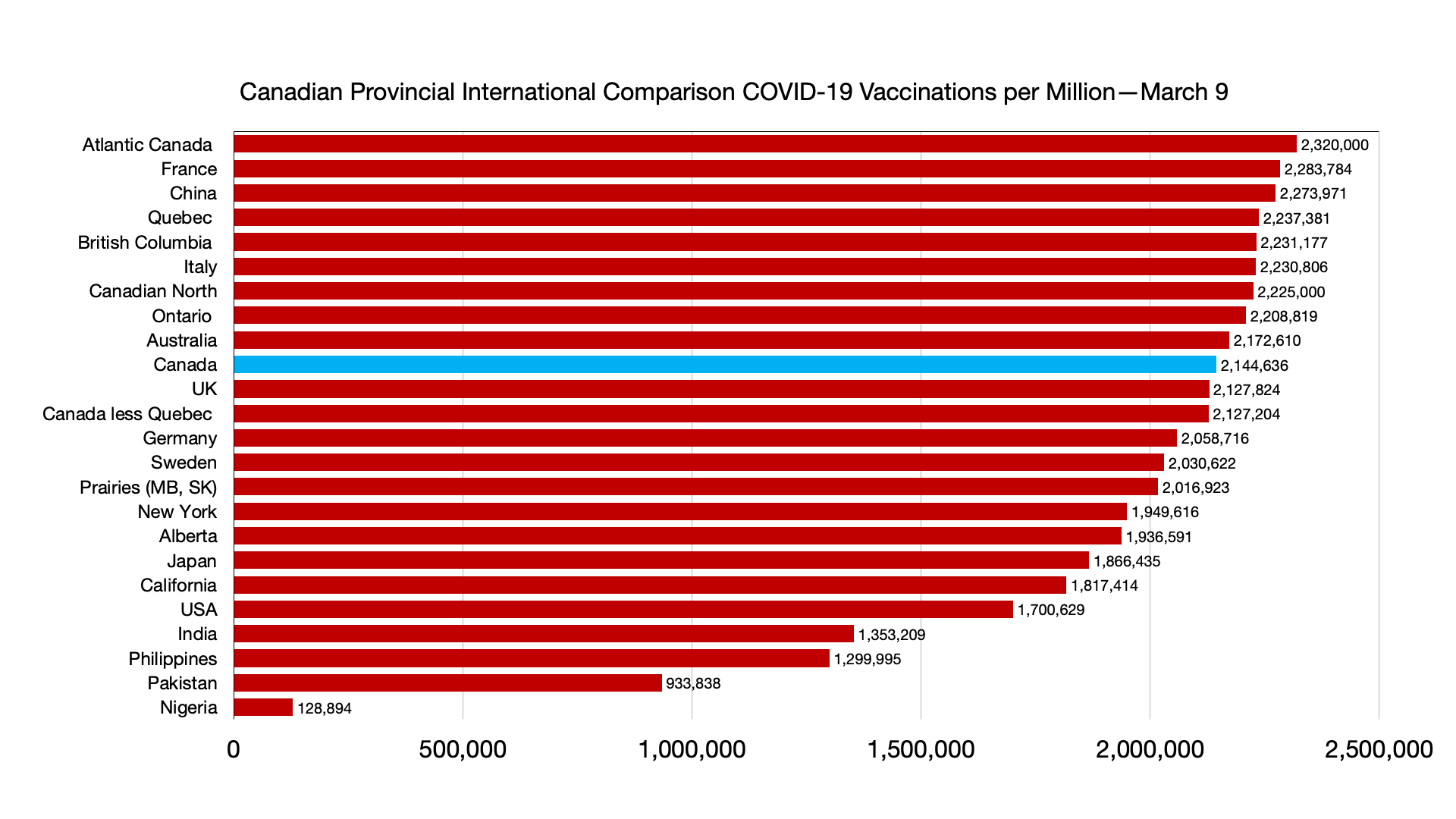
Vaccinations: Some minor shifts but convergence among provinces and countries. Canadians fully vaccinated 82.4 percent, compared to Japan 79.5 percent, UK 73.5 percent and USA 65.9 percent.

Immigration source countries are also converging: China fully vaccinated 88.3 percent (numbers have not budged over past four weeks), India 58.9 percent, Nigeria 4.2 percent, Pakistan 46.6 percent, Philippines 58.4 percent.

Trendline Charts:

Infections: Ongoing signs of omicron and other variants plateauing, more so in Canadian provinces than comparator groups.

Deaths: G7 still not plateauing.

Vaccinations: No major relative changes although Japan is now ahead of California.

Weekly

Infections: No relative changes. Infections per million in China have increased from 226 per million to 436 per million.

Deaths: Major change again is with respect to China with deaths per million increasing from 3.9 to 5 per million.

New Zealand changes its tack on surging COVID-19 cases

Back in August, New Zealand’s government put the entire nation on lockdown after a single community case of the coronavirus was detected.

On Tuesday, when new daily cases hit a record of nearly 24,000, officials told hospital workers they could help out on understaffed COVID-19 wards even if they were mildly sick themselves.

It was the latest sign of just how radically New Zealand’s approach to the virus has shifted, moving from elimination to suppression and now to something approaching acceptance as the omicron variant has taken hold.

Experts say New Zealand’s sometimes counterintuitive actions have likely saved thousands of lives by allowing the nation to mostly avoid earlier, more deadly variants and buying time to get people vaccinated. The nation of 5 million has reported just 65 virus deaths since the pandemic began.

But virus hospitalizations have been rapidly rising, hitting a record of more than 750 on Tuesday and putting strain on the system.

Across the country, the explosion in cases has left people stunned. Just a month ago, case numbers were around 200 per day. Now, the outbreak is affecting everyone from frontline workers to lawmakers.

Opposition Leader Christopher Luxon became the highest profile politician yet to announce he was infected on Monday, saying he felt fine and would continue working from home.

One factor that hastened the outbreak was the return of thousands of university students to campuses around the country last month.

Ralph Zambrano, the student president at Victoria University of Wellington, said the virus had spread rapidly through hundreds of students in residence halls, taking a toll on their mental health and well-being.

“The campus would usually be buzzing at this time of year but it has a very eerie feeling to it,” he said, adding that most students were opting to learn remotely. “There’s lots of anxiety and tension.”

He said the outbreak had strained the food supply system in the halls, with some students being offered only a protein drink for breakfast or a piece of cold meat and some peas for dinner.

The university said case numbers in the halls were now reducing as students recovered.

Professor Michael Baker, an epidemiologist at the University of Otago, said the variant had proved as ferociously infectious in New Zealand as it had in other countries.

He said cases appeared to be plateauing or even starting to dip in the largest city of Auckland, while still rising elsewhere.

While much of the world was breathing a sigh of relief after two years of terrible problems, Baker said, New Zealand was at its worst point yet in the pandemic and was coming to terms with the fact the virus would remain in the country permanently.

He said he was concerned health authorities had lost the ability to properly track the outbreak, as they struggled to shift from a system where they carefully monitored a few cases to dealing with thousands of self-reported results from rapid antigen tests.

Dr. Caroline McElnay, the director of public health at the Ministry of Health, told reporters the number of hospitalizations would grow, but that patients with omicron generally had less severe illnesses than previous patients had experienced with the delta variant.

She said the rising number of both patients and infected health workers had prompted the relaxation in the rules around when health workers could return to hospitals.

She said infected workers would only be allowed to work with patients who already had the virus, and if there were no other options.

“It’s an extra tool that enables our health system to keep running,” she said.

Source: New Zealand changes its tack on surging COVID-19 cases