Arabic is not an extension of Islam

Good reminder:

While taking Arabic over four semesters here at Princeton, I have learned about the language as well as about the complexities of incorporating lessons about culture and religion into language instruction. Yet there’s one dynamic I’ve seen clearly:  Arabic courses at Princeton identify the language as representative of the people of a single culture and religion — Islam. This teaches Princeton students to consider the Arab and Islamic world as a monolith, excluding diverse groups such as Jewish, Christian, Baháʼí Arabs, as well as non-Arab Muslims. When presenting regional cultures, Princeton should seek to teach diversity rather than try to encourage a uniform perspective.

Throughout all of the introductory Arabic sequence courses, I’ve seen Arabic presented as an extension of Islam many times. For instance, the textbook teaches students traditional Islamic phrases at a disproportionate rate compared to those from other religions, and the lecturers have sometimes referred to Islamic law as “Arab law.” This sends the message that Islam is the only religion practiced by Arabic speakers, which is factually incorrect — there are prominent Jewish, Christian, and Baháʼí communities, not to mention Zoroastrianism and many others. Similarly, this tendency inaccurately represents Islam as a religion of only Arabic speakers, when in reality, less than 20 percent of Muslims are Arab.

However, the moment during which I felt the most unmistakable conflation of Arabic with the culture and religion of Islam was when the non-Muslim students in my Arabic class were asked by the lecturer to refrain from eating and drinking in class during Ramadan. This request made me realize a bias I had not previously observed: the only religious holidays that we had ever learned about in class were Muslim ones. This felt problematic to me as I felt uncomfortable by the demand for all students to change their behavior for the religious beliefs of some. After voicing my opinion to the class, the lecturer rescinded their request. In a subsequent conversation with the lecturer, they said that they didn’t think asking students to not eat and drink in class for Ramadan was requesting behavior from students for a religious reason but rather that it had to do with the culture of the Arab world. To me, this was curious, as I don’t subscribe to the narrative that a language has only one specific culture associated with it — especially not a language that has over 450 million speakers in 60 different countries. It is listed as an official language in about 30.

It is undeniable that the vast majority of the Arab world — 93% — is Muslim. This, however, does not mean that Islam should dominate religious and cultural lessons in Arabic classes. Minorities matter, and they should not be forgotten, especially because many religious minorities are persecuted in the Arab world. Further, these minorities demonstrate the wonderful diversity and complexity of the Arab world. Moreover, there is no single Islamic culture or version of the religion. For example, not all Muslim sects prohibit depictions of the Prophet Muhammad, nor do all Muslim women believe that wearing a hijab is a legitimate interpretation of Islam, so when only a single version of Islam is presented, some Muslims are misrepresented in their own culture and religion.

The Arab world is not monolithic; not only are there varied cultures throughout the Arabic-speaking world, but there is also no one uniform culture that exists in each Arabic-speaking country. Though in some parts of the Arab world, people do not eat or drink in public during Ramadan — indeed, in the United Arab Emirates, all individuals, including non-Muslims, are prohibited from publicly eating or drinking during fasting hours —  this is not a custom practiced in every Arab country. It is impossible to import the “Arab culture” into an Arabic class because no such culture exists. My father, who grew up in Lebanon, never once discussed a cultural custom of avoiding public food consumption during Ramadan, and when I’ve visited Lebanon, this “part” of the culture has never come up. But to reemphasize an important point, his experience is not an example of “Lebanese culture,” as there is not simply one Lebanese culture. The culture in my father’s home village is different from the culture of other Lebanese communities.

There will always be more than one culture and religion practiced by people who speak the same language. Presenting languages as only being spoken by practitioners of one religion or members of one culture excludes the many others that are just as important. There is no homogenous Spanish culture, Chinese culture, or Russian culture. Even languages that are seemingly spoken by a smaller population, such as Italian, are utilized by multicultural communities.

This does not mean that we must avoid discussing religion and culture altogether in language classes. Rather, language instructors ought to highlight as many religions and cultures as possible in their instruction. Muslim holidays are important for Muslims in the Arab world, just as Jewish holidays are important for Jewish people in the Arab world, Christian ones are important for Christians, and Baháʼí ones are important for the Baháʼí community. Educators should not discuss the cultural practices of only one culture in class, but touch on practices from many cultures. Instead of leaving students with a monolithic idea of the people who speak a language, language classes should highlight the diversity of culture and religion within a specific language-speaking population.

Anais Mobarak is a sophomore from Newton, Massachusetts studying chemistry.

Source: Arabic is not an extension of Islam

Fact-checking immigration: Boustan uses big data to explore myths about the past

Some interesting work here:

“When the horns started to blow and we saw the Statue of Liberty, I thought I was in heaven. Really. She’s up there and saying, ‘Come on in. From now on you are a free person.’”

These are the words of Turkish immigrant John Alabilikian, who came to the United States in 1922, collected by the Ellis Island Foundation in 1985 as part of its oral history library. In his interview, Alabilikian described escaping the Armenian genocide and journeying to America.

Personal anecdotes like these serve as a rich source of data for economist Leah Platt Boustan, who brings modern statistical analysis and big-data tools to the study of historical events and trends. With the recent digitization of first-person accounts and other documents, Boustan can uncover insights from people’s personal experiences in ways previously not possible. “It’s almost as if we can conduct surveys of people who lived in the past,” she said.

Statue of Liberty with quote from Leah Boustan, Professor of Economics; “Many people imagine that [19th-century] immigrants from Europe very quickly climbed the economic ladder and adopted U.S. behavior norms, and that immigrants today are slower to do so. That’s not the case.”

Boustan, who joined Princeton as a professor of economics in 2017, has an impressive record of proving and disproving ideas that people believe based on anecdotes or “gut feelings.” In the past, economists and historians had few data tools, but with today’s powerful computers and mathematical approaches, historical perspectives can be tested against hard numbers.

“Often what we think we know, we don’t really know,” Boustan said. “If you start to introspect, and ask, ‘Where do my beliefs come from?’ you might realize they come from your family’s experience or from relatively few anecdotes. We rarely test our beliefs with thousands of cases.” Boustan tries to rediscover that lost nuance, giving economists and historians a statistical footing for their research.

One of the questions Boustan has tackled is the issue of “white flight.” Between 1940 and 1970, white Americans left cities in large numbers, but historians have debated whether this exodus was motivated by the desire to pursue opportunities in suburbs or because of an influx of black Americans. Boustan’s analysis, published in the Quarterly Journal of Economics in 2010 when she was on the faculty at the University of California-Los Angeles, suggests that both were true.

Another of Boustan’s recent projects is on the age of mass migration, a period from around 1850 to about 1920, when more than 30 million Europeans moved to the United States. Working with longtime collaborators Ran Abramitzky at Stanford University and Katherine Eriksson at the University of California-Davis, and with support from the National Science Foundation, Boustan compared historical data to today’s records, asking: Are immigrants today assimilating more slowly than they did in the past?

“Many people imagine that immigrants from Europe very quickly climbed the economic ladder and adopted U.S. behavior norms, and that immigrants today are slower to do so,” Boustan said. “That’s not the case.”

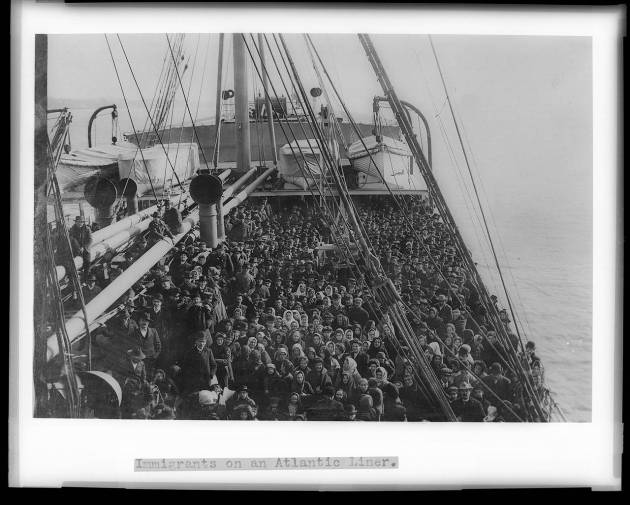
Crowds on 19th century immigrant ships

Leah Boustan, professor of economics, uses digitized historical records and other sources — like this 1906 photograph of immigrants on an Atlantic liner — to give researchers a statistical footing for studies on immigration, past and present.

Prior work suggested that European immigrants during the age of mass migration were paid less than native-born workers upon first arrival, but then quickly caught up. Boustan and her collaborators tracked the occupations of 21,000 natives and immigrants over two decades, and, in work published in 2014 in the Journal of Political Economy, showed that this common wisdom does not fit the facts in two different ways. Many recently arrived immigrant groups did not have lower earnings than natives and, overall, the income of immigrants and natives rose at close to the same rate.

Slow rates of economic assimilation are consistent with the experiences of recent immigrants, according to studies by other researchers, Boustan said. “There is nothing special — or necessarily alarming — about economic convergence that takes more than one generation,” Boustan said. “We have been there before.”

One measure of cultural assimilation that Boustan looked at was how immigrants named their children. Because selecting a child’s name costs nothing, and thus is independent of socio-economic status, Boustan argued that names indicate a family’s eagerness to adopt American culture. In work supported by a grant from the Russell Sage Foundation, she and her colleagues used millions of entries from recently digitized census records to calculate a “foreignness index” for each name in the early 1900s. She conducted a similar exercise using birth certificate records from California today. In both cases, she found that immigrants shift away from foreign-sounding names as they spend more time in their adopted nation, and at the same rate.

“What was striking about those two sets of analyses — the past and present — is that the speed of cultural assimilation, by this measure, is almost identical in the past and present,” Boustan said. The study is detailed in an NBER Working Paper posted in July 2016.

Boustan’s work is part of a growing trend in economics toward harnessing large data sets to explain historical observations, said her colleague and former mentor, Henry Farber, Princeton’s Hughes-Rogers Professor of Economics. Farber met Boustan when she was an undergraduate at Princeton in the late 1990s. Boustan later earned a Ph.D. at Harvard University in 2006 and then became a professor at the University of California-Los Angeles.

Today, Boustan’s office is only a few doors down from Farber, who is next door to his own dissertation adviser, Orley Ashenfelter, the Joseph Douglas Green 1895 Professor of Economics — three generations of empirical economics in one hallway. “Princeton is lucky to have her on the faculty,” Farber said.

Boustan is also part of the trend toward increasing female participation in a historically male-dominated discipline. When a leading journal recently asked her how the field might attract and train more women, she was caught off guard. “I realized that I didn’t know much about the overall situation of women in economics — I only knew anecdotes from my personal experiences,” Boustan said.

So she began investigating the problem with her characteristic big-data approach. “It is a very important question, and the best way to work on big questions is to take a look at the data,” she said.

She paired with graduate student Andrew Langan to collect data on the male-female graduate student ratios in economics departments at leading research universities and learn more about why some programs have more success than others in training women. Graduate programs in economics are on average 30 percent female across the nation, with some as low as 10 percent female and others achieving a 50-50 balance, Boustan and her team found.

“The average picture looks gloomy, but there are some bright rays,” Boustan said. For example, even departments with high numbers of male students and faculty can serve female students well if they provide opportunities for training and mentoring, they found.

Boustan keeps this in mind as she mentors and advises students in Princeton’s economics department. One advisee, Ji Won Choi, said, “I hope I can be an example, like Leah, for others in the future.”

Until recently, Princeton’s Department of Economics had few women in senior faculty positions, but the department has doubled its number of female faculty members over the past four years, said Janet Currie, the Henry Putnam Professor of Economics and Public Affairs at the Woodrow Wilson School, who was department chair until June 2018. “Nevertheless,” Currie said, “we are not where we would like to be, and we’ll need continuous effort not to lose the gains we have made and to diversify the faculty and student body in other dimensions.”

With so many charged topics facing society today, from the equitable treatment of women in the workplace to the role of immigrants in building the nation, Boustan’s data-driven approach to controversial issues is more relevant than ever. To explain the importance of this work, Boustan quotes her former mentor, the Harvard economic historian and labor economist Claudia Goldin: “The best historical questions are the ones that speak to the world we live in today.”

Source: Fact-checking immigration: Boustan uses big data to explore myths about the past

Professor Cancels Course On Hate Speech Amid Contention Over His Use Of Slur : NPR

Precious student over reaction or not? Valid use or not?:

Professor Emeritus Lawrence Rosen opened his course last week with a question. The anthropologist, who has spent four decades teaching at Princeton University, was introducing a class called Cultural Freedoms: Hate Speech, Blasphemy, and Pornography — and his question was meant to shock.

“What is worse,” he asked students last Tuesday, according to The Daily Princetonian, “a white man punching a black man, or a white man calling a black man a n*****?”

The student newspaper reports that Rosen, a white man, went on to use the racial slur multiple times in the ensuing discussion, despite increasingly strong objections from some students. Citing student accounts, the Princetonian notes Rosen defended his use of the word as “necessary” and intended to “deliver a gut punch” — but by lecture’s end, several students had walked out in protest.

Now, just one week later, the course is no more. It was canceled by Rosen after a weeklong storm of debate over the incident, including one criticism that the effect of his words — no matter the intent behind them — “can only be described as personal assault, even though the injuries are not visible on the surface of the skin.” A handful of national media outlets caught wind of the simmering controversy, as well.

University spokesman Michael Hotchkiss tells NPR the decision to cancel the course after just one week was Rosen’s, and that the school exerted no pressure on him to do so. Rosen himself did not immediately respond to a request for comment.

“I respect professor Rosen’s decision about how to teach the subject in the way that he did, by being explicit in using very difficult words — and they are very difficult words,” Princeton President Christopher L. Eisgruber said at a previously scheduled town hall meeting Monday.

“It’s a tough kind of conversation to have,” he added, “and I think professor Rosen himself has expressed his view — and certainly it is my view — that it is important to have the kind of conversation when people feel uncomfortable about the language and why they might or might not feel that it’s appropriate to use the language.”

Carolyn Rouse, chairwoman of the university’s anthropology department, also defended her colleague in a letter to the Daily Princetonian shortly after news of the incident surfaced. She wrote that this is far from the first time Rosen has begun a course in this way, “breaking a number of taboos” — such as saying a racial slur or having a student wipe her feet on the American flag — in order to elicit a visceral response in students and explore why.

According to its description, the course had planned to explore the power of oppressive symbols and how “freedom of expression is always limited, both by the harm that may be said to occur if unbridled and by the constraints of the dominant culture.”

“This is the first year he got the response he did from the students. This is diagnostic of the level of overt anti-black racism in the country today. Anti-American and anti-Semitic examples did not upset the students, but an example of racism did,” Rouse wrote. “This did not happen when Obama was president, when the example seemed less real and seemed to have less power.”

Yet others, including parent De’Andre Salter, see the matter in starkly different terms. Salter took to the pages of the same student paper to rebut the points of Rouse’s argument the day after it was published.

“Has anyone offended by flag desecration been oppressed, discriminated against, or systemically denied civil rights? In fact, both flag desecrators and those offended by them have been offered more protections than those called ‘n*****’ by their oppressors,” Salter wrote in part.

Timothy Haupt, a lecturer in the writing program at Princeton, argued that though there may be teaching value in drawing out an emotional reaction, the issue rests in how Rosen handled that reaction.

“My main concern here is with Rosen’s response to student discomfort and confusion, which strikes me as profoundly unproductive, because he appears to have avoided (and perhaps indefinitely postponed) an important teaching moment,” Haupt said.

Haupt noted Rouse’s point about students’ heightened sensitivity to examples of racism — but, he countered, “if a shifting context has influenced how students respond to certain course material, doesn’t that suggest that we as educators have the responsibility to adapt our teaching to guarantee a favorable outcome?”

“Rosen could have stepped back, clarified the difference between using hate speech and talking about it, and then asked his class how they felt comfortable representing the term going forward — so that the conversation could continue,” Haupt added. “But that isn’t what happened.”

Still, the university is standing by its longtime professor.

“I both believe the academic freedom is important to make the pedagogical decision and I respect the pedagogical decision that he made,” Eisgruber said Monday, “although I also appreciate it’s a controversial one and I understand why it’s controversial.”

via Professor Cancels Course On Hate Speech Amid Contention Over His Use Of Slur : The Two-Way : NPR

x