More on the politics – Liberals as road kill (middle of the road trying to satisfy two different constituencies):
…Chez les électeurs musulmans, les libéraux sont à la traîne de dix points derrière le Nouveau Parti démocratique, toujours selon Angus Reid, avec l’appui de 31 % des électeurs de cette communauté, contre 41 % pour le NPD. Parmi tous les groupes religieux sondés par Angus Reid, il s’agit du plus fort appui pour le parti de Jagmeet Singh. C’est deux fois plus que les intentions de vote qu’il récolte à l’échelle nationale. Les néodémocrates étaient à l’origine d’une motion débattue à la Chambre des communes en mars qui demandait au gouvernement fédéral de reconnaître immédiatement l’État de Palestine. Les libéraux avaient réussi à faire amender la motion en appelant plutôt à la poursuite des travaux « en vue de l’établissement de l’État de Palestine dans le cadre d’une solution négociée à deux États ». M. Singh a sommé le gouvernement Trudeau d’appuyer M. Khan et sa demande de mandat d’arrêt contre M. Nétanyahou.
Le Canada comptait plus de 1,8 million de musulmans, contre 335 000 juifs, lors du dernier recensement en 2021. Selon une analyse de l’ancien haut fonctionnaire fédéral Andrew Griffith, 109 circonscriptions canadiennes comptent entre 5 % et 20 % de résidents musulmans ; et il y en a six où les musulmans comptent entre 20 % et 50 % de la population. Le poids politique des électeurs musulmans dépasse maintenant celui des électeurs juifs. Preuve du pétrin politique dans lequel ils se trouvent plongés depuis le 7 octobre, les libéraux de Justin Trudeau n’ont plus la cote ni chez les premiers ni chez les seconds.
Hard to reconcile Muslim and Jewish perspectives. Middle of the road is often road kill, as is the zig-zagging of the government:
A new poll suggests Muslim and Jewish voters are leaning away from the federal Liberals in voting intentions — a possible sign that Prime Minister Justin Trudeau’s efforts to straddle gaps in public opinion over the Israel-Hamas war are falling short.
The new poll of voting intentions by the Angus Reid Institute says the federal NDP is leading the Liberals among Muslim voters 41 per cent to 31 per cent, while the federal Conservatives are beating the Liberals among Jewish voters 42 per cent to 33 per cent.
“This does feel to the Liberals, in terms of their outreach around diaspora politics, to now be a fairly untenable situation,” Shachi Kurl, president of the Angus Reid Institute, told CBC News.
“The Jewish diaspora is now saying, ‘You haven’t gone far enough in condemning Hamas and condemning the violence and stopping antisemitism in Canada.’ And you’ve got pro-Palestinian voters and populations, many of whom are Muslim, obviously saying, ‘You haven’t gone far enough to condemn the Israeli Defence Forces for its counterattack in Gaza.'”
The data shows only 15 per cent of Muslims polled say they would vote for the Conservatives, while just 20 per cent of Jewish voters say they would support the New Democrats.
Kurl said that under Trudeau’s leadership, the Liberals have made a concerted effort to appeal to Muslim voters since 2015, when the Conservatives under Stephen Harper ran an election campaign that included controversial promises like a ban on the niqab and a “barbaric cultural practices” tip line.
An Environics Institute poll looking back on that election found 65 per cent of Muslims who said they voted cast their ballots for the Liberals, while only 10 per cent voted for the NDP.
“We saw the Liberals go out and court Muslims in Canada to vote Liberal,” Kurl said.
She said the Liberals appear to be feeling the fallout from trying to appease both Muslim and Jewish voters since Hamas’s attack on Israel of Oct. 7, 2023. Israeli officials say up to 1,200 Israelis were killed and 253 were taken hostage in that attack. Health authorities in Gaza say the Israeli military operation launched in response has killed almost 35,000 people….
Not that surprising but some interesting variations among different visible minority groups (although the sample size by group may be too small to be definitive):
…Leger vice-president Andrew Enns says the numbers offer an intriguing snapshot into the current state of Canadian politics.
“It sends along a pretty interesting insight in terms of how things might be shifting within ethnic communities, and what people tend to assume and admittedly what we saw over the past couple of elections,” he said.
“The Liberals typically do quite well with the newcomer vote.”
When asked about which political party they support more generally, 24 per cent of those who gave an answer reported agreeing with the Conservatives most often, followed by 22 per cent for the Liberals, and eight per cent for the NDP.
The Conservatives’ biggest share of support came from Chinese immigrants, of whom 30 per cent said they support the Tories, compared to just 10 per cent who said they mostly agreed with the Liberals.
Of the ethnic categories in the poll, all but Latinos, Blacks and Filipinos say they agreed with Conservatives over the Liberals, with Black immigrants reporting 27-per-cent support for the Liberals compared to 13 per cent for the Tories.
Professed support among Southeast Asian immigrants was evenly split between the Conservatives and Liberals at 25 per cent each, while 31 per cent of South Asian immigrants prefer the Conservatives compared to 22 per cent for the Liberals. (Southeast Asian refers to those from nations including Cambodia, Vietnam, Laos, Thailand, Indonesia and Malaysia, while South Asian countries include India, Pakistan, Sri Lanka and Bangladesh.)
Thirty-eight per cent said they didn’t know what party they agreed with the most.
A little over a quarter of poll respondents were Canadian citizens, 41 per cent were permanent residents, 15 per cent were here on work permits, 10 per cent were international students and a small number said they were refugees.
….Among poll respondents who said the latest immigration targets are too permissive, Southeast Asian immigrants represented the highest numbers in that cohort at 64 per cent, followed by the Chinese community (55 per cent,) South Asian (50 per cent,) Filipinos (45 per cent,) White (41 per cent,) Latinos (38 per cent,) Middle Eastern/North Africans (32 per cent,) and Black (17 per cent.)
Of those who felt the new policies were too loose, 47 per cent arrived in Canada between six and 10 years ago, compared to the 38 per cent who immigrated within the past five years.
Black respondents were most likely to say the new policies will admit the right number of immigrants (47 per cent,) followed by Filipinos (40 per cent) and those from Latin American nations (39 per cent.)
Less than 10 per cent of respondents from all categories felt the new targets wouldn’t let enough immigrants into Canada.
While margins of error cannot be applied to online panels, a comparable probability sample would yield a margin of error no greater than +/- 2.1 per cent, 19 times out of 20.
No real surprises as similar findings in other surveys. But an evidence-based riposte to criticism of Shachi Kurl’s (ED of Angus Reid) for raising anti-muslim attitudes in Quebec during the 2021 election debate:
A new study from the non-profit Angus Reid Institute finds unfavourable views of Islam prevalent across the country at varying levels and highest in Quebec.
Indeed, two-in-five Canadians outside of Quebec (39%) hold an unfavourable view of Islam. In Quebec that number reaches half (52%). These views take more concrete forms, however, than just the overall sentiment that the religion receives. Its followers face the risk of being unwelcome in a number of areas of Canadian society.
To clarify the picture further, the Angus Reid Institute created the “Views of Islam Index”. Respondents were asked six questions about five religions – Islam, Christianity, Sikhism, Hinduism, and Judaism. The dimensions measured included:
Feeling favourable or unfavourable about the religion
Support or opposition to people wearing distinctive religious symbols in public
Levels of comfort with working in the same space where colleagues wore these symbols
Support or opposition to the establishment of different places of worship in their neighbourhood
Acceptance of a child marrying a member of one of these religions.
For the purpose of this analysis and given the ongoing discussion about the level of Islamophobia in Quebec and elsewhere in Canada, responses to this national survey were analyzed according to the level of positivity or negativity towards Muslims across all six question areas. Four groups were created, those with Very Positive, Positive, Negative, and Very Negative views of Islam.
A comparison of Quebec with the rest of Canada reveals stark differences. Outside of Quebec, Very Positive and universally accepting views of Muslims and their religious symbols are evident in 37 per cent of the population. A further one-quarter (27%) hold generally positive views but not in all circumstances assessed in the study. On the other end of the spectrum 16 per cent of Canadians outside Quebec hold Very Negative views on Islam and religious practices of this faith in nearly every circumstance assessed in the survey.
In Quebec, positive views are more muted but still represent almost half the attitudinal landscape with one-in-five (20%) displaying Very Positive views and a further one-quarter (25%) on the generally positive side of the index.
That said, the largest segment of the population in Quebec (30%) displays Very Negative views toward Islam. The level is about twice that observed in the rest of the country (16%). This “Very Negative” segment in Quebec is similar to the group of the same name in the rest of Canada with one important exception: among this group in Quebec there is a distinct level of negativity towards Judaism and Christianity that is less prevalent elsewhere in the country.
Amid this, Quebec’s Bill 21 continues to be supported by more than half in that province (57%). That law, which prohibits the wearing of religious symbols for individuals in certain public positions of authority while they are on the worksite, is unpopular in the rest of the country with one-in-four (25%) supporting the concept for their own province and two-thirds (65%) opposing it.
Asked whether Canada has a problem with Islamophobia more broadly, Canadians are evenly divided, with 50 per cent saying it does and 50 per cent saying it does not. Those most likely to view Islam negatively, both in Quebec and in the rest of Canada alike, are also most likely to say there is no problem.
There is some correlation between age and education when it comes to the Views of Islam Index. Older Canadians are more likely to be in the Very Negative group than younger ones while younger Canadians are more likely to be in the Very Positive group. As well, half of the Very Negative group has a high school diploma or less, while the Very Positive group is much more likely to have graduated from university than other segments.
More than two-in-five (44%) Canadians believe it is unnecessary to have a special representative on combatting Islamophobia, a position recently appointed by Prime Minister Justin Trudeau. This view is the overwhelming majority one (82%) of those who have Very Negative views of Islam.
Seven-in-ten outside of Quebec (72%) support the wearing of the hijab in public spaces, while 28 per cent oppose it. In Quebec, slightly more than half (55%) are supportive, while 45 per cent voice opposition. In Greater Montreal support for the hijab rises to 63 per cent, while it drops to 46 per cent in the rest of Quebec.
Would be interesting to see the breakdown between Montreal and the rest of Quebec, where immigration is low as is the number of visible and religious minorities:
New research shows that three years after Quebec’s secularism law — commonly known as Bill 21 — was adopted, religious minorities in the province are feeling increasingly alienated and hopeless.
“Religious minority communities are encountering — at levels that are disturbing — a reflection of disdain, hate, mistrust and aggression,” Miriam Taylor, lead researcher and the director of publications and partnerships at the Association for Canadian Studies, told CBC in an interview.
“We even saw threats and physical violence,” Taylor said.
Bill 21, which passed in 2019, bars public school teachers, police officers, judges and government lawyers, among other civil servants in positions of authority, from wearing religious symbols — such as hijabs, crucifixes or turbans — while at work.
Taylor and her colleagues at the association worked with polling firm Leger to gather a unique portrait of attitudes toward Bill 21 in Quebec.
The association surveyed members of certain religious minority communities including 632 Muslims, 165 Jews and 56 Sikhs.
Those results were folded into a Leger survey of the Quebec population as whole, and then weighted to ensure the sample was representative of the entire population.
That allowed Taylor to compare and contrast the attitudes toward Bill 21 of Quebecers who are religious minorities with the attitudes of Quebecers as a whole.
In total 1,828 people were questioned in the online survey.
Taylor shared an advance copy of her final report, which is being released today, with CBC.
Muslim women most affected
Although all three religious minority groups surveyed said they’ve experienced negative impacts due to Bill 21, the effects are being most acutely felt by Muslims and, in particular, Muslim women.
“We saw severe social stigmatisation of Muslim women, marginalization of Muslim women and very disturbing declines in their sense of well-being, their ability to fulfil their aspirations, sense of safety, but also hope for the future,” Taylor said.
Of the Muslim women surveyed, 78 per cent said their feeling of being accepted as a full-fledged member of Quebec society had worsened over the last three years.
Fifty-three per cent said they’d heard prejudicial remarks about Muslims from family, friends or colleagues.
People surveyed were given the opportunity to share examples of comments they’d heard or behaviours they’d experienced.
One reported hearing: ”These Muslim women with rags on their heads, if they are not able to integrate, let them return to their country.”
Forty-seven per cent of Muslim women said they’d been treated unfairly by a person in a position of authority.
One person reported being called a “dirty immigrant” by a police officer in Quebec City. Another reported that a teacher told disparaging anecdotes about Islam in class.
Two thirds of Muslim women said they’d been a victim of and/or a witness to a hate crime. Seventy-three per cent said their feeling of being safe in public had worsened.
Taylor found that nearly three quarters of Muslim women surveyed felt their comfort about safety in public had worsened in the three years since Bill 21 was adopted. (Association for Canadian Studies)
People surveyed offered examples ranging from racist remarks to death threats, having hijabs ripped off and being spat on. One person reported that a man deliberately tried to run over them and their three-year-old daughter with a pickup truck.
A majority of Muslims also reported feeling less hopeful, less free to express themselves in public and less likely to participate in social and political life.
“For a law that’s supposed to be very moderate and only touch a very small number of people, we were shocked at the responses,” Taylor said.
She said the response she found most upsetting was that 83 per cent of Muslim women surveyed said their confidence in their children’s future had worsened since Bill 21 passed.
Taylor said the figure that most upset her was the lack of hope Quebec Muslims have for their children’s future. (Association for Canadian Studies)
“It’s one thing to say: ‘you know what, I’m experiencing a lot of unfair treatment because I’m not understood,'” Taylor said. “It’s another thing to project forward and have no hope for your children.”
Law reinforces existing prejudices
Taylor believes Bill 21 alone isn’t responsible for the feelings of alienation and insecurity Quebec Muslims and other religious minorities feel.
She said prejudicial attitudes have been gestating in Quebec for nearly 20 years, when the debate over so-called “reasonable accommodations” for religious minorities first took hold.
“Malaise, fear and anxieties get provoked over time,” Taylor said.
She said often those anxieties are based on ignorance.
“By their own admission, Quebecers in general have very little contact with members of religious minorities,” Taylor said. “All of these negative opinions are based on lack of knowledge.”
Taylor said Bill 21 has enabled those prejudices — rooted in ignorance — to become the norm.
“We end up with a situation where the malaise of the observer trumps the deep convictions of the person actually wearing the religious symbols,” Taylor said.
“We’re validating and reinforcing those opinions, and then we’re politicizing the symbols. Those symbols are lightning rods,” she said.
“And so we end up dehumanizing the people wearing the symbols,” Taylor said.
Women generally less supportive of Bill 21
Taylor said that Bill 21 has consistently maintained the support of about two thirds of Quebecers since it was adopted, with a dip last January after the high-profile case of a hijab-wearing teacher in Chelsea who was removed from the classroom and reassigned.
But she said that support is nuanced and full of contradictions.
Women in Quebec, for example, are generally less supportive of Bill 21 than men. Sixty-eight per cent of men support the law compared to 58 per cent of women.
Taylor said the research showed that women, and in particular young women, are less supportive of Bill 21 than men. (Association for Canadian Studies)
And the younger women are, the less likely they are to support the law. Just 31 per cent of women aged 18-24 support Bill 21.
Taylor said that raised questions for her.
“It’s touted as a feminist law by the people who support it. So why is it that particularly the younger women of Quebec are so much less in favour of it when one would expect the reverse proportion?” she said.
Support for the law but not for enforcement
Another statistic that surprised Taylor: even Quebecers who support the law don’t necessarily want to see it enforced.
Only 40 per cent of people surveyed believe a public servant who does not comply with the law should lose their job.
“The law is supported and liked by Quebecers. But they seem much less keen to see it actually applied,” Taylor said.
“I think that we’re a human society and we care about people. We all need income to survive and I think people are aware of what a heavy price that would be to pay,” she said.
Quebecers care about what courts say about Bill 21
Taylor was also surprised that the survey showed that Quebecers care deeply about what courts have to say about Bill 21.
When drafting the law, the Quebec government, recognizing that it would likely violate both the Canadian and the Quebec charters of rights, pre-emptively invoked the constitutional notwithstanding clause, and altered the Quebec charter to try to shut down court challenges.
But those challenges came anyway, and now both the government and groups that oppose the bill are challenging a 2021 Quebec Superior Court ruling that upheld most of the law before the Quebec Court of Appeal.
It’s widely expected the law will eventually be challenged in the Supreme Court of Canada.
The bill’s architect, Justice Minister Simon Jolin-Barrette, has argued that it’s up to elected politicians in the National Assembly — and not the courts — to decide how they want to organize relations between the state and religion.
But Quebecers seem to feel differently.
Sixty-four per cent, roughly the same percentage that support the bill, also feel it’s important for the Supreme Court to issue an opinion on whether Bill 21 is discriminatory.
And if the courts were to confirm the law is discriminatory, support for the bill would plummet.
Only 46 per cent of people surveyed — less than half — said they would continue to support the law if the courts confirmed it violates the Charter of Rights.
Debate not over
Jolin-Barrette has portrayed Quebecers as united in support of the bill, and has accused detractors of trying to divide Quebecers.
But Taylor’s survey shows that a majority of Quebecers — 56 per cent — believe the law itself is divisive.
When Bill 21 was adopted, Jolin-Barrette said it would “permit a harmonious transition toward secularism” for Quebec.
Taylor said that clearly hasn’t been the case.
“The debate is very far from closed,” she said. “Bill 21 is having devastating impacts on citizens in our province. It’s tearing apart our social fabric and I think it’s undermining our democracy.”
“If national unity is achieved at the expense of labelling minorities as in some way harmful or a threat, these are signs of the degeneration of democracy,” she said.
Taylor said as a Quebecer, she finds this distressing.
“We live in a very distinct province. We’re different. It’s an experiment that on some level should never have succeeded: a thriving French society on an English continent,” she said.
“In all my years, I associate that distinct nature with a humanity, with understanding how important identity is,” Taylor said.
She said Bill 21 threatens that.
“I feel like we’re doing major harm to those values that we hold dear and that make us special,” Taylor said.
Interesting data, worth looking at the detailed breakdowns by age, education, income etc and significant concerns particularly among the younger and university cohorts.
Data on the number of immigrants who actually emigrate is imperfect but this 2018 Statistics Canada study, Measuring Emigration in Canada: Review of Available Data Sources and Methods, provides estimates for all Canadians, not just immigrants, ranging from 150,000 (using tax data, likely the best indicator) to 450,000.
Earlier studies by Statistics Canada indicate that recent immigrants, young adults and more highly educated individuals are more likely to emigrate.
Given that our selection criteria are biased towards the younger and more highly educated, a certain amount of “churn” is to be expected:
A new national survey conducted by Leger on behalf of the Institute for Canadian Citizenship (ICC) — Canada’s leading citizenship organization and the world’s foremost voice on citizenship and inclusion — challenges some cherished Canadian assumptions about immigration and citizenship.
“Canada is a nation of immigrants — and one of the stories we tell ourselves is that we are welcoming to new immigrants, wherever they may be from,” says ICC CEO Daniel Bernhard. “But while this may be generally true, new survey data points to the fact that many new Canadians are having a crisis of confidence in Canada — and that should be ringing alarm bells all over Ottawa.”
Survey findings include:
30% of 18–34-year-old new Canadians and 23% of university-educated new Canadians say they are likely to move to another country in the next two years.
While most Canadians and new immigrant Canadians alike believe that Canada provides immigrants with a good quality of life, Canadians have a much more positive outlook on Canada’s immigration policy compared to new Canadian immigrants.
New Canadian immigrants are more likely to believe that Canadians don’t understand the challenges that immigrants face and feel the rising cost of living will make immigrants less likely to stay in Canada.
Immigrants with university degrees tend to have less favourable opinions on matters related to fair job opportunity and pay than other immigrants.
Among those who would not recommend Canada as a place to live, current leadership and the high cost of living were the top two reasons
“The data suggest that younger, highly skilled immigrants in particular are starting to fall between the cracks,” said Dave Scholz, Executive Vice-President at Leger. “We need to continue working hard to ensure that we are welcoming newcomers with the resources they need to succeed, and that we continue to be a country that provides opportunity.”
Of note. Will be interesting to see if the further increase in the 2022-24 immigration plan results in any change, most surveys don’t include the number of immigrants although I remember one which did which highlighted some concerns with the actual higher numbers:
In 2020, the ramifications of the COVID-19 pandemic on immigration to Canada were not particularly clear.
With universities moving to virtual classes, there was little incentive for international students to secure loans and pack their bags. Economic uncertainties at home also made hiring workers from abroad more complicated.
Last year, the federal government set an aspiration of welcoming 400,000 immigrants to Canada. In December, it was announced that the goal had been reached. Ottawa touted the benefits of immigration, particularly in the area of health care, where professionals who were not born in Canada amount to 25% of the workforce.
Other countries around the world have struggled to explain how immigration works over the past few years. Canada has not been immune to these problems, even if the issue is not as polarizing as it has been in the United States and parts of Europe.
It is also clear that COVID-19 exacerbated some unjustified feelings of animosity. A survey Research Co. conducted on behalf of BC’s Office of the Human Rights Commissioner (BCOHRC) found that 9% British Columbians have directly experienced hate incidents since the start of the pandemic, a proportion that rises to 15% among residents of East Asian descent.
Research Co. and Glacier Media recently reviewed the feelings of Canadians on immigration, and some views are stable. More than half of Canadians (54%, unchanged since a similar survey conducted in December 2020) think immigration is having a mostly positive effect in Canada, while just over one in four (26%, down four points) consider the effect as mostly negative and about one in five (19%, up three points) are undecided.
While majorities of Canadians of all ages concur on the positive effect of immigration, there are some regional differences. Ontario is ahead of all provinces at 58%, followed by Quebec and Alberta (each at 56%), Atlantic Canada (54%) and British Columbia (51%). The situation in Saskatchewan and Manitoba is strikingly different, with practically the same proportion of residents looking at immigration either positively (40%) or negatively (39%).
Canadians who voted for the Liberal Party and the New Democratic Party (NDP) in the 2021 federal election are also more likely to regard immigration in a favourable light (69% and 60% respectively) than those who cast ballots for Conservative Party candidates (46%).
There is some movement when Canadians are asked about the number of immigrants that are allowed to settle in the country each year. About two in five (39%, down four points) think immigration levels should remain the same, while the same proportions would prefer to increase them (25%, up eight points) or decrease them (25%, down seven points).
A seven-point drop in the proportion of Canadians who call for lower immigration levels is noteworthy, even if we continue to see larger numbers for the status quo. Once again, not every province feels the same way. Quebecers are particularly adamant on allowing more immigrants into Canada (36%), followed by Atlantic Canadians (26%). In Saskatchewan and Manitoba, more than a third (35%) want the number to be reduced.
There was no change in two other statements that we test every time we ask Canadians about this issue. Three in four Canadians (75%, unchanged) believe that the hard work and talent of immigrants makes Canada better. However, while almost half of supporters of the New Democrats (49%) and Liberals (46%) “strongly agree” with this statement, only 28% of Conservatives concur.
Finally, almost two-thirds of Canadians (65%, also unchanged) think immigrants should only be allowed in Canada if they adopt Canadian values. Four groups have particularly strong feelings about this dictum: men (70%), Canadians aged 55 and over (77%), Quebecers (72%) and Conservative voters in 2021 (80%).
On the economic front, Canada is going through a time of mixed signals. Canadians are increasingly worried about inflation but expect the economy to do better in the future. The national unemployment rate is 6%, making the argument of immigrants taking away domestic jobs moot.
Still, it is important to recognize that the divide on the immigration file is mostly ideological. Conservative Party voters are significantly more likely than other Canadians to say that immigration has a negative effect, to call for a decrease in the number of immigrants allowed into Canada and to demand that newcomers adopt Canadian values.
As a new leadership race gets underway, Canada’s official opposition party runs the risk of overreacting on immigration, in a similar fashion to the way its provincial cousins in Alberta and Saskatchewan have recently misread public sentiment about the pandemic. Conservative voters in Canada may be more reticent about immigration, but not in numbers that suggest that the ruinous positions of other centre-right parties around the world should be emulated.
Summary of latest Angus Reid survey, with the usual clever segmentation. Glass half full or half empty?:
These are times of deep reckoning over issues of race and identity, hatred, and violence in Canada.
Against the backdrop of the London, ON, attack that targeted and killed a Muslim family, the deep pain associated with revelations about the hundreds of children buried on the grounds of former residential schools, and ongoing reports of discrimination against Canadians of Asian origin, many are attempting to reconcile the realities of the nation’s attitudes towards diversity and equality with national mythologizing about multiculturalism.
The second report from a comprehensive research series from the non-profit Angus Reid Institute in partnership with the University of British Columbia dives deeply into the sentiments of those living in this country – to illuminate perceptions and attitudes towards diversity and racism.
For 85 per cent of the population, that Canada is home to people from different races and ethnicities betters the nation. Canadians of all regions of the country, age groups, political ideologies and ethnic backgrounds agree on this point.
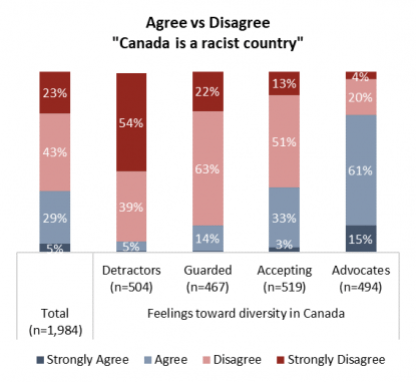
But does everyone feel it? Contradictions abound. Fully one-in-three (34%) say “Canada is a racist country.” Among those who believe this most keenly: visible minorities (42 per cent of whom say so) and women, particularly those under the age of 35, who are much more likely than men to hold this view (54%).
On the other hand, however, fewer than one-in-eight (12%) say they believe some races are superior to others. Further, 41 per cent of Canadians say that people seeing discrimination where it does not exist is a bigger problem for the country than people not being able to see where it does.
These perspectives coalesce to form four mindsets with which Canadians view diversity. This report analyzes each – the Detractors, Guarded, Accepting and Advocates – to better understand the expectations of Canadians heading into the second half century of official multiculturalism.
More Key Findings:
Three-quarters of Canadians over the age of 55 disagree that Canada is a racist country, while 54 per cent of women between the ages of 18 and 34 say that it is
One-in-five Canadians (21%) say that they feel like they are treated as an outsider in Canada. This proportion is 17 per cent among Caucasians, 30 per cent among Indigenous respondents and 29 per cent among visible minorities.
The Advocates, one-quarter of Canadians, are very concerned about racism and discrimination, to the point that they are twice as likely as visible minorities themselves to say that police are prejudiced or racist toward the latter demographic (83% vs 42%)
The Detractors, made up of older and more conservative Canadians, are also one-quarter of the population. This group is distinct in that it is more likely than others to say that immigration levels are way too high, and that racism is not a problem in Canada
One-quarter of Canadians feel “cold” toward Muslims, more than any other group asked about in the survey. Men over the age of 55 (42%) and Quebecers (37%) are among the most likely to say that.
Most Albertans (54%) and Saskatchewanians (57%) believe exaggerating racism is a bigger problem in Canada than not seeing racism where it exists.
Yet residents of Saskatchewan (44%) were the most likely to agree that Canada is a racist country. Residents of Quebec (24%) were the least likely.
The top level finding, with the report having a wealth of detail, with some of the same characteristics as in Canada such as age, education, political affiliation in terms of support or not for immigration:
The Cato Institute 2021 Immigration and Identity National Survey, a new national survey of 2,600 U.S. adults, finds that nearly three‐fourths (72%) of Americans believe immigrants come to the United States to “find jobs and improve their lives” while 27% think immigrants come to obtain government services and welfare.
Support for more immigration has tripled from the mid‐1990s when about 10% of the public supported more immigration and two‐thirds wanted less. Today 29% of Americans want more, 38% want to maintain current levels, and 33% want less.
Democrats’ views largely account for this shift. Starting around 2008–2010, Democratic support for more immigration rose from about 20% to 47% today.
Good initiative by Senators Black and Omidvar in commissioning this poll:
Eight in 10 Canadians say temporary foreign workers should be entitled to the same benefits and protection as any other workers in this country, according to a Nanos Research poll.
The survey, commissioned by senators Ratna Omidvar and Rob Black, was released Thursday in the wake of a Star story that highlighted the plight of hundreds of Trinidadian seasonal migrant farm workers, who are stuck in Canada due to COVID-19 travel restrictions and unable to access employment insurance benefits.
The pandemic has shed light on the vulnerability of temporary foreign workers, who pay the same EI premiums as Canadian workers but who have difficulty accessing the benefits due to their precarious immigration status.
Trinidad and Tobago has closed its airports to international flights since March and the estimated 400 stranded workers are on the verge of losing their legal status in Canada as their work permits expire on Dec. 15. Many have been denied EI, with officials saying their “closed” work permit prevents the workers from looking for other employers, resulting in them being declared not “ready or available” for work.
The senators say that in addition to benefits, migrant workers should have “pathways” to obtaining permanent resident status in Canada, something that is currently very limited for these workers.
“The pandemic has highlighted the fact that temporary migrant workers and seasonal agricultural workers are essential to Canada,” said Black. “We are calling on the Government of Canada for pathways to permanency for essential workers, should they so desire.”
The poll of 1,040 Canadians was conducted in late October and independent from the Star story.
It found that 93 per cent of respondents said migrant workers are essential contributors to Canada’s agricultural sector and 81 per cent said they deserved a pathway to permanent residence.
Canada’s agricultural sector depends on the temporary migrant work force, which makes up 17 per cent of the total employment in the sector.
“We need more concrete and equitable improvements to our migrant workers program. Since the workers are essential to our well being and safety, then the safest … and the most human way forward is to provide them with more permanent residency options,” Omidvar said.
Both Black and Omidvar plan to introduce a motion in the Senate on Thursday calling on the Liberal government to create permanent residence pathways for migrant workers.




 Multicultural Meanderings