Reaction to Quebec’s values charter
2013/09/11 Leave a comment
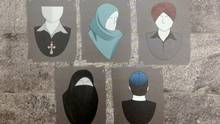 So the draft Charte is out with few surprises. Lots of reaction. Starting with what’s in and what’s out:
Would
Bar public sector employees — including everyone from civil servants to teachers, provincial court judges, daycare workers, police, health-care personnel, municipal employees and university staff — from wearing a hijab, turban, kippa, large visible crucifix or other “ostentatious” religious symbols while on the job.
Allow five-year opt-outs from the ban for certain organizations, but not daycare workers or elementary school teachers.
Require that those receiving or providing government services uncover their faces.
Exempt elected members of the Quebec legislature from the regulations.
Amend Quebec’s human rights legislation, the Charter of Human Rights and Freedoms, to specify limits on when someone can stake a claim for religious accommodation.
Wouldn’t
Remove religious symbols and elements considered “emblematic of Quebec’s cultural heritage.” That includes: the crucifixes in the Quebec legislature and atop Mount Royal in Montreal, the thousands of religiously based geographic names (e.g. Saint-Louis-du-Ha! Ha!) and the names of schools and hospitals.
Ban public sector employees from wearing small religious symbols like a ring with a Star of David, earrings with the Muslim crescent or a necklace with a small crucifix.
Eliminate subsidies to religious private schools. The Quebec government currently funds about 60 per cent of the budgets of most of the province’s private schools, including parochial ones.
Ban opening prayers at municipal council meetings, which was recommended by the 2008 Bouchard-Taylor Commission report into cultural accommodation. The Quebec Court of Appeal ruled in May that such prayers do not necessarily violate Quebec’s current human rights legislation.
Eliminate property tax exemptions for churches, mosques, synagogues and other religious buildings.
In other words, some of the deeper aspects of multiculturalism, deeper than the rest of Canada, and arguably less integrative like subsidies for religious schools, would remain, while imposing restrictions on public service employees. And will we have a ‘sartorial’ police measuring the size of ‘discrete’ or small religious symbols?
5 things Quebec’s values charter would do, and 5 it wouldn’t – Montreal – CBC News.
Quebec reveals religious symbols to be banned from public sector
Five key consequences of Quebec’s planned Charter of Values
Reaction in Quebec to the proposal is mixed. While Minister Drainville continues to say with a straight face that the Charte aims at harmony, others disagree, particularly in Montreal, where most of the communities live and work together:
Une Charte au nom de l’harmonie, selon Drainville
Signes religieux: la Charte se bute à un écueil
Mairie de Montréal : unanimité contre la charte des valeurs
Signes religieux – Québec fait fausse route, dit la Fédération des femmes
Charte des valeurs québécoises – Réactions mitigées sur la scène politique provinciale
«C’est une Charte contre les femmes»
Federal politicians have pronounced strongly against the proposed Charte. Particularly striking – and courageous given Quebec politics – that both federal leaders from Quebec, Justin Trudeau of the Liberals, and Tom Mulcair, Leader of the Official Opposition and NDP, have been unequivocal in their defence of human rights and freedoms, as has been Minister for Multiculturalism and Economic and Social Development Jason Kenney, speaking on behalf of the government, although as some have noted, he was less expansive than usual.
Given the Ottawa-Quebec dynamics, and the desire by the PQ to play politique identitaire, this may fit into their game plan to create a wedge issue. But irresponsible politics at best.
How Kenney, Mulcair and Trudeau took on Quebec’s charter of values
Tories gear up for constitutional fight as parties unite against PQ’s charter
NDP Leader Tom Mulcair denounces Quebec’s proposed charter of values
Some other reaction and analysis in English Canada:
Charter of Values hints that Quebec having second thoughts over mad dash for immigrants
And an opinion piece in Le Devoir in favour of laicité:
And unfortunately behind Le Devoir’s firewall, an opinion piece by Gérard Bouchard, one of the co-authors of the Bouchard-Taylor report, and one of the more thoughtful thinkers on multiculturalism and interculturalisme around. Interview below:
Le sociologue Gérard Bouchard, professeur à l’Université du Québec à Chicoutimi, a codirigé avec le philosophe Charles Taylor de l’Université McGill la Commission de consultation sur les pratiques d’accommodements reliées aux différences culturelles, en 2007-2008. Il juge sévèrement la proposition du gouvernement défendue par le ministre Bernard Drainville pour « répondre au pluralisme religieux dans un état moderne ».
Si le ministre Drainville vous appelait pour vous demander conseil, lequel lui donneriez-vous ?
Je lui dirais que la façon de poser les termes du débat indispose les libertés fondamentales et risque de produire une fracture sociale. C’est donc une mauvaise façon et nous allons nous faire mal. La sagesse consisterait présentement à couper le projet de réforme en deux. Une partie concerne les accommodements et une autre concerne les signes religieux. Sur les signes religieux, visiblement, le Québec n’est pas prêt à se diriger vers un consensus. À mon avis, cette partie du débat sera un échec. Les Québécois seront très, très divisés. Par contre, sur les accommodements, il y a toutes les chances de réaliser un très large consensus parmi l’ensemble des Québécois, la minorité, comme la majorité. Là, à mon avis, il y aurait la possibilité d’en arriver à une loi.
Et tout irait pour le mieux, tout simplement ?
Non. J’ai une autre inquiétude. En parlant des accommodements, le ministre a amplifié toutes les mauvaises perceptions à propos des accommodements. Il a répandu l’idée que les accommodements portaient atteinte régulièrement à l’égalité hommes-femmes. Ce n’est pas vrai. Aucune étude ne soutient ça. Il a aussi répété qu’il y avait une accumulation d’accommodements déraisonnables consentis récemment. Pas de preuve encore. Pas d’études. Rien pour soutenir ça.
Quel autre élément de la proposition vous semble négatif ?
Au cœur de l’affaire, il y a la volonté de s’en prendre à un droit fondamental qui concerne la liberté de manifester sa religion en public, incluant au travail, dans les postes de l’État ou les institutions parapubliques. C’est reconnu comme un droit fondamental par les deux Chartes, canadienne et québécoise, partout en Occident et par l’ONU. Il est permis de supprimer un droit fondamental. Mais il faut alors s’appuyer sur un motif supérieur. Le meilleur exemple au Québec, c’est la loi 101. Elle restreint ou supprime des droits, par exemple en limitant le droit de choisir l’école de ses enfants. Mais il y avait un motif légitime que même la Cour suprême du Canada a reconnu. Je ne trouve pas de motif équivalent dans le cas présent. Il n’y a pas de proportionnalité entre le droit restreint et les motifs évoqués.
Pourquoi est-ce si grave d’interdire des signes religieux aux fonctionnaires ?
Dire que tous les employés de l’État et des organismes parapublics — et ça fait beaucoup — devraient s’abstenir de porter un signe religieux ne tient pas compte de la réalité profonde de certaines croyances. Pour certains croyants, le signe religieux n’est pas dissociable du credo. En se défaisant du signe, le croyant trahit sa foi. C’est pourquoi jamais un sikh ne va retirer son turban au travail. Voilà pourquoi les sociétés doivent trouver des accommodements, dans la mesure où ça ne nuit à personne, sans nuire au travail.
Qu’auriez-vous souhaité alors ?
Charles Taylor et moi, dans notre rapport, nous recommandions l’adoption d’un régime de laïcité au Québec. Il fallait énoncer les grands principes et les justifier. Il fallait énoncer des règles générales de conduite à l’usage des décideurs des institutions. Ce qui a été dévoilé ne fait pas ce travail, ne décrit pas le régime de laïcité qui dirait les rapports entre les religions et les convictions profondes, qui ne sont d’ailleurs pas toutes religieuses, dans notre société. Le gouvernement a tout de suite sauté à des conclusions qui conduisent à la suppression d’un droit fondamental.
Que pensez-vous du droit de retrait de certaines institutions, pour une période allant jusqu’à cinq ans, inclus dans la proposition ?
C’est une affaire difficile à comprendre. Ce droit de retrait se trouve à défaire ce que le projet est censé faire. Premièrement, le problème juridique de fond reste. Deuxièmement, il va en découler une fragmentation juridique du Québec, d’une municipalité à l’autre, d’une université à l’autre. Une jeune étudiante portant le foulard pourra fréquenter tel cégep, mais pas tel autre. C’est assez surprenant. En général, quand l’État statue sur un droit, il le fait pour l’ensemble de la société. Il paraît très étrange de donner aux citoyens la liberté de respecter la loi et des dispositions de la Charte. Troisièmement, cette option donne à la majorité la possibilité de disposer des droits des minorités. On ne peut pas confier la gestion des droits fondamentaux aux humeurs de la majorité. Imaginez où en serait le droit des homosexuels si on fonctionnait comme ça.
Gérard Bouchard: «Nous allons nous faire mal»
And lastly, some questions for those in favour of the Charte and laicité absolue:
- Is this driven by ideology or unconscious prejudice against people with religious beliefs?
- Do you assume greater competence among public servants without religious symbols than those with?
- Do you view the wearing of a cross as purely secular or not?
- When being treated at a hospital, taking a child to day care or school, or getting on a bus, what assumptions do you make regarding someone wearing a cross, kippa, turban, hijab or other symbol?
- Is the issue competence or appearance? Comfort or discomfort?
As someone who has been in and out of hospital for more time than I would like to remember, and has been treated with a variety of doctors and nurses, some with religious symbols, some without, competence trumps appearance and I have not been disappointed. Yesterday, it was a nurse wearing a hijab that did my regular blood work; and it was one of the more painless pokes in recent memory.

 Multicultural Meanderings