Shootings raise unanswered life-or-death question for black men in America: Neil Macdonald

Good column by Macdonald:

In the racially electrified fog of fear and rage following the events in Dallas Thursday, one question remains conspicuously unanswered: If you are a black man in America, how are you supposed to cope?

President Barack Obama has no real answer, nor do the members of Congress who bowed their heads in memory of the slain Dallas police officers, nor does Dallas’s anguished police chief, a black man himself.

The deadly consequences of carrying while black
#SayHisName: Americans react to videos of police killings
The only advice black Americans seem to get is to respectfully submit when some cop calls them out on the street, or looms at the door of their car, or shows up at their home, no matter how terrified they may be.

‘Comply, comply, comply’

For heaven’s sake, don’t give the officer any lip, or try to run away, even if you aren’t guilty of anything, and no matter how abusive the cop may become.

Because if you are black, that policeman is far more likely to gun you down, or choke you to death, or Taser you, or beat you into a coma.

“Comply, comply, comply,” Philando Castile’s mother says she used to tell him. “Comply — that’s the key thing in order to try to survive being stopped by the police.”

‘When is it going to stop?’: Philando Castile’s family speaks out1:10

Perhaps Alton Sterling’s parents gave him the same counsel. It’s as common for black parents to have that talk with their kids as it is for white parents to warn about talking to strangers.

But of course supine compliance does not guarantee survival at the hands of police if you are black in America (or, to be honest, if you are Indigenous in some parts of Canada, but that’s a separate discussion).

Philando Castile was evidently complying with the Minnesota policeman who’d pulled him over for a broken tail light this week when that policeman opened fire through the driver’s window. The police force has not said otherwise.

And a day earlier, Alton Sterling was pinned down, hands free of weapons, when two Louisiana cops shot him in the back and chest.
After the Castile killing, Minnesota Gov. Mark Dayton stated the obvious: “Would this have happened if those passengers, the driver and the passengers, were white? I don’t think it would have …”

There is simply no question that your race can determine whether you live or die at the hands of police in America. If you are black, you are several times more likely to be killed.

Benefit of the tiniest doubt

And, chances are, your killer will walk away, unpunished, and likely consoled by his fellow officers for having had to go through such trauma.

Source: Shootings raise unanswered life-or-death question for black men in America: Neil Macdonald – Politics – CBC News

In a class of 300, they were the only two black women. Now they’re top cops

Good long-read profile of some of the pioneering Black women in police forces:

Over breakfast, senior officers Ingrid Berkeley-Brown and Sonia Thomas are chatting about a Toronto movement that has taken on the police.

Black Lives Matter came into prominence here in the spring, and both officers saw the images of the group, led primarily by black women, camped outside Toronto police headquarters for two weeks. The group’s members were furious over the decision by the Special Investigations Unit not to charge the police officer who last year shot and killed Andrew Loku, 45, while he held a hammer.

Thomas and Berkeley-Brown are black women, friends who met at Ontario Police College in the mid-1980s. They’re straddling two realities.

“Black Lives Matter makes me a little bit uncomfortable,” Thomas admits.

“Not only am I a member of the black community (who) strives for justice, but I’m also a member of the police service they’re accusing of racism. So yeah, (I’m) a little bit uncomfortable.”

But Berkeley-Brown says she doesn’t share that discomfort.

“If they have areas of concern and get together to voice those concerns, I think that’s legitimate,” she says.

Berkeley-Brown, 55, and Thomas, 52, share a bond. In 1986, they were the only two black women in their largely white, male class of about 300 recruits at the police college in Aylmer, where they met.

Now a superintendent, Berkeley-Brown is the officer in charge at 21 Division for Peel Regional Police, and Insp. Thomas is second in command at 53 Division for Toronto police. They’re among the highest-ranking black female officers in Canada, and the friends climbed steep hills to get there.

….In an interview, James, 61, who retired as a detective, says she’s pleased with her own career. But there were low points.Particularly the time she served on an undercover unit four years into her career, when a fellow officer (senior in years of service but not rank) “went out of his way to make life difficult for me.”

While on duty together — sometimes alone on stakeouts — he would make comments like “‘I’d rather go out with a hooker than a black woman,’ or ‘if a black woman ever comes to my house it’s just to clean it,’” James recalls. She eventually switched units.

Thomas says it hasn’t happened often but she has always challenged inappropriate comments and behaviour by fellow Toronto officers.

Berkeley-Brown believes that given her own past work in the black community, and with the race and ethnic relations bureau for Peel police, her colleagues have known “what to say and not say in my presence.”

On the subject of racial profiling, Berkeley-Brown says she hasn’t ever witnessed her fellow officers in Peel engaging in it. Officers with that service patrol alone.

But when she hears over the Peel police radio that a member of the public has called in about black males seen at such-and-such address, Berkeley-Brown says her ears perk up and her first question is “So what? Are they doing anything wrong?”

She believes it’s important that the public — as well as the police — be informed about bias-free law enforcement.

Thomas no longer does frontline patrol work in a cruiser in Toronto, but when she did she questioned some of the instances black people were pulled over by her fellow officers.

“I mean challenging, ‘Well, why are we stopping this car? Give me a good reason why we’re stopping this car.’

“If there was a valid explanation, we would continue (investigating). If there wasn’t, we may have disengaged,” Thomas says.

Over the years numerous voices from legal circles, academia and visible minority groups have actively pushed to stamp out racial profiling, but Thomas believes it is not a common practice by police in the province.

“The reality is police services across Ontario hire from our communities, and like communities there is going to be some discrimination, there’s going to be some racism. We’re going to have officers who are racist, who racially profile. But I can tell you those numbers are so minimal,” Thomas says.

As for their lasting friendship, Berkeley-Brown and Thomas say part of it is based on respect for each other’s rise through the ranks.

They often meet up at police-related functions, including networking and professional development events put on by the Association of Black Law Enforcers.

Berkeley-Brown attended Thomas’s wedding in 1989, and Thomas was a guest at Berkeley-Brown’s wedding in 1994.

Nearly 30 years after that meeting in police college, they’re still bound by their love for the badge.

Source: In a class of 300, they were the only two black women. Now they’re top cops | Toronto Star

Exploring the lack of diversity in Quebec police forces

This has been an issue for a considerable time.

Police_ForcesThe table above compares police force diversity in Montreal, Toronto and Vancouver; what surprised me when collecting this information directly from the respective police forces was the degree to which the information is not public on their website and does not appear to be systematically collected (Surête de Québec does keep good stats):

Quebec’s police academy doesn’t have “a lot of influence” over whether visible minorities apply to become officers, says a spokesman for the academy.

Pierre Saint-Antoine, director of communications of École nationale de police du Québec in Nicolet, said racial minorities made up five per cent of its student population in 2015, despite attempts to “recruit people from all diversities and communities in Quebec.”

“We don’t have a lot of influence on the people that apply here,” Saint-Antoine said, adding that Nicolet has a program in place, in conjunction with the Quebec government, to encourage more diversity among applicants.

Saint-Antoine’s comments come after numbers compiled by CBC News show that Quebec police forces are lagging in their hiring of visible minorities.

For instance, the Sûreté du Québec serves more than 2.5 million people, however, fewer than one per cent of its officers are not Caucasian.

Community activists have said a lack of diversity among police leads to strained relationships with racial minorities.

But getting more people to apply is no easy task, says Paul Chablo, the head of John Abbott’s police technology program.

Before going to Nicolet, prospective police officers must first complete a three-year CEGEP program, and Chablo said many people from minority backgrounds don’t apply.

Out of roughly 250 students at John Abbott, 49 define themselves as having an “ethnic background” and only seven are visible minorities.

‘They have to adjust their techniques’

Chablo, who is also the former director of communications for the Montreal police, points to a multitude of factors — including lacklustre recruiting efforts and poor relationships with some ethnic communities — to explain the lack of diversity among applicants.

He said Quebec police need to a better job of reaching out to prospective employees to encourage them to apply to CEGEP programs in the first place.

“I think they have to adjust their techniques,” he said in an interview.

Source: Exploring the lack of diversity in Quebec police forces – Montreal – CBC News

Newly elected Peel police board chair sets a fresh tone | Toronto Star

Plain language:

“It doesn’t affect brown people and white people — it affects black males.” With that sharp rebuke of a report on police street checks — insisting that it missed the essence of the controversy — the man now heading the oversight of Peel Region police made clear that change is coming.

Minutes after Amrik Singh Ahluwalia stood Friday morning and moved to his new seat following his unanimous election as chair of the Peel Police Services Board, he joined other members calling for change within the country’s third-largest municipal police force.

The first issue: frustration with a consultant’s report commissioned by police chief Jennifer Evans.

“It was offensive,” said Brampton Mayor Linda Jeffrey, who just moments earlier had nominated Ahluwalia for the job as chair. “It was supporting the status quo,” Jeffrey said of the report, put together and presented by Louise Doucet and Liz Torlee, joint managing directors of TerraNova, a strategic marketing company.

Ahluwalia’s leadership could spell trouble for Evans if she continues to challenge the board on the controversial issue of police street checks, known as carding in Toronto. Unlike the outgoing chair, Laurie Williamson, who sided with Evans on the issue, Ahluwalia says the practice is harmful and has to stop.

“It disproportionately effects one segment of the society,” Ahluwalia told the Star after the meeting. “Three-and-a-half times the probability of stopping black men — it effects them significantly.”

In September, the Star published six years of street check data, obtained from the force under freedom of information laws, that showed black individuals were three times as likely to be stopped by Peel police as whites.

The next day, Mississauga Mayor Bonnie Crombie, Jeffrey, Ahluwalia and Norma Nicholson won a 4-3 vote to stop street checks, requesting that Evans take immediate action. She refused, claiming they did not have authority over her on operational matters. Anti-carding advocates, including the Law Union of Ontario, have refuted this claim. In October the provincial government announced it will ban the practice of random street checks.

Sophia Brown Ramsay, programming director for the Black Community Action Network of Peel, attended Friday’s meeting and is thrilled to have a new chair who supports her group’s goal to end street checks.

Source: Newly elected Peel police board chair sets a fresh tone | Toronto Star

Black rights groups call for changes to Ontario’s ‘carding’ rules

The ongoing debate about police carding in Ontario:

The chorus of voices calling for revisions to the province’s carding regulations grew louder Monday as a coalition of black community groups spoke out about the “the deeply problematic gaps” in proposed legislation aimed at halting discriminatory policing in Ontario.

“Ultimately, when it comes to eliminating racial profiling or preventing racial profiling and anti-black racism, the regulation does not go far enough,” said Anthony Morgan, a lawyer with the African Canadian Legal Clinic.

Among the groups speaking out is the Association of Black Law Enforcers (ABLE), which expressed doubt about the effectiveness of carding in a letter to the province this fall.

Carding, also known as street checks, “has yet to be reasonably demonstrated an effective or scientific tool to achieve the intended purpose of public safety,” ABLE president Kenton Chance wrote in a submission to the Ministry of Community Safety earlier this year. The Star recently obtained the submission.

On behalf of membership that includes black police officers across Ontario, Chance told the province that police now have other ways to solve crimes, such as video surveillance, that could be “exponentially more valuable and dependable” than the “hit or miss” information obtained through carding.

ABLE spokesperson Terrence Murray stressed the group does not speak for all black and racialized officers.

But in a statement to the Star, he reiterated that the group could not find any reliable information to prove the effectiveness of carding.

“As black police and peace officers, we live and work in two worlds that have allowed us to develop unique perspectives,” Murray wrote.

In October, Minister of Community Safety Yasir Naqvi unveiled draft regulations aimed at eliminating random and arbitrary police stops. Written after months of public consultation, the proposed regulations would place new limits on how and when police stop, question and document members of the public who are not suspected of a crime.

While many are applauding the sentiment behind the regulation, several dozen rights groups and community leaders have sounded the alarm in recent weeks about problems with the regulations.

Among the major concerns is that the proposed legislation includes too many exceptions that allow police to circumvent the safeguards.

Source: Black rights groups call for changes to Ontario’s ‘carding’ rules | Toronto Star

How Ontario politicians teamed up to rein in police carding: Cohn 

Good overview by Regg-Cohn on how the carding issue was addressed, with all party support (all too rare):

Provincial politicians are not usually top of mind when dealing with tensions in the inner cities or outer suburbs. But all three parties answered the call.

NDP deputy leader Jagmeet Singh launched a public campaign for change earlier this year, disclosing that he’d been carded more than 10 times by police — accosting him, questioning him, profiling him. A turban-wearing Sikh (which apparently arouses suspicions), Singh is a lawyer who now represents the riding of Bramalea-Gore-Malton — and knows his rights. But in news conferences, he made the case that most young people don’t know they have a right to refuse police street checks unless they are under suspicion for a crime.

Leading a legislative debate last month, Singh exhorted his fellow MPPs to “send a clear message to the entire province that arbitrary and discriminatory carding and street checks are not acceptable.”

The appeal from Singh’s third-place New Democrats struck a chord with the Progressive Conservatives. As the official Opposition, they have hewed to a rigid law and order line ever since John Tory led the party from 2004-09 and cleaved to police unions (a pattern he continued after becoming Toronto’s mayor last year).

The current PC leader, Patrick Brown, is taking a broader view. After reaching out to ethnic communities, notably people of South Asian descent, he is acutely aware that carding is seen as profiling. The PCs’ new legal affairs critic, Randy Hillier — a rambunctious libertarian but also a civil libertarian — delivered a passionate critique of carding for infringing on fundamental freedoms.

“Societies that arbitrarily or unduly limit people’s freedoms and liberties are also places where individual safety is in jeopardy,” Hillier argued.

The governing Liberals were ready to respond. Community Safety Minister Yasir Naqvi announced that his party would support the opposition motion to ban discriminatory street checks.

“There is zero tolerance when it comes to any kind of racial profiling or discrimination in interactions that our police engage in,” he announced.

Naqvi, who, like Singh, is a lawyer of South Asian descent, says he has never been carded. But after conducting consultations across the province through the summer, he heard an earful about the practice — and learned about his own tin ear.

His ministry’s initial consultation paper caused a storm for repeating the police claim, unquestioningly, that street checks are a “necessary and valuable tool.” Naqvi was embarrassed into admitting that he’d never asked police to back up their assertions.

Source: How Ontario politicians teamed up to rein in police carding: Cohn | Toronto Star

Ontario sets strict new limits on police street checks

Changes to carding, the new Ontario policy:

You will be told you have the right to walk away. You will be told the interaction is voluntary. You will be told that you do not have to give any information, and why you are being stopped and asked for it to begin with.

You will be provided with a written record of your interaction, given information about the officer, and informed about the police complaints system.

In a move hailed as historic — and overdue — the Ontario government is proposing a strict set of regulations banning all random and arbitrary police stops, and setting limits on how and when police can question and document citizens.

“The regulation makes it very clear that police officers cannot stop you to collect your personal information simply based on the way you look or the neighbourhood you live in,” Yasir Naqvi, Ontario’s minister of community safety and correctional services, announced at Queen’s Park on Wednesday.

“This is the first rights-based framework surrounding these police interactions in our history.”

Source: Ontario sets strict new limits on police street checks | Toronto Star

And Desmond Cole’s reminder that rules need to be accompanied by cultural change:

The Wynne government is finally acknowledging that residents’ stories of intimidation and surveillance are credible, and deserve a response. It’s a welcome, if long overdue, development. But new rules cannot, on their own, reverse a police culture of aggression and hostility towards residents, especially black Torontonians. We can’t regulate decency and respect in policing, but we must nevertheless demand it.

… Too many residents — especially those who are black, indigenous, homeless, or living with mental illness — can recount stories similar to Miller’s. They rarely have the video evidence to prove what we should all collectively know by now: the police regularly abuse their authority when dealing with vulnerable and marginalized people.

New rules and technologies can help discourage bad behaviour and hold officers to account when they transgress, but without tackling the ingrained culture of police intimidation no real solution to this problem is possible. Indeed, the arresting officers in Miller’s incident directed their TAVIS colleagues to “turn the camera on that guy,” to use their recording devices as a tool of intimidation. Equipping police with body cameras is different from insisting that police respect all residents, and ensuring that those who do not are taken off the streets.

Likewise, provincial rules on carding, which have simply not existed until now, can’t fully eliminate arbitrary police stops or disproportionate police suspicion of black people. It makes no difference that the TAVIS officers who accosted Miller are themselves black; if the expectation in police culture is to treat black residents with greater suspicion and less respect, all officers must fall in line, or must face internal scrutiny for failing to play the game.

It took too long for the province to object to carding. It will be many months before the new regulations are critiqued, modified and passed. Even then, it will be up to local police services boards, many of whom have shown no interest in stopping carding, to make the proposed changes real. But carding is just an ugly manifestation of the dominant social belief that blacks and other marginalized people need to be kept in line with aggression, dominance, and disrespect.

The Disproportionate Risks of Driving While Black – The New York Times

Black drivers stopped

Black Drivers ContrabandGood in-depth article and analysis:

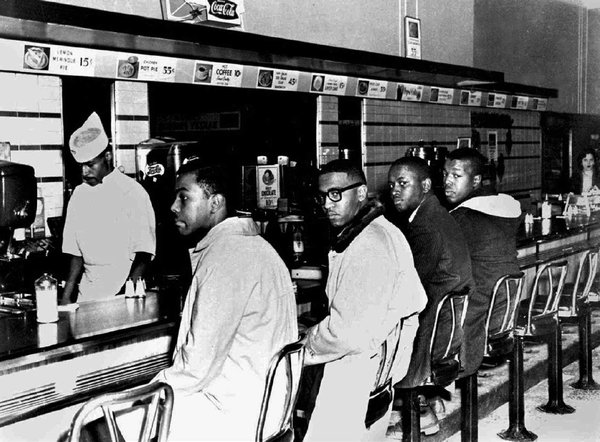
Greensboro has long cherished its reputation as a Southern progressive standout. This was the first Southern city to pledge to integrate its schools after the Supreme Court’s 1954 decision in Brown v. Board of Education, although it was among the last to actually do so. And when four black freshmen from North Carolina A&T State University occupied the orange and green stools at Woolworth’s whites-only lunch counter in 1960, Greensboro midwifed a sit-in movement that spread through the South.

Photo

North Carolina A&T State University students at the whites-only lunch counter at Woolworth’s in Greensboro in 1960. They were, from left, Joseph McNeil, Franklin McCain, Billy Smith and Clarence Henderson.CreditJack Moebes/Greensboro News & Record, via Corbis 

But this is also where hundreds of National Guardsmen suppressed black student protesters in 1969 and where, a decade later, five protesters were murdered at an anti-Ku Klux Klan rally conspicuously devoid of police protection.

And it was here, in 2009, that 39 minority police officers accused their own department of racial bias in a lawsuit that the city spent nearly $1.3 million fighting before agreeing to settle for $500,000. In a city that is 48 percent white, 75 percent of Greensboro’s force of 684 sworn officers remains white.

The Rev. Nelson Johnson, a civil rights leader here since the 1960s, contends that like Greensboro as a whole, the Police Department “has a liberal veneer but a reactionary underbelly.” An activist group he heads recently established a citizens’ board to hear complaints about the police, arguing that official investigations too often are shams.

“This is not about one officer,” Mr. Johnson said at a recent meeting about police behavior at the Beloved Community Center. “This is about a culture, a deeply saturated culture that reflects itself in double standards.”

The Times analyzed tens of thousands of traffic stops made by hundreds of officers since 2010. Although blacks made up 39 percent of Greensboro’s driving-age population, they constituted 54 percent of the drivers pulled over.

While factors like out-of-town drivers can alter the racial composition of a city’s motorists, “if the difference is that big, it does give you pause,” Dr. McDevitt of Northeastern University said.

Most black Greensboro drivers were stopped for regulatory or equipment violations, infractions that officers have the discretion to ignore. And black motorists who were stopped were let go with no police action — not even a warning — more often than were whites. Criminal justice experts say that raises questions about why they were pulled over at all and can indicate racial profiling.

In the past decade, officers reported using force during traffic stops only about once a month. The vast majority of the subjects were black, and most had put up resistance. Still, if a motorist was black, the odds were greater that officers would use force even in cases in which they did not first encounter resistance. Police officials suggested that could be because more black motorists tried to flee.

In an interview, Chief Scott said that overall, the statistics reflected sound crime-fighting strategies, not bias. They have produced record-low burglary rates, and most citizens welcome the effort, he said.

Deborah Lamm Weisel, an assistant professor of criminal justice at North Carolina Central University in Durham, said the best policing practices “involve officers making proactive contacts with citizens, and traffic stops are the main way they do that.”

But many criminal justice experts contend that the racial consequences of that strategy far outweigh its benefits — if, indeed, there are any.

“This is what people have been complaining about across the nation,” said Delores Jones-Brown, a professor at the John Jay College of Criminal Justice in New York. “It means whites are ‘getting away’ with very low-level offenses, while people who are poor or people of color are suffering consequences.”

“It amounts to harassment,” she said. “And police cannot demonstrate that it is creating better public safety.” To the contrary, she added, it makes minority citizens less likely to help the police prevent and solve crimes.

Source: The Disproportionate Risks of Driving While Black – The New York Times

Ontario says it can’t get data on effectiveness of carding for current review

Evidence-based policy requires data:

The provincial government cannot compel Ontario’s police forces to hand over their data on street checks — including information as to how many times the controversial practice has helped solve crimes, according to Minister of Community Safety and Correctional Services Yasir Naqvi.

That means that as the province continues its review of street checks, commonly known as “carding,” it will do so without knowing how often the practice has actually proved useful to investigations, by leading to an arrest, to the discovery of a weapon or drugs, or more.

“Legally we are not entitled to that data, under the Police Services Act, unless we require it in the regulation,” Naqvi told reporters during Tuesday’s public consultation at the Toronto Reference Library. Naqvi said his ministry has been consulting with Ontario’s Information and Privacy Commissioner about how to gain access to this policing data in aggregate form, stripped of any personal information.

“One of the reasons why this regulation is needed is to give the province the ability to require the disclosure of data, specific to how police services conduct street checks, to ensure that they are conducted in a way that is rights-based, fair and consistent across the province,” Lauren Callighen, Naqvi’s press secretary, said in an email.

Under Ontario’s Police Act, Callighen said, there are certain circumstances where the province may inspect municipal police services to review their practices, such as the use of force. “This regulation will ensure the same oversight for any policy on street checks.”

Nonetheless, in the absence of such data, the province described street checks in its online discussion document as a “necessary and valuable tool for police” when used properly —something critics of the provincial review have decried as, at best, presumptive.

Naqvi’s office did not respond to a question about what criteria were used to describe street checks as “a necessary and valuable tool,” if not police data.

The lack of information as to how carding interactions produce results has become one of the central issues in the heated debate around the practice.

Carding proponents, including Toronto Police Chief Mark Saunders and Toronto Police Association president Mike McCormack, defend it as a vital investigative tool. Police have said the information contained in carding records can help officers connect the dots, perhaps to show an association between individuals, to place someone in an important place at a key time, and more.

Source: Ontario says it can’t get data on effectiveness of carding for current review | Toronto Star

John Tory, Mark Saunders get cover from Queen’s Park on carding issue: James

Royson James on the Ontario government’s public consultations on carding:

There is little reason to believe that the provincial Liberal government consultations on carding will yield anything more satisfactory than the chaotic farce the Toronto Police Services Board has delivered, led by Mayor John Tory.

To expect meaningful reform from the current initiative, with a stop in Toronto at the reference library Tuesday night, is to be overcome with naiveté borne of willful blindness.

In fact, the evidence points to a provincial government in cahoots with Tory and the Toronto police brass; one whose intervention is designed to offer pap and a public relations show, while preserving the essence of police street checks.

Notwithstanding the lofty statements about the government’s intolerance of discrimination, the impact of any new rules passed will likely be: police will have the ability to stop anyone, anytime, for any reason, stated or unstated, to psychologically, if not expressly detain said person, record personal information from said subject, and record the same in a police database.

And we know who will be targeted most.

And we know — or have been told ad nauseum this past year — the real, psychological, and social costs borne by the black community, particularly young black men.

But carding is a useful tool — according to opening statements on the Ministry of Community Safety and Correctional Services website, announcing the review.

Done properly, the new police chief has said, carding is legal.

Done properly, we wouldn’t be here debating the matter, attempting to tame it, wrestling with the chief to find reasonable constraints on the practice, and advocating for reform.

Done properly, street checks in Toronto would follow the protocol drawn up in April 2014 by a Toronto police board that studied the matter and came up with as good a compromise as possible.

That was before John Tory and (now board chair) Andy Pringle and former chief Bill Blair turned the file into a horrible mess, a political hot potato and a public relations disaster.

Pringle, a member of the board in 2014 and Tory acolyte and Blair’s fishing buddy, convinced Tory that he should back Blair in his refusal to implement the board’s decision. Tory, while condemning carding, destroyed the 2014 policy designed to fix it, brought in new guidelines that created a firestorm of controversy, and was forced to go back to the very 2014 board policy he meddled with.

And this is where the province mysteriously entered the fray.

Why? Few can explain the motivation. How? In a manner that only fosters cynicism. Who would enter this messy situation, with the epicenter in Toronto, and decide to hold consultations in Ottawa and Thunder Bay but not Toronto? Who would set up private sessions with groups familiar with the issue and not include the Black Action Defence Committee (BADC)?

Source: John Tory, Mark Saunders get cover from Queen’s Park on carding issue: James | Toronto Star