Auschwitz inmates’ families oppose ex-PM on museum council

Of note:

Relatives of former Auschwitz prisoners from Poland are protesting the appointment of a top member of the country’s right-wing ruling party to an advisory council at the state-run Auschwitz-Birkenau museum in Poland.

They argue that the former prime minster, Beata Szydlo, has tolerated “openly fascist” groups and supported attempts to stifle research into the Holocaust, among other complaints.

Szydlo was appointed in April to the Auschwitz-Birkenau State Museum Council, a body of experts that advises the museum director. That prompted three members of the nine-member panel of experts to resign, followed by a fourth resignation reported this week.

On Friday evening, the news portal Onet carried a letter signed by children and grandchildren of former Polish prisoners, as well as one Auschwitz survivor, addressed to Prime Minister Mateusz Morawiecki.

They did not want Szydlo because of her and the ruling Law and Justice party’s strong opposition to accepting refugees and the conservative party’s attempts in the past to win over voters on the extreme right.

“We remember statements that excluded refugees, the undermining of achievements of Holocaust researchers, the toleration of openly fascist organizations, and finally denying European Union alliances,” they wrote to Morawiecki, according to the letter quoted by Onet. “We do not agree to this.”

Early on during World War II, the German forces operated Auschwitz as a camp for Polish prisoners, including Catholic clergy and members of the resistance. They later created nearby Birkenau for the mass killing of Jews from across Europe. In all, some 1.1 million people were murdered at the site located today in southern Poland.

Among those who signed the letter to Morawiecki were the son and two granddaughters of Capt. Witold Pilecki, one of the most notable heroes of the Polish resistance. Pilecki volunteered to be an Auschwitz inmate and smuggled out reports of atrocities there before fleeing. He was tortured and executed in a show trial by communists after the war.

There were no immediate reactions from the Polish government on Friday evening.

Culture Minister Piotr Glinski, who appointed Szydlo to the council, reacted after the first three resignations by denouncing them.

Glinski said it was an for the museum to have Szydlo on the council and said the resignations threatened to “politicize the discussion around the most important museum of martyrdom in Poland, a place of world heritage.”

Szydlo is now is a member of the European Parliament for the Law and Justice party. She has studied ethnography and history, and is from the area of Oswiecim, the Polish town where the site of the former Auschwitz death camp is located.

Source: Auschwitz inmates’ families oppose ex-PM on museum council

Polish court rebukes Canadian historian for defaming alleged Nazi collaborator

Sigh….

A Polish court order that an eminent Canadian historian and his co-editor apologize for suggesting a man helped kill Jews during the Second World World has angered Jewish human rights activists in Canada and abroad.

They say the ruling against Jan Grabowski and Barbara Engelking is part of an ongoing effort to obscure Polish complicity in the genocide of Jews during the Holocaust.

Michael Levitt, head of Toronto-based Friends of Simon Wiesenthal Center for Holocaust Studies, called the ruling shocking and shameful.

“Poland cannot continue to bury the facts and silence Holocaust scholars,” Levitt said. “Its actions must be roundly rejected by Canada and the rest of the international community.”

The group said it was reaching out to senior government leaders urging them to speak out against “Holocaust distortion in Poland.”

At issue was a short passage in a 1,600-page book “Night Without End: The Fate of Jews in Selected Counties of Occupied Poland,” co-edited by Grabowski, a professor at the University of Ottawa, and Engelking, director of the Polish Center for Holocaust Research in Warsaw.

According to the passage, which Engelking wrote, Edward Malinowski robbed a Jewish woman during the war and contributed to the deaths of 22 other Jews hiding in a forest in Malinowo in Nazi-occupied Poland in 1943.

Malinowski’s niece, Filomena Leszczynska, 81, argued her uncle was a Polish hero who had saved Jews, and that the scholars had defamed her and her family. She demanded a retraction and 100,000 zlotys – about C$34,000 – in compensation.

Judge Ewa Jonczyk, of the District Court in Warsaw, ordered the authors to make a written apology for “providing inaccurate information” and “violating his honour.” The judge, however, stopped short of imposing monetary compensation, saying it could hinder academic research.

Nevertheless, Mark Weitzman, with the Los Angeles-based Simon Wiesenthal Center, said the ruling opened the door to further intimidation of Holocaust scholars and researchers.

“By ordering the scholars to ‘apologize,’ it puts both historians and victims on trial, and offers protection to the reputations of Poles and others who collaborated in the murder of Jews,” Weitzman said

Grabowski could not be reached for comment, although Engelking said they planned an appeal.

Grabowski, whose work on the Holocaust has attracted death threats, told The Canadian Press in 2017 that he would not allow fierce criticism of his research in Poland to deter him.

“I feel personally attacked but this is for me a much more dangerous and general problem that has to be dealt with,” Grabowski said. “It’s a pure and simple attack on basic academic freedoms, which we take for granted here in Canada. I’m dismayed.”

The Nazis slaughtered about three million Jews and another two million Christians in Poland during the war. While many Poles resisted the invaders, others collaborated with the Nazis.

Leszczynska was backed by the Polish League Against Defamation, a group that fights harmful and untruthful depictions of Poland. The league, which has previously attacked Grabowski’s work, is ideologically aligned with the ruling nationalist Law and Justice Party.

The researchers, however, viewed the case as an attempt to discredit their overall findings and discourage other researchers from investigating the truth about Polish involvement in the German mass murder of Jews.

Source: Polish court rebukes Canadian historian for defaming alleged Nazi collaborator

Future of Holocaust research in Poland hinges on libel case

Of note, ongoing disturbing trend:

Two Polish historians are facing a libel trial for a scholarly examination of Polish during World War II, a case whose outcome is expected to determine the fate of independent Holocaust research under Poland’s nationalist government.

A verdict is expected in Warsaw’s district court on Feb. 9 in the case against Barbara Engelking, a historian with the Polish Center for Holocaust Research in Warsaw, and Jan Grabowski, a professor of history at the University of Ottawa.

It is the first major legal test in the wake of a 2018 law that makes it a crime to falsely accuse the Polish nation of crimes committed by Nazi Germany. The law caused a major diplomatic spat with Israel.

Since it won power in 2015, the conservative ruling party, Law and Justice, has sought to discourage investigations into Polish wrongdoing during the wartime German occupation, preferring instead to almost exclusively stress Polish heroism and suffering. The aim is to promote national pride — but critics say the government has been whitewashing the fact that some Poles also collaborated in the German murder of Jews.

The Israeli Holocaust museum Yad Vashem said the legal effort “constitutes a serious attack on free and open research.”

A number of other historical institutions have condemned the case as the verdict nears, with the Paris-based Foundation for the Memory of the Shoah describing it Tuesday as a “witch hunt” and a “pernicious invasion into the very heart of research.”

The case on a 1,600-page, two-volume historical work in Polish, “Night Without End: The Fate of Jews in Selected Counties of Occupied Poland,” which was co-edited by Grabowski and Engelking. An abridged English version is due to be published in a few months.

Grabowski and Engelking say they see the case as an attempt to discredit them personally and to discourage other researchers from investigating the truth about the extermination of Jews in Poland.

“This is a case of the Polish state against freedom of research,” Grabowski told The Associated Press on Monday.

Grabowski, a Polish-Canadian whose father was a Polish Holocaust survivor, has faced considerable anti-Semitic harassment by nationalists, both online and at lectures in Canada, France and elsewhere.

The niece of a man in the village of Malinowo, whose wartime is briefly mentioned, is suing Grabowski and Engelking, demanding 100,000 zlotys ($27,000) in damages and an apology in newspapers.

According to evidence presented in the book, Edward Malinowski, an elder in the village, allowed a Jewish woman to survive by helping her pass as a non-Jew. But the survivor is also quoted as saying that he was an accomplice in the deaths of several dozen Jews.

The niece, Filomena Leszczynska, has been backed by a group, the Polish League Against Defamation, which receives funding from the Polish government.

That organization argued that the two scholars are guilty of “defiling the good name” of a Polish hero, whom they claim had no role in harming Jews, and by extension harming the dignity and pride of all Poles. The lawsuit was filed in court free of charge as allowed under the 2018 law.

Mark Weitzman, director of government affairs for the Simon Wiesenthal Center, called “Night Without End” a “meticulously researched and sourced book … that details thousands of cases of complicity by Poles in the murder of Jews during the Holocaust.”

“The proceedings against these two scholars of international repute are nothing more than an attempt to use the legal system to muzzle and intimidate scholarship on the Holocaust in Poland,” Weitzman said.

Germany occupied Poland in 1939, annexing part of it to Germany and directly governing the rest. Unlike other countries occupied by Germany, there was no collaborationist government in Poland. The pre-war Polish government and military fled into exile, except for an underground resistance army that fought the Nazis inside the country.

Yet some people in Poland collaborated with the Germans in hunting down and killing Jews, in many cases people who had fled ghettos and sought to hide in the countryside.

Grabowski said “Night Without End” is “multi-faceted, and it talks about Polish virtue just as much. It paints a truthful picture.”

“The Holocaust is not here to help the Polish ego and morale, it’s a drama involving the death of 6 million people — which seems to be forgotten by the nationalists,” he said.

A deputy foreign minister, Pawel Jablonski, described the case as a private matter.

“It is everyone’s legal right to seek such a remedy before (a) court if they feel that their rights have been infringed by (another) person or entity,” Jablonski told the AP in an statement Monday. “The government is not involved in the proceedings, it is a private matter to be decided by the court.”

Yet those who fear that the case could stifle independent research take a different view.

“The involvement in this trial of an organization heavily subsidized with public funds can be easily construed as a form of censorship and an attempt to frighten scholars away from publishing the results of their research out of fear of a lawsuit and the ensuing costly litigation,” said Zygmunt Stepinski, director of the POLIN Museum of the History of Polish Jews in Warsaw.

Source: Future of Holocaust research in Poland hinges on libel case

Polish nationalists protest against US over Holocaust claims

Disheartening:

Several thousand nationalists rallied in Warsaw on Saturday against a US law on the restitution of Jewish properties seized during the Holocaust, fuelling concerns about anti-Semitism in the country.

Far-right supporters who marched from the prime minister’s office to the USembassy waved banners reading “No to claims”, “Shame” and “Stop 477”.

The latter refers to the US Justice for Uncompensated Survivors Today (JUST) Act which requires the US State Department to report to Congress on the progress of countries including Poland on the restitution of Jewish assets seized during World War Two and its aftermath.

The protest took place amid a dramatic rise in anti-Semitic hate speech in public life in Poland and it appeared to be one of the largest anti-Jewish street demonstrations in recent times. It also comes as far-right groups are gaining in popularity, pressuring the conservative government to move further to the right.

‘Biggest European anti-Jewish demonstration in recent years’

Poland was a major victim of Nazi Germany during World War II and those protesting say it is not fair to ask Poland to compensate Jewish victims when Poland has never received adequate compensation from Germany.

“Why should we have to pay money today when nobody gives us anything?” said 22-year-old Kamil Wencwel. “Americans only think about Jewish and not Polish interests.”

The protesters shouted “no to claims!” and “This is Poland, not Polin,” using the Hebrew word for Poland.

Rafal Pankowski, a sociologist who heads the anti-extremist group Never Again, called the march “probably the biggest openly anti-Jewish street demonstration in Europe in recent years.”

One couple wore matching T-shirts reading “death to the enemies of the fatherland,” while another man wore a shirt saying: “I will not apologise for Jedwabne”   a massacre of Jews by their Polish neighbors in 1941 under the German occupation.

Among those far-right politicians who led the march were Janusz Korwin-Mikke and Grzegorz Braun, who have joined forces in a far-right coalition standing in the elections to the European Parliament later this month. Stopping Jewish restitution claims has been one of their key priorities, along with fighting what they call pro-LGBT “propaganda.” The movement is polling well amongst young Polish men.

Prime Minister Mateusz Morawiecki echoed the feelings of the protesters at a campaign rally Saturday, saying that it is Poles who deserve compensation.

Poland was the heartland of European Jewish life before the Holocaust, with most of the 3.3 million Polish Jews murdered by occupying Nazi German forces. Christian Poles were also targeted by the Germans, killed in massacres and in concentration camps.

Looted property ‘continues to benefit Polish economy’

Many Poles to this day have a feeling that their suffering has not been adequately acknowledged by the world, while that of Jewish suffering in the Holocaust has, creating what has often been called a “competition of victimhood.”

Many of the properties of both Jews and non-Jews were destroyed during the war or were looted and later nationalised by the communist regime that followed.

Protesters said paying compensation would ruin Poland’s economy. But Jewish organisations, particularly the World Jewish Restitution Organisation, have been seeking compensation for Holocaust survivors and their families, consider compensation a matter of justice for a population that was subjected to genocide.

Poland is the only European Union country that hasn’t passed laws regulating the compensation of looted or national property, and the head of the WJRO, Gideon Taylor, noted Saturday that such property “continues to benefit the Polish economy.”

At least two US Confederate flags were visible at Saturday’s protest, which began with a rally in front of the prime minister’s office before the protesters walked to the US Embassy. Men in Native American headdress held a banner with a message pointing to what they see as US double standards: ‘USA, Practice 447 at home. Return stolen lands to the descendants of native tribes.”

With pressure building on this issue, the US State Department’s new envoy on anti-Semitism, Elan Carr, was in Warsaw this past week, telling leaders and media that the US is only urging Poland to fulfil a non-binding commitment it made in 2009 to act on the issue. He also said the US recognises that Poland was a victim of the war and is not dictating how Warsaw regulates compensation.

Source: Polish nationalists protest against US over Holocaust claims

Jewish congress condemns revival of folk tradition in Poland as anti-Semitic

More disturbing news from Poland:

A video published by local website expressjaroslawski.pl showed several dozen locals watching on as an effigy of the disciple Judas was beaten and burned.

The tradition, first reported in the 18th century, was revived on the Christian holiday of Good Friday in the southeastern town of Pruchnik after several years, expressjaroslawski.pl said. In the past the Catholic church has banned the practice over the aggression involved.

“Jews are deeply disturbed by this ghastly revival of medieval anti-Semitism that led to unimaginable violence and suffering,” Jewish congress CEO Robert Singer said in a statement posted on the organization’s website on Sunday.

“We can only hope that the Church and other institutions will do their best to overcome these frightful prejudices which are a blot on Poland’s good name.”

More than 3 million of a population of 3.2 million Jews were murdered by Nazis in the Holocaust. Many Poles refuse to accept research showing thousands of their countrymen participated in the Holocaust in addition to thousands of others who risked their lives to help Jews.

Poland, ruled since 2015 by the right-wing Law and Justice (PiS), pulled out of a planned summit in Israel in February after Israel’s acting foreign minister said many Poles had collaborated with the Nazis in World War Two and shared responsibility for the Holocaust.

The government has made what it saw as the defense of national honor over its wartime record a cornerstone of foreign policy.

Tensions between Israel and Poland rose last year after Poland introduced new legislation that would have made the use of phrases such as “Polish death camps” punishable by up to three years in prison.

After pressure from the United States and an outcry in Israel, Poland watered down the legislation, scrapping the prison sentences.

Poland Bashes Immigrants, but Quietly Takes Christian Ones

Telling:

The far-right Law and Justice party came to power in 2015, at the height of Europe’s migrant crisis, after running a campaign that inspired choruses of “Poland for Poles.” With national elections due in October, the governing party is once again promoting its vision of “Poland First.”

The party’s loud, anti-immigrant rhetoric has created special headaches for the European Union, which has largely failed to distribute quotas of migrants from North Africa, the Balkans and the Middle East around the Continent because of resistance from Poland and other hard-line member states.

So it may come as a surprise that the Polish government has, very quietly, presided over the largest influx of migrant workers in the country’s modern history — though they are mostly Christians from neighboring Ukraine.

Prime Minister Mateusz Morawiecki has not been shy about promoting the government’s agenda. “We want to reshape Europe and re-Christianize it,” he said in 2017 in an interview with a Catholic television station. The government recently ordered all new passports include the phrase, “God, Honor, Motherland.”

But immigration is Poland’s paradox. It has benefited greatly from the European Union’s open borders, earning billions of dollars in remittances from the hundreds of thousands of Polish workers who have migrated to other countries in the bloc, especially to Britain. Yet with Poland now facing labor shortages, the government is failing to lure back the diaspora — and is restricted by its political stance against migrants.

If government officials rarely speak about needing migrant workers, the infusion of Ukrainians is apparent in many Polish cities. According to Eurostat, more than 683,000 foreigners received their first residence permits in Poland in 2017, the highest number for any country in the European Union. There are now over two million Ukrainians working in Poland, most flocking to cities that are the engines driving the Polish economy.

The question is whether they will stay. Last year, the European Union began allowing visa-free travel for Ukrainians, and Germany is easing work requirements for skilled workers, targeting Ukrainians. A recent newspaper survey in Poland found that 59 percent of Ukrainians in the country said they would leave for Germany if the labor market opened up.

“There is no ownership of the issue by the government,” said Anna Wicha, a director at the Adecco Group, one of the largest employment agencies in Poland. “You ask how many Ukrainians are working here and they will say 500,000. But it is more than two million. And many may be going to Germany.”

For now, the government lacks a long-term strategy to expand the labor pool. Many experts and some opposition politicians in Poland say the situation will only be resolved if political leaders soften their resistance to migrants and embrace plurality. But at the national level, even talking about immigration can be politically lethal.

When Pawel Chorazy, the deputy minister of investments and development, said during a televised debate before the October local elections that “the inflow of immigrants to Poland needs to be increased to sustain economic growth,” he was met with scorn.

Joachim Brudzinski, the interior minister, said that Mr. Chorazy’s comments were “not a position of the government.” The prime minister, Mr. Morawiecki, said that Mr. Chorazy “got seriously ahead of himself.”

Then he fired him.

“Politicians are dancing on the line, well aware that you can wake up demons,” said Irena Kotowska, head of the center for demography at the Warsaw School of Economics. “It is easy to play into nationalist feeling with anti-immigrant rhetoric. But the reality of the need in the labor market is more and more clear every day.”

“This is a defining moment for the country,” she added. “Some decisions simply have to be made.”

Here in the central city of Lodz, the contradictions of Poland’s migration dilemma are evident. Unlike national leaders, however, the local mayor, Hanna Zdanowska, has embraced immigrants. When she ran last October, she called for an inclusive Poland that welcomed newcomers.

The governing party campaigned hard against her, but she won with 70 percent of the vote, which she credited in part to the city’s history of tolerance. It was once a manufacturing center of hundreds of red brick factories, with a diverse population of Dutch, English and German residents, and a strong Jewish contingent.

Henryk Panusz, 89, whose family were leaders in the knitwear industry and part of a boomtown that was an eclectic mix of ethnicities and cultures, said Lodz “was the promised land.”

“Until the Second World War, there were so many cultures and ethnicities and nationalities,” he added.

After the war, Lodz struggled under Communist rule before the Iron Curtain started disintegrating in Poland in 1989. After the country joined the European Union, providing a chance for people to leave more easily, Lodz saw its population decline to under 690,000, from more than 850,000. That was part of an exodus since 2004 of about 2.5 million people from a nation of around 38 million.

But Poland has also benefited from billions in European Union subsidies that have helped turn the country into one of the Continent’s fastest-growing economies. Lodz has attracted international companies, while reinventing many old factories as cultural spaces to attract a new creative class.

Even as the economy thrives, however, the Polish government has had little success in luring home many of those who went abroad in search of better pay and greater opportunity, despite spending millions on a publicity campaign.

Aleksandra Modrzejewska left Lodz in 2014 and found a job as a waitress when she first arrived in Britain. She now lives in Chelmsford, England, and works as an insurance broker. She says she believes the assurances of the government in London that no matter what happens when Britain leaves the European Union, a process known as Brexit, she will be able to stay.

“No one I know is thinking of leaving,” she said. “Brexit may have an impact on new people coming but, as far as I can tell, for people who have built their lives here, it is not going to change anything.”

“It was just a different quality of life,” she added, explaining her decision to leave Poland. “People are much more open and inviting of different cultures and nationalities.”

For officials in Lodz, and elsewhere in Poland, the labor shortage is a problem that could curb economic growth. More than half of the companies in Poland reported having trouble finding workers, according to a survey by Work Service, Poland’s largest employment agency.

Antonina Marushko, 30, came to Lodz from Ukraine three years ago with her husband and two children. She says the move has been difficult. But, she adds, she does not want to leave. She worked and saved and recently was able to open her own beauty salon.

“Our life is here now,” she said.

To reconcile the new arrivals with the government’s anti-immigrant, Christian identity, Poland’s leaders have gone to great lengths to create narrow policies that almost completely limit the influx to Christians. That goal was all but stated in proposed legislation that would make it easier for people from former Soviet satellite countries that are “culturally similar” to Poland to become permanent residents.

Polish immigration officials declined to be interviewed for this article. But the government has worked so hard for so long to build a narrative that bolsters suspicion of all outsiders that even an immigration policy built on proximity and cultural affinity is fraught.

The influx of Ukrainians has come at the same time as a straining in the relationship between the Polish and Ukrainian governments over the politicization of history and the difficult pasts of the two nations, which share a border that has shifted multiple times over the decades.

For Ukrainians migrating to Poland, those tensions can ripple into daily life. Ms. Marushko, the beauty parlor owner, said that her son was the only Ukrainian in his class and that some of the other children — presumably repeating talk they heard at home — had told him that Poland was for the Poles.

Ms. Marushko said that one of her older Polish clients routinely mocked Ukrainians, calling them radioactive because of Chernobyl, a bitter reference to the nuclear disaster in 1986.

“Things are better now,” Ms. Marushko said, referring to her experiences of prejudice.

Perhaps the biggest problem for Poland is that another generation, despite growing up in an era of economic growth, also seems eager to leave.

“There is still the perception here that you ‘make it’ outside of Poland,” said Ms. Wicha of the Adecco Group.

Ms. Modrzejewska, the insurance broker in Britain, agreed. “Even if you have the worst job, it is a better life,” she said.

She talks frequently with her family and her 14-year-old sister, Magda, who seems to have taken the message to heart.

“I want to be a doctor or a medical engineer,” Magda said. “We also have family in Florida. I am too young to know what I will do, but I think about it and going to Florida is my dream.”

Dina Porat, Netanyahu’s secret agent in his war on the ‘new anti-Semitism’

Knowing both Dina Porat and Yehuda Bauer from my time as Canadian delegate to IRHA, found this story particularly of interest. Agree with Bauer:

A public outcry and a media storm have raged in recent months over a joint declarationissued by the prime ministers of Poland and Israel and read by Israel’s Prime Minister Benjamin Netanyahu last June. The statement praised Polish resistance to the Nazis. It came on the heels of Poland passing a controversial law akin to Holocaust-denial that banned implicating Poles for crimes committed during the Holocaust, an offense punishable by a three-year prison sentence. When Netanyahu read the declaration, many criticized him over reaching a faustian detente with Poland.

Professor Yehuda Bauer, Israel Prize laureate and one of the world’s leading Holocaust scholars, deemed the joint statement “betrayal.”

In an interview on Israeli public radio, Bauer said that Israel had accepted the Polish narrative of the Holocaust. “The Poles have deceived us, they have us wrapped around the finger, and we agreed to this, because the State of Israel finds the economic-political-military relations with Poland more important that such a small business, the Holocaust,” he said.

Senior officials in the Netanyahu government, including Naftali Bennett, Minister of Education and Ayelet Shaked, Minister of Justice, also criticized the declaration.

The statement was drafted far from the public eye with support from a secret delegation of Netanyahu allies and former appointees, Yaakov Nagel and Yossi Ciechanover. According to reports by Israeli media, a meeting between the delegations was held at the Mossad offices. It came about in spite that this kind of historic declaration should be made after deep discussion involving experts and the public.

After the statement was made, Netanyahu revealed that “Professor Dina Porat, the chief historian of Yad Vashem was involved the drafting of the declaration.” However, Yad Vashem had already published their own unprecedented and sharp condemnation of the statement. It said the joint Israeli-Polish declaration contained “historical distortions” and was written without Yad Vashem’s involvement.

Porat would have liked to have some sections corrected, she explained in an interview with Kan radio and reported by Ynet. Yet, taken as a whole, she said “We can definitely live with it,” Porat clarified she was not paid for consulting on the declaration. “I was asked to give personal and discreet advice, I did not act as the chief historian [of Yad Vashem],” she said.

How was it possible that Porat acted behind the backs of both Yad Vashem and the Israeli public? Do political ends (such as bolstering Netanyahu’s attempt to have more embassies moved to Jerusalem) justify the means? Does that include the desecration of the memory of the Holocaust? Prima facie, Porat’s conduct was no fluke but a matter of worldview and priorities.

What is anti-Semitism? Depends on what’s in the Israeli government’s self-interest

“New anti-Semitism,” a vague term promoted by the Israeli government and its partners, regards the BDS movement and criticism of Israeli occupation policies as a form of anti-Semitism. While the Israeli right-wing often mocks the “peace industry,” it has formed its own industry under the assumption that new anti-Semitism is real and spreading. The government calls this fighting the “de-legitimization of Israel.” It is spearheaded by politicians who strive to gain personal capital, organizations on the right and extremist groups. This industry offers lucrative jobs and huge budgets.

While sporadic anti-Semitic elements in the boycott movement do occur and should not be tolerated, it makes no sense to sweepingly label this global, diverse movement as innately “anti-Semitic.” Many Jews in Israel and across the world support a full boycott of the State of Israel, or a boycott of Israeli settlements and those who profit from the occupation.

In spite of strenuous efforts by the Netanyahu government, a boycott of the State of Israel is still considered an integral part of the civil right to freedom of speech and conscience in many countries, even if the local governments oppose the boycott or do not support it. In reality, the Netanyahu government has used the fight against the “new anti-Semitism” to silence criticism of the occupation and its policies in the occupied Palestinian territories, to persecute left-wing and human rights groups, and to shrink the democratic sphere in Israel.

It comes as no surprise that the Netanyahu government’s fight against the boycott movement and the “new anti-Semitism” shifted gears in 2015, against the backdrop of the international nuclear agreement with Iran. A new existential enemy had to be found, around which the public in Israel could be rallied. To manufacture a public consensus as to the current “existential threat,” the Netanyahu government could not rely just on the fringe right wing. In this context, Porat became an important asset to the Netanyahu government by joining the campaign. For example, the Kantor Center at the Tel Aviv University, headed by Porat, publishes an annual report (of which she is the editor) on the status of anti-Semitism throughout the world. These reports pay close attention to the boycott movement and groups which campaign against Israeli policies. The reports also regard the labeling of Israel as “an apartheid state” as a manifestation of anti-Semitism. At ahearing of the Knesset’s Immigration and Absorption Committee in May 2015, Porat stated that “It’s obvious that anti-Israeliness and anti-Zionism are acquiring an increasingly anti-Semitic tone.” This means that in her view, anti-Zionism may amount to anti-Semitism.

When it comes to the “old anti-Semitism,” Porat seems more pragmatic. This was evident not just in her (professed) clandestine participation in the preparation of the joint declaration with the Polish government, but also in her approach to other regimes with a serious anti-Semitism problem. Hungarian Prime Minister Viktor Orban, has been waging a racist and anti-Semitic campaign for years, and has even expressed his personal support of Miklós Horthy, the country’s ruler during WWII who was directly responsible for the extermination of Hungary’s Jews. While the United States Holocaust Memorial Museum in Washington has condemned Orban sharply, and Elie Wiesel returned a medal he had received from the Hungarian government due to its whitewashing of the country’s Nazi past, we have not heard Porat’s criticism of this grave anti-Semitism in Orban’s party and government. In fact, the opposite is true – Orban visited Yad Vashem recently. It comes as no coincidence that Hungary is being coaxed by Netanyahu to transfer its embassy to Jerusalem.

Furthermore, we have not heard Porat’s critique as to Ukrainian legislation which, similarly to the Polish one, bans criticism of Nazi Germany’s Ukrainian henchmen during WWII. Nor have we heard her public voice regarding the integration of a neo-Nazi Militia, Azov, which uses Nazi insignia, into the national Ukrainian security forces. Once again, the converse is true: The Prime Minister of Ukraine visited Yad Vashem in May 2017, and metIsraeli Minister of Defense Avigdor Lieberman to discuss arms deals. By contrast, the Simon Wiesenthal Center has campaigned against the militia’s efforts to recruit new members, and the United States Memorial Museum has strongly condemned the Ukrainian legislation. Nor have we heard Porat’s critique as to the recent visit by Philippine President Rodrigo Duterte, who is responsible for the extrajudicial killing of thousands of suspected drug dealers and addicts. Duterte has also compared himself to Hitler and said he would gladly slaughter three million drug addicts similarly to Hitler’s slaughter of the Jews.

A dangerous stamp of approval

Porat published in Haaretz a response to an article by the Israeli writer Amos Oz, in which he claimed that Israel would not resolve its conflict with the Palestinians by using its military might, but only through negotiation, including with the Hamas terror organization. Porat criticized Oz strongly and cited an excerpt from his book “A Tale of Love and Darkness,” in which the guard from Kibbutz Hulda  says: “It’s not because they are a nation of murderers that we will shoot them (if they show up to shoot us), but only for the simple reason that we too are allowed to live and for the simple reason that we too are allowed to have a country, not just they.” Porat of all people should have known that the logic of this sentence has served to justify crimes against humanity and genocide in Guatemala, Rwanda, Bosnia, South Sudan, Burma and other countries.

Accordingly, we did not hear Porat’s voice when the Chairman of the South Sudanese Parliament, Mr. Anthony Lino Makana, visited Yad Vashem in December 2017, as crimes against humanity were being committed in South Sudan by the government’s security forces and allied militias, and the UN warned that the situation could escalate to a full genocide. Nor did we hear Porat’s voice when the head of the Burmese military regimevisited Yad Vashem in September 2015, although the Burmese security forces under his command are responsible for crimes against humanity and war crimes. Porat should have noted reports by the United States Holocaust Museum, regarding the minority Muslim Rohingya population, as to grave violations of human rights taking place in the country, with a serious threat of genocide. Israel has sold weapons to the above-mentioned states, and visits to Yad Vashem have been a part of the package deal.

Porat is surely not responsible for the decades-long policies of the Israeli government and Yad Vashem. But her stamp of approval to the Netanyahu government’s foreign policy illustrates the danger of politicizing the memory of the Holocaust and the Israeli right-wing’s cynicism. It seems that the more she deals with the “new anti-Semitism” bogeyman, the less she addresses the “old anti-Semitism.” If Porat is really more concerned with support for BDS in Ireland, which has enacted a law banning settlement products, than with Hungary, whose government erects statues honoring those who assisted in the elimination of Jews, and a senior extreme right-wing figure calls for the compilation of a “Jewish list” for national security reasons – She would do wisely in letting someone more qualified assume her position at Yad Vashem. Indeed, Porat has offered her resignation, but reportedly Yad Vashem did not accept it. If she does leave her post, she will be free to advise Netanyahu as personally and publicly as she wishes.
Source: Dina Porat, Netanyahu’s secret agent in his war on the ‘new anti-Semitism’

Poland’s ‘Holocaust law’ caused an outcry. Now, surprisingly, it’s being largely reversed

Better late than never in removing the most egregious aspects. But the fundamental denial remains:

When the Polish government pushed ahead with a controversial Holocaust speech law at the beginning of the year, the outcry was so swift and intense that even Polish lawmakers themselves appeared surprised. Besides Israel’s strong rejection of the Polish legislation, U.S. condemnations hit Warsaw policymakers especially hard.

And yet, for months, there were few signs of backtracking, even as the issue emerged as a key obstacle to Poland’s desire to bolster its security ties to the United States. But after an unexpected intervention by Poland’s prime minister on Wednesday, the law that was never enforced is now being largely walked back.

After the country’s right-wing governing party submitted a new draft, the lower house of parliament voted to remove criminal provisions Wednesday morning. This would stop courts from being able to use the law to impose prison terms of up to three years.

In caving in to international and domestic pressure, Poland’s right-wing Law and Justice party is taking a political gamble. While the changes are meant to soothe tensions with strategically important allies such as the United States and the European Union, Law and Justice also appeared eager to limit the political fallout among the party’s more extreme right-wing supporters.

At least rhetorically, the Polish government stood by its arguments that led to the law’s passage earlier this year.

“Those who say that Poland may be responsible for the crimes of World War II deserve jail terms,” Prime Minister said Wednesday. “But we operate in an international context, and we take that into account.”

The Polish government, Morawiecki emphasized, would continue its “fight for the truth” about the Holocaust regardless of possible changes to the legislation.

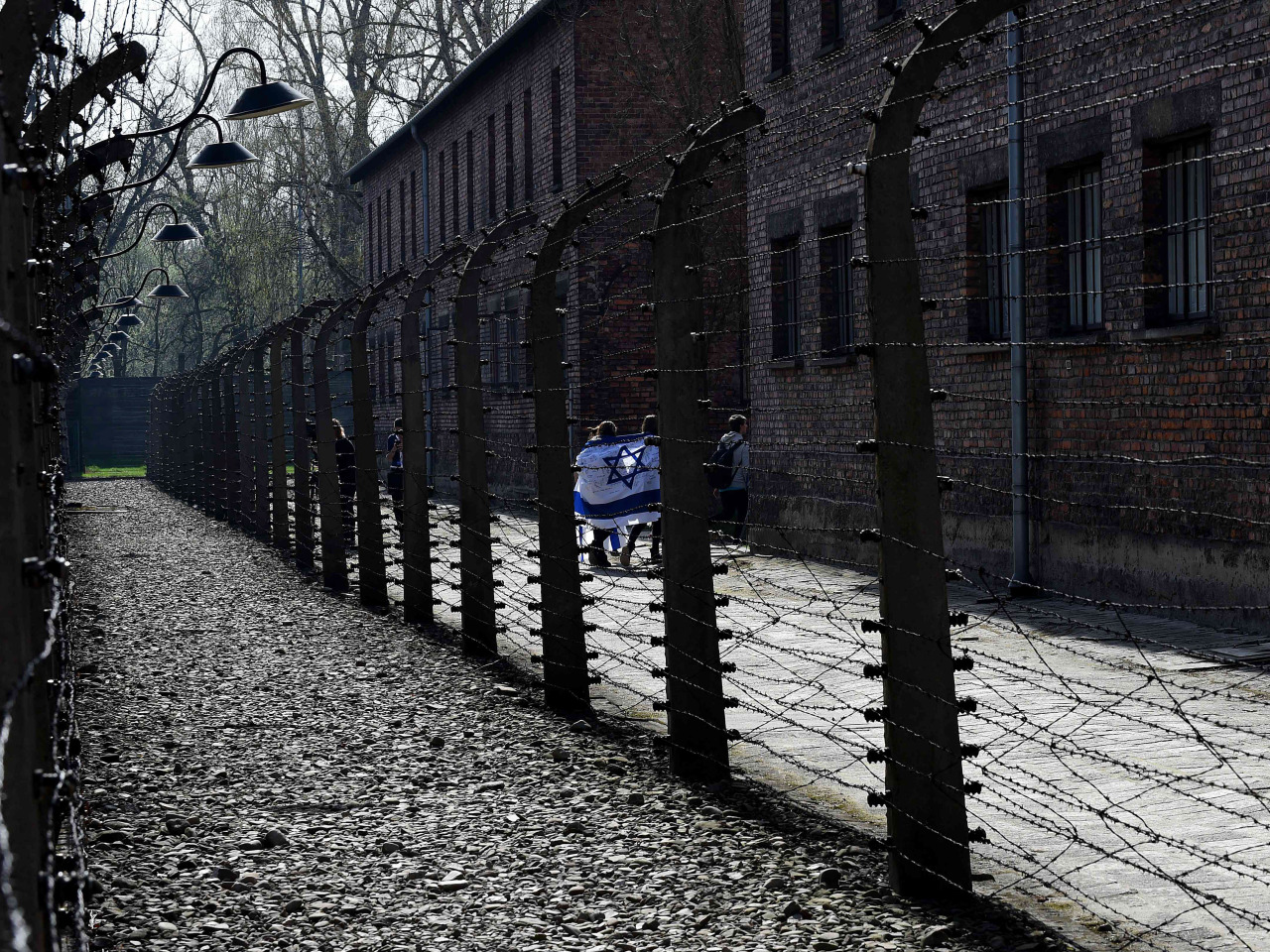
In this file photo taken on April 12, 2018 participants are wrapped into an Israeli flag as they arrive to the memorial site of the Auschwitz-Birkenau Nazi death camp in Oswiecim to attend the annual “March of the Living.”

The bill’s international critics had long argued that it violates freedom of expression by essentially banning accusations that some Poles were complicit in Nazi crimes committed on Polish soil, including in the Auschwitz-Birkenau extermination camp, where more than 1.1 million people died. Germany operated six camps in Poland where Jews and others whom the Nazis considered enemies were killed.

Polish officials emphasized early on that artistic and historical research work would not be affected by the ban, but critics cautioned that the law provided courts with too much room for interpretation and may silence debates on the issue, even though some scholars agreed that the Polish government was right in emphasizing that crimes were committed by individuals rather than the Polish state and that the term “Polish death camps” was wrong.

Poland was invaded and occupied by Nazi Germany in 1939, but unlike in other European countries, there was no collaborationist Polish government. About 6 million Polish citizens were killed during the Second World War, about half of them Jews.

Throughout years of Nazi occupation between 1939 and 1945, a number of Polish underground movements resisted the Nazis. It is that chapter of history that the Law and Justice Party wants to emphasize.

But historians have long argued that it is not the full story: Some Poles, they say, were complicit in the Nazi crimes. Historians have pointed to incidents, including a 1941 atrocity in the town of Jedwabne, in which Poles rounded up and killed their Jewish neighbors. Critics also said that the legislation was mainly intended to fuel nationalistic sentiments in the country.

In an early response to the law in February, the State Department similarly said that the phrase “Polish death camps” was “inaccurate, misleading, and hurtful.” But it also cautioned that the bill “could undermine free speech and academic discourse.”

In Israel, the reaction was even fiercer. “One cannot change history, and the Holocaust cannot be denied,” Israeli Prime Minister Benjamin Netanyahu said in a statement in February. Other Israeli officials even compared the legislation to Holocaust denial.

The strong reactions eventually resulted in less outspoken Polish defences of the law itself, even as the government has stood by its reasoning to pass it.

Source: Poland’s ‘Holocaust law’ caused an outcry. Now, surprisingly, it’s being largely reversed

Canadian historian joins uproar in Israel over Polish Holocaust law

There is so often a Canadian connection given the number of immigrant and ethnic communities:

University of Ottawa history professor flew to Israel this week, right into the eye of a brewing diplomatic storm involving the Jewish state and Poland over a controversial bill dealing with remembering the Holocaust.

Jan Grabowski has spent years examining the Holocaust in Poland, where he was born, focusing on Polish-Jewish relations. His research has brought death threats against him and his family and angry letters to his employer demanding he be fired.

But in an interview with CBC News hours after arriving from Canada, Grabowski vowed to press on with his work, outlining the focus of his next book, which will examine the role of the Polish Blue Police during the Second World War.

“It’s about 20,000 people who were armed and who inflicted horrific suffering on the Jews,” he said.

Controversial Polish legislation

Israeli leaders are leading the charge against a piece of legislation passed by the Polish Parliament earlier this month that made it illegal to assert that Poland bore any responsibility for atrocities committed by Nazi Germany.

Six million Jews were killed during the Holocaust, and many of those victims were Polish. Some of the most notorious extermination camps — Auschwitz-Birkenau and Treblinka to name two — were built on Polish soil.

DV1949535

Many Poles have long complained when atrocities committed by Nazi Germany, such as the killings at the Auschwitz death camp, have been linked to the Polish nation. ( Janek Skarzynski/AFP/Getty Images)

But for decades Poles have chafed at references linking their nationals to the crimes of the Holocaust. Former U.S. president Barack Obama issued an apology in 2012 when he used the term “Polish death camp”.

While most scholars, including those at Yad Vashem, the official Israeli memorial to the Holocaust, agree that labelling concentration camps as Polish is misleading, critics say what’s more worrisome is the crux of the new Polish law that imposes fines or prison terms of up to three years for linking “the Polish nation” to crimes committed during the Holocaust.

‘No Polish bystanders’

Grabowski notes that the prison sentence is the same duration Poles could expect to serve behind bars before the Second World War for “insulting the Polish nation.”

At his Tel Aviv press conference. the Polish-Canadian dual citizen discussed a newspaper article from 1936, detailing the case of a Jewish woman who was evicted from a Polish university.

“As she was evicted, she shouted ‘Polish animals.’ They beat her up, but she was the one the police arrested,” Grabowski said. “She was put in prison for two months for insulting the Polish nation.”

Grabowski, who is in Israel for a conference on Holocaust history, has faced much criticism from some Polish historians for his years of research, including his controversial conclusion that 200,000 Polish Jews were killed — directly or indirectly — by Poles during the war.

“There are no Polish bystanders to the Holocaust,” he told reporters.

Poland’s embassy to Canada, in Ottawa, has criticized Grabowki for offering “groundless opinions and accusations.”

“In reality, there was no free Poland during the Second World War, and the Holocaust was the murder by Nazi Germany of six million Jews,” the mission wrote in a statement to Macleans magazine. “Poland, unlike many countries, was never an ally of Nazi Germany and never had a collaborative regime.”

While he questioned the legal effect of the new Polish legislation, calling it “nonsense,” Grabowski does worry about a chilling effect.

“This law was an embodiment of the growing frustration of nationalists in power [in Poland] who simply are trying to find tools with which to freeze the debate, knowing that they cannot refute historical evidence,” he said. “What they can do is they can try to silence people who would like to undertake research in these areas.”

‘One cannot change history’: Israel slams bill that would send people to prison for blaming Poles for Holocaust

Rightfully so. Poland continues to decline in recognizing its past and antisemitism. Those who do not acknowledge their history …:

Israeli leaders angrily criticized pending legislation in Poland that would outlaw blaming Poles for the crimes of the Holocaust, with some accusing the Polish government of outright denial Saturday as the world marked International Holocaust Remembrance Day.

Prime Minister Benjamin Netanyahu called the proposed law “baseless” and ordered his country’s ambassador to Poland to meet with Polish leaders to express his strong opposition.

“One cannot change history, and the Holocaust cannot be denied,” he said.

The lower house of the Polish parliament on Friday passed the bill, which prescribes prison time for using phrases such as “Polish death camps” to refer to the killing sites Nazi Germany operated in occupied Poland during World War II.

A group of children at the Auschwitz Nazi concentration camp on Jan. 27, 1945, just after the liberation by the Soviet army.

Many Poles fear such phrasing makes some people incorrectly conclude that Poles had a role in running the camps. But critics say the legislation could have a chilling effect on debating history, harming freedom of expression and opening a window to Holocaust denial.

The bill still needs approval from Poland’s Senate and president. However, it marks a dramatic step by the country’s current nationalist government to target anyone who tries to undermine its official stance that Poles only were heroes during the war, not Nazi collaborators who committed heinous crimes.

Netanyahu’s government generally has had good relations with Poland, which has been recently voting with Israel in international organizations.

At Auschwitz on Saturday evening, Israel’s ambassador to Poland, Anna Azari, abandoned a prepared speech to criticize the bill, saying that “everyone in Israel was revolted at this news.”

In Israel, which was established three years after the Holocaust and is home to the world’s largest community of survivors, the legislation provoked outrage.

Israeli President Reuven Rivlin, noting that exactly 73 years had passed since the Auschwitz death camp on Polish soil was liberated, cited the words of a former Polish president about how history could not be faked and the truth could not be hidden.

“The Jewish people, the State of Israel, and the entire world must ensure that the Holocaust is recognized for its horrors and atrocities,” Rivlin said. “Also among the Polish people, there were those who aided the Nazis in their crimes. Every crime, every offence, must be condemned. They must be examined and revealed.”

Today’s Poles have been raised on stories of their people’s wartime suffering and heroism. Many react viscerally when confronted with the growing body of scholarship about Polish involvement in the killing of Jews.

In a sign of the sensitivities on both sides, Yair Lapid, head of Israel’s centrist Yesh Atid party and the son of a survivor, got into a heated Twitter spat Saturday with the Polish Embassy in Israel.

“I utterly condemn the new Polish law which tries to deny Polish complicity in the Holocaust. It was conceived in Germany but hundreds of thousands of Jews were murdered without ever meeting a German soldier. There were Polish death camps and no law can ever change that,” Lapid wrote.

That sparked the Embassy to respond: “Your unsupportable claims show how badly Holocaust education is needed, even here in Israel.”

“My grandmother was murdered in Poland by Germans and Poles,” Lapid responded. “I don’t need Holocaust education from you. We live with the consequences every day in our collective memory. Your embassy should offer an immediate apology.”

To which the embassy retorted: “Shameless.”

Israel’s foreign ministry said the deputy Polish ambassador to Israel had been summoned for a clarification.

For decades, Polish society avoided discussing the killing of Jews by civilians or denied that anti-Semitism motivated the slayings, blaming all atrocities on the Germans.

In this photo provided by the United States Holocaust Memorial Museum, people walk on a commercial street in the Lublin ghetto near a sign forbidding entry, in Warsaw, Poland.

A turning point was the publication in 2000 of a book, “Neighbours,” by Polish-American sociologist Jan Tomasz Gross, which explored the murder of Jews by their Polish neighbours in the village of Jedwabne. The book resulted in widespread soul-searching and official state apologies.

But since the conservative and nationalistic Law and Justice party consolidated power in 2015, it has sought to stamp out discussions and research on the topic. It demonized Gross and investigated whether he had slandered Poland by asserting that Poles killed more Jews than they killed Germans during the war.

Holocaust researchers have collected ample evidence of Polish villagers who murdered Jews fleeing the Nazis. According to one scholar at Israel’s Yad Vashem Holocaust memorial, of the 160,000-250,000 Jews who escaped and sought help from fellow Poles, about 10 per cent to 20 per cent survived. The rest were rejected, informed upon or killed by rural Poles, according to the Tel Aviv University scholar, Havi Dreifuss.

The memorial issued a statement Saturday night opposing the Polish legislation and trying to put into historical context the “complex truth” regarding the Polish population’s attitude toward its Jews.

“There is no doubt that the term ‘Polish death camps’ is a historical misrepresentation,” the Yad Vashem memorial said. “However, restrictions on statements by scholars and others regarding the Polish people’s direct or indirect complicity with the crimes committed on their land during the Holocaust are a serious distortion.”

Source: ‘One cannot change history’: Israel slams bill that would send people to prison for blaming Poles for Holocaust