Ottawa declassifies more details from Rodal report on Nazi war criminals in Canada

Of note:

As justice minister in the late 1960s, Pierre Trudeau opposed revoking the citizenship of a naturalized Canadian suspected of murdering 5,128 Jews in Latvia during the Second World War, over concerns about legality and social cohesion, long-redacted memos released on Thursday show.

…The previously redacted sections of Ms. Rodal’s report explore, among other cases, the case of F, from Latvia, a suspected firing-squad captain. He had been convicted in absentia by the Soviet Union. A 1965 memo by the legal division of External Affairs observed that the Soviet Union had requested his extradition to embarrass the Canadian government, but that at the same time, Canada had no reason to doubt the truth of the accusations. If true, the memo says, F was “an ardent Nazi lackey, not only cooperating actively with the occupying German forces but actually serving their Jewish and Gypsy extermination squads.” The memo said Canada had denied requests for extradition in at least four cases.

When the Canadian Jewish Congress asked in 1966 for a re-examination of the legal possibilities for action, a meeting across government departments was held. Two ideas for addressing war criminals were rejected: the revocation of citizenship for failing to disclose details of their past, and therefore not being of “good character” as required in citizenship applications; and retroactive legislation to allow for trials in Canada. There was a caveat: If a major war criminal such as Martin Bormann, who was once suspected of being in Canada, turned up, retroactive laws might be considered.

Mr. Trudeau later wrote, in a memo to Paul Martin Sr., who was secretary of state for external affairs, that nothing in Canadian law suggests a citizenship application is “in the nature of a confessional, requiring the applicant to disclose all prior conduct.”

On the subject of F, the alleged firing squad captain, Mr. Trudeau added that while anxiety in the Jewish community was understandable, “it would be most ill-advised for the government to undertake this venture, which would involve publicly accusing a Canadian citizen of having committed crimes in Latvia in respect of which he has been convicted, in absentia, in Russia.” Such a move, Mr. Trudeau said in a separate memo, could suggest widespread revocations of citizenship ahead.

…..Mr. Matas said Mr. Trudeau has since been proven wrong on his legal concerns, as the courts have allowed the revocation of citizenship for intentional non-disclosure.

Source: Ottawa declassifies more details from Rodal report on Nazi war criminals in Canada
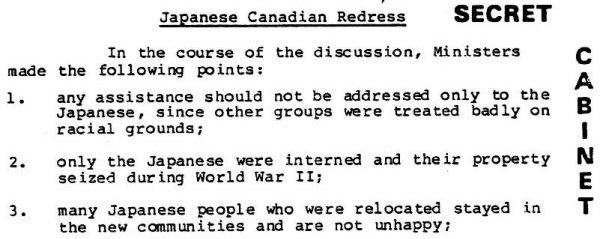
Trudeau Sr. cabinet opposed payments to interned Japanese-Canadians

Not much new here in terms of the substance of former PM Trudeau and his Cabinet’s position but nevertheless of interest:

The cabinet of then-Prime Minister Pierre Trudeau opposed compensation for interned Japanese-Canadians because they didn’t seem unhappy, say secret documents.

The declassified documents, obtained by Blacklock’s Reporter, said the cabinet was concerned about the precedent it would set to give cash to people whose property was seized.

“Any assistance should not be addressed only to the Japanese since other groups were treated badly on racial grounds,” cabinet agreed at a confidential April 18, 1984 meeting.

The National Association of Japanese Canadians had sought for years settlement of claims over the seizure and forced sale of property in 1942.

About 22,000 Japanese, including Canadian citizens, were removed from the BC coast after the Pearl Harbour attack and taken to the interior, Alberta, Manitoba and northern Ontario.

The wartime cabinet invoked the War Measures Act and seizing more than $152.4 million worth of fishing boats, real estate and automobiles owned by Japanese-Canadians.

Then-Multiculturalism Minister David Collenette in a censored 1984 report to cabinet proposed a settlement of claims.

“Many Japanese people who were relocated stayed in the new communities and were not unhappy,” said Cabinet Minutes.

“A nation cannot go back and wipe out the past, it should look forward. A more general approach should be taken, if anything is to be done.”

“All minorities will feel they should have a right to redress. Any resolution in the House of Commons should not be related to a single group.”

Cabinet said instead of compensating Japanese-Canadians, “other ways should be looked at, for example endowing chairs at universities,” said Minutes.

“In concluding, Ministers expressed the wish that the Minister (of Multiculturalism) look at the issue again and have it discussed in the cabinet committee on social development.”

Trudeau, Sr. at the time also publicly opposed any apology or compensation for the wartime internment.

“I’m not inclined to envisage questions of compensation about acts which have maybe discoloured our history in the past,” Trudeau told the Commons.

“I’m not sure where we would stop in compensating.”

The Liberal cabinet lost re-election five months later without settling the issue.

When Prime Minister Brian Mulroney was elected, in 1he 988 formally apologized for the wartime internment and approved $21,000 in compensation to some 6,000 surviving internees.

“All Canadians know apologies are inadequate,” Mulroney said at the time.

Japanese were interned under a 1942 order that demanded “all property situated in any protected area of British Columbia belonging to any person of the Japanese race be delivered up” for sale by federal agents.

Japanese-Canadians did not regain the right to vote until 1949.

Source: Trudeau Sr. cabinet opposed payments to interned Japanese-Canadians

MOMENT IN TIME: OCTOBER 8, 1971 – Canada’s multiculturalism policy is introduced

In 1971, prime minister Pierre Elliott Trudeau announced multiculturalism as an official government policy – a first of its kind in the world. In his speech to the House of Commons, Mr. Trudeau said that no single culture could define Canada and that the government accepted “the contention of other cultural communities that they, too, are essential elements in Canada.” In a rare moment of parliamentary unity, Mr. Trudeau faced no opposition that day as no one wanted to vote against a policy that fought against discrimination. The Liberal Party’s goal was integration – to formally respect the diversity of Canadian citizens’ many different languages, religions and cultures. The policy grew out of a Royal Commission studying bilingualism and biculturalism and the unrest of the October Crisis and rising Québécois nationalism. But what happened next in the country was just as interesting, author Erna Paris wrote in a 2016 Globe editorial. “Over the next decades, official multiculturalism evolved into an ingrained collective value. Incrementally, Canadians began to define themselves as citizens of a multiethnic, multireligious society.” The policy helped shape Canadian society but, as protests against systemic racism continue in this country, there is much room to improve. 

Source: https://www.google.com/url?sa=t&rct=j&q=&esrc=s&source=web&cd=&cad=rja&uact=8&ved=2ahUKEwiexYWu46XsAhUEGc0KHYHeDsAQFjAAegQIAhAC&url=https%3A%2F%2Fwww.theglobeandmail.com%2Fnewsletters%2Fmorning-update%2F&usg=AOvVaw0KIa0o3u9bIUTUzyUMuesJ