Learn English or leave? Mind your language, Mr. Cameron: Shasta Aziz

Valid points:

If Mr. Cameron’s government is serious about immigrant women learning English, it first needs to reverse the deep funding cuts it has made to organizations providing these services.

Of course, speaking English is going to assist any woman living in the U.K. and will help her to navigate through her daily life with more confidence and ease. But no amount of learning English is going to help integrate a woman if her and her ilk are marked as a problem and a catalyst for fragmenting society.

This is the subtext behind much of the hysterical tabloid media coverage of Muslims in Britain, in the age of the so called war on terror.

Many Muslim women here tell me that they feel increasingly uncomfortable in the country of their birth. They feel exhausted by having to constantly explain who they are and to prove they are loyal to their country every time there is a terrorist atrocity in the world – because the default position is they’re guilty by association.

The politics of identity are becoming more and more loaded in an increasingly polarized world. It is becoming harder especially for young British Muslims to navigate their way through all the noise and increasingly hostile discourse around what it means to be a Muslim in the west.

Monday’s announcement is simply another failed and missed opportunity by the British government to build a meaningful dialogue with a section of the population that it needs to urgently reach out and engage with.

One Muslim woman I interviewed in London after the terrorist attacks in Paris late last year asked me “how am I expected to feel comfortable and at ease in my society if every time I leave my house I’m looking over my shoulder to see who might physically attack me because I’m a visible Muslim woman who wears a hijab? How can anyone expect me to feel like a valued member of my society?”

That is a very good question – and one Mr. Cameron should start thinking about carefully.

Source: Learn English or leave? Mind your language, Mr. Cameron – The Globe and Mail
David Cameron to back Muslim veil ban, will announce anti-radicalization measures

Sigh. Pandering to the base (and UKIP) more than improving integration, and by applying it to Muslims only as appears from press accounts (some other religions have separate seating for men and women), further reinforces the Islamist narrative:

Muslim women can be banned from wearing veils in schools, courts and other British institutions, David Cameron has said.

The Prime Minister said he will give his backing to public authorities that put in place “proper and sensible” rules to ban women from wearing face veils.

The Government is also preparing to announce a series of measures designed to stop British Muslims becoming radicalized and travelling to the Middle East to join terrorist groups like Islamic State of Iraq and the Levant.

As part of the plans, ministers will pledge to outlaw gender segregation in public buildings amid concerns that some Muslim organizations are forcing women to sit separately.

Nicky Morgan, the Education Secretary, will also today announce plans to force schools to help stop teenagers travelling abroad to fight alongside jihadist groups such as ISIL.

Schools will be required to inform councils when pupils stop attending without any explanation and Muslim parents will be encouraged to carry out checks to ensure their children are not being radicalized.

Cameron also announced that tens of thousands of Muslim women would face deportation unless they pass a series of English language tests after coming to Britain on spouse visas.

The Prime Minister’s comments about veils will reignite the row over whether British institutions should be able to stop women covering their faces for religious reasons in public places.

The Prime Minister refused to endorse a French-style blanket ban but made clear that individual organizations could choose to stop Muslim women wearing the veil.

Source: David Cameron to back Muslim veil ban, will announce anti-radicalization measures

UK: Anti-Muslim hate crime to be treated as seriously as antisemitism

Good and needed as part of engagement strategy:
Prime Minister David Cameron will tell police forces in England and Wales to record anti-Muslim hate crimes separately and treat them as seriously as anti-Semitic attacks. The move comes amid rising incidents of Islamophobia.

New funding to boost security at religious buildings, including mosques, will also be announced.

The policy move on Tuesday is designed to reassure Muslim communities that the government’s counter-extremism strategy will be balanced, amid fears that the measures alienate them.

Cameron will make the announcement at the first meeting of his new Community Engagement Forum, which will meet to discuss the government’s counter-extremism strategy, due to be published next month.

Islamophobic crime in London jumped by 70 percent in the year up to July, according to official statistics from the Metropolitan Police, one of the few forces to record anti-Muslim hate crime.

Anti-Muslim hate crimes in other parts of the UK are currently monitored by Tell MAMA, an unofficial recorder of Islamophobia in the UK that relies on victims logging incidents online or over the phone.

Speaking ahead of the announcement, Cameron said he wanted to show Muslim communities support.

I want to build a national coalition to challenge and speak out against extremists and the poison they peddle.

I want British Muslims to know we will back them to stand against those who spread hate and to counter the narrative which says Muslims do not feel British.”

And I want police to take more action against those who persecute others simply because of their religion,” he added.

Source: Anti-Muslim hate crime to be treated as seriously as anti-Semitism – Cameron — RT UK

David Cameron launches 5 year-plan to tackle Islamic extremism in Britain

Always interesting to observe and take note of how UK approaches against violent extremism evolve and build upon previous experience and lessons learned (and no, there is no magic bullet).

But encouraging to see a strong emphasis as well on the “soft” side, not just security:

Young Muslims are drawn to fundamentalist Islam in the same way young Germans were attracted to fascism in the 20th century, David Cameron will suggest today, as he sets out a five-year strategy to combat Isis-inspired radicalisation.

In a speech in Birmingham, Mr Cameron will say Islamic extremist ideology is based on the same intolerant ideas of “discrimination, sectarianism and segregation” that led to the rise of Hitler and that still exist in the far right.

He will also reject suggestions that Western foreign policy has contributed to the rise of Isis and its popularity among Muslim populations in the West, arguing that such extremism existed long before the Iraq war.

The Prime Minister will also announce details of a new drive to promote integration led by the Government’s “tsar” for troubled families, Louise Casey. This will include addressing issues around integration, language and employment and learning from “past mistakes” where government funding was “simply handed” over to “self-appointed ‘community leaders’” who “sometimes used it in a divisive way”.

Downing Street said Mr Cameron was determined to make tackling Islamic extremism in Britain a central priority over the next five years with a comprehensive strategy that involved not just the police and the criminal justice system but also “softer interventions” to tackle the root causes of radicalisation.

However he is likely to face criticism for the tough language in the speech from some in the Muslim community who have warned it could play into the hands of extremists.

And on the question of “tough language,” hard to argue with the following:

“It is an extreme doctrine and like any extreme doctrine, it is subversive. [It] subscribes to intolerant ideas which create a climate in which extremists can flourish.

“Ideas which are hostile to basic liberal values such as democracy, freedom and sexual equality. Ideas which actively promote discrimination, sectarianism and segregation. Ideas – like those of the despicable far right – which privilege one identity to the detriment of the rights and freedoms of others.”

David Cameron launches 5 year-plan to tackle Islamic extremism in Britain – UK Politics – UK – The Independent.

David Cameron seeks to seize passports of Islamist fighters

From The Economist

From The Economist

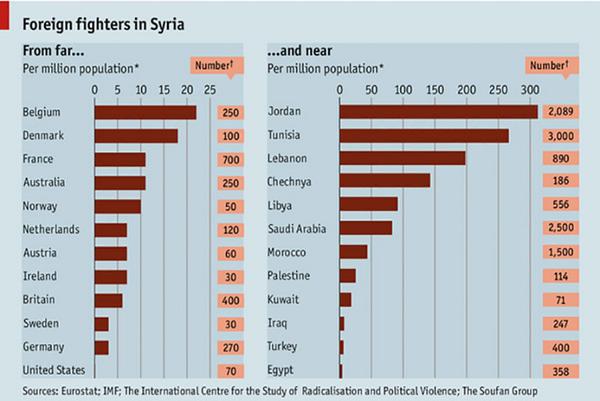
More on efforts to curb home-grown radicalization in the UK. While these are “hard” approaches to prevention, UK has also invested considerably in “soft” approaches as well.

As with all these initiatives, particularly their expanded application of revocation to prevent born-Britons without dual nationality to return home, questions about who decides and whether the person accused can defend himself.

One thing to hold them for investigation (legitimate), another to make a decision without due process.

One could argue that refusing entry, understandable from a security perspective, simply means that any such extremist would return to Syria or Iraq to continue their brutality, rather than being under the watch of the police in the UK:

“There are two key areas where we need to strengthen our powers to fill specific gaps in our armoury. These are around preventing suspects from travelling and dealing decisively with those already here who pose a risk.”

David Cameron’s new anti-terrorism proposals come days after the U.K. raised its terrorism alert to its second-highest level.

Cameron said he would bring in new “specific and targeted legislation” to give the police powers to temporarily seize a suspects passport at the border to give authorities time to investigate them. Currently only Britain’s interior minister has the power to withdraw a passport.

He also said the government would consult on a discretionary power to prevent Britons from returning home if they have pledged allegiance to extremist causes. This would extend existing powers which can only be applied to foreign nationals, naturalized citizens and those with dual nationalities.

David Cameron seeks to seize passports of Islamist fighters – World – CBC News.

Meanwhile, in Canada, more on the RCMP’s High Risk Travel Case Management Group approach to prevention (see also 2014 Public Report on the Terrorist Threat to Canada):

While the report’s emphasis is on prevention and intervention, several recent cases related to the Syrian conflict have raised questions about the effectiveness of efforts to reason with determined youths blinded by zeal.

After serving a prison sentence for his role in the Toronto 18 terrorist group, which plotted bomb and shooting attacks in southern Ontario, Ali Dirie used a fraudulent passport to travel to Syria, where he fought and died last August.

A British Columbia man charged with terrorism in July, Hasibullah Yusufzai, 25, was known to Canadian authorities because of a previous trip he had made to Afghanistan. Although he was on a no-fly list, he still managed to make his way to Syria using a passport that did not belong to him.

When Ahmad Waseem returned to Windsor, Ont. after he was wounded in combat in Syria, his mother hid his passport, his mosque counseled him and police spoke to him. But he returned to Syria last year and now calls the Islamic State of Iraq and Al-Sham his “brothers.” He has been charged with passport fraud.“

Early intervention through a joint community/law enforcement response is no guarantee that a person will not radicalize to violence,” the report says. “However, early intervention is one constructive way to deter potential violent extremists from causing harm.”

Canadian government plans ‘targeted interventions’ to stop citizens from joining armed Islamists in Syria

David Cameron: British values arent optional, they’re vital

UK Prime Minister on British values:

The second is social. Our values have a vital role to play in uniting us.

They should help to ensure Britain not only brings together people from different countries, cultures and ethnicities, but also ensures that, together, we build a common home.

In recent years we have been in danger of sending out a worrying message: that if you don’t want to believe in democracy, that’s fine; that if equality isn’t your bag, don’t worry about it; that if you’re completely intolerant of others, we will still tolerate you.

As I’ve said before, this has not just led to division, it has also allowed extremism – of both the violent and non-violent kind – to flourish.

So I believe we need to be far more muscular in promoting British values and the institutions that uphold them.

That’s what a genuinely liberal country does: it believes in certain values and actively promotes them. It says to its citizens: this is what defines us as a society.

What does that mean in practice? We have already taken some big steps.

We are making sure new immigrants can speak English, because it will be more difficult for them to understand these values, and the history of our institutions, if they can’t speak our language.

We are bringing proper narrative history back to the curriculum, so our children really learn our island’s story – and where our freedoms and things like our Parliament and constitutional monarchy came from.

And as we announced this week, we are changing our approach further in schools. We are saying it isn’t enough simply to respect these values in schools – we’re saying that teachers should actively promote them. They’re not optional; they’re the core of what it is to live in Britain.

DAVID CAMERON: British values arent optional, they’re vital | Mail Online.

Ironically, given the UK’s citizenship revocation policy, even for those who would be left stateless, he closes with a reference to the Magna Carta, which abolished banishment as a form of punishment (although not for the convicts who settled Australia):

Next year it will be the 800th anniversary of Magna Carta. Indeed, it was on this very day, 799 years ago, that the Great Charter was sealed at Runnymede in Surrey.

It’s a great document in our history – what my favourite book, Our Island Story, describes as the ‘foundation of all our laws and liberties’.

In sealing it, King John had  to accept that his subjects were citizens – for the first time giving them rights, protections and security.


David Cameron’s ‘Christian country’ remarks fuel mini media frenzy

David Cameron’s faith and politics statements and the predictable controversy. Had he talked about Christianity’s influence on Britain’s development and values, and linked to the openness to other faiths, likely would have been a non-issue.

Of more interest is the much higher percentage of British who state they have no religion (51 %), likely one of the higher percentages in the world (Canada is about 24 %):

In last year’s British Society Attitudes Survey, 51 per cent of those polled described themselves as having no religion. And the number of those who say they are members of the Church of England continues to fall year by year.

British Attitudes Towards Religion:

No religion: 48 per cent

Church of England: 20 per cent

Other Christian: 17 per cent

Source: British Social Attitudes Survey, 2012

Campbell refers to Cameron as a “bog standard middle England churchgoer.” During his reign as Tony Blair’s chief spin-doctor, Campbell managed to curb any talk of religion with an imperious command delivered from the plinth, telling reporters: “We don’t do God.”

Cameron’s critics accuse him of deciding to “do God” now in a bid to prevent an exodus of more traditional members from his governing Conservative Party to the UK Independence Party or UKIP, running on a staunchly anti-European, anti-immigrant platform.

Also amusing to see former PM Blair’s spin doctor, Alistair Campbell, comment on Cameron without disclosing just how much he suppressed any evidence or news about Blair’s deep religious faith (Blair only “came out,” so to speak, when he left office)

David Cameron’s ‘Christian country’ remarks fuel mini media frenzy – World – CBC News.