John Ivison: The Liberals are too eager to erode the singular power of the citizenship oath

Powerful commentary against the proposed change permitting self-administration of the citizenship oath:

I have vivid memories of taking the oath of Canadian citizenship 18 years ago, a humbling, life-changing experience.

The day before the ceremony, I was looking down on the House of Commons from the press gallery with vaguely anthropological interest in a curious but distantly related species.

The day after being welcomed to the Canadian family with a roomful of wide-eyed new arrivals, the sense of detachment was gone, replaced by a common purpose, summed up in the citizenship certificate that bound me to uphold “the principles of democracy, freedom and compassion which are the foundations of a strong and united Canada.”

That is the experience that the government wants to deny to a future generation of Canadians, who will be asked to take the oath of citizenship by clicking a box online in order to save a few bucks.

In January, Immigration, Refugee and Citizenship Canada (IRCC) Minister Sean Fraser said his department would begin making the necessary changes to allow self-administration of the oath. This would replace the requirement to take the oath in person before a citizenship judge, along with a room full of other new Canadians, which has been the law since 1947.

The reason, according to the government’s explanation in the Canada Gazette, is that citizenship applications have doubled in recent years to around 243,000 in 2021/22, and are set to keep rising as we move towards the Liberal immigration target of 500,000 newcomers in 2025. During the pandemic, citizenship tests migrated online, which, in the second half of last year, accounted for around 90 per cent of all ceremonies. In April, Fraser said his department was holding 350 virtual ceremonies a month.

The government has been delighted by the time and cost savings and says self-administration will save people roughly three months between taking their citizenship test and officially becoming Canadian.

The Liberals say that they will always maintain in-person ceremonies. The government says it doesn’t track how many people asked for an in-person ceremony and didn’t get one. But if self-administration of the oath is adopted, it says it expects fewer people to attend a ceremony and for there to be fewer ceremonies overall.

Andrew Griffith, a former director general at IRCC, said the anticipated savings of $5 million is only a small portion of the cost of administering the oath. Much greater savings in time and money could be made by focusing on administration and processing efficiencies prior to the citizenship ceremonies. “This actually does matter,” he said of “the rare positive celebratory moment in the immigration journey.”

There are some things that transcend bureaucratic efficiencies, and the citizenship ceremony is one of them. It is about a sense of participation and belonging, the culmination of a long and often difficult immigration process.

The minister’s press secretary said in an email that the intention is to make public ceremonies available for those who request them. “Those who choose to do an online attestation will still have an opportunity to attend an IRCC organized citizenship ceremony,” said Bahoz Dara Aziz.

But it is clear that the government would be happy to let the ceremonies wither on the vine.

The minister and his department are starting to get a sense of a backlash as prominent Canadians, including former governor general Adrienne Clarkson, ex-Calgary mayor Naheed Nenshi and former Liberal immigration minister Sergio Marchi, have argued that the government is robbing future citizens of a deeply meaningful moment. Nenshi said the reasons are “bureaucratic and puerile.”

The public comments during the consultation process, which were overwhelmingly hostile, suggest many Canadians agree. “This proposal takes what should be one of the most meaningful things a person will ever do in their lives and equates it with ordering a new pair of underwear from Amazon,” wrote one person (commenters’ names were removed before the feedback was made public).

A petition has been launched in Parliament (petition e-4511), where people can sign up and urge the government to support the in-person ceremony as a unifying bond for Canadians.

The petition urges the government to reverse the trend of moving the oath online by limiting virtual ceremonies to 10 per cent of all citizenship events.

Fraser can hardly be immune to the power of the argument in favour of in-person ceremonies. He swore in nine new Canadians on Canada Day in front of 41,813 baseball fans at a Toronto Blue Jays game at the Rogers Centre this year, with the crowd joining in a noisy rendition of the national anthem.

There is a magic to the tradition that goes beyond a pledge of allegiance to the King and the Constitution.

Before becoming a citizen, I remember feeling it was vaguely treasonable to forsake the land of my fathers and adopt the common sympathies of another nation.

Yet, it was strangely comforting to be in a room with 50 or so others from all over the world, who were, in all likelihood, wrestling with their own doubts.

Qualms quickly turned to elation on being called to receive my citizenship certification in front of friends and family.

There was something extraordinary about watching all those newcomers experience true patriot love for the first time as citizens by singing O Canada.

I feel sorry for my future countrymen and women if that time-honoured tradition is replaced by the click of a mouse.

Source: John Ivison: The Liberals are too eager to erode the singular power of the citizenship oath

Advocates calling on Canada to resolve citizenship application backlog

No surprise. The requests are largely reasonable (greater transparency on status of applications, resumption of tests but not waiving them). Given the government’s campaign commitment to abolish the fees, understandable that they request a reimbursement of the fees (to date, no sign of IRCC acting on that commitment):

Citizenship-applicants and their supporters are calling on the federal government to address the backlog that is preventing thousands from becoming Canadian citizens.

A group called Advocates for Resumption of Canadian Citizenship Tests held demonstrations in Toronto and Montreal on November 7. The group was formed in response to the backlog in citizenship applicants waiting to get approved for a test, or for a citizenship ceremony. Their next demonstration will be in Ottawa on November 28.

Canada’s immigration department, Immigration, Refugees and Citizenship Canada(IRCC), cancelled all citizenship tests, interviews, and ceremonies on March 14 in response to the pandemic. IRCC began offering online citizenship ceremonies in April, at a rate of about 2,500 to 3,000 per week, significantly down from the 4,700 they were processing per week in 2019.

Citizenship applicants must demonstrate basic knowledge of Canada, as per the Citizenship Act. Applicants now must meet this requirement by doing the citizenship test, which is currently not available online. Though some in-person retesting has resumed, this means for many that they are unable to get Canadian citizenship. As of September, there were about 85,000 people waiting to take the citizenship test.

As a result, they are unable to vote, work in certain government jobs, or get a Canadian passport.

“It worries us, when we receive several messages in our group from people describing how this is affecting their mental health, relationships, their ability to travel home, their government job prospects, the need to unnecessarily extend their PR status etc.,” wrote a spokesperson from the citizenship tests advocates in a media release.

Nael Asad is one of the co-founder of the advocacy group, and one of thousands waiting for an invitation to take the citizenship test. He has had his permanent residency since 2008, and applied for citizenship in April 2019. Before the pandemic, IRCC’s average processing time for citizenship applications was about one year, so Asad was expecting an invitation for around the time when the pandemic hit in March.

“It’s very disrespectful to leave 85,000 people or more out there in limbo without any kind of update,” Asad told CIC News. “Tell us, ‘OK we’re not going to open up until this pandemic are over,’ but for eight or nine months now they’re saying the same thing ‘We’re monitoring the situation, check our website for updates.’ So people are going every single day on the website to check for updates.”

He also described how being a citizen comes with a sense of security, especially for people who fled war zones to come to Canada.

“When you are a citizen, you are a citizen,” he said. “Nothing is gonna happen to you this is your home country, but technically it is not our home country until we become citizens.”

The advocacy group’s online petition now has over 9,000 signatures. They are making three calls to action for IRCC: transparency on what the immigration department has been doing with the applications since March; the resumption, or wavier, of citizenship tests; and the reimbursement of the citizenship application fee, which runs about $630 for adults.

CIC News reached out to IRCC on updated numbers of citizenship files processed, but did not receive a response in time for publication.

Source: Advocates calling on Canada to resolve citizenship application backlog

Our reply to the co-chairs: Petition to reconsider location of the 2020 International Metropolis migration conference in Beijing

Further to our petition on change.org and the email received from the co-chairs of the Conference, Jan Rath of the University of Amsterdam and Paul Spoonley, Massey University New Zealand, we have sent and posted on change.org our reply:

Thank you for your comprehensive and thoughtful response to our questions and concerns.

Under normal circumstances, holding a migration conference in China would be of interest.

Equally, in principle we do not disagree that cultural, academic and policy exchanges can sometimes be useful in generating shifts in repressive regimes and that isolation only worsens and alienates such regimes. 

However, this depends on the subject matter and country circumstances.

Is it appropriate to hold a migration conference, where so many issues are linked to human rights, in a country which does not enshrine human rights and the associated values of promoting integration, tolerance, academic freedom, multiculturalism, and protection of refugees?

While Metropolis may view itself as an apolitical network, the host organization in China, the Centre for China and Globalization (CCG), is not, as it is effectively part of the Chinese government through the United Front Work Department.

The decision to hold the conference in Beijing at a time of the repression of the Uighurs and other minorities along with general human rights abuses is in itself a political decision to turn a blind eye to those abuses. 

There can be little doubt that it will be presented as such by the Chinese government. We are also convinced, based on experience, that Chinese authorities will not permit a free and open exchange of ideas on relevant Chinese policy or practice. Foreign speakers will be discouraged from raising issues that might ‘offend’ the government, Chinese participants will be prohibited from doing so, and ‘minders’ will be present to monitor and intervene in the event of any real or perceived criticism.

While indeed all countries have “blemishes in its policies and actions,” there is a difference between China and the countries that have typically hosted Metropolis. 

Placing restrictive immigration policies among Western countries on the same level as the Chinese government “re-education” camps for Uighurs or its lack of respect for human rights and the rule of law lacks credibility.

The bilateral disputes between China and Canada have nothing to do with broader issues raised by the petition and its signatories.

To claim that “the Government of China is not involved in setting the agenda or the terms of the debate” when the host organization, the CCG, is effectively part of the Government of China, is not credible.

Once again, the decision to hold the Conference in China given the current circumstances is in itself a political decision and it is disingenuous if not naive to pretend otherwise.

Once again, grateful that you consider signing the petition (change.org) and spreading the word as the more signatures we get, and the broader the geographic coverage, the better (as of November 15, we have about 150 signatories, about 70 percent from Canada with the vast majority of the rest being from the US.


Response to our petition to reconsider location of the 2020 International Metropolis migration conference in Beijing

Further to our petition on change.org, the co-chairs of the Conference, Jan Rath of the University of Amsterdam and Paul Spoonley, Massey University New Zealand, provided the following response:

The International Metropolis Project has been made aware of a petition urging that Metropolis change the location of our 2020 annual conference which is  planned for Beijing in June. The argument that the petition expresses concerns about  the position and actions taken by the Government of China with respect to some of the country’s ethnic minorities and with respect to freedom of expression. Let it be said that Metropolis understands these concerns, which have long been voiced, and takes them seriously. But let it also be said that Metropolis has always been – and remains – an apolitical network that believes in the value of international exchange among a whole range of migration players and stakeholders, to enhance mutual understanding. It also believes in engagement and dialogue over isolation. We, therefore, stand by the decision to accept the offer of the Beijing-based think tank, the Centre for China and Globalization, to host the Metropolis Conference in 2020.

China has emerged not only as a major economic power in the world, but also as a country with a significant role in migration, whether in Asia or globally. For us to understand regional and global migration means understanding China’s role in migration, both as a country of origin and, more recently, a country of destination. To ignore China in the field of migration today is to have but a partial understanding of global migration phenomena. An International Metropolis Conference there offers a direct opportunity for members of the Metropolis network to meet and engage with their counterparts in that country and in the region, and vice-versa. We trust that this will foster an enhanced mutual understanding of migration developments.

The petition that asks Metropolis to re-locate the 2020 conference originates in Canada, which is now engaged in a sensitive and difficult diplomatic matter with China. This is no matter for Metropolis to get involved with. Furthermore, that Metropolis should choose to hold its conferences in any particular country is not to be taken as support for the policies of our host country, regardless of which country it is. No country is without blemishes in its policies and actions, not even those with enviable reputations regarding migration. That is why, engaging in international exchanges of the kind that Metropolis conferences facilitate is important to keep the dialogue going and to map out issues of interest  and concern in an informed manner. The 2020 Metropolis Conference in Beijing is being organized jointly by the Metropolis International Steering Committee and the Centre for China and Globalization. The Government of China is not involved in setting the agenda or the terms of the debate. As always, the program is set by the International Steering Committee, specifically its Chairs in consultation with the local host in Beijing, China. This will therefore be a regular International Metropolis Conference located in a country that, owing to its current migration dynamics, offers a range of pertinent insights for those who take part.

As we said, although we understand the concerns expressed in the petition and we take them seriously, we regard the petition as mistaken in its position that it is better to isolate than to engage.

We will, in due course, post a formal response but suffice to say, to make the assertion that:

“The Government of China is not involved in setting the agenda or the terms of the debate. As always, the program is set by the International Steering Committee, specifically its Chairs in consultation with the local host in Beijing, China.”

The Chinese host is, of course, the Center for China and Globalization (CCG), part of the United Front Work Department, a branch of the Chinese Communist Party, that aims to project Chinese government influence.

Once again, grateful that you consider signing the petition (change.org) and spreading the word as the more signatures we get, and the broader the geographic coverage, the better (as of November 8, we have about 140 signatories, about three quarters from Canada with the vast majority of the rest being from the US.


Petition: Reconsider location of the 2020 International Metropolis migration conference in Beijing

As you may have noticed, I have been critical of the planning committee for the International Metropolis Migration conference decision to select Beijing as the site despite the country’s regime has been a producer of refugees and the UN and Amnesty International recognizing it is actively supressing China’s ethnic minority populations.

Examples can be seen with the Muslim Uighur minority through prison camps as well as suppression of the Tibetan minority.

The regime also regularly interferes with academic freedom both at home and abroad and uses such venues to legitimize its practices.

The Canadian government, moreover, notes that Canadians should “exercise a high degree of caution in China due to the risk of arbitrary enforcement of local laws.”

For these reasons, Howard Ramos and I have started a petition the International Metropolis conference steering committee to reconsider the location of the next conference.

We write to you to consider signing and endorsing our petition. More information and the petition can be found here:http://chng.it/PR5HX5ZsyH

Please share with your various networks.

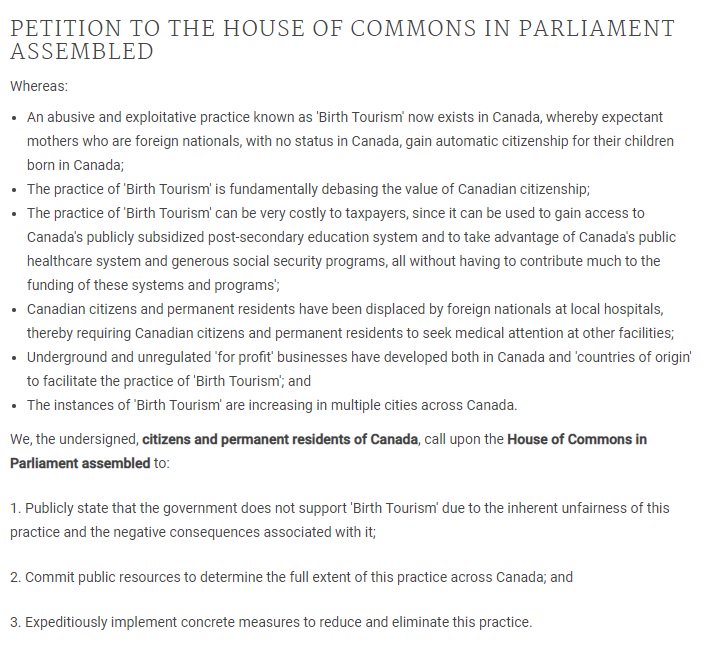
Yet another petition on birth tourism

Likely a political response to the tensions in Richmond, where over 20 percent of live births are to non-resident mothers and positioning given the Conservative party resolution calling to limit birthright citizenship to offspring of Canadian citizens or permanent residents.
Working on an article with more accurate and. spoiler alert, higher numbers which should be out later this month or early November:

ICYMI: Petition to Parliament calls for end to automatic citizenship to end ‘birth tourism’

Again, the same small numbers. Again, the Conservative government considered ways to address this through working with the provinces or a separate federal system and the costs were too high relative to the small numbers (500 in their estimate) to warrant the additional costs.

Far better to continue to monitor non-resident births and prohibit consultancy services and ‘birth houses,’ and enforce the prohibition:

Thousands of Canadians have signed an electronic petition urging the government to restrict automatic citizenship rights for babies born in Canada to foreigners in an effort to stop what they call “birth tourism.”

The petition was presented in Parliament this week by B.C. Conservative MP and former cabinet minister Alice Wong.

The 8,886 signatories want to change Canada’s birthright citizenship law they say “enables an abusive and exploitative practice” where “expectant mothers who are foreign nationals with no status in Canada can gain automatic citizenship for their children born within Canada.”

Wong said the issue is “significant” in her riding of Richmond Centre, as well as other large cities like Toronto and Calgary.

She said “birth houses,” which are sometimes dubbed “maternity motels,” have sprouted up, operating as temporary lodging for pregnant women from other countries. Some are waiting to qualify for health insurance, while others pay for the hospital services, Wong said.

“Immigration and our diversity is what makes Canada unique. It is also important to protect the integrity of our immigration system and ensure that new Canadians join our country in a way that is fair,” she said in an email.

The petition notes that Canada is one of only two developed countries that have not moved to end automatic citizenship due to “widespread abuse.”

The other is the U.S., where Republican presidential nominee Donald Trump has controversially called for an end to “anchor babies.”

But the issue of “birth tourism” is flaring up in other countries as well. The U.K. does not have birthright citizenship, but British Prime Minister Theresa May recently suggested establishing passport checks on pregnant women at hospitals to crack down on the growing number travelling from other countries to take advantage of free hospital services.

‘Nothing’s right about it’

The petition says the practice of birth tourism can be costly to taxpayers for health and education and other social services. Once 18 years old, someone born in Canada can sponsor parents and other family members.

Kerry Starchuk, a resident of Richmond, B.C. who launched the petition, said Canadian citizenship should not be automatically granted when neither parent has any status or ties to the country.

She said she became aware of the issue after noticing a residence next door to her was housing a “revolving door” of pregnant women.

She believes there is a growing underground economy where commercial enterprises help bring over and accommodate women from other countries to give birth in Canada.

“Nothing’s right about it,” she said. “It needs to stop or more and more people will take advantage of the loophole.”

‘No plan to change policy’

The government has 45 days to formally respond to the petition, but Camille Edwards, spokeswoman for Immigration, Refugees and Citizenship Minister John McCallum, said no change is in the works.

“Children born in Canada to parents who are temporarily in the country (except children of diplomats, other representatives or employees in Canada of a foreign government) are automatically Canadian citizens under the Citizenship Act,” she said in an email. “There is no current plan to change this policy.”

The Immigration Ministry does not collect data related to this issue.

Statistics Canada shows the number of births in Canada to mothers of residence outside Canada climbed from 247 in 2008 to 699 in 2012, the last year figures are available. But those numbers could include some Canadians who live abroad, but return to Canada to give birth.

Lori Cascaden, media relations manager for B.C.’s Ministry of Health, said non-resident births account for approximately two per cent of the 44,000 babies born in the province each year. She said residents of other countries give birth in Canada for a variety of reasons, including premature or unexpected labour.

Maternity tourism

She said the top priority is to ensure all babies are safely welcomed to the world, no matter where they are from. But non-residents must pay all the associated costs, with revenue put back into the system.

“The ministry in no way endorses or supports the marketing of maternity tourism,” Cascaden said, adding that “Immigration Canada should be responding to allegations of someone coming to Canada for the sole purpose of giving birth.”

B.C. has an eligibility, compliance and enforcement unit that monitors this issue, she said.

Source: Petition to Parliament calls for end to automatic citizenship to end ‘birth tourism’ – Politics – CBC News