Wells: Ira Wells on book banning

Peel Region never fails to disappoint in its excesses:

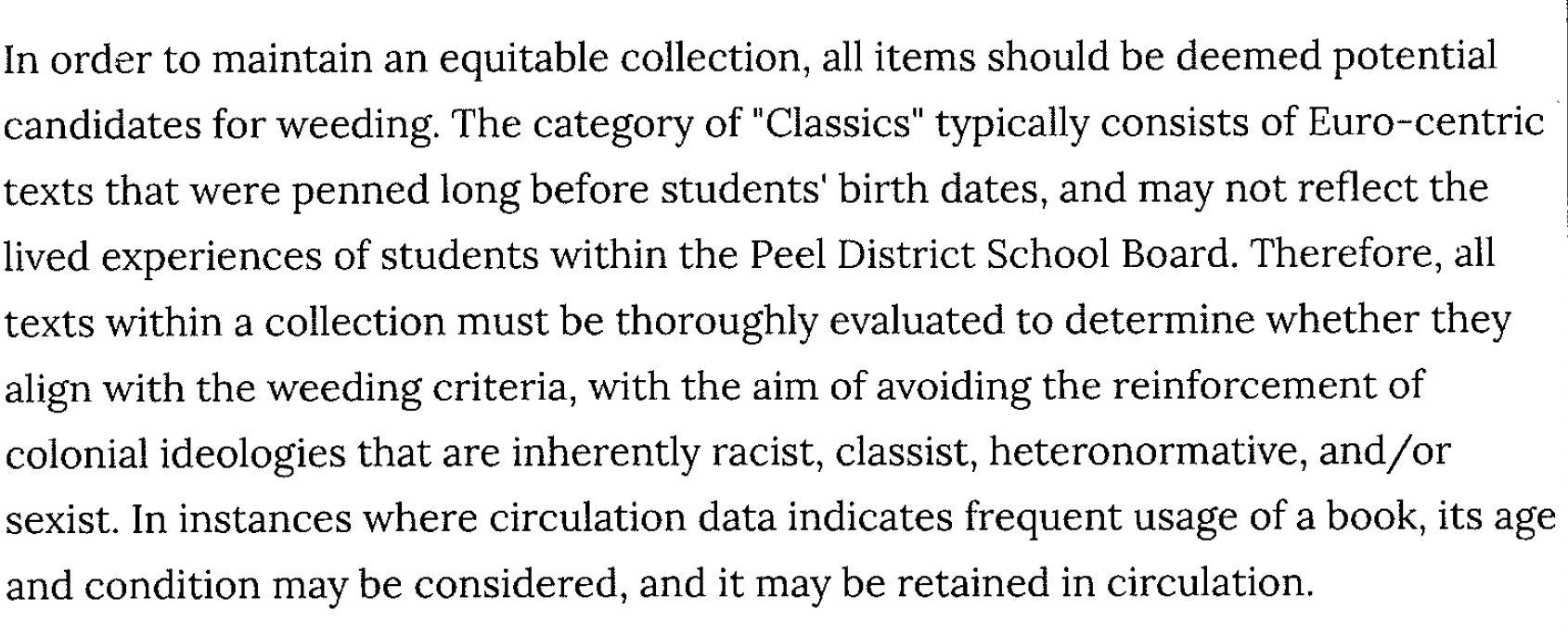
In one, [Ira] Wells was invited to take part in a “library audit” at his child’s Toronto school, led by a principle who said that if it were up to her, they’d get rid of “all the old books.” In another, all books published before 2008 were removed by the armful from Peel Region school libraries west of Toronto, on the general understanding that justice was invented in 2008 and that before that year, we were mostly just pummeling one another with rocks and other tools of oppression. I paraphrase.

Here’s a paragraph from the manual Peel Region school librarians used to guide them in this work of moral uplift. For my money, the word “therefore” is being asked to carry more than its fair comic weight:

Source: Ira Wells on book banning

Wells: Immigration Minister Marc Miller

Well worth listening to the intv:

All the time I’ve been covering politics I’ve had a category in my mind for politicians who just sound like people when they talk to me. I don’t put all that much stock in it. There are lots of ways to be good at your work, or less good, and talking’s only part of it. But just on a human level, it’s hard not to like people who don’t robot up as soon as I walk into a room.

Marc Miller is one such. He’s in a tough portfolio these days, not for the first time. Thirteen months ago he was on the pod as minister of Crown-Indigenous Affairs. Now of course he’s at Immigration, Refugees and Citizenship Canada. He’s a careful talker, and like a lot of people who mistrust communications advice, he’s low on pat slogans, so at no point in our interview did he sound like he had a bunch of ready answers. But I’ve always had the impression I’m basically talking to Marc Miller, not to some homunculus version of him that he’s interposed between me and the real item. 

His job since last June is to introduce a note of caution, or a symphony, into what had been the most pro-immigration government in generations. Symphonies of caution are all the rage these days; even the prime minister has started to notice there’s something amiss. (I don’t think the text of the linked tweet quite summarizes what Justin Trudeau said, but the clip is worth hearing.)

Since the flow of new Canadians has implications for housing, federalism, and the fortunes of the official opposition, just for starters, it’s become clear that Miller has a mandate to change some policies. Which he’s done, capping international student permits and planning for a gradual cut in temporary residents. We talked about both in our interview.

We also caught up on the ambitious reform to the department’s organization that his former deputy minister, Christiane Fox, undertook last year — before she was shuffled yet again in January. (She’s now Deputy Clerk of the Privy Council.) 

And I took the opportunity to run a peculiar theory past Miller: that the recent substantial increase in immigration rates was essentially orchestrated by the McKinsey consulting firm and its former top executive, Dominic Barton. I don’t put much stock in the notion, and Miller gives it even less credence, but it led the nightly French-language national news at Radio-Canada for days on end last year, beginning with this story (the linked version of the story is in English). In the first years of this government, Barton led an advisory council on economic growththat recommended much higher immigration. Later he helped found the Century Initiative, an NGO that advocates for much higher immigration. (Barton’s name has disappeared from the group’s website since Radio-Canada started reporting.) And McKinsey has been getting far more contracts from the Liberal government than its Conservative predecessor. My Rad-Can colleagues suggested all these things are connected. I’ve now spent more time explaining the hypothesis to you than I wanted, but at least now you’ll know what I’m on about when I ask Miller about it.

I don’t endorse everything Miller says here. He’s got this thing where he pre-emptively blames Pierre Poilievre for stuff he thinks Poilievre mightsay eventually, which strikes me as a stretch. But I know few effective politicians who aren’t also ardent partisans. Anyway, give it all a listen. 

Source: Immigration Minister Marc Miller

Wells: The end of the high-value economy [immigration aspects]

The usual insightful and acerbic Paul Wells:

….We are going to go on a bit of a stroll today, so before I go further I should emphasize that I see nothing wrong with students from anywhere taking jobs as baristas or dog walkers. I think jobs at pubs or with Uber are a valuable part of the international student experience, and I congratulate Edvoy for their success in connecting young people with Canada’s community colleges and its gig-worker economy. 

But surely all this is useful context for the news that Sean Fraser was told in 2022, while he was immigration minister, that removing the 20-hour weekly cap on work international students could perform would “detract from the primary study goal of international students… circumvent the temporary foreign worker programs and give rise to further program integrity concerns with the international student program.” With that information in hand, Fraser took the 20-hour cap off anyway.

That’s because Fraser attached more value to the first thing the memo said, which was that increasing hours worked would help alleviate labour shortages. In other words, immediate post-COVID Canada was a place where the big problem was the limited number of people available to work. Bringing in more international students was a quick way to address that, and letting them work nearly full-time would help too. 

Ontario became Ground Zero for the rapid increase in enrolment for college students. That’s because Ontario premier Doug Ford was transfixed with what he called a “historic labour shortage” and eager to attract more people to the province — from other provinces, from outside Canada, seriously, wherever. I was told at the time that when Ford and Justin Trudeau met soon after the 2022 elections in Ontario and Quebec returned the incumbents, the PM bonded with Ford by complaining about Quebec’s François Legault behind Legault’s back, because Legault was still trying to limit immigration while Ford wanted the roof blown off. 

A certain creative laxity in international-student visa distribution permitted the overlap between Ford’s interests, Trudeau’s and those of Ontario’s community colleges: Ford could address his labour shortage, at least at the lower end of the skills ladder (I assume international students are often highly skilled and eager to increase their human capital, but in the meantime they’re dog walkers). Trudeau could goose the economy during a shaky period when a lot of people were worried about the prospects of recession. And Ontario’s colleges could enjoy a revenue bonanza, at a time when most other sources of funding for Ontario higher education are capped. Alex Usher’s been covering that part all along….

Source: The end of the high-value economy

Sears: Convoy inquiry reveals another Canadian intelligence fiasco

One of the better commentaries. Paul Wells on substack continues to have a number of must read commentaries:

The developed world grudgingly accepts that its intelligence agencies have a perennially poor performance record. Despite the tens of billions of dollars we spend on them, their list of failures is breathtaking: Iraq, 9/11, prediction that Afghanistans would survive and Ukraine wouldn’t. 

In Canada, we have our own humiliations: Air India and the rendition of Canadian citizens to be tortured in police states. The most recent horror is CSIS’s employ of a human trafficker as its agent, then lying about it to allies.

The guru of intelligence history, Christopher Andrew (“The Secret World”), observes that these disasters are rarely a failure in intelligence collection. More often it is failures in sharing, analysis, and execution. However, as the convoy inquiry (officially, the Special Joint Committee on the Declaration of Emergency) has made glaringly clear, Canadian intelligence and police agencies often fail at collection, as well. 

Bizarrely, CSIS, RCMP and OPP have for years failed to understand and master the power of social media. They monitor the obscure hate sites peripatetically. They fail to see patterns, share findings, or dig into identities and connections. Shopify does a better job at it than Canadian security agencies. Perhaps we should retain them. 

It is the absence of an aggressive outbound social media strategy that is even more astonishing. No agency smacks down misinformation, calls out lies and disinformation, let alone offers a more Canadian view on issues from race to terrorism. The reason may be that they fear to be seen to be “political.” No other NATO country’s spooks are so meek, they use surrogates.

Several police and intelligence agency leaders have shared with me their frustration at their bosses failure to understand the essential role an effective social media strategy has today. It is predictably, generational. Mine doesn’t get it, my son’s generation do.

The OPP’s nose-stretchers are a case in point. Their witnesses claimed on the one hand that the Ottawa Police Service did not digest their intel warnings about the convoy’s potential for violence. Then in the same testimony they concede they did not have any “specific” evidence of such tendencies. Nor can they claim that they raised the alarm with any other agency or police service with the intensity their intel teams were shouting for.

A teen at a screen in their basement could have pointed them to the dozens of cases of inciteful rhetoric and the open calls for violent overthrow of the government, months in advance. The Inquiry has made clear this needs to be addressed urgently: work the social media platforms faster, more deeply, and share your findings. 

The second revelation of the Inquiry: little has changed since Bob Rae revealed the staggering cost in lives of CSIS and the RCMP’s mutual enmity. They treat each other, and their political masters, as interfering and untrustworthy threats. Why was their no high-level forum among three levels of government, and their agencies, weeks before the convoy arrived.

Blaming the dysfunctional state that the Ottawa police had descended to is a useful out for the OPP and RCMP. It is no defence, however, for their failure to do everything they could to ensure public safety. John Morden in his blistering assessment of the G20 Summit disaster made all of these points crystal clear more than a decade ago. No one, apparently, took him seriously.

The politicians hiding under their desks for the first two weeks are the most galling: Premier Ford refusing to even attend a high-level meeting, Justin Trudeau clinging to his “separation of powers” fig leaf until dropping it in favour of the Emergency Declaration, as his inner circle finally realized that this was going to bite them too; and the slippery mayor of Ottawa conspiring behind his own chief’s back to hire a completely unqualified negotiator who reached a deal to move even more trucks to Parliament Hill. Some deal! Political vanity made a bad situation even worse. 

The inquiry has been a blessing already. It has revealed incompetence, infighting, and childish jurisdictional games in texts, emails and testimony. Let us hope some of those tarnished by its revelations now sit down and apply its lessons — before the next armed attack on Ottawa.

Source: Convoy inquiry reveals another Canadian intelligence fiasco

Wells: And now, the inevitable Bill 21 fight

Usual insightful column by Paul Wells:

Here’s one measure of how little Building Back Better we’re getting done here in the nation’s capital: MPs from different parties and perspectives are having an interesting conversation about important matters. But it’s entirely off-book. It’s spontaneous, the leaders of the various parties didn’t ask for it, and it’s pretty clear they desperately wish it weren’t happening. In Ottawa, saying what you think is an act of rebellion.

The week’s topic is, of course, Quebec’s Bill 21, which forbids hiring public servants, including teachers, who dress incorrectly (“The persons listed in Schedule II are prohibited from wearing religious symbols in the exercise of their functions.”) The bill was introduced in March of 2019 and passed into law soon after. Federal party leaders fielded questions about it in debates during the 2019 and 2021 elections. Each time, Quebec’s premier François Legault got angry at the people who asked the questions. So did federal party leaders, who pay ever-growing hordes of witless staffers to tell them how to move and talk and who cannot for the life of them understand that the rest of us aren’t also conscripts in that effort.

Anyway the inevitable happened. This week news broke that a Grade 3 teacher in the bucolic Quebec town of Chelsea, a stone’s throw from Ottawa, was pulled from class for wearing a hijab. Here’s how it played in one early story: nameless teacher reassigned to “another function” outside the class, school officials shtum on details, shocked community hanging green ribbons.

A chain reaction ensued. Kyle Seeback, a Brampton Conservative MP, kicked it off by tweeting, “I cannot in good conscience keep silent on this anymore… Bill 21 has to be opposed. In court, in the house of commons and in the streets.” Jamie Schmale, Chris Warkentin and Mark Strahl tweeted their agreement.

Seeback’s conscience seems to have gnawed at him after he retweeted a Wednesday-night tweet from the Globe’s Robyn Urback wondering why Catherine McKenna, the former Liberal environment minister, now calls Law 21’s application “appalling” but didn’t, at the time, contradict Justin Trudeau’s milder language in the 2019 and ’21 campaigns. Good for Seeback, actually, for amplifying some snark aimed at a Liberal and then realizing it applied to him too. Soon McKenna and the Conservative MPs had company among Liberals still in caucus: Alexandra Mendes, Salma Zahid, Iqra Khalid, Marc Garneau. Finally a sitting cabinet minister, Marc Miller, called the law’s application “cowardly.” There is also a clip of Chrystia Freeland, the federal Minister of Careful What You Wish For, saying as close to nothing as she can possibly say, a recurring highlight of many recent debates.

I don’t like Bill 21 either. It’s based on silly reasoning—“the state” must have no religion, so nobody who works for the state may be seen to have any religion. This is like saying the state has no particular height, so public servants must be required to hover above the ground. Somewhere around here there’s an old column I wrote patiently explaining this logic and its heritage in the receding role of the Catholic church in Quebec society, a column some of my Toronto colleagues still enjoy mocking, but there’s a difference between understanding the argument and buying it. On a list of the top, say, thousand problems facing modern Quebec, “teachers in head scarves” would not appear. And one of the most obvious things we can say about this law is that the costs it imposes—in personal freedom, economic opportunity, social ostracism—is essentially never borne by people named Tremblay or Côté or Wells. Somehow the burden seems to land reliably on people named—well, in the current instance, on Fatemeh Anvari. About whom more in a moment.

I have also never felt that Bill 21 reveals some universal moral failing of “Quebec.” Every criticism I can level against this law has been levelled, many times, by Quebecers, including several of the Liberal MPs who ran out of patience yesterday; the Quebec Liberal and Québec Solidaire parties, which between them won more votes than Legault’s party did in 2018; an impressive selection of municipal politicians and commentators in, mostly, Montreal; and Judge Marc-André Blanchard of Quebec Superior Court, whose ruling struck down parts of Bill 21 and exclaimed his helplessness with regard to the rest: he plainly doesn’t like the thing, but Legault’s use of the constitution’s “notwithstanding” clause protects most of the law from legal challenge or judicial invalidation. Solid majorities in Quebec have supported the law in polls, but I’m not sure how long that will last, and since the law’s Charter-proofing provisions must be renewed every five years in the National Assembly, I’m not sure the law itself will last long either. I reject the notion that only Quebecers may have an opinion on the thing, because of course everyone can have an opinion on anything. But the conversation among Quebecers is plenty multifaceted already.

A few points of context. First, the provisions of the law, as they apply to the Western Quebec School Board which employs Fatemeh Anvari, have already been struck down. Minority-language education rights are notwithstanding-proof, and Judge Blanchard did to the provisions regarding English school boards what he plainly wished he could do to the whole law. Legault’s government appealed the ruling, and under Quebec law the provisions remain in place pending appeal, but Legault will lose the appeal and by next year, there may be no remaining barrier to teachers in hijabs teaching in Quebec’s English-language schools. This doesn’t help the rest of the province, at least not immediately, but it sets up two cases that parents will be able to observe and compare. Which is a ball that can bounce in many different ways over time.

Second, in interviews Anvari is plainly rattled by a situation she should not be in. But neither is she fired nor banished to the furthest reaches of her school’s steam-pipe trunk distribution venue. As the Lowdown’s excellent story notes, she’s been assigned to lead “a literacy project for all students [that] will target inclusion and awareness of diversity.” This is not as good as simply letting her teach the curriculum would have been, if the law had permitted it, but it shows considerable wit. Again, in a complex society, citizens respond in ways governments often don’t intend and wouldn’t prefer. Governments often don’t take that news well.

Third: those calling on governments to do something, now including members of the federal governing caucus, are sometimes short of ideas about what, precisely, to do. Federal lawyers in a court challenge could make no argument that hasn’t already been made—and, largely, rejected by the frustrated Judge Blanchard. Short of reviving the obsolete powers of reservation and disallowance, a step even Pierre Trudeau declined to take against even Bill 101, there’s not much a federal intervention could add.

Is there therefore no point in simply talking, or simply sending federal lawyers to say what lawyers for civil-society groups have already said? No, I think there’s a point, in that it brings government’s actions more closely in line with what are obviously the opinions of the people who compose the government. (Note that there isn’t a single Liberal MP tweeting, “Guys, Bill 21 is great!”) A reduction in the amount of hypocrisy in a system is always welcome and lately well overdue. But as a practical matter, the feds can’t do much to change the situation.

Finally, less important but still worth mentioning: When four Conservative MPs tweeted within minutes about their renewed love of freedom, it was hard to escape the suspicion that there’s something else going on. Perhaps this: those Conservatives are not, by and large, conspicuous Erin O’Toole fans, and many come from ridings where much of the Conservative voter base is spitting mad at O’Toole for perceived softness on vaccine mandates. When Seeback talks about opposing Bill 21 “in the street,” that sure sounds like an echo of the way a lot of people opposed vaccine mandates. MPs who can’t give their voters much satisfaction on the latter are probably grateful for a chance to blow off some steam on the former. That’s not to dismiss or rebut the Bill 21 Freedom Four; it’s just to note that motives are often mixed or additive.

Here’s the thing: in a liberal democracy you can’t keep a cork in everyone’s mouth forever. You shouldn’t try. It’s been fun watching the leaderships of three federal political parties try to deny simple human feelings over an inherently emotional issue. But the fun’s over. Now citizens are going to act like citizens. Always a scary moment for communications professionals.

Wells: Michael Wernick has some advice

Good and informative interview and comments:

Brian Mulroney was the prime minister the first time Michael Wernick sat at the back of a cabinet committee room, taking notes. One time the young civil servant found himself transcribing John Crosbie’s remarks as the powerful fisheries minister recited arguments Wernick himself had put into Crosbie’s briefing notes. That particular ouroboros of influence was “quite exciting for a young desk officer,” Wernick said in an interview shortly before the recent federal election.

The venue was my back yard. The occasion was the release of Wernick’s new book, Governing Canada: A Guide to the Tradecraft of Politics (UBC Press). Wernick was a senior official for decades in Ottawa, a deputy minister under Paul Martin and Stephen Harper. Justin Trudeau made him Clerk of the Privy Council, a position from which Wernick retired amid the SNC-Lavalin controversy in 2019, after Jody Wilson-Raybould released a surreptitious recording of a conversation with Wernick.

Wilson-Raybould, clandestine recordings, and the doctrines of independence for attorneys general are not topics of Wernick’s book, and he made it clear he preferred that they not figure in our interview. I relented, mostly. I’ve known Wernick for 26 years. He’s been learning how Ottawa works for longer than that. The lore he’s accumulated, poured between the covers of a slim volume aimed at students of political science, is a valuable contribution to Canadians’ understanding of how they’re governed.

“I didn’t want to write a memoir,” Wernick said. What came out instead is “a kind of an amalgam of many experiences with different ministers and three prime ministers that I got to work with reasonably closely. I was trying to capture those conversations—what it’s like to sit across from the new minister after swearing in, or some of the conversations that go on. Particularly in the early days of a government as they’re finding their feet or learning their skills.”

For the longest time he couldn’t settle on a format. He finally found a model in Renaissance Florence.

“I have a daughter who’s studying political science at U of T. She was doing a political theory course. And she was home for Christmas, but still working on a paper. And one of the things on that second-year political science course, that I took umpteen years ago, is [Niccolo Machiavelli’s] The Prince. It’s second-person advice on statecraft. It’s held up for a long time. And that gave me that sort of lightbulb moment. ‘Oh, I can do something that way. I could do it direct and second-person advice to somebody who’s coming into that position.’ That unlocked the whole thing for me.”

The resulting book is nearly devoid of juicy insider gossip—never Wernick’s style—but full of pithy advice to political leaders in general. “If you can end a meeting early and gain a sliver of time,” he tells prospective prime ministers, “get up and leave.” And, elsewhere, “It is rarely to your advantage to meet the premiers as a group.” And, ahem, “The longer you are in office, the more courtiers you will attract.”

From various perches in the senior ranks of the public service, Wernick watched three prime ministers land in the top job and try to figure out how to govern. “There is a skill set involved in governing,” he said. “We seem to expect people to learn that skill set on the job quickly, without a lot of help.”

And yet the days after a gruelling election campaign are nearly the worst time to be starting a new job. “One of the things I try to emphasize is the human element of it. People come in off an election campaign, exhausted. Physically exhausted. And in a state of considerable disruption. Often they’re new to being a minister. They’re also new to being an MP. They have to make decisions about their family, relocate or not to Ottawa. They’re changing locations. They’re changing careers, fundamentally. And I was always warning public service colleagues, ‘You have to allow for that. Allow for some of that exhaustion and shock.’”

New governments have only a few weeks to get up to speed. And habits that are formed early are not likely to be substantially revised later, with the benefit of hindsight. By then it’s too late. “The Prime Ministers I saw settled into the job very quickly. But then it’s hard to change. They get into a comfort zone or routines and patterns. It’s a very human thing to do. So part of my purpose in the book is just to say, ‘Pause and be a little bit mindful of the how of governing before it all gets locked in.’”

One of the recurring themes in Wernick’s book is how little time everyone has. A federal cabinet will have 100 hours in a year for all of its plenary discussions. Maybe 120. It’s never enough. “It’s overbooked from day one until the day they leave. And you’re always making choices: to do one thing means not doing something else. And mindful management of the allocation of time is really important. It can get away on you.”

The cabinet is going to need a lot of help. That was Wernick’s job, and that of all his bureaucratic colleagues, as well as countless political staff, operating with different aims and methods. “When it works well, you have a certain balance in what I call a triangle between the decision-maker—could be the PM, could be a minister—the support network they get from the public service, and the support network that they get from the political side.”

Sometimes the triangle gets out of balance. “The system gets into trouble when the public service tries to anticipate politics too much. And it clearly gets into trouble when the political side starts trying to run departments administratively. If people keep in their swim lanes and understand each other’s roles, each can add something. I always found it irritating when people chided ministers for being political. They’re supposed to be political in a democracy.”

I asked Wernick about a favourite Ottawa worry, that the public service is losing its ability to generate new ideas and policies. He didn’t bite. “I think there’s a little bit of a mythology that there was some other time when the great and good mandarins of the town—all white males, by the way—generated the ideas and pushed them towards the political system,” he said.

“I think there’s a competing narrative that the policy space is much more open and inclusive than it ever was. The costs of entry are much lower. Anybody with a laptop and a Google account can be a policy analyst. When I joined government, we had a quasi-monopoly on the ability to run big simulation models on income-security programs. Now many university professors can do it better.”

Besides, “I don’t think it’s really the role of the public service to be the originator of new ideas. Those usually come from democratic politics: ‘We wish to decriminalize cannabis.’ And then you work through the problem of how to do it competently.”

Governing Canada includes some pointed advice to cabinet ministers about the fact that they’re probably not going to get a chance to choose the date of their departure from politics. Prime ministers and voters have a way of making those decisions quickly and at inconvenient moments. Did I detect an autobiographical element to these passages?

“That’s largely true of clerks and public servants as well,” Wernick said. “Or hockey coaches. Like, there’s a lot of job jobs where you can’t arrange a perfectly-timed departure. I’m not the only person who’s been backed into a corner where it was impossible to continue to do the job. It’s unfortunate, but it happened.”

“But it’s happened to other people. Circumstances get away on people. People fall into all sorts of things that make it untenable for them to continue in the job.”

When things got weird for Wernick, did he draw any comfort from those earlier examples?

“No. I mean, that’s not the way I’d put it. I was conscious, during those last few months, that I was drifting towards a zone where I couldn’t do the job anymore. I was becoming part of the story. You have to enjoy at least some basic level of trust from the opposition leaders. I didn’t have that. And that just made it impossible to carry on.”

If he had a do-over, would he handle SNC-Lavalin differently? “That’s probably for another day, in another interview. I did not pick up on some of the warning signs about the trouble that was coming…. But I don’t spend a lot of time thinking about that. You work and live in the moment and you do the best you can at the time.”

I tried one more question that was a little closer to the concrete example of the current government than to the trends and aphorisms Wernick’s book prefers. In the book, he writes to a hypothetical prime minister: “You will not be successful if you hang on to the same closed circle of close advisors and confidants for your whole time in office. There is an inevitable drift into a comfort zone and a form of groupthink that can create blind spots and put you at risk.”

Gee, did he have anyone in mind?

Butter would not melt in Wernick’s mouth as he told me he had no examples from current events. “The example I was actually drawing on was Stephen Harper in 2011. You know, the opposition leaders [Erin O’Toole and Jagmeet Singh, in the election that had not yet happened when Wernick and I spoke] probably have a transition team, who will give them some advice on how to set things up. And I worked with Derek Burney from the Harper team, and Mike Robinson from the Martin team, and Peter Harder from the Trudeau team.” Those new governments are always “very conscious and mindful about how they want to set things up.” But re-elected prime ministers “tend to just start up again, with the same people in the same processes. People have argued, and I think I agree, that Stephen Harper missed an opportunity in 2011, to pause and think.

“I would say to any Prime Minister, when they’re going into a second or third mandate: ‘You should pause. It’s going to be different. Think about the processes and the people.’”

Source: Michael Wernick has some advice

CPC Platform: Immigration-related plans and some missing parts

Will be preparing a comparative table when the platforms of other parties are out. While Conservatives have five priority themes: jobs, accountability, mental health, strategic stockpile of vaccines and PPE, and economy, the platform contains a myriad of commitments across most areas.

The immigration section is also detailed, covering the following themes: “addressing administrative backlogs, fixing a broken visitor visa system, innovation efficiency and cultural sensitivity, strengthening credential recognition, family reunification, super visas, pathways to permanence, advancing Canada’s interests, reforming Canada’s broken refugee system, and securing our border.”

Striking what is missing: no reference to citizenship and multiculturalism, racism reference pertain to Diefenbaker), no substantive references to diversity and inclusion, no reference to employment equity, no reference to antisemitism or Islamophobia, discrimination references limited to the CAF and (again) to Diefenbaker. Anti-Asian hate including in section “Standing up to China’s aggression.”

The other initial observation is the platform is silent on the question of levels, likely given that any suggestion of reduced levels would provide the other parties an opportunity to paint the CPC as anti-immigrant (unfairly, IMO).

Source: https://www.conservative.ca/plan/

Paul Well’s take:

Increasingly I think detailed campaign platform documents are terrible for governance.

They shackle entire governments, struggling with the unimaginable realities of life three years from now, to the best guesses a few campaign strategists were able to make last month. They crowd out the civil service’s policy-development function, because the first thing a new PM’s transition team says to the Privy Council Clerk who greets them is, “Shush. Do all of this.” They discourage agility amid changing circumstances because everyone’s busy ticking off stale boxes so they can run for re-election on “promise made, promise kept.” They practically guarantee fiscal trouble because who’d ever campaign on an appropriately pessimistic outlook for the economy?

Fie on the whole mess. The best way to run for high office would be to say, “You know me. Meet my team. Do we seem solid? Count on us to handle whatever comes our way.”

Of course I’m outvoted. Constantly. Whatever their worth as blueprints for government, thick platforms often work a charm in campaigns, especially if the goal is to rebut widespread worry that the leader in question is a lightweight or a nutbar. Modern campaign credibility-building was invented by Jean Chrétien’s Liberals in 1992 with Creating Opportunity: The Liberal Plan for Canada, instantly dubbed the Red Book. It transformed Chrétien from a yesterday’s man without a clue to a big thinker with an eye for detail. “It’s in there. Read it,” he’d say. Ontario’s provincial Conservatives under Mike Harris won power back in 1995, after a decade of Liberal and NDP governments, with the Common Sense Revolution pamphlet. And Justin Trudeau did a lot in 2015 to parry perceptions that he was a lightweight with Real Change: A New Plan For a Strong Middle Class (.pdf here). And even though each of those documents would have occasion to cause grief for its authors, they all worked, so they’ve spawned a hundred more or less successful imitators over the years.

This year the emerging novelty is a preference for early platform launches, a repudiation of the notion that you should dribble out your announcements for weeks on end, maintaining suspense and keeping campaign reporters from getting bored. Jagmeet Singh’s NDP went for a big bang last week with the release of the party’s entire platform, Ready For Better. And on Monday Erin O’Toole did the same, releasing the entire platform (Canada’s Recovery Plan) on the campaign’s first full day. Well, all of it except the costing: since it’s up to the Parliamentary Budget Office to check costing claims, and they couldn’t do that in a timely fashion because of the snap election, the costing will come later, Conservative campaign strategists told reporters on Monday. Meanwhile, apparently everything O’Toole is promising is free! I kid.

The problem O’Toole seeks to address is that, to borrow the language I used a few paragraphs ago, lots of people worry he’s a lightweight and a nutbar. A lightweight because a lot of his public pronouncements until now have been comically low on detail—Justin Trudeau got NAFTA wrong, we need a plan, the debate is over, whatever random combination of fridge magnets you want to assemble. A nutbar because he campaigned as a “True Blue” and then discovered his party doesn’t believe the Earth is round, or some such.

Canada’s Recovery Plan (rejected title: Erin O’Toole’s Hail Mary Pass) is an attempt to answer every question anyone will ever have about O’Toole and his party. Surely a doomed attempt—it’s always easy to come up with more questions, this week often featuring the words “nasal swabs”—but ambitious in the trying nonetheless. It starts out a little pre-school (Actual quote from the first page of text: “What is Canada’s Recovery Plan? It’s a plan. A very detailed plan.” Gee thanks, Einstein). But before it’s done it sprawls across nearly twice as many pages as Trudeau’s 2015 platform. The word “detail” and its derivatives appears 54 times, often in chapter titles that read like so much grim found poetry: “A Detailed Plan to Lift Up Working Canadians/ A Detailed Plan to Support Working Families/ A Detailed Plan to Lower Prices/ A Detailed Plan to Tackle Home Prices,” and on and frickin’ on.

Another word frequently spotted in the thing is “support,” also a favourite of the Trudeau government, especially since COVID-19. In Trudeauspeak, “support” means “give money to,” and I suspect O’Toole swiped it to convey the impression this year’s Conservatives are more spendy than previous generations. “Support” and its derivatives appear 190 times in the CPC platform, including a record 23 appearances over the four pages from 108-111. What’s the beneficiary of this four-page burst of support? I was surprised to discover it’s the rest of the world, for it’s in his platform’s foreign-policy section that O’Toole feels most, um, uplifting.

Among the very many things he wants to support: “Taiwan’s participation in multilateral fora”; “a climate-conscious, clean alternative to the Belt and Road Initiative;” “regional security” across “Pakistan, Bangladesh, Nepal, Sri Lanka and beyond;” “Israel’s existence as a sovereign democratic Jewish state” and “the aspirations of the Palestinian people and a two-state solution leading to a Palestinian state;” and “East Africa with data and infrastructure development.”

So the gauntlet is thrown. If you don’t vote Conservative this year, I guess you just don’t want a digital East Africa. It’ll be interesting to see whether this brick dominates O’Toole’s campaign or whether, having dropped it, he never mentions it again. I’ve seen both happen in various campaigns. It’s a drag that the Parliamentary Budget Officer hasn’t checked the Conservatives’ math, though they swear they’ll fix that in future editions, once the PBO reports. It’s close to a sure thing that amid all these words, there’ll be something to upset Conservatives’ opponents and probably also some supporters. Whatever happens next, at least, O’Toole can tell himself he left everything on the field, and indeed that he put it out there early.

Source: https://www.macleans.ca/politics/ottawa/erin-otoole-fills-in-blanks/

Rosie Abella said she’d answer questions when she turned 75

Good long interview by Paul Wells.

Money quote regarding her 1984 employment equity report:

What Abella knew was that she didn’t much like examples from American jurisprudence. “It was based on the individual. No concept of membership in groups as defining identity, as defining equality.” The more she thought about it, the more Abella decided that one concept of equality—simply treating everyone the same—constituted a dead-end path. “I thought, equality, to me, is not sameness. Civil liberties are sameness. Everyone should have the same right in their relationship with the state to be treated as well as the leaders. There is no such thing as ‘more rights,’ vis-à-vis the state, for one individual over another.

“But that’s different from human rights, where you are treated a certain way because of the groups you belong to. So if you are a woman, if you are a Muslim, if you are Jewish, if you are disabled, people treat you based on your identity. And so I thought, you can’t say, ‘Treat everyone the same.’ If you treat everyone the same, the person in a wheelchair is treated like the person who’s able-bodied, and there’s no need for a ramp, if you’re going to treat everybody the same.

“So it occurred to me that what equality really was, was acknowledging and accommodating differences. So people could be treated as an equal and not excluded arbitrarily for things that had nothing to do with whether or not they could contribute to the mainstream.”

This philosophy is encapsulated in a quote from the French poet Anatole France that opens Abella’s commission report, which she has cited frequently in her work since: “The law, in its majestic equality, forbids the rich as well as the poor to sleep under bridges, to beg in the streets and to steal bread.” She would define a different law, less majestic and more alert to nuance. She coined a new term, “employment equity,” to describe “programs of positive remedy for discrimination in the Canadian workplace.”

The first surprise was when Flora MacDonald, Brian Mulroney’s employment minister, called Abella and said the Progressive Conservative government would implement the report’s recommendations. Another surprise came when countries around the world began to adapt elements of the report to their local circumstances.

Source: Rosie Abella said she’d answer questions when she turned 75

Wells: Who should get a monument? Meet the Canadian man trying to answer the question.

Of interest and relevance given ongoing debates and discussions:

Circumstances have a way of giving meaning to seemingly odd choices. Ten years ago, Ken Lum was an important figure in the Vancouver art scene. Then, without much fanfare, he wasn’t around anymore. But when the long summer of 2020 turned into a global debate about race, memory and commemoration, it turned out Lum was in a vital, important place. In fact, he’d been getting that place ready for years.

In 2012, Lum and historian Paul Farber co-founded Monument Lab, a think tank in Philadelphia that asks what we’re trying to do when we build monuments in public places to historical figures and events.

In the United States in 2012, the political purpose of monuments was already a long-standing debate. It’s just that a lot of people hadn’t noticed. In the years that followed, as controversies over the Confederate flag and monuments to Civil War-era secessionist generals took centre stage in a succession of national controversies, it became harder to ignore the questions Monument Lab exists to raise.

“It started as a pedagogical project,” Lum says in an online interview from his home in the Philadelphia Main Line, a suburb where the 1940 Katharine Hepburn-Cary Grant comedy The Philadelphia Story was set.

“I was teaching a class on observations I had made on my first visit to Philadelphia as a new Philadelphian, regarding the unevenness of the monumental inventory, if I can put that way, of the city.”

Lum had moved to Philadelphia in 2012 to join the faculty of the University of Pennsylvania’s school of design. Over the course of his first summer in the city where the Liberty Bell resides, he had a chance to see many of Philly’s most famous monuments. Ben Franklin, William Penn, Commodore John Barry, all the greats.

Except maybe not all of them? “Philadelphia had over a thousand statues and, at that time, not a single officially sanctioned full-figure African American—in a city that’s 40 per cent African American,” Lum recalls. “And also in the city where John Coltrane, Marian Anderson, Billie Holiday, Paul Robeson”—the legendary jazz saxophonist and three singers, each among the greatest American artists, all Black—“grew up or spent a lot of time. So I became very interested in who gets heeded and who doesn’t get heeded.”

In various ways, Lum has made a career of asking questions about who gets heeded and who doesn’t. If such things can be measured and quantified, Lum was one of Vancouver’s leading artists when he left for Philly. A soft-spoken man with a subtle but persistent mischievous streak, he grew up in Vancouver’s Strathcona neighbourhood and started studying art in his spare time near the end of a difficult undergraduate degree in other subjects. His early experience in art had not been encouraging. “I took art class from Grades 8 to 9 but stopped when the art teacher admonished me for making what he called ‘weird’ images,” Lum writes in the preface to Everything Is Relevant, an essay collection he published in 2020. His teacher “had very strong ideas about what art was and would criticize me harshly for not following his instructions to the letter.” Young Ken would have needed his teacher’s permission to study tenth-grade art, so he gave up.

Eventually he made a career doing the sort of thing that infuriated that middle-school art teacher. Lum’s art is, to some extent, a set of challenges to other people’s strong ideas about what art is. Uninterested in displays of technical skill, he hires tradespeople or buys commercial products to complete his works. His “furniture sculptures” are just that, arrangements of rented furniture. His best-known piece in his hometown is his 2010 Monument for East Vancouver, a neon cross in the form of an image from graffiti art that’s been scrawled on walls and underpasses in the city’s east side since before Lum was born. The A in EAST intersects with the A in VAN, as on a Scrabble board. For a decade the monument has served as a kind of gateway to the neighbourhood.

At times, Lum has seemed to be involved in the design of monuments even without meaning to. In 1990, he was invited to contribute to the opening exhibition of a new contemporary art centre in Rotterdam, Netherlands, the Witte de With Centre for Contemporary Art. One piece he contributed was billboard-sized, a photo of a young woman working an old-fashioned adding machine. The caption is as big as the photo and not subtle: “MELLY SHUM HATES HER JOB.” It was a wry commentary on contemporary workplaces, and its tenure in Rotterdam was meant to be temporary. The museum hung it on the street outside. When the exhibit ended, people called to complain that Melly had vanished. “Every city deserves a monument to people who hate their job,” one caller said. So the museum put Lum’s piece of art back up.

Then, quite recently, things took a surprising turn. The Witte de With Centre was named after the street it is on, which in turn was named after a 17th-century colonial Dutch naval officer who got rich ensuring the Netherlands could efficiently plunder various colonial territories. (As a grim bonus, his name translates as “Whiter Than White.”) The museum decided to change its name, and asked visitors for ideas. The winning suggestion was that it be named after Melly Shum. So since the beginning of 2021, it’s been called the Kunstinstituut Melly, or the Melly Art Institute.

While that entirely accidental process was playing out, Lum and Farber were setting up the Monument Lab. At first the organization was nothing more than a set of questions: what’s a monument? Who decides? Could it be done better? Farber is an academic historian; he wanted to write something. “I was more interested in, ‘Well, how can we make an exhibition out of it?’ ” Lum says. What would the venue be? Lum said the city of Philadelphia itself could be the venue.

In 2015, they set up an office outside city hall and asked visitors, “What is an appropriate monument for the current city of Philadelphia?” Eventually teams of volunteers fanned out across the city to ask the same question. Participants wrote their ideas on file cards. Eventually, more than 4,000 ideas were collected.

Eleven of the proposals were for monuments to soldiers of one kind or another. Sixty-eight proposed monuments to peace, and the word “peace” appeared in 168 proposals. Education was a topic in 173 proposals, the environment in 342. The proposals were sometimes highly specific, and suggested an idea of history at times starkly at odds with the one generations of Philadelphia city elders had promoted. Thirty-five people suggested a monument to commemorate the 1985 firebombing of MOVE, a Black separatist group. During an extended standoff, police helicopters dropped incendiary bombs onto the group’s headquarters. The resulting fire killed 11 people, including five children, and destroyed 65 houses.

To Lum and his colleagues, the desire for a MOVE commemoration suggested people wanted more than a procession of ramrod-straight soldiers in their public squares. “That suggested to us that the citizens, members of a public, which is heeded enough—they have longer memories and a greater sense of decency than the city itself, right?”
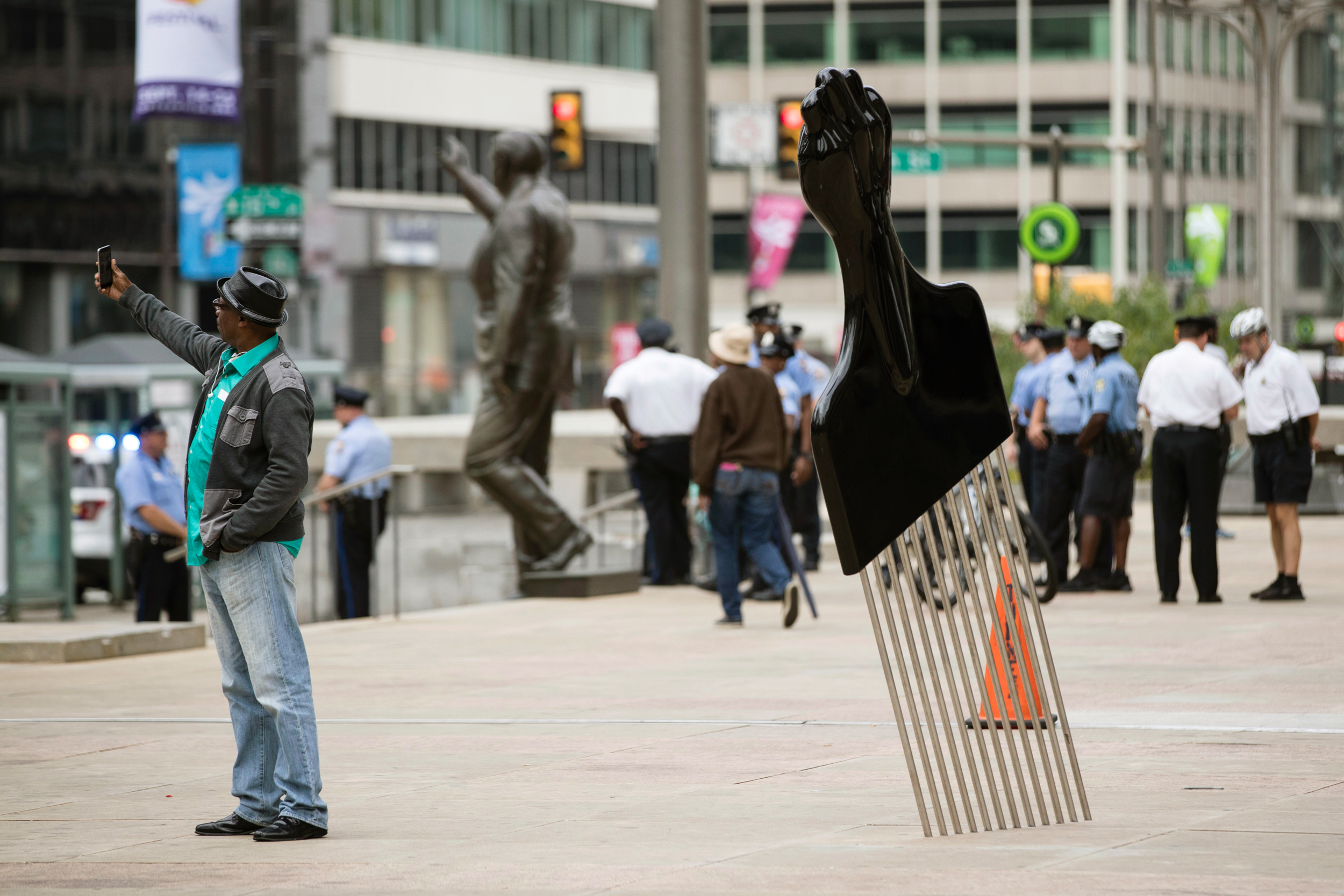
A man takes a selfie in front of Thomas’s sculpture of a 12-foot Afro pick, called All Power to All People, in view of a statue of Philadelphia’s former mayor and police commissioner Rizzo (Matt Rourke/AP/CP)

Monument Lab’s staff published the results of its inquiries as a report to the city. “The way we often talk about existing monuments and public history may severely limit our perception and reinforce the status quo,” they wrote. “We contend that it is not enough to simply say this knowledge is obscure or lost, or that it needs to be discovered or recovered by someone in the future. We must listen and take in what is already common knowledge: an expanded field of history that lives within people and places throughout the city.”

That’s one of the questions you can ask about monuments: who gets heeded, in Lum’s phrase. Another question is how. Big, realistic full-body statues sometimes make sense. There’s been one of those for Joe Frazier in Philly since 2015, an overdue real-life counterpart to the statue of Rocky, the movie boxer, that’s stood in various parts of the city since 1980. But sometimes the depiction can be more oblique or allusive. In 2017, Monument Lab invited 20 artists to build temporary new monuments around the city. Detroit artist Tyree Guyton put dozens of paintings of clocks around every side of a five-storey building: a meditation on time and its different meanings for different people.

Hank Willis Thomas, from Brooklyn, made a 12-foot Afro pick, the distinctive comb that became a symbol of Black pride in the 1970s, and stuck its tines into the ground in front of the Philadelphia municipal services building. For a time it stood within sight of a long-standing statue of Frank Rizzo, a brutal former police commissioner who was Philadelphia’s mayor through the 1970s. Running for a third term, Rizzo urged supporters to “Vote white.” In June 2020, the Rizzo statue came down; the current mayor, Jim Kenney, called his predecessor’s rule “among the worst periods” in the city’s history. Thomas’s giant Afro pick, meanwhile, is part of the permanent collection at the Pennsylvania Academy of Fine Arts.

The debates that fuel Monument Lab’s work have their parallels in Canada. As a Canadian, Lum follows these debates closely. Dundas Street and Yonge-Dundas Square in Toronto are named for a Scottish politician who is viewed by many historians as having delayed the end of the British slave trade. James McGill owned slaves. Egerton Ryerson helped design the residential school system. “Canadians overestimate their benign circumstances,” Lum says, “but there’s a lot of pernicious harm that’s been done.” Should statues come down? Lum isn’t categorical on the question, but whatever happens in every case, there should at least be more discussion and fewer resorts to the notion that monuments, as “history,” are eternal and inviolate.

“I think it’s a testament to a country’s fortitude and character that you can actually say something that is actually true” about the checkered past of previously lionized figures, he says. “It’s not like it’s being made up, or we’re impugning a country for its own sake, right? It’s not like these facts are somehow contrived.”

As most historians would acknowledge, history is about the present as well as the past. Perspectives change. “The whole project” of Monument Lab “is to un-fix the monument, right?” Lum says. “The authority of the monument. I think that’s really important because we tend to bestow this authority upon monuments, as something consensually derived, when in fact it’s particular to certain interests over other people. It’s a reflection of the distribution of power.”
The post Who should get a monument? Meet the Canadian man trying to answer the question. appeared first on Macleans.ca.

Wells: Emmanuel Macron, l’ENA, and the old weird France

Interesting take by Paul Wells:

We haven’t updated you on French President Emmanuel Macron in a while. It’s not going great. The next presidential election is a year away and polls suggest Macron could lose to Marine Le Pen, leader of the populist Ralliement National, the successor to her father Jean-Marie Le Pen’s Front National. The older Le Pen made it to the second round of presidential elections in 2002, the younger in 2017. Each time respectable opinion told French voters they must vote against Le Pen to save the Republic; both times voters did as they were told. The second time the result was Macron’s presidency. He can’t be sure it will work again. He’d become France’s third consecutive one-term president. His successor would open a can of worms. A belated sequel to Trump and Brexit.

Macron needs to get his mojo back. His choice of project is surprising. Last week he announced the closure of France’s École nationale d’administration, or ENA. It’s a graduate school for the bright young men and women who will form the senior ranks of France’s public service. Four of its graduates have become president. Nine have been prime minister. Countless others run government departments, city halls, banks, retail giants, museums. Because énarques (as ENA alumni are called) are so superbly adaptable—super-generalists, the Swiss army knives of the country’s management apparatus—they tend to flit from one job to another, with little apparent connection between positions except that each is the sort of job an énarque would have.

L’ENA is also the school Macron attended. The school that made his presidency possible, certainly the only thing that made his presidency possible. There’s drama in this assault on what made him. Something almost oedipal. It’s like when Ralph Klein had the Alberta hospital where he was born demolished. It’s as if Justin Trudeau had closed McGill University, or some ski lodge at Whistler, or whatever made him what he is today. Twenty-four Sussex? Actually, come to think of it, he has closed 24 Sussex. Hey, wait a minute…

But I digress. To an outsider, it’s hardly obvious why a stalled politician would close a fancy school. The answer hardly seems to match the question. The explanation lies in the distinctive place l’ENA occupies in the French cultural myth. As for why Macron would be the guy who’d decide to pull the trigger… well, therein lies a tale. For one thing, his reform project goes back quite literally to the day Macron graduated from the school 17 years ago.

This will take some telling. I’ve met a number of énarques. The school admits foreign students, so the odd Canadian gets in and graduates. French graduates sometimes find themselves posted to the stately French embassy on Sussex Drive, next door to 24. The current ambassador, Kareen Rispal, just won a prize for alumnae who dedicate themselves to advancing women’s rights. Énarques are, with no exception that I’ve met, cool, eloquent, poised in complex situations. Absolutely superb talkers, but not pushy. They know they’ll get their chance to shine. They always have. I once got invited to speak to alumni of the ENA and one of its main feeder schools, the Institut d’Etudes politiques de Paris, which I attended for a year on a lark ages ago. I’ve rarely been so nervous before a speaking gig.

To get into l’ENA, you have to pass a tough battery of written and oral exams on law, economics, public finances, current events, the European Union and more. Students typically study for a year at a prominent university simply to prepare for the exams. If you fail you’re free to try again the following year, but there is no other recourse or appeal. French higher education is bracingly unsentimental. One of Nicolas Sarkozy’s speechwriters famously failed the entry exam three times as a young man and has carried an epic grudge against the place ever since.

Students spend two school years at the school, divided between courses in Paris, courses at the seat of the European Parliament in Strasbourg, and work terms in government departments. At the end, another brutal round of exams. If you finish in the top 15 of a class of 100-odd, you get to pick your spot in the most prestigious departments in government. Finish much lower and you may wonder whether l’ENA was worth the trouble.

The point of it all is that social connections are no help. You can’t survive all these tough exams because you come from the right family or you have the right accent. L’ENA was founded in 1945 as France crawled from the rubble of occupation and liberation. The old French civil service was like old bureaucracies everywhere: file clerks, stenographers and power brokers who landed jobs for life because they knew someone or had a cousin return a favour. A prewar minister of education, Jean Zay, came up with plans for a school to replace all this cronyism and inertia with something more merit-based. An elite public-service corps, chosen by merit and trained with care. But after the Nazi invasion Zay was arrested by the collaborationist Vichy regime for resisting the occupation and for being a Jew. In 1944 he was murdered by the Nazi-collaborating militia. Soon after France’s liberation Charles de Gaulle put Maurice Thorez, the former French Communist Party leader who’d become the minister for the public service, in charge of implementing Zay’s plan.

Within a decade the énarques were key to a highly-planned postwar economy. By the ’60s there were signs of resentment. For all its egalitarian inspiration, the school had a knack for collecting and promoting cohorts that looked a lot like the same old hereditary leadership class. In France as anywhere else, money buys tutors, quiet study time, and connections that shape your life before the entrance exam even if they don’t play a direct role after. That sense of resentment, of a reform that had entrenched privilege instead of erasing it, deepened over time.

Each graduating class at l’ENA holds a party early on to select a name for their promotion, or graduating class. It’s an emblem of the solidarity that comes from shared stress. The class of 1949 was the Promotion Nations unies, after the United Nations. Later classes named themselves after writers (Tocqueville, Proust) or politicians (de Gaulle, the ’70s West German Chancellor Willy Brandt). Some promotions achieve legendary status. The promotion Voltaire, class of 1980, was legendary: it produced a president, François Hollande; a presidential candidate, Hollande’s longtime partner Ségolène Royal; and a prime minister, Dominique de Villepin.

But then along came Macron, who arrived in 2002 and graduated in 2004. There were already magazine articles about Macron’s class at l’ENA before anyone suspected he would be a presidential candidate. The charming kid from the northern city of Amiens didn’t particularly stand out in a class of rapid climbers who moved into key posts in government and business soon after they graduated in 2004. Here’s the piece in French Vanity Fair from 2014. Twenty members of the class of 2004 were already chiefs of staff or senior advisors to government ministers, it says. Others ran insurance companies or worked at the United Nations. “Their names aren’t known to the general public but they constitute what must be considered a rising power network. And there’s no reason to think they’ll stop there, when it’s all going so well.” Much of the material for my own article, the one you’re reading, comes from Les Jeunes Gens, a book that the Vanity Fair article’s author, Mathieu Larnaudie, published after Macron’s 2017 election.

From their first days at l’ENA, the class of 2004 had a sense of themselves as a unique group, blessed—and tested—by their good fortune. Things were happening.

On April 21, 2002, Jean-Marie Le Pen had been one of two winners in the first round of the country’s presidential election. He soon lost big to Jacques Chirac in the run-off, but the unprecedented breakthrough by a far-right populist seemed an unprecedented challenge to France’s Republican values. This was also the first class at l’ENA after Chirac abolished compulsory military service for young French men. A double cohort, comprising returning conscripts and men who’d never have to serve, swelled the class’s ranks (134 French students aiming for choice spots in the civil service, plus 51 international students) and made it more lopsidedly male than usual.

Finally, on Valentine’s Day 2003, France’s foreign minister, Dominique de Villepin (ENA 1980, promotion Voltaire) gave his speech at the United Nations opposing the Bush administration’s plans for war in Iraq. Here was France carving its own path, standing against the tide, putting Anglo-Saxon noses out of joint.

All these events seemed to pose questions to the young classmates: what’s France for in the world? What’s the nature of public service? Who owes what to whom in this world? The questions were all the more pressing because, looking around, it was pretty obvious to the bright young kids that many of them were born lucky and that the hard work had come later. One was the grandson of a legendary cabinet minister. Most came from prominent families. Their school was France’s highest-pressure meritocracy, but it wasn’t only that.

The class gave a hint that it might have a rebel streak when it came time to name itself. On a long, boozy night, a few surprising names for the promotion were proposed. One was “Les Héritiers,” after a 1964 book that described how France’s higher education system reinforced privilege instead of  opportunity. The group finally decided their class would be known forever as the promotion Léopold Sedar Senghor, after a Senegalese poet who, educated in Paris and elected to the prestigious Académie Française, became Senegal’s first democratically elected president.

But that gesture was nothing compared to the coup de théâtre the class of 2004 pulled off on the last day of school. Here was the moment when students would learn how they scored on the exams and the top 20 would have their pick of civil-service jobs. The highest-scoring student in the class—the major, in the lingo—was Marguerite Bérard, daughter of an énarque and another énarque, living with a classmate she would later marry, on her way to jobs as senior advisor to Sarkozy and then as a bank president. She accepted a handshake from the director of l’ENA and then handed him a 20-page manifesto, ENA: The Urgent Need for Reform, signed by 132 of the class’s 134 students. Emmanuel Macron, 6th in his class, was one of the signatories.

The surprise was complete. The school’s leadership was humiliated. The students all received letters from a French cabinet minister berating them for their cheek. They also received the jobs they wanted and the future the ENA had been built to deliver. But 17 years later, the most relentless and seductive and unstoppable member of the promotion Senghor is implementing the reform they called for on the day when it seemed they really could write their own future.

Will it make a difference? It’s hard to say. Macron has already announced that ENA will be replaced with a new Institute for Public Service, with more entry paths than the single round of brutal exams, but with the same exit ranking as the old school. Instead of going to central coordinating agencies of government, the new school’s top grads will have to get out into the country and work in departments that actually deliver services to citizens. My hunch is that to the great majority of French citizens, it’ll be a distinction without a difference: a factory for producing a leadership class that, after it finishes its stint on the ground, will go on to run everything else.

The option of replacing ENA with nothing—leaving France without a dominant dedicated public-service school, an absence that would make it more like Canada and a lot of other countries—seems not to have occurred to Macron. Old habits die hard, even in people who think they’re dedicated to change. I do hope Macron, or some other politician who shares a certain idea of France, beats the latest Le Pen next year. For all its quirks, indeed in most cases because of them, it’s still a great country.

Source: Emmanuel Macron, l’ENA, and the old weird France