Non-Jewish community leaders should stand up against antisemitism too

More calls to action. How effective these calls are on the ground remains to be seen:

In response to more than 100 Jewish institutions across Canada receiving identical bomb threats, Deborah Lyons, Canada’s Special Envoy on Preserving Holocaust Remembrance and Combatting Antisemitism, wrote, “These threats against the Jewish community are intended to intimidate and sow fear. The vast silent majority of Canadians finds the harassment and intimidation of the Jewish community of Canada vile and unacceptable. It is past time to stand up and say NO MORE.” 

While largely silent today, we have seen courageous acts of leadership from the non-Jewish community in the past. In 1947, a broad-based coalition of allies came together to form the Canadian Council of Christians and Jews — an organization whose mission was to push back against antisemitism and religious-based hate. With chapters across Canada, it became the leading forum for dialogue and understanding between Christians and Jews.

In 2004, in the wake of antisemitic incidents in Toronto and Montreal, then-Bank of Montreal President and CEO Tony Comper and his late wife, Elizabeth, formed a coalition called Fighting Antisemitism Together or FAST. It was pointedly made up exclusively of non-Jewish business leaders. The CEOs of Canada’s leading corporations lent their own names and their companies’ names to full page ads that ran in major Canadian newspapers.

The October 7th terrorist attacks by Hamas and the increase in antisemitism have brought back painful memories from the horrors of the Holocaust and millennia of dangerous demonization and discrimination. Today, Canada urgently needs a whole-of-society commitment to denouncing and eradicating antisemitism, and that takes courageous leadership.

Our business leaders need to speak up and push back. The chamber movement can play a critical role through its local chapters across Canada. Our national business organizations should be speaking up too.  

Our university leaders especially need to push back. Every Jewish student needs to feel safe from harassment and violence on and off campus. And all students, and their professors, must demonstrate tolerance for, and even curiosity about, the views and cultures of others. That’s, arguably, the core mission of universities. At the moment, too many of our universities are failing in that regard.

Municipal leaders need to ensure that their police forces have the resources they need to uphold and enforce our laws.

Our provincial political leaders need to follow the lead of Ontario and British Columbia and ensure that teaching curriculums provide facts and context about antisemitism and the Holocaust.

Federal leaders need to communicate clearly that antisemitism is antithetical to Canadian values, and it is an affront to democratic norms and freedoms everywhere. So too do our senior public servants.

Faith leaders from across the spectrum need to use their pulpits to promote unity and understanding across all peoples of faith.

Canada has been deeply enriched by its Jewish community, which has made tremendous contributions to every aspect of our society. Our leading universities, hospitals, and research institutes have also benefitted incredibly from cooperation, collaboration, and people-to-people exchanges with their counterparts in Israel.

Every Jew in Canada should feel safe, protected, proud and unhindered from religious practice, welcomed and supported by their classmates, colleagues and community. Simply put, there is no place in Canada for antisemitism.

The poem First They Came by Pastor Martin Niemöller should be a cautionary note to all minorities in Canada. Where antisemitism flourishes, so too do other forms of hate and intolerance. It threatens not just the Jewish community, but all of us and our social fabric.

As non-Jews, we believe this is no time to be a bystander. It’s time for non-Jewish leaders from all walks of life to speak up and push back against antisemitism as they have in the past. As Tony Comper told the Empire Club two decades ago, “Non-Jews must join the battle against what has been described sadly, but accurately, as the oldest and longest of hatreds.”

All Canadians need to communicate clearly to their Jewish neighbors, classmates, and colleagues that they are not alone: Canadians stand with the Jewish community and have their backs against antisemitism.

Hon. Paul Tellier was Clerk of the Privy Council and president and chief executive officer of CN and Bombardier, Hon. Kevin Lynch was Clerk of the Privy Council and vice chair of BMO Financial Group, Andrew Molson is Chair of AVENIR Global, Paul Deegan is CEO of Deegan Public Strategies

Source: Non-Jewish community leaders should stand up against antisemitism too
Noël: Quand les gouvernements trébuchent [call for policy and program modestly]

Echoes the calls by others but nevertheless important.

Money quote: “le gouvernement fédéral devrait probablement modérer ses ambitions dans ses propres sphères de compétence, en adoptant des objectifs plus réalistes en immigration par exemple, afin d’éviter les échecs récurrents de gestion.”

Je n’étais pas en avance, c’est vrai, mais au début juillet, tard en soirée, je faisais des réservations pour un séjour de camping à Terre-Neuve et en Nouvelle-Écosse. Les réservations pour le traversier entre les deux provinces, opéré par Marine Atlantique, une société d’État fédérale, se sont avérées plutôt simples, tout comme celles pour des parcs provinciaux dans chaque province. Mais pour réserver des sites au parc national du Gros-Morne et à celui des Hautes-Terres-du-Cap-Breton, c’était un peu plus stressant. Avant de pouvoir réserver, il fallait créer une « CléGC (Service de gestion des justificatifs du gouvernement du Canada) », avec un nom d’utilisateur (toutes les variantes de mon nom ont été refusées), un mot de passe, et des réponses à une panoplie de questions. Pas un obstacle majeur, mais un processus un peu lourd pour une si petite tâche. À Ottawa, les missions les plus simples semblent souvent devenir complexes.

Tout ne va pas mal au Canada. Une étude parue à la fin juin dans le Canadian Medical Association Journal montre que, pour les deux premières années de la pandémie, le pays s’est classé parmi les meilleurs pour le nombre de cas, le taux de vaccination et la mortalité excédentaire, avec un bilan économique somme toute satisfaisant. Au Canada, ce sont les provinces atlantiques et le Québec qui ont connu les plus faibles taux de mortalité excédentaire.

Mais quelque part sur l’interminable voie de sortie de la pandémie, le bilan du gouvernement fédéral s’est détérioré. Cafouillage dans l’émission des visas et des passeports, congestion dans les aéroports, délais inacceptables à l’assurance-emploi, accueil difficile des réfugiés, traitement déficient des dossiers d’immigration, les échecs semblent s’accumuler.

Tout ne va pas nécessairement mieux dans les provinces. Il y a même des domaines où les ratés sont habituels, voire pérennes. La gestion des soins de santé constitue un cas patent. Mais dans ce cas, c’est largement une question de ressources. En 2019-2020, les soins de santé représentaient 41,4 % des dépenses de portefeuilles des provinces, comparativement à 31 % en 1981-1982. La même année, la contribution fédérale, par le biais du Transfert canadien en matière de santé, était tombée à 22,4 %. Si les provinces ne font pas mieux en santé, c’est largement parce que d’une année à l’autre elles doivent faire plus avec moins.

Dans d’autres domaines, comme en environnement, il s’agit plus clairement d’un manque de volonté politique. Si le ministre de l’Environnement du Québec « avait les convictions, la volonté, le courage et l’autorité morale nécessaires pour relever le défi de l’urgence climatique », écrivait récemment le chroniqueur Michel David, François Legault ne l’aurait pas choisi pour ce poste.

Mais émettre des visas et des passeports, acheminer des prestations d’assurance-emploi, traiter des demandes à l’immigration ? Le gouvernement fédéral a sûrement les ressources pour accomplir ces tâches et il devrait même être capable de marquer des points dans des secteurs qu’il contrôle depuis toujours, qui sont visibles et significatifs pour les citoyens et ne demandent pas des ressources faramineuses. « Il ne fallait pas être un génie », déplorait récemment l’ancien greffier du Bureau du Conseil privé Paul Tellier, « pour prédire qu’il y aurait une hausse des demandes de passeport » au sortir de la pandémie.

M. Tellier attribue les difficultés du gouvernement Trudeau à la centralisation excessive de la gestion autour du premier ministre et à la méfiance qui en découle entre élus et fonctionnaires. D’autres auteurs blâment le jeu politique, qui amène les élus à négliger les conseils et les actions des fonctionnaires.

Plus plausible, à mon avis, est le constat de l’ancien haut fonctionnaire Ralph Heintzman selon lequel le gouvernement fédéral se désintéresse des services aux citoyens depuis au moins trente ans. Dans la fonction publique fédérale, le prestige est associé aux conseils et à la stratégie, pas à la gestion compétente des programmes en place. Une carrière ascendante se caractérise par des sauts rapides d’un ministère à l’autre, pour appliquer à des niveaux supérieurs des méthodes de gestion largement indifférenciées. Consacrer trop d’années à maîtriser un domaine d’intervention gouvernementale semble manifester un manque d’ambition. Les hauts fonctionnaires voient ainsi les choses de haut. Quant aux élus, ils préfèrent annoncer des programmes plutôt que de veiller à leur bon cheminement.

Mais pourquoi ces travers semblent-ils plus prononcés à Ottawa ? Pour le comprendre, il faut considérer le fonctionnement de la fédération canadienne. Un rapport récent de l’Institut sur la gouvernance rapporte les propos d’un haut fonctionnaire qui note que « nous ne sommes pas un pays cohésif. Nous sommes une grande fédération ». On pourrait interpréter ce constat comme un appel de plus à davantage de collaboration entre les ordres de gouvernement. Mais il semble plus juste d’y voir une caractéristique structurelle, une condition d’existence du Canada.

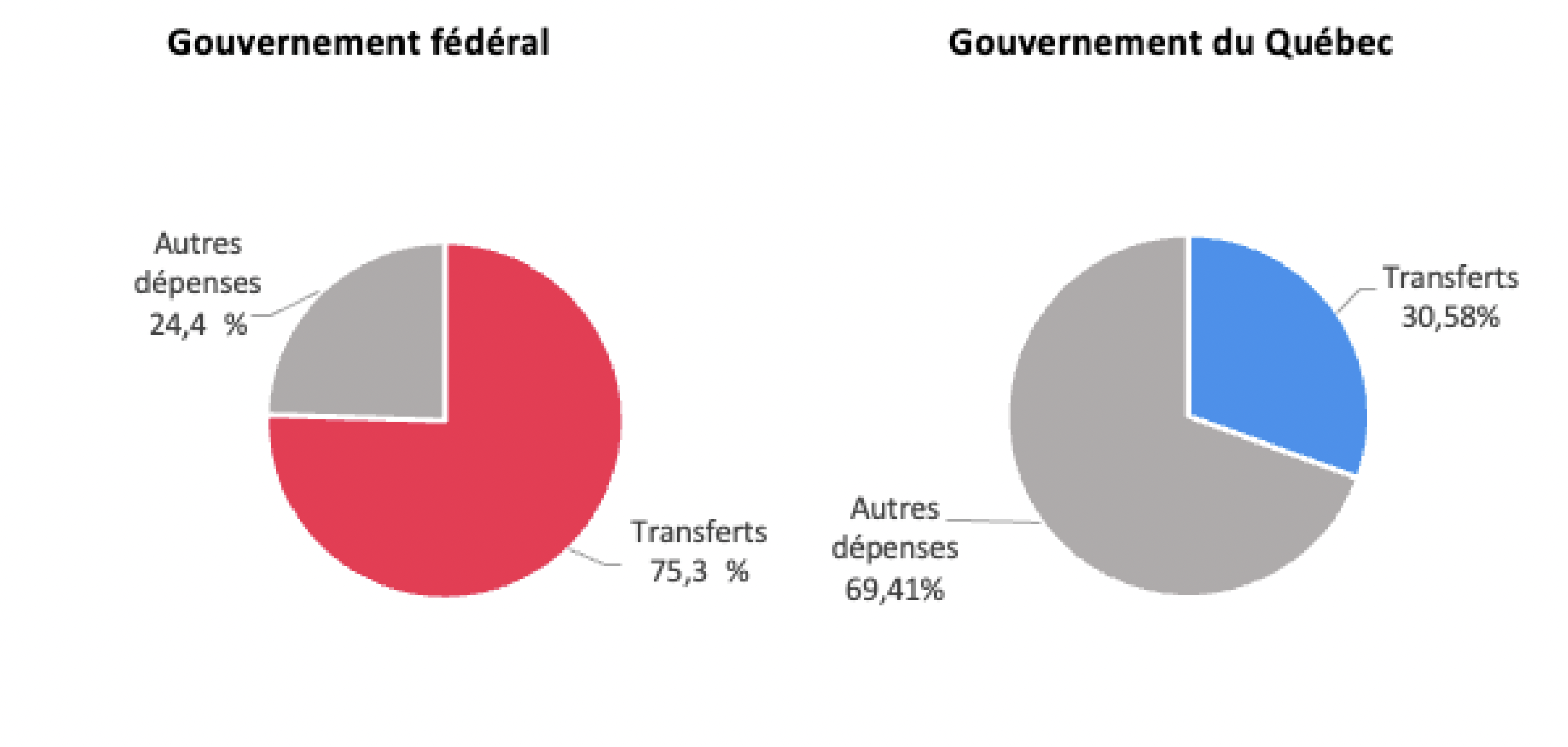
La figure 1 ci-dessous montre bien pourquoi la gestion quotidienne de services aux citoyens n’est pas le fort du gouvernement fédéral.

Figure 1 : Dépenses du gouvernement fédéral et du gouvernement du Québec, 2021Sources : Comptes publics du Canada ; Comptes publics du Québec

Le gouvernement fédéral est un animal particulier, plus habitué à émettre des transferts aux individus, aux entreprises et aux gouvernements, et à énoncer des normes associées à ces transferts, qu’à livrer des services à la population. L’année 2021 exagère un peu le trait, puisque la pandémie a engendré son lot de transferts exceptionnels. Mais la logique générale ne change pas. Il y a plus de vingt ans, le rapport de la Commission sur le déséquilibre fiscal faisait état de proportions assez semblables.

Les difficultés actuelles du gouvernement Trudeau ne sont donc pas si exceptionnelles. Le gouvernement fédéral demeure principalement une machine à récolter et à distribuer des ressources fiscales et il a tendance à se perdre quand il s’agit de gérer des programmes concrets.

La solution réside donc moins dans une réforme additionnelle de la fonction publique fédérale que dans une meilleure compréhension du fonctionnement de la fédération. En premier lieu, il faudrait améliorer l’équilibre fiscal en laissant davantage de ressources propres aux gouvernements provinciaux, dont la tâche principale consiste justement à livrer des services à la population.

Ensuite, pour des raisons évidentes, il conviendrait de prendre avec un grain de sel les volontés de leadership fédérales sur des questions de compétence provinciale. Notant dans une formulation bien à lui qu’en santé « ce n’est pas juste pitcher de l’argent vers le problème qui va le résoudre », M. Trudeau invitait récemment les provinces à des « conversations » afin de réduire les délais d’attente. Compte tenu de l’état de ses services, il devrait se garder une petite gêne.

En fait, le gouvernement fédéral devrait probablement modérer ses ambitions dans ses propres sphères de compétence, en adoptant des objectifs plus réalistes en immigration par exemple, afin d’éviter les échecs récurrents de gestion.

Mais les difficultés actuelles ne sont pas nouvelles, et elles ne se résorberont pas facilement.

Source: Quand les gouvernements trébuchent

All-powerful PMO, mistrust “destroying” the public service: Paul Tellier

Of note.

Would be of interest for other former and more recent clerks (e.g., Michael Wernick, Wayne Wouters, Mel Cappe etc) would also be surveyed on their perceptions on trust/mistrust between the public sector and PMO. Certainly existed under the Harper government although diminished over time for most:

A lack of trust between politicians and senior levels of the public service, and a Prime Minister’s Office that calls all the shots, is “destroying” Canada’s public service, warns Paul Tellier, Canada’s former top bureaucrat and former head of both Canadian National Railway and Bombardier Inc.

“The current government, with centralization of everything in the PMO, is in the process of destroying the public service … and the word ‘destroying’ is not too strong,” the former clerk of the Privy Council in the Brian Mulroney era said in an interview.

Tellier made his comments after the release of a new report, Top of Mind, by two think tanks – the Ottawa-based Institute on Governance, and the Brian Mulroney Institute of Government at St. Francis Xavier University – which threw the spotlight on the increasingly troubled relationship after probing public service executives at all levels of government about their biggest challenges.

The report found that today’s executives worry about falling public trust in government; the decline in senior bureaucrats giving “fearless advice” to ministers; a hollowing-out of policy capacity; a post-pandemic economic reckoning; conflicts among levels of government; and the need for public service reform.

The relationship is a longstanding problem, one that Tellier argues was aggravated by the Stephen Harper rules-bound Federal Accountability Act. But he thinks the problems have worsened under the current Justin Trudeau government.

Tellier questions how the public service can recruit and keep top talent, as well as drive change if deputy ministers and ministers feel compelled to check everything they do with PMO.

“There is no way that if I was a cabinet minister, I would allow a bunch of people in PMO to tell me how to do my work. And it’s at every level, it’s not only for junior ministers, the most senior ministers… It’s for deputy ministers and departments.”

“So why, if you trust the minister and if you trust the advisors to the minister in his office and in the department, do you want six people in PMO to review a draft press release, or a tweet?”

Tellier has never been far from Canada’s public service over the past five decades. He joined as a young lawyer in the 1970s, went on to lead the public service and advise ministers and prime ministers. He has watched various public service renewal efforts come and go – including Public Service 2000 (PS 2000), which he led under Mulroney.

Mulroney came to power after the Liberals had ruled for all but a few months from 1963-84. At first, the new prime minister distrusted the public service and promised to issue them “pink slips and running shoes.” But Mulroney said in a recent interview he grew to trust and rely on public servants who gave him the “straight goods,” even poaching senior bureaucrats like Derek Burney and Mark Entwistle to join his PMO.

Mulroney also told the Institute on Governance that without the work of public servants, “we wouldn’t have got our major agenda through.”

Today, many experts say much about the public service needs fixing, but Tellier believes the first step is to restore trust between politicians and bureaucrats – a key relationship in Canada’s Westminster-style democracy.

“There’s no trust,” said Tellier. “And it starts at the top.”

“I don’t know what happened (to trust). I like to say, if you write a good policy paper or a good briefing note, it is going to be read. But if it’s not going to be read, why bother?

The relationship has been strained for years, but respect for the public service nosedived during the Harper era as its role was diminished, its advice devalued and its neutrality undermined.

The Federal Accountability Act, with its focus on rules, oversight and compliance, changed the role of the deputy ministers, which left them inward-looking and isolated from Canadians.

Tellier pulls no punches about the accountability act, introduced by the Harper government in response to the sponsorship scandal. He called it a “mistake” that must be reviewed.

He said the act deepened a culture of risk-aversion, putting a stop to public servants meeting with business leaders, which was essential to understanding the various forces at play when developing policy.

“The accountability act was a mistake – not every single clause – but I think that it went way too far. As a result, it has deprived future governments of very useful input from the public service and the business sector and visa-versa.”

The public service’s job is to offer policy advice, then deliver programs and services to Canadians. Of late, the focus on reforming the public service is aimed at fixing problems that get in the way of implementing programs and service – an archaic human resources regime, a gridlock of rules and outdated technology.

But Tellier argues such reforms miss a key problem – fixing the relationship between ministers and deputy ministers.

“I think that Tellier is right about that,” said Lori Turnbull, director of the school of public administration at Dalhousie University.

“There’s only so much the public service can do by way of self-improvement that will really change anything if the political classes aren’t interested in what they say or what ideas they have.”

Take innovation. If politicians aren’t interested in public servants’ advice or innovations – unless it’s risk-free – then there is no impetus for innovation, Turnbull said.

A big problem is politics. Parties get elected on campaign platforms they consider a “contract with the voter” that they must deliver. As a result, they come to power knowing what they want and don’t believe they need any advice from public servants.

This leaves little “time and space” for public servants, who end up “playing at the margins,” taking care of implementing promises, but not coming up with the big ideas, Turnbull said.

Also, ministers want advice and answers fast. They complain that public servants take too long to gather evidence and assess options. That urgency has ramped up over the years because of technological change, the 24-hour news cycle and the rise of social media.

“There’s always been a kind of time difference between how fast the political side wants things, and how quickly the public service can move while still doing its job responsibly,” said Turnbull. “That time crunch seems to be getting worse. At one point, it was a healthy tension and now it’s becoming unhealthy, where the political side stops waiting and just does it. “

But Turnbull worries what could happen to the already fractured relationship with the shift to a public service with more flexible working arrangements in the wake of COVID-19.

She said executives and politicians are more likely to return to the office “in real time” while the rest of the public service could work remotely from anywhere across the country. That could further distance senior bureaucrats and politicians from the rest of the public service, which delivers services and does the legwork for evidence-based policy advice.

Stephen Van Dine, senior vice-president of public governance at the Institute on Governance, said those “opportunities to have a quiet word” with the minister that are critical to building trust are less likely in a public service where some are working remotely.

“The hustle and bustle of briefing a minister, whether in the car to-and-from the Hill, over a sandwich, in a hallway where you can grab one-on-one encounters where the minister and deputy can have a quiet word,” Van Dine said. “If these opportunities become fewer and fewer, that is like the compounding impact of (playing) broken telephone.”

Canada is not alone in facing this issue. The tensions between ministers and senior bureaucrats have been studied to death over for years. A major U.K. study on the relationship called it the “fulcrum” of a Westminster system. When it’s not working, policy and service delivery are compromised.

But past efforts at fixing it in Canada have focused on making the public service more accountable – such as the accountability act – and responsive to what politicians want. There’s been little discussion of what ministers could do to repair the relationship.

Tellier said there must be a “healthy tension” between public servants and politicians, but that balance is out of whack with politicians increasingly dominating.

Without trust, frank discussions between politicians and public servants — which Tellier called “the tennis match” — don’t happen, putting policy and delivery at risk.

He said a fix begins with the prime minister, who must make it clear that ministers should consult their deputies. And if they don’t trust them, the prime minister should replace them with deputies they do trust.

Source: All-powerful PMO, mistrust “destroying” the public service: Paul Tellier