It’s Easier To Call A Fact A Fact When It’s One You Like, Study Finds

Interesting nuanced study:

Study after study has found that partisan beliefs and bias shape what we believe is factually true.

Now the Pew Research Center has released a new study that takes a step back. They wondered: How good are Americans at telling a factual statement from an opinion statement — if they don’t have to acknowledge the factual statement is true?

By factual, Pew meant an assertion that could be proven or disproven by evidence. All the factual statements used in the study were true, to keep the results more consistent, but respondents didn’t know that.

An opinion statement, in contrast, is based on values and beliefs of the speaker, and can’t be either proven or disproven.

Pew didn’t provide people with definitions of those terms — “we didn’t want to fully hold their hands,” Michael Barthel, one of the authors of the study, told NPR. “We did, at the end of the day, want respondents to make their own judgment calls.”

The study asked people to identify a statement as factual, “whether you think it’s accurate or not,” or opinion, “whether you agree with it or not.”

They found that most Americans could identify more than three out of five in each category — slightly better than you’d expect from random luck.

(You can see how your evaluations stack up in Pew’s quiz.)

In general they found people were better at correctly identifying a factual statement if it aligned with or supported their political beliefs.

Republicans and Democrats more likely to correctly identify factual news statements when they favor their side

For instance, 89 percent of Democrats identified “President Barack Obama was born in the United States” as a factual statement, while only 63 percent of Republicans did the same.

Republicans, however, were more likely than Democrats to recognize that “Spending on Social Security, Medicare, and Medicaid make up the largest portion of the U.S. budget” is a factual statement — regardless of whether they thought it was accurate.

And opinions? Well, the opposite was true. Respondents who shared an opinion were more likely to call it a factual statement; people who disagreed with the opinion, more likely to accurately call it an opinion.

Pew was able to test that trend more precisely with a followup question: If someone called a statement an opinion, they asked if the respondent agreed or disagreed with that opinion.

If the opinion was actually an opinion, responses varied.

“If it wasn’t an opinion statement — it was a factual statement that they misclassified — they generally disagreed with it,” Barthel says.

Some groups of people were also more successful, in general, than others.

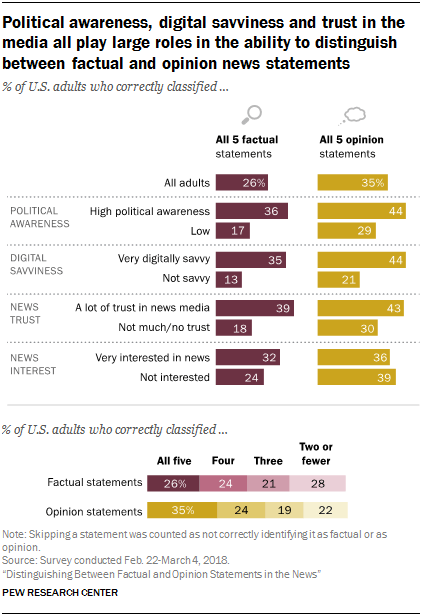
The “digitally savvy” and the politically aware were more likely to correctly identify each statement as opinion or factual. People with a lot of trust in the news media were also significantly more likely to get a perfect score: While just over a quarter of all adults got all five facts right, 39 percent of people who trust news swept that category.

But, interestingly, there was much less of an effect for people who said they were very interested in news. That population was slightly more likely to identify facts as facts — but less savvy than non-news-junkies at calling an opinion an opinion.

Political awareness, digital savviness and trust in the media all play large roles in the ability to distinguish between factual and opinion news statements

The results suggest that confirmation bias is not just a question of people rejecting facts as false — it can involve people rejecting facts as something that could be proven or disproven at all.

But Barthel saw a silver lining: In almost all cases, he said, a majority of people did classify a statement correctly — even with the trends revealing the influence of their beliefs.

“It does make a little bit of difference,” he said. “But normally, it doesn’t cross the line of making a majority of people get this wrong.”

Source: It’s Easier To Call A Fact A Fact When It’s One You Like, Study Finds

Top bureaucrats met to resist partisanship imposed on public service #cdnpoli

Encouraging sign that senior levels appear not to have remained in denial mode (the change in government makes this all the more pertinent as the incoming government and the public service need to establish trust):

As a new Liberal government takes the reins this week, Canada’s top bureaucrats are looking for ways to purge partisan politics from the shell-shocked public service.

The highest echelon of the bureaucracy met in the spring, before the election was called, to discuss ways to insulate public servants from intense pressure to be “promiscuously partisan” instead of neutral in carrying out the government’s agenda.

The May 13 meeting of deputy ministers was asked by Canada’s top civil servant to consider how Canada’s Westminster parliamentary system needs to be “re-set and if medium-term planning could provide the opportunity.”

The group was provided with one paper for backgrounding — dating from 2010, by the late scholar Peter Aucoin — describing how partisanship has damaged Westminster systems in Canada, Britain and Australia.

The new reality “is characterized by integration of governance and campaigning, partisan-political staff as a third force in public administration, politicization of appointments to the senior public service, and expectation that public servants should be promiscuously partisan,” says a summary provided for the meeting by the Privy Council Office, the central organ of government .

The group was urged to consider how the damaged system could be fixed “during periods of transition and government formation.”

One proposal called for clarifying the job description of Canada’s top public servant, the clerk of the Privy Council.

‘Confusion and mistrust’

“Without a set of guidelines to clearly determine which of the clerk’s roles should be given primacy in situations where duties may conflict, confusion and mistrust can arise during periods of government formation.”

Meeting documents, some heavily censored, were obtained by CBC News under the Access to Information Act. They represent a candid acknowledgment by the bureaucracy that partisan politics have radically changed the nature of their work, especially under the Harper government.

A spokesman for Janice Charette, appointed clerk just last year, declined to respond to questions, including what actions were taken arising from the meeting. “We are not able to provide details of meetings of senior executives,” Raymond Rivet said in an email.

The so-called “creeping politicization” of the public service dates as far back as the 1970s, under Liberal governments, but the Harper administration has come under special criticism from some scholars.

Ralph Heintzman, a research professor at the University of Ottawa, has cited the example of a communications directive requiring bureaucrats to refer to the “Harper government” in news releases, rather than the government of Canada.

Other examples include a request last year that departments send retweets promoting a family-tax measure not yet passed by Parliament, including a hashtag with the Conservative slogan #StrongFamilies, and public servants working overtime to create promotional videos about child benefits, spots that prominently featured Pierre Poilievre, the employment minister.

“For anyone who cares about the condition of our federal public service, this is a very depressing story,” Heintzman wrote about the “Strong Families” tweets last April, a month before the deputy ministers’ meeting.

“It seems to confirm the widely reported slide of too many senior public service leaders from their traditional and proper role as non-partisan professionals to a new and improper role as partisan cheerleaders for the current political administration.”

Source: Top bureaucrats met to resist partisanship imposed on public service – Politics – CBC News

Boundary between politics, public service is ‘no man’s land’: Savoie

More on the inappropriate use by Employment Minister Poilievre use of government video services for partisan purposes (taking a lead from the PM’s 24/7 videos).

Should there be a change in government, there will likely be questions regarding whether or not deputies and senior officials provided any advice on the ethics of such advertising, particularly in the pre-writ period. There is also a risk that an incoming government may choose to emulate this approach rather than limiting it.

While Savoie is right that not all responsibility should fall on the shoulders of the Clerk and that all executives have a role in questioning such practices, the Clerk and deputies need to set the tone and provide space for other executives to challenge such requests:

Employment Minister Pierre Poilievre’s taxpayer-funded video to promote the Conservatives’ universal childcare benefit shows the traditional line between politics and the public service is a “no man’s land” where there are no rules, says a leading public administration expert.

Donald Savoie, a Canada Research Chair in Public Administration and Governance at Université de Moncton, said the online video “smacked” of partisanship to which public servants should have been “hyper-sensitive” coming only four months before a federal election.

“If anyone should know and be sensitive to the partisan line that should not be crossed, it’s the public service,” said Savoie. “They should not get involved in initiatives or measures that can viewed by Canadians, or opposition politicians, as partisan. They are guardians of the public interest, not the political interest.”

But Savoie said the rules and boundaries that once separated politicians and bureaucrats, and the workings of politics and administration have been “thrown out the window” — setting the stage for a creeping politicization of the public service.

There are still rules like those laid down in the communication policy and values-and-ethics code that are supposed to ensure that public servants don’t stray into partisan territory. And the department argued that it followed government policies in making the video.

But Savoie argues codes and policies don’t fill the void of rules that guided the traditional bargain between Canada’s non-partisan public servants and politicians. As a result, public servants don’t know what their roles are anymore in policy-making, operations or communications.

“No values and ethics code can paper over this no man’s land. The minister should have basic respect for public service, and senior public servants should have it too. It takes two to have a bargain. That old bargain is gone and we are searching for a new one,” said Savoie.

“So what’s the role of the public service in contemporary government? We haven’t defined the new rules. All we have are values and ethics and they have no teeth. We absolutely need a frank and open discussion on the role of the public service in policy making, operations and communications.”

Academics have for years warned that the traditional role of the public service was radically shifting as power gathered at the centre in the Prime Minister’s Office and its bureaucratic arm, the Privy Council Office.

That shift has accelerated by rapidly changing technology, the 24-hour news cycle, and governments obsessed with managing the message.

But critics argue that nothing has strained the neutrality of public servants like the Conservatives’ highly centralized and partisan approach to government communications.

Liberal MP David McGuinty argued that Privy Council Clerk Janice Charette, who heads the public service, should justify how public servants could work on what he called Poilievre’s “taxpayer-funded vanity video.”

The video was produced by department funds, and public servants were called in on a Sunday to work on it, including filming Poilievre glad-handing constituents.

But Savoie questions why the clerk should be on the hook when every public servant has been immersed in the values-and-ethics code.

“Don’t point the finger at the clerk,” said Savoie. “If you are an EX-1 or above you should know the importance of the value-and-ethics code and when you see a red flag like this a few months before a general election, live by it. You should be asking if this is appropriate. Values and ethics code covers everybody, not just the clerk.”

But Savoie said Poilievre, as a minister, should have known better.

“Ministers have a responsibility to back off and respect the line and realize what’s in the public interest and what’s in their own interest. It’s not all on the shoulder of the public service — the ministers shouldn’t be making inappropriate demands.”

Boundary between politics, public service is ‘no man’s land’: Expert | Ottawa Citizen.