Fewer Canadian companies disclosing DEI records, study finds

Of interest:

Fewer Canadian public companies are trumpeting their records on diversity, equity and inclusion, though many are quietly pressing ahead with the initiatives despite the DEI backlash in the United States, a study by a national law firm has found.

U.S. President Donald Trump signed a number of executive orders aimed at stamping out the practice of promoting diversity in workplaces, saying hiring and promotion should be done solely on merit. These actions could be influencing Canadian companies to pull back on reporting data, Osler, Hoskin & Harcourt LLP said in its annual diversity disclosure report.

The shift halts a years-long trend of increasing reporting for metrics such as the percentages of women on boards of directors and executive teams, the report said. 

The report found the percentage of female directors among Toronto Stock Exchange-listed companies increased, rising above 30 per cent of board seats for the first time to 30.5 per cent. But the rate of increase fell to 0.7 percentage points from midyear 2024, the slowest in the 11 years Osler has conducted the study.

Despite reduced public disclosure, institutional investors still demand this information from companies in their portfolios, and many corporations see maintaining DEI programs as key to attracting top talent they will require as demographics change, said John Valley, chair of Osler’s corporate governance practice and co-author of the report.

Source: Fewer Canadian companies disclosing DEI records, study finds
Osler: Diversity Disclosure Practices – Diversity and leadership at Canadian public companies

Useful comprehensive and detailed report, looking at representation at the board and executive levels, for Canada’s largest publicly trade companies, including sector breakdowns.

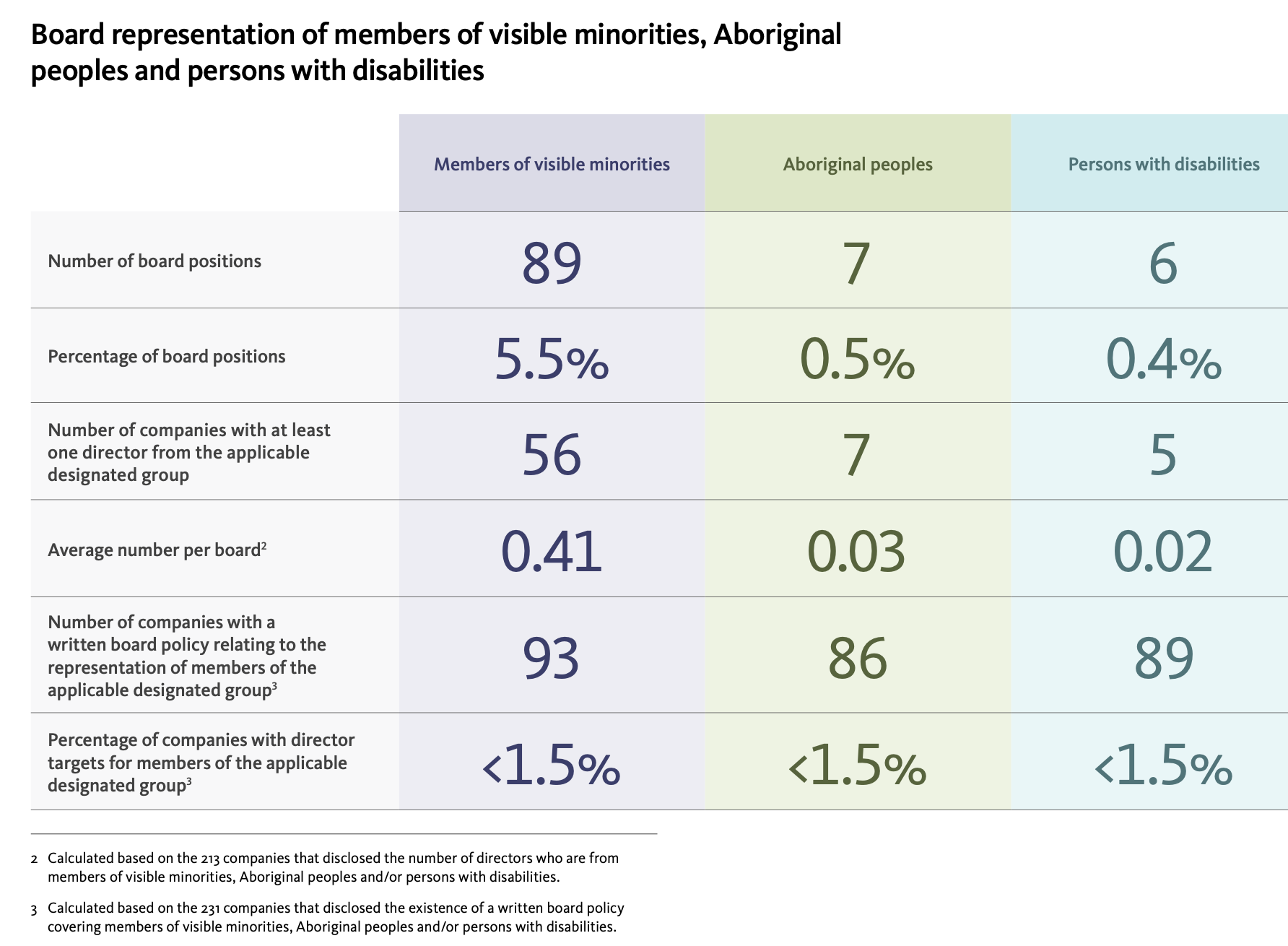
Previous reports have only looked at women’s representation, the current report includes all four employment equity groups. Summary below, along with tables for visible minorities, Indigenous peoples and persons with disabilities:

Women now hold over 21.5% of board seats among TSX-listed companies disclosing the number of women on their boards, an increase of almost 3% compared to 2019. The rate at which women are being appointed to fill newly created or vacated board seats declined slightly to 35%, compared to 36.4% in 2019. As in past years, Canada’s larger companies continue to lead the way as women hold 31.5% of board positions among the S&P/ TSX 60 companies and 28.3% of board positions among the 221 companies included in the S&P/TSX Composite Index. All-male boards continue to wither away, representing only 18.5% of the TSX-listed companies.

We anticipate that certain of our 2020 full-year results, including the percentage of board seats held by women, will be approximately 1% lower than our 2020 mid-year results as a significant number of issuers which historically have had below average diversity results took advantage of permitted extensions of normal deadlines to file their disclosure after our July 31, 2020 cut-off for our mid-year results.

The number of TSX-listed companies with written board diversity policies increased to 64.7% and approximately 97% of the time those policies included a specific focus on women on the board. This year we noticed a significant increase in companies disclosing that their board policy also considers other diversity characteristics – the most common of which was ethnicity/race, which was identified approximately 57.5% of the time.

However, we continue to see no progress being made at the executive officer level. The proportion of women executive officers has remained largely unchanged since 2015, and under 10% of TSX-listed companies have targets for women executive officers.

Our review of diversity disclosure by CBCA companies under the new CBCA requirements shows results on the representation of women that are comparable to those reported for TSX-listed issuers under the new CBCA requirements. However, there is a marked absence of directors from other diversity groups. Only 5.5% of the 217 disclosing CBCA company directors are visible minorities. And among the 2,023 board positions of the 270 CBCA companies that provided full or partial disclosure on their practices before July 31, 2020, there were only 7 positions held by Aboriginal peoples and only 6 positions held by persons with disabilities.

The key data tables:

Source: https://www.osler.com/osler/media/Osler/reports/corporate-governance/Diversity-and-Leadership-in-Corporate-Canada-2020.pdf