Men accounted for more than two-thirds of Order of Canada appointments last year

I have been tracking Order of Canada appointments since 2013 from a diversity perspective.

While my initial interest was sparked by the Harper government’s effort to increase the number of appointments from Western Canada and the business community (limited success), I increasingly viewed this a an integration indicator and one that likely reflected other award and recognition program (my 2017 detailed review can be found here: The Order of Canada and diversity):

Less than a third of Canadians appointed to the Order of Canada last year were women — a figure that represents the widest gender imbalance in appointments to the order in years.

Analysis by diversity researcher Andrew Griffith, a former senior government official, shows that 71.4 per cent of appointees in 2019 were men. The low number of women among the 2019 appointees — just 28.6 per cent of the total — and the low number of visible minorities — just 5.4 per cent — show the Order of Canada falling short of representing Canada’s diverse population.

Griffith said there may be a lag effect because the Order of Canada tends to be given in recognition of a lifetime’s body of work — and high-profile women were scarce in many fields until relatively recently. But he said he expected to see progress toward gender parity among Order of Canada recipients mirror the advances experienced by women in the public service.

“It indicates where the country has been because these are previous contributions that are being recognized, and yet it says how far we have to go to ensure that, at the honours level where we recognize Canadians, that we’re actually recognizing a broad, diverse spectrum of Canadians,” he said.

A lack of balance

Griffith looked into Order of Canada appointments since 2013. He said he found that, on average, the gender balance on appointments over the seven-year period was 65.6 per cent male and 34.4 per cent female. The appointments came closest to gender balance in 2015, when 54.4 per cent were men and 45.6 per cent were women.

Over the seven-year period Griffith studied, members of visible minorities made up an average of 4.8 per cent of Order of Canada appointments — well below the 22.3 per cent of the population who identified as visible minority in the 2016 census.

In that same period, Indigenous nominees comprised 4.7 per cent of the appointments — very close to the 4.9 per cent identified as Indigenous in the last census.

More than 7,000 people have been invested in the Order of Canada since it was launched in 1967 as one of the country’s highest civilian honours. Appointments are made by the governor general based on recommendations by an independent advisory council, which reviews nominations and holds confidential discussions before voting on each nominee.

Natalie Babin Dufresne, spokesperson for the Office of the Secretary to the Governor General, said there has been some progress toward gender balance in the Order of Canada in recent years. She noted that just 21 per cent of the appointees in 2000 were women.

Although the number of women nominated to the Order of Canada has remained steady at about 200 a year, out of roughly 500 to 800 total nominations, Babin Dufresne said the success rate for nominations is higher for women — 72 per cent, compared to 58 per cent for men.

“Progress remains slow, and new initiatives continue to be developed to improve this situation so that we can achieve results with the Order of Canada that are comparable to other programs, such as the Sovereign Medal for volunteers, where close to 48 per cent of the recipients are women,” she said in an email.

“Data collection to get a better understanding of historical trending for other diversity groups began during the current mandate, and will offer us some important insights in the coming years to better target our initiatives and efforts to increase representation for all groups, including gender, visible minority and Indigenous representation.”

Babin Dufresne said modernizing the broader Canadian honours system is one of Gov. Gen. Julie Payette’s top priorities.

While there is no mention of diversity representation in the Order of Canada’s constitution and regulations, Babin Dufresne said steps have been taken to boost its diversity, such as new data collection on gender identity, disabilities, visible minority and Indigenous status, and a new, more user-friendly nomination platform.

She also pointed out that all Order of Canada ceremonies are now livestreamed to boost visibility and accessibility.

Babin Dufresne said the best way to improve diversity in a merit-based public program like the Order of Canada is to get more Canadians to nominate more people — which is why her office is working to increase the public profile of all of Canada’s honours programs and to make the nomination process user-friendly.

Sarah Kaplan, director of the Institute for Gender and the Economy at the University of Toronto, said more must be done to make the Order of Canada reflect the country.

‘Not acceptable’

“It’s not acceptable, in the Canadian context — a country that considers itself to be a land of opportunity, a land of equal opportunity, a land that pays attention to the diverse communities that exist within Canada — that we would see the awards going mainly to men,” she said.

Kaplan rejected the notion that bringing in quotas could erode the merit-based selection process, arguing that there are plenty of Canadians from all backgrounds who have made extraordinary contributions to Canadian society who aren’t recognized because they don’t fit the “historical template.”

“Our definition of merit is one that is self-reinforcing, about giving the same elite people the same awards. And so, when people say it should be based on merit, they’re not recognizing the fact that the idea of merit itself has been designed by the people in positions of privilege to reinforce their privilege and keep others out,” she said.

Rideau Hall said the Order of Canada advisory council makes appointment recommendations based on merit, but also takes factors like diversity into account.

The spring meeting of the advisory council was postponed due to the pandemic so the July appointments were not named. A new group of appointees is to be announced later this year.

Source: Men accounted for more than two-thirds of Order of Canada appointments last year
The Liberal government wants to pin more medals on bureaucrats

This article does beg the question of whether this is a real issue compared to other under-representation. While the public service initiative is with respect to the wide range of awards under the Governor General, I have looked at Order of Canada recipients.

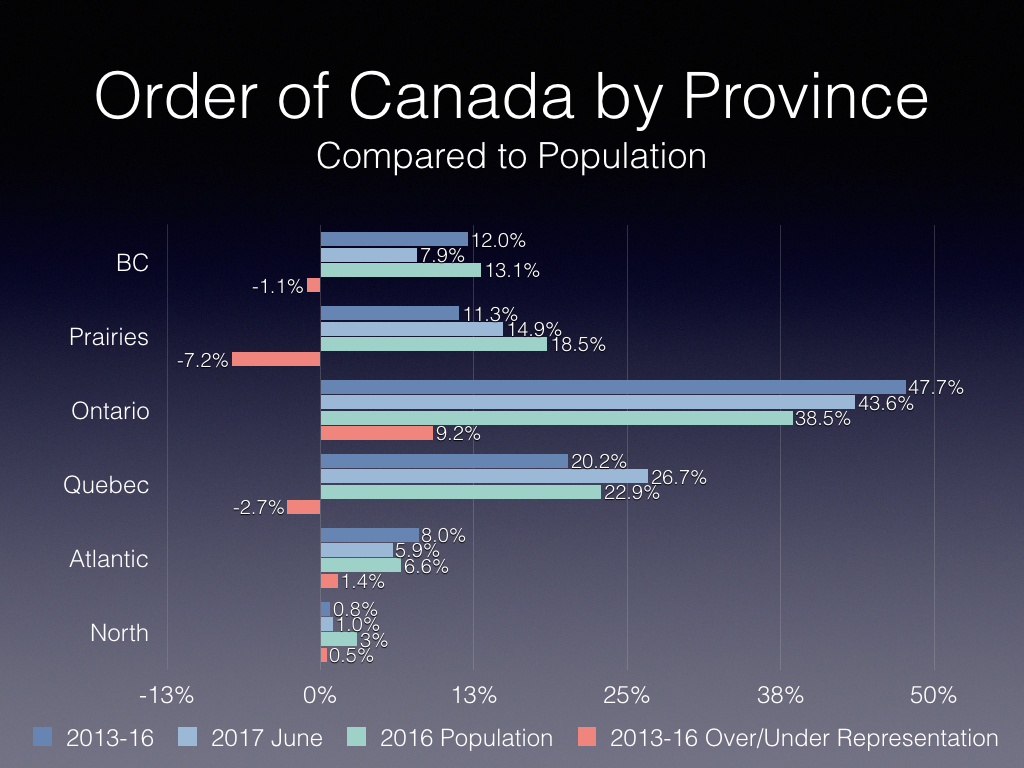
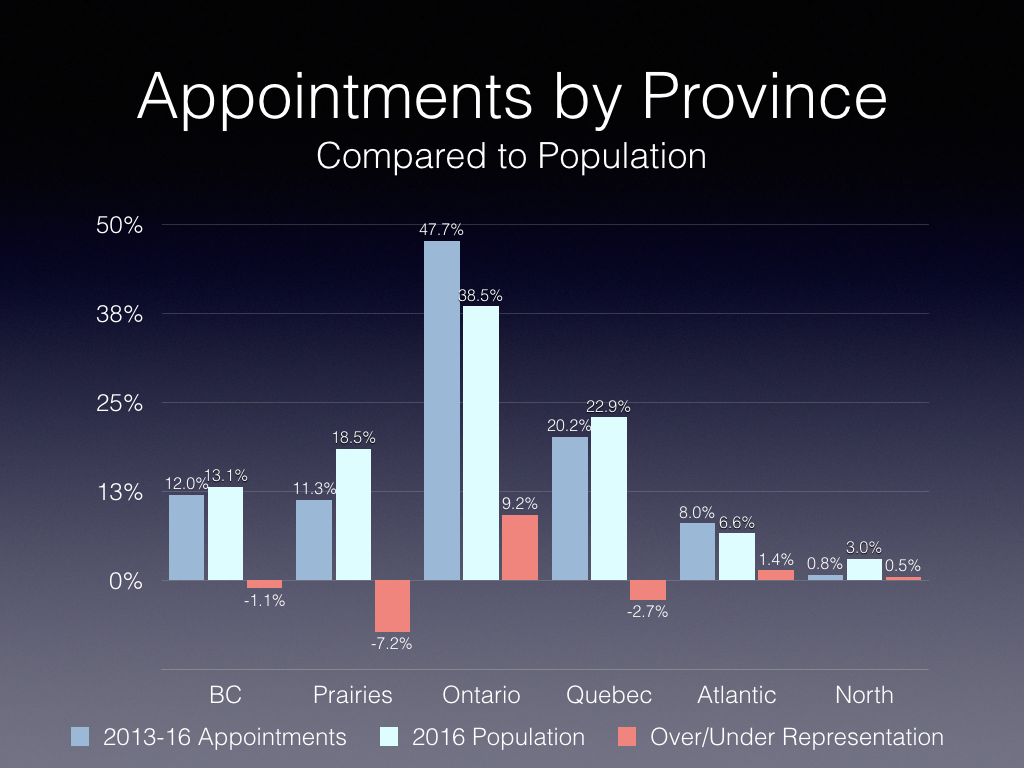
Under the previous government, there were efforts to improve representation with respect to regional representation (e.g., under-representation in the West, over-representation in Ontario and Quebec) and under-representation of the business community (see my earlier The Order of Canada and diversity).

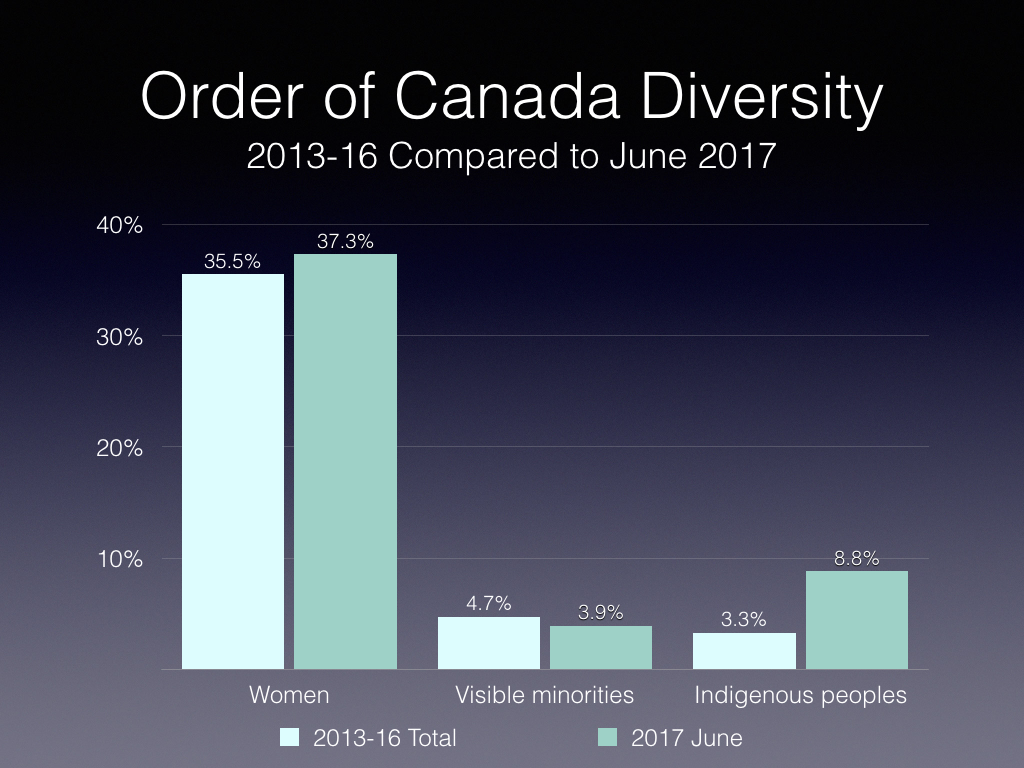
Recently, it appears that Indigenous representation has increased substantially, and is now greater than their percentage of Canada’s population. Visible minorities, reflecting in large part their relatively newer presence in Canada, but also likely some network effects of not visible minorities, remain under-represented. And women’s representation seems to have plateaued at about one-third with a few exceptions.

And, as the article correctly points out, there are already a considerable number of existing public service awards, both general and department specific:

The Liberal government wants to see more medals pinned on the chests of public servants, and so has established a kind of quota system to make sure they’re nominated more frequently.

Michael Wernick, clerk of the Privy Council and Canada’s top public servant, has pressed all federal departments to submit the names of at least five of their employees each year to the Governor General’s office for various awards.

“We encourage you to task the senior managers responsible for employee recognition within your department to begin nominating at least five public servants per year for Canadian honours,” says a letter co-signed by Wernick and Stephen Wallace, then-secretary to the Governor General.

The fall 2017 missive to deputy ministers, obtained by CBC News under the Access to Information Act, was followed up last year directly by the Governor General’s office to ensure departments were co-operating.

“We look forward to hearing about your department’s strategy to recognize deserving individuals in your department whose achievements, contributions or accomplishments have made a difference or have had a positive impact on your organization,” says an email from Sylvie Barsalou, administrative officer with the Chancellery of Honours.

The Liberal government initiative was triggered by an internal assessment that concluded public servants historically have been “underrepresented” within the Canadian Honours System, which includes a broad range of medals and decorations.

“[W]e are taking steps towards reversing this phenomenon,” says the Wernick-Wallace letter.

Called ‘underrepresented’

A spokesperson for the Governor General cited statistics for the Order of Canada, one of the Government of Canada’s highest honours, to support the claim that public servants are underrepresented.

“Between 1976 and 2018, people whose contributions were considered ‘public service’ made up, on average, 2.4% of annual appointments to the Order of Canada,” Sara Regnier-McKellar said in an email.

“Over this time period, public servants comprised an average of 5.9% of Canada’s employed labour force each year.”

The phrases “public service” and “public servants” in this context, she said, refer to those working in all kinds of governance and government, including Indigenous governments and municipal, provincial and federal governments.

The impact of the new nominating initiative is unclear. Both the Governor General’s office and the Privy Council Office (PCO) say they are not counting nominations submitted by federal departments.

“We do not monitor or track nominations and have no plans to do so,” said PCO spokesperson Stephane Shank.

At least one department – Innovation, Science and Economic Development – formally launched the PCO initiative internally on Aug. 15, 2018, says a briefing note to the deputy minister.

“It is anticipated that most nominations will be submitted for the Meritorious Service Decorations,” says the note, also obtained under the Access to Information Act.

Civilians in silver

Civilian versions of the Meritorious Service Decoration – either a service cross or a medal, both of silver – were introduced in 1991, complementing a military variant. A formal nomination requires the names of three people as references, as well as a full description of the reasons for making the award.

More than 800 civilian service crosses and medals have been awarded since 1991 — about 28 each year.

The Wernick-Wallace letter also says departments might consider nominating their employees for the Order of Canada. Wernick himself sits on the committee that vets such nominations.

There’s no shortage of other awards specifically reserved for federal public servants. The annual Public Service Award of Excellence, for example, recognizes five categories, including “outstanding career.” There were 123 recipients last year (131 in 2017); each one receives a medal.

And new awards are being added each year. The newly created Parliamentary Protective Service, which has provided security on Parliament Hill since June 23, 2015, recently launched an awards program involving gifts such as jewellery, art and show tickets to recognize excellence, long service and retirements.

Canada’s new information commissioner, Caroline Maynard, also created a new award last year for access-to-information officers, selecting two employees (at the Canada Revenue Agency and the Canada Border Services Agency) as the inaugural recipients.

The Canadian Press reported in 2013 that the Treasury Board of Canada was spending an average of more than $100,000 a year on gifts and prizes for public servants in that department.

The Governor General’s office alone is responsible for 13 categories of national awards, and lists a total of 413,526 people in its database of previous and current recipients.

Order of Canada 2013-18: Diversity

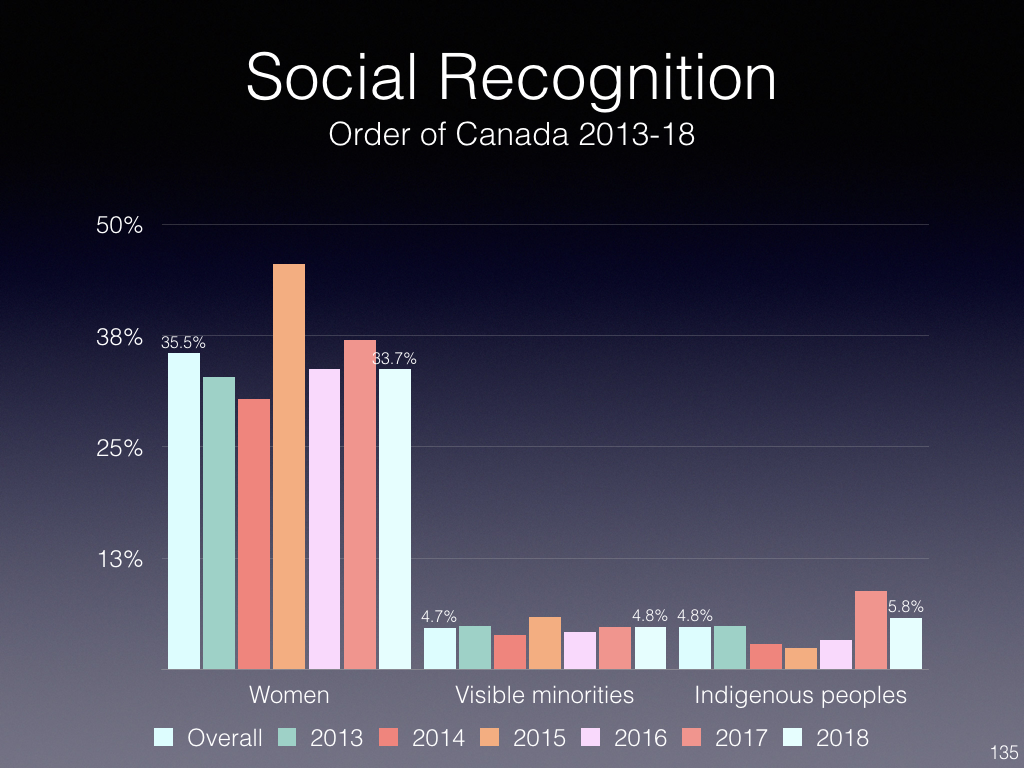
With the latest batch of Order of Canada appointments, I have updated my summary of the number of women, visible minorities and Indigenous peoples for the years 2013-18:

Order of Canada Appointments Update

For those that are interested, with the December 2017 Order announcements, I was able to update a number of  the key charts from my earlier The Order of Canada and diversity.

The first charts looks at the overall diversity of 953 appointments, broken down by year, for the last five years. The most notable change is the large jump in the number of Indigenous peoples appointed to the order in 2017 (particularly the December appointments).

Source: Order of Canada announcements

The second chart shows the provincial breakdown compared to the population shares, showing the historic pattern of over-representation of Ontario.

The third chart breaks down appointments by rank and group, showing slight relative over-representation at the officer level for visible minorities and Indigenous peoples compared to the ‘feeder’ group member level.

Source: Order of Canada announcements

While as noted in the article, there are a number of factors that make Order of Canada appointments an imperfect indicator for diversity and inclusion (i.e., nomination driven process, regional balance considerations etc) it nevertheless provides a sense of how the contributions of three employment equity groups are publicly recognized.

Order of Canada marks 50 years of honouring Canadian contributions – Diversity analysis


Two charts contrasting the 2013-16 baseline with the latest appointments, which should start reflecting some of the changes and additional funding announced in Budget 2015 to improve under-represented sectors, understood as Western Canadian and business-related appointments (see my earlier article in Policy Options The Order of Canada and diversity).

Given that these are only part-year appointments, full-year numbers may or may not confirm these apparent changes in diversity and provincial representation:

The Order of Canada marks its 50th anniversary this year with 99 new appointments on its Canada Day honours list, including renowned figures from the fields of law, government, entertainment and sport, as well as Canadians whose contributions are less widely known.

The list includes soccer star Christine Sinclair, television host Alex Trebek, actor Catherine O’Hara and Globe and Mail editorial cartoonist Brian Gable.

Three people were named to the highest rank, Companion of the Order of Canada: former Supreme Court Justice Marshall Rothstein, National Arts Centre president Peter Herrndorf and The Prince of Wales.

Nineeteen people were named Officers of the Order of Canada, including former spymaster Richard Fadden, hockey player Mark Messier and actor Michael Myers. There were 77 people named as members of the Order, including opera singer Tracy Dahl, historian Bill Waiser, public health nurse Cathy Crowe and Indigenous leader Terrance Paul.

The Order of Canada is considered one of the country’s highest civilian honours. It was created in the centennial year of 1967 to recognize outstanding achievement and service to the community. More than 6,700 people have been named to the Order in its 50 years.

Source: Order of Canada marks 50 years of honouring Canadian contributions – The Globe and Mail

Australia: Queen’s honours list awards diversity, multiculturalism and Indigenous service | SBS News

Another illustration of the differences between Australia and Canada: this article highlights in a positive sense that 1.6 percent of the Australian honours list (equivalent to the Order of Canada) are from visible minorities or Indigenous peoples (or have made major contributions to these communities).

By way of comparison, in Canada 2013-16 Order recipients were 4.7 percent visible minority, 3.3 percent Indigenous peoples (The Order of Canada and diversity):

The list of almost 900 Australians included a dozen honoured for their contribution to Indigenous Australia and fourteen honoured for their contribution to multiculturalism and diversity.

Source: Queen’s honours list awards diversity, multiculturalism and Indigenous service | SBS News

The Order of Canada and diversity

My latest, in Policy Options:

In Budget 2015, the then Conservative government announced additional funding of $13.4 million over five years and $2.8 million in ongoing funding for the Canadian Honours System. This aimed to “bring [honours] closer to all Canadians” by increasing the number of Order of Canada nominations from “under-represented sectors” (e.g. business) and regions (i.e. the West).

This was prompted by an Ottawa Citizen analysis that showed only 26 percent of recipients since the Order’s creation in 1967 came from the West, compared to the region’s 31 percent share of the population. In contrast, Atlantic Canada had 11 percent of recipients, about twice its share of the population. Moreover, the study showed an increasing percentage of awards had gone to those active in the arts while the share going to business people had declined.

Source: The Order of Canada and diversity (for complete article)

Order of Canada Recipients 2016 – Diversity

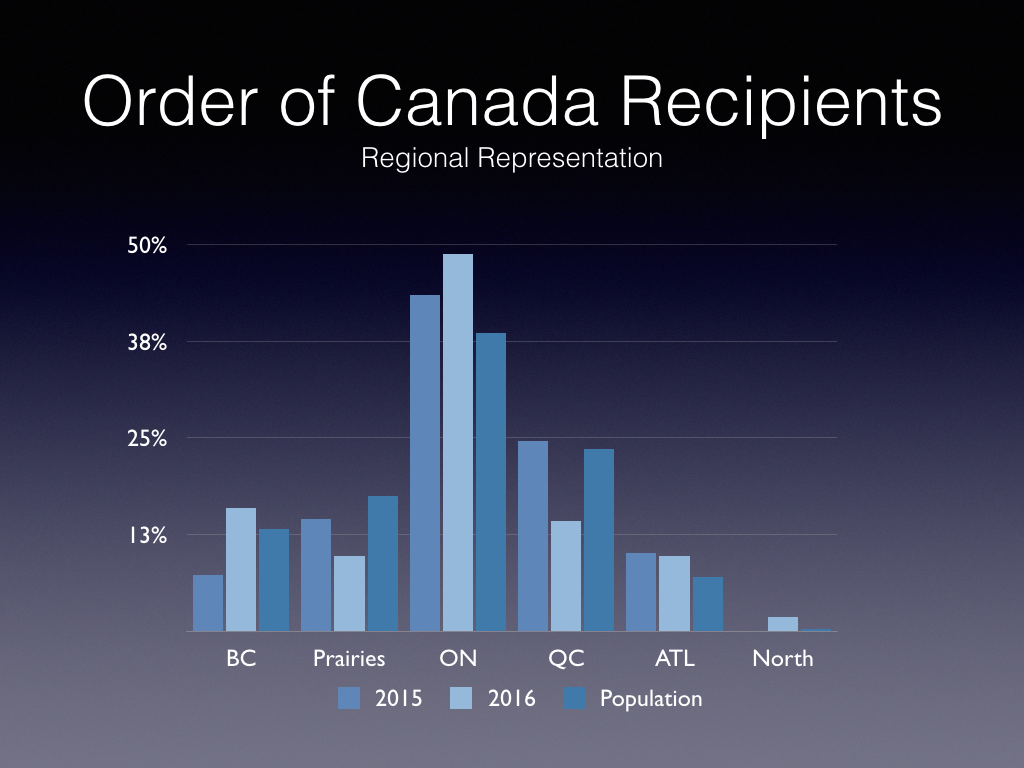
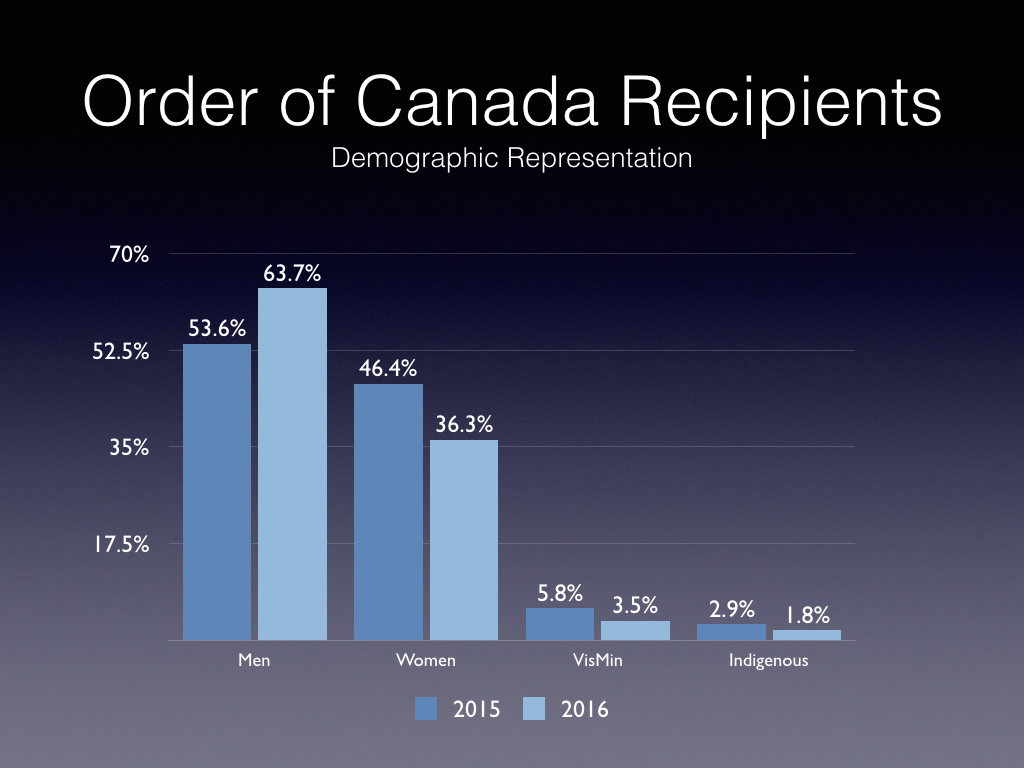
Order of Canada Recipients.001 Order of Canada Recipients.002The above slides analyze this year’s appointments along with last year’s for comparison purposes.

Two aspects strike me:

  • despite the previous government’s efforts to encourage representation more in lines with provincial populations, Ontario, British Columbia and Atlantic Canada remain over-represented, the Prairies and Quebec under-represented; and,
  • the share of women declined substantially. Although visible minorities and Indigenous peoples data is less certain (based upon names, short cvs and photos), representation of these groups also appears to have declined.

As these are not under the direct control of the government, and the lengthy nomination and appointment process, it is not surprising that this year’s appointments do not reflect the current government’s diversity and inclusion agenda.

Order of Canada Appointments 2015 – Diversity lens

Media commentary largely focused on gender and regional diversity as can be expected. The lengthy process involved (about a year) means that this largely took place under the previous government (although the process and decisions are under the GG).

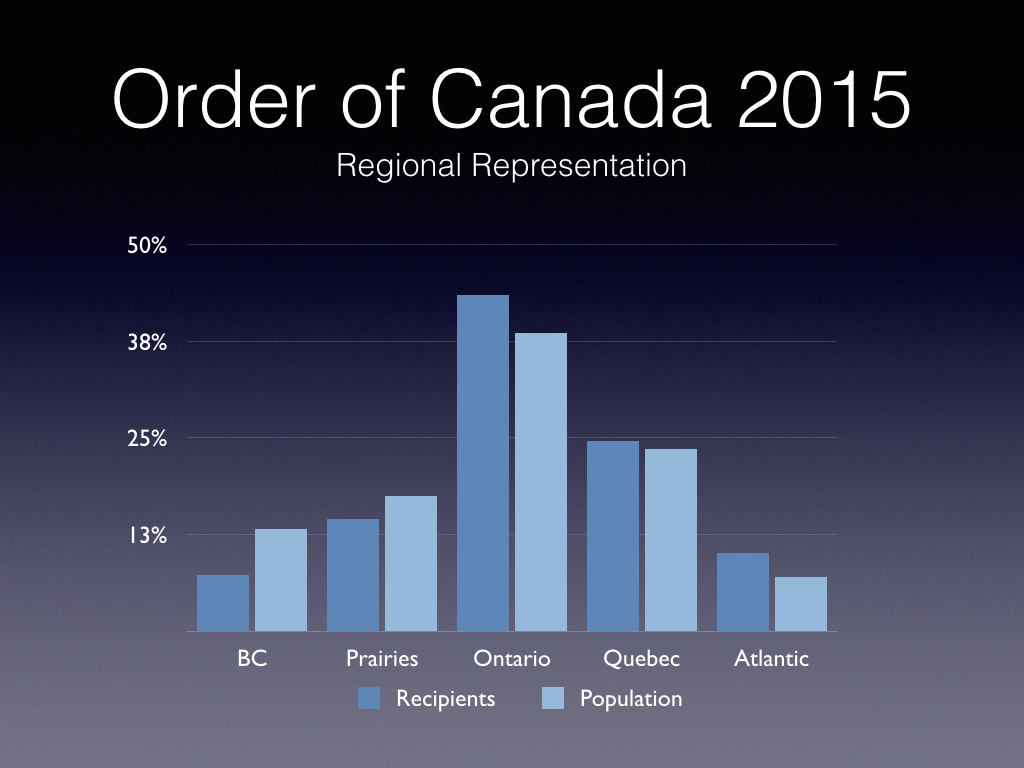
Looking at regional diversity, as some have noted, Ontario and Atlantic Canada are over-represented in relation to their share of the population:

Order of Canada 2015.001

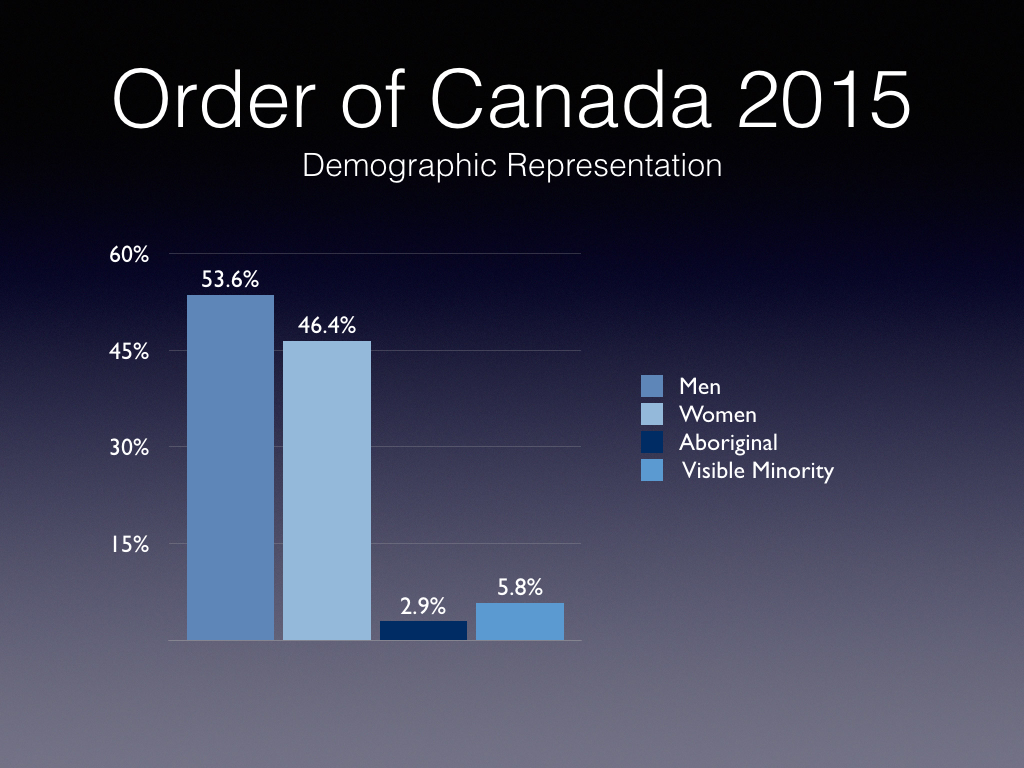
Looking at gender, indigenous and visible minority representation, both women and indigenous representation are relatively close to their share of the population.

However, visible minorities, whether measured against the overall number (19.1 percent) or the number who are Canadian citizens (15 percent), are under-represented at 5.8 percent. (Note: this analysis was based on names and descriptions and not correlated against photos and thus may understate representation).

Order of Canada 2015.002

This is not surprising, given that visible minorities have a shorter history in Canada than other ethnic groups and thus less time to make the kind of contributions that the Order recognizes. But, like other open nomination processes, it may also reflect fewer nominations, in turn reflecting less awareness among visible minorities regarding the Order.

Hard to say without more data but suggests that more outreach to get more nominations may be warranted.

Order of Canada Appointments