Maximum Canada is happening
2023/07/05 Leave a comment
Rather naive in terms of minimizing the practicalities of ensuring adequate housing, healthcare and infrastructure, one of the key points that Saunders needed to be addressed in Maximum Canada. And the nation-building aspect overstated, given this gap and persistent low productivity that current policies, with few exceptions, are not addressing. Same large population fallacies:
A lot of people — at least, a lot of people who read this blog — know of Matt Yglesias’ book One Billion Americans. It’s good, you should read it. But not as many seem to know that it’s actually a riff on a book that came out three years earlier called Maximum Canada: Why 35 Million Canadians Are Not Enough, by Doug Saunders. In fact, the books are pretty different; Saunders spends most of his time justifying the idea of a bigger Canada with appeals to the country’s history, culture, and politics, where Yglesias mostly discusses the practical details of how we’d fit the newcomers into the country.
But what these two books share is that they’re both advocating a certain type of nation-building strategy — the idea of deliberately promoting large-scale immigration in order to expand a country’s population toward a numerical target. This isn’t something the U.S. has really done in the past. We enacted laws to make immigration more or less restrictive, but this was typically done either as an ad-hoc reaction to a wave of immigration pressure from abroad (e.g. in 1924), or out of moral and ideological concerns (e.g. in 1965). To a large extent, we didn’t really have to do this; people were almost always beating down our door to get here, and all we had to do was sit back and decide who to let in. (In the two decades after the Civil War, there was some talk of recruiting immigrants from abroad to populate the Midwest and West, but this was shelved when it turned out lots of people wanted to come of their own accord.)
Canada, for much of its own history, was similar. But in recent years, the Canadian government has begun to set hard targets for immigration, such as last year’s target of 1.5 million more by 2025. And the country is deliberately encouraging more people to come, with one of the world’s most aggressive recruitment strategies.
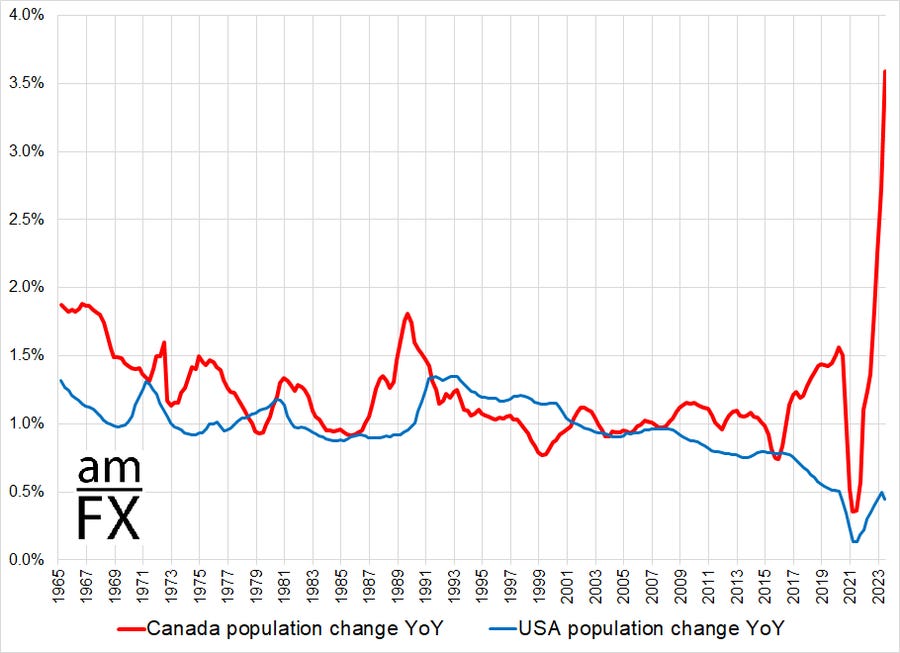
First, let’s just take a look at the results Canada is achieving. The country’s population has just passed 40 million — a 14% increase from when Doug Saunders published Maximum Canada. The national statistics agency loudly celebrated the achievement. And the country’s population growth rate has just shot up to over 3.5%, which is among the world’s fastest:
Here’s another fun graph, just from Nova Scotia:
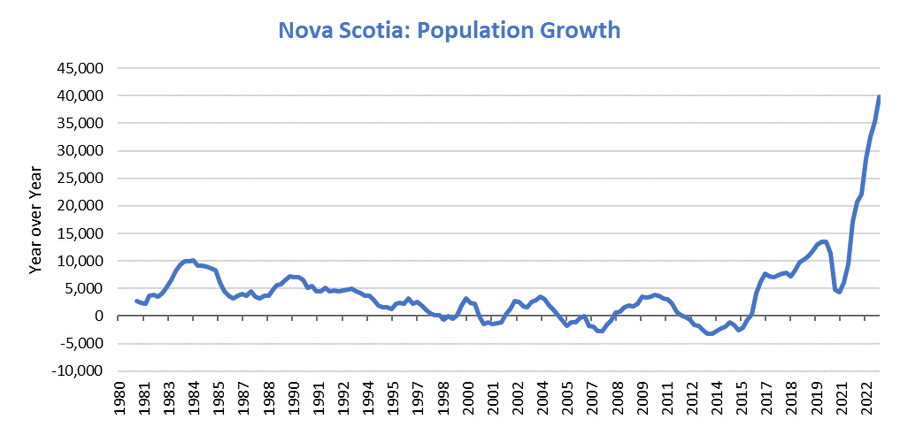
And this is all from immigration. The country’s total fertility rate is 1.4, far below the replacement rate. Yet population is booming because Canada is recruiting from abroad.
This isn’t quite Maximum Canada yet, but it’s clearly headed in that direction.
And Canada’s zeal for greater population inflows is matched by its determination to recruit the best and the brightest en masse. The country’s points-based immigration system, the Federal Skilled Worker Program, is well-known, as is the Provincial Nominee Program that allows individual Canadian provinces to recruit immigrant workers to specific locations. But the country keeps adding more programs for grabbing talent. Its latest idea includes an offer of permanent residency to people working in the United States on H-1B visas — basically, poaching America’s own skilled immigrants! Here are some excerpts from the announcement:
As part of Canada’s first-ever Tech Talent Strategy, Minister Fraser announced the following aggressive attraction measures:
- the creation of an open work permit stream for H-1B specialty occupation visa holders in the US to apply for a Canadian work permit, and study or work permit options for their accompanying family members
- the development of an Innovation Stream under to the International Mobility Program to attract highly talented individuals…
- the promotion of Canada as a destination for digital nomads
- the creation of a STEM-specific draw…under the Express Entry program…
- improvements to the Start-up Visa Program
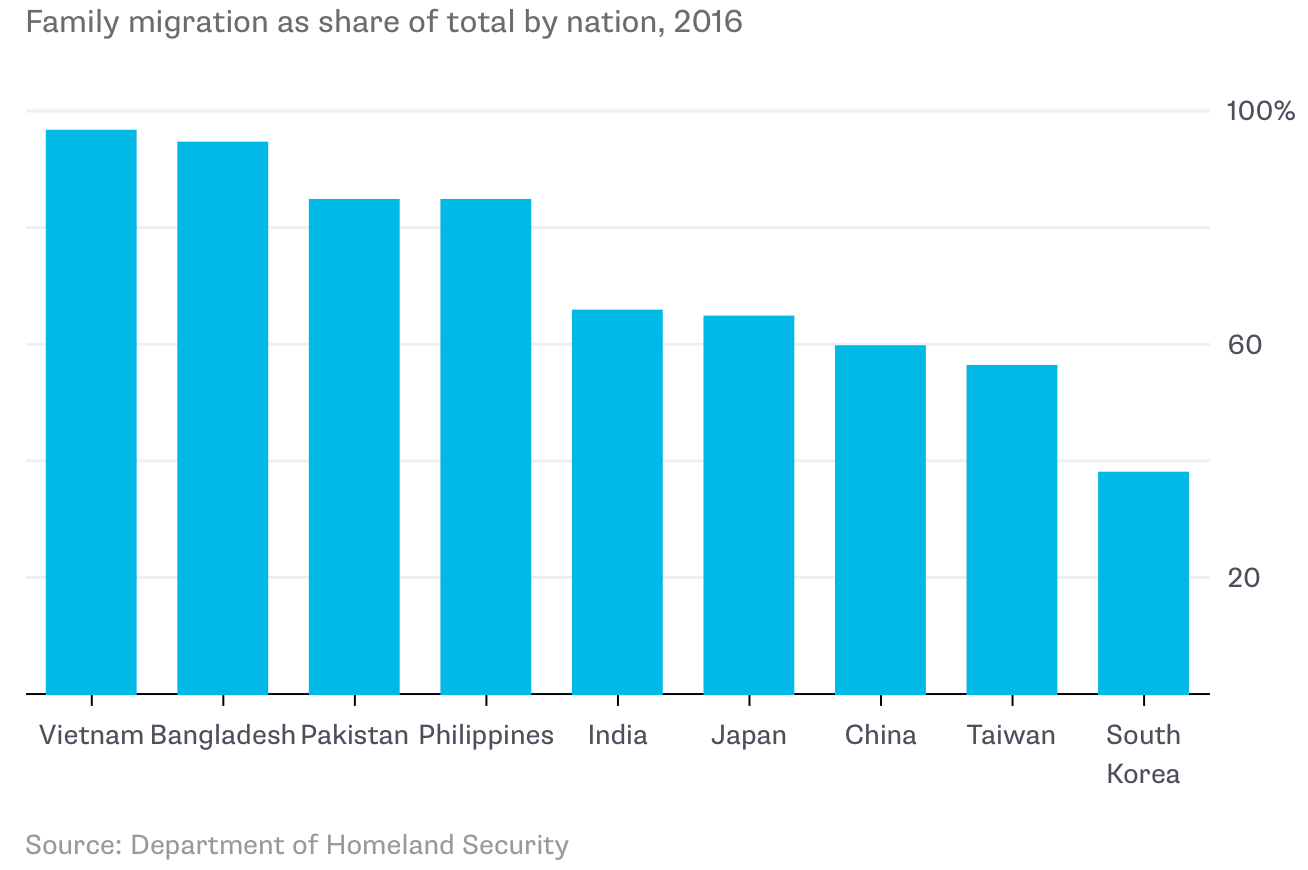
Canada also has family-based and humanitarian immigration programs like the U.S. does, but the big difference here is that they take absolutely massive numbers of skilled immigrants from all over the world.
All of this adds up to what looks to me like a nation-building strategy. Canada has a clear vision for itself as a multicultural mecca for all of the world’s smart and hard-working people. It’s a bit like Singapore, except more democratic, and without that country’s emphasis on preserving a single ethnicity’s demographic dominance. If you’re smart and you want to work and you like Canadian culture, it doesn’t matter what you look like; you’re in the club.
What’s amazing is that the vast majority of the country’s populace appears to have signed onto this strategy. As Derek Thompson writes, immigration has not produced a big backlash in Canada, outside of some highly localized concerns (like Chinese capital flight buying up property in Vancouver). A little of this might be from the Anglophone majority’s desire to reduce the political influence of Quebec, but much of it is just that multiculturalism and immigration are deeply rooted in the country’s self-defined national identity. And on top of that, the fact that so much of Canada’s immigration is based on employment prospects and skills probably reduces social friction; immigrants are likely to make a lot of money and not commit much crime.
There’s also one additional factor that no one talks about, but which would definitely be on my mind if I were Canadian: national security. Canada has a very large, very powerful, and occasionally politically unstable neighbor to its south. It has already defeated one invasion from that southern neighbor, and while more recently relations between the two countries have been friendlier, you never know when attitudes might shift. A country of 100 million would be a lot more capable of resisting the U.S. than a country of 40 million.
Of course, there are major challenges for Canada’s nation-building strategy. Chief among these is NIMBYism; Canada is huge, but you can’t just scatter your population randomly across the plain (I mean, you can try, but the results are comedic). Modern knowledge-based economies harness clustering and agglomeration effects, which means Canada needs to fit those new millions into its cities. And despite very low crime rates, Canada is having a bit of trouble doing this. Unlike Japan, Canada does not have simple national zoning laws administered by a competent technocratic bureaucracy; instead, local municipalities are free to block housing as they choose.
And block it they do. The Fraser Institute notes that Canada is not building nearly enough housing to house its massive population inflows:
And the mismatch has been getting worse over time:
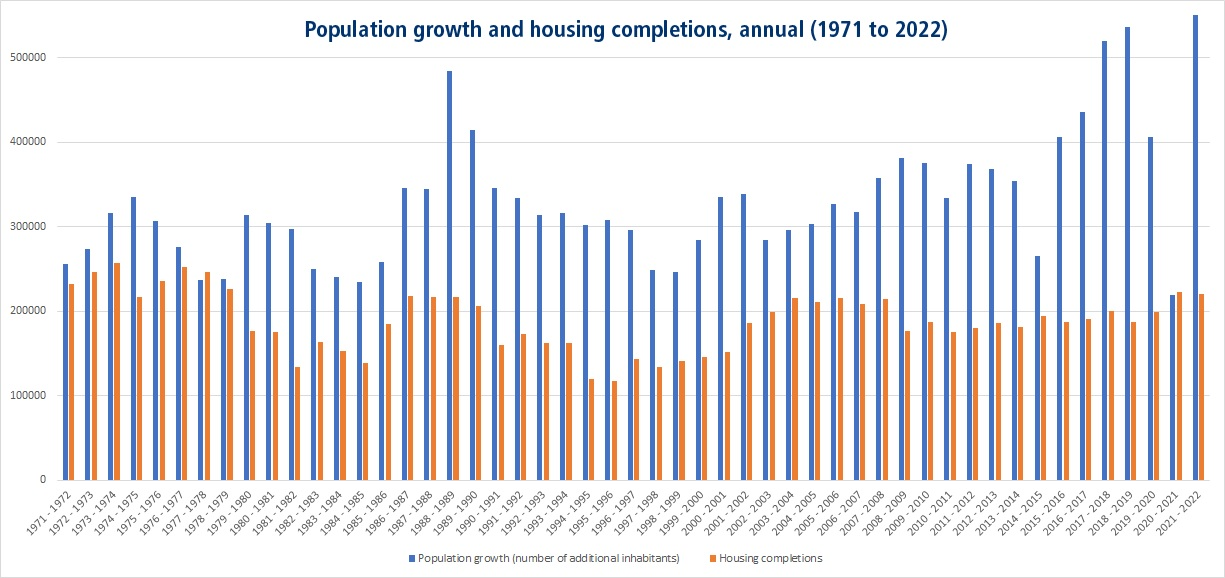

Jean-François Perrault of Scotiabank notes that Canada has fewer housing units per 1000 people than France, Germany, Japan, the UK, or even the United States. He writes:
A key challenge is finding an approach that can overcome the political obstacles to a better supply response. Very often within city limits, measures to increase density pit current owners versus prospective residents. Municipal councillors are politically responsive to their voters given the nature of the democratic process. What may be great policy from a national perspective, like high immigration, runs into obstacles when it means finding practical solutions at the local level to increase the housing stock…
To get a sense of the main obstacles to a more elastic supply response, we have polled several of our clients in real estate and development across the country to find the cross-cutting factors they see as most limiting supply growth. To no surprise, the key impediments are in the planning and approval process. In many major cities, the entitlement process is very lengthy and unduly political. Many processes can delay or derail development applications and this can be exacerbated by under-resourced planning departments within cities.
Hmm, where have I heard this story before??
Even Canada’s commitment to multiculturalism is starting to come into conflict with its anti-housing NIMBY instincts. The government returned a plot of land in the middle of downtown Vancouver to the Squamish Nation, which promptly planned a very cool dense housing development with solarpunk aesthetics. The project is still going ahead, but urban planners are now starting to complain about the density, and local residents are trying to stop an access road to the development.
This will simply not do. If you let in tens of millions of people, you must house them; there is simply no other option, other than to let rents continue to skyrocket until the people revolt. Canadian leaders would do well to supplement Doug Saunders’ book with Matt Yglesias’ pragmatic tome. If Canada can’t figure out how to beat its entrenched NIMBY instincts and replace its old ideal of quiet pastoral low-rise cities with one of dense, bustling, efficiently functioning metropolises, it will never achieve Maximum Canada.
In the meantime, though, we Americans to the south need to take a hard look at what Canada is doing, and ask ourselves why we can’t do something similar. Like Canada, the U.S. is a highly diverse nation of immigrants. Like Canada, our fertility is below replacement (though not quite as bad), and we rely on immigration for population growth. Like Canada, we face the inherent economic disadvantage of being located far from the world population supercluster in Asia, and thus we will always be fighting an uphill battle to get high-value industries to want to locate here. So like Canada, we should be importing huge numbers of skilled immigrants — especially because our software and finance and biotech industry clusters, and our world-beating research universities, make it easier for us to attract skilled immigrants in the first place. We should be playing to our strengths.
And yet in the U.S., immigration of any kind is now at the center of a vicious culture war. The political right may occasionally claim that they only oppose illegal immigration, or that they want skilled immigration, but when it comes time for actual policy proposals, what they want is just to decrease all types of immigration. The days of pro-immigration Republicans like George W. Bush are gone. In fact, various hard-right figures have specifically railed against immigration from India, which is America’s most important source of skilled immigrants.
Meanwhile, American progressives, unlike their Canadian counterparts, seem generally unenthusiastic about the idea of mass recruitment of high-skilled foreign workers; my suspicion is that they fear the competition the children of these immigrants will provide for their own children in the academic system. Instead, in recent years, some progressives have begun to lean toward the idea that immigration should be viewed as a form of reparations for colonialism, rather than a strategy for nation-building. Naturally, that absurd idea just triggers the right even more.
This is a terrible political equilibrium. Survey after survey finds that Americans very strongly support high-skilled immigration, but because it’s a political football, only centrists like Biden seem interested in doing anything about it. Without a popular political mandate, any nation-building strategy like Canada’s is doomed.
I wish Americans could tell themselves a positive narrative like Canada’s — of immigration as the way to build a multicultural nation. Many of us have tried to tell that narrative, and have foundered on the rocks of America’s age of division. As John Higham wrote, when America is underconfident — when we start to doubt who we are as a people and a nation — we instinctively think about closing the door. Right now, America definitely doesn’t know who we are, as a people and as a nation. Maybe next decade we’ll remember.
Canada, however, does know who they are. And good for them. Now all they have to do is build a bunch of housing, and they’ll be golden.
Source: Maximum Canada is happening


 Multicultural Meanderings