Canada is Recruiting H-1Bs. DACA Recipients Could Be Next.  

Of note:

Deferred Action for Childhood Arrivals, or DACA, is a program that provides legal protections and work authorization to immigrants who otherwise lack legal status but were brought to the U.S. as children through no fault of their own. In place since 2012, DACA currently protects over 570,000 Dreamers, the majority of whom have been productive members of the American economy for years.

Despite the well-documented contributions of DACA recipients, the program continues to hang in legal limbo. For two decades, Congress has failed to authorize permanent protection, and now, some Republican states are suing to terminate the program. While activists scramble for solutions ahead of an inauspicious Supreme Court decision, the door is open for Canada to poach yet another crucial group of U.S. residents.

In recent months, Canada has escalated its efforts to actively recruit immigrants with work experience in the U.S. or an American education. From creating a new visa for specialized foreign workers in the U.S. to running targeted ads for individuals frustrated with the American immigration system, Canada and its businesses have long since benefited from the dysfunction of our immigration laws. 

While Canada has not yet publicly attempted to entice DACA recipients to consider northern migration, it may be a matter of time before it does. DACA recipients would be competitive applicants for Canadian visa pathways like the points-based Express Entry program designed to attract the world’s best and brightest. 

Express Entry does not require employer sponsorship and instead awards points for qualifying factors like work experience, English language proficiency, and education. Points are also assigned according to age, with applicants between 18 and 35 receiving the highest possible age points

The average DACA recipient is 29 years old, and nearly half have college degrees. More than 80 percent of DACA recipients are working, and most have lived in the U.S. for over 20 years, receiving the majority, if not all, of their formal education here. Although many DACA recipients are bilingual, surveys indicate that “over 90 percent speak English well, or better.” By these standards, most DACA recipients would likely receive high scores that could result in invitations to migrate. 

Given the number of American corporations that have previously voiced supportfor their Dreamer employees, it is easy to imagine employers willing to sponsor employees who transfer to their Canadian offices through other visa pathwaysshould they lose work authorization here. 

If Canada poached these Dreamers, the United States would face significant economic losses as Canada reaps the benefits of highly productive U.S.-trained immigrants. 

For instance, Dreamers would pay their rent or mortgage in Canada, which, in the U.S., currently generates $272 billion in economic activity every month. They would spend money on groceries, clothes, transportation, and services in Canada. 

The U.S. would also lose teachers and essential workers while Canada filled its labor market gaps with our American-educated talent. The nearly $40 billion that Dreamers would contribute to Social Security and Medicare over the next ten years would instead bolster the Canadian social security system. 

Even after taxes, DACA-recipient households still hold over $25 billion in spending power, but if they go to Canada, their money will likely go with them. Under the Express Entry program, selected candidates receive permanent residence for themselves, their spouses or common-law partners, and their dependent children. Even temporary foreign worker programs in Canada permit immediate family members to accompany the beneficiary and work. 

With over 300,000 U.S. citizen children, the impacts of their departure would represent a significant loss for the U.S. economy and labor market when we are already struggling to fill the jobs we need. DACA recipients are, on average, more educated than the native-born U.S. population and have higher workforce participation rates. Yet, without action, we risk losing these productive individuals raised with American values, educated in the American school system, and trained in the American labor market. 

We have already witnessed Canada siphoning thousands of our valuable immigrant workers and taking advantage of our inability to create policies that retain the talent we attract and cultivate. If we do not act on DACA, Canada will also take advantage of this opportunity by becoming the haven that DACA recipients have been seeking in the U.S. for over a decade. Bipartisan solutions can protect Dreamers and allow them to stay and contribute to the only home they’ve ever truly known. Timely action is imperative. 

Source: Canada is Recruiting H-1Bs. DACA Recipients Could Be Next.

Canada’s ploy to use U.S.-trained immigrants to surpass American innovation

Good explainer and advocacy:

The U.S. engages in the global innovation race every single day. From artificial intelligence to nuclear technology and net-zero ambitions, cutting-edge innovation is crucial to protecting the U.S.’s economic wellbeing and security. According to the Global Innovation Index, the United States falls behind Switzerland, ranking second for the most innovative economies in the world.

Yet our biggest competition comes from the countries ranking behind us. China and South Korea are rapidly rising through the ranks, nearing ever closer to overtaking American innovation. And thanks to our ongoing immigration failures that drive talented immigrants away, Canada is also close in the rearview mirror.

This month, Canada launched a new visa specifically for individuals already holding an American H-1B visa. Less than 48 hours after the launch, 10,000 applicationswere already submitted. H-1B visas are issued to foreign workers who U.S.-based employers sponsor to fill specialty occupations. These workers are educated and highly sought-after, and the demand for them far outpaces visa availability.

Most H-1B visas are issued on a lottery basis, and Canada has often been the second-best destination for companies and individuals failing to secure a spot. However, the new Canadian visa isn’t targeted to these unsuccessful applicants–rather, it aims to entice those who were selected and now work in the U.S.

Although Canada has long  benefited from the international appeal of its southern neighbor and from our immigration system’s inability to retain the talent we attract and produce, this new visa is the most overt attempt yet to lure away valuable U.S. employees.

It demonstrates that Canada recognizes what the U.S. still does not: immigrants are among the most creative and innovative members of our society. They patent more inventions and start more businesses per person than native-born citizens. And when armed with a U.S. university degree or experience at a U.S. company, their value skyrockets–increasingly, to Canada’s benefit.

Canadian Versus U.S. Programs

In designing its visa, Canada took the general parameters of the H-1B and made them even more attractive.

Like the American H-1B, the Canadian visa offers employees an initial stay of three years. Unlike the U.S., Canada will offer these workers open work authorization, allowing them to work for nearly any employer anywhere in Canada. While only some spouses of H-1B workers are eligible for work authorization in the U.S, Canada’s program will allow all spouses and dependents to apply for work or study permits.

The Canadian program outshines the H-1B chiefly because it offers a much more accessible route to permanent residence. After just one year of full-time eligible work experience, workers can apply for many permanent residence pathways available to them.

One of the most direct and widely used pathways, the Express Entry program, does not require employer sponsorship, boasts processing times of 6-12 months, has no country caps, and costs just over $1000.

On the other hand, transitioning from H-1B status to employment-based permanent residence in the U.S. requires employer sponsorship, is subject to country and annual caps, can take years to obtain, and, at a minimum, costs well over $2000.

While the worker benefits of the Canadian program are indisputable, the program is likely to be lucrative for Canada as well.

American Economic Loss Is Canada’s Economic Gain

Canada has repeatedly opened its doors to companies and employees stalled by the American immigration system, and while company profits may still flow southward, even remote workers boost economic activity in Canada by contributing in tax and local consumption.

Even when accounting for money sent abroad or home to other relatives, an estimated 85% of migrant worker earnings are reinvested in the local economy. For instance, an employee earning the average H-1B wage of $126,000 may invest over $107,000 in taxes and local expenditure, adding up to nearly $47 billion for the whole population of FY2022 approved beneficiaries. If these individuals instead worked remotely from Canada, that $47 billion would likely be spent there, even if the company headquarters remained below the border.

With the introduction of this new program, however, the employees the U.S. loses will be free to terminate their relationship with the American company that sponsored their H-1B. They will have nearly free choice to work for any employer operating in Canada, whether that company is Canadian, American, Chinese, or other.

The U.S., therefore, is poised to lose not only the taxes and spending of these individuals but also the crucial knowledge they accumulated while working here. Sixty-six percent of H-1B beneficiaries approved in FY 2022 were employed in computer-related occupations. The technology they learned and mastered in the U.S. will fuel innovation in Canada and the companies working within its borders.

The Canadian program aims to recruit only 10,000 H-1B holders this year. Still, that amounts to  nearly 12 percent of our annual H-1B cap–or as applied to the above model of income reinvestment, over $1 billion in spending power. Without these specialty workers and their economic and innovative contributions, the U.S. is likely to fall behind.

This visa is set to compound the brain drain already siphoning American-trained talent across our northern border.

While there are many ways to promote innovation, one of the primary weaknesses of the American economy according to the Global Innovation Index is our underwhelming production of STEM graduates. International students in the U.S. are much more likely to study STEM fields, and when the H-1B lottery does not play in their favor or permanent sponsors do not materialize, these students often turn to Canada, further slashing our already subpar numbers. This is already playing out as we recently lost nearly 40,000 foreign graduates through Express Entry alone. The new H-1B visa pathway will only expand that trend.

With this new visa, companies may also choose to offshore employees to Canada more aggressively to bypass the long waits and limited capacity of the U.S. Even entrepreneurs may choose to found their startups in Canada, rather than in the U.S., to facilitate easier access to necessary talent. The next Google or Tesla could begin in Canada. A one-year highway to permanent status seems like a more reliable business foundation than endless waitlists and lotteries with uncertain outcomes. Even so, these possibilities are just the tip of the iceberg in terms of what the U.S. could lose with the launch of Canada’s latest poaching visa.

If we don’t act before Canada entices away even more valuable talent, we are putting our  innovative and economic advantage at risk. Much of Canada’s strategy hinges on human capital that we educate, train, and discard thanks to our flawed immigration system. As such, we should respond by creating an immigration system that can rival Canada’s. It must be accessible, affordable, and functional–a far cry from our current reality.

Source: Canada’s Ploy to Use U.S.-Trained Immigrants to Surpass American …

Niskanen Center: The rising cost of stagnant immigration policy

More on the implications of their recent study (from a Canadian perspective, this harm to the USA is to our benefit):

In a recent Niskanen commentary, we released new data revealing how Canada is poaching valuable graduates of American universities by offering a direct pathway to permanent residency based on merits alone–without requiring sponsorship or even a job offer. What’s more, American companies are increasingly moving their foreign employees to Canada and other nearby countries to avoid the delays in our immigration system.

By seeking immigration status for foreign employees in countries other than the U.S.,  businesses can dodge the visa caps, backlogs, and country caps currently plaguing our immigration system–a short-term win for these businesses.

The practice of moving business operations or employees abroad is commonly known as offshoring or, in the case of our closest neighbors, nearshoring. Although these practices may give businesses greater stability than our current immigration system, they could also severely affect the U.S. economy.

In a survey of over 500 business representatives, 86 percent reported that visa challenges forced them to hire employees abroad for roles intended to be U.S.-based. Ninety-three percent said they were likely to pursue nearshoring or offshoring in the future due to immigration barriers and labor shortages in the U.S.

Businesses consider these alternatives because even after demonstrating that no qualified American workers are available to meet their needs, they are often left without sufficient labor for months or even years due to backlogs and capacity restraints. At that point, transferring a new hire to work remotely from Canada, Mexico, or another nearby country that can promptly meet their immigration needs becomes the next-best option.

While remote work may now be the new normal for many Americans, there are economic consequences to losing out on in-person employment. Many American cities have already felt it, with office buildings remaining empty and downtown lunch spots shuttering their doors.

Furthermore, because American spending patterns have shifted away from city centers, other localities have been able to capitalize on the opportunity for economic gain.

Domestically, one program offers remote workers over $10,000 to live in certain parts of West Virginia, and internationally, many developing countries have profited from Americans’ desire to work remotely by offering so-called digital nomad visaswith hefty incentives.

These policies recognize that although the work contributes to a company’s profits elsewhere, the mere presence of those workers can still stimulate local economic growth.

Similarly, when American companies move workers to Canada out of necessity, Canada benefits through tax and consumption. Foreigners pay income tax to the Canadian government, even if they work for a company that does not have an office or operations in Canada. These workers then spend the vast majority of their income in Canada on rent, cars, groceries, and lifestyle goods.

This translates to the U.S. economy losing out on significant profits made by American businesses because they are used to stimulate economic growth in other countries.

The current outlook for retaining immigrant workers in the U.S. is also hardly promising. The H-1B program for specialty workers was established in the 1990s, and demand for the program has outsized its cap every year since 2004. Country caps have exacerbated already daunting wait times, and some green card wait times are nearly 50 years, even with employer sponsorship.

These factors, among others, make offshoring and nearshoring attractive alternatives for employers frustrated by the U.S.’s current limitations.

The U.S. must act fast to alleviate these concerns by updating the American immigration system so that it’s responsive to our economic interests, capable of attracting and retaining talent, and robust enough to encourage corporations to keep their workforce within our borders. If we don’t, we will only continue investing in the growth and prosperity of our competitors at the expense of our economy.

Source: The rising cost of stagnant immigration policy

Previously unreported data: the U.S. lost 45,000 college grads to Canada’s high-skill visa from 2017 to 2021

Of note, Canadian advantage in play:

Despite having some of the best universities and training programs in the world, the U.S. struggles to retain high-value international students, thanks to our outdated immigration system. Canada has historically been one of our competitors for talent, and new data obtained by the Niskanen Center demonstrates just how stark this problem has become. To remain competitive in the global market, the U.S. must find ways to prevent the continued loss of domestically-trained talent.

The data demonstrate that Canada is eager to profit from the valuable training of our graduates and can do so by taking advantage of the systemic shortcomings that often render our labor market inaccessible to these foreign students.

Niskanen recently obtained previously unreported (and still unpublished) data from the Canadian immigration office’s Statistical Reporting Group detailing top Express Entry applicants’ educational and citizenship backgrounds. Express Entry is Canada’s recruitment arm for skilled talent worldwide. Recipients can pursue permanent residence in Canada without requirements for employer sponsorship or secured employment. Express Entry applicants must demonstrate their language skills, educational credentials, and work experience and are then ranked as a part of Canada’s point-based system. Only the top applicants are invited to seek permanent residence.

According to the data we obtained, between 2017 and 2021, approximately 45,000 invitations went to skilled workers who received their postsecondary education in the U.S–88 percent of whom were not U.S. citizens.

This is especially disconcerting because many international students at American universities do want to work in the U.S. after graduation. What’s more,the U.S. desperately needs these students. Still, our outdated immigration system makes employing them unnecessarily difficult.

One of the most common pathways for international students to remain in the United States is Optional Practical Training, followed by a bid in the H-1B lottery. Unlike Express Entry, success in the H-1B lottery is not based on merit, but on a random selection of petitions chosen for adjudication. The most recent rate of selection was about one in four, meaning that nearly 75 percent of H-1B hopefuls never had the chance to put their credentials before U.S. immigration officials.

This lottery and the overall capacity restraints of the immigration system put the U.S. at a distinct disadvantage. We invest in educating and training thousands of international students every year, often with incredibly valuable skill sets. But then we don’t offer opportunities for these skilled individuals to stay and contribute to our economy after graduation–despite the high demand from employers. This amounts to our loss, and Canada’s gain.

Since 2013, Canadian companies have regularly run billboard advertisements in Silicon Valley to target foreign talent frustrated by the American immigration system’s limitations. These billboards are straightforward: “H-1B Problems? Pivot to Canada.”  Though they target individuals, companies are also responding.

According to Envoy Global’s 2022 Immigration Trends Report respondents, 71 percent of American employers are pursuing global strategies to retain talent that couldn’t obtain U.S. work authorization, with Canada being the top destination for employee relocation.

This is a win-win scenario for Canada. Immigrants arrive ready to work with highly sought-after skills, contribute to the Canadian economy in tax and consumption, and fill — or create — jobs that can stimulate further economic growth.

While international students make up less than 5 percent of all higher education enrollees in the U.S., they are vastly overrepresented in our most crucial fields. For instance, in electrical engineering, petroleum engineering, and computer sciencegraduate programs, approximately 80 percent of students are foreign-born. When the U.S. fails to provide ample and accessible visa pathways for these students after graduation, they take their valuable skills elsewhere–to our competitors’ benefit, and to our detriment.

This new data spells out in stark numbers what we had already reasonably deduced: that the U.S. is in the midst of a brain drain, and Canada is reaping the benefits as talent moves elsewhere to put their critical skills into practice. The U.S. must respond promptly by providing ample and viable visa pathways that can protect the educational investments made in these students.

Source: Previously unreported data: the U.S. lost 45,000 college grads to Canada’s high-skill visa from 2017 to 2021

USA: How anti-immigrant groups are misrepresenting border data

Of note:

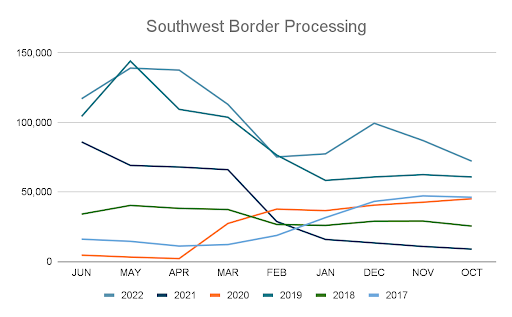
Recently, there has been increasing concern over the growing number of encounters (the number of people apprehended) reported on the southwest border. U.S. Custom and Border Protection (CBP) data show 207,416 encounters in June 2022 — a record high. Many anti-immigrant groups misinterpret — or purposefully misuse — this data, suggesting encounters are akin to admissions or arrests. But citing that number alone to demonstrate the need for more robust deterrence policies ignores the impacts of Title 42 expulsions and discounts historical migration trends.

CBP tracks the number of noncitizens apprehended each month, known as “encounters.” Anti-immigrant groups have cited the high number of encounters in June 2022, stating that it is a dramatic departure from the typical amount of migrants entering the U.S. in other years — but that’s not the case.

The number of migrants at the southwest border demonstrates a return to regular migration trends. In a study of migration trends over the last decade, researchers found that there is consistently an increasing number of encounters between January and May, with a sharp decrease after June.

The Covid pandemic significantly disrupted these patterns. As a result, between March and June of 2020 the U.S. saw the lowest rate of encounters in years. In 2021, that number steadily increased, but the overall was still drastically lower than average. This year, we have seen a return to regular patterns, with numbers increasing in the spring and decreasing starting June.

CBP Southwest Land Border Enforcement data for 2019-2022. Data prior to 2019 can be found here.

Since March 2020, a significant portion of migrants at the southwest border have been subjected to rapid expulsion under Title 42. Although the administration has attempted to terminate the health order, the courts blocked its termination. The result is a recidivism rate for border crossers that is more than triple what it was before the pandemic. Moreover, the encounter data alone does not account for the continued rapid expulsions nor the amount of people who repeatedly attempt to enter the U.S.

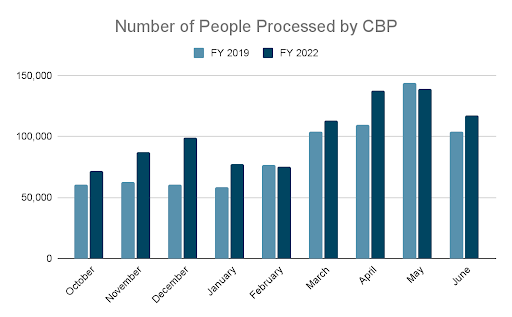
Indeed, the number of people that CBP is processing now is comparable to FY 2019, before the implementation of Title 42 in response to the pandemic. There is only an eight percent difference in the number of people processed in FY19 compared to FY22. In February and May, the Trump administration processed more people in FY19 than the Biden administration in FY22.

CBP Southwest Land Border Enforcement data for FY 2019-2022. CBP Title 42 Expulsions data for FY 2022.

Whenever there is a “surge” at the border, anti-immigrant groups use it as an excuse to call for and implement deterrence policies. Citing numbers of encounters without additional context has led to administrations repeating the mistake of using previously failed deterrence measures.

To counter this pattern, we should learn to anticipate when there will be higher numbers of people arriving at the border and improve processing capacity to efficiently and humanely process those seeking admittance to the U.S.

Source: How anti-immigrant groups are misrepresenting border data

DOL H-1B Visa Wage Rule: Donald Trump’s Bad Parting Gift To Immigrants

Two contrasting views on the Trump administration’s rule imposting higher salary requirements on H-1B visas. The first from the National Foundation for American Policy opposes the change, the second, from the Niskanen Center, supports it. From a self-interested Canadian perspective, the Trump rule provides an immigration advantage to Canadian firms.

Starting with opposition to the change: 

The Department of Labor (DOL) reissued a controversial rule designed to price H-1B visa holders and employment-based immigrants out of the U.S. labor market, setting up new legal battles and a decision by the Biden administration on whether to keep a rule that fulfills a key part of White House adviser Stephen Miller’s anti-immigration agenda. The final rule makes only minimal substantive changes from the original rule and was drafted to avoid the violations of the Administrative Procedure Act (APA) that caused three judges to issue opinions blocking the regulation.

Under immigration law, employers must pay H-1B visa holders the higher of the prevailing wage or actual wage paid to similar U.S. workers. DOL determines the prevailing wage with data from the government’s Occupational Employment Statistics (OES) wage survey and uses a mathematical formula to create four levels of wages for each occupation.

A formula is already problematic, since it is much less accurate than asking employers what they pay employees at different levels of experience. A formula can be manipulated to achieve a result, as analysts note, by artificially raising the required wage. That is what the Department of Labor has done in the two versions of its wage rule.

The Department of Labor (DOL) reissued a controversial rule designed to price H-1B visa holders and employment-based immigrants out of the U.S. labor market, setting up new legal battles and a decision by the Biden administration on whether to keep a rule that fulfills a key part of White House adviser Stephen Miller’s anti-immigration agenda. The final rule makes only minimal substantive changes from the original rule and was drafted to avoid the violations of the Administrative Procedure Act (APA) that caused three judges to issue opinions blocking the regulation.

Under immigration law, employers must pay H-1B visa holders the higher of the prevailing wage or actual wage paid to similar U.S. workers. DOL determines the prevailing wage with data from the government’s Occupational Employment Statistics (OES) wage survey and uses a mathematical formula to create four levels of wages for each occupation.

In October 2020, the Department of Labor issued an interim final regulation that raised the required wage employers must pay not just to H-1B visa holders but for employment-based immigrants who required labor certification. Three courts blocked the rule on grounds that it violated the Administrative Procedure Act by claiming a “good cause” exception to allow the regulation to go into effect immediately without notice and comment. Judges cited, among other things, a National Foundation for American Policy analysis that showed the unemployment rate for computer occupations had not increased during the pandemic.

The new rule does not go into effect for 60 days. It also phases in the latest higher salary requirements over several months. Trump officials hoped that would force employers and universities to argue that the regulation violates the statutory language or did not properly address comments, rather than the more straightforward violations of the Administrative Procedure Act contained in the original rule that were defeated in court.

The Fragomen law firm summarized the regulation’s phase-in:

  • “Phase 1, Rule Effective Date through June 30, 2021: LCAs [labor condition applications] filed and PWDs [prevailing wage determinations] issued during this timeframe are to remain subject to current wage levels, with Level I at the 17th percentile, Level II at the 34th percentile, Level III at the 50th percentile and Level IV at the 67th percentile.
  • “Phase 2, July 1, 2021 through June 30, 2022: The new wage levels will take effect, however, they are to be adjusted downward as follows – Levels I and IV are to be set at the higher of either 90% of the wage value calculated at the 35th and 90th percentile or the mean of the lower one-third of the current OES wage distribution. Levels II and III are to be set using the wage calculations outlined in the Immigration and Nationality Act (INA), which rely on the amounts listed in Levels I and IV.
  • “Phase 3, July 1, 2022 and after: The new wage levels are to take effect without any adjustments, with Level I at the 35thpercentile, Level II at the 53rd percentile, Level III at the 72ndpercentile and Level IV at the 90th percentile.”

“The revisions to the rule don’t change the fact that it still fails to do what the law requires—to reflect the actual, prevailing wage for workers in that geographical area doing similar work,” said Kevin Miner, a partner at Fragomen, in an interview. “The fact that Level 1 wages are now tied to around the 35th percentile rather than the 45th percentile doesn’t change the fact that it is artificially inflating required wages. Prevailing wage data published by DOL should reflect the actual wages paid in the market. It should be math, not politics. If Congress wants to make changes to the H-1B statute, it can do so. But DOL shouldn’t be trying to do that through rulemaking.”

The new rule has the same defects as the earlier version, even if the wage effects are slightly less extreme, according to a preliminary analysis by the National Foundation for American Policy. In effect, at the 35th percentile, the new rule would require employers to pay an entry level employee the same or more than 35% of the people working in the same occupation and geographic location, even if those individuals have much more experience.

One way of looking at the new rule is since the current Level 2 wage is at the 34th percentile, and the new Level 1 is at the 35th percentile, then what the new rule does is eliminate the entire Level 1 wage level and pushes everything else upwards. “That is one of the ways the rule violates the statute,” said Miner.

The wages mandated under the DOL rule do not reflect market wages or meet the definition of a prevailing wage. “The prevailing wage rate is defined as the average wage paid to similarly employed workers in a specific occupation in the area of intended employment,” according to the Department of Labor.

Compared to the regulation in effect for years, the new DOL rule will require employers to pay, on average, 34% higher salaries at the Level 1 wage for biochemists and biophysicists, 29% higher for software developers and database administrators, and 28% more for computer programmers, according to a National Foundation for American Policy (NFAP) estimate of the new rule’s impact.

To examine how much above the market wage the new rule requires employers to pay, NFAP looked at private wage survey data. Under the new DOL mandated minimum salary, an employer in the San Jose, California area would pay an electrical engineer at Level 4 more than $41,000 above the market wage, as indicated by a private wage survey (Willis Towers Watson). At Level 1, an employer in San Jose would pay an electrical engineer more than $36,000 above the market wage, according to an NFAP estimate.

The Department of Labor wage rule is designed to make it as difficult as possible for employment-based immigrants and visa holders to enter or work in America. The DOL wage rule should be viewed the same as Trump administration’s policies that ended nearly all refugee admissions, prevented individuals from applying for asylum, banned people from several Muslim-majority nations and stopped family immigrants from entering the United States.

H-1B visas are important because they generally represent the only practical way for high-skilled foreign nationals, including international students, to work long-term in the United States and have a chance to become employment-based immigrants and U.S. citizens. Analysts note the visas are a crucial part of America’s ability to innovate at a time when elected officials want companies to develop and produce more products and services in the United States.

Pricing visa holders and immigrants out of the U.S. labor market will push more work to other nations and further discourage international students from coming to America. Economists recognize there is a global market for labor, which is ignored in the DOL rule: “[A]ny policies that are motivated by concerns about the loss of native jobs should consider that policies aimed at reducing immigration have the unintended consequence of encouraging firms to offshore jobs abroad,” according to research by Britta Glennon, an assistant professor at the Wharton School of Business.

Litigation is expected from employers. The more critical issue is whether the Biden administration will implement the Trump administration’s most recent assault on high-skilled immigration or move to rescind or substantially revise the regulation through the rulemaking process.

The DOL wage rule is Donald Trump and Stephen Miller’s parting gift to immigrants, universities and high technology companies. The Biden administration must decide if it wants to carry out the Donald Trump-Stephen Miller agenda on immigration.

Source: DOL H-1B Visa Wage Rule: Donald Trump’s Bad Parting Gift To Immigrants

In support, from the Niskanen Center:

Just days before the 2020 election, the Trump administration proposed a new ruleto change how H-1B visas are allocated. The final rule was announced last week and is set to go into effect before the 2022 H-1B lottery. The Biden administration will have many Trump-era immigration rules to reverse. But this rule — uniquely — is worth supporting after the end of the Trump administration, since it ensures visas go to the best and brightest, reduces risk for H-1B employers, protects native workers, and fulfills one of Biden’s campaign promises.

Allocating visas efficiently

The demand for cap-subject H-1Bs consistently outpaces the 85,000 that are allowed each year. The result is a zero-sum game; one employer’s approval is necessarily one fewer visa available to other employers. And the lottery-based allocation established under the old rules dictates that virtually all employers are equally likely to win, regardless of their petitions’ relative merit.

The new rule replaces the random lottery with a wage-based ranking, awarding visas to employers offering the largest salaries. Under wage-based allocation, U.S. Citizenship and Immigration Services no longer has to be indifferent between a superstar who is a perfect fit for a lucrative niche job and a worker to fill an entry-level position. Instead, USCIS can ensure visas are going to the most valuable workers.

Of course, much of this zero-sum competition is artificially imposed by the low H-1B cap — even the less productive H-1B-eligible workers with sponsors would still be of enormous benefit to the United States. But the Department of Homeland Security can’t get rid of the cap. It can make sure that in the face of the cap, visas go to the best and brightest of the best and brightest.

Pro-worker and pro-business

In addition to allocating H-1Bs efficiently, wage-based allocation yields three other significant benefits.

First, it protects native workers. Labor market competition between H-1B workers and natives is largely overblown, with H-1B workers earning much more on average than natives of the same level of education. However, there are several disturbing cases where businesses use H-1B workers to replace or undercut natives, even if such cases are quite rare. However uncommon, such cases are bad for the native workers affected and bad for the H-1B program’s political prospects. After all, how can lawmakers be persuaded to raise the cap if H-1Bs are already displacing workers?

Naturally, the issue is the lottery system, which often awards visas to the least deserving petitions and incentivizes the proliferation of outsourcing companies and H-1B dependent firms. Assigning visas to the workers who will earn the highest salaries automatically makes cases of abuse financially unviable. Making employers compete for visas by offering better wages is pro-worker and can help recover some of the program’s damaged reputation.

Second, wage-based allocation is good for business and reduces a tremendous amount of waste. Under a lottery, businesses face costly uncertainty about whether all the money and time spent trying to secure a visa will pay off. If an employer wins the lottery, their new employee will make the process worth it, but if they lose, the resources are squandered. On top of the waste, the uncertainty and risk deters some businesses from participating at all. Wage-based allocation addresses these issues, giving high-paying employers security and reliability, while providing lower-paying employers the signal they need to know they won’t win a visa if they petition for one.

Third, a wage-based allocation generates valuable information to lawmakers about the value of H-1Bs. Each year’s salary cutoff — that is, the lowest salary that still secures a visa — sends a  much stronger signal about the demand for H-1B labor than does the number of lottery applicants, which can obscure the underlying need for workers by only including employers who are willing to take on the risk inherent in entering the lottery. As demand for labor increases, it might not show up clearly in the number of H-1B applications because the value of an H-1B application decreases as the probability of winning the lottery decreases. Therefore, the number of H-1B applications is a mixed signal about the demand for workers and the risk-aversion of employers that is hard to disentangle. On the other hand, movement in a salary cutoff can more transparently inform lawmakers how to set the cap and assure them that increasing it won’t lead to low-wage labor.

As it happens, this policy is included in Biden’s immigration plan. “An immigration system that crowds out high-skilled workers in favor of only entry level wages and skills threatens American innovation and competitiveness,” his plan reads. Then it follows with Biden’s proposal to fix it: “first reform temporary visas to establish a wage-based allocation process.” Granted, Biden’s plan indicates that he hoped the change would come from Congress.

Nevertheless, allowing the rule to stand would make sure that talent and resources aren’t squandered in the next lotteries before Congress has a chance to get to it — if it does at all. Meaningful H-1B reform to charge innovation and productivity growth doesn’t stop at wage-based allocation, but it’s a promising start.

Source: Trump’s One Immigration Reform That Biden Should Keep

How US Immigration Policy Creates A Robust Soft Power Advantage for America [pre-Trump]

Pre-Trump:

Originally an academic term popularized by Harvard political scientist Joseph Nye in the 1990s, soft power has increasingly embedded itself in popular discourse and has operated as a significant consideration in U.S. foreign policy for the past few decades. Soft power, in the words of Nye, is about “attraction and seduction.” It is based on the idea that co-option, rather than coercion, is an essential component of international relations; in short, getting others to “want what you want” instead of “forcing others to do what you want.”

In general terms, it refers to the nonmilitary resources available to states and institutions: culture (when considered attractive by others around the world), political values (when lived up to both at home and abroad), and foreign policy (when based in cooperation, legitimacy, and credibility).

As Nye and other scholars have argued, contemporary international politics increasingly revolve around institutions and collaborations. While hard power — military and economic might — still forms a crucial piece of international relations, as Katherine Brown argues, soft power strategies bolster trust and understanding, which can make or break foreign policy, business, cultural, and educational initiatives.

The United States tends to rank at the top of the Soft Power 30 index, one of the most highly regarded and comprehensive indices that ranks the top soft power-rich countries. This is primarily due to its pervasive culture, well-ranked universities, foreign aid programs, free press, and innovation in research and technology. It is also related to the United States’ image as a multicultural “nation of immigrants.”

In fact, in its many forms, immigration has functioned as a soft power resource for the United States. For much of the 20th century, the U.S. accepted millions of refugees and immigrants escaping poverty and political turmoil, generating a reputation of openness and opportunity.

During the Cold War, the U.S. reception of Jewish refugees and others from the Soviet bloc juxtaposed U.S. magnanimity against Soviet intolerance. Diasporas from a wide range of countries have created communities in the U.S. that have remained in contact with home communities, facilitating cultural, political, technological, and business exchange.

However, these moments of generosity have not always been congruent with other realities: immigration laws in the 1920s imposed quotas and excluded Asian immigrants; many Jewish refugees of World War II were denied entry; political dissidents had to flee the U.S. during the 1950s; Japanese-Americans were interned; millions have been deported; the U.S. has supported regimes in Latin America that persecuted minority groups; and the Trump administration has recently implemented travel bans on citizens of majority-Muslim countries, separated families, and left thousands of vulnerable asylum-seekers to wait in unsafe cities in northern Mexico.

These inconsistencies reduce the potential for U.S. immigration policy to be a source of soft power, and in extreme cases, reduce U.S. soft power.

The connection between immigration and soft power spans many of the metricsused by the Soft Power 30 index to rank countries by their soft power resources. One metric, education, is measured in terms of the “ability of a country to attract international students,” based on numerous empirical studies that show that educational exchange promotes positive images of the host country amongst exchange participants.

Engagement and enterprise, two other metrics that deal with the ability to engage with global audiences and the capacity for innovation respectively, are also related to immigration; in the U.S., immigrants have played essential roles in maintaining ties between the U.S. and their home countries and have also contributed significantly to research and business development.

Another metric, culture, is also related to immigration; immigrant singers, celebrities, artists, writers, and filmmakers have been behind some of the most influential American cultural productions, creating content that resonates with a global audience and promotes images of tolerance and multiculturalism, which boost soft power.

Immigrant diplomats and politicians have brought international perspectives to their U.S. government work, including Madeleine Albright, Samantha Power, Zalmay Khalilzad, and many other ambassadors, Cabinet members, and members of Congress.

Recent studies by the Australian and British governments and several institutesand analysts have affirmed the substantial ties between immigration and soft power.

Policies that generate soft power include expansive student, employment, and diversity visa programs and a consistent commitment to refugee resettlement. In the short term and long term, these policies boost the ability of the U.S. to engage with global audiences and project images of cooperation and tolerance that, in turn, translate into soft power.

These policies and programs all have first-order effects — national security, economic growth — but they also have less tangible and more interpersonal implications. These soft skills of international diplomacy are essential for any global actor, not least the United States, which has an outsized influence in many parts of the world.

Take the diversity visa program (DVP), for example. In a 2011 House Judiciary Committee hearing, Johnny Young, who served as U.S. ambassador to multiple countries under presidents of both parties, testified that “foreign policy interests are served by the Diversity Visa program.” Young argued that the DVP could be placed in a broader context of initiatives undertaken by the U.S. to “help shape the minds and hearts … to regard the United States and the democracy it enjoys as a beacon of hope and opportunity, and therefore a leader, in the world.”

In regards to foreign students, David Di Maria, associate vice provost for international education at the University of Maryland, Baltimore County, writes, “the alumni of educational and cultural exchange programs include more than 75 Nobel Laureates and nearly 450 current and former heads of state and government. Having established personal ties, international students often return home as unofficial ambassadors for the U.S.”

Di Maria adds, “International alumni are more likely to look to the U.S. for ideas and trade agreements and to otherwise exert influence abroad that benefits U.S. interests.”

There are also various exchange programs overseen by the State Department that bring young foreign nationals to the U.S. with the hopes they will learn and embody the American democratic experience, which we hope they bring back to their home countries. In short, soft power creates new ambassadors for the U.S. around the globe. The opposite works as well: Think of U.S. Peace Corps volunteers, study abroad participants, business travelers, or tourists who travel elsewhere and come back to tell the tales of the places they visited. In essence, anyone can transmit soft power upsides or downsides.

In July, more than 40 former U.S. ambassadors wrote to President Trump opposing the suspension of J-1 Exchange Visitor programs. They wrote, “We have seen first-hand the important role that international exchange programs play in our nation’s diplomatic efforts.” They note that 75 percent of cultural exchange participants developed a more favorable opinion of the U.S. after their experience. It’s not just foreigners who benefit; their letter notes American hosts of Exchange Visitor programs develop familiarity with different cultures and languages that can benefit them professionally in the future, equipping Americans to be competitive in today’s globalized marketplace.

Soft power mixes directly with hard power in the case of immigration pathways for Iraqi and Afghan translators and interpreters who worked alongside U.S. forces in the last two decades. Special programs were created to provide those nationals and their families with visas to live in America in exchange for their service. National security luminaries such as Jim Mattis and many others have discussed the importance of maintaining pathways and keeping promises to these people to reinforce trust in the U.S.

Robert Natter and Mark Hertling wrote, “We promised our Iraqi partners support and safety when they were shoulder to shoulder with us fighting a despicable enemy. If today we turn these people away, or reduce the numbers who are allowed entry, it will be extremely difficult to ask others to assist us in the future.” In FY 2020, the U.S. has resettled a paltry 125 of these partner Iraqis, undermining trust and eroding American soft power for future conflicts.

Even more soft power can be generated through integration policies that allow immigrants and refugees to realize their potential; in the long term, this could increase cultural competence and language skills in many sectors, including U.S. government agencies, which are surprisingly language-deficient.

In 2012, Nye wrote explicitly about immigration and soft power, noting:

Equally important are immigration’s benefits for America’s soft power. The fact that people want to come to the U.S. enhances its appeal, and immigrants’ upward mobility is attractive to people in other countries. The U.S. is a magnet, and many people can envisage themselves as Americans, in part because so many successful Americans look like them. Moreover, connections between immigrants and their families and friends back home help to convey accurate and positive information about the U.S.

The Trump administration has been a devastating example of how immigration policy can hurt soft power resources while putting immigrants and refugees in difficult, sometimes dangerous situations. Travel bans targeting majority-Muslim countries, visa restrictions, current COVID-19 policies that target international students, the so-called Migrant Protection Protocols (MPP), the dismantling of the asylum system, and the xenophobic rhetoric of the administration portray the U.S. as intolerant and disrespectful of international law. It’s no surprise that since the election of President Trump, the U.S. has fallen from first place in 2016 to fifth place in 2019 in the Soft Power 30 report.

Recent analyses have attributed this significant soft power decline in part to reductions in international student enrollment, cuts in funding to the State Department, and travel bans and visa restrictions. The American refusal to resettle Iraqi refugees who risked their lives to assist the U.S. and its historically low resettlement ceiling are other examples of how restrictive immigration policies conflict with the values the U.S. has traditionally advocated for around the world, namely tolerance, diversity, and respect for human rights.

For the U.S. to recuperate the soft power resources it has traditionally drawn from immigrants and refugees, clean up its image worldwide, and improve its ability to share its culture and values, it must advance policies that are in concert with its values. In the short term, this means honoring refugee resettlement commitments and increasing the ceiling for 2021, ending MPP, promoting international exchange, supporting international students, expanding access to the diversity and H-1B employment visas, and offering more opportunities for immigrants to work for or assist the government in its international efforts.

In the long term, this means a sustained recognition that immigration increases soft power, closer collaboration between the State Department and the Department of Homeland Security on the connection between immigration and diplomacy, and policies that are constructed to create relationships of mutual benefit with immigrants and refugees.

Immigrants, refugees, and international students have helped the U.S. achieve its full soft power advantage. Rejecting this reality will continue to reduce the nation’s soft power and negatively impact its ability to engage with countries, institutions, and other global actors strategically.
Source: How US Immigration Policy Creates A Robust Soft Power Advantage for America