Michael Den Tandt: Conservatives would be wise to call a truce in the culture wars

Minister Kenney’s attempt to explain more coherently the reasons for the ban on niqabs at citizenship ceremony and tone down some of the government rhetoric, led by the PM with an assist by Minister Alexander, among others:

Mr. Kenney then ventured a Q&A with Macleans‘ John Geddes, in which he provided the first thoughtful defence, that I am aware of, of his banning the niqab from citizenship ceremonies.

“Something politically correct Liberals don’t understand, which I do rather profoundly,” Mr. Kenney told Macleans, “is that the vast majority of new Canadians, including new Canadians of the Muslim faith, believe that there are certain important hallmarks of integration. They don’t believe that multiculturalism should be misconstrued as cultural relativism. They believe that multiculturalism should mean a positive regard for what’s best about people’s cultural and religious antecedents. But it should not mean a completely unquestioning acceptance of every cultural practice, especially those of an abhorrent nature.”

Mr. Kenney continued: “I can tell you that the vast majority of Muslims that I’ve spoken with strongly supported my decision in 2010 to state what I thought was axiomatic that a public citizenship ceremony had to be performed publicly.”

So there you have it; the crux, about which reasonable people may disagree. Absent from Mr. Kenney’s construction was the overreach — whether it be Prime Minister Stephen Harper thundering that Islamic culture is “anti-women,” to Immigration Minister Chris Alexander’s earlier conflation of the niqab and the hijab or headscarf — that have opened the Conservatives up anew to the hoary old charge that they are anti-immigrant.

Michael Den Tandt: Conservatives would be wise to call a truce in the culture wars

Amid niqab controversy, women ask Harper if they meet dress code

Some of these are quite funny, and a good reminder of the power of humour and parody to make a point:

For Farrah Khan, a counsellor at a Toronto clinic for women experiencing violence, the last several months have signalled a growing sentiment of Islamophobia in Parliament, and across Canada. The government’s anti-terror and “barbaric cultural practices” bills haven’t helped, she says, and she’s seeing more Muslim women come into the clinic saying they’re being violently attacked on the subway and at school. Even a senior Conservative senator, Marjory Lebreton, acknowledged this week that the party needs to “work harder” so that Muslims don’t feel alienated. And Stephen Harper’s Tuesday comments about women wearing niqabs during their Canadian citizenship ceremonies made things seem worse.

“Why would Canadians, contrary to our own values, embrace a practice at that time that is not transparent, that is not open, and frankly is rooted in a culture that is anti-women?” he told the House of Commons.

Khan says these sort of comments deflect from acts of violence against women the government should be speaking out about. “We should be addressing the more than 1,000 missing and murdered indigenous women,” she said in a phone interview with Maclean’s. “As a feminist and as a Muslim woman, it’s difficult for me to see that Muslim women’s bodies are being used as a battleground. It’s anti-women to dictate what women should and shouldn’t wear.”

That’s why she was thrilled to see her frustration shared by hundreds of people using the hashtag #DressCodePM, an attempt to criticize and parody the government’s stance on the niqab.

Amid niqab controversy, women ask Harper if they meet dress code.

Niqab debate important for Canadians, religious freedoms ambassador says

More on the incoherent messaging from the Government; showing openness and inclusion on the one side, playing wedge and identity politics on the other:

Bennett, who was appointed Canada’s ambassador for religious freedoms in 2013, said balancing equality rights against religious freedoms is always a challenge.

“Freedom of religion necessarily intersects with equality between men and women and freedom of expression, freedom of association,” he said.

“So we have to ensure that one right does not trump another right, and I think we always have to be aware — as the prime minister has articulated — about the rights of women in society and we have to be careful to defend those rights.”

….The scramble to clarify came amid a social media backlash to Harper’s comments and escalating opposition charges that the Conservatives are deliberately stoking prejudice against Muslim Canadians in their bid to ramp up fear about radical Islamist terrorism.

Clement argued that Liberal Leader Justin Trudeau, who gave a major speech Monday denouncing what he dubbed Harper’s “politics of fear,” is the one expanding the issue beyond just niqabs at citizenship ceremonies.

But Conservative party talking points issued Wednesday suggest the issue is tied to the party’s broader goal of making terrorism an key issue in the coming election. After offering several lines about Trudeau being out of step with public support for banning the niqab during citizenship ceremonies, the final point says: “Unlike Justin Trudeau, we are not afraid to call the growing threat of jihadi terrorism exactly that — jihadi terrorism.”

For a Government that is normally so disciplined in its messaging, interesting to observe.

Niqab debate important for Canadians, religious freedoms ambassador says – The Globe and Mail.

National Post View: Sneaking in new ‘Canadian values’

National Post editorial on the mixed messages from the Government on the niqab:

In an interview with iPolitics on Tuesday, Treasury Board President Tony Clement rolled out the red carpet for niqab-wearing women who wish to work in the public service. Indeed, he asserted they “are frequently worn” by civil servants. “If you are in your place of work or privately in your home or in your private life, what you wear is of no concern to the state,” he said, with the reasonable proviso that the garment presents no safety concerns.

In an interview with Maclean’s the same day, Minister for Multiculturalism (among other portfolios) Jason Kenney made similar noises. Though he defended his government’s stance against niqabs at citizenship ceremonies on grounds that it involves “an interaction between the individual and the state,” and what’s more “a public declaration,” he drew a firm line there. “I’ve said consistently … that I think the state has no business regulating what people wear,” he said.

Meanwhile in the House of Commons, Stephen Harper was taking a very different line. Responding to a question, he stood up and doubled down against the niqab: “Why would Canadians, contrary to our own values embrace a practice [at citizenship ceremonies] that is not transparent, that is not open, and frankly is rooted in a culture that is anti-women? That is unacceptable to Canadians and unacceptable to Canadian women.” (Our italics.)

In the past we’ve argued that no one in government has yet made the case for uncovered faces as an obligation of citizenship, albeit one that applies only at the moment of its ceremonial confirmation. That remains true today. Mr. Kenney speaks of “interaction between the individual and the state” as the threshold at which people must show their faces, which at least has a certain logical coherence. The Quebec Liberals, for example, have committed to banning the niqab in the provincial public service on the same grounds. But in Ottawa, we have the Prime Minister denouncing niqabs as misogynist symbols contrary to Canadian values, while two of his senior ministers mildly declare that what people wear is none of their business.

And still, no one has managed to articulate why niqabs should be banned at citizenship ceremonies — or just as confusingly, why they aren’t actually banned. The regulations governing citizenship judges advise them to afford “the greatest possible freedom in the religious solemnization or solemn affirmation” of the oath. The “ban” is merely a ministerial directive — one that could hardly contradict those regulations more blatantly. In fact, government lawyers defended the policy on just those grounds. “In the respondent’s view, the policy is not mandatory and citizenship judges are free not to apply it,” Justice Boswell of the Federal Court wrote, in striking the policy down.

If this cynical sleight of hand was an effort to keep the issue out of court, it has failed miserably. If it’s as essential to “Canadian values” as Mr. Harper says that citizenship oaths be taken with uncovered faces, then surely it belongs in the regulations. That he seems more inclined instead to bluster and spend public money appealing the Federal Court ruling, while his ministers try not to let the anti-niqab fire get too hot, speaks volumes.

Politicians trying to sneak new “Canadian values” in through the service entrance are not to be trusted. The Conservatives need to let this bugbear die.

National Post View: Sneaking in new ‘Canadian values’

Michael Den Tandt: Justin Trudeau’s manifesto stakes a claim for pluralism and liberty

By far, the best commentary on Trudeau’s Toronto speech on the politics of fear and the reaction:

What’s most novel about Trudeau’s thesis, at root, is the claim it lays to upholding individual freedom against the encroachments of the state. It’s intellectual ground the Harper Conservatives have been pleased to occupy, virtually without competition, since their Reform Party days in the early 1990s.

Most curious of all: Monday’s speech and the strategy underlying it have been in the works for months, according to Liberal party sources. But the hook was a series of recent Conservative missteps — ­from a Facebook post caterwauling about a non-existent imminent attack on the West Edmonton Mall, to Immigration Minister Chris Alexander’s conflation of the hijab (headscarf) and the niqab, to Conservative MP John Williamson’s facepalm-inducing recent musings about “whities” and “brown people” –­ that together convey the impression that, contrary to all its careful messaging of the past two decades, this Conservative party may not be friendly to minorities, after all.

Clearly, the PMO now perceives some peril here: Late Monday, staffers sent out an email reiterating past assertions by Jason Kenney and by the PM of warm support for Canada’s million-strong Muslim community.

The question is whether it will be enough. Intolerance of minorities is a 35-year-old chink in the Western conservative movement’s armour, which long held it back in Ontario. It’s odd indeed to see this dialectic re-emerge now, long past the time when most had thought it dead and gone.

Michael Den Tandt: Justin Trudeau’s manifesto stakes a claim for pluralism and liberty

Other interesting commentary by Aaron Wherry, notes the contradiction between the public position and the one argued in Court:

It would seem useful here to turn to the actual ruling of the Federal Court, in the case of Zunera Ishaq, that overturned the government’s attempt to ban the wearing of the niqab during the citizenship oath. What undid the government’s position was simple incoherence—the policy directive by the minister, Jason Kenney in his previous portfolio, conflicted with the regulations that govern the citizenship process. So while the directive demanded that the niqab be removed during the saying of the oath, the regulations instruct the citizenship judge to allow “the greatest possible freedom in the religious solemnization or solemn affirmation thereof.” The regulations also do not require visual confirmation that an oath has been sworn—only that the applicant sign their name to a certificate bearing the oath. In the case of a discrepancy between the minister’s directive and the regulations, the judge ruled that the regulations took precedence.

And then there is paragraph 30 of the ruling: ”The Respondent argues that this application is premature. In its view, the Policy is not mandatory and citizenship judges are free not to apply it.”

Unless the judge has misunderstood the arguments, this seems a remarkable concession by the government. One imagines the government’s lawyers might’ve thought they had a novel argument for the case’s dismissal—that the ban on the niqab was not mandatory and therefore “there is no way to know what would have happened had the Applicant attended the ceremony and refused to uncover her face.” But, as the judge noted, this clashed with both the public statements of the minister and private statements of government officials.

On those grounds, the government’s claim of an option was dismissed by Justice Boswell. But that doesn’t quite absolve the government of the contradiction. In the House today, the Prime Minister said, “We do not allow people to cover their faces during citizenship ceremonies.” But in the court the Prime Minister’s government would seem to have argued that we do allow for people to cover their faces, so long as the presiding citizenship judge agrees. So which is it? And if it’s the former, why were the government’s lawyers arguing the latter?

(I’ve asked Immigration Minister Chris Alexander’s office for an explanation on this point and will post what I receive.)

Justin Trudeau and the niqab What Justin Trudeau says and what the Federal Court said

Terry Milewski of the CBC provides the play-by-play of  the political jousting back and forth over Trudeau’s remarks:

Niqab controversy: Stephen Harper, Justin Trudeau wade into culture war over the veil

Niqab welcome in federal public service: Clement

That’s interesting. I am not so sure that in fact a niqab or burqa would be welcome in the federal government workplace but Clement’s comments are a welcome change from that of some of his colleagues.

Contrary to his assertion that hijabs and niqabs are frequently worn in the public service, the number of hijabs I believe is relatively small and I am not aware of any niqab-wearing federal employees. But if any reader knows of any cases, please advise.

Muslim women can’t wear a niqab at a citizenship ceremony but they are perfectly free to wear them working for Canada’s public service, says Treasury Board President Tony Clement.

In an interview with iPolitics, Clement said what counts for him as the head of the federal public service is how well someone gets the job done – not what they are wearing.

“If you are in your place of work or privately in your home or in your private life, what you wear is of no concern to the state,” Clement explained. “But the state does have a concern on citizenship and citizenship is a public demonstration of loyalty and allegiance to Canada and its values and its principles and that’s where the niqab is inappropriate.”

Clement said to his knowledge hijabs and niqabs “are frequently worn” in the public service.

“I’m sure we have employees in the public sector who wear a niqab – I’m sure we do.”

“If you’re carrying on your job and doing your job well then I don’t think we have a problem with that.

The one exception, he said, might be if a hijab or a niqab posed an operational or safety problem.

“I can’t talk about bona fide occupational requirement – if there is an occupational requirement that requires something that might be different.”

Niqab welcome in federal public service: Clement

Chris Selley: NDP and Liberal positions on niqab during citizenship oath are pleasantly surprising

Chris Selley on the courage of both opposition parties in opposing the government in appealing the niqab ban at citizenship ceremonies:

It’s good news because it does seem unreasonable, as the Federal Court found, to go after veiled oaths when citizenship judges’ marching orders stipulate they should allow “the greatest possible freedom in the religious solemnization or the solemn affirmation [of the oath].” It does seem unreasonable for Mr. Harper to suggest allowing people to wear niqabs is “not how we do things here” when, like it or not, it plainly is. It does seem unreasonable to spend goodness knows how much appealing the Federal Court ruling on what seem to be highly dubious legal grounds. And it’s certainly unreasonable in a country that has enshrined religious freedom in the constitution — indeed, it’s grotesque — for the Conservatives to fundraise on the backs of someone wishing to exercise a religious freedom that the courts have thus far upheld. It’s one thing to support unveiled oaths; it’s quite another to endorse this approach to the issue.

No doubt fighting the good fight is reward enough for Mr. Mulcair and Mr. Trudeau. But the risk they’re running may not be as acute as it seems. With their seemingly popular niqabs-and-anti-terror package, Conservatives are essentially fronting a watered-down version of the Parti Québécois’ “values” campaign with a war bolted on. The values charter was popular in the polls, and so was the PQ. And when it came time for Quebecers to vote, it was no help to the PQ at all — not, it seems, because anyone changed their minds about Islam, but because their identitarian angst simply didn’t rank as a priority. Considering how unpopular the Conservatives are in Quebec on just about every other issue, that has to be an encouraging precedent for the opposition.

Chris Selley: NDP and Liberal positions on niqab during citizenship oath are pleasantly surprising

And on a less positive note, the BQ plays to xenophobic card, even less subtly than the Government:

A new ad from the Bloc Québécois is targeting NDP voters unhappy with NDP Leader Tom Mulcair’s comments Wednesday defending women’s right to wear the niqab at citizenship ceremonies.

“Should you have to hide your face to vote NDP?” the ad asks in French.

​The text is superimposed on an image of the House of Commons through the eyeholes of a black niqab, the full-face covering worn by certain Muslim women.

Bloc Québécois anti-niqab ad takes aim at NDP

At Malala’s citizenship ceremony, will she be forced to bare her head? – Sheema Khan

Sheema Khan makes the point regarding the wedge politics of the PM and Minister Alexander regarding the niqab, and in Minister Alexander’s case, the hijab (from someone who should and does know better):

… A few weeks ago, a federal court agreed with Ms. Zunera. However, our Prime Minister, who is campaigning for re-election, said that it was “offensive” to hide one’s face while joining “the Canadian family”. These comments were made in Quebec, where there is strong opposition to the niqab and increasing Islamophobic sentiment. Our Prime Minister chose to pander to these fears.

Citizenship Minister Chris Alexander went further, and tweeted “niqab, hejab, burqa, wedding veil – face coverings have no place in cit oath-taking”. He explained that a hijab can be used to cover the face.

Regarding the burqa issue in the U.K., you have told The Guardian: “I believe it’s a woman’s right to decide what she wants to wear and if a woman can go to the beach and wear nothing, then why can’t she also wear everything?”

Please Malala, ask Mr. Alexander if you will be required to remove your head-cover at your ceremony. And ask Mr. Harper and Mr. Alexander why Ms. Zunera should remove her niqab. Your carry great moral authority and your words will assist Muslim women who are being used as cheap political fodder. We know that you will stand by your principles.

At Malala’s citizenship ceremony, will she be forced to bare her head? – The Globe and Mail.

And Geoffrey Hall’s commentary on the risks the Government is taking:

A sizeable number of Canadians have genuine concerns about Islam. Some may even view certain of its manifestations, including the wearing of a niqab, as un-Canadian. Sure, the Conservatives may be playing on fears and unstated prejudices. But there’s a political risk inherent in dismissing those fears and prejudices without confronting them — in allowing ignorance to fester below the surface and voice itself in chauvinistic bumper stickers.

What happened with the values charter in Quebec? Remember, the Marois government introduced it because it thought it had a winner — and in the early stages of the election campaign, that’s what it looked like. But then something happened: The discussion, dialogue and opposition it provoked brought together individuals and groups from diverse cultural backgrounds — all rallying around the shared value of tolerance. Intended to draw neat lines around what is and isn’t Quebec culture, the charter managed to unite a plurality of Quebecers against it.

Which is what happens sometimes when unspoken prejudices are uttered aloud — people are forced to confront what they think in the daylight of community opinion. Right now, the federal parties are road-testing their messages for the election campaign. The Conservatives, like all the parties, always need issues they can exploit to fire up their base — and going after un-Canadian outliers has worked for them in the past.

But a message intended for core or regional audiences can linger, and turn into a liability in the heat of a campaign. The question now is how far the Conservatives can push the “I love Canada — fit in” slogan before voters tell them to f@*k off.

The risks and rewards of identity politics (pay wall)

Niqab Politics Commentary – Various

Starting with Margaret Wente:

I loathe the niqab. I agree with Prime Minister Stephen Harper that niqabs are “not how we do things here.” A cloth that covers the face is a symbolic rebuke to Western values – especially when the covered woman is walking three steps behind her jeans-and-sneakers-clad husband.

But I also think a woman has the right to choose – even when her choice is offensive to a lot of people. I believe that religious freedom is a cornerstone of Western values. People should have wide latitude to exercise that freedom as they wish, and we shouldn’t constrain them without very good reasons.

So if Zunera Ishaq, a devout Sunni Muslim from Pakistan, wants to wear a veil while she swears the oath of citizenship, let her. Our democracy has survived greater threats than that.

…I despise niqabs. I really, really do. But I despise attacks on people’s freedom even more. There’s a difference between a woman in a veil and a jihadi sawing off a head. We need to remember that.

Why Stephen Harper is playing niqab politics – The Globe and Mail.

Stephen Maher focusses more on the politics:

The best way to counter the online recruiters who prey on those weak-minded souls is not to set up a mosque inquisition, as Mr. Legault proposed, but to build good relations with the imams who are on the front lines of anti-radicalization efforts.

We need these guys to drop a dime when they’re worried that Ahmed has gone off his meds, and they’re less likely to do that if they feel their community is under attack.

This is a good time to lower the temperature and remind Canadians of what draws us together, not constantly point to the things that divide us.

But Mr. Legault, like Mr. Harper, risks bitter defeat in the next election. So both men are playing with fire, trying to capitalize on fear, the most powerful emotion in politics.

And it is working. Recent polls show the Tories’ tough-on-terror message connecting in Ontario and, especially, Quebec, opening a ray of hope for a government that until recently looked doomed.

That’s fair play, but I’m worried that Mr. Harper will add fuel to the fire, linking terrorism to mosques — as he did when he introduced C-51 — inveighing against niqabs in fundraising emails and scaring everyone by warning about “jihadist monsters” at every opportunity.

Mr. Harper’s back is to the wall. If he loses the next election, or even fails to win it convincingly, his career is likely over.

Since oil prices collapsed, the economy is not the political winner it once was, leaving fear as his best issue.

Things could get ugly between now and the election.

  Stephen Maher: Tough talk about Muslims by Canadian politicians is unnecessary  

And Andrew Coyne issues a further warning:

On the surface, the insistence of Obama and other leaders that “this has nothing to do with Islam,” would seem as odd as that of their critics, that it has everything to do with Islam. As David Frum writes on the Atlantic website, “it seems a strange use of authority for an American president to take it upon himself to determine which interpretations of Islam are orthodox and which are heretical.” But there is a strong case for saying such things, even if you don’t believe them — especially if you don’t believe them — precisely in the service of fighting terrorism.

The one thing that could be predicted to cause more Muslims, here and abroad, to believe that violence against the West was justified would be if they were to become convinced that, indeed, there is “a clash of civilizations,” that Islam was under attack, and that they themselves, as practitioners of the religion, were objects of suspicion and hostility. The phenomenon is often observed in other social groups that, rightly or wrongly, feel themselves besieged: they will close ranks, even with those with whom they might otherwise have no sympathy.

That would be a calamitous setback to efforts, largely successful, to win the cooperation of the Muslim community in rooting out the few radicals in their midst. Which takes us to the rhetoric of the Harper government. Merely referring to “Islamic extremism” or “jihadism” would be unobjectionable in itself. But when coupled with recent, needless interventions in such volatile debates as whether the niqab may be worn at citizenship ceremonies, it suggests at best a troubling indifference to the importance of symbols and the need for those in power to go out of their way to reassure those in minority groups that they have not been targeted.

It may be good politics. But they are playing with fire.

Violent extremism or jihadism: The case for watching our language on terror

Lastly, Salim Mansur’s efforts to compare Indian religious and cultural practice restrictions doesn’t work: there is a difference between bigamy, child marriage, concubinage, FGM, which directly impact upon the rights of others or impact on the health of the person, unlike the wearing of a niqab.

The only valid comparison is that with other religious closing and headgear accommodations  (which the niqab is) and other dress code conventions (i.e., one cannot demand government services or attend a citizenship ceremony full or partially naked).

But we need to compare apples with apples, not oranges:

The same week the Federal Court ruled the niqab ban unlawful, India’s Supreme Court ruled that bigamy and polygamy is not protected under Article 25 of the Indian Constitution, which refers to freedom of conscience and religion. The justices of the Indian Supreme Court upheld a lower court ruling that the appellant, Khursheed Ahmad Khan, in taking a second wife while remaining married to his first wife, violated the civil service regulations that do not permit bigamy and polygamy as part of religious belief. The justices agreed a “bigamous marriage amongst Muslims is neither a religious practice nor a religious belief and certainly not a religious injunction or mandate.”

The relevant point here is that certain practices — such as bigamy or child marriage, concubinage, female genital mutilation, etc. — even when permitted by a religion, need to be distinguished from religious belief as customary practices. In making this appropriate distinction, the Indian courts have ruled, with the Supreme Court in agreement, that what is protected under Article 25 is religious belief, not practices that may run counter to public order, health or morality.

This ruling of the Indian Supreme Court is instructive. India shares with Canada the system of government and democratic traditions handed down from Britain. India is also the world’s third-largest Muslim country after Indonesia and Pakistan. In ruling that bigamy and polygamy are in violation of India’s laws, the courts have defended the rights of women, especially Muslim women, in terms of equality rights, and against Muslim Shariah-based laws that discriminate against them in favour of men.

Canadian courts would be well advised to make a similar and appropriate distinction between religious beliefs and customary practices, and whether any or all customs should be protected under the Charter provision of religious freedom.

Salim Mansur: Defending the niqab ban
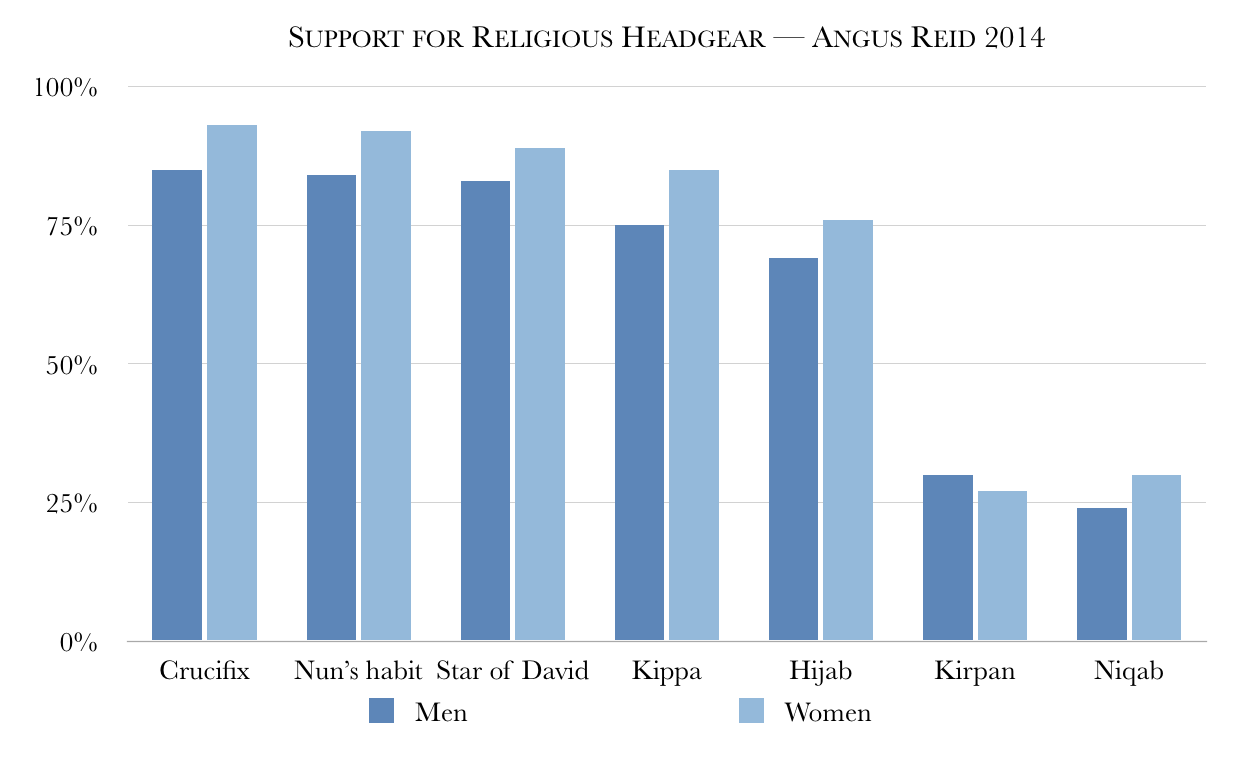
Citizenship minister’s office declines to clarify “hijab” reference

Canadian_Multiculturalism_Integrated_Book_DraftAs noted by John Geddes, Minister Alexander surely knows the difference between a hijab and niqab (mainly worn in Gulf Arab countries) and the burqa (worn in Afghanistan where he lived and worked).

As the above chart shows, Canadians clearly make a distinction between the hijab and the niqab, with the former supported by three-quarters of Canadians, the latter only one-quarter.

Is this part of an emerging Quebec strategy to play on xenophobia? Part of the strategy to play the values card? From another Minister, I might assume an inadvertent slip of the tongue.

And sad to see, after Minister Kenney and the Government, were so strong in their opposition to the PQ’s proposed Charter of Quebec Values:

Based on today’s evidence, you would have been wrong. News that the Conservatives sent out a fundraising email on the topic led to a question from Liberal MP Chrystia Freeland in the House. She focused specifically on how the Tory email mentioned that the government was appealing a judge’s ruling “allowing people to wear the hijab while taking the oath.”

The odd thing about that phrase, which Freeland zeroed in on, is that the word “hijab,” at least in Canada, almost always refers to a Muslim woman’s head scarf that covers only the hair, unlike the “niqab,” which also covers much of the face. Directing her question at Citizenship Minister Chris Alexander, a former diplomat who served in Muslim countries, including Afghanistan, Freeland said, “Surely the minister, of all people, ought to know the difference between a niqab and a hijab.”

But Alexander defended his terminology. He alluded to his experiences “living in a majority Muslim country where the hijab has been used to cover the face of women, just as the niqab and just as the burka has been used under the terrible influence of the Taliban, and other obscure entities, in places like Afghanistan and Pakistan.”

I took that to suggest the government might mean to allow the hijab during the citizenship oath, so long as it wasn’t somehow used to cover the face. To be certain I understood properly, I emailed Alexander’s office for a clarification. The first response said Alexander was referring to “the actual covering of the face during the oath.” Just to be certain, I followed up by asking if, in that case, the hijab would be permitted, if it didn’t cover the face.

Instead of answering that question directly, Alexander’s office forwarded me this statement: “As the Prime Minister said, it is offensive that someone would hide their identity at the very moment where they are committing to join the Canadian family. We are opposed to anything that hides someone’s face when reciting the Oath of Citizenship. We believe the oath should be taken freely, openly and proudly for everyone to hear.”

I don’t think that directly answers my question about the hijab. In fact, I remain puzzled about why Alexander injected such a precise term as “hijab” at all into this already fraught debate. Having used it, though, he should now explain in plain language exactly how he means to be understood.

I assume he means it in a different way than Defence Minister Jason Kenney did, back when he was citizenship minister in 2013, and the Quebec Charter of Values debate was roiling, and he tweeted: ”A child is no less Canadian because she or he wears a kippa, turban, cross, or hijab to school.”

Citizenship minister’s office declines to clarify “hijab” reference.