Refugee board’s plea for assistance with growing backlog ignored: Assessment of Budget 2017 Immigration-related policies and programmes

As usual, the Star and Nicholas Keung provide the best coverage:

Despite a worsening backlog and surging number of land-border asylum claims via the U.S., the beleaguered Immigration and Refugee Board will not be getting any relief from the Liberal government.

Although the 2017 budget provides $62.9 million over five years — and $11.5 million per year thereafter — for legal aid services for asylum claimants, it ignored a recent plea from IRB chair Mario Dion for additional money to deal with its rising backlog of refugee claims, which is expected to hit 30,000 cases this year.

“It is discouraging,” said Janet Dench of the Canadian Council for Refugees. “We are expecting the number of claims to go up dramatically. This is going to hurt everybody.”

The number of refugees arriving in Canada went up by 48 per cent to 5,520 in the first two months of this year, including 2,145 who crossed the land border via the United States.

Instead of ensuring there is money to hire enough refugee judges to hear asylum claims, the government said it will spend $29 million in the next five years to make permanent an unpopular “reviews and interventions pilot project.”

Launched in 2012, the project assigns representatives from the Canada Border Services Agency and the Immigration Department to intervene in refugee hearings by raising concerns over the credibility of claims.

A 2015 internal evaluation of the program identified operational challenges because of causes confusion and redundancy around responsibilities between the two government departments.

“It is inefficient, wasteful intervention that causes delays. Their submissions are often poorly thought out,” Dench said.

On the immigration front, critics said little change was made to improve the temporary foreign worker program, other than a new permit exemption for short-duration work terms for intercompany exchanges, study exchanges or the entrance of temporary expertise.

The budget also proposes to eliminate the $1,000 labour market impact assessment for families seeking to hire foreign caregivers to care for people with high medical needs and for families with less than $150,000 in annual income looking for a nanny.

“The problem with the temporary foreign worker program is it’s been poorly managed. It’s not about writing stricter rules but actually investing into the system to vet and make sure the rules are followed. The government needs to step up on the expenditures for enforcement,” said Professor Jeffrey Reitz, director of ethnic, immigration and pluralism studies at the Munk School of Global Affairs.

Chris Ramsaroop of Justicia for Migrant Workers, a grassroots advocacy group, said the budget fails to address the vulnerabilities faced by foreign workers in Canada.

“The refusal to implement a policy of permanent residency on arrival for migrants send a strong message that Canada refuses to acknowledge the invaluable social and economic contributions that migrant workers provide toward our society,” he said.

Also missing are additional resources to address immigration backlogs for qualified live-in caregivers applying for permanent residency and family reunification for parents and grandparents, said MP Jenny Kwan, immigration critic for the opposition NDP.

“The processing time is taking so long that for many families, their medical, criminal and security checks have expired,” said Kwan. “Canada is contributing to breaking up families.”

Source: Refugee board’s plea for assistance with growing backlog ignored | Toronto Star
Canada faces dramatic drop in citizenship, prompting concerns about disengaged immigrants

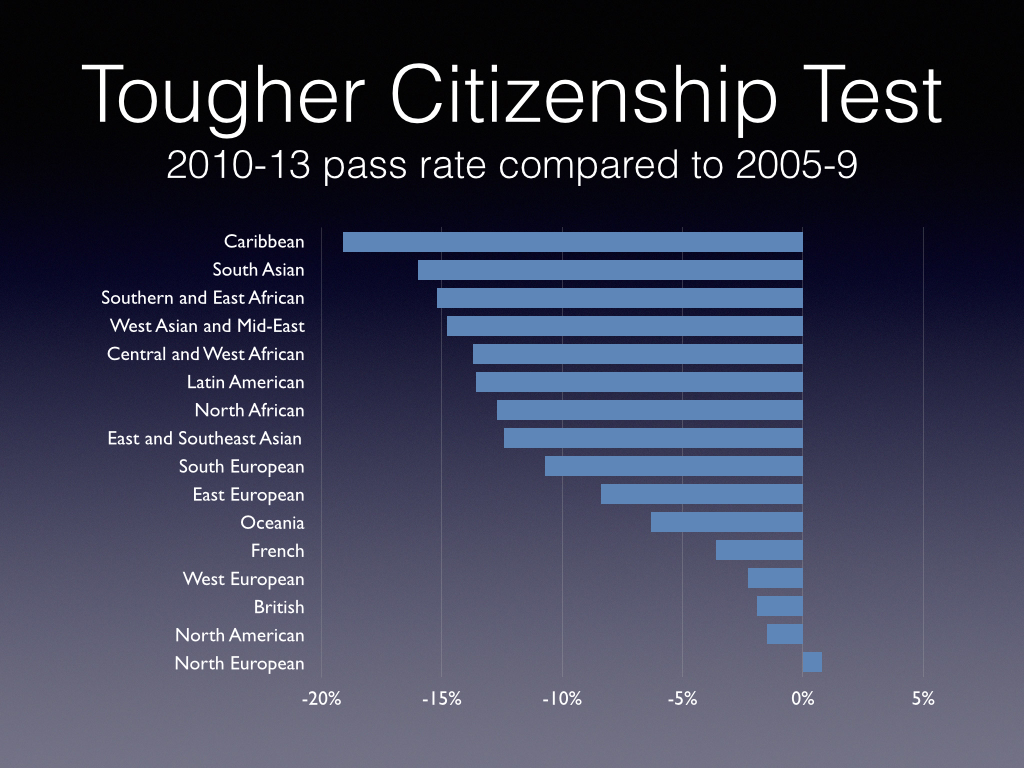
Canadian Multiculturalism: Evidence and Anecdote Deck - Images.039Further to yesterday’s post regarding my forthcoming book (Multiculturalism in Canada: Evidence and Anecdote) and the deck summarizing some of the high level results, the Toronto Star article focussing on my findings regarding citizenship take-up and the impact of the 2010 changes (the chart above shows the impact of the citizenship test changes on different ethnic groups):

“In the past, citizenship was viewed as a stepping stone to immigrant integration, and it should be done earlier on,” said Griffith, who will present Multiculturalism in Canada at a three-day national immigration and settlement conference in Vancouver that starts Thursday.

“These changes have made it harder and prohibitive for some to acquire citizenship, turning Canada into a country where an increasing percentage of immigrants are likely to remain non-citizens, without the ability to engage in the Canadian political process.”

Based on latest government data, Griffith found that the ratio of permanent residents who eventually become citizens has been in decline since 2000, and has dropped most rapidly in recent years.

Only 26 per cent of permanent residents who settled in Canada in 2008 have acquired Canadian citizenship, compared with 44 per cent for the wave of immigrants settling in 2007, and 79 per cent of those who arrived in 2000.

Griffith said the government data used in his analysis was selected to reflect the fact that it takes immigrants an average six years to acquire Canadian citizenship. The 2008 cohort best indicates the early impact of reforms implemented by the Conservative government.

The permanent-resident-to-citizen conversion rate does generally rise the longer immigrants have been in Canada. But an 18 per cent decrease between the 2008 and 2007 cohorts is alarming, Griffith said.

Citizenship and Immigration Canada spokesperson Johanne Nadeau said Canada has one of the highest naturalization rates in the world, “as 86 per cent of eligible permanent residents for Canadian citizenship decide to acquire it.”

She suggested the Griffith is misinterpreting the data because “he is not taking into account those (permanent residents) who are not yet eligible to become citizens because they haven’t met all of the requirements needed to begin the citizenship process.”

Citizens are protected by the Charter of Rights and Freedoms, can vote in elections and are entitled to Canadian passports. Not only do permanent residents not have those privileges, they are also vulnerable to revocation of their status and removals from Canada.

“I understand the rationale behind these government changes,” said Griffith, who worked for the government as the reforms were developed and rolled out, and retired in 2013.

“But I’m on the side of inclusion rather than exclusion. We need to make sure those who apply for citizenship take it seriously, but we don’t want to inadvertently create excessive barriers and shift the relationship of some of the communities with the country.”

… “When you make it more difficult for some communities to become citizens, you are going to create issues with their engagement, attachment and identity of Canada,” said Griffith.

“The question is how we balance between ensuring the rigours of the (citizenship) process and yet making it fair and reasonable.”

Canada faces dramatic drop in citizenship, prompting concerns about disengaged immigrants

Ontario says No to removing citizenship by birth on soil | Toronto Star

Expect that Ontario, which accounts for 37 percent of all births in Canada, essentially killed federal plans when it formally notified CIC in September 2012 of its opposition:

“In our view, there is not enough evidence to justify the effort and expense required for such a system-wide program change. Citizenship and immigration Canada has not quantified the extent of fraud resulting from ‘birth tourism,’’ said Ontario Deputy Immigration Minister Chisanga Puta-Chekwe.

“At this time, there is insufficient data to demonstrate the demand placed on Ontario’s economy or public services from ‘birth tourists,’” he wrote in a letter to Ottawa, dated September 6, 2012, after a technical briefing on the plan. A copy of the province’s response was obtained by the Star this week.

On Friday, a spokesperson for Ontario Immigration Minister Michael Chan said the province has not changed its position.“While citizenship is the sole responsibility of the federal government under Canada’s constitution, any proposed change to citizenship policy can have profound impact on the provinces and territories,” said the spokesperson.

“Adequate time needs to be taken to understand the full implications of any change in policy. Canada needs to get this right, in partnership with provinces and territories.”

Ontario says No to removing citizenship by birth on soil | Toronto Star.

Direct link to the DM letter here, along with some other related Ontario documents:

ON – Letter from ON DM Citizenship and Immigration to CIC DM 6 Sep 2012

Ottawa urged to remove citizenship by birth on Canadian soil | Toronto Star

Nicholas Keung’s story on the recently released under ATIP birth tourism briefing material (Citizenship Reform Proposal #19: Birth on Soil link to document), including my quote:

The proposal, marked “secret” and with inputs from various federal departments, found fewer than 500 cases of children being born to foreign nationals in Canada each year, amounting to just 0.14 per cent of the 360,000 total births per year in the country.

The issue of citizenship by birth on Canadian soil once again raises concerns among critics over the current government’s policy considerations being based on ideologies rather than evidence and objective cost-benefit analyses.

“An impartial observer would conclude that the evidence supports no need for change, given the small number of cases. Yet the recommendation supports the government’s public rhetoric and anecdotes on the need for change,” said Andrew Griffith, a former director general for citizenship and multiculturalism at Citizenship and Immigration Canada, and author of Policy Arrogance or Innocent Bias.

The Conservative government overhauled the Canadian Citizenship Act earlier this year by further restricting eligibility. However, the “birth on soil” provision was left intact and required further studies.

“Eliminating birth on soil in order to ensure that everyone who obtains citizenship at birth has a strong connection to Canada would have significant cost implications,” said the 17-page report prepared for former immigration minister Jason Kenney, obtained under an access to information request.

“The challenge of communicating this change would be convincing the public that restricting the acquisition of Canadian citizenship is worth that cost, particularly in a climate of deficit reduction.”

The office of Chris Alexander, Kenney’s successor, confirmed with the Star that the government is still reviewing citizenship policy with regard to the issue of “birth tourism” — a term referring to foreigners travelling to give birth in Canada so the baby can claim automatic citizenship here.

Dubbed “anchor babies,” these children are eligible to sponsor their foreign parents to Canada once they turn 18. It is unknown how many of them actually return to their birth country with their parents, but it’s believed the number is low.

“As provinces and territories are responsible for birth registration, consultation and co-ordination with the provinces is required,” said Alexis Pavlich, a spokesperson for Alexander.

“Canadian citizenship is an honour and a privilege, and our Conservative government is committed to increasing its value. Birth tourism undermines the integrity of our citizenship program and takes advantage of Canadian generosity.”

I have some outstanding ATIP requests to the key provinces (QC, ON, BC) on their data on “anchor babies” and will share when released.

And if you have a different take than me on Citizenship Reform Proposal #19: Birth on Soil, please share.

Ottawa urged to remove citizenship by birth on Canadian soil | Toronto Star.

Residents urged to apply for Canadian citizenship to avoid hurdles on horizon

Nicholas Keung’s story on the coming-into-force provisions of C-24 Citizenship Act, and some concrete stories about some who will be affected:

When Ottawa enacted the new law in June, many, including frontline immigrant settlement workers, assumed it would take effect immediately and that little could be done to beat its more restrictive criteria.

In fact, some of the most controversial changes — requiring citizenship applicants to be present in Canada for four years out of six rather than three years out of four, and raising the age of exemption from language and citizenship tests to 65, from 55 — won’t come into force until next June, immigration officials confirmed to the Star.

“We want to tell people it’s not too late, and they should take advantage of the old rules,” said Ann McRae, executive director of the Rexdale legal clinic, a member of the Inter-Clinic Immigration Working Group.

At the South Asian Legal Clinic of Ontario, staff have reached out to community groups to deliver workshops and help clients file citizenship applications.

“All the changes were rushed through so quickly that people are confused,” said clinic lawyer Karin Baqi. “Those who are eligible today may not be eligible tomorrow. We have to get the word out.”

Remon Kirkor came here from Iraq with his wife and three daughters in 2007. The family met the three-year residence requirement in 2010. Yet, Kirkor, 44, hasn’t applied for citizenship, because he knows that as a high school dropout he would have a tough time passing the language test or the citizenship knowledge exam offered only in English and French.

“I work 20 hours a day to support my family. By day, I am a window installer. At night, I work as a dishwasher,” Kirkor, a former truck driver for UNICEF, said through his daughter, Mariam. “I have no time to sleep. I have no time to study English.”

Residents urged to apply for Canadian citizenship to avoid hurdles on horizon | Toronto Star.

Filipino Canadians fear end of immigrant dreams for nannies

Nicholas Keung’s article on the future of the Live-in Caregivers program:

Critics of the government’s approach, including some Conservative loyalists, warn that the growing Filipino Canadian vote could also be at stake in next year’s federal election if the government removes access to immigration from the live-in caregiver program LCP — 90 per cent of those participating are from the Philippines.

Family separation, lost skills the biggest challenges for immigrant nannies“This is a defining issue for the Filipino Canadian community,” said Chris Sorio of Migrante Canada, an international advocacy group for Filipino migrants.

“This is something very close to our hearts. It is worrying us because we feel this could be a smoke-screen for changes that are coming to the LCP program. Our concern is they are going to further restrict family reunification under the program.”

In recent meetings with the media to discuss Ottawa’s planned reforms to the controversial temporary foreign workers program, Employment Minister Jason Kenney criticized the LCP as being “out of control” and having “mutated” into a program of family reunification.

… Findings of the nanny study [by Ethel Tungonan of U of Alberta]

Researchers surveyed 631 Filipina caregivers about their jobs, recruitment, education, use of community supports and health, in the first national study of Canada’s live-in caregivers.

It found:

  • Caregivers’ average age on arrival was 34

  • 86% had university education or above.

  • Nearly 90% arriving in the past five years were recruited by employment agencies or directly hired by unrelated employers.

  • Two-thirds had children; about half experienced continued separation because their children had grown too old to be considered dependants for immigration.

Filipino Canadians fear end of immigrant dreams for nannies | Toronto Star.

Immigrants more likely to fail citizenship test the longer they’re here

Some internal data from CIC on citizenship pass rates and trends. Delivering on “harder to get,” C-24 revocation provisions aimed at “easier to lose.”

Based on two immigration databases, the report, marked “confidential,” said the pass rates of the citizenship exam dropped significantly from 83 per cent in 2011 to 72.6 per cent in 2012, after the government introduced new test questions and raised the pass mark from 60 per cent to 75 per cent.

More than 80 per cent of immigrants applied for citizenship within the first five years of permanent residency and the group had a pass rate above 83 per cent — compared to the low 70s among those who have been in Canada for at least 10 years.

“That’s the irony,” said Meurrens. “People who want it do it quickly and are more motivated.”

The report also found immigrants from South Korea and China led the rest of the pack in passing the citizenship test, averaging 90 per cent and 88 per cent respectively.

In contrast, those from Sri Lanka and Vietnam had the lowest pass rates, averaging just 70 per cent and 67 per cent.

,,,

The number of rejected applicants has also remained consistent, averaging 2,308 per quarter. Flunking the citizenship test accounted for 65 per cent of all refused cases, followed by failing the language requirement (24 per cent) and not meeting the residence obligation (6.6. per cent). The rest were rejected on criminality and security grounds.

Immigrants more likely to fail citizenship test the longer they’re here | Toronto Star.