Internal documents reveal how much consultants shaped the National Gallery

While most of the attention has been on McKinsey, reminder that other organizations are involved.

Given all the management and staff upheavals, hard to see the value for money in these consulting contracts. One also has the impression that Sasha Suda, the director who launched them, was “just visiting” until she got a more important gig in the USA, leaving the mess behind:

Consulting companies had profound influence on the National Gallery of Canada’s reimagining over the past few years, with senior management relying on hired guns to help craft the new identity of the country’s premier visual arts institution, documents released through access-to-information requests reveal.

The documents paint a picture of the extent to which two consulting companies – one headquartered in Vancouver and focused on diversity and inclusion, the other a California-based change management firm – shaped the gallery’s new focus, operations and culture.

The contracts began in the spring of 2020, shortly after Sasha Suda became director of the gallery (she left last summer to run the Philadelphia Museum of Art). Under Ms. Suda’s leadership, and under current interim director Angela Cassie, the gallery embarked on a reinvention intended to make the institution, its collection and its staff more diverse and inclusive.

Management viewed this as an overdue step toward restoring the gallery’s relevance and correcting its blinkered past. Current and former staff members and donors have criticized the project as well-intentioned but poorly executed, and they have said it left the institution in disarray.

In May, 2020, the gallery signed a contract with NOBL Collective, a change management consultancy based in California, for strategic planning work, at an initial cost of $95,000. As the scope of its work expanded, NOBL would eventually bill the gallery $632,500 over two-and-a-half years, making it the single biggest line item among the museum’s outside contractors during that time.

The documents, which were obtained by researcher Ken Rubin and shared with The Globe and Mail, include an initial proposal in which NOBL wrote that the gallery was “in the midst of a sea change” that represented “a moment of uncertainty but also of rebirth.”

“You have many of the right ingredients: a dedicated team, hungry for direction and empowerment; a rich history and story; a world-class collection; a new Director willing to do what it takes,” NOBL wrote. “We would be honoured to help your team make it happen.”

The documents detail a program of one-on-one interviews with senior management and other team members, as well as surveys and strategic planning sessions focused on topics such as “Sensing, Vision and Bet Making.”

Eventually, the scope of NOBL’s work became all-encompassing. The consultancy laid out plans and timelines for defining the museum’s values and crafting its “change narrative.” It said it would create working groups and synthesize for the gallery what it heard from them; communicate with the board of trustees, department heads and team leads; align blue-sky strategic ideas with budgets and staffing; even design and help to deliver the all-staff meetings in which the new vision would be shared.

The result was a strategic plan titled Transform Together. Unveiled in 2021, it is the spine on which the museum’s new direction rests.

“The Gallery’s strategic transformation is about how we can better develop, preserve and present our collection for the learning and enjoyment of generations to come,” said Douglas Chow, the gallery’s director of communications. NOBL “did not have the expertise required” to incorporate a justice, equity, diversity and inclusion (JEDI) approach, so NOBL recommended Elevate Inclusion Strategies as a subcontractor to its own work, he said, and the two jointly helped to craft the strategic plan.

Getting some specialized help with strategic development is fine, said Richard Powers, who teaches governance at the University of Toronto’s Rotman School of Management, but it should always be an institution’s own management that does the heavy lifting.

“It appears that management has handed off all the work to the consultants: tell us what we should do,” he said of the gallery. “Any consultant will never know as much as management – that is why management must be intimately involved in the development of the strategic plan.”

In August, 2020, Ms. Suda wrote a confidential memo explaining the gallery’s reasons for embarking on this work, and why it required sole-sourced contracts rather than the usual competitive bid process. When the pandemic struck, the gallery was forced to close and most employees shifted to working remotely, she wrote, and at the same time the gallery was affected by “various social movements that catapulted the necessity of diversity and inclusion review and reconciliation with BIPOC groups.”

The unusual pandemic circumstances and the “extremely sensitive nature of the subject matter” justified an exception to the standard procurement processes, Ms. Suda concluded. The following month, she wrote a virtually identical memo laying out the need to sole-source work from Elevate, which is based in Vancouver.

One year later, in September, 2021, Ms. Cassie – then vice-president of strategic transformation and inclusion at the gallery – wrote a more detailed confidential memo explaining the reasoning for an additional sole-sourced contract with Elevate.

Elevate had conducted an assessment of the gallery’s inclusion environment, and “significant differences in the level of knowledge and understanding amongst the team” became apparent, Ms. Cassie wrote. Among the key recommendations from Elevate was that the gallery remedy this. Because Elevate staff had already built a relationship with gallery employees, Ms. Cassie wrote, the company was “well positioned to create a safe and positive environment” for the ongoing work.

Mr. Powers said this process – with Elevate conducting an assessment of the gallery, then producing a report that effectively recommended further services provided by Elevate – appears odd.

“They are in a clear conflict of interest and the National Gallery should have gone to a competitive bid to avoid the conflict or the perception of a conflict,” he said. “Elevate may be the best company to do this type of work – and a competitive bid could have come to that conclusion.”

Asked for additional context on the sole-sourced contracts, Mr. Chow replied with sections of the internal memos on that topic. He added that the board was aware of the contracts. “The Elevate team had built that trust using a trauma informed approach and had the knowledge and expertise to carry on the next phases of work without requiring employees to retell stories of their trauma and racism experienced within the workplace to new people,” he said.

The gallery subsequently signed a contract with Elevate for $352,200. That fee included a retainer of $10,000 per month from September to February, 2022, for services including the development of a “JEDI working group,” meeting with gallery leadership or other consultants as needed, attending staff meetings and assisting with the onboarding of new staff. The hourly cost and hours of work covered by the retainer are redacted in the documents, because access-to-information laws permit public bodies to withhold those details about their private contractors.

Elevate’s contract also included a coaching program described as “a deep dive for senior leadership and management who wish to develop and practice critical inclusive leadership skills,” and the development and delivery of a suite of inclusive workplace training modules.

In June, 2021, the gallery again turned to NOBL, this time for a more targeted project that hinted at tensions behind the scenes. There had been near-total turnover among the gallery’s senior leadership since Ms. Suda’s arrival.

In its proposal, NOBL wrote that the gallery had evolved a great deal over the previous year, and now, with its new team members in place, it was time to focus on “engaging in productive, courageous conversations.”

“While conflict is a necessary part of our day to day existence on a team, both emotions and assumptions take the lead when we’re not paying attention,” NOBL wrote. “You’d like the team to improve their ability to separate the people from the problem and create space for learning for all involved.”

To that end, NOBL would design and deliver a four-hour team-building workshop for the seven members of the gallery’s senior management committee, at a cost of $15,000. The topics included conflict style, giving and receiving feedback and empathy perspective.

“Even though the session will be half a day, we’d request that SMC members clear their full day calendars to allow time to process conversations and bring their full presence to the session,” NOBL wrote to the gallery. “Development experiences should feel like an opportunity to slow down and set yourself up for success.”

Source: Internal documents reveal how much consultants shaped the National Gallery
ICYMI: Is the Art World Entering the Age of ‘Anti-Woke’ Backlash? Here’s …

Of interest, particularly in the context of the National Gallery of Canada controversy:

We are in a backlash period—or, at least, the early stages of it, with new consensus about the “excesses” of the social justice movements of the past few years percolating through the discourse. Whether this backlash will look like previous ones is what I have been asked to comment on in this article.

The nostalgia cycle is about 30 years—long enough for the past to feel fresh again as a new generation ages (hence: That ‘90s Show). There is also an edgier kind of political nostalgia cycle. Contemporary debates about representation in the museum are experienced as a repeat of debates over “multiculturalism” from the 1990s, themselves experienced as a return to the combative confrontations of the 1960s. Indeed, so much of the politics of the present feels like a kind of replay of the ‘90s—alt-right “culture wars” as an even darker reboot of Pat Buchanan’s classic ‘90s version; the debates over “wokeness” replaying early-‘90s panics over “political correctness,” etc.

The Trump administration touched off dramatic debates, changing the texture of the conversation within the U.S. art world. Blue-chip galleries added Black artists to their programs, important overlooked female artists have been rediscovered at a brisk clip, museums shook up their schedules, and biennials reversed polarities so that the once-drastically overrepresented white Euro-American male demographic has been rendered a near non-presence in almost every such recent survey, from New York to New Orleans, and from Arkansas to Italy.

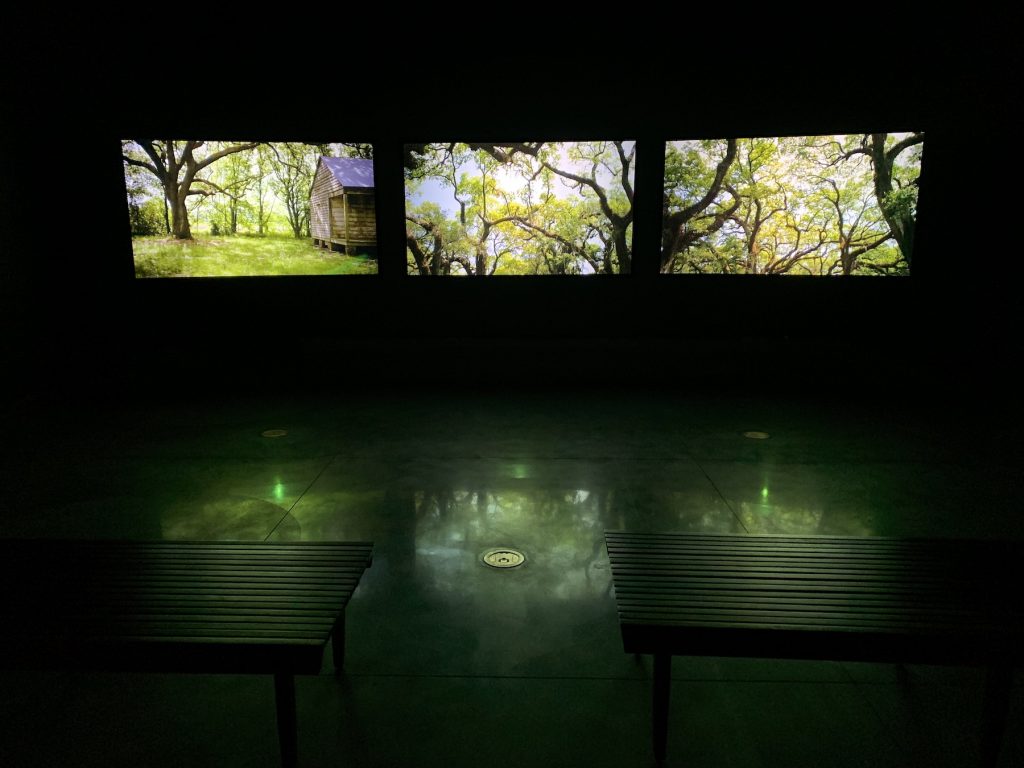
Video by Dawoud Bey at the Historic New Orleans Collection. Photo by Ben Davis.

Video by Dawoud Bey at the Historic New Orleans Collection during Prospect New Orleans. Photo by Ben Davis.

Yet from the beginning, all this has been haunted by an awareness that backlash is incoming. For art observers looking at the intense focus on identity in recent biennials, the obvious reference is the 1993 Whitney Biennial, the so-called “identity politics biennial” (in fact, the recent 2022 Whitney Biennial self-consciously returned to many of the artists from 1993). This event remains a touchstone, having surfaced a large number of non-white, queer, and feminist voices. The ’93 biennial caught the angry zeitgeist of a liberal art world at the end of 12 years of Reaganite rule, in the wake of the most intense period of the AIDS crisis and the ‘92 conflagration in L.A. (VHS footage of Rodney King being beaten by the LAPD was included in the show.)

It was a watershed. But it was also a high-water mark, signaling the inflection point after which backlash officially took the wheel.

The ’93 biennial was panned by critics. Conceptual artist Daniel J. Martinez produced a series of pins given to Whitney visitors that read “I Can’t Imagine Ever Wanting to Be White.” In Who We Be, Jeff Chang’s history of the rise and cooption of multiculturalism, he quotes Martinez on what came next: “’93 was the last shot of the war. We lost right at the moment we thought we were winning.” Coco Fusco, another star of that show, remembered recently the shift that marked the second half of the decade: “In the art world of the late ‘90s and early ‘00s there was a shift away from the moral argument about empowerment and civil rights, which was widespread in the 1980s and early ‘90s, to an emphasis on visual talent and success.”

Daniel Joseph Martinez created these entry badges for the Whitney Museum of American Art's 1993 biennial exhibition.

Daniel Joseph Martinez created these entry badges for the Whitney Museum of American Art’s 1993 biennial exhibition.
Photo courtesy the artist and Simon Preston Gallery, New York.

What can we learn from this moment? How is today different or the same?

An uncomfortable fact is that periods of advance tend to coincide with moments when the kinds of cultural liberals who make up the base of the art world feel that they are in crisis, politically. The spectacle of conservatives in power puts more pressure on culture, as rage at political disempowerment is channeled into gestures of cultural activism and symbolic atonement. The ’90s wave came out of the anger with Reagan and Bush, just as the recent climate grew out of reaction to Trump’s election. (There was some of this vibe under Bush II, but 9/11 and the Iraq War really defined the politics of that period in a different way.)

Conversely, while it flatters the liberal art world to focus on right-wing culture warriors as the driver of regression, it was actually Bill Clinton’s ascent to power in 1992 that was the harbinger of the quietist turn in 1990s cultural discourse. He and the Democratic Leadership Council had made it their mission to represent the Democratic party as pro-business, distancing it from unions and social movements. Toni Morrison may have quipped that Clinton was “the first Black president” in the New Yorker, but during the campaign, Clinton staged his own version of the “culture wars” on Democratic party terrain, deliberately baiting Jesse Jackson into a battle over rapper Sister Souljah and making a big show of condemning “anti-white” rhetoric to prove that he was the safe hand for mainstream (read: white, pro-business, and business-as-usual) America.

As a parallel, more recent talk of a “vibe shift” in culture following the #Resistance moment coincides with the election of Joe Biden, who literally promised on the campaign trail that, were you to elect him, you wouldn’t have to think about politics too much anymore. “The 2010s were such a politicized decade that I think the desire people have to be less constrained by political considerations makes a lot of sense,” Sean Monahan, whose blog 8Ball touched off the “vibe shift” talk, told New York Magazine.

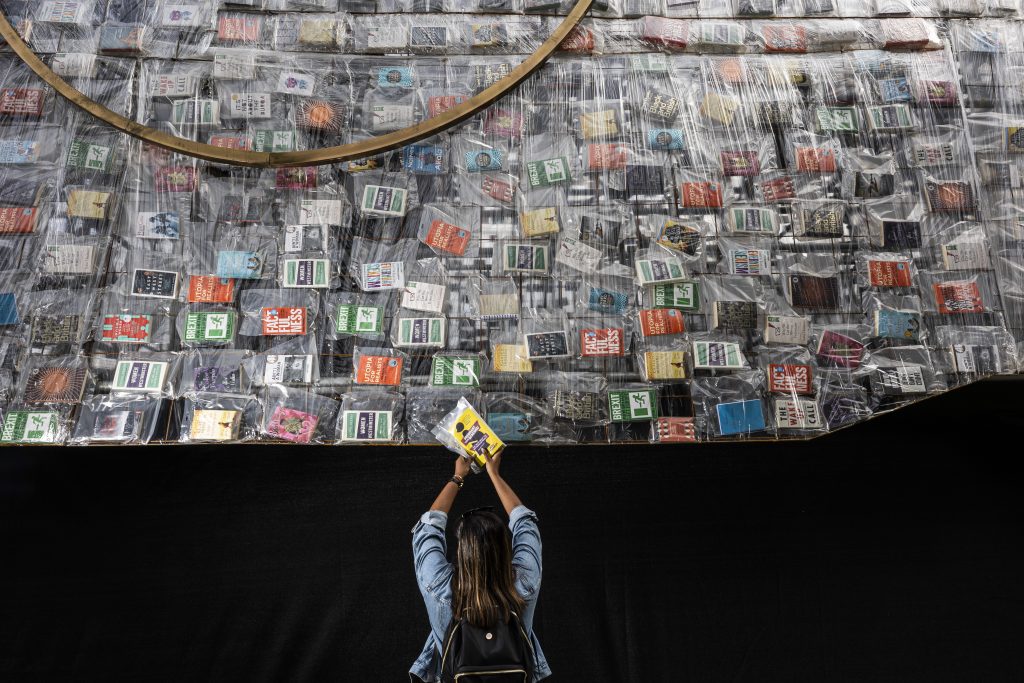
Claire Govender adds the 20,000th book to "Ben Ben Lying Down with Political Books" by Marta Minujin, Photo: Fabio De Paola/PA Wire.

Claire Govender adds the 20,000th book to “Ben Ben Lying Down with Political Books” by Marta Minujin, Photo: Fabio De Paola/PA Wire.

The Burns Halperin Report shows just how vulnerable to rollback recent advances in representation may be. Permanent collections, they show, are not so deeply affected by the social justice zeitgeist—indeed, they are little affected (although contemporary museums seem to be making solid progress towards gender parity in collecting, at least). As one mechanism for this inertia, the report points to the fact that 60 percent of the objects that enter museum collections come from gifts or bequests; these, in turn, presumably form the basis of exhibition programs. Among other things, the blockage thereby represents the embedded malaise and biases of wealth, and its accumulated power (a point theorist Nizan Shaked also argues in her important treatise from this year, Museums and Wealth).

Researching the 1990s backlash, I found this quote from David Lang, the cofounder of the Bang on a Can festival: “If you’re giving an organization $10,000, you can say, ‘In return to that we expect you to have a social face.’ If you’re cutting them from $10,000 to $1,000, you can’t say, ‘Oh by the way for this $1,000 we’d like you to change your organization.’” Lang was speaking about how arts funding cuts took the wind out of the sails of diversification efforts in the mid-‘90s, but the line could also apply to the contemporary challenge of turning arts institutions around despite the considerable reputational and commercial incentives to do so. Compared to the 1990s, even big museums today are actually much more crisis-ridden, symbolized by the last year of protests and strikes over barely livable conditions for ordinary staff.

Without money behind social justice demands, you are left with fleeting gestures and moralistic browbeating, ultimately preparing the ground for cynicism and backlash.

The United States is much less white than it was in 1990s, meaning there is more of a self-interested business case for institutions to change. But on the other hand, inequality is much worse than in the 1990s. Private wealth has today accumulated much more power and is thus even more arrogantly disconnected from the experiences of ordinary people and convinced of its own rightness. How these two dynamics interact is going to shape what the future of what museums look like. My feeling is that they point to an intensified fragmentation of the arts rather than a return to the ideological status quo.

The long-term movement towards a more diverse country is a fact. Even if you are very cynical, it is not impossible to think that bequest patterns will evolve, with a time lag to account for changing generational sensibilities. Since the huge Black Lives Matter protests of 2020, it does feel as if diverse cultural consumption has been firmly established as a virtue for high-status individuals (whether it is embedded remains to be seen).

Last year’s strange, guilt-ridden Sex in the City reboot, And Just Like That…, had the merit of unintentionally underlining this newly mainstream mindset for premium cable consumers. Erstwhile gallery owner Charlotte proves her good ally status—and relieves the anxiety she and her husband Harry feel at a dinner where they are the only white people—when she explains to her friend’s critical mom that the Black artists her daughter collects are truly investment quality (including “an early Derrick Adams!”)

Still, there is a very real limit to guilting patrons into “Doing Better” on voluntaristic moral grounds. It alienates as many would-be patrons as it moves.

Burns and Halperin write, “At the current rate of change, it may be a simpler task to build entirely new museums and market structures than to create the necessary change within the existing systems.” Melissa Smith has reported on one of the most intriguing developments of the past years: Black artists, experiencing an unprecedented market windfall, are putting funds into building up their own alternative institutions, from Titus Kaphar’s NXTHVN to residencies from Derrick Adamsand Mcarthur Binion.

But alternative institution-building is also happening on a much bigger scale—and it is not necessarily progressive. As Georgina Adam writes in her recent book The Rise and Rise of the Private Art Museum, the major trend of the past decade around the world has been stagnation in public museums, and the parallel creation of new personal founder-driven museums (the so-called “ego-seum”), born out of “a distrust of public institutions, and in some cases more problematic aims: self-aggrandizement, hyping the value of their collection, getting better access to desirable art and getting whopping tax breaks.”

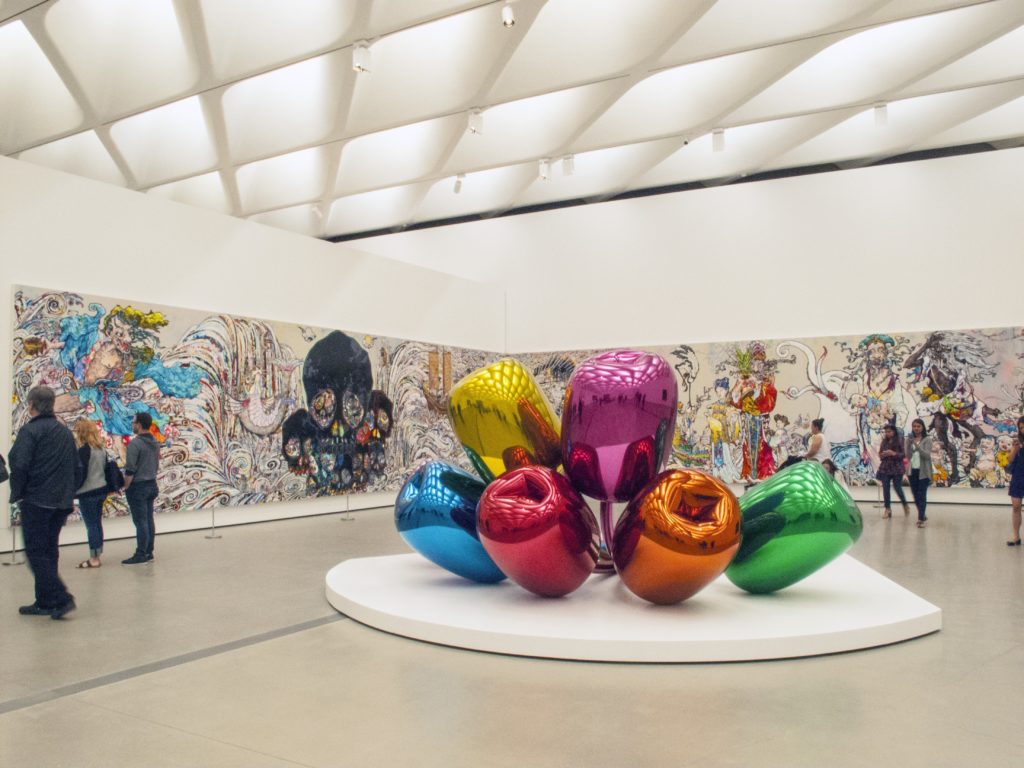
Here’s a case study for the limits of the moral appeal to patrons in an age of runaway inequality. Back in 2008, billionaire Eli Broad first backed L.A. MOCA when it needed a bailout, prompting fears, from New York Timescritic Roberta Smith, that he would merge “the museum’s exemplary collection of art with his own, more predictable, market-driven one.” That turned out not to be what happened at all. After debates over the museum’s direction, Broad simply withdrew from supporting L.A. MOCA to build his own glitzy Broad Museum across the street—with free admission and Jeff Koonses galore.

Jeff Koons’s tulips sculpture at the Broad. Photo by Santi Visalli/Getty Images.

The new political demands on culture from one direction are likely to produce new cultural moves that are equally unprecedented in the other. Until very recently, you used to be able to assume that Silicon Valley was a lock for liberals. But the kinds of new tech fortunes that the art industry has been unsuccessfully courting for over a decade—the bulk of new wealth creation, before the recent tech downturn—now seem to be flirting with reaction. In opposition to the Bernie Sanders-style social-democratic wave, Black Lives Matter, and #MeToo, techie libertarianism seems to be mutating into a turbo-charged Nietzschean neo-monarchism, militantly hostile to traditional liberal institutions, creating a new political bloc with the alt-right trolls.

Contemporary cultural backlash may not look like a return to a cozy, oblivious cultural center. It may take its cues more from Elon Musk buying Twitter to “defeat the woke mind virus” or Peter Thiel funding an “anti-woke” downtown film festival out of his pocket change.

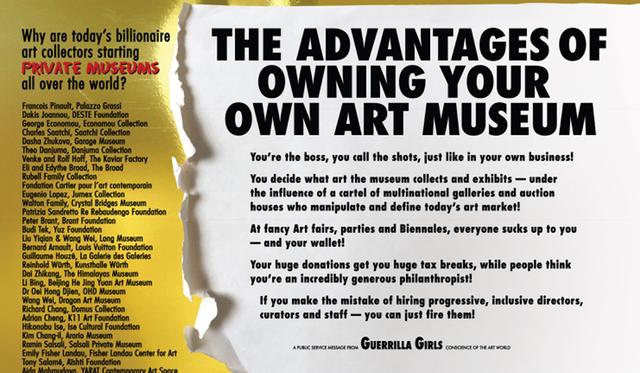
When art observers think of backlash in the 1990s, they often think of the 1995 Whitney Biennial. It is often considered a “return to beauty” biennial, where representation snapped back towards the historical norms after the aberration of ‘93. The Guerrilla Girls printed fliers and posters summing up the feeling, declaring ironically, “Traditional Values and Quality Return to the Whitey [sic] Museum.”

A translation of the Guerrilla Girls’ banner. Photo: Courtesy Guerrilla Girls.

But the more relevant example of culture-wars backlash for today possibly came one year later: the 1996 founding of Fox News. Its boss Roger Ailes had served as a media guru to George H.W. Bush in the period of the infamous, race-baiting Willie Horton ad. He officially ejected himself from politics after Bush’s defeat in the 1992 election. And yet, all that reactionary political energy, instead of being neutralized, deflected into the cultural sphere. In Fox News, Ailes masterminded the creation of a free-standing ideological universe, one that openly challenged the idea that you could assume a mainstream “liberal media bias.” We know what its effects have been.

Given this potential shape of backlash and the structural flaws at the heart of the traditional art system, where to look for hope for real progress? I’ll give the last word to Cornell West. In his 1990 essay on “The New Cultural Politics of Difference,” West described the “double bind” of cultural producers within academia and museums, critical of institutions that they were nevertheless materially dependent on.

I think invoking it here is the opposite of nostalgia—it may be even more apt in the 2020s than it was in 1990s:

Without social movement or political pressure from outside these institutions… transformation degenerates into mere accommodation or sheer stagnation, and the role of the “coopted progressive”—no matter how fervent one’s subversive rhetoric—is rendered more difficult. In this sense there can be no artistic breakthrough or social progress without some form of crisis in civilization—a crisis usually generated by organizations or collectivities that convince ordinary people to put their bodies and lives on the line. There is, of course, no guarantee that such pressure will yield the result one wants, but there is a guarantee that the status quo will remain or regress if no pressure is applied at all.

Source: Is the Art World Entering the Age of ‘Anti-Woke’ Backlash? Here’s …

Yakabuski: National Gallery mess shows what happens when decolonization goes awry

Thanks to Paul Wells raising the alarm, more commentary. And, while I don’t have any inside information, it strikes me that the previous director who developed the plan and then left just over half-way through her term is blameworthy (strategic thinking vs implementation). Disclosure, some of my father’s prints are in the collection:

The messy and rancorous upheaval at the National Gallery of Canada is the result of efforts to “decolonize” the institution at the pinnacle of the country’s museum hierarchy. But it is hardly an isolated case. Similar battles are playing out at museums across Canada and the West as institutions conceived as repositories of the collective memory are morphing into agents of social change and redefining themselves in the name of reconciliation.

What could go wrong? Plenty. The saga unfolding at the NGC shows what happens when good intentions are undermined by a mixture of naiveté, overzealousness and political score-settling. And make no mistake, the decolonization exercise – aimed at correcting curatorial errors of the past by placing an obsessive emphasis on inclusiveness and Indigenous perspectives – is steeped in politics.

We have entered an age of curatorial activism. Indigenous and minority artists are being co-opted into this exercise to satisfy the agendas of museum directors and, in some cases, their political masters. It follows the final report of the Truth and Reconciliation Commission, which called for “a national review of museum policies and best practices to determine the level of compliance with the United Nations Declaration on the Rights of Indigenous Peoples.” The rise of the Black Lives Matter movement further supercharged efforts by museums to feature works from minority artists.

The new approach was evident in the NGC’s Rembrandt in Amsterdam exhibition that ended in 2021, which juxtaposed the 17th-century Dutch master’s work against the crimes of colonialism committed in his era. The museum “took a new curatorial approach by integrating newly commissioned and acquired works from Indigenous and Black artists, bringing multiple voices to contextualize the period in which Rembrandt lived and the devastating impact of colonialism then and now for Indigenous and Black people,” the museum’s annual report explained.

The NGC also went through a rebranding exercise in 2021, led by an advertising agency, that resulted in the adoption of the term Ankosé (an Anishnaabemowin word meaning “everything is connected”) to embody the museum’s new approach. “This powerful word invites us to find hope and joy in difference and encourages us to seek out the perspective and knowledge of those who are not around the table,” said Sasha Suda, then the NGC’s director.

There would be something wrong if major cultural institutions did not seek to question their practices in the face of evolving societal expectations. Things start to go awry, however, when decolonization takes the form of erasure and leads to the purging of those who question its methods, pace and consequences. That, along with an archetypal power struggle among those leading the decolonization effort, is what now appears to be happening at the NGC.

“It is literally a coup d’état. It resembles the Russian Revolution; the methods are the same,” former NGC director Marc Mayer told La Presse last week.

Seven former high-level NGC staffers wrote to Heritage Minister Pablo Rodriguez to denounce the recent dismissal of four senior museum employees by interim director Angela Cassie, as well as the departures of at least half a dozen others during Ms. Suda’s three-year tenure. They warned the NGC risks falling into “irrelevance” as it neglects core aspects of its mandate.

“The message conveyed to Canadian and international audiences in recent years has been sadly devoid of celebrating art, the Gallery’s collections, and its artists, without which there is no National Gallery of Canada,” they wrote. “The newest dismissals of senior staff will impact the security of the artworks, the development of knowledge of the collections and future acquisitions, and the delivery of a world-class exhibition programme.”

For now, the NGC’s board of trustees is standing behind Ms. Cassie. NGC chair Françoise Lyon, appointed by then-heritage minister Mélanie Joly in 2017, last week put out a statement saying that the initiatives around racism, diversity and decolonization are “not politically driven platitudes” and reflect “the sentiments of the government of Canada.” Nothing less.

The decolonization of museums is a culture war for the highbrow set. The International Committee for Museology last year devoted a virtual symposium to the topic, hosted by the Université du Québec à Montréal. The academic papers presented at the event highlighted the tensions within the museum world that decolonization has unleashed.

“This polarisation seems, at first sight, to be similar to the quarrel between the Ancients and the Moderns that spread through the cultural world in Europe in the 17th century,” UQAM professor Yves Bergeron and Michèle Rivet, vice-chair of the Canadian Museum of Human Rights, wrote in an anthology on the symposium. “Ultimately, we believe that the museum is not doomed to disappear … but there is no longer any doubt that museums are most certainly on the road to reform, while a conservative faction seems to be moving towards counter-reform.”

The NGC is Exhibit A, and not in a good way.

Source: National Gallery mess shows what happens when decolonization goes awry