New Atheists are wrong about Islam. Here’s how data proves it – Salon.com

Interesting study by Steven Fish of Berkeley on his study and book, Are Muslims Distinctive?: A Look at the Evidence, finding less difference between Muslims and others than commonly believed:

I [Fish] found that Muslims in general are less distinctive than many of us think. In many ways there is really very little difference between Muslims and everybody else. Sometimes I use “everybody else” as the reference category, and sometimes I use Christians in particular, because Christianity and Islam are by far the world’s biggest faith traditions…

Even in some areas in which we expect … I didn’t find a great deal of difference. For example, many people think that Muslims are really intent on fusing religious and political authority, that there’s really no room in Islamic thinking for independent civic sphere that is not run by religious authorities, and in which religious authority and doctrine predominate, meaning there’s little room for an independent civil society and public sphere. Well, I found in this survey data that … Muslims and Christians don’t differ very much on this question, and that most Muslims, once one controls for everything that needs to be controlled for in these statistical analyses, actually do not want to fuse religious and political authority…

Some, of course, do. Some absolutely do. But some Christians do as well … There are many American Christians who are skeptical about dividing church and state rigorously. That’s true for many Muslims as well. But a majority of both Christians and Muslims seem to embrace at least some separation of sacred and secular in politics. That’s one finding that was perhaps surprising and also showed that Muslims are less distinctive than we might think.

Another finding that showed that Muslims were less distinctive than we might think looked at … membership in organizations, all kinds of things that we would use to actually measure social capital — interpersonal trust, for example. We find there that there really is little or no difference between those Muslims and everyone else.

There’s some questions by which I did find evidence of Muslim distinctiveness. For example, gender inequality; I find in the data that there are big problems in the Muslim world relative to other regions, and among Muslims relative to people of other faiths when it comes to gender inequality. It seems that there are lower workforce participation ratios — that is, female-to-male and earned-income ratios — among Muslims than among non-Muslims, generally speaking, which means that women tend to work less and earn less than men do in Muslim countries to a greater extent than they do elsewhere. I also find other evidence of gender discrimination …

Generally speaking, women should outlive men by several years. I found that that gap is somewhat smaller in predominantly Muslim societies, which is a red flag and shows that perhaps there are gender discrimination problems that run more deeply than in predominantly non-Muslim societies.

New Atheists are wrong about Islam. Here’s how data proves it – Salon.com.
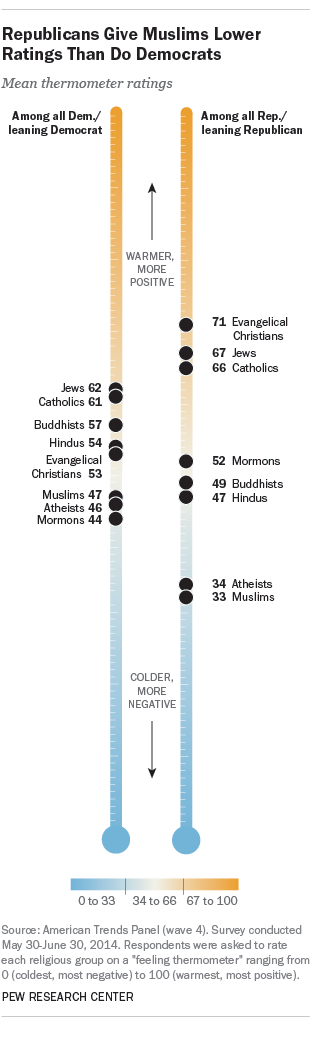
The US political divide on views toward Muslims and Islam | Pew Research Center

USA Views of Religion - PewMapping US party affiliation to attitudes towards different religions. Sharp contrast:

Party affiliation is not the only factor that correlates with differing views toward Muslims and Islam. Younger U.S. adults of all ideological stripes feel more warmly toward Muslims than do older Americans. On the feeling thermometer, those ages 65 and older gave Muslims an average rating of 32 – they don’t rate any group more negatively – while Americans ages 18-29, on average, rated Muslims more positively, at 49.

One’s own religious affiliation also is a factor. For instance, we found that no other religious group is cooler toward Muslims than are white evangelical Protestants, who give Muslims an average rating of 30.

Compared with other groups, older Americans and white evangelicals both tend to affiliate heavily with the Republican Party.

Haven’t seen an equivalent chart for Canada mapping political affiliations to political party supporters although one would expect a similar breakdown between Canadian right and left leaning parties.

The political divide on views toward Muslims and Islam | Pew Research Center.

Marc Champion: British imams offended by call for help against extremism

The debate in the UK prompted by a letter to UK Imams from Communities Minister Eric Pickles:

Ultimately, though, I think this is all weirdly theoretical. It is surely accurate that parents, faith and political leaders are better placed to influence young Muslim men than is the state. Read without hostility, that’s what the letter from Eric Pickles, the wonderfully named British minister for local government and communities, said.

Who else can convince young men who are infuriated by Israel’s policies in Gaza that this has nothing to do with individual Jews? Who else can convince them that the best way they can protest against British foreign policy in Iraq, or the use of U.S. drone strikes in Pakistan, is at the ballot box or using other lawful tools of protest available to them as U.K. citizens?

Most British Muslims already know this — as do French Muslims — and it’s why they find it offensive when the government demands they prove themselves. Yet a few don’t, with horrific consequences. Like it or not, this creates a special burden. It helps nothing to take instant offense, or to resurface long-aired complaints over foreign policy. Better to tell the government: Of course, we’re already on board, because we’re more worried about our sons and daughters than anyone else can be.

Marc Champion: British imams offended by call for help against extremism  

A Muslim Message to Those Leaving Canada to Join ISIS | Shahla Khan Salter

Some of the anti-extremist messaging by Canadian Muslims:

If you are a Canadian Muslim, considering joining ISIS, here are a list of sins you will commit if you do:

– You will murder the People of the Book, mainly Iraqi and Syrian Christians and others, without justification.

– You will destroy churches.

– You will kill innocent Muslims, Sunni, Shia and others — including seniors, the disabled, women and children of all ages.

– You will destroy mosques, Sunni and Shia.

– You will remove people, Muslims, Christians and others, including those many consider “believers” from their homes and promote the exodus of innocent families from the region to refugee camps, where many suffer and some die, including seniors, children and pregnant women.

– You will dishonour your parents, particularly your mother, upon whom there is the duty to regard in the highest honour, regardless of her faith.

– You will engage in acts of rape and child abuse, none of which is permissible.

– You will act in contravention of the laws of your country, the nation of Canada.

– You will imitate the oppression perpetuated by the established tribes of Mecca, during the period of jahiliyya, against our Holy Prophet Muhammad (pbuh). It was as a result of such oppression that our Holy Prophet (pbuh) joined with Jews, Christians and pagans to stop such oppression, as our Iraqi and Syrian brothers and sisters, against ISIS, are doing now.

As well, many Muslim Canadians, including peaceful conservative ones, those you likely consider “strong” Muslims, will no longer consider you part of the Muslim Ummah. As a result of your expressed hatred for much of humankind, you will be considered a kufr, subjected to takfir.

A Muslim Message to Those Leaving Canada to Join ISIS | Shahla Khan Salter.

Stephen Harper thanks Muslims for condemning recent soldier attacks

Overdue but welcome:

Harper told a Toronto-area Muslim event last night that non-Muslim Canadians needed to hear from their Muslim neighbours that Islam is a force for peace and not something to be feared.

Its believed to be Harper s first public words of support for Canadian Muslims following the attacks.

….Some Muslims criticized Harper for not publicly stating his support for Canadian Muslims in the wake of the attacks.

Stephen Harper thanks Muslims for condemning recent soldier attacks – Politics – CBC News.

Jonathan Kay: Sun News’ cynical attacks on Justin Trudeau have crossed the line into anti-Muslim hysteria

Kay nails it:

Moreover: If indeed it is true that al-Sunnah al-Nabawiah mosque remains a religious home for unassimilated Muslim immigrants with radical, un-Canadian views, shouldn’t that be all the more reason for Canadian politicians to let those congregants know that if they want to live and flourish in this country, they need to adapt to our values?

Justin Trudeau’s riding of Papineau is one of the poorest and most diverse in Canada. It is full of immigrants who are wrestling with the process of integrating into Canadian life. What sort of MP would we want for such a riding — one who brags to Sun News viewers about how he wouldn’t set foot within 50 feet of this or that house of prayer, lest he be tainted by association with the teeming Muslim hordes who pray therein … or someone who actually seeks to engage with these people and draw them into the political mainstream?

Jonathan Kay: Sun News’ cynical attacks on Justin Trudeau have crossed the line into anti-Muslim hysteria

Andrew Lawton, also in the National Post, piles on this critique:


When the PMO arranged my interview with James, I was looking forward to hearing what the government had done or was doing to address the radicalization alleged at the Al Sunnah Al Nabawiah mosque. Shockingly, what I presumed was the most relevant question to the discussion, appeared to dumbfound James, who skirted it no fewer than three times, offering up only scripted condemnations of Justin Trudeau.

“I think it was completely outrageous. I think it’s completely unacceptable that the leader of the Liberal Party, Justin Trudeau, would associate with a group that allegedly radicalizes Canadians to join al-Qaeda and has even been listed by the Pentagon as a location known to them,” James told me during the live interview.

I asked, “Why is this a politics question and not a question of Canadian public safety and intelligence?”

I was expecting anything but the answer she gave.

“I thank you for that question, but as you know, I probably —I cannot comment on operational matters of national security, Andrew,” she said. “But I think the real question is here — Justin Trudeau knew about this. He knew about this and instead he went into this mosque, did a whole lot of handshaking and trying to win votes. He will stoop at nothing to try to win over terrorist organizations. I can’t believe this.”

Embarrassing. But even intelligent MPs sound stupid when they have to stick to stupid talking points (e.g., Chris Alexander defending the government’s handling of the F-35, among others).

Not sure this helps them.

Andrew Lawton: If Trudeau is schmoozing with terrorists, why aren’t we arresting any?

Multicultural Britain: Conviviality The Sociological Imagination

Sadia Habib on a number of initiatives demonstrating a more open approach to multiculturalism than often mentioned in the media in the #ShareRamadan social media campaign:

Yet in spite of the politicians and the mainstream media falling short in highlighting examples of how British people experience multiculturalism amongst their friends, colleagues and family, there are glimpses of good that prove that difference and diversity are respected. There is much going on that contradicts this spiel that multiculturalism has failed. Here comes in social media democracy that allows the spread of stories illustrating the significance of small-scale social interaction between diverse Britons of diverse ethnic and religious backgrounds. One such example of Gilroy’s concept of conviviality in action is #ShareRamadan, which shows British people engaging in social practices that are beyond the confines of giving lip-service to tolerance and civility.

Ramadan 2014 is part-way through, and an interesting project aiming to #ShareRamadan with non-Muslims has been trending on social media. Those taking part in #ShareRamadan have been providing video logs of the experience of the fasts that British Muslims are experiencing this lunar year. Non-Muslims are getting to know first-hand how it feels to not eat or drink in daylight hours, and have been waking up at Suhoor time to eat a pre-dawn meal, and then breaking their fast with Muslim friends at sunset (around 9.40pm for most some parts of Britain). Throughout the world the lengths of the fasts vary according to the time of the Fajr and Maghrib prayers, with the fasts in Brazil and Australia being relatively short compared with Iceland and Britain. The Guardian online has provided a space for user-generated content where contributors from all around the world are sharing their photos and tales about Ramadan.

Multicultural Britain: Conviviality The Sociological Imagination.

Mideast conflict affects all Muslims and Jews: Marmur

Interesting column by Dow Marmur, rabbi emeritus at Toronto’s Holy Blossom Temple, and the need to focus on relations between Jewish and Muslim communities at home, as some of the recent tensions at demonstrations attest:

Christians act as catalysts here. Thus the proposed centre is to be built on a site where churches had stood since the Middle Ages; the last was damaged in the Second World War and subsequently demolished. Berlin is now to have a home promoting religious tolerance erected on Christian ground.

Christians in post-war Germany have a history of trying to bring Jews and Muslims together without meddling in the politics of the Middle East. Already more than 40 years ago, Christian institutions in what was then West Germany helped to create an organization called Jews, Christians and Muslims in Europe. To this day JCM promotes fruitful interfaith encounters, particularly between theology students. The Berlin House of Prayer and Learning would be a logical and more far-reaching extension of this work.

Toronto has a sizeable Jewish community and an even larger Muslim minority. Canada is known for its commitment to multiculturalism and peace. This city may, therefore, be the right place to imitate and fine-tune what’s being done in Berlin, not by seeking to import the Palestinian-Israeli conflict but by bringing together committed Christians, Jews and Muslims who would help to enrich our lives here despite the tensions there.

The Canadian Association of Jews and Muslims is already engaged in this kind of non-political work. What I know of it suggests that it could benefit from active Christian involvement and resourcefulness reflecting Canada’s commitment to peace and coexistence. Where Chicago and Los Angeles failed, Toronto taking its cue from Berlin might succeed.

Mideast conflict affects all Muslims and Jews: Marmur | Toronto Star.

Multiculturalism, Britishness, and Muslims | openDemocracy

A somewhat (over) lengthy piece by Tariq Madood on British multiculturalism and Islam, but nevertheless interesting and rich in its reflections:

The Islamic-modernity argument counters by positioning the sharia not as a body of unchanging law, but as a set of ethical principles with legal conclusions that apply only to specific places and times and thus have to be continually reinterpreted; the effect is to place the ethical over the legal and the political see Ziauddin Sardar, The Future of Muslim Civilization [Mansell, 1987] and Tariq Ramadan, Western Muslims and the Future of Islam [Oxford University Press, 2005. This is an example of how scholarship can draw on extra-European heritages and reinterpret them in a context of a democratic citizenship.

As Muslims’ discussion of these matters develops, and as their discourse becomes an integral part of British debates, one positive effect could be that a broader range of Muslim voices or civic participants are able to contribute. Such a development would reflect a healthy internal variety among Muslims as within any group, part of which is that different individuals or members will want to locate themselves variously across the representational landscape secular, religious, close to government, distant from political parties. That, after all, is true integration; new groups should have similar opportunities to old groups and do not need to conform, or feel obliged to conform, to a special “minority” perspective.

These discursive and institutional processes have two implications. The first is that an increasing acceptance that Muslims can politically organise “as Muslims” without any sense of illegitimacy – in raising distinctive concerns or having group representation in public bodies, for example – means allowing them to choose the paths they think appropriate at different times, in different contexts and for different ends.

The result will be a democratic constellation of organisations, networks, alliances and discourses in which there will be agreement and disagreement, in which group identity will be manifested more by way of family resemblances than the idea that one group means one voice.

The second implication is that where there is “difference” there must also be commonality. That commonality is citizenship, a citizenship seen in a plural and dispersed way. There is no contradiction here, for emphasising and cultivating what we have in common is not a denial of difference – it all depends upon what kind of commonality is arrived at, something that cannot be taken for granted. Difference and commonality are not either-or opposites but are complementary and have to be made – lived – together, giving to each its due.

More than that, commonality must be difference-friendly, and if it is not, it must be remade to be so. This does not mean as a corollary weak or indifferent national identities; on the contrary, multiculturalism requires a framework of dynamic national narratives and the ceremonies and rituals which give expression to a national identity. Minority identities are capable of generating a sense of attachment and belonging, even a sense of a “cause” for many people. If multicultural citizenship is to be equally attractive to those people, it needs a comparable and counterbalancing set of emotions; it cannot be merely about a legal status or a passport.

A sense of belonging to one’s country is necessary to make a success of a multicultural society. An inclusive national identity is respectful of and builds upon the identities that people value and does not trample upon them. So integration is not simply or even primarily a “minority problem”. For central to it is a citizenship and the right to make a claim on the national identity in the direction of positive difference.

Multiculturalism, Britishness, and Muslims | openDemocracy.

What Europe Thinks of Jews, Muslims and Roma – Pew

Some interesting comparative data on European country attitudes towards Jews, Muslims and Roma in the recent Pew study:

Roma, often dismissively referred to as “gypsies” in Europe, have suffered discrimination in Europe for centuries, and some estimates suggest that 70 percent of their European population was killed during the Holocaust. Last year, Europe’s tabloid media got into a frenzy over allegations that Roma families in Greece and Ireland had stolen “blond girls.” (In both cases, it was later confirmed that the children were actually Roma).

Many are predicting a good showing for right-wing and nationalist groups in the elections, which begin May 22. If so, these charts may be worth remembering: As Pew notes, “negative sentiments about all three groups are consistently more common among people on the ideological right.”

What Europe thinks of Muslims, Jews and Roma