Enclaves of Islam see UK as 75% Muslim | News | The Times & The Sunday Times

Failure of British integration and related programs. Some interesting observations at the end of the article about the risk of monocultural white schools and far right radicalization:

Some Muslims lead such separate lives that they believe Britain is an Islamic country where the majority of people share their faith, according to a report to be published this week.

Evidence gathered by Dame Louise Casey, the government’s community cohesion tsar, will lift the lid on how some Muslims are cut off from the rest of Britain with their own housing estates, schools and television channels.

Her report finds that thousands of people from all-Muslim enclaves in northern cities such as Bradford, Dewsbury and Blackburn seldom, if ever, leave their areas and have almost no idea of life outside.

A source who has read the report said: “Certain Muslims, because they are in these communities and go to Muslim schools, think Britain is a Muslim country. They think 75% of the country is Muslim.”

The correct figure, according to the 2011 census, is 4.8% of the population in England and Wales. Christians account for 59.3%.

Casey’s report will be embarrassing for ministers, and Theresa May in particular, because it will say the government does not have any serious integration strategy.

The report will criticise the Home Office, which May used to run, and other departments for not doing enough to manage the pace and consequences of mass immigration.

“It will say that nobody has been on it,” said a source familiar with the contents.

A source close to Casey said: “There is a desire [among policymakers] to tolerate such a level of significant difference that you have overcompensated and gone way too far.”

Those familiar with the report say Casey, who investigated failings by children’s services at Rotherham council after the child abuse scandal, has seen off attempts by the Home Office to water down her report. One described it as “full-fat Louise”.

The report will “send shock waves through the system”, a Whitehall source said, adding: “It’s going to be quite hard reading for some people.”

Casey will attack the police and other state bodies for “weakness” and pandering to false notions of what they think ethnic communities want — such as a police chief who said female officers could be allowed to wear the full veil.

“The report will say that we are in a vicious circle where some institutions are so wrongfully interpreting their version of political correctness that they are gifting the far right,” a source said.

Sir Michael Wilshaw, the departing chief inspector of schools, warns today that about 500 schools in England are either 100% white or 100% ethnic minority — and pupils in them are at risk of alienation and radicalisation.

Wilshaw told The Sunday Times that parallel communities were developing in Britain and children growing up in monocultural schools in these communities were in danger of being cut off from British values and vulnerable to either far-right or Islamist causes.

The chief inspector said that he was particularly worried about a cluster of 21 schools in Birmingham — many of them primaries with predominantly Muslim pupils — where there were no white pupils. Nearly half of the schools have been judged “less than good”.

“We have to make sure these schools are good schools so youngsters in them feel they are part of British society and they have to respect other people’s faiths and cultures,” Wilshaw said.

“In white-only schools the same thing applies. Though we might not be as concerned in white communities about radicalisation, certainly we are worried about alienation and the rise of the far right.

“If these children have not been well educated and cannot get jobs as a result that will feed into alienation and the espousal of right-wing ideologies.”

Casey has examined the social alienation felt by the white working class. Although her report will not dismiss the far right it will say that Islamist extremists pose a more serious threat.

The report will also attack the government for not doing enough to defend Prevent, its embattled counter-extremism policy, against misinformation put out by Islamist and far-left groups.

Source: Enclaves of Islam see UK as 75% Muslim | News | The Times & The Sunday Times

Trump is right about radical Islam: Raheel Raza

Raheel Raza on Trump.

I fail to see how she finds his way of “sparking a conversation” actually furthers efforts to reduce radicalization.

Ironically, the one moderate Muslim that Trump did put on stage was Khizr Khan but at the Democratic Convention, who demonstrated better what a moderate Muslim is than this commentary by Raza:

When First Lady Michelle Obama took up the plight of 276 schoolgirls kidnapped by radical Islamists Boko Haram, with the #BringBackOurGirls campaign, I thanked her. When President Obama called female genital mutilation “a tradition that is barbaric and should be eliminated,” I thanked him. And now that Trump has made the issues that we moderate Muslims care about front-page news, I must do what is right for my faith and for my calling. I must do what is right for my long-suffering Muslim sisters and say — without an asterisk this time — that Trump is right: for sparking a conversation about radical Islam.

Because until we really do #BringBackOurGirls, until 500,000 girls in America are no longer victims of genital mutilation or at risk of it, until we stop radical Islamists from killing us for being open, tolerant and liberal, we must continue the conversation that Trump has helped bring to every news broadcast, water cooler and dinner table around the world.

Now it’s time for Mr. Trump to step up and put moderate Muslims on stage, to amplify our voices and make our issues part of the conversation. Because we moderate Muslims are the solution to the problem of radical Islam.

Source: Trump is right about radical Islam: Raheel Raza

Muslim Women in the U.K. Are The Most Economically Disadvantaged | TIME

Not surprising given patterns of UK immigration. Comparable numbers in Canada: the unemployment rate of Muslim women is 10 percent higher than Christian women, the participation rate 8 percent lower:

A new report has found that Muslim women are the most economically disadvantaged group in Britain, blighted by the highest level of unemployment compared to other religious and ethnic groups in the country.

Muslims, who make up 4.8% of the population of England and Wales, are more than two times likely to be unemployed compared to the general population. Women make up 65% of economic inactive Muslims are women, compared to 59% across all religions, says the report released by the House of Commons Women and Equalities Committee, a cross-party group of British lawmakers.

The report also found that traditional family practices affected Muslim women’s job prospects; 44% of all economically inactive Muslim women were not in work because they were looking after the home, compared to a national average of 16%.

The report says Muslim women looking for work or in employment also face a “triple penalty” of being a woman, part of an ethnic minority and being Muslim. It said Muslim women suffered the “impact of Islamophobia” on women’s job prospects, facing discrimination due to their beliefs, culture or clothing.

“We heard evidence that stereotypical views of Muslim women can act as a barrier to work,” the Committee Chair and Conservative Member of Parliament Maria Miller said in a statement. “The data suggests that in communities these patterns are shifting across generations but we remain concerned that this shift is happening too slowly and that not all Muslim women are being treated equally.”

The committee called on the government to roll out a plan to tackle these inequalities by the end of 2016. They also called for “name-blind recruitment” for all employers, following studies that suggest people with white-sounding names are more likely to get interviews.

Source: Muslim Women in the U.K. Are The Most Economically Disadvantaged | TIME

What France thinks of multiculturalism and Islam – The Washington Post

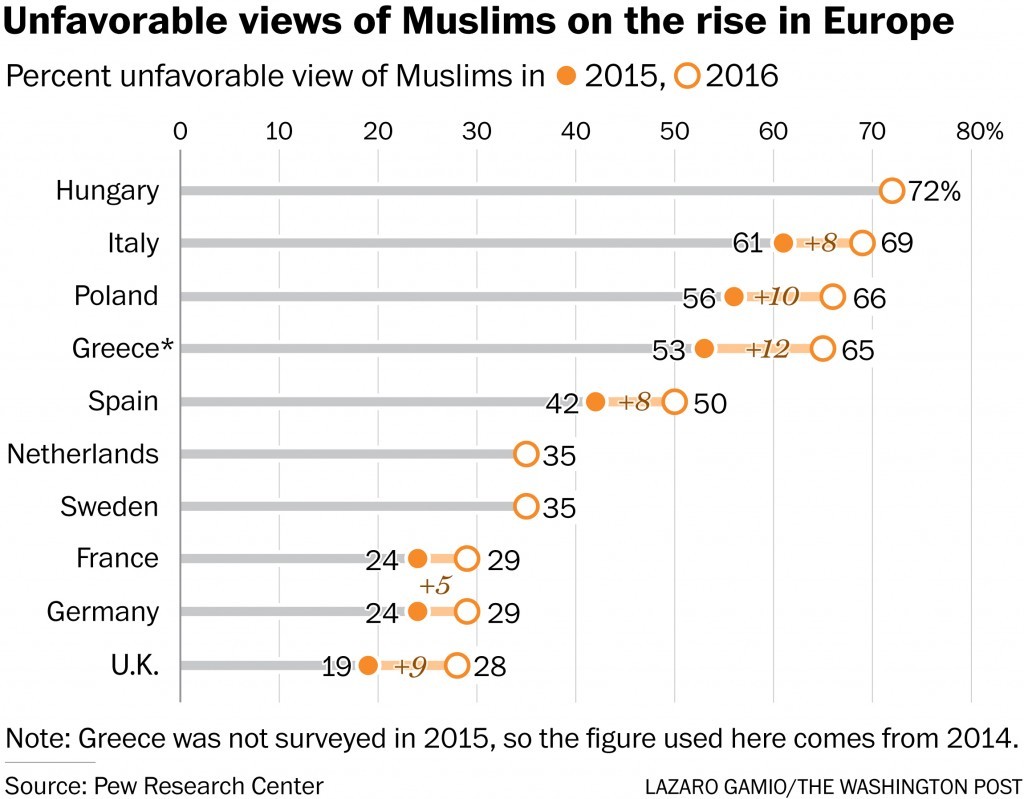
2300europemuslims-11-1024x799Some interesting polling data that sometimes gets lost in the rhetoric:

In the aftermath of a devastating attack in Nice, France, Poland’s interior minister, Mariusz Blaszczak, told reporters that the blame lay with the embrace of multiculturalism. “Have we not learned lessons from previous attacks in Paris and Brussels?” the Financial Times reported Blaszczak as saying. “This is a consequence of the policy of multicultural politics, and political correctness.”

A member of Poland’s controversial right-wing Law and Justice Party, Blaszczak’s point may be in bad taste. However, many around the world probably agree with it.

It’s certainly hard to disagree with the idea that France seems to be more embracing of multiculturalism than Poland. In a recently released study by the Pew Research Centerthat was conducted early this year, just 24 percent of French people were found to believe that diversity made France a worse place to live. A higher proportion, 26 percent, said it made France better, while 48 percent said that it didn’t make much difference.

These results appeared to show that France has one of the most tolerant, though also largely indifferent, attitudes to racial and ethnic diversity in Europe. Only Spain had a higher positive view of diversity. Meanwhile, in Poland, 40 percent of the population said that diversity was a negative, while only 14 percent said it could be a positive and 33 percent said it made no difference. Hungary, Italy and Greece were the only countries with higher negative feelings toward diversity.

The same poll found that France had a far more positive view of Muslims than much of Europe. Despite a series of terror attacks that were inspired by Islamic extremism, just 29 percent of French citizens were found to have a negative view of Muslims, while 67 percent had a positive view. While this was an increase of 5 percentage points over previous years, only Germany and Britain had more positive views.

Conversely, in Poland, 66 percent had negative views of Muslims, while only 19 percent said they had positive views. Hungary and Italy were the only countries with more negative views — 72 percent and 69 percent, respectively.

People in Poland were also far more likely to believe that Muslims in their country were supporters of groups like the Islamic State, a group whose supporters have cheered the attack on Nice but have not claimed official responsibility. Twelve percent of Poles were said to believe that “most” Muslims in their country supported extremist groups, and a further 23 percent said “many.” Just 12 percent said “very few” supported these groups. In France, 44 percent said “very few” Muslims in their country supported extremism, while just 6 percent said “most” and 13 percent said “many.”

And despite the perceived link between refugees from Muslim majority countries and terrorism that is widespread across Europe, Pew’s data showed that on the whole, French citizens were more concerned about economic factors.

Source: What France thinks of multiculturalism and Islam – The Washington Post

Mosque Attacks, Apparent Anti-Islam Spending Up: Report – NBC News

There does appear to be an anti-Islam, anti-Muslim industry:

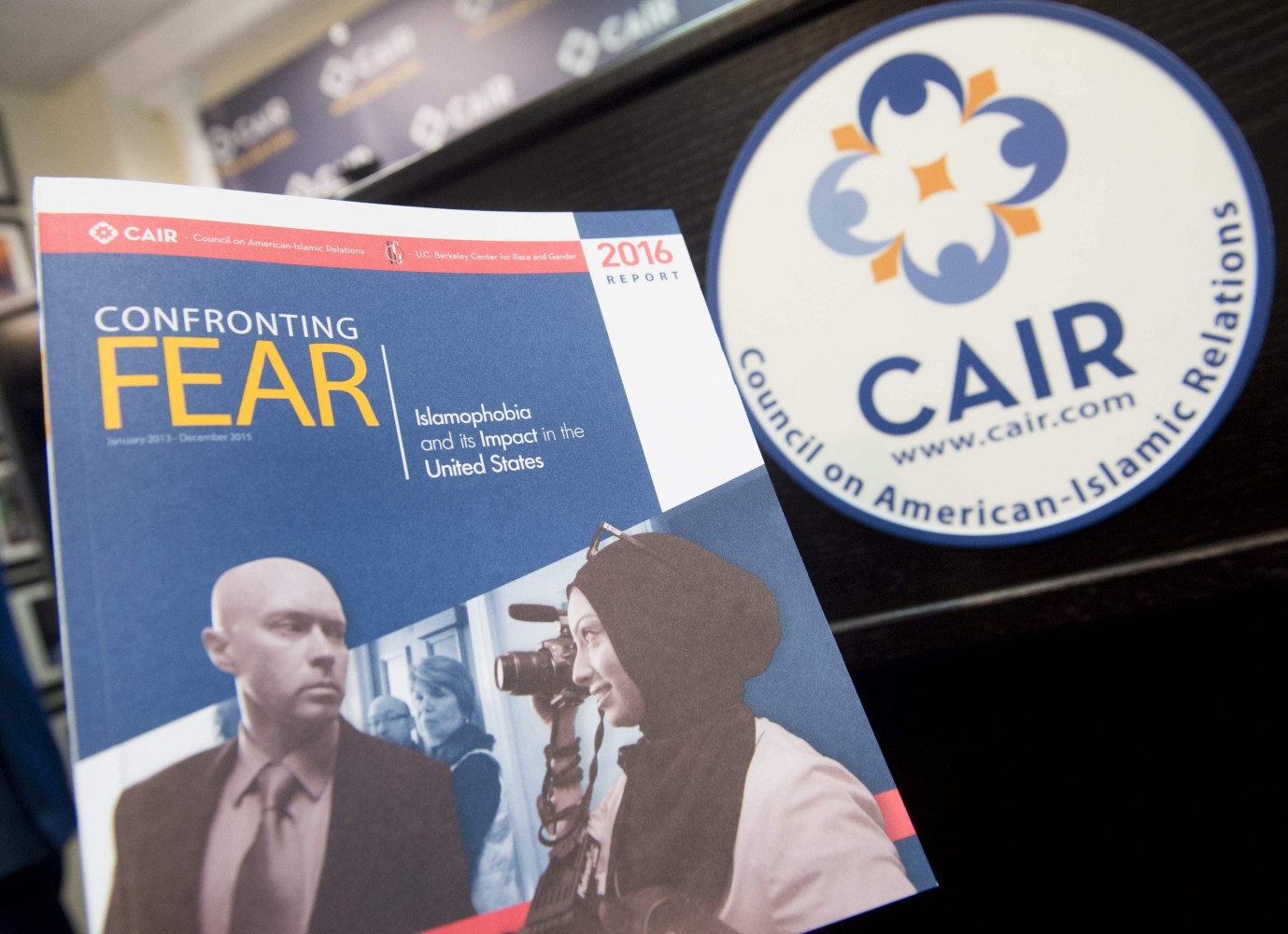
Thirty-three Islamophobic groups had access to $205 million between 2008 and 2013 to spread fear and hatred of Muslims, according to a new report by the Council on American-Islamic Relations (CAIR) and the Center for Race and Gender at the University of California, Berkeley. “Confronting Fear: Islamophobia and its Impact in the U.S. 2013-2015” documents the ways this and other funding has made Islamophobia manifest in America, as well as a new national strategy to improve American understanding and acceptance of Islam. The report also found that mosque attacks had reached an all-time high in 2015.

Image: US-POLITICS-CAIR
A report titled “Confronting Fear,” about Islamophobia in the US released by the Council on American-Islamic Relations (CAIR), is seen at their headquarters in Washington, DC, June 20, 2016. SAUL LOEB / AFP – Getty Images

“The last two months of 2015 saw 34 incidents in which mosques were targeted by vandals or those who want to intimidate worshippers,” Nihad Awad, CAIR executive director, writes in the introduction. “This is more incidents than we usually record in an entire year. This report makes a case that those who value constitutional ideals like equal protection, freedom of worship, or an absence of religious tests for those seeking public office no longer have the luxury of just opposing the U.S. Islamophobia network’s biased messaging.”

The number of Islamophobic groups in America has increased from 69 groups in 2013 to 74 groups in 2015, according to the report. Thirty-three of these groups are considered the inner core of the American Islamophobic network because their primary mission is to promote hate and prejudice against Islam and Muslims. Among the report’s other findings: Attacks on mosques have increased, with 78 recorded incidents in 2015. Ten states have passed anti-Islam laws. Two states have changed the way textbooks are approved in order to change the way Islam is taught in schools, law enforcement trainings on handling anti-Islamic crime has decreased, and a new phenomenon of “Muslim-free” businesses and armed anti-Islam demonstrations has developed.

“The 2016 presidential election has mainstreamed Islamophobia and resulted in a number of un-constitutional proposals targeting Muslims,” Corey Saylor, director of CAIR’s department to monitor and combat Islamophobia, said in a statement. “‘Confronting Fear’ offers a plan for moving anti-Muslim bias back to the fringes of society where it belongs.” 

Source: Mosque Attacks, Apparent Anti-Islam Spending Up: Report – NBC News

Muslims Are Just The Latest In History Of Scapegoats, Author Says

All too true, similar to Canadian experience. Good interesting interview with Ardalan Iftikhar, author of Scapegoat:

IFTIKHAR: Generally speaking, islamophobia has come to mean a hatred of anything related to Islam and Muslims. And it’s important to keep in mind that if you look at the civil rights history of the United States, every minority group in America has been scapegoats. And tomorrow, it’ll be somebody else. And so that’s the key thing here, is that, you know, when you look at the presidential campaign of Donald Trump, it’s not only the Muslim ban that he’s called for. He’s called for building a wall against Latinos and said disparaging remarks against African-Americans.

The point here is that we as Americans need to focus on the things that bring us together as Americans and not things that separate us. And I feel like – as though we have always had scapegoats in the past. We have scapegoats currently. And I believe that Islam and Muslims are the current scapegoats in America today.

MARTIN: Well, in fact, in the book you write about Germans during World War I who were targets of harassment. You said at the time that they were actually the largest minority group in the United States – that German-language newspapers were shut down, German-American religious services were disrupted. You write that a German immigrant in Illinois was actually lynched after having been accused of stealing dynamite. And then of course, during World War II, the internment of the Japanese, which is something that a lot of people are familiar with. Why do you think that is?

IFTIKHAR: Well, I think that as an American society, we’ve always needed a proverbial bogeyman. I think politicians have used bogeymen to further their own political agendas, whether it’s Catholics that were coming across the pond at the turn of the 20th century to German-Americans to Japanese-Americans to anti-Semitism to Jim Crow and African-American – the African-American civil rights movement. And I think that now, in the post-9/11 civil rights era that we live in, I believe that Islam and Muslims are being used as a scapegoat. And I think that many politicians are trying to score cheap political points, and I think that Donald Trump is a perfect example of that.

MARTIN: Now I want to talk about the second part of the title of the book, though, which is that it helps our enemies and threatens our freedoms. That’s what you say islamophobia does. I mean, the premise of your book is that there is a broader, corrosive effect on the society if that mentality is maintained. Tell me why you think that.

IFTIKHAR: Well, because as I look at American history, right? Because even though the fill-in-the-blanks is Muslims today, tomorrow it could be anyone else. I mean, when the USA Patriot Act came out in 2001, you know, this was a 348-page document that trumped 50 federal laws. And it wasn’t just targeted at brown Muslims who were suspected of terrorism. This allows the federal government to come in and, without a warrant, get all of your information without even notifying you, going to college registrars, getting all their information. I mean, it affects everybody.

You know, political rhetoric leads to laws. And that’s important to keep in mind, is that again, you know, the internment camps of World War II didn’t come out of a vacuum. You had people – President Roosevelt’s general, who was the head of Pacific Command, James DeWitt, was quoted in Congress as saying once a Jap, always a Jap. I mean, this sort of anti-Japanese rhetoric was actually what led to the internment camps.

And that’s the thing, is that, you know, we can’t just see this as, you know, ha ha, this is just kind of silly political rhetoric that’s coming out. This could – you know, if somebody – if Donald Trump comes out tomorrow and says, you know, we should put Muslims in internment camps – well, you know, we’ve had them in the past. Who’s to say that we can’t have them again in the future?

Source: Muslims Are Just The Latest In History Of Scapegoats, Author Says : NPR

Unsettling U.S. Political Climate Galvanizes Muslims to Vote – The New York Times

Not surprising. A similar shift happened in the Canadian 2015 elections with Canadian Muslims:

In late December — after the terrorist attacks in Paris and San Bernardino, Calif., and the call by Donald J. Trump, now the presumptive Republican presidential nominee, for “a total and complete shutdown of Muslims entering the United States” — the United States Council of Muslim Organizations, a national umbrella group, announced plans to register a million voters.

“When your existence in society is in danger, you try to mobilize your community,” said the organization’s secretary general, Oussama Jammal. “You have to be part of the entire society.”

While the effort is mostly geared toward the November election, groups here have made a push to register Muslims in time for the state primary on Tuesday. Drives were held on a recent Friday at 21 mosques and Islamic centers in the Bay Area and Sacramento and at seven places in the Los Angeles area.

“Muslims are a big campaign issue, as big as the climate, the economy and immigration. We’re spoken about as if we’re not there,” said Rusha Latif, an organizer of the Rock the Muslim Vote campaign. “We want to amplify our voices.”

For organizers, the time is ripe for registration.

“It’s hard to encourage people to participate based on good things happening,” said Melissa Michelson, an author of “Mobilizing Inclusion: Transforming the Electorate Through Get-Out-the-Vote Campaigns” and a professor at Menlo College. “Fear and threats are much more powerful motivators.”

As the general election approaches, Muslim organizations will pay particular attention to swing states, where “several thousand voters have the ability to tip the elections,” said Robert S. McCaw, the director of the government affairs department at the Council on American-Islamic Relations.

Muslims make up about 1 percent of the United States population. A study conducted by the Institute for Social and Policy Understanding, a nonpartisan think tank, found that only 60 percent of citizens who are Muslim were registered voters, compared with at least 86 percent of Jews, Protestants and Roman Catholics.

“A lot of Muslims didn’t participate in elections because they didn’t see a lot of difference between the parties,” said Emir Sundiata Alrashid of the Lighthouse Mosque in Oakland, where a voter-registration drive was held last month. The mosque sits in a residential neighborhood near a freeway overpass.

Source: Unsettling U.S. Political Climate Galvanizes Muslims to Vote – The New York Times

Sadiq Khan and the Future of Europe: Mehdi Hasan

Mehdi Hasan on Sadiq Khan’s election, contrasting multiculturalism and integration in Britain and other European countries:

Mr. Khan’s resounding victory was a stinging rebuke to the peddlers of prejudice. Here is a Muslim who prays and fasts and has gone on the hajj to Mecca. But he sees no contradiction in being a card-carrying liberal, too. As a member of Parliament, he voted — despite death threats from Islamist extremists — in favor of same-sex marriage and he campaigned to save a local pub in his constituency from closure. He has pledged to serve as a “feminist mayor” of London and made his first public appearance after the election at a Holocaust memorial service.

The capital, admittedly, is a city apart — diverse, immigrant-friendly and home to around four in 10 of England’s 2.6 million Muslims. But even outside London, the more relaxed and tolerant British model of multiculturalism has done a far superior job of integrating, even embracing, religious and racial diversity than the more muscular, assimilationist models in Continental Europe.

While Angela Merkel and Nicolas Sarkozy have declared multiculturalism a failure, the truth is that their countries, Germany and France, have never tried it. As Tariq Modood, the author of “Still Not Easy Being British,” writes, multiculturalism is the “political accommodation of difference.” For the French, however, difference has never even been tolerated, much less accommodated. In contrast, British-style multiculturalism has treated integration, as even David Cameron conceded almost a decade ago, as “a two-way street” and never required, in the words of Will Kymlicka, the author of “Multicultural Odysseys,” that “prior identities” must “be relinquished” in order to build a national identity.

Is it surprising that polls find that British Muslims are more patriotic and take more pride in their national identity than their non-Muslim counterparts and studies show that ethnic and religious segregation in Britain is either steady or in decline?

That isn’t to deny the problems. Britain’s Muslims tend to have the highest unemployment, worst health and fewest educational qualifications of any faith community. But this likely has more to do with a history of racism than it does with an unwillingness to integrate. A 2013 study found that Muslim men in Britain were up to 76 percent less likely to get a job offer than Christian men of the same age holding similar qualifications, while Muslim women were 65 percent less likely to be employed than Christian women.

The situation, then, is far from perfect, but there is a good reason that British Muslims look across the English Channel and breathe a sigh of collective relief.

Source: Sadiq Khan and the Future of Europe – The New York Times

For Muslim women in Canada, a sense of vulnerability: Sheema Khan

Sheema Khan focuses on gender differences in analysis of the recent Environics Institute survey:

The recent Environics Institute survey of Muslims in Canada reveals a community that belies facile stereotypes – no more so than when you analyze the results along gender lines.

For example, the survey (for which I served as an unpaid consultant) found that fewer Muslim women share the optimism about Canada felt by their male counterparts. And while both groups believe that their Muslim and Canadian identities are very important, when asked to choose between the two, women choose their Muslim identity at a far higher rate. As a corollary, fewer women than men believe that immigrants should set aside their cultural backgrounds and try to blend into Canadian culture. Furthermore, more female immigrants have indicated that their attachment to Islam has increased since moving to Canada.

The survey, based on telephone interviews with 600 Muslims across the country, also provides an interesting snapshot of gender-based attitudes toward community institutions. For example, only 33 per cent of Muslim women attend a mosque at least once a week for prayer, compared with 62 per cent of men. The lack of female attendance is not surprising, given that many mosques do little to encourage female participation. Interestingly, a core of about 20 per cent of women (and men) is unhappy with opportunities for women to play leadership roles in Muslim organizations. This could provide the basis for an unmosqued movement, or the creation of women’s mosques.

 When it comes to family life, a whopping 90 per cent of Muslim men and women believe the responsibility for caring for the home and children should be shared equally. However, more men believe that the father must be the master in the home, placing the Muslim level of support for family patriarchy roughly equal to that of Canadians in the 1980s. However, today’s younger Muslim generation rejects patriarchy at roughly the same level as that of other Canadians.

Muslim women are less optimistic about relations with non-Muslims than men are, the survey found. A greater number worry about the reaction of Canadians toward Muslims, believing that the next generation of Muslims will face more discrimination. They are also more concerned about media portrayal of Muslims, and stereotyping by colleagues and neighbours.

It seems the crux of the matter lies in discrimination, as 42 per cent of Muslim women (compared with 27 per cent of men) say they have experienced some form of discrimination or ill-treatment during the past five years. Such incidents occurred mainly in public places – stores, restaurants, banks, public transit. Of women who experienced xenophobia, 60 per cent said they are identifiably Muslim. This ratio is reversed among the 25 per cent of Muslim women who experience difficulties at border crossings. As a result, women worry far more about discrimination, unemployment and Islamophobia than men.

The discrimination concerns are real, as illustrated by employment statistics from the 2011 National Household Survey, in which the unemployment rate of Muslims was 14 per cent, compared with the national average of 7.8 per cent, despite Muslims having high levels of education. The unemployment rate was highest in Quebec (17 per cent), which was double the provincial average. In comparison, the national unemployment rate of visible minorities hovered around 10 per cent.

Even Canadian-born Muslims, who graduated from a Canadian institution, fared worse than the national average, with an unemployment rate of 9.5 per cent. One can only imagine the difficulties in finding employment for the 60,000 Muslim women who head a single-parent household.

Clearly, Muslim women feel more vulnerable about the future, given that they bear a greater brunt of discrimination than their male counterparts.

Source: For Muslim women in Canada, a sense of vulnerability – The Globe and Mail

The taint of anti-Semitism from Europe’s left: Ian Buruma

Good piece by Buruma:

When the state of Israel was founded in 1948, the Soviet Union and leftists in general were sympathetic. For several decades, socialists of Russian and Polish extraction dominated Israeli politics. Zionism was not yet regarded as a noxious form of racism, along with apartheid in South Africa. Things began to change in the early 1970s, after the occupation of the West Bank and other Arab territories. Two intifadas later, the Israeli left finally lost its grip, and the right took over.

Israel became increasingly associated with the very things leftists had always opposed: colonialism, oppression of a minority, militarism and chauvinism. For some people, it was perhaps a relief that they could hate Jews again, this time under the guise of high-minded principles.

At the same time, and for much the same reasons, Israel became popular on the right. People who might have been fervent anti-Semites not so long ago are now great champions of Israel. They applaud the Israeli government’s tough line with the Palestinians. Israel, in a common right-wing view, is a bastion of “Judeo-

Christian civilization” in the “war against Islam.”

It is remarkable how often the old anti-Semitic tropes turn up in the rhetoric of these cheerleaders for Israel. But this time it is Muslims, not Jews, who are the target. Muslims in the West, we are repeatedly told, can never be loyal citizens. They always stick to their own kind. They will lie to people outside their faith. They are naturally treacherous, bent on world domination. Their religion is incompatible with Western values. And so forth.

The genuine threats coming from a violent revolutionary movement within the Islamic world can make such assertions seem plausible. But, in most cases, they should be recognized for what they are: tired old prejudices meant to exclude an unpopular minority from mainstream society. Islamist violence only helps to boost the politics of hatred and fear. Many Western warriors in the so-called war against Islam are nothing but modern-day anti-Dreyfusards.

None of this excuses the vile language of Mr. Livingstone and others like him. Left-wing anti-Semitism is as toxic as the right-wing variety. But the role of Israel in Western political debate shows how prejudices can shift from one group to another, while the underlying sentiments remain exactly the same.

Source: The taint of anti-Semitism from Europe’s left – The Globe and Mail