Liberal Jewish and Muslim MPs condemn imams who called for the death of Jews [and anti-Muslim hate]

Great initiative and statement:

….So right now, the Parliamentary record shows Liberals voting down a motion condemning racism and intolerance even as Conservatives, New Democrats, and Bloc Quebecois MPs, along with the lone Green Party MP, voted in favour of condemning all racism and religious intolerance. (Conservatives, it should be noted, vowed not to vote for M-103 when that motion comes to the floor, preferring, instead the one voted on Tuesday.)

It’s in that context — the reports of the imams calling for death to Jews and the Liberal rejection of a motion condemning, in part, discrimination against Jews —  that a group of Liberal Jewish and Muslim MPs issued this statement Wednesday:

“As Canadians, we rise and fall together. Polarization doesn’t only hurt targeted groups, it hurts all Canadians.

As Parliamentarians, we feel it is our responsibility to rally Canadians around our shared values of human rights, equality and respect for each other. It is our duty to speak out and set an example for Canadians in confronting stereotypes and prejudice, and advancing understanding and education.

We are horrified by reports that two Imams in Montreal and Toronto called for the death of Jews during sermons. We condemn such behaviour and call on the mosques’ administration to take appropriate action.

We are equally troubled by reports of hate notes posted outside identifiable Jewish homes in Toronto this past weekend, as well as deeply concerning accounts from university campuses of Jewish students being targeted and vilified. Anti-Semitism is real and we must stand together against it.

We are also united in condemning Islamophobia and supporting Motion 103. Three weeks ago, six Muslim Canadians were killed during their prayer service at a Quebec mosque. Since the attack, there have been troubling incidents of mosque vandalism and a protest with hateful slogans outside a Toronto mosque. As Parliamentarians we recognize this rise in Anti-Muslim sentiment as Islamophobia.

We respect and defend Canadians’ right to freedom of speech and peaceful protest, and Motion 103 does nothing to change speech laws in Canada, contrary to falsehoods being circulated. We believe the best way to counter hate is through free and open dialogue and as such we also want to exercise our right to speak out against intimidating Canadians, including children, when they’re visiting their place of worship.

Motion 103 sends a message of solidarity to all those affected by religious and other forms of systemic discrimination and calls on the Heritage Committee to study and make recommendations to respond to them.

Religious, ethnic, gender and sexual orientation discrimination is a threat to our diversity and social cohesion. We call on all Canadians to lead by example. Words matter.

The overwhelming majority of Canadians reject guilt by association and stigmatization. That is why we must redouble our efforts to promote education and understanding.

We take pride in the countless Canadian stories of interfaith groups coming together to make our communities better.

We must continue to defend a Canada that is based on our Charter of Rights and Freedoms respecting the rights and responsibilities of all. Diversity is our strength.

Members :
Hon. Jim Carr, Winnipeg South Centre
Hon. Karina Gould, Burlington.
Hon. Ahmed Hussen, York South — Weston
Hon. Maryam Monsef, Peterborough — Kawartha.
Omar Alghabra, Mississauga Centre
Julie Dabrusin, Toronto — Danforth.
Ali Ehsassi, Willowdale.
David Graham, Laurentides — Labelle.
Anthony Housefather, Mount Royal
Majid Jowhari, Richmond Hill.
Iqra Khalid, Mississauga — Erin Mills.
Michael Levitt, York Centre
Yasmin Ratansi, Don Valley East
Dan Ruimy, Pitt Meadows — Maple Ridge.
Marwan Tabbara, Kitchener South — Hespeler
Arif Virani, Parkdale — High Park.
Salma Zahid, Scarborough Centre”
For racialized communities, electoral reform is about more than voting | Toronto Star

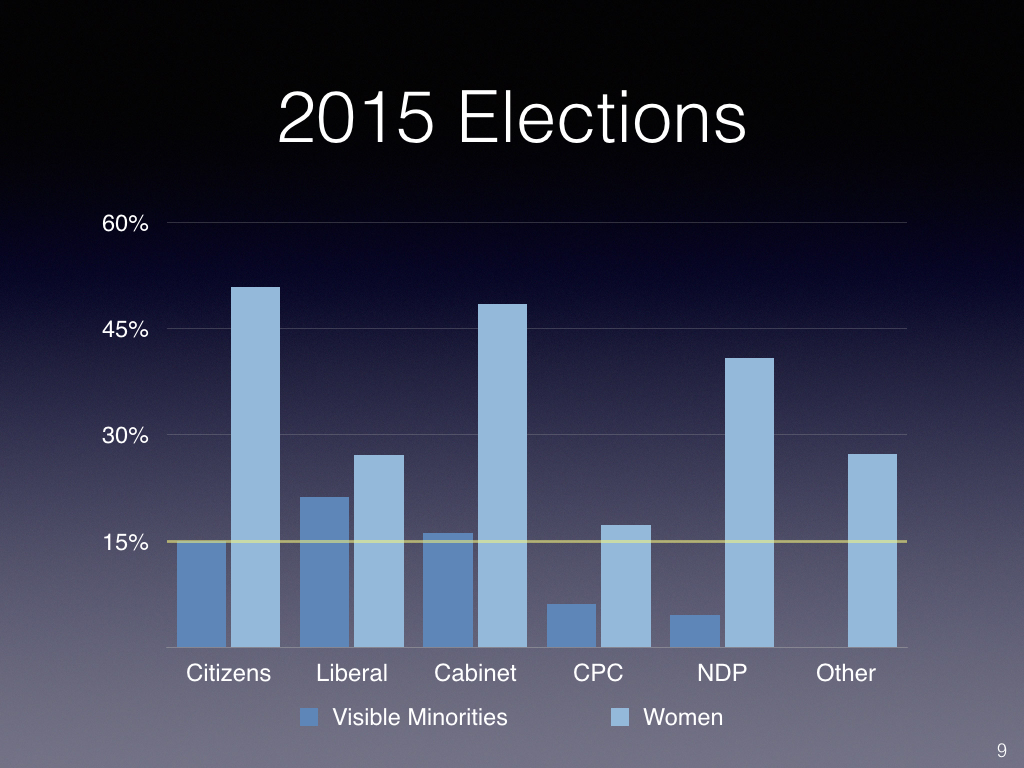
While Avvy gets the numbers wrong – there are 47 visible minority MPs, not 46  (14 percent), close to the 15 percent of visible minorities who are also Canadian citizens and who can vote, her broader point on the need for better representation would benefit for more attention to the declining naturalization rate, and how that disproportionately affects visible minorities, and hence participation in elections (see Citizenship Applications: Third Quarter Continues to Show Decline).

Moreover, while it is legitimate to criticize the specific choices of which  visible minorities made it into Cabinet (four Canadian Sikhs, one Afghan Canadian), a broader look at senior political positions (parliamentary secretaries etc) and Senate appointments presents a more nuanced picture (see my Government appointments and diversity).

My focus is more on the declining naturalization rate given the longer term impact on social inclusion/cohesion and representation:

When the 46 so-called “visible-minority” MPs were elected to the Canadian Parliament in the 2015 election, some media called it a “watershed” moment in our history and a victory for Canada’s multiculturalism. In reality, out of a total of 338 seats, the politicians from different communities of colour represent just over 13 per cent of Parliament, while about 19 per cent of Canada’s population is made up of people of colour, with the largest three groups being South Asian, Chinese and black, who together made up 61 per cent of all communities of colour. When Trudeau named his cabinet, one that he described as looking like Canada, not one Chinese or black made it to his short list.

Today, tens of thousands permanent residents of Canada are denied the right to vote because of the strict naturalization law, not to mention the 200,000 or immigrants with precarious status who have lived and worked in Canada for years, in some cases decades, without ever given a chance to regularize their status.

As Canadians ponder which electoral system will be best for our democracy, considerations should be given for the following two questions:

  • Which electoral system will be best able to engage the marginalized communities, including racialized communities and new Canadians, in order to ensure their full participation in the democratic process.
  • Regardless of which system is chosen, what can we do to make our political bodies more fully reflect the makeup of Canada?

On both questions, the special committee report fell short. While the Report did make some passing references to the need to increase representation of “visible minorities,” no specific recommendation — or an attempt to come up with one — was made to address this issue.

This is in contrast with the committee’s treatment of some of the other under-represented groups, or groups that are not as engaged in the political process as they should, such as indigenous peoples, students, youth, people with disabilities, and women, where there were specific sections in the report devoted to analyzing how to increase their democratic purification, and in the case of indigenous people and women, their political representation. But even then, the committee did not offer any concrete solutions for these critical challenges.

The government has since been hosting its own online consultation to gather public opinion. Apart from offering no public education or information about the electoral reform process or the various possible options, the questions posted on Mydemocracy.ca are replete with false dichotomy.

Canadians are asked a number of “either-or” questions, as if the choices presented are mutually exclusive. One question assumes, for instance, a system that requires greater collaboration among parties would be less accountable. Another asks Canadians to choose between improving representation of under-represented groups and greater political accountability.

While there is no perfect system, there is no reason why we cannot aspire to design a system that is inclusive, accountable, and above all, responsive to all Canadians.

Source: For racialized communities, electoral reform is about more than voting | Toronto Star

Directing MPs through new call centre for immigration cases disastrous, say critics

This has been raised at CIMM (the immigration committee):

Opposition MPs say they are incredibly frustrated with a new method for MPs to get information from the government about immigration case files, quietly introduced by the Liberals in April.

Both NDP MP Jenny Kwan (Vancouver East, B.C.), immigration critic for her party, and Conservative MP and immigration critic Michelle Rempel (Calgary Nose Hill, Alta.), say a new system of making immigration inquiries, which has their staff asking questions about immigration cases through a call centre, is creating a backlog of cases for their staff.

Prior to the change, which both MPs referred to as being “quietly” implemented by the government in April, MPs’ offices had two lines they could call: one was a direct Ottawa phone number that connected them to the Ministerial Enquiries Division within the immigration minister’s office, when they had complex or urgent cases and needed a ministerial intervention. The other was a line for simple inquiries, like updates.

With the new general line, information they are expecting to get back in the outlined two business days can easily turn into five days, the opposition MPs suggested. Ms. Rempel said in her office the two days has turned into 10, sometimes 15 days.

This article is the second in a series examining the challenges that Members of Parliament experience in their constituency office. In the first of the series, The Hill Times looked into the challenges associated with helping constituents with passport applications.

Remi Lariviere, a spokesperson for Citizenship and Immigration Canada, responding to questions about the concerns of Ms. Rempel and Ms. Kwan, said the new system has been set up “in order to streamline and enhance services to parliamentarians.” To do so, “a single point of contact dedicated for MPs has been implemented…to ensure that Members of Parliament receive the most expedient and informative service possible to assist them in helping their constituents and managing their cases,” he wrote in an email.

According to Mr. Lariviere, the Ministerial Enquiries Division is still providing the information, just by way of what he called the “information centre,” which is based in Montreal.

Ms. Rempel and Ms. Kwan said calling the Ministerial Enquiries Division directly for complex cases was an efficient and effective way of getting information for their constituents. The new call centre, however, is anything but that, they said.

“In this system, we’re put on hold. Calls can take up to an hour and a half for us to get the information, whereas before we were never put on hold, they had the information, and we were going to get the information expeditiously…[in] a far quicker turnaround time with way less bureaucracy,” Ms. Kwan said. The new system is frustrating she said, not only for her, but for her staff, and “most importantly,” her constituents.

Responding to complaints about delays in getting information, Mr. Lariviere wrote that the “service standard for simple case inquiries is to respond within two days, whereas more complex inquiries are responded to within 10 days. Those have not changed since the implementation of the new line.”

Source: The Hill Times

The complicated task of getting more women involved in politics

The debate over how to get more women involved in politics, contrasting the NDP’s Kennedy Stewart’s private members bill linking election expense reimbursement with female candidate share with Michelle Rempel’s encouragement and education approach:

Mr. Stewart’s academic research has shown that the party selection processes are biased, and that men are five times more likely to win nominations just because the selectors are biased against women.

So, the problem is with the political parties, and their old-boy networks and structures.

Equal Voice, a non-partisan group that advocates for more elected women, notes that only 32 per cent of candidates in last year’s federal election were women.

Based on the formula in his bill, Mr. Stewart says $1.25-million would be deducted from the Conservatives’ reimbursement for the 2015 election, because 20 per cent of their candidates were female; the Liberals, with 31 per cent female candidates, would lose about $900,000, and the NDP, which ran 43 per cent female candidates, would have lost about $200,000.

Mr. Stewart’s bill was debated earlier this month in the Commons; it comes back for a vote in September.

Some note that, even if it passes, the desired change might not come. Equal Voice says that in France, for example, the major parties will simply take the financial hit.

For Ms. Rempel, the bill would not make “real change.” She says women need to be educated on how to win nominations – raising money, dealing with the media, and building networks – to prepare them for the “fiery furnace” of a federal election. She believes going through rigorous internal party vetting is a positive exercise for women.

“The propensity is – and frankly you see it in all political parties in Canada – I don’t want to see women that are thrown into non-winnable ridings just to be a token so that [the party] is not financially penalized,” she says. “I think that actually takes women a step back.”

She fears a bill such as Mr. Stewart’s will change the calibre of women in the Commons: “There are women in our House of Commons across party lines that have really strong CVs or really strong life experiences. All of the women that are in the House of Commons are there because they won elections, full stop. They are not there because of tokenism.”

The NDP has the strongest female representation in caucus (41 percent), the Conservatives the weakest (17 percent, identical to 2011 election), the Liberals 27 percent.

Source: The complicated task of getting more women involved in politics – The Globe and Mail

Canada has more women in cabinet, but fewer sit on Commons committees

The Globe picks up on the same issues I raised earlier in Diversity on parliamentary committees: Does it matter? | My piece in The Hill Times with interesting commentary from a variety of parliamentarians, but only focuses on gender:

Diversity on committees is important; women believe they bring a different view to issues.

“It’s not that it’s a right or a wrong perspective. It’s just different,” said Pam Damoff, the newly elected Liberal MP for Oakville North-Burlington and the only woman on the public safety and national security committee. “It’s early going so far, but I do think it [female membership] gives a slightly different lens to look at things.”

There are 10 members on each committee – six Liberals, three Conservatives and one New Democrat. The numbers for each party are based on their representation in the House.

Mr. Trudeau’s promise to make committees more independent has also added to the dearth of female representation. There was criticism among opposition during the past government about having parliamentary secretaries, who are considered junior cabinet ministers, on their respective committees. The view was that the Harper government was using parliamentary secretaries to do the bidding of their minister, hijacking the committee’s independence.

Mr. Leslie said his government was “determined not to repeat that.”

And so, parliamentary secretaries are not on committees, giving Mr. Leslie even fewer female MPs to work with (the Prime Minister, cabinet ministers, opposition leaders, and the Speaker are also not appointed to committees).

“Do we need more women in caucus? Absolutely,” Mr. Leslie said.

And not just in the Liberal caucus, but in the entire Commons, where there are a total of 88 female MPs and 250 male MPs; women account for 26 per cent of the 338 seats.

The Conservatives elected 99 MPs – 17 are women. They are allowed to appoint three MPs to each committee. The third-party NDP has 44 MPs, 18 of whom are women. They are allowed one MP on each committee.

“We made a decision to put women on key committees,” Ms. Mathyssen said. Her party purposely put women on the foreign affairs committee and also on international trade, given that the massive trade deal, the Trans-Pacific Partnership, is one of the most important issues facing the Commons for the NDP.

Ms. Mathyssen suggested that women are more pragmatic and work harder than their male counterparts. “We go in prepared … We’ve always had to be very efficient in terms of time management because of all the things women do.”

For Ms. Damoff, being the only woman on the public safety committee was a surprise. She had asked to be on the infrastructure committee. “When I first got appointed, I thought, ‘Wow, I’m the only woman on here.’” she said. But she quickly realized she could play an important role.

“I do bring a different perspective,” she said. Recently, RCMP Commissioner Bob Paulson appeared before her committee on issues around sexual harassment in the police force. She asked him what he was doing to promote women into leadership roles.

“The only way you change the culture in any organization, whether it is business or politics … is to have women in leadership roles,” she said about why she asked that question. “Not that men may not have thought of it. But it was just a different perspective I was bringing to the issue.”

Government House Leader Dominic LeBlanc recognizes that there are too few women on committees, but says the Prime Minister made the commitment to put women in leadership roles in government. “One objective is to encourage more women to run for nominations and get elected to Parliament,” he said. “This would be a direct way to increase the number of women serving on committees of the House.”

Nancy Peckford of Equal Voice, the non-partisan organization advocating for more elected women, says it’s important to have gender parity in cabinet, but the trick now is not to be complacent and think that women have somehow won.

“What this points to is that you have a House that is only 26-per-cent women … so, really, it comes down to electing more women,” she said.

The print edition also has a neat graphical representation.

Source: Canada has more women in cabinet, but fewer sit on Commons committees – The Globe and Mail

Nine new MPs came to Canada as refugees or from current or past war zones |

Good profile of the backgrounds of this group of MPs:

Nine newly-elected MPs in the 42nd Parliament, which is considered the most diverse crop of MPs in Parliament’s history, came to Canada either as refugees or fled from war-torn countries.

Out of the nine, according to research conducted by John Chenier, former editor of <em>The Lobby Monitor</em> and now editor of ARC Publications, four came to Canada as refugees from war zones or suffered persecution and five immigrated to Canada from current and past troubled zones such as the Middle East or Pakistan.

The four MPs who came to Canada as refugees are: Liberals Arif Virani (Parkdale-High Park, Ont.) from Uganda; Gary Anandasangaree (Scarborough-Rouge Park, Ont.) from Sri Lanka; Maryam Monsef (Peterborough-Kawartha, Ont.) from Afghanistan and Ahmed Hussen (York South-Weston, Ont.) from Somalia.

The five first-generation immigrants from current and past danger zones include: Liberal MP Faycal El-Khoury (Laval-Les Iles, Que.) from Lebanon; Liberal MP Iqra Khalid (Mississauga-Erin Mills, Ont.) from Pakistan; Liberal MP Salma Zahid (Scarborough Centre, Ont.) from Pakistan; Liberal MP Eva Nassif (Vimy, Que.) from Lebanon, and Conservative MP Ziad Aboultaif (Edmonton Manning, Alta.) from Lebanon.

In total, there are 40 MPs from all parties who were born outside of Canada, according to Parliament of Canada website and research conducted by <em>The Hill Times</em>. Of these, 29 are Liberal, eight are Conservatives, two are NDP, and one from the Green Party.

Source: Nine new MPs came to Canada as refugees or from current or past war zones |

Women remain a distinct minority in House: Nancy Peckford

Nancy Peckford of Equal Voice on the challenges of gender parity, particularly with respect to committee chairs (we will have the full analysis of committee leadership diversity once all have chairs and vice-chairs have been selected the week of February 15 – currently only half have done so but enough to demonstrate the trend highlighted below):

This said, the excitement about a gender-balanced federal Cabinet has worn off some as we come to terms with the fact that women remain a distinct minority in the House. Many have expressed their dismay at the fact that there are so few women on the 28 House and joint House/Senate committees in Parliament. Some have questioned the government’s commitment to leveraging the talents of the women.

Clearly, few have done the math. While it may seems egregious, the reality is that with women comprising just 26 per cent of the House of Commons, parity on committees is nearly impossible. There are only 88 women in the House (versus 250 men). 50 of those belong to the Liberal caucus—more than half of whom are serving as Cabinet ministers or parliamentary secretaries, thereby precluding their capacity to sit on committees. The remaining Liberal women MPs are fewer than the current number of committees established. The opposition caucuses have, among them, just 38 women MPs and a limited number of seats on each committee. Ensuring there are more women serving as committee members can only happen if there are far more women elected to the House. It’s an obvious point but one that seems lost on many commentators.

This is why Equal Voice is so keen to encourage and equip thousands of more women to seek election—at all levels of government. And it’s precisely why we are preparing to do this work soon. It may seem premature, but the reality is that we will need hundreds of more women across parties to position, to seek, and secure federal nominations in the coming years if we are to achieve anything close to parity in the House of Commons, not just Cabinet. Only the NDP broke 40 per cent female candidates in the past election. As we celebrate an historic 100 years since (some) women in Canada attained the right to vote, achieving equal numbers of women and men on the ballot within the decade should be the ultimate goal.

Source: Women remain a distinct minority in House | hilltimes.com

Take pride that Parliament reflects the face of Canada – The Globe and Mail

Election 2015 - VisMin and Foreign-Born MPs.002Michael Adams and my take on the composition of the new Parliament:

So what is new about the 42nd Parliament, aside from altered partisan composition and a gender-balanced cabinet? In fact, not too much, considering that the previous Parliament was quite diverse. But the Liberal government is doing more to make diversity – and an aspirational vision of an inclusive Canada – central to its agenda, and there is no doubt that some of the energy that came out against the Conservative government during the election campaign was a renunciation of tactics that pitted Canadians against each other along ethnic and religious lines.

So when it comes to the composition of the legislature itself, the 42nd Parliament is not so much a watershed as it is one more significant, if incremental, step in a long move toward a national legislature that represents the identities, experiences and perspectives of all Canadians.

Source: Take pride that Parliament reflects the face of Canada – The Globe and Mail

Immigrants in Parliament, including cabinet ministers and just announced parliamentary secretaries | Canadian Immigrant

For those interested, and impatiently awaiting the updated Parliamentary MP listing with birthplace and birthdate info, Diana Manole went through google and other tools to piece together this list: 41 foreign-born MPs, 35 of which are visible minority.

Source: Immigrants in Parliament, including cabinet ministers and just announced parliamentary secretaries | Canadian Immigrant

Highest ever number of Muslim Canadian MPs elected in new House | hilltimes.com

Good range of interviews on the large number of Muslim Canadian MPs elected:

In interviews last week, MPs, political insiders, and academics said the newly-elected legislators from diverse cultural and religious backgrounds will bring unique perspectives, community feedback and different life experiences to the table which will prove to be valuable in the overall legislation and policy-making process at the highest level of government. They also pointed out that these MPs are not just token representatives of their respective communities but people who have solid credentials in a variety of professions including law, medicine, and business.

“Every Member of Parliament will bring their values to the debates and values are shaped by religion, by experience, by the community that they come from. So, it will shape their values and values will shape what they have to say and their positions, no question,” said Prof. Donald Savoie, the Canada Research Chair in public administration and governance at the Université de Moncton and one of Canada’s leading experts on public administration, in an interview with The Hill Times.

He said Muslim MPs and MPs from other religious backgrounds will have important input in Parliamentary debates in the new Parliament.

“They will have very important points of view that need to be heard,” said Prof. Savoie, adding that Muslim MPs should also not be stereotyped.

“Let them come and debate the issue and let’s hear what they have to say. What they will have to say is as important, as relevant, and ought to be listened to, as much as a white MP from Newfoundland, or from British Columbia.”

Meanwhile, pollster Greg Lyle of Innovative Research said that MPs from different cultural and religious backgrounds will offer valuable input in legislative debates on social and economic issues that affect all Canadians.

“When you are in the room, you don’t have to wait for someone to think about you. You’re right there to bring your concerns front and centre,” Mr. Lyle said.

He said that newly elected MPs from a variety of demographic groups won their ridings because they were the best candidates. Using the example of Justice Minister Jody Wilson-Raybould (Vancouver Granville, B.C.), Mr. Lyle said she is an indigenous woman who ran in a riding that has almost negligible presence of aboriginal people, but won by a margin of about 9,000 votes.

 “In a lot of cases, people are just nominating the best person for this job and they happen to come from different backgrounds,” Mr. Lyle said.

“When you look at their resumés, they’re not getting appointed as tokens. These are people who have really impressive stories to tell,” Mr. Lyle said.

Muslim MPs interviewed for this article said that the previous government’s Anti-Terrorism Bill C-51, the so-called Strengthening Canadian Citizenship Act Bill C-24, the niqab debate, and the barbaric cultural practices snitch line affected the Muslim community directly and motivated it to get engaged a lot more actively than in past elections.

“The community is reaching a new level of maturity, overall. The Muslim community in Canada tends to be a newer community. It’s going through various levels of growth and sophistication, maturity as a newer Canadian community,” said Mr. Alghabra who represented the riding of Mississauga-Erindale, Ont., from 2006 to 2008, lost the two subsequent elections and was elected again on Oct. 19.

“This was a new milestone in that growth process. There’s a greater level of sophistication, greater level of awareness about the importance of getting involved. It was demonstrated through various groups and organizations and individuals,” said Mr. Alghabra.

Ms. Ratansi, who represented the riding of Don Valley East from 2004 to 2011, lost the 2011 election but was re-elected last month, also reiterated that the divisive issues that the Conservatives pushed in the campaign made the Muslim community get involved more actively.

“People got a little concerned about the negativity against Islam. A lot of intelligent people who are lawyers, [legal scholars] who teach law in universities, who are accountants, businesspeople like me, got a little fed up with this constant badgering of Muslims as if we were a homogenous group and we all work the same way. We don’t,” said Ms. Ratansi, adding that unlike the impression portrayed by some in the last government and some news organizations, the Muslim community, overall, is a peaceful hardworking community trying to make the world a better place.

Carleton University Prof. Howard Duncan, who has conducted extensive research on immigration integration theory, multiculturalism theory, globalization, and migration, in an interview, predicted that the election of MPs from different religious and cultural backgrounds will encourage those who did not participate in this election to get engaged in the political process.

“What you’re going to find as time goes by is that immigrants from other countries and other religious and ethnic backgrounds are also going to participate more in politics,” said Prof. Duncan.

Andrew Cardozo, president of Pearson Centre for Progressive Policy, told The Hill Timesthat in the current international political scenario, a number of political conflicts are religion based. He said he hoped that the newly-elected MPs from different religions will prove they can all work together.

“If you think of it in global terms, the biggest division that’s taking place amongst people in the world is around religion. It’s good when you have a country that’s religiously diverse. It’s good to have so many religions represented. With many of them in the same caucus, there should be room for discussion and accommodation when there are differences,” said Mr. Cardozo.

Source: Highest ever number of Muslim Canadian MPs elected in new House | hilltimes.com