TFW’s are just one piece of immigration puzzle – New Canadian Media


TFWs

My piece on Temporary Foreign Workers and the linkages to permanent residency and citizenship:

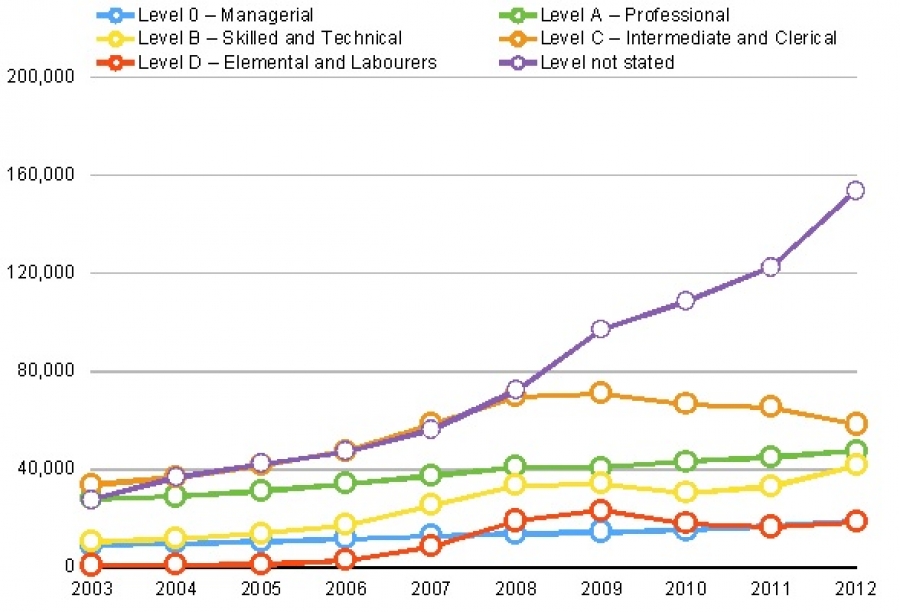
Over the past 10 years, permanent immigration levels and citizenship applications have largely remained stable. The only major growth that has occurred is for Temporary Foreign Workers, many at lower skill levels, most of whom do not have a pathway to permanent residency. Moreover, the pathway from permanent resident to citizen has also become harder, and will become even more so, undermining the overall Canadian model of immigration and citizenship.

Over reliance on anecdote and weakness in the evidence base have contributed to a number of these policy changes. Policy change is complex and the effects are only known after a number of years. It took four years before the flaws in the redesign of Temporary Foreign Workers became apparent. It will likely take that long to know whether the new “Express Entry” immigration approach works as intended. The full effect of changes to the Citizenship Act will only be known in about 10 years, given the increased residency and related requirements.

TFW’s are just one piece of immigration puzzle – New Canadian Media – NCM.

Kenney defends job bank despite outdated postings

Yet another headache for the government in the context of Temporary Foreign Workers and the introduction of the “Express Entry” new immigration approach which will also use the Job Bank. To be fair, keeping such sites up-to-date is always a challenge:

The federal government will soon make enhancements to its online job bank amid revelations that hundreds of positions posted on the site have long since been filled, Employment Minister Jason Kenney said Monday.

“We are making improvements to the Canada Job Bank … we will be using new technological developments in the near future to ensure an even better matching of unemployed Canadians with available jobs,” Kenney said in the House of Commons.

The government will work with “private-sector web platforms” when provinces fail to send their own postings to the job bank, he added. Currently, most provinces and territories do so automatically.

The job bank is a critical component of Ottawa’s controversial temporary foreign worker program. Employers are required to post ads on the site seeking Canadian workers for four weeks before they’re able to apply to hire temporary foreign workers.

The government also relies in part on job bank data to determine what regions of the country are clamouring for labour.

But from customer service representatives in New Brunswick to food service supervisors in B.C. and RCMP clerks in Saskatchewan, many of the 110,000 jobs listed on the job bank are no longer available. A litany of postings are several months old; some have been on the site for more than a year.

Kenney defends job bank despite outdated postings.

In related Temporary Foreign Workers news, Minister Kenney’s refuses Quebec’s request for an exemption for the moratorium, and Minister Alexander makes one of his few public comments:

Kenney told the Commons the moratorium was imposed to protect Canadians who are looking for work.

The federal minister pointed out that 14 per cent of Quebec youth are unemployed as are 20 per cent of new arrivals to the province.

Ottawa announced the moratorium in late April after reports suggested the program was being abused by the food-service industry.

A spokesman for Quebec Immigration Minister Kathleen Weil said on the weekend the province has no problem with the program and that restaurants need temporary foreign workers to keep operating, especially in summer.

The moratorium has been widely criticized by industry groups, with Quebec’s restaurant association calling it “exaggerated and unreasonable.”

Earlier on Monday, federal Citizenship and Immigration Minister Chris Alexander said the moratorium was imposed for “very good reasons.”

“There was abuse and we are absolutely committed to completing the review and the reform we have underway,” he said at an unrelated event in Montreal.

“And I can assure you and her (Weil) and Canadians across the country that when this program is relaunched, it will not be subject to abuse.”

He said the hiring of foreign temporary workers should be a “last resort.”

“There are young people across Canada…who are looking for permanent jobs and summer jobs and our first obligation as employers is to look to the domestic market.”

Temporary foreign worker ban: Kenney tells Quebec to hire unemployed youth

Lastly, commentary by Matt Gurney on the irony of the Quebec request:

But restaurant workers? It’s harder to make that case. If Canadians aren’t taking those jobs, the jobs probably aren’t paying enough. I’m sympathetic to the restaurant owners — the restaurant business is highly competitive, with razor-thin margins — but this is how capitalism works. Long-term jobs won’t adjust their prices to appropriate market-driven levels if there’s a gigantic foreign-worker-fed short circuit built into the process. Foreign workers when necessary to sustain and grow the economy, sure, but not foreign workers handing out the dessert menus as the default option.

Quebec is in an odd position here, and an ironic one. Despite the recent election of the Liberal party, and the attendant crushing defeat of the oft-xenophobic Parti Quebecois, the province still has a warranted reputation of being one of the less welcoming places in Canada with which to move. Even Canadian citizens, of the generically white ethnic background, can run into trouble for what language they speak. There are recent signs that this sad trend may slowly be moderating, but there’s still a very long way to go.

And while Quebec sorts out its discomfort with outsiders, it’s also insisting that it wants to retain access to a vast pool of foreigners to work in an industry in which they probably ought not to be working in the first place. “Send us some foreigners so we can hire them for service-sector jobs!” isn’t really something anyone would have expected to hear coming out of the province that was recently in an uproar about what civil servants could wear on their head or around their necks without getting binned, but here we are.

Quebec government really wants more foreigners. OK, then

Jayson Myers: Building a better foreign workers program | National Post

From Jason Myers, CEO of the Canadian Manufacturers and Exporters (CME) on Temporary Foreign Workers and some sensible recommendations (these are not fast food workers) to improve the program, including pathways to residency and implicitly citizenship:

We recommend that a new foreign skilled worker program be introduced, incorporating:

  • an improved national jobs bank that includes employment insurance claimants;

  • a broadly defined classification of skilled workers that’s based on industry needs, rather than on pre-specified qualifications;

  • an “above normal” wage threshold for temporary employment;

  • streamlined and consistently administered application and approval processes;

  • additional flexibility for employers located outside major urban centres, or in regions of rapid economic growth; and

  • improved pathways to residency, in order to give temporary foreign skilled workers better opportunities to become permanent contributors to the Canadian economy.

Jayson Myers: Building a better foreign workers program | National Post.

Meanwhile, Quebec wants an exemption from the federal moratorium.

Interesting that no cases of abuse or concern about Temporary Foreign Workers in food service industries, given Quebec’s overall higher unemployment rate. Quebec had about 44,000 foreign workers in 2012, about 13 percent of the Canadian total (Quebec’s percentage of Canada’s population is almost 24 percent):

“We are a bit worried about the impact of the moratorium on our restaurants and on our small and medium-sized businesses,” he said Sunday.

“We are ready to work with the federal government to tighten the rules of the program if need be.”

Weil is also planning to make the same case to Employment Minister Jason Kenney, who oversees the temporary foreign workers program, McMahon said.

A spokeswoman for Kenney said there are no immediate plans to lift the ban, in Quebec or anywhere else.

“Abuse of the temporary foreign worker program will not be tolerated,” Alexandra Fortier said in an email.

“Allegations of misuse will continue to be investigated and any employer found to have violated the rules will face serious consequences.”

Quebec wants exemption from temporary foreign worker moratorium on restaurants – The Globe and Mail.

Québec réclame la levée du moratoire sur l’embauche de travailleurs étrangers | Le Devoir

Canada has “moral obligation” to support Israel, stop anti-Semitism: Jason Kenney

While most observers would disagree with Minister Kenney’s characterization of the Canadian approach to the Mid-East as “balanced,” his interview well worth reading as an overview of the Canadian government’s position on Israel and antisemitism, on the eve of the PM-led delegation to Israel.

Kenney was instrumental in increasing the focus on antisemitism, through participation in a number of international fora, hosting the Ottawa Conference of the Inter-Parliamentary Coalition Combatting Antisemitism, joining the International Holocaust Remembrance Alliance,withdrawing Canada from the follow-up to the Durban Anti-racism conference,  and shifting general racism and discrimination programming to address specific forms such as antisemitism, among others.

While political parties always take into account the political advantage of positions (“shopping for votes”), this is more driven by beliefs, rather than electoral calculations (Stephen Harper’s deceased father a key influence in PM’s support for Israel).

Canada has “moral obligation” to support Israel, stop anti-Semitism: Jason Kenney.

Tories’ lead Quebec minister on PQ values plan: Nothing about it upsets me

Mixed messages are never a good communications strategy.

Tories’ lead Quebec minister on PQ values plan: Nothing about it upsets me – Need to know – Macleans.ca.

Rien de précis dans la charte ne choque le ministre Lebel

Half a cheer for Jason Kenney’s revolution in immigration policy | Toronto Star

Natalie Brender in The Star on Policy Arrogance or Innocent Bias: Resetting Citizenship and Multiculturalism, focussing on the risks and limits of anecdotes for decision-making. Nice to see words like epistemological  (theory of knowledge – yes, I had to look it up too!) to capture the issues and dynamics.

In the end, I am more in the camp of anecdotes and evidence, understanding the strengths and weaknesses of each one, but using both to ensure the best possible policy outcome.  Article as follows:

Andrew Griffith, a retired senior official at Citizenship and Immigration Canada, has just published a book about the tense period beginning in 2007 that saw minister Jason Kenney bring a tidal wave of change to two federal departments. Among the many virtues of Griffith’s book, Policy Arrogance or Innocent Bias: Resetting Citizenship and Multiculturalism, is a striking commitment to epistemological modesty and self-reflection.

Throughout his case studies of various policy issues, Griffith underlines how officials working on multiculturalism and citizenship issues under Kenney were forced to confront their own latent ideologies and grapple with challenges to their expertise under a regime that broke starkly from the approach of previous governments.

From vocabulary to policy priorities to the deepest questions of what counted as sound evidence for policy-making, the Conservatives upended decades of received wisdom. For instance, Griffith reports, Kenney and his staff held in particular odium the blame-laying perspectives taken by “downtown activists” and researchers in analyzing mainstream discrimination toward cultural minorities.

An organization’s use of terms such as “oppression,” “white power” and “racialized communities” became grounds for striking it from a pool of grant applicants. This aversion was part of the minister’s larger distaste for the issue of barriers facing visible-minority Canadians, and his desire to shift focus toward discrimination within and among minority communities.

Because Griffith writes as a consummately professional public servant, he doesn’t pass explicit judgment on the policy shifts effected during the Kenney years. As he notes, it’s the job of elected officials to decide government priorities, and the job of public servants to be loyal implementers of those decisions.

On the other hand, it’s also the job of public servants to provide expert insight and advice to their ministers, who are supposed to take that advice into account in making policy decisions. It’s on this score that some of the book’s most revealing insights lie, since there was an unprecedented parting of ways between Kenney and officials on the question of what counted as sound evidence.

Multiculturalism and citizenship officials had long been used to basing their insight on social scientific research such as large-scale surveys and data collection on a range of standard topics. In Kenney, they were confronted with a minister who took his bearing from first-person anecdotes gathered from tireless meetings across Canada. (Such a minister, in the words of another official quoted by Griffith, was “like Halley’s comet, only coming by once every 76 years.”) Through the nuggets of information gained from his unmatched ear-to-the-ground contact with the nation’s increasingly suburban ethnic communities, Kenney was confident in his knowledge of their realities and concerns.

That confidence accompanied what Griffith alludes to as “the minister’s (and the government’s) general skepticism about social policy research,” and their disdain for the “downtown activists” who had forged deep ties with multiculturalism staff. Two starkly different “evidence bases,” as he puts it, were being drawn on by the political and bureaucratic levels.

Notably, Griffith does not depict the outcome as an unmitigated disaster from a policy-making perspective. Kenney was indeed gleaning real insights into experiences and concerns within different communities, which could not be captured in large national surveys or data sets. He gathered anecdotal reports on topics it had never occurred to officials to investigate systematically – for instance, on violations of citizenship integrity within certain immigrant groups in matters such as cheating on citizenship tests or so-called “birth tourism.”

Expert officials sometimes found to their surprise that the minister’s revamped multiculturalism priorities met with approval among diverse communities in the department’s focus group testing. And in Griffith’s own judgment, the anecdotal evidence that Kenney gained sometimes did produce worthwhile new directions in policy and programming (such as initiatives to address discrimination within and among ethnic groups).

For these reasons, Griffith writes, “officials had to learn to listen to — and respect — the key messages and insights coming from the minister, reflecting his anecdotes and conversations from his extensive community outreach.” It was a wrenching adjustment for many to have their expertise challenged and world views dismissed. Eventually, though, most staff took on board the insights that anecdote could offer, and worked to incorporate them into programming and policy.

There is no indication that Kenney and his staff reciprocated in the epistemological modesty department. In one exceptional instance, Griffith reports, officials found studies that managed to persuade them that racism and discrimination indeed pose real barriers to the success of certain ethnic groups in Canada. But other than that, the learning and broadening of world views seems to have been entirely one-sided.

And in the bigger picture, even anecdotes reflecting a partial reality give precious little for policymakers to go on. Stories of fraud whispered in the minister’s ear don’t tell policy makers how widespread the incidence of citizenship-test cheating or birth tourism is. They don’t tell policymakers what the relative dollar costs of taking action or keeping the status quo will be; nor do they predict what side effects might come from dramatically changing current policy.

Only careful data collection and analysis can do that. And that’s precisely what the Kenney regime (and the Harper government) couldn’t be bothered with in their haste to get tough on “abusers of Canadians’ generosity.”

Writing as a loyal civil servant, Griffith doesn’t say it explicitly, but the lessons of his book are clear. Anecdote is a lousy basis for policymaking, and modesty and self-reflection are not virtues to be expected only on one side of the relationship between the public service and politicians. As Chris Alexander takes over these files as minister of immigration, he could get a fine start by bearing those truths in mind.
Half a cheer for Jason Kenney’s revolution in immigration policy | Toronto Star.

Tories focus on ethnic outreach with multiple multiculturalism ministers | hilltimes.com

Reasonably good analysis in The Hill Times on the various roles of ministers on multiculturalism. I expect that statutory responsibilities will be met by Minister Alexander but only after vetted by Minister Kenney’s office. It will be interesting to see who signs the Annual Multiculturalism Report – may end up being joint-signature to underline the senior political minister role played by Minister Kenney.

Tories focus on ethnic outreach with multiple multiculturalism ministers | hilltimes.com.

Federal Multiculturalism Minister concerned about Quebec religious-symbols ban – The Globe and Mail

A bit less strong than his tweet earlier this week, but recognition that the federal government cannot sit on the sidelines on this one.

My upcoming book, Policy Arrogance or Innocent Bias, has a section that covers the multiculturalism/interculturalisme debates and some of the earlier challenges at both the political and official levels in deciding how and what level to respond.

Federal Multiculturalism Minister concerned about Quebec religious-symbols ban – The Globe and Mail.

Charte des valeurs québécoises: Articles

Another series of articles on the proposed Charte des valeurs québécoises.

First, confirmation that the government plans to go ahead, and leak is likely more than trial balloon:

Charte des valeurs québécoises: Drainville dit unir les Québécois | Paul Journet | Politique québécoise.

Quatre conditions pour un accommodement raisonnable

Secondly, a piece by Jocelyn Maclure, quoted in a CBC interview earlier, speaks strongly of the risks and dangers of such a rigid, exclusionary approach, and notes the false assumption that the Canadian and Quebec charters of rights allow every form of accommodation, where the reality is different:

Charte des valeurs québécoises – Le jeu dangereux du Parti québécois

And from the English media, Farzana Hassan, former president of the secular Muslim Canadian Congress, a harsh critique, particularly interesting how consistently strong the MCC has been on secularism:

More xenophobia from PQ’s Marois

And a few pieces on some of the broader ethical and rights issues involved from professors of religion and ethics: Ian Henderson and Margaret Somerville:

 The state cannot decide what is a religious symbol

Op-Ed: Quebec bans religion from the public square (I do disagree with her definition of ‘freedom from religion’; religious freedom applies to all, whether they are believers or non-believers, the issue is whether or not the government allows people this freedom.

On the federal political level, interesting to see how this plays out. One leader has been clear and categorical against it (Trudeau, the same week as his marijuana revelations), the Prime Minister has ducked the issue but the real Minister for multiculturalism, Jason Kenney, issued a strong tweet, and the NDP and official opposition leader has also ducked, saying he will await the actual bill before commenting. Not inspiring leadership that. 

And then there were 2… multiculturalism ministers on the cabinet roster – Inside Politics

More from Kady O’Malley on her series ‘would the real Minister for Multiculturalism please stand up’. I think in practice it will be less confusing for outside observers as Minister Kenney will be the main public face of multiculturalism and is clearly the senior political minister. Officials will adjust as they must, the focus of the program will be political, given the importance of ethnic communities as the ‘fourth sister’ of electoral strategies.

Not elegant from a machinery of government perspective but a totally understandable and rational, from a political perspective decision (even if the former official in me groans about what it means for the long-term health of the multiculturalism program).

And then there were 2… multiculturalism ministers on the cabinet roster – Inside Politics.