No plans to change refugee target in wake of U.S. travel ban: immigration minister

Calibrated response:

As MPs debate U.S. President Donald Trump’s travel ban in the House of Commons, Canada has already confirmed it will not hike its refugee intake target in the wake of a contentious immigration and travel crackdown in the U.S., says Immigration Minister Ahmed Hussen.

Under pressure by the NDP, human rights groups and refugee lawyers to bring more asylum-seekers to Canada, the minister said Canada’s plan will not change in response to an executive order by Trump that suspends the U.S. refugee program and bars entry to nationals from seven Muslim-majority countries.

“Our immigration levels plan has an allocation that is historically high for refugees,” Hussen said. “We intend to maintain that plan.”

Canada’s 2017 immigration plan is set to accommodate 40,000 refugees.

Hussen also rejected calls to suspend the Safe Third Country Agreement, a pact which considers asylum-seekers safe in both Canada and the U.S.

“All the parameters of that agreement are in place and there is no change at this time,” he said.

MPs held an emergency debate Tuesday evening, which concluded around midnight, on the U.S. immigration and travel directives,.

Noting that the U.S. has now agreed to allow in 872 refugees who were already screened and in transit, and were previously denied entry, Hussen said that’s a sign the situation is evolving fast. He added that Canada will closely monitor developments.

“The responsible thing to do is to maintain contact, to continue to engage and make sure we monitor the situation closely to make sure we provide information to Canadians,” he said.

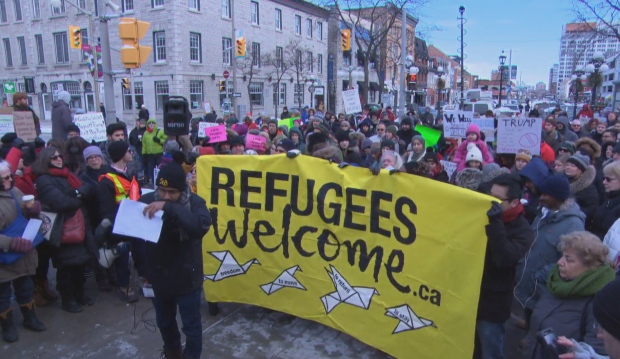
Ottawa U.S. Embassy Trump protest travel ban Jan 30 2017

People gathered outside the U.S. Embassy in Ottawa Monday afternoon to protest an executive order signed by President Donald Trump banning citizens of seven Muslim-majority countries from entering the United States. (CBC)

Call for ‘special measures’

NDP immigration critic Jenny Kwan, who requested the emergency debate, held a news conference Tuesday morning urging the government to lift a cap on privately sponsored refugees and to fast-track refugee claims.

The B.C. MP laid out a number of proposed “special measures” ahead of the debate.

“There is no question that this ban promotes hate and intolerance,” she said. “This ban will have a disastrous effect for thousands of innocent travellers and refugees.”

Calling it “absolutely shocking,” Kwan said the Trump travel ban will have a huge negative impact on the economy, as well as cultural and academic development.

…Conservative immigration critic Michelle Rempel used the debate to launch into an examination of whether Canada was effectively managing its own immigration file.

She questioned whether there was adequate funding to help refugees integrate into Canadian society, and whether it was wise to lift the visa restrictions on Mexicans coming to Canada.

“To respond to the immigration policies of other nations, we must first get our own house in order, and then through those actions, show the world what immigration policy best practice looks like,” Rempel said.
Ahmed Hussen, my kind of Muslim | Tarek Fatah

Interesting to see the various sources of praise for the new Minister for Immigration, Refugees and Citizenship on both sides of the political spectrum (Candace Malcolm, former Conservative communications assistant and Sun columnist tweeted her support and subsequently wrote a column Ahmed Hussen has shown courage and conviction).

Will be interesting to see how long this lasts as he makes policy decisions or implements existing one’s (i.e., C-6 repealing of the revocation and other provisions  of the previous government’s C-24):

On Jan. 10, Prime Minister Justin Trudeau made a decision that made ripples throughout the world.

From Singapore to India, to the BBC and beyond, the only news from Canada that made headlines was about Ahmed Hussen, a Somali-born refugee who arrived on our shores in 1993 and rose to become our Minister of Immigration, Refugees and Citizenship.

For spotting talent and lifting a backbencher into the Privy Council, I tip my hat to Trudeau.

For hundreds of thousands of African-Canadian boys and girls, Ahmed Hussen’s story is a beacon of hope.

(Readers should know Hussen is a close friend, though we disagree on much.)

He first came to my attention at the height of Ontario’s historic (and successful) fight rejecting the use of Sharia law in family law arbitration matters in 2004-2005.

On one side was the mosque establishment and many Islamic clerics who had set up quasi courts and appointed “Qazis” to invoke Islamic Sharia in settling family disputes.

Opposing them was a much smaller group of secular and liberal Muslims – including yours truly – for whom this was a do-or-die moment.

We knew how the UK had let this happen many years before, only to discover, too late, the Muslim community of Britain being held hostage by Islamic clerics.

At the time, Hussen was a Liberal staffer with ties to then Ontario cabinet minister George Smitherman.

Along with another Muslim staffer, Hussen helped us connect with Smitherman, where we made our case to ban Sharia courts in Ontario.

While Hussen supported our goals, he never crossed the line to help us more than what was appropriate, transparent and above board.

That same year, the Toronto Star listed Hussen as a “Person to Watch”.

People were already noticing the lanky lad from Regent Park, but I am not sure Hussen knew that at the time.

When asked by the Star if he had political ambitions, the future immigration minister said, “I don’t think I could handle the life of a politician . . . I don’t want to be front and centre.”

A community organizer in Regent Park, when the Toronto District School Board (TDSB) tried to pigeonhole Canadian-born kids of Somali ancestry as “Somali kids” in 2014, Hussen led the fight against this paternalistic orientalism, denouncing attempts by the board to segregate in the name of integration.

He told the TDSB: “Do you need to stigmatize and marginalize people to help them? … In the name of ‘help’ you can actually do a lot of damage if you don’t do it the right way.”

Canadians concerned about the global and Canadian rise of Islamism and jihad should be reassured they have an ally in Hussen.

Here is what he told the U.S. Committee on Homeland Security hearings in Washington in July 2007, in criticizing the idea of treating terrorism only as a criminal offence:

“The strategy of Canadian officials as they confront this phenomenon in my community has been to view this serious matter only through the prism of law enforcement … There has not been a parallel attempt to counter the toxic, anti-Western narrative that creates a culture of victimhood in the minds of members of our community.”

Hussen is already showing his mettle. On Monday, he told CBC News he was committed to bringing non-Muslim Yazidi refugees, victims of ISIS, to Canada, a group that has been largely excluded so far.

Source: Ahmed Hussen, my kind of Muslim | Fatah | Columnists | Opinion | Toronto Sun

2017 Cabinet Shuffle

election-2015-and-beyond-implementation-diversity-and-inclusion-024The above chart contrasts the original 2015 Cabinet with the changes announced Tuesday by the Prime Minister (will update when parliamentary secretary changes are announced to replace those who were promoted to minister).

Gender parity remains, visible minority representation increases to 20 percent, no change in the number of persons with disabilities, with only one Indigenous minister compared to two in the original Cabinet (Hunter Tootoo was later removed).

The choice of a neophyte Minister for Immigration, Refugees and Citizenship, Ahmed Hussen, is not without risk given the complexities and politics of the department’s issues (as Monsef’s difficulties attest).

Hussen is the third immigration minister to have been an immigrant, the first visible minority and non-European. (Joe Volpe, born in Italy,  and Sergio Marchi, born in Argentina but of Italian ancestry, are the previous ones). As most of Canada’s current immigrants are visible minorities, he will bring that perspective and experience with him to the portfolio, as well his experience on security and radicalization issues.

Like McCallum, his riding is majority visible minority (54 percent compared to McCallum’s 82 percent) but with a different mix: York South-Weston is 21 percent Black, 9 percent Latin American whereas Markham-Thornhill is 35 percent Chinese, 31 percent South Asian.

Look forward to seeing the mandate letters for Minister Hussen (and others) to see if any new commitments compared to former Minister McCallum (largely achieved or in progress – list below):

  • Lead government-wide efforts to resettle 25,000 refugees from Syria in the coming months.
  • As part of the Annual Immigration Levels Plan for 2016, bring forward a proposal to double the number of entry applications for parents and grandparents of immigrants to 10,000 a year.
  • Give additional points under the Entry Express system to provide more opportunities for applicants who have Canadian siblings.
  • Increase the maximum age for dependents to 22, from 19, to allow more Canadians to bring their children to Canada.
  • Bring forward a proposal regarding permanent residency for new spouses entering Canada.
  • Develop a plan to reduce application processing times for sponsorship, citizenship and other visas.
  • Fully restore the Interim Federal Health Program that provides limited and temporary health benefits to refugees and refugee claimants.
  • Establish an expert human rights panel to help you determine designated countries of origin, and provide a right to appeal refugee decisions for citizens from these countries.
  • Modify the temporary foreign workers program to eliminate the $1,000 Labour Market Impact Assessment fee to hire caregivers and work with provinces and territories to develop a system of regulated companies to hire caregivers on behalf of families.
  • Lead efforts to facilitate the temporary entry of low risk travelers, including business visitors, and lift the visa requirement for Mexico.
  • Work with the Minister of Justice and the Minister of Public Safety and Emergency Preparedness to repeal provisions in the Citizenship Act that give the government the right to strip citizenship from dual nationals.
  • Eliminate regulations that remove the credit given to international students for half of the time that they spend in Canada and regulations that require new citizens to sign a declaration that they intend to reside in Canada.