Justin Trudeau rolls the dice on immigration

Cam Clark’s take on the multiculturalism-year immigration levels planned increases:

Justin Trudeau’s Liberal government is doing something no Canadian government has done for decades: It is gambling on a lot more immigration.

There should be no doubt that it is a gamble. On the day that U.S. President Donald Trump was responding to a terrorist attack in New York by blaming the immigration system, exploiting resentment there, the Liberals were saying Canada needs more immigrants. And don’t think that’s because it’s a slam-dunk political winner with new Canadians: Polls show first-generation immigrants are not much keener on expanded immigration than those born here.

Mr. Trudeau’s government is making a statement that it is going in a different direction. In fact, that’s the statement that Immigration Minister Ahmed Hussen made. “We are emphatically and unapologetically taking the opposite approach,” he said at a press conference in Toronto.

The numbers that the Liberals are shooting for are nowhere near the massive, 450,000-a-year level proposed by the Liberal-appointed Advisory Council on Economic Growth headed by McKinsey and Co. guru Dominic Barton and backed by some big-business voices and the Conference Board of Canada. Mr. Barton had suggested more newcomers could foster economic growth and mitigate the aging of Canadian society. But that would be a huge expansion, and for politicians, that’s not just a gamble but going all in.

Yet Mr. Hussen’s numbers are still large increases. Under Stephen Harper’s Conservatives, there were typically about 260,000 immigrants each year. The Liberals have increased the target to 300,000 this year, and will keep increasing to 340,000 by 2020 – that’s a 30-per-cent increase over a typical Conservative year, and a 21-per-cent increase over the Conservative 2010 high mark. When compared with the size of the population, the Liberals are planning a rate of immigration not seen since Brian Mulroney was in power.

Immigration levels dropped substantially for two years under Jean Chrétien, and levels have fluctuated from year to year, but no government since Mr. Mulroney’s has made any sustained, substantive change to immigration rates – the number of immigrants as a percentage of the population. The Liberals plan to move the rate upward significantly.

It’s a plan to keep increasing immigration steadily. Mr. Hussen even revived the Liberal target of increasing immigration to 1 per cent of the Canadian population – a promise made by Mr. Chrétien in 1993 but ignored once he was in power.

Politically, it’s not the specific number that matters. The government has done polls that show that most Canadians don’t have the foggiest notion how many immigrants come to Canada. But Canadians still have opinions on whether there are too many immigrants, or too few.

A survey commissioned in March by the Association for Canadian Studies found that 38.4 per cent of Canadians think there are too many immigrants, while just 10.4 per cent said there are too few. But a lot, 41.1 per cent, said that the number’s about right. Perhaps that’s one reason recent governments haven’t risked changing things much.

Jack Jedwab, the association’s president, said the number of people who think there are too many immigrants is generally pretty stable, between 30 per cent and 40 per cent; it’s near the high end of the range now. (The March survey was conducted by web panel that used a sample of 2,559 people.)

People born outside of Canada are a little less likely to think there’s too much immigration, but not much. There is a substantial political divide: People who consider themselves on the right are far more likely to think there are too many immigrants than people on the left.

That may be one reason Mr. Trudeau’s Liberals are willing to take a political gamble on immigration. It emphasizes a difference that plays better with left-leaning voters. And it represents a contrast with Mr. Trump. But it’s still a gamble.

Even Mr. Trump is calling for a “merit-based” immigration system, which sounds similar to Canada’s “high-skilled” class, rather than the United States’s current visa lotteries. He won’t end immigration; the Trump culture war is mostly about Mexicans and Muslims, and he has portrayed both as dangerous.

In Canada, Mr. Jedwab said, the resentment of immigration was once driven by economics – the sentiment that immigrants take Canadian jobs or cost the treasury – but now, it is clearly driven by perceived security concerns and fears immigrants are changing Canadian culture and values.

No wonder then, that Mr. Hussen emphasized the economic reasons for expanding immigration, noting, for example, that there will be fewer workers to support retirees in coming years. His plan also includes more family reunification, asylum-seekers and resettled refugees. People like the notion of hard-working economic immigrants, but not everyone is as positive about the rest. That’s probably a very big reason why governments have not signalled a sustained change in immigration levels for a quarter century. Until now, they didn’t want to take a risk.

Source: Justin Trudeau rolls the dice on immigration – The Globe and Mail

Link to government background info: Backgrounder2018-2020 Immigration Levels Plan

Minister says 300,000 new immigrants a year is Canada’s ‘new normal’ – Home | The House | CBC Radio

Setting the stage for the 2018 levels announcement. Not much suspense in that the number will be higher; some suspense as to whether the government will announce a multi-year plan as long talked about. Some political risks in doing so as steady increase may provoke some reaction, and possible political benefits to the government’s brand.:

Canada’s immigration minister says Canada will welcome at least as many immigrants next year as it is in 2017.

The government’s plan for annual immigration levels, which was set at 300,000 for this year, is expected to be tabled in the House of Commons next week.

Immigration minister Ahmed Hussen told The House that the government will not go below that level next year.

“Three hundred thousand is now our new normal,” he said, while not closing the door to a higher number for 2018.

“As a government we went from 260,000 to 300,000 because of the need to meet the demands of Canadian families who wanted to reunite with their loved ones,” Hussen continued. “But also employers who are asking us to allow them to continue to use immigration more and more as a way to meet their growth needs.”

Hussen added that he’s been in the process of consultations since April to put together the immigration outlook that’s coming soon, and that those consultations focused on the numbers Canada should bring in and what the right mix immigration, in terms of the different classes, should be.

He said the “vast majority” of immigrants coming in will be from the economic class because that’s where the greatest need is.

This will be followed closely by family class immigrants and then refugees, Hussen said.

Statistics Canada census numbers released Wednesday revealed the number of immigrants in Canada has reached its highest rate in a century.

Source: Minister says 300,000 new immigrants a year is Canada’s ‘new normal’ – Home | The House | CBC Radio

Kellie Leitch criticized over tweet attacking Syrian refugee program

Deservedly so. Sun columnist and former Conservative ministerial staffer Candice Malcolm, the originator of the line (The real legacy of Trudeau’s Syrian refugee program), merits the same:

Conservative MP Kellie Leitch is facing new criticism after she issued a tweet portraying the legacy of the Liberals’ Syrian refugee program as a lone domestic violence case involving a Syrian refugee in Fredericton.

Social media erupted after Ms. Leitch tweeted Sunday: “A battered wife and a bloodied hockey stick. That’s the legacy of Trudeau’s Syrian refugee program,” quoting and including a link to a Toronto Sun column about a Syrian refugee in Fredericton who beat his wife with a hockey stick. Immigration Minister Ahmed Hussen said Ms. Leitch’s tweet is as disgraceful as domestic violence itself.

“It’s [domestic violence] clearly something that we abhor and we condemn. What Ms. Leitch is doing is equally reprehensible because she’s tying in a problem that exists everywhere – both in refugee communities and in … our society. This is a problem that many societies grapple with. She’s tying that in with our refugee policy,” Ms. Hussen said in an interview with The Globe and Mail on Monday.

The column, written by Candice Malcolm last Friday, attempts to make the case for Ms. Leitch’s Canadian values test, saying it would have “gone a long way” in the case of Mohamad Rafia, who told the court he didn’t know it was against Canadian law to beat his wife. The Syrian refugee, who arrived in Canada 14 months ago, was sentenced to one year probation, according to a report by The Daily Gleaner on June 8.

Ms. Leitch’s proposed “Canadian values test” was a key part of her recent Conservative leadership campaign. The test would make newcomers go through face-to-face interviews with trained immigration officers to screen for Canadian values such as freedom, tolerance and generosity.

Ms. Leitch lost last month’s Conservative leadership vote, dropping off the ballot at the ninth of thirteen rounds with 7.95 per cent of the vote. Andrew Scheer won the race and now leads the Conservative Party in the House of Commons, where Ms. Leitch sits on his front bench.

When contacted by The Globe Monday, Ms. Leitch’s phone line went dead. Follow-up calls were not answered.

Asked about Ms. Leitch’s tweet, Conservative immigration critic Michelle Rempel said she would not speak on behalf of her colleague.

“I’m not going to speak on behalf of one member of our party. I’m going to speak on behalf of the record of our former government and the very positive and assertive position that we’ve taken as a party since the last election on a Conservative vision for helping the world’s most vulnerable, including refugees.”

NDP immigration critic Jenny Kwan accused Ms. Leitch of “fear mongering.”

“Kellie Leitch continues to spout divisive dog-whistle rhetoric even after her own party rejected her and her ideas,” Ms. Kwan said.

Source: Kellie Leitch criticized over tweet attacking Syrian refugee program – The Globe and Mail

Liberals’ citizenship bill [C-6] to proceed with some Senate amendments

Being debated and voted on in the House Monday June 12.

Expect that the Senate will/should declare victory given two out of three amendments accepted, including the most important one of restoring procedural protections for those accused of fraud or misrepresentation:

Far more people lose their citizenship because it was obtained fraudulently, and the Senate wants to amend the bill in order to give those people a chance at a court hearing before their status is stripped away.

Hussen said the government will accept that proposal, albeit with some modifications of its own, including giving the minister the authority to make decisions when an individual requests it.

Hussen’s hand was partially forced by a recent Federal Court decision that said people have a right to challenge the revocation of their citizenship, although predecessor John McCallum had earlier suggested he would support the amendment.

“This amendment recognizes the government’s commitment to enhancing the citizenship revocation process to strengthen procedural fairness, while ensuring that the integrity of our citizenship program is maintained,” Hussen said in a statement.

The government will also accept a Senate recommendation that would make it easier for children to obtain citizenship without a Canadian parent.

But they are rejecting efforts to raise the upper age for citizenship language and knowledge requirements from 54 to 59, saying it’s out of step with the goal of making citizenship easier to obtain. The current law requires those between the ages of 14 to 64 to pass those tests; the Liberals want it changed to 18 to 54.

Hussen thanked the Senate for its work making the bill “even stronger and for providing an example of productive collaboration on strengthening important legislation.”

The Senate has the choice of accepting the government’s decision, rejecting it, or proposing further amendments of its own, which could further delay the legislation.

Source: Liberals’ citizenship bill to proceed with some Senate amendments – The Globe and Mail

Minister Hussen on citizenship #Immigration150 conference

Interesting insight at yesterday’s Conference Board of Canada Immigration Summit during the session with IRCC Minister Hussen.

In response to a broad question regarding multiculturalism from the moderator, CBoC Senior VP Craig Alexander, the Minister responded that the world has two choices: give into fear or make a “deliberate choice” to be open to people, skills and talent. This was not only “morally right” but also beneficial to economic development.

The Minister noted that when questioned in other countries about diversity, he replied that Canadian citizenship is based upon shared values, not on ethnicity, cultural origin or religion as in many other countries.

Canada’s ability to welcome all, whatever their origins, and integrate them well, is key to our success.

He noted that as Canadians, “we all assume that when people come as immigrants, they will become citizens” and that was not the case in many other countries.

He went on to emphasized that not becoming a citizen affects the ability to integrate and never becoming part of society and never able to contribute to their full potential. Canada does not that problem. Again, we assume that all immigrants will become Canadian.

Canada is unique in the regard. We take this for granted. It is our history of immigration that makes us open to immigration. By welcoming and including everyone, Canada can realize the potential of all and use the full resources of its population.

Powerful words, eloquently stated.

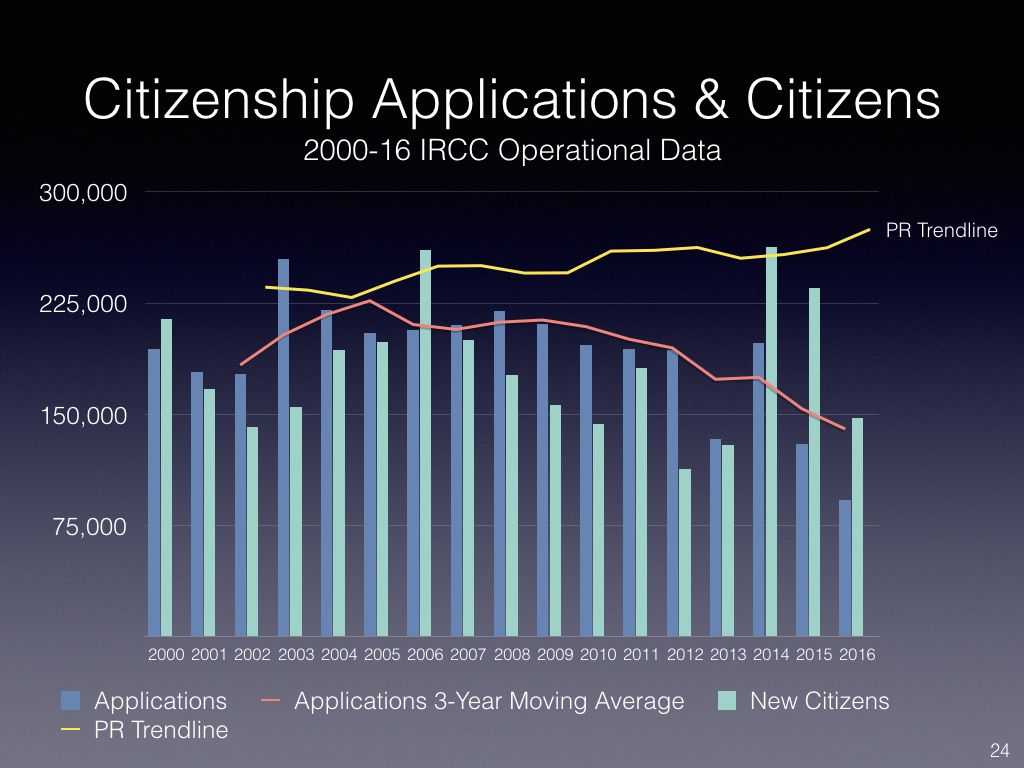
However, someone at IRCC should point out to him the recent data that show a dramatic drop citizenship applications – from 198,000 in 2014 to 92,000 in 2016 – and the increasing gap between new permanent residents and new citizens (296,000 compared to 148,000 in 2016, following the elimination of the backlog in 2014-15).

The key chart captures the trends.

So rather than assuming the immigrant-to-citizen path, we need to recognize the impact of previous changes and take steps to address this decline, starting with reviewing the steep fees as I have noted previously (and repeatedly).


Ottawa pilots ‘name-blind’ recruitment to reduce ‘unconscious bias’ in hiring

This pilot will provide some real world data to the existing blind cv studies that have been conducted by Oreopoulos and Reitz.

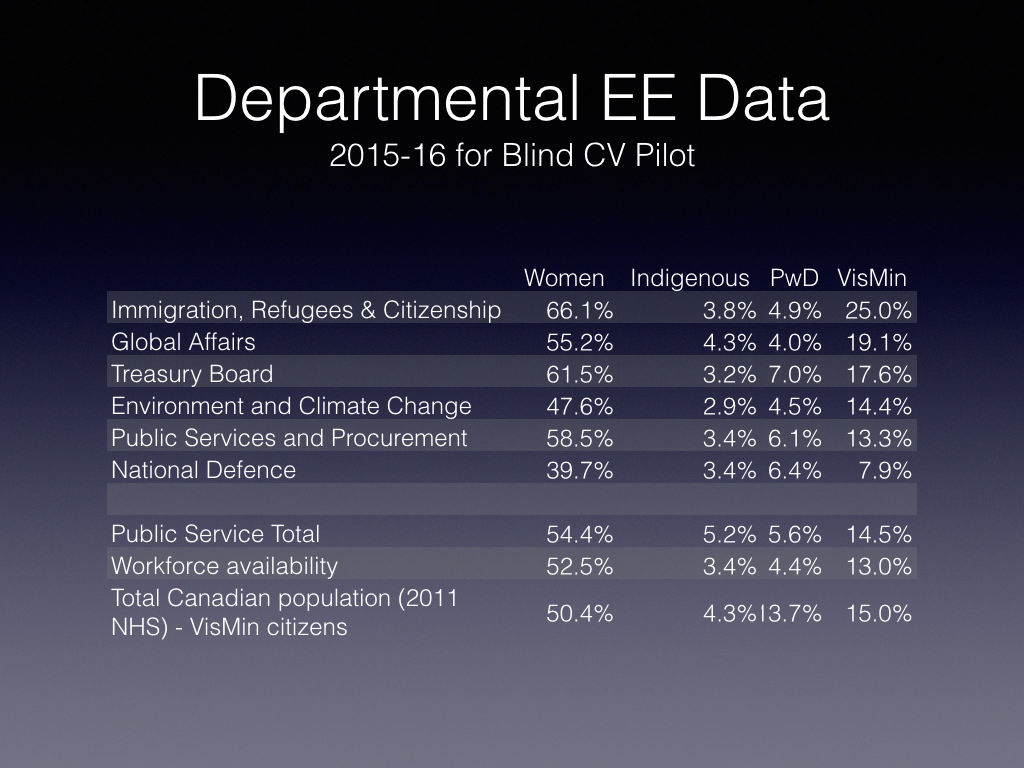
Wisely, the government has chosen to pilot this in a number of departments with different representation challenges, as shown in the table below:

As the government has largely met the goal of being representative of the population it serves, implicit bias may be less of a factor in the government sector. Representation is somewhat less at more senior levels, where implicit bias is likely less of an issue given that candidates are known.

It would be ironic indeed if the pilot, intended to test for bias against visible minorities, would show a bias for visible minorities, given some of the “over-representation” in some departments. In any case, a valuable exercise.

Ottawa has launched a pilot project to reduce biases in the hiring of federal civil services through what is billed “name-blind” recruitment, a practice long urged by employment equity advocates.

The Liberal government’s move came on the heels of a joint study by University of Toronto and Ryerson University earlier this year that found job candidates with Asian names and Canadian qualifications are less likely to be called for interviews than counterparts with Anglo-Canadian names even if they have a better education.

“It’s not just an issue of concern for me but for a lot of people. A number of people have conducted research in Canada, the U.K., Australia and the U.S. that showed there is a subliminal bias in people reading too much into names,” said Immigration Minister Ahmed Hussen, who first delivered the idea to Parliament last year as a rookie MP from Toronto.

“Name-blind recruitment could help ensure the public service reflects the people it serves by helping to reduce unconscious bias in the hiring process.”

Some companies in the private sector, including banks and accounting firms, have already adopted the practice, which removes names from application forms in order to stop “unconscious bias” against potential recruits from minority backgrounds.

In the United Kingdom, the government now requires name-blind applications for university admissions service and other applications for organizations such as the civil service, British Broadcasting Company and local government.

U of T sociology professor Jeffrey Reitz said the initiative is an important step forward but cautioned officials they must consult independent experts in developing the process and reviewing the results to make sure it is done correctly.

To conduct name-blind screening, he said, recruiters must remove any information on a resumé that would reveal the ethnicity of the person, such as name, birth place and membership in an association before coding the candidates in the talent pool.

“If the government is serious about it, they need to make the process transparent and allow researchers to look at the new procedures and the results,” said Reitz, a co-author of the Canadian study on name discrimination against Asians.

Debbie Douglas of the Ontario Council of Agencies Serving Immigrants said she hopes the pilot could benefit other minority groups, given studies have shown that white English- and French-speaking able-bodied women have been the primary beneficiaries of current employment equity programs.

“We hope as the government moves proactively to ensure diversity in hiring it will review the existing program and strengthen it to ensure the intentional inclusion of racialized and indigenous job seekers,” said Douglas.

Treasury Board President Scott Brison, who championed Hussen’s initial idea, said he welcomed the opportunity to explore new ways of recruiting talent for the public service.

“A person’s name should never be a barrier to employment. Diversity and inclusion in the workplace is critical to building an energized, innovative and effective public service that is better able to meet the demands of an ever-changing world,” said Brison at the launch of the pilot at Ryerson Thursday.

The six departments participating in the pilot include Department of National Defence; Global Affairs Canada; Immigration, Refugees and Citizenship Canada; Public Services and Procurement Canada; Environment and Climate Change Canada; and the Treasury Board Secretariat. A report on the pilot is expected in October.

Using data from a recent large-scale Canadian employment study that examined interview callback rates for resumés with Asian and Anglo names, U of T and Ryerson researchers found Asian-named applicants consistently received fewer calls regardless of the size of the companies involved.

Although a master’s degree can improve Asian candidates’ chances of being called, it does not close the gap and their prospects don’t even measure up to those of Anglo applicants with undergraduate qualifications.

Compared to applicants with Anglos names, Asian-named applicants with all-Canadian qualifications had 20.1 per cent fewer calls from organizations with 500 or more employees, and 39.4 per cent and 37.1 per cent fewer calls, respectively, from medium-sized and small employers.

Source: Ottawa pilots ‘name-blind’ recruitment to reduce ‘unconscious bias’ in hiring | Toronto Star

Too soon to put Canadian price tag on Trump’s immigration overhaul: officials

Useful questioning of the Minister and officials, and reasonable responses to an evolving situation:

The Liberal government is examining whether the fallout from U.S. President Donald Trump’s executive orders on immigration will require more cash to be spent north of the border.

But both immigration officials and the federal minister told a House of Commons committee that right now, there’s no new money.

Departmental officials say Trump’s executive orders are too new for them to be able to estimate how much they could cost Canada and in what ways.

The Immigration and Refugee Board, however, has been saying for months that a rise in the number of asylum claims is already straining its resources and it has put in a pitch for more cash.

Board officials had been hoping to get an answer in Wednesday’s federal budget but Immigration Minister Ahmed Hussen wouldn’t commit Monday to new funds.

He says the fact that claims have been rising at the IRB since 2015 is proof the problem goes beyond the so-called Trump effect.

The board did receive about $4.5-million to deal with an expected increase in claims from Mexican nationals following a government decision to lift visas for Mexicans last December.

Those numbers are already up over last year – 241 Mexicans lodged asylum claims in all of 2016 and 156 have already done so in 2017.

Many anticipate the U.S. president’s executive orders curtailing immigration from certain countries, scaling back refugee admissions and speeding up deportations could push the numbers of people seeking asylum in Canada higher.

Hussen and his officials were pressed Monday by the NDP’s immigration critic Jenny Kwan on whether any more money has been earmarked yet to deal with the potential fallout.

The executive orders are too new and the money currently being requested from Parliament deals with already identified needs, said Daniel Mills, an assistant deputy minister in the Immigration Department.

“We haven’t yet estimated the amount that we will need,” he said in French.

What might be needed next is under review at least in one area.

“The IRB is already facing a number of pressures and recent events will only give rise to further pressures,” Richard Wex, an associate deputy minister in the department, told the committee.

“This matter is under active consideration by the government.”

Hussen tried to bolster the case at committee that the so-called Trump effect isn’t to blame for the rise in claims.

Of the 143 people who’ve who crossed illegally into Manitoba to make an asylum claim in 2017, he said only about 50 had U.S. visas, 97 per cent had been the U.S. less than two months and had not filed an asylum claim there.

“It puts into context the claim made by many that this is as a result of the U.S. administration,” he said.

“In fact, the rise in asylum claims through the border . . . there’s been a small and steady increase since 2015, most of 2016. This is definitely not specific to the incoming U.S. administration.”

Another element that could complicate the IRB’s caseload is the upcoming plan to lift the visa requirement people coming from Romania and Bulgaria. Romania in particular was a large source of asylum claims in Canada prior to a visa requirement being imposed and the decision to phase-out the visa later this year is likely to lead to a renewed increase in asylum claims.

No money has been earmarked yet for the IRB to deal with that.

Source: Too soon to put Canadian price tag on Trump’s immigration overhaul: officials – The Globe and Mail

Senate Hearings on C-6: Minister Hussen and Witnesses March 1

Summary: Senate committee hearings on Bill C-6 finished March 1 with the last set of witnesses, including Minister Hussen and officials, with the clause-by-clause review taking place this morning. The Minister was challenged particularly on the lack of procedural protections in the cases of revocation for fraud or misrepresentation. While he stated his general willingness to consider improvements, the overall tenor of his responses and those of his officials was to defend the current process. Conservative senators questioned the rational for the elimination of knowledge and language assessment for 55-64 year olds, probed the protections of the current revocation process for misrepresentation and expressed their disagreement with the repeal of revocation in cases of treason or terror. Senator Eggleton, just as he had during C-24, expressed his concern over the impact of the increase in citizenship fees, with the Minister and officials defending the increase and arguing it did not cause the decline.

The clause-by-clause review this morning may see a number of observations (greater flexibility for those applicants who have difficulty in knowledge or language assessment, the impact of citizenship fees). An amendment to improve procedural protections is expected to be introduced at third reading.

External witnesses

Robert Watt, a former Vancouver-based citizenship judge 2009-15 focussed his remarks on his experience in reviewing thousands of applications. While the majority clearly demonstrated the desire to stay and contribute, a basic competence in language and understanding of Canada, a small number had a more instrumental interest in having a Canadian passport and the benefits of medicare and tax credits, or being “citizens of convenience. He believed strongly that the intent to reside should remain given the clear signal it sends that a new citizen should centre her of his life in Canada; that the current residency requirements of four to six years should not be reduced and the need for the department to have “robust audit procedures” to check the validity of third-party language assessment.

Lorne Waldman of CARL, and Josh Patterson of BCCLA spoke on to restore procedural protections for revocation in cases of fraud and misrepresentation, either reverting to the previous access to the Federal Court or some other procedure that involved the right to a hearing, the right to disclosure, an independent decision-maker and reversion to permanent residence status rather than foreign national.moan independent

Main questions

Revocation for fraud or misrepresentation and procedural protections: Most of the time was taken up by this issue, with questions and witnesses noting the contrast between the solid procedural protections for permanent residency misrepresentation and refugee determination and the limited protections for citizenship misrepresentation. Patterson and Waldman repeatedly noted the dubious constitutionality of the provision. In terms of which option was preferred, they noted their preference for an expansion of the IRB to handle such cases, given their experience and expertise. However, as there was no reference to a possible IRB role, that was beyond the scope of what could be considered and thus some variant of a process providing an oral hearing before the Federal Court was provided. There was relatively low risk of cases being appealed beyond the Federal Court level. A number of examples were cited highlighting the limitations of the C-24 approach.

Smart Permanent Resident Cards to track entry and exit (raised by Julie Taub in last set of hearings): Watt noted that pending technological developments, applicants should present their travel documents to CBSA (but was unclear how that would work). Waldman noted that unlike the EU, Canada does not control on leaving the country. This would be a significant change and would be expensive to implement. While it would work for airports, it would not be practical for land crossings given the resulting delays.

Fees: Senator Eggleton continued to press on fees, noting the dramatic increase in fees and that applications had taken a “real nose dive,” noting the points made in my brief (https://sencanada.ca/content/sen/committee/421/SOCI/Briefs/C-6_A_Griffith_e.pdf). He noted that the press on full cost recovery did not take into account that those applying for citizenship were taxpayers too, and they would be contributing for many years. Waldman confirmed the impact on immigrants, that the costs to families, including external language assessment, was in the $1,000s and that the government had to look at costs as a barrier if Canada wants to encourage people to become part of the fabric of society. Watt noted the fee increases came near the end of his term but he had seen instances of individuals and families struggling even with the previous fees, and a “good case” can be made to balance accessibility and cost recovery.

Language proficiency and age requirement: Watt was probed further on what he meant by the need for a robust audit on whether or not language requirements were met. He responded by noting the wide range of organizations offering assessment services and that random audits were needed to ensure that the level had been attained. He noted that some applicants may lose proficiency in the period between getting assessed and becoming citizens (but also noted that the reverse could occur). Patterson noted there was no issue with respect to 14-17 year olds as they would learn in schools or the workforce. For 55-64 year olds, economic class immigrants already would have met language requirements, and the issue was with respect to family class, particularly parents and grandparents. He referred to Avvy Go’s earlier testimony regarding the barriers faced by low-income immigrants and refugees and believe a better approach was increased resources for language training.

Residency requirements: Watt was challenged whether one more year or less made a difference in terms of integration. He responded by noted the importance that the clarity that residency meant physical presence provided given previous Federal Court jurisprudence. He never saw any evidence from IRCC that an additional year would be burdensome and did not believe it was. Waldman confirmed the helpfulness of the physical residency definition but noted that the change to three out of five years was particularly helpful to refugees as they had no other citizenship. The restoring of part-time credit for time spent in Canada prior to becoming a Permanent Resident was also a welcome improvement.

Minister Hussen and officials

Minister Hussen opened by noting that the previous government’s changes had created barriers to citizenship. C-6 would repeal some of the changes and facilitate citizenship, and send a clear signal of Canadian inclusivity, fairness and diversity (“diversity is our strength”). C-6 was part of implementing the Speech from the Throne commitment to make it easier for immigrants to participate.

Repeal of the national interest revocation provision (terror treason) was to ensure that Canadians, whether single, dual or multiple nationality were treated equally and the government did not support treating people differently, noting the positions of organizations such as the CBA and CCR along with focus groups “much troubled” by this distinction. Those convicted of terrorism or treason will face the Canadian justice system and will “go to jail for a long time.” Revocation for fraud or misrepresentation was different.

Other measures in C-6 removed barriers. Repeal of the intent to reside provision would reassure citizens that they were not at risk of losing citizenship. Physical presence was maintained but citizenship could be attained one year earlier. Providing part-time credit for pre-permanent residency time provided greater flexibility for those such as international students who had “started building connections.” The return to the previous 18-54 age requirements for testing recognized that 14-17 year olds would meet these through the school system while easing the burden for55-64 year olds.

He also reiterated the government’s commitment to program integrity, noting the provision that would allow the government to seize fraudulent documents.

Main questions

Revocation for fraud or misrepresentation and procedural protections: As in the previous session, the absence of procedural protections was the main focus. Minister was repeatedly challenged along the earlier testimony by legal experts, and was reminded that his predecessor had indicated he would welcome an amendment in this regard. The Minister repeatedly stated that he believed that the present process has safeguards and is sound, but he was open to proposals that would improve protections.

A number of questions served to clarify the steps in the process and the criteria used by officials to assess whether revocation was warranted. Factors included: age of applicant, extent of ties to Canada, whether they were primarily living in Canada or not, and the health of an individual. The process was completely delegated to officials.

Some questions concerned the assertions of CARL/BCCLA:

  • no right to disclosure: unanswered by Minister unless I missed it
  • no H&C consideration: Minister replied party can provide under personal considerations
  • no right to counsel: Minister replied absolute right to counsel (in preparation of documents)
  • no right to appeal: Minister said not correct (seek leave which is not the same thing)

Minister resorted at one point by noting that C-6 only dealt with some issues – dual national revocation and removing barriers – and that the appeal mechanism was “not central” to C-6. He was, however, “committed” to procedural fairness.

Officials confirmed that the majority of cases pertained to residency, with other cases related to identity or not disclosing criminality.

Revocation (terror or treason): Conservative senators challenged Minister on the rational to repeal the revocation provisions of C-24 and he reiterated the equal treatment arguments. He confirmed that the one person whose citizenship which had been revoked under the C-24 provision would have his citizenship reinstated.

Fees: Senator Eggleton raised the same questions as before. Minister replied that the drop was more attributable to the barriers contained within C-24, primarily the longer residency requirements. Fees were much lower than many countries, citing the USA and UK (comment: correct, but not mentioning Australia and NZ which are lower). Officials reiterated the direct correlation between the extended residency requirement, noting the sharp drop after June 2015 when the four-year minimum came into effect.

Comment: The one-year transition effect ended in June 2016. The final 2016 numbers, due out any day now, will confirm a sharp decline. The July-September numbers – the first quarter after this transition period – do show an increase (from 11,970 to 20,329) but one far short of the historical number of applications (about 200,000 per year or 50,000 per quarter). Hence fees matter!

Language proficiency and age requirement: In response to questions regarding the number of applicants 55-64, officials provided some useful data. 7.7 percent of all applicants were in this age category (not clear which year – I have a pending request for this data). Officials noted that the numbers of this age group had dropped from 15,243 last year to 2,317  (believe it referred to mid-year comparisons 2016 to 2015), with total applications of 67,000 (not clear which period she was referring to). Minister indicated his confidence in language assessment process.

Officials noted that applications were not accepted if the applicant had little or no language. Settlement programs provided language training and applications would be accepted following successful completion. Officials also noted the various steps to ensure the integrity of the citizenship test. On the citizenship study guide, officials confirmed that the current guide was written higher than CLB-4 (the formal requirement) and that it would be re-written to be more aligned to the requirement: not to “simplify but in clearer language.”  Officials were also looking at including more language on Indigenous peoples, given TRC recommendation number 93.

Minister reiterated that it was important for 55-64 year olds to obtain citizenship, that it contributed further to their integration and they contributed to Canadian society (e.g., providing child care) and this restored what “has worked in Canada for more than 40 years.”

Integrity: In addition to points in opening remarks, Minister noted that the department had agreed with all recommendations in the OAG audit of the citizenship program, with all either acted or being acted upon.

Only media coverage I have seen is in the National Post (Immigration minister defends legislation that prevents convicted dual nationals from losing citizenship), largely unbalanced as it focuses mainly on the testimony of one witness, Julie Taub, and her critique of C-6)
 

Liberals unveil resettlement plan for 1,200 Yazidis and other victims of ISIS

One of the few areas that the Conservative opposition has made a positive contribution. Michelle Rempel deserves full credit for pushing the government:

Canada plans to resettle 1,200 Yazidi refugees and other survivors of ISIS by the end of this year.

Immigration Minister Ahmed Hussen announced today that nearly 400 survivors have already arrived in Canada in the last four months since the House of Commons unanimously supported a Conservative motion that called on the government to provide asylum to an unspecified number of Yazidi women and girls.

Of those, about 74 per cent are Yazidi.

Canada has been given consent from the Iraq and Kurdish regional governments, which are supporting and co-operating with the plan, Hussen said.

The motion recognized that ISIS, also called Daesh, is committing genocide against the Yazidi people and holding many of the group’s women and girls as sex slaves.

Hussen said many of the newcomers will have far greater needs than other refugees who have come to Canada.

“Many have experienced unimaginable trauma and vulnerability, both physical and emotional, and many will have unique physical, psychological and social needs, such as trauma counselling,” he told reporters at a news conference in Ottawa Tuesday.

Survivors arriving at ‘controlled pace’

The survivors have been arriving on commercial flights at a “controlled pace” to avoid over-burdening support services. The federal government will also work with provincial, territorial and municipal governments to ensure unique ongoing needs are met.

Although the motion referred only to providing asylum to Yazidi women and girls, the 1,200 refugees will include male family members. Hussen said ISIS also deliberately targets young boys, so the program will help resettle all child survivors of ISIS.

The government will also facilitate private sponsorships of Yazidi refugees, he said.

Source: Liberals unveil resettlement plan for 1,200 Yazidis and other victims of ISIS – Politics – CBC News

Ahmed Hussen: The rise and rise of Canada’s immigration minister

Good long profile of IRCC Minister Hussen in Macleans (Hussen is well respected by many Conservatives who while in government engaged with the Canadian Somali Congress – whether this respect will continue as he implements Liberal policies remains to be seen):

Still, Hussen was not exactly a high-profile MP, and when he was tapped to take over the immigration file from veteran John McCallum—who subsequently resigned his seat and was named ambassador to China—the reaction was largely, “Who?” Hussen says he had no sense this was coming, but he was “very, very honoured and really touched” that the Prime Minister handed him this file. “I’ll be frank: it’s a big job, and he didn’t start as a parliamentary secretary, so he didn’t have the opportunity to get seasoned on the brief,” says Chan, who remained friends with Hussen after both left McGuinty’s office. “But I’ve never doubted his intelligence. So for me, his only major challenge is the cut-and-thrust, and the speed with which things will transpire in his life.”

Chan exudes a warm, fatherly sort of pride toward his colleague, despite being only nine years older. Hussen has three sons aged seven, three and five months; Chan’s three sons are just about a decade older, and he’s warned Hussen of how hectic it will be juggling everything now. Chan echoes others who know Hussen, in remarking on how he manages to be quietly commanding. “I think the challenge sometimes is in the heat of the bright lights, some people might take that (soft-spokenness) as a form of weakness. I would never take that as a view, that he won’t see through the issues or that he’s going to act in a capricious way, or that there’s a soft underbelly to him,” Chan says.”There isn’t.”

In fact, the PMO saw Hussen’s “preternatural calm” as a major asset in this portfolio, the senior government official says. The Liberal government—not unlike vast swaths of the U.S. government apparatus, apparently—didn’t know exactly what the Trump administration had planned, but it was clear from the campaign that immigration would be a hot file. Hussen was also seen as an ideal fit because he had, quite literally, been there. “We wanted to make sure there was someone in the control room who really understood what it was like to be on the shop floor,” the official says.

Hussen is almost comically understated about his dramatic public introduction to the job, conceding only that it was a “very interesting” weekend. “I’ve always learned most when I’m placed quickly in a situation where I have to deal with something,” he says. “It was a very steep learning curve to get right into it, but I have a very good staff and supportive department officials.”

When asked about his seeming reluctance to respond to issues like the U.S. travel ban from a personal perspective, Hussen returns to a familiar line in spelling out the various pieces of his identity and history. “I’m very happy and proud of my Somali heritage, but I also make it a point to emphasize that I’m a Canadian citizen, and I’m a Canadian,” he says. “This is where I have spent more of my life, this is home for me and this is the society I have grown to cherish.”

For Hussen, it’s about being proud of his roots, but recognizing that he is a citizen of one country now: Canada.

Source: Ahmed Hussen: The rise and rise of Canada’s immigration minister