In 2000, the UN Security Council unanimously recognized that the key to peace and security lies in the equal participation of women in civil society. UN Resolution 1325 reaffirmed the important role of women in the prevention and resolution of conflicts, peace negotiations, peacebuilding, peacekeeping, humanitarian response and post-conflict reconstruction. Canada is one of 79 member states with a national action plan to achieve these goals. Last June, the government went one step further by appointing Jacqueline O’Neill as its first ambassador for women, peace and security.
And yet, the full participation of women in civil society is fraught with danger in countries where women’s rights are lacking – especially when demanding basic human rights and speaking truth to power. For their efforts, many have been beaten, sexually abused, imprisoned or killed in an attempt to silence their call for human dignity. Now, the pandemic has multiplied the challenges faced by these courageous activists.
In late April, the Nobel Women’s Initiative launched an ambitious online campaign to highlight the work of seven extraordinary women striving for human rights in the Middle East. This took place in lieu of a one-day conference originally planned for April in Ottawa, during which Nobel peace laureates Tawakkol Karman, Jody Williams and Shirin Ebadi were to address delegates.
A number of common themes emerge from this campaign.
Foremost is the worry that with countries focused on domestic initiatives regarding the pandemic, less attention will be paid to human-rights abuses elsewhere. Omaima Al Najjar, an exiled Saudi human-rights activist, believes the Saudi government will further violate rights “because the world is busy with COVID-19.”
Many of these activists are pleading with us to remember the vulnerable – especially in conflict zones where many of the NGOs that had been working on peacebuilding are now also helping with the COVID-19 response with very limited resources. Muna Luqman, a Yemeni peacebuilder, points out that despite the recent ceasefire, women human rights defenders (WHRDs) are now “more isolated to face the threats of warring parties on their own,” given the decreased oversight of ceasefire violations. She also reminds us that the basic act of hand-washing is a challenge for many Yemenis lacking access to clean water. She fears the spread of COVID-19 through her war-ravaged country.
There is also deep concern that prisons in the Middle East will become COVID-19 hot spots – perhaps by design.
Fahima Hashim of Sudan has devoted her life to women’s equality and rights. Years ago, she led a successful campaign to reform rape laws. She warns that female prisoners in Sudan “are at great risk for the spread of COVID-19” due to poor living conditions, overcrowding and lack of access to health care.
Mozn Hassan, a prominent Egyptian feminist human-rights defender, has been under a travel ban and asset freeze because of her work. She reminds the world that “when priorities shift, we need not to forget WHRDs who have been jailed because of their legitimate activism. We need to call for their release.”
While a number of countries have released prisoners to ease overcrowding, COVID-19 is being used to endanger the lives of political prisoners who remain incarcerated. Reem Al-Ksiri, a Syrian women’s human-rights lawyer and expert on torture, leads research at the Syrian Centre for Legal Studies and Research. She has raised the alarm: “Women in prison, especially those imprisoned with children and those imprisoned for political reasons, are at present in a catastrophically dangerous situation due to the COVID-19 pandemic.” She is calling for the release of all political and pre-trial detention prisoners.
Similarly, Maryam Shafipour is an Iranian human-rights activist who spent time in Evin Prison for her political views. She advocates for the release of female Iranian political prisoners, observing that “COVID-19 has become a tool in the hands of the Iranian authorities to do more harm to political prisoners” and accusing authorities of using COVID-19 to “kill political prisoners.”
Finally, the spectre of increased domestic violence is on the mind of Yanar Mohammed, a prominent Iraqi feminist who heads an organization that runs underground shelters for women fleeing honour killings, sex trafficking and domestic violence. COVID-19 is a ”double jeopardy,” she believes, since authorities are ”threatening us and trying to shut us down” while ”at the same time COVID-19 has locked us in our homes.” Please spare a thought for these brave women who, at great personal risk, are demanding basic rights that we often take for granted.
And one wonders why conspiracy theories take hold:
British government propaganda unit ran covert campaigns across the Middle East for several years at the height of the Cold War, distributing Islamic messages in a bid to counter the appeal of communism.
Recently declassified official papers show that the Information Research Department (IRD), a then-secret division of the UK Foreign Office, commissioned a series of sermons that were reproduced and distributed throughout the Arabic-speaking world.
The papers show that the unit also arranged for articles to be inserted in magazines published by Al-Azhar University in Cairo, “to ensure that every student leaves the University a resolute opponent of Communism”.
In an attempt to reach as wide an audience as possible, the IRD also published and distributed across the region a series of Arabic-language romantic and detective novels, within which anti-communist messages were embedded.
These stressed that Soviet communism was essentially atheistic in philosophy and practice, and claimed that Moscow aimed to sow political disorder and economic chaos in the Middle East.
The papers also shed new light on the way in which the British government covertly controlled or influenced many of the radio stations and news agencies in the Middle East from the 1940s to the late 1960s. Some details of these operations became public after the IRD was shut down in 1977.
However, the latest tranche of declassified papers appear to show the IRD to have been particularly sensitive about what its officials termed “religious operations”, in which they attempted to utilise Islam as a bulwark against communism.
Marked Secret or Top Secret, many of the papers are being declassified after 50 or 60 years; nevertheless, some passages were blacked out by government censors before they were made public at the UK National Archives.
Subterfuge, bribery and sermons
The IRD was set up in 1948 in order to continue the work of a wartime body called the Political Warfare Executive. For the next 29 years it ran a number of newspapers, magazines, news agencies, radio stations and publishing houses, in order to spread unattributed anti-communist propaganda across much of the world.
Its favoured method, however, was to place stories in established newspapers and to covertly brief opinion formers. This was achieved on occasion by subterfuge or bribery, although early on, a senior IRD official, John Peck, warned that bribery might not always work.
“I have serious doubts about the value of bribery as a means of getting anti-communist articles in the press,” he wrote.
“I am told that except in Jordan and possibly in Syria the circulation of those Middle East newspapers which are open to bribery is small and their individual influence negligible.”
In the same memorandum, he summed up the reason for IRD material being distributed without attribution: “However valid our arguments may be, the fact that they are our arguments makes them suspect to the Arabs. We can only overcome this difficulty by presenting the same arguments through an Arab intermediary.”
Despite Peck’s wariness, bribery continued to be used as a means of distributing propaganda material across the region.
Although financed through the same unpublished budget as Britain’s intelligence services, the newly-released papers show that the IRD also received funding from the oil industry.
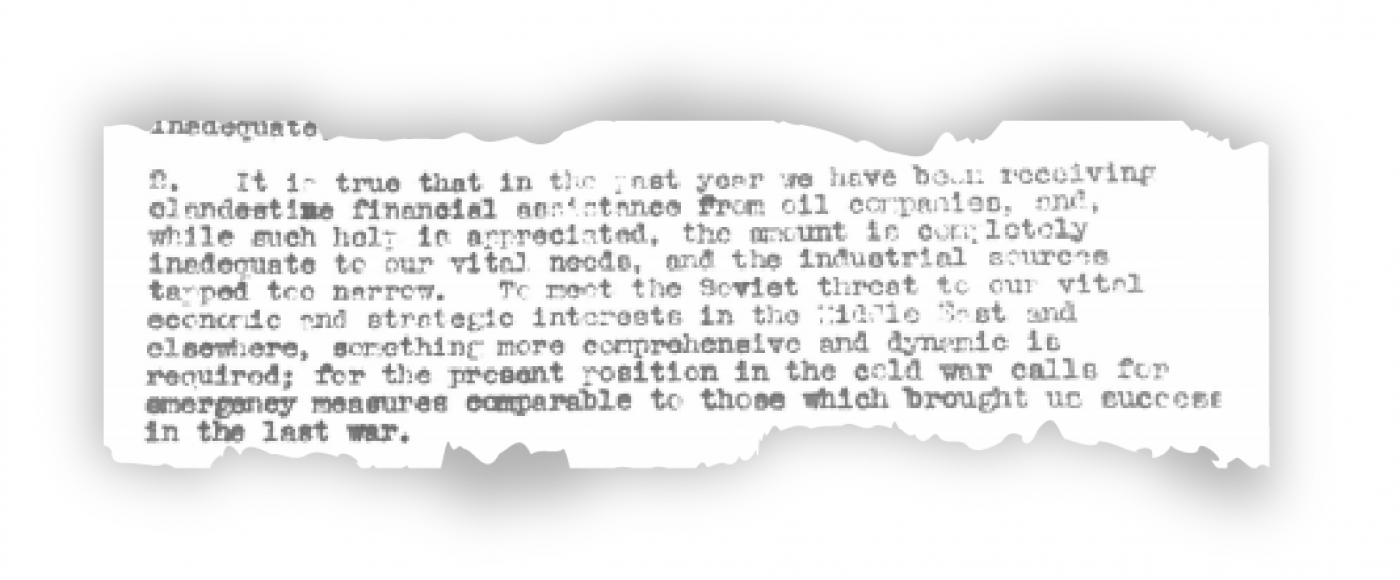
“It is true that in the last year we have been receiving clandestine financial assistance from oil companies,” a memo to IRD director Ralph Murray, marked Top Secret, noted in 1954.
But the Middle East was seeing “the emergence of a state of total ideological warfare”, the author claimed. “And while such help is appreciated, the amount is completely inadequate to our vital needs.”
The newly declassified papers contain a number of references to “religious operations”. Frequently these references are concerned with the financing of such propaganda campaigns, rather than the means of delivery. “You will note that we are including new budgetary provision for £1,000 to cover ‘Religious Operations’” is one typical entry.
Some details of the campaigns do emerge, however. In February 1950, for example, two years after the IRD was set up, its representative at the British embassy in Cairo informed London: “The Friday sermon has always been recognised as one of the most important way [sic] of spreading propaganda in the Moslem world.
“We have now devised a scheme for ensuring that anti-Communist themes are adequately dealt with. A series of sermons has been written here.”
This was still happening 10 years later, as a top-secret memo from Beirut from August 1960 makes clear: “We hope to produce two short pamphlets or sermons a month on religious subjects. They will be written by Sheikh Saad al Din Trabulsi, formerly of the Beirut Moslem Tribunal (sharia) and now of Zahle Moslem Tribunal, who is well-known as a pious Moslem.
“Two thousand copies of each would be distributed unattributably … throughout the Arabic-speaking world (less Iraq). Recipients will be Sheikhs, other leading Moslem personalities, Mosques and Muslim education establishments.”
The intermediary between the IRD and Trabulsi is named in the files as a man called Rivera, although this is possibly a codename.
Another intermediary between the IRD and individuals described as “religious operators” is named in the files as Talaat Dajani, a Palestinian refugee living in Beirut. Dajani later moved to London, where he received a medal of honour from the Queen in 1979, and died in 1992.
The whole Trabulsi operation, the IRD representative explained to London, would cost around 8,800 Lebanese pounds, or around £1,000 sterling, a year.
Although Iraq was excluded from that campaign, the country was on occasion the subject of IRD religious operations. In 1953, for example, IRD headquarters wrote to its man in Baghdad, saying: “We would like to know more about your ‘pilot’ scheme for the covert dissemination of propaganda in the Shia holy places since it may suggest ideas which could be used outside Iraq.
“Is the scheme connected with the working party’s proposal to make Friday sermons prepared in Beirut available to certain Shia divines?”
IRD officials saw another chance to make use of “religious operations” in Iraq following the attempted assassination of the country’s prime minister, Abd al-Karim Qasim, as he was being driven through Baghdad in October 1959.
There had been a “remarkable religious revival” following the attempt, the unit noted. “Workmen engaged in demolition work near the site of the attempted assassination had discovered the tomb of a Moslem holy man; this story had been widely publicized and had given substance to the popular belief that the Premier had been miraculously preserved. It was agreed that there would be an advantage in giving wider circulation to the story.
“Religious stickers have been appearing in Baghdad and the possibility of augmenting them is to be considered.”
Disruption and influence operations
The following April, a conference of Middle East-based IRD officers was held in Beirut. The minutes of what was described as a “restricted session on covert propaganda” show that Ralph Murray “listed the targets at which we should aim to disrupt or influence”.
Those to be disrupted included communist parties and hostile propaganda agencies. This was at a time when printing presses inside Soviet embassies were thought to be producing 10,000 copies of a newspaper entitled Akhbar every day.
Those to be influenced, on the other hand, included young people, women, trades unions, teachers’ organisations, the armed forces and religious leaders.
The representative from the British embassy in Baghdad explained that Iraq “was now an important target for religious material”, at which point, the minutes say, IRD officers based in Amman and Khartoum “also pressed strongly for supplies of sermons and religious articles, which they said they could easily place”.
The files make clear that several governments in the region connived with the IRD and would assist in the distribution of sermons and the placement of newspaper and magazine articles.
The IRD’s man in Baghdad also “emphasised that the Iraqi army was an important target” and suggested that arrangements might be made for selected officers to visit the UK, with the trip appearing to be arranged by bodies with no clear connection to the British government.
He also noted that in Basra, the same press was being used to print both communist and non-communist newspapers, and said that “the judicious use of some financial inducement would probably make it possible to put the Communist paper out of business if that were thought to be desirable”.
Delegates were briefed on the propaganda efforts of other members of the Baghdad Pact: the Cold War alliance of Iran, Iraq, Turkey, Pakistan and the UK that was dissolved in 1979. The IRD enjoyed extensive contacts with Baghdad Pact governments, offering both propaganda materials and technical support.
“In practice,” the delegates were told, “only the Turks are really active, having achieved the publication in the Turkish press of 25-30 articles a month prepared by a writers’ panel.”
Finally, the secret conference was informed that HMG [Her Majesty’s Government] was running two newspapers published in Bahrain: al Khalij and its English-language sister paper, the Gulf Times.
One paragraph in the minutes of the session notes that delegates were told that these newspapers were “exceptional”, in that IRD “preferred to work through staff of established newspapers”.
These minutes are among the papers that have been declassified and handed to the UK National Archives. But, 60 years after the conference, the subsequent paragraph remains blacked out.
Nasser and the Suez crisis
From the end of the Second World War to the late 1960s, successive British governments appear to have used intelligence and propaganda in an attempt to preserve strategic and economic interests in the Middle East at a time when they were struggling to retain influence.
Earlier disclosures about the IRD’s activities have shown that while some senior British diplomats in the region were highly enthusiastic, others were sceptical, fearing that exposure would exacerbate anti-British sentiment.
This is exactly what did happen, at a time and place where the British were about to take their last fling of the imperial dice: in 1956, in Egypt.
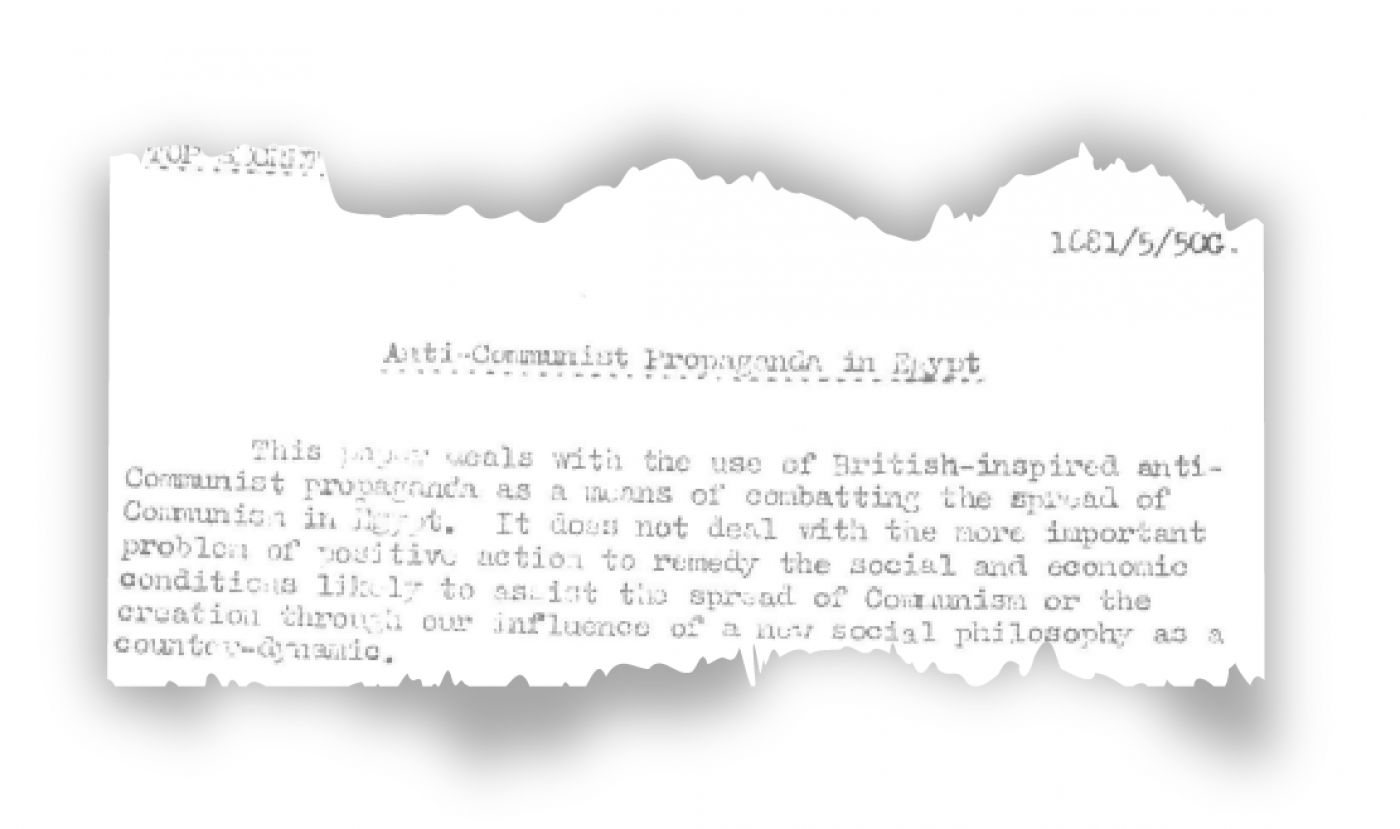
The IRD had been highly active in Egypt from the organisation’s inception. As an IRD paper written in Cairo in 1950 noted: “Conditions in Egypt are such as to make it eminently suitable breeding ground for Communism.”
The author went on to highlight “acute maldistribution between rich and poor” and the concentration of land in the hands of a small proportion of the population.
Nevertheless, he wrote: “This paper deals with the use of British-inspired propaganda. It does not deal with the more important problem of positive action to remedy the social and economic conditions likely to assist the spread of Communism.”
Instead, the author explained, the IRD was targeting the students at Al-Azhar University on the grounds that “from among them come the Imams who preach the Friday sermon in every Egyptian Mosque; the teachers of Arabic in the secondary schools and all teachers in the village schools; and the lawyers specializing in Moslem law”.
The organisation was also arranging for “the production in drafts in English of short love or detective novels, or thrillers, embodying anti-Communist propaganda but following their local counterparts as closely as possible in presentation etc.
“The Information Department, Cairo, would arrange for the drafts to be rewritten in Arabic by local hacks, and for them to be published locally.”
The unit would also “investigate the feasibility of producing short love or thriller magazine stories (of about 2,000 words) with an anti-Communist twist”.
The jewel in the IRD’s crown in Cairo was the Arab News Agency (ANA), one of several media organisations that British intelligence had set up during the Second World War.
Like other news agencies and radio stations that had been established in Beirut, Tripoli, Sharjah, Bahrain and Aden, ANA came under the control of the IRD after that organisation was founded in 1948.
To those on the outside, ANA appeared to be part of Hulton Press, a large company owned by Edward Hulton, a Fleet Street media baron. In fact, Hulton had allowed his company to give cover to the IRD and Britain’s overseas intelligence agency, MI6.
As well as distributing genuine news stories, gathered by Egyptian and British journalists, the agency disseminated propaganda produced by IRD, and became a base for MI6 officers masquerading as journalists.
In March 1956, with relations between the UK and Egypt deteriorating sharply, the UK Foreign Office instructed the IRD to switch its focus away from communism and towards the government led by Gamal Abdel Nasser – who had been engaged in propaganda operations against the British for some years.
The following July, after Nasser nationalised the Suez Canal Company – taking control of the waterway that the British considered to be the jugular vein of their empire – the UK’s propaganda and espionage efforts under the cover of ANA rapidly picked up pace.
Anthony Eden, the British prime minister, had long been convinced that Nasser was under the influence of the Kremlin – although the British ambassador in Cairo, Humphrey Trevelyan, disagreed – and MI6 began considering whether the Egyptian president could be assassinated.
Poison gas was one favoured option; an exploding electric razor was another.
Instead, as the Suez Crisis began to unfold, Eden vetoed the murder plot and the British decided to engage in several months of psychological warfare in Cairo, followed by military intervention.
A powerful new radio transmitter was erected in Iraq, broadcasting programmes from Arabic stations around the region that were covertly under British control, an operation that was for a while given the codename Transmission X.
As the British, French and Israelis plotted to invade Egypt and occupy the area around the canal, a steady stream of IRD and MI6 propaganda specialists began to appear at the ANA’s offices in Cairo.
This had not gone unnoticed by the Egyptian government, however, and in August, just weeks before the invasions, all of the agency’s operations – news reporting, spreading propaganda and gathering intelligence – were brought to an abrupt halt.
Egyptian secret police raided its offices and the homes of several of its staff. Eleven Egyptians were accused of being spies working for MI6 officers based at the agency; one, Sayed Amin Mahmoud, a teacher, was executed, and his son, a naval officer, was jailed for life.
Two MI6 agents who helped to manage the agency were subjected to lengthy interrogation and jailed. Others were tried in their absence, and two British diplomats and four journalists were expelled.
However, the British head of the agency – who was also a correspondent for the Economist and the London-based Times newspapers, escaped arrest: it appears that the Egyptian government may have been feeding him disinformation, and wished to continue.
In the event, IRD simply set up a new Arab News Agency, from offices in Beirut, with staff in London, Cairo, Amman and Damascus.
By 1960, according to one of the recently-declassified files, few people working at the agency’s Beirut headquarters were aware that it was controlled by the British government; IRD staff were warned “therefore to be cautious in their dealings” with them.
In March that year the senior IRD officer at the British embassy in Beirut wrote to London to say: “Of our secret information operations, I … attach the greatest importance to the Arab News Agency. There is no doubt they are doing the most useful work throughout the area and they run a good office here.”
Reuters and the BBC
The recently declassified documents also shed new light on the way in which in the 1960s the British government persuaded Reuters, the international news agency, to take over the operations run by two IRD fronts, Regional News Service (Middle East) and Regional News Service (Latin America). The relationship between Reuters and the IRD was first exposed in the 1980s.
The government funded these Reuters operations through the BBC. It began paying the BBC enhanced fees for its World Service operations, and the BBC in turn paid Reuters extra sums for receiving its news feed.
While the IRD accepted that it could not exercise editorial control over Reuters, the declassified papers show it did believe that it would gain “a measure of political influence”.
Some of the IRD’s Cold War activities in the Middle East and North Africa remain secret, however, with many of its old files remaining classified on national security grounds.
Not all of the papers on Reuters and the Arab News Agency have been transferred to the UK National Archive, for example. One dating from 1960, with the catalogue description “renegotiation of contract between Reuters and the Arab News Agency”, is among the IRD files that remain classified.
Another that has been withheld by the UK Foreign Office is known to contain papers from 1960 and is entitled “Information Research Department: Jordanian television”.
Other withheld files concern efforts to distribute IRD material through the Maghreb Arab Press news agency after it was set up in 1959, or have titles like “Information Research Department: Arab trade unions”.
Many of the titles of the classified IRD files are themselves classified: the UK National Archives catalogue simply lists them as “Title withheld”.
Reputational damage?
The United States was also an enthusiastic purveyor of propaganda in the Middle East throughout the Cold War. Material created and distributed by the US Information Service tended to promote the idea of common western and Islamic values rather than attack Communism.
The recently declassified files are all concerned with British campaigns, however.
With the IRD being shut down in 1977 – in part, because too many people had become aware of its existence and activities – two questions remain.
The first is: did their campaigns have an impact on people’s attitudes and behaviour?
Throughout the Cold War, many British diplomats in the Middle East were sceptical about the IRD’s efforts. Some argued repeatedly that communism had only limited appeal in the region, and that Arab nationalism posed a greater threat to the UK’s interests than Moscow.
‘In our experience, it is barely possible to interest the politically conscious Iraqi in the Communist system at all’
– British diplomat, Baghdad, 1955
Even in Iraq – which the IRD appears to have believed to be more susceptible to communist influence than Egypt – some of Britain’s envoys had their doubts.
One diplomat wrote from Baghdad to the IRD in 1955 to explain: “The Arabs have no means of checking the accuracy of our allegations about the iniquities of the Communist system … but they have the means, as they believe, of checking Russian propaganda about French and British wickedness in the Persian Gulf and North Africa.
“In our experience, it is barely possible to interest the politically conscious Iraqi in the Communist system at all.”
Looking back, a number of historians remain equally sceptical.
Vyvyan Kinross, author of Information Warriors, a forthcoming book about the battles for hearts and minds in the Middle East, believes that Eden’s attempts to demonise Nasser in 1956 left him looking hopelessly out of touch, and propelled Britain into disastrous military action.
The failed propaganda war contributed to “a general collapse of Britain’s reputation for honesty and fair dealing in the region”, Kinross says.
James Vaughan, lecturer in international history at Aberystwyth University in Wales, who has extensively studied western Cold War propaganda in the Middle East, concludes: “The history of British propaganda in Egypt demonstrates how the decline of British influence was a well-advanced phenomenon, several years before Nasser’s decision to nationalise the Suez Canal Company.”
The second question is: what happened after the IRD was closed in 1977?
An intriguing answer to this question was provided by Adnan Abu-Odeh, who served as information minister in the government of King Hussein of Jordan.
Abu-Odeh would have been on MI6’s radar at the time. He was Palestinian who had risen through the ranks of the Jordanian secret police and been handpicked for the job by the king.
At the time the kingdom was going through a major crisis, which became known as Black September, when the Jordanian Armed Forces attacked and expelled the PLO under the leadership of Yasser Arafat from the refugee camps in Jordan.
The crisis was resolved when Palestinian fighters known as the fedayeen were escorted to Syria.
In an interview with Middle East Eye in 2018, Abu-Odeh explained how he was sent to England in the early 1970s, to be trained by the IRD.
‘The king was preparing me to become minister of information, on the advice of MI6. The IRD taught me their tactics and methods’
– Adnan Abu-Odeh
While working as an intelligence officer, Abu-Odeh said, he was approached by the country’s newly-appointed director of intelligence. “He said to me: ‘His Majesty wants you to go on a course in London at the IRD.’
“I said to him: ‘What is the IRD? I didn’t know.”
Later, he was sent back to England to study psychological warfare at a military academy.
“The king was preparing me to become minister of information, on the advice of MI6. The IRD taught me their tactics and methods.
“When I became minister of information, I trained one or two people how to do it.”
Although there is no confirmation in the recently declassified IRD files, it seems entirely possible that before it was disbanded, the organisation trained other government officials across the region.
Just two years ago, Prime Minister Benjamin Netanyahu declared, “I don’t intend to bring a diplomatic plan on the eve of the elections.” He was responding to a reporter who challenged him on saying in 2008 that then-Prime Minister Ehud Olmert, “neck-deep in investigations, has no moral or public mandate to make fateful decisions for Israel” in a quest for political survival. A few days ago, on Jan. 28, Netanyahu did exactly what he said he would not do.
Several hours after “making history” by becoming the first sitting Israeli prime minister to be officially charged with bribery, fraud and breach of trust, Netanyahu took part in the unveiling ceremony of President Donald Trump’s “deal of the century” for Israeli-Palestinian peace, declaring it a “historic day like May 1948,” when Israel declared independence.
Peace is unlikely to emerge from Trump’s plan, but Netanyahu proved once again that all means justify his end of winning the March 2 elections and remaining in the prime minister’s official residence on Balfour Street in Jerusalem. To that end, he mobilized Trump’s help in presenting an alleged peace plan that consists of everything except peace and a Palestinian partner. The East Room ceremony resembled a wedding without the bride, celebrating a deal between Israel and the United States, rather than Israel and the Palestinians.
As expected, the Palestinian leadership rejected the plan. Channel 12 reported that on Jan. 29, Palestinian President Mahmoud Abbas sent Netanyahu a handwritten note informing him, “The Palestinian Authority now sees itself as free to disregard the agreements with Israel, including security cooperation.”
Anyone delving further into the details of the 80-plus-page proposal could not have missed the surprising clause allowing Israel to transfer to a future Palestinian state the populated Arab communities in the so-called Triangle of central Israel: Kufr Qara, Arara, Baka al-Garbiyeh, Umm al-Fahm, Kalansua, Taybeh, Kafr Qasem, Tira, Kafr Bara and Jaljulya.
This is not the first time an Israeli government during the Netanyahu era has tried to trade away its Arab citizens in the Triangle, which borders the West Bank, by moving the border and thereby turning them into nationals of a future Palestinian state. The idea previously arose in 2013 when US Secretary of State John Kerry mediated peace talks between the two sides, with the clear goal of finding a solution to the land swap issue. There also appears to have been a hidden agenda — reducing the number of Israel’s Arab citizens — an estimated 300,000 of who live in the Triangle communities.
“Just as with many earlier initiatives, this one too does not have any hold or acceptance among the Arab Israeli or Palestinian public,” Jamal Mjadlah, a social activist from Baka al-Garbiyeh, told Al-Monitor. “This is an initiative devoid of justice and logic, which will not be accepted and will not be adopted.”
Salah Smara, a high-tech engineer from Tira, asserted to Al-Monitor, “This is an attempt to enhance ideologies espousing population transfer using political tools to get rid of the Arab citizens rather than physically removing people from their homes. The motivations are racial — to preserve demographic superiority.”
The initiative could also have the absurd and tragic impact on many families by tearing them, as in the case of Firas Azam, an attorney born in Taybeh but now living in the coastal Mediterranean city of Haifa. If the land swap goes through, he would remain an Israeli citizen, but his mother and brother’s Israeli citizenship would be revoked.
“‘And we were like strangers in our land.’ This is my headline for this absurd move,” Azam told Al-Monitor. “Our state, where we grew up, went to school, worked, respected its laws and principles, does not want us anymore and is willing to give us up just like that. I would have expected the Jews to understand this better than any other people in the world, but I guess I was wrong.”
Trump and Netanyahu present the idea of exchanging populated lands as targeting communities that “largely self-identify as Palestinians,” according to the plan. A 2019 study by the Israel Democracy Institute found, however, that only 13% of Arab Israeli citizens define themselves as “Palestinians” in terms of their main identity, whereas 65% are “proud to be Israelis.” The study further indicates that 83% of Israeli Arab citizens want to integrate into Israeli society and become full members of it.
The above results do not conform to the premise of the Trump plan, proving yet again that it is nothing more than an attempt by Netanyahu and Israel’s political right to shrink the number of Israel’s Arab citizens, who constitute 21% of the state’s population. That, in turn, would reduce the number of Arab voters, who obviously do not tend to vote for right-wing parties, helping the right perpetuate its rule and prevent the formation of a center-left government.
Shimon Sheves, who served as director general of the Prime Minister’s Office under the late Yitzhak Rabin, shared his thoughts on Facebook about the actual difference between the so-called deal of the century and Rabin’s peace plan. Indeed, there are many similarities between the American blueprint and the one charted by Rabin, who was, as we know, assassinated because of the peace he sought to advance. At the time, it was Netanyahu who led numerous protests against Rabin and addressed rallies at which Rabin was dubbed a traitor and the crowd chanted, “With blood and fire, we will expel Rabin.” The difference is that Rabin did not agree to land swaps, as Ben Caspit explained in a Jan. 29 Al-Monitor article. Perhaps that is what the Netanyahu-led right really wants: to revoke the citizenship of hundreds of thousands of the state’s Arab citizens.
With an effective and well-targeted campaign by the Arab Joint List, currently the third largest Knesset faction, the initiative could backfire against Netanyahu. Such was the case with the so-called Camera Law, a Likud-led initiative to install cameras at Arab polling stations. The alleged idea was to guard against voter fraud, but in reality was devised to intimidate Arab voters. The move ultimately prompted a significantly high Arab turnout in protest in the September 2019 elections. If the current initiative gains ground, Netanyahu will once again be crowned the main campaigner of the Joint List.
President Donald Trump’s national security adviser warned Palestinians on Wednesday that Israeli settlements will continue to expand because rising anti-Semitism around the world means more Jews will immigrate to Israel.
Addressing many hot-button global issues in a speech and discussion with foreign diplomats to the United States, Robert O’Brien also said the president hoped to go to Beijing to talk to the Chinese about a three-way nuclear arms control pact with the U.S. and Russia. He said the president still hopes that North Korean leader Kim Jong Un will resume nuclear talks with the U.S.
O’Brien defended Trump’s Mideast peace plan, which was embraced by Israel but rejected by the Palestinians. O’Brien said the plan is not “perfect,” but urged the Palestinians to negotiate terms of the proposed deal. The deal offers economic benefits that would allow Palestine to become the “Singapore of the Middle East,” he said.
The Palestinians have roundly denounced the proposal, which offers them limited self-rule in scattered chunks of territory with a capital on the outskirts of Jerusalem while allowing Israel to annex large parts of the West Bank. Protesters have burned U.S. and Israeli flags as well as posters of Trump and Israeli Prime Minister Benjamin Netanyahu, who stood with Trump at the White House when he rolled out the plan last week.
“This could be the last opportunity for a two-state solution,” O’Brien said at the Meridian International Center. “The Israeli birth rate is strong and is growing because sadly anti-Semitism in Europe and other places around the world is encouraging more Jews to return to Israel. The settlements are going to continue to expand. If this freeze on settlements doesn’t hold. If this peace process doesn’t work, it may be physically impossible to have a two-state solution.”
It was unusual for a high-level administration official to tie anti-Semitism to the settlements. The Palestinians, as well as much of the international community, view the settlements in the West Bank and annexed east Jerusalem — territories seized by Israel in the 1967 war — as illegal and a major obstacle to peace. But O’Brien’s comments are in line with the Trump administration strongly favoring Israel in the longtime conflict.
O’Brien didn’t note that the Palestinian population is growing too in both the Palestinian territories and Israel, according to U.N. statistics. The Palestinian population is growing at roughly 2.4% a year, 33% higher than Israel’s.
Those demographic shifts have led previous peacemakers to warn that Israel risks losing its ability to remain both a Jewish state and a democracy without a two-state solution that gives the Palestinians enough inhabitable and arable land to accommodate their growing numbers.
Trump’s plan would foresee the eventual creation of a Palestinian state, but would allow Israel to annex all Jewish settlements in the West Bank, as well as the strategic Jordan Valley.
U.S. officials had discouraged Netanyahu from proceeding with plans to immediately annex any new territory and had played down the possibility that the release of the plan would make any such move imminent. But after the rollout, Netanyahu vowed to bring his West Bank annexation plans to a vote at his next Cabinet meeting just days away.
That surprised and frustrated the Americans. In a series of interviews, Trump’s point people on Israel jammed the brakes on annexation, putting greater emphasis on the prospects of Palestinian statehood that Netanyahu was trying to sidestep.
U.S. Ambassador to Israel David Friedman said a U.S.-Israeli committee would need to be formed to ensure that any move matches up with the Trump administration’s “conceptual map.” Jared Kushner, Trump’s son-in-law and a chief architect of the plan, said Israel should wait until after the March 2 Israeli elections before annexing territory.
Any quick move to annex land would galvanize Netanyahu’s hard-line base and shift the focus of his reelection campaign away from his legal woes. But annexation also would likely spark an international backlash, and neighboring Jordan, a key player in Middle East peace efforts, has warned against it. It could also foreclose the possibility of a negotiated two-state solution.
Gruesome billboards of a woman in a bloodied and torn bridal gown appeared around Beirut recently, captioned in Arabic: “A white dress doesn’t cover up rape.” This spring, a women’s rights group, Abaad, hung similarly defiled gowns along the city’s famous seaside promenade.
Such provocative public awareness campaigns are part of a new push in Lebanon and across the Middle East to repeal longstanding laws that allow rapists to avoid criminal prosecution if they marry their victims. The laws were built around patriarchal attitudes that link a family’s honor directly to a woman’s chastity; the marriage option is aimed at shielding the victim’s family from “the scandal,” as one victim’s brother put it in an interview.
In 2014, Morocco repealed a provision that allowed convicted rapists to evade punishment by marrying their victims. Parliamentary votes are expected as early as this summer here in Lebanon and in Jordan after government committees in both places recommended repealing similar exemptions for both the accused and the convicted.
Any change would come too late for Basma Mohamad Latifa, whose family said she was raped three years ago in a village in southern Lebanon by a man more than twice her age. Her family did not go to the police, making a deal not to file charges in exchange for her marrying him.
In June, just after the middle-of-the-night Ramadan meal, the man went to Ms. Latifa’s brother’s house, where she was staying, and shot her nine times. She died, at age 22.
Experts attribute the traction of the movement to repeal these laws to a steady expansion of women’s education in the region and a new kind of public activism spurred by social media, in which advocates have sometimes pushed the envelope with stunts like the bloodied gowns.
Wafa Bani Mustafa, a member of Parliament in Jordan and a leading proponent of repeal, said only a change in the law could drive change in social norms. Without repeal, she argued, “the state of impunity will continue, and the interest of the family will be put ahead of the victim’s right to justice.”
Marriage loopholes in rape cases are not unique to the Arab world, though countries in the region are among the last to retain them in their penal codes. The Philippines, a predominantly Catholic country, still has a marry-your-rapist loophole, according to an 82-country survey by Equality Now, a women’s rights group. Until 2006, so did Uruguay, and until 1994, so did France, according to Human Rights Watch.
Bahrain’s Parliament voted last year to repeal a similar law. But the executive branch balked, saying the marriage loophole should be revoked only in rape cases involving multiple perpetrators.
And in Turkey, the government proposed last November to exonerate around 3,000 men accused of statutory rape if they married their victims and were not accused of using physical force. But so much public outcry followed that the plan was scrapped.
Opposition to the push to repeal the marry-your-rapist laws has been far more muted than that to other demands made by women’s groups, including criminalizing marital rape and granting women the right to pass on their nationality to their children.
But the impact the prospective changes in the rape laws would have on the lives of ordinary women in the Arab world is a matter of debate among women’s rights advocates.
On top of the shame that attaches itself to rape, women’s advocates say, rape survivors in many countries do not always trust law enforcement authorities to address their cases seriously. And so marriage deals are often made in private without criminal charges being filed.
If the Lebanese law is repealed, it will be “a moral victory,” said Maya Ammar, a spokeswoman for Kafa, a Lebanese group that works with domestic violence survivors.
More survivors will have to file charges, she said, instead of settling it privately. “These are cases that are not discussed in public,” she said. “They all happen in silence.”
In Morocco, the issue drew public attention only after a 16-year-old girl committed suicide in 2012 after being forced to marry the man she said had raped her. Her father said a state prosecutor had urged the accused to marry her in return for the charges to be dropped.
The death of the girl, Amina Filali, who swallowed rat poison, prompted public outrage. Two years later, the government amended the country’s rape law, eliminating a provision that had allowed a man convicted of statutory rape to escape punishment if he married his underage victim.
In Lebanon, Ms. Latifa’s family was averse to going public with her ordeal. She and her brother, Ahmad, had come from Syria as refugees. They kept a low profile as Sunnis in a predominantly Shiite village in southern Lebanon. There, a middle-aged man visited the family for months and then, according to Mr. Latifa, raped his sister.
Villagers advised the family to negotiate a marriage contract with the man. “My sister didn’t like the deal, but I assured to her, it will be temporary,” Mr. Latifa said.
She ended up staying in the marriage for three years, which is what the law requires for the accused to evade prosecution. “He was beating her continuously,” her brother said. “I used to see the scars on her face, when she used to visit me.”
Ms. Latifa finally divorced the man, but it didn’t save her. He scrawled a threatening note on the side of the house where they were staying, and then, the next night, went inside and shot her dead. He has been arrested and is facing charges including murder.
Mr. Latifa was skeptical about whether a change in law would have made any difference. The family members were under pressure to settle, and they were refugees, with no political patrons. “Our words won’t have much impact,” he said.
“Neither the horror of what Christians go through at the hands of Islamists and others, nor the scale of the crisis of Christian populations in the Middle East especially, appears to be widely known, let alone the subject of public concern.” So wrote Peter D. Williams, the Catholic social and political commentator in the online journal Spiked.
His article was published at the end of last May, days after 28 Coptic Christians were killed and many more wounded on their way to a monastery in Egypt. The same week, Williams reported, there were also two attacks on Christians in the Philippines.
His conclusion is that “it’s hard not to suspect that the reason why the persecution of Christians is not being reported widely across the globe is not merely due to over-familiarity, but because of active disinterest.” He suggests that “more could and would be done if the Western media gave Christians subjected to the cruellest and filthiest forms of tortuous hate the attention and concern their situation truly deserves.”
As a result, according to Prof. Jonathan Adelman of the University of Denver writing in The World Post, the Christian population in the Middle East has dropped from 20 per cent in 1900 to 4 per cent today. It’s likely to drop another per cent by 2050.
The only exception is the Jewish State of Israel where, according to Adelman, “the 160,000 Israeli Christians live as citizens in a democratic First World country with freedom of religion, rule of law and open elections.” They can move anywhere, their holy places are secure and their churches own much land in Jerusalem.
Adelman isn’t blind to problems that the Christian minority is facing also in Israel, mostly by the hands of bureaucrats and some Jewish fanatics. Yet, he insists, “Israel is the only place in the Middle East where the Christians are growing in number. They are excelling in education, doing well in business and feeling relatively safe from their radical tormentors.”
Jews have known for much of their history the lethal power of religious prejudice, much of it manifest as Christian anti-Semitism. It’s therefore gratifying to know that, despite the past, Jews are now providing a safe haven for Christians.
But Israel isn’t in a position to solve the global problem. Collectively, however, the Western world — where most Christians reside and many still greatly influence public discourse and policy — could and should do very much more than they seem to be doing.
That was ostensibly the purpose of the World Summit in Defence of Persecuted Christians held In Washington in early May. U.S. Vice President Mike Pence made the promising declaration that “protecting and promoting religious freedom is a foreign policy priority of the Trump administration.”
Though he assured the audience they “have the prayers of the president of the United States” and that “the suffering of Christians in the Middle East has stirred Americans to action,” it’s not clear if this will go beyond rhetoric and result in tangible deeds.
Having experienced Catholic-laced anti-Semitism as a child in Poland after the horrors of the Holocaust, I identify with the millions of Christians around the world who’re now facing extinction. I’m astounded that the very resourceful churches here and elsewhere don’t seem to be doing enough to protect them. Some, particularly ostensibly liberal Christians, appear to be much keener to find faults with Israel’s treatment of Muslims than to actively support Christians in Muslim lands.
Even if they may not be able to defeat extremism, they should seek measures to protect Christian minorities in ways that go far beyond President Trump’s prayers.
Worth noting (but uneven, as Saudi Arabia’s development of Mecca and Medina illustrates):
A recent conference in Bahrain brought together experts in Islamic archaeology to discuss the lessons of the past and how to safeguard Muslim heritage for future generations.
Under the blistering Bahraini sun archaeologist Salman Al Mahari and his team are excavating a section on the western side of the Al-Khamis mosque site.
With its twin minarets the mosque used to act as a landmark for ships at sea guiding them to land in the 14th century.
But today, excavating the mosque has a far more important function as Islamic archaeology takes on the extremists at their own game.
At a recent conference in Manama, the capital of Bahrain, archaeologists working in over 14 Islamic countries around the world participated in a first of its kind conference.
Islamic Archaeology in Global Perspective brought together some of the most distinguished scholars working in the field of Islamic archaeology to share first hand their recent practical experience in countries torn apart by war, and to investigate the various influences on the science of archaeology.
New Zealander, Alan Walmsley, Professor of Islamic Archaeology and Art at the University of Copenhagen says his investigations aim to disseminate a fuller account of social, cultural, and economic developments in Arab and Islamic history. “I interrogate faded and misinformed historical narratives,” he explains.
He begins by unpicking past Western interest in Bilad Al-Sham, an historic region of the Middle East known as Greater Syria.
“Islamic discoveries were incidental to the objective of archaeological interest in Greater Syria,” he says.”The focus of digs were on the Biblical, Hellenistic and Classical past. These earlier periods took precedence in research.”
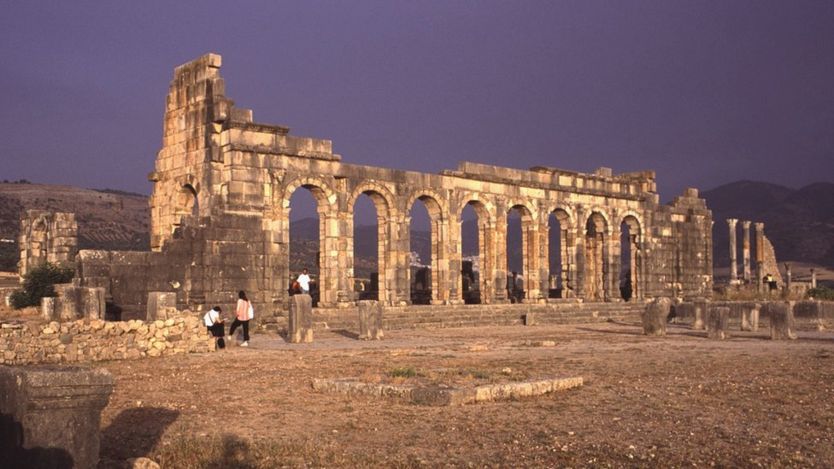
Image copyrightRICHARD DUEBELImage captionThe site of Volubilis in Morocco is a Roman and Islamic site
Animosity between Islam and the West compounded the lack of interest in Muslim remains according to Alastair Northedge, professor at the Universites de Paris 1.
He spoke in the context of his recent trip to Iraq, about the West’s overwhelming concerns with their own past. “There is quite a good example in Iraq,” he says. “Babylon seems to belong to the West.”
Corisande Fenwick, a lecturer in Archaeology of the Mediterranean at University College London (UCL) took time to describe painstaking research into food remains indicating when pork was no longer consumed and so revealing the pace at which Islam was established across the Maghreb region.
She attributes the Western assessment of archaeological finds prior to the mid-1950s to a colonial interpretation.
“If you go back before independence, archaeology is all driven by colonial scholars,” she says.
“They were attracted by the exotic nature of their finds. That reinforced the idea that the Islamic world was somehow different and needed to be controlled by colonial powers,” she adds.
But it is not just a Western agenda that has shaped excavations in the Muslim world. Alastair Northedge also notes that Muslims themselves have not always been concerned with protecting the material heritage of the great spiritual sanctuaries.
“It is not just Mecca and Medina, but also Shia shrines in Najaf and Karbala in Iraq” he says.
“There seems to be a preference for building something new rather than conserving the old because the emphasis is on the spiritual nature of these places not their materiality.”
But a wider vision is coming and the rise in the number of excavations throughout the Gulf area attests to a burgeoning interest in the material past. St John Simpson, archaeologist and senior curator at the British Museum, says that a revival of interest in Islamic archaeology is long overdue.
“It’s part and parcel of a search for Muslim cultural identity,” he explains. It is also an opportunity to redress earlier misconceptions.
“Since the 19th century and continuing though much of the 20th century commercial excavations led by dealers have in parts of the world flooded the market with objects which were traditionally celebrated by art historians,” Dr Simpson says. “They celebrated the beauty of those pieces and therefore reconstructed material cultures on the basis of those objects.”
Good article in The Economist regarding state control of mosques and Imams to reduce radicalization:
In fact, the Saudi effort to tone down its clerics is mild, hesitant and belated compared to what some Muslim states do. Uzbekistan, Kazakhstan and Tajikistan already routinely use cameras. Kuwait has long installed tape-recorders to monitor Friday sermons. Preachers in the neighbouring United Arab Emirates need not write their own sermons. Except for a few trusted senior clerics, they read instead from a text delivered weekly by the government department for religious affairs that also pays all their salaries. “Protecting Youth from Destructive Ideas” and “Our National Flag, Symbol of Affiliation and Loyalty” provided two stimulating recent topics. Similarly, Turkey has for decades enforced a monopoly of Islamic discourse via a religious bureaucracy, known as Diyanet, that wields 121,000 employees and a budget of $2.3 billion.
Other governments aspire to such dominance. Tunisia’s government has in recent months restored strict state control of mosques that had slipped following its revolution of January 2011, leading to a brief flowering of Wahhabist-style jihad promotion. Morocco, whose king has traditionally posed as Commander of the Faithful, delivering televised Ramadan sermons, has steeply boosted state promotion of a relatively tolerant version of the faith. Its budget for training imams, including a growing number of foreign students, has swollen tenfold in the past three years. The unspoken aim is to counter the spread of extreme Salafist ideas in places such as Mali and northern Nigeria.
…Egypt’s government has of late clamped unprecedented controls. In January it decreed that all Friday sermons must adhere to a weekly theme set by the religious-affairs ministry, establishing a hotline to allow worshippers to denounce preachers daring to voice political dissent. Further decrees required all preachers to be government-licensed, imposed a code of ethics forbidding discussion of politics in mosques, and banned smaller prayer halls from holding Friday prayers. The ministry fired 12,000 preachers and now allows only those trained in government-approved institutes to deliver sermons.
…As a foil to the powerful Brotherhood, the [Egyptian] state had long allowed followers of quietist forms of Salafism to run some 7,000 mosques. But the ministry in September decreed it would take over their mosques too, after reports of a sermon forbidding the faithful from buying interest-bearing government bonds.
Amr Ezzat, an Egyptian researcher, sees the effort to impose state-ordained orthodoxy as misguided and possibly dangerous. Religious institutions will lose legitimacy with time, pushing more Muslims towards radical margins. And by acting in effect as the imam, the state takes upon itself a duty to enforce morality. It is perhaps as a sop to religious conservatives, for instance, that Egyptian authorities have mounted an increasingly lurid campaign against homosexuality, most recently by staging a midnight raid on a Cairo bathhouse on national television, dragging a score of naked men to prison.





 Multicultural Meanderings