Liberals shift immigration focus to family reunification, refugee resettlement

Immigration_Plan_2016One of the more comprehensive reports on the changes, but changes that some of my colleagues more expert in immigration characterize as ‘less change than meets the eye’:

Canada will seek to admit a record number of immigrants as the Liberal government shifts its focus on family reunification and the settlement of refugees, says Immigration, Refugees and Citizenship Minister John McCallum.

“This plan sends a message about the importance of family,” McCallum said in Brampton, Ont., on Tuesday.

“It outlines a significant shift in immigration policy towards reuniting more families, building our economy and upholding Canada’s humanitarian traditions to resettle refugees and offer protection to those in need.”

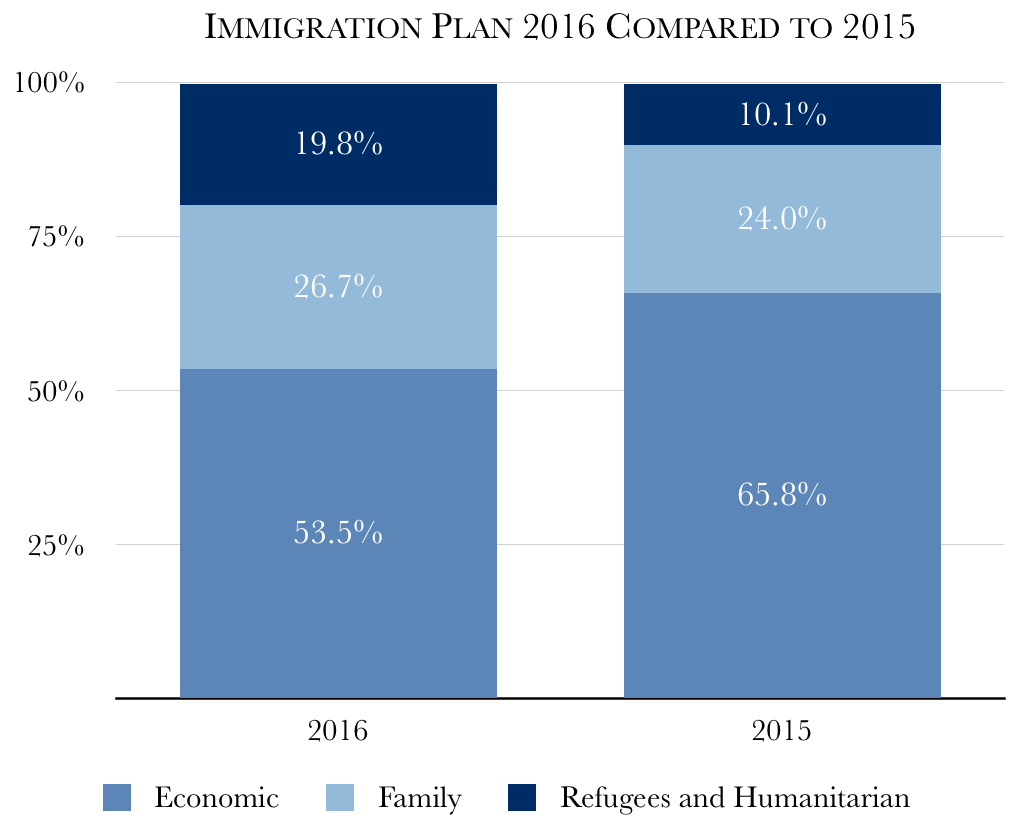
McCallum said Canada will admit between 280,000 and 305,000 new permanent residents in 2016, a record increase from the 260,000 to 285,000 newcomers the previous Conservative government had planned to welcome by the end of 2015.

The Liberal plan will see Canada admit:

  • 151,200 to 162,400 caregivers, provincial nominees, and other skilled workers under the economic stream.
  • 75,000 to 82,000  spouses, partners, children, parents and grandparents of Canadians under the family reunification plan.
  • 51,000 to 57,000 refugees, protected persons and others admitted for humanitarian reasons.​

The Liberal plan also includes admitting 18,000 privately sponsored refugees, “three times more than in earlier years,” McCallum said.

The government has resettled some 25,000 Syrians, a mix of government-assisted and privately sponsored refugees, in four months. The Liberals have also pledged to resettle another 10,000 government-assisted Syrian refugees by the end of 2016.

Reviewing sponsorship conditions

McCallum said the government will review some of the conditions imposed on Canadians looking to sponsor their children and spouses living overseas, making family reunification a priority.

“The government of Canada will make family reunification an important priority because when families are able to stay together, their integration to Canada and ability to work and grow their communities all improve,” McCallum said in a much-anticipated report tabled in Parliament on Tuesday.​

“We will work to restore the maximum age for dependants to 22 from 19 and re-examine the two-year conditional permanent residence provision for sponsored spouses.”

In its annual report to Parliament, the Liberal government is also pledging to:

  • Eliminate the $1,000 labour market impact assessment (LMIA) fee for families looking to hire caregivers for family members with physical and mental disabilities. An LMIA is a document employers must file to prove the need to hire a foreign worker over a Canadian one.
  • Review the express entry system launched in January 2015 “to provide more opportunities” for applicants who have Canadian siblings.
  • “Expand and monitor the use of biometrics” to verify the identity of all temporary and permanent residents  who need a visa or permit to enter Canada.

Fewer economic immigrants

Conservative immigration critic Michelle Rempel denounced the government’s decision to admit fewer economic immigrants.

“These cuts to economic immigration come at a time when our workforce is aging, our economy is slowing, and refugees are waiting for months to have long-term affordable housing,” Rempel said during question period,

She said the government’s changes to the caregivers program would “leave the most vulnerable Canadians without care.”

Source: Liberals shift immigration focus to family reunification, refugee resettlement – Politics – CBC News

Refugees and the long political journey: Martin Patriquin

A reminder, as if needed, just how much can change with new political direction, and the ideology and values of the previous government’s restrictive approach. Must read:

Given all this, I asked Vassallo, a 27-year CIC veteran, why the Canadian government took so long to get comparatively few suffering souls to this country. “I can’t answer that, it’s a political question,” he said, with a hint of a smile.

Unfortunately, Vassallo is right, and his non-answer is a reminder of what happens when a life-or-death issue of refugees gets fed into the cauldron of partisan politics, then further distilled by an at times ugly election campaign. In a sense, the machinations by which potential refugees are sorted and selected should be as apolitical as, say, getting one’s license renewed. Yet as the previous Conservative government demonstrated, there was a distinct attempt to shape and direct the work of its civil servants here and overseas when it came to the victims of the crisis in Syria.

Last January, Stephen Harper’s government announced plans to bring in 10,000 Syrian refugees over three years. Yet several months later, only about 10 per cent of this number had been admitted—in part, it seems, because of a directive from Harper’s office itself that attempted to halt the screening process. At the time, it was presented as a security measure “to ensure the integrity of our refugee referral system,” as Citizenship and Immigration Minister Chris Alexander put it at the time.

Numerous sources, including one with first-hand knowledge of the processing of refugees, said the directive was less about security than about ensuring that Christian minorities took precedence over Muslims. “You got the feeling they were trying to cherry pick religious minorities,” one source said. (Syria, which is majority Sunni Muslim, has a sizeable Christian minority.)

It took the picture of Alan Kurdi, whose lifeless body washed up on a Turkish beach, for the government to slacken the reigns somewhat. Because Kurdi’s family was trying to reach Canada, the political intonations on the Harper election campaign were profound. On Sept 10, eight days after the picture made headlines worldwide, the government waived the stipulation that “resettlement candidates” must provide information regarding why they fled their country of origin.

“Going forward, unless there is evidence to the contrary, visa officers will be able to presume those fleeing the conflict meet the definition of a refugee, which will make processing faster,” reads a CIC briefing document.

There is a certain irony in this. The  government to first make a significant security-related change to the processing of refugees—arguably making it easier for Syrians and Iraqis to make it to these shores—was that of the ostensibly security-first, tough-on-terror Stephen Harper. And he did so as a political calculation, out of fear of losing an election.

Meanwhile, the “security concerns” that supposedly prevented the Harper government from increasing the numbers of refugees brought to Canada were seemingly a partisan mirage. “There have been no shortcuts to the process. They’ve accelerated it in the sense that they’ve sent over additional personnel,” Tim Bowen, chief of operations for Canadian Border Services Agency, told me. According to CIC staff, this includes the addition of some 500 officials deployed overseas to help with the effort, including between 50 and 70 visa officers.

Thankfully, there is a happy ending. First and foremost, refugees are finally arriving. Secondly, the Conservatives are critiquing the effort exactly as they should: on purely financial grounds. The refugee resettlement program will cost $671 million. It is a huge amount of money, and Conservative immigration critic Michelle Rempel promised to hold the government to account. “It is one thing to inspire Canadians, it’s another thing to be accountable to them,” she said.

That Rempel said as much without a fear-mongering whisper about “security concerns” shows how far the party has come in two months.

Source: Refugees and the long political journey – Macleans.ca