Time to act on newsroom inequality

From the Star’s Public Editor:

“For years, we at The Star have talked about, sometimes in terms of despair, the need to reflect the changing nature of this city… Our coverage has not been inclusive enough. One obvious solution would be to hire more reporters and editors of all colors and cultures. New perspectives and new contacts would clearly improve the breadth and scope of our coverage.”

1995: Toronto & the Star: Report of the Diversity Committee

How can it be that a generation – a quarter century — has passed and still the Toronto Star and newsrooms throughout North America have not come to terms with the reality and repercussions of predominantly white newsrooms that look nothing like the communities they seek to serve?

Certainly, journalists at all levels of news organizations have seemingly long understood that a more diverse newsroom can provide more representative, more accurate and more complete news coverage that is necessary in a just and equitable society. Yet, after all these years, the truth of this matter is found in statements released earlier this year by the Canadian Association of Black Journalists and Canadian Journalists of Colour.

“Canadian newsrooms and media coverage are not truly representative of our country’s racial diversity. We acknowledge that journalism outlets have made efforts to address this worrying gap, but glaring racial inequity persists.”

I am not the first person to note that the brutal police killing of George Floyd and the subsequent global protests against systemic equality and for racial justice have presented journalism with something of a “#MeToo” moment – a seemingly rapid and revolutionary recognition of the need for change and broad refusal to accept the status quo of a long simmering situation.

Indeed, as Canadians confront the broader realities and repercussions of systematic anti-Black and Indigenous racism in our own country, it is well past time for a “reckoning” within journalism, a time to listen, to learn and to examine journalism’s role in the damaging prevalence of systemic racism.

As many have also made clear, this is most of all, a time for action. To its credit, the Star and its parent company, Torstar, committed this week, in a statement sent to all staff, to “taking concrete measures to address inequality, exclusion and discrimination.”

That was followed by a memo to the newsroom from Star editor Irene Gentle, who endorsed well-justified calls to action by the CABJ and CJoC that hold newsrooms to account for racial equality in Canadian media.

“Calls on behalf of Black, Indigenous and journalists of colour are founded in principles of anti-racism, justice and accountability this newsroom has long stood for in its reporting but did not live up to in its internal make-up, organization and, at times, judgment,” Gentle said. “Words don’t matter without actions and these actions can only make us a better, more fair newsroom to work in, inspire more relevant, vital journalism and help make our ideals a reality.”

In an earlier note to staff, Gentle acknowledged that the Star’s newsroom is not representative of the communities it reports on, even as its own outstanding anti-racism reporting continues to expose systemic racism within other institutions and organizations such as education and police.

“Internally, we obviously cannot ignore our own deficits,” she said. “There are historical and financial reasons for this, but that, while a fact, is not an excuse.”

Among the actions the Star and Torstar news organizations have committed to are: voluntary surveys of newsroom demographics to measure employment diversity statistics, hiring and promoting of Black and Indigenous employees and other people of colour and diverse ethnic and religious backgrounds, training and mentoring of young and aspiring journalists of colour, including possible collaborations with journalism schools. Gentle also committed to establishing ongoing consultations with racialized and other communities through advisory groups.

“Some of these are underway or beginning. Others will require some time to set up and entrench,” Gentle said. “But we are committed to doing it because we, like all of you, know it is the right thing to do.”

The Star’s newsroom commitments are supported fully by the Torstar organization overall. In the memo to all staff, Torstar CEO John Boynton made clear the company “cannot just talk about appointing more committees, more task forces more study groups to look at these actions.”

“As a media company with a long history of championing equality for all, Torstar is uniquely positioned to learn from our past, to give voice to the present through our news coverage and providing opportunities in our pages and on our websites for frank, honest and open conversations about race and diversity and to help provide guidance and examples for future generations,” he said.

While I have been discouraged at knowing how long Canadian newsrooms have been talking about this issue, with so little real and necessary change happening. I am heartened by these statements of actions and our CEO’s words seeking accountability: “We will be – and we should be – held accountable for ensuring that we act. If we fail, please let us know.”

Indeed, equality and diversity are not simply “nice to have,” an exhaustive 2019 report from the Reuters Institute for the Study of Journalism on “the struggle for talent and diversity in modern newsrooms” tells us.

“More diversity and a better representation of the underlying population is not only a question of justness and fairness, it’s also a question of power, as the media still largely decide who gets to be heard in society and thus who gets to shape political and social issues,” that report states.

Within the Star, I believe there is strong understanding that this week’s commitment to action is just the beginning as we all listen to learn and understand our own roles in the perpetuation of newsroom inequity. I see need for ongoing discussion and debate among journalists, their employers and unions, people of colour from the wider community, journalism scholars and industry associations about newsrooms structures, and journalism’s practices, standards and values. Most important, as is happening throughout North America now, this time demands a rethinking about how journalism and its mission in a democracy that stands for universal human rights is defined — and more important, who defines it.

Whether we regard this moment as a reckoning or a revolution, the time for that is now.
New Zealand is a far more multicultural place today – its mainstream media is not

Similar issues in Canada and some interesting info regarding their ethnic media:

Let’s start with a test, about references to Indian people in the news. Last year, an Indian Naval crew completed the first-ever circumnavigation of the globe by an all-women team, in about eight months. They had a scheduled stop-over (one of only four worldwide) in Lyttelton, Christchurch, for over two weeks in 2017. They were facilitated by the Mayor, ministers, local MPs, and the wider community.

Such a great, inspiring story for women around the world, and in New Zealand, right? But I’m sure a majority of you are reading about it in New Zealand media for the first time. By contrast, stories about the Kiwi-Indian Christchurch GP Rakesh Chawdhry, who in 2018, was found guilty of sex offences against his patients, are hard to miss. His case was, and is, extensively reported by all mainstream New Zealand media.

No one can – or should – question a newsroom’s editorial judgement on what to cover, and what not to cover on an individual story basis. But editors, and even more importantly, owners, must realise that journalism is a business with public interest at its core. And that ‘public’ in New Zealand has changed, and is now more multicultural than ever.

Recently released Census 2018 figures tell us that almost 30% of the country’s population is non-European now. If we just take the three main Asian ethnicities – Chinese, Indians, and Filipinos – two-thirds of whom live in Auckland, they make up about 25 percent of the city’s population. Nationwide, there are more than 700,000 people of Asian descent living in New Zealand.

And to my mind, the recent financial struggles of mainstream New Zealand media are partly due to a failure to acknowledge, appreciate and cater to anyone except the majority community. Apart from a token mention of celebrations such as Diwali and Chinese Lantern Festival, any coverage of multicultural communities tends to invariably be negative, if they get a mention at all.

I dare say that a business that ignores a quarter of New Zealand’s only big city – especially a business that runs on public trust and goodwill – is a recipe for financial failure. The same argument applies to the rest of the country.

I am not for a moment denying the two main reasons being put forward for the struggles of commercial media. The dominance of Google and Facebook in terms of digital advertising revenues, and the subsidisation of state-owned media organisations in New Zealand.

But it is worth adding that ignoring 30% of the population is a third and equally important reason. Google, Facebook, RNZ and TVNZ are not going anywhere, any time soon. So this third reason is really the only one within our control.

A question might be asked – ‘why should we cater to these communities, they don’t matter financially?’ This assumption is incorrect, on two counts. There is a difference in income levels – per NZ Stats June 2019 quarter figures, European median weekly income ($1,060) is almost $100 more than Asian ($959.) But this gap is reducing every year. This is partly due to the aspirational nature, and emphasis on achieving social mobility through education, in the multicultural communities.

Secondly, due to discrimination in securing a job in the New Zealand market, many migrants turn to entrepreneurship. The salaried class doesn’t bring in the same advertising revenues as the business class. So migrant businesses are where some significant untapped advertising dollars are sitting.

Don’t believe me? Attend a Meet the Press programme, which the Indian High Commission in New Zealand regularly organises. I went to one recently held in Auckland. There were more than 10 Indian-origin media organisations present – including print, radio and digital – which report in English, Hindi, Punjabi, and Gujarati, among others. There is a similar number for the local Chinese-origin media. We also have some Filipino, Korean, and Japanese publications across the country. And this number has only grown over the last decade or so.

Clearly, communities are sustaining all these publications.

Hence, the market, the audience, the stories, and the business, is all there for someone who is able to appreciate the changing nature of New Zealand, and is willing to change with it.

Mainstream news media in New Zealand is struggling because, as one CEO said, consumer behaviour is changing. What he failed to say was that the consumer itself is changing. The emerging consumer is is young, urban, earning – and increasingly multicultural.

Source: New Zealand is a far more multicultural place today – its mainstream media is not

‘Plain cruel’: Vanuatu stops newspaper chief boarding plane home after China stories

Another reminder of the influence of China:

The media director of a Vanuatu newspaper whose visa renewal was refused this month has been barred from flying home to Vanuatu from Brisbane with his partner.

Dan McGarry, who has lived in Vanuatu for 16 years, applied to have his work permit renewed earlier this year but it was rejected. McGarry believes his visa was refused due to articles he had published about China’s influence in Vanuatu.

In July the Daily Post broke the story of Vanuatu deporting six Chinese nationals – four of whom had obtained Vanuatu citizenship – without due process or access to legal counsel.

McGarry said he was “quite confident” it was that series of reports which had upset the government.

McGarry, who is Canadian, left the country to attend a forum in Brisbane on media freedom in Melanesia, at which leading journalists and the editors from the region spoke about attacks on journalistic freedom in the region and discussed his case in detail.

The parties went negative, and the media enabled them

Good reflections on election coverage:

It is hard for outsiders to understand how gruelling, exhilarating, exciting, frustrating and physically demanding it can be for journalists covering an election. In the modern multi-media, multi-tasking universe in which journalists live, reporters on campaign planes may be tweeting, doing live interviews and writing several stories in the course of 18-hour days, often eating crappy food at irregular hours without proper exercise and with inadequate sleep. All while trying to be fair and accurate. On election night, columnists like the Toronto Star’s Chantal Hébert and the National Post’s Andrew Coyne were writing their pieces for the next day’s papers while simultaneously appearing on live TV shows.

Ordinary reporters broke stories in this campaign and exhaustively documented the statements of the leaders. Analysts and commentators took apart the platforms. And despite what you may have thought or heard, they collectively produced reams of copy on policy issues. Every time I saw someone complaining that no one was writing about some specific issue, I went online and found deeply reported stories. There were policy pieces on housing affordability and the dependency ratio, and examinations of party platforms on child care and the environment, just to offer a few examples.

But for all the individual excellence and all the expenditure of energy and intellectual capital from journalists, this was a deeply dissatisfying election for many Canadians, and the media played a part in that.

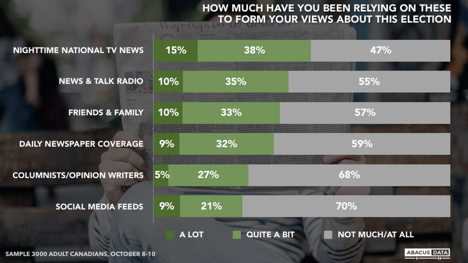
First, let’s be clear. Despite talk that the mainstream media have been displaced by social media, they continue to play a dominant role in the way most Canadians experience a campaign. More than half of Canadians relied on the evening national TV news to form their views on the election, according to a survey by Abacus Data. That was followed by talk radio. Both of these old-fashioned news sources were ahead of social media, as was the influence of “family and friends.”

Not surprisingly, the picture was quite different when it came to the youngest cohort, those 18-29 years of age. For them, the most important source of election information was not social media, though, but family and friends. True, social media were more important to this group than mainstream media; nonetheless, TV news, talk radio and newspapers were all important sources of election information for more than 40 percent of them. What this suggests is that the grip of the mainstream media might continue to diminish over time, but the day of its irrelevance has surely not yet come.

So, the coverage mattered. And the coverage, certainly as it was experienced by many voters, was predominantly negative. We have some interesting data on this from Greg Lyle at Innovative Research Group. He asked respondents mid-campaign whether they had read, seen or heard anything in recent days about each leader. Among those who had heard anything about Liberal leader Justin Trudeau, they said it led them to think less favourably of him by a margin of two-to-one. Almost precisely the same was true of Conservative leader Andrew Scheer.

This is very much in keeping with the unprecedently negative tone of the entire 2019 campaign in which both major parties trended down in the polls and which produced a government with the lowest-ever share of the popular vote.

Like any campaign, so much happened in such a short time that it can be easy to forget the way it began. In the first few days after the writ was dropped, it felt like a formless void, a space without narrative. And this was a vacuum that was gleefully filled by the Liberal war room. The Liberals had obviously accumulated a little video storehouse of horrors: Conservative candidates saying controversial or outright offensive things on abortion, Quebec, homosexuality and race. In that first week, they dropped bits of what they had found onto social media with deliberate menace just hours before Scheer made campaign appearances with particular candidates.

They did this before Scheer appeared with Rachel Willson in York-Centre (her call for anti-abortion legislation). Boom! When he was about to appear with Arpan Khanna in Brampton North (his homophobic Facebook posts). Boom! When he was on his way to see Justina McCaffrey in Kanata-Carleton (her friendship with far-right commentator Faith Goldy). Boom! (Each of these candidates ultimately lost, by the way.)

So, it was the Liberals, not the media, who set the tone of the campaign in its first week. Gloomy Ways! But they did so by performing a sort of hack on the media, exploiting their weakness for novelty and tension. Because it was in video form, it took little or no effort to verify on the fly.

What reporter rushing to a constituency event where the less-than-electric Scheer was slated to address some small-bore policy idea recycled from Harper 2015 could resist the lure of the video the Liberals had just dropped on Twitter? Particularly when the Tory candidate obliged the Liberal war room by running away from the camera, as Justina McCaffrey did.

So, the media did not set the tone, but their weakness for a particular kind of story enabled and amplified it. This kept everyone occupied until that blackface photo appeared on Time’s website, giving Justin Trudeau his time in the barrel (and forcing the Liberals to cage in the residents of their war room for a while). Two weeks later, though, the media dug up information about Andrew Scheer’s resumé and then his citizenship, swinging the narrative back to him.

Of course, the media are not helpless in the face of the narratives that campaigns present any more than the parties themselves are. Indeed, every day is a struggle among the parties themselves and between them and the media to decide what the election should be about. On the very first day of the campaign, the Globe and Mail dropped a story on the RCMP looking into the SNC-Lavalin affair that the paper may have hoped would set the frame for the entire campaign. It did set the frame, but for only a day. Later it seemed plain that many people in the media expected the blackface controversy to dominate the rest of the campaign, until it seemed it had not made much of a dent in the Liberals’ polls, at which point they moved on.

Neither of those narratives would have elevated the tone of the election campaign, it has to be said. You could argue in contrast that the Toronto Star strove admirably to frame the election around climate change, which if you believe is real, as I do, is surely as worthy a subject to debate at election time as free trade in 1988 or cutting the GST in 2006. The Star published a series of vividly reported stories that helped remind those who read them of the stakes if we do not act. But it was Swedish activist Greta Thunberg’s journey to North America that raised the profile of the issue in the media more generally, at least for a week, along with an assist from the Liberals on the hustings anxious to move on from blackface. But then climate change, too, faded into the cacophony.

In the last week, it was the most familiar of media narratives that dominated: who is ahead in the polls; can anyone get a majority; if not, who will play with whom in the new Parliament? This emptied the election of most of its policy content and opened up a mostly negative conversation among the parties about which voters should fear the most. Should we be more afraid of Liberal/NDP profligacy or of Conservative budget cuts?

It would be wrong to say that the media alone were responsible for the negativity of this campaign. What we witnessed was rather a cycle, much of it beginning with the parties themselves, turbo-charged by the media, spun through social media, then picked up again and further amplified by the politicians. This cycle could have been broken had the parties presented big ideas or divided more clearly on issues of principle or policy, but for the most part they chose not to. And there were signs of resistance in the media — reporters and columnists who worked mightily to bring us back to what mattered, or should matter: climate change, the economy, taxes and deficit, systemic racism, the scandal of the condition of Indigenous people, foreign policy even. But in the end, all their efforts to save us from this dismal election were in vain.

Source: The parties went negative, and the media enabled them

Canadian media lacks nuance, depth on racial issues

Part of the Policy Options elections series. I have flagged to Anita Li, some of the weaknesses in her arguments:

  • Voter turnout: StatsCan analysis comparing Canadian-born versus long-term and recent immigrants in the 2015 and 2011 elections shows that the gap has shrunk (2007 data not relevant).
  • 2011:  77.4 percent Canadian-born, 70.7 percent established immigrants, 55.7 percent recent immigrants
  • 2015: 76 percent Canadian-born, 75.9 percent established immigrants, 70.1 percent recent immigrants
  • There is considerable variation based upon country of origin.

My sense is that the issue lies more with the financial and business model of media, and consequent reduced local and other news, which applies to all Canadians, whether visible minority or not.

My work with diversityvotes.ca which allows me to analyze ethnic media election coverage indicates that ethnic media is less ghettoized than Li suggests, largely mirroring mainstream coverage (spoiler alert for future article).

As to the diversity of journalists, given the number of visible minorities in j-schools and the buy-outs of senior journalists, expect that diversity will improve but not as quickly given the financial struggles of the industry:

Newsrooms in Canada are disproportionately white. This inequity means Canadian news coverage is less inclusive and therefore not truly representative of our country’s racial diversity. We’ve known all this for years, and still — despite the approach of the next federal election — establishment journalism organizations have not taken steps to address this worrying gap in a meaningful and systemic way. One consequence is lower voter turnout among people of colour.

The media is a pillar of democracy. Numerous studies reveal how an erosion in local news weakens civic engagement. Research suggests people who consume local news regularly are more likely to vote and participate in civic activities. But the spate of local publication closures in nearly 200 Canadian communities over the past decade has left a vacuum for misinformation to fill, compromised journalists’ ability to hold government accountable and resulted in more polarized communities where neighbours don’t trust each other.

These studies focus on geographic communities. But there’s scant research into how news poverty impacts racialized communities or geographic communities that are majority-minority, such as Scarborough, a suburb of more than 600,000 in the Greater Toronto Area where people of colour make up 73 percent of the total population. That’s concerning.

Why? According to a 2018 report from the UNC Center for Innovation and Sustainability in Local Media, news deserts tend to be around areas whose residents are poorer, less well-educated and older than people in other communities. News poverty impacts inner-city neighbourhoods and suburbs as well as sparsely populated rural and interior regions, the report says.

It’s not a stretch to extrapolate findings from geographically focused research on news deserts and apply them to underserved racialized communities. If you don’t see yourself reflected in the news, and you don’t see the connection between your community and policy issues, how motivated would you be to vote? How convinced would you be that you could effect change in your country — especially if the media rarely bothers to portray your perspective?

Of course, as many detractors of diversity and inclusion efforts have commonly but pointlessly argued, ethnic groups are not monolithic and have a diversity of thought, and race is just one pillar of a person’s identity. But few markers of identity are visible beyond race, and systemic racism is pervasive in Canada. Members of particular ethnic groups, especially visible-minority groups, will have shared experiences by virtue of their skin colour.

Ethnic media doesn’t even reflect citizens like me, a second-generation Canadian-born Chinese whose native language is English. To me, ethnic media is for my immigrant parents’ generation, not my friends and peers who grew up here.

There are ethnic media outlets in Canada, but they’re ghettoized in a two-tier system, where establishment media is seen as more legitimate and also seemingly absolved of covering issues that matter to immigrant Canadians in an in-depth way. Beyond that, ethnic media doesn’t even reflect citizens like me, a second-generation Canadian-born Chinese whose native language is English. To me, ethnic media is for my immigrant parents’ generation, not my friends and peers who grew up here. Unfortunately, these two audiences have been traditionally conflated, so there’s a gaping hole where news coverage should be for young, diverse Canadians.

Keeping this lack of relevant media presence and Canada’s long history of excluding people of colour from voting in mind, it’s no wonder eligible voters from some non-European communities have voted at lower rates than members of European communities, according to a 2007 Elections Canada study. Citing data from the Ethnic Diversity Survey of Statistics Canada, Elections Canada also reports that rates of voter participation are higher among foreign-born than Canadian-born people of colour.

Low voter turnout among people of colour will become a bigger problem for Canada if we don’t address it soon. StatsCan reports that among the country’s working-age population (ages 15 to 64), 20 percent identified themselves as “visible minority” in 2011 — a number that could double to nearly 40 percent by 2036.

When it comes to authentic pluralism, there’s a significant disconnect between how Canada perceives and portrays itself and what’s actually happening in this country.

Canada was the first country in the world to adopt multiculturalism as an official policy, in 1971, and it’s globally recognized as an arbiter of pluralism, so we tend to rest on our laurels regarding issues of race. It’s why, for so long, neither government nor the media seriously grappled with the country’s evolving cultural identity. Because there’s a sense that we’ve “achieved” multiculturalism in theory, Canadian political and media institutions are complacent and don’t frequently entertain conversations about our evolving cultural identity — much less move them forward. When it comes to authentic pluralism, there’s a significant disconnect between how Canada perceives and portrays itself and what’s actually happening in this country.

The 1971 Canadian Multiculturalism Policy and subsequent 1988 Canadian Multiculturalism Act, which came about after Canada became the first country in the world to pass a national multiculturalism law, were significant milestones. But they’ve had the sanitizing effect of falsely casting us as a perfect multicultural haven and as a foil to our unstable neighbour, America, with its unmanageable race problems.

In fact, contrary to popular belief, we’re far behind the United States in our discussions of race in the public sphere. Despite the extreme polarization in America, there’s an institutional and public willingness to talk about these issues that opens up dialogue and breaks down barriers. In Canada, we ignore the problem, so silos persist. In addition, this false sense that Canada is post-racial often has the effect of gaslighting people from racialized communities who continue to face discrimination today.

Given our British colonial past, Canada has a long history of defining its identity in terms of how un-American we are, so we resist embracing our neighbour’s practices for fear of surrendering to American cultural hegemony. But what is Canadian culture? Before the Second World War, it was synonymous with British and French culture, but that perception failed to take into account the tens of thousands of years of Indigenous cultures that predated Canada’s colonization. In fact, we didn’t have a clear, unified national identity of our own until after the war — and even now, it’s not one that all Canadians have embraced.

When it comes to filling in gaps in coverage for racialized communities in Canada, outlets here would be wise to follow in American media’s footsteps. Resistance to including these other narratives will only push Canadians into the arms of US publications — which have much more robust coverage of people of colour — and, ironically, put Canada on a path toward greater American cultural influence. We must evolve.

With Canada facing a rising populist tide and the incendiary language that tends to come with it, October’s election is an opportunity for all Canadian media to call things as they are. For example, journalists shouldn’t use “racially charged” or similar euphemisms when “racist” is more appropriate. The values underpinning multiculturalism are enshrined in our Constitution under section 27, so rather than seeking “balance,” the media must hold our leaders to account by challenging views and policies that are unconstitutional. The world, including Canada, is experiencing a historic moment that necessitates adversarial watchdog journalism.

The media should also move beyond reactive coverage of race that stokes outrage for outrage’s sake. Instead of a “he said, she said” style of reporting, journalists should provide context that breaks down Canada’s history of systemic racism and analyze how party policies will affect specific racialized communities (for example, they should examine why Indigenous communities are particularly vulnerable to climate change).

Outside of the election, the media should strive to capture the lived experiences of Canadians of colour (which, it’s important to note, are quite different from the experiences of Americans of colour). They should also keep up their recent increase in coverage of reconciliation and Canada’s Black Lives Matter movement. But I don’t want to see only stories of outrage — they paint a limited, black-and-white picture of racialized communities. I also want to see the nuanced spaces in between, where most people of colour live their lives: an intersectional take on climate change in Canada through a racial justice lens; a look at the historical contributions of Canadians of colour and how they impact us today; a deep dive into how second-generation Canadians are preserving their ancestors’ dying languages.

The media here must stop talking about Canada as if it’s an Anglo monoculture and start reflecting the multiculturalism that we proudly lay claim to but seldom live up to.

Source: Canadian media lacks nuance, depth on racial issues

Domise: Who gets to be a ‘teen’ and a ‘good kid’?

Worth reflecting on:

For a very long time, I’ve been of the mind that corporal punishment is detrimental for black children, and should be discouraged. Many in the Caribbean community would likely disagree; spare the rod, spoil the child is an axiom I learned from elders long before I first read its source quote in the Book of Proverbs. But it never sat well with me that black children, faced with a world that would capriciously limit their opportunities, fling them into the maw of the criminal justice system, and justify their murder at the hands of police and vigilantes, should come home—their only refuge against a world that fears and misunderstands them—only to be faced with more harsh discipline.

In her recent book Spare the Kids, journalist, anti-spanking advocate and Morgan State University professor Dr. Stacey Patton draws a solid line between corporal punishment and the violence of western colonialism, slavery, and genocide. The harsh treatment of white children endemic in Europe, Patton argues, gave way to a widespread belief in the innocence of children that stigmatized use of “cat-o’-nine-tails, shovels, canes, iron rods and sticks” in the 19th century.

In place of such punishment, which often resulted in infanticide, and wasn’t prosecuted for a long time, came the manual discipline we refer to today as spanking. “In other words,” writes Patton, “white people began to recognize the vulnerability of their own children and had to rescue them, if only partially, from this unthinkable close proximity to blackness and the brutality of childhood.”

For the African-descended and Indigenous people of the Americas, regarded as the most savage and therefore childlike members of the human race, the concept of childhood carries a much different import. All punishments allotted to them—floggings, rape, torture and murder—were not considered wanton violence, but instead the loving attempt of the white patriarch to drive savagery out of their bodies and instill the values of civilization. This belief, that black and Indigenous peoples must be refined through the disciplining of their bodies and minds, has lingered in the white psyche long after the emancipation of black people, and the recognition of Indigenous sovereignty.

It is a belief that white people, as humanity’s patriarchs, have a responsibility to discipline humanity’s children.

This belief is why the words “boy” and “girl” can become slurs when they slide off the white tongue, directed at grown adults. Meanwhile, our children are stamped from birth with the stigma of maturity; plenty of studies exist to show that our children are viewed as older and less innocent by teachers, police and other authority figures who are, by the oaths they take and the titles they wear, supposed to be children’s protectors.

This has tainted racialized communities with a social paradox that quickly ages children out of childhood in order to strip from them the aegis of innocence, yet also infantilizes our adults in order to subordinate them to white hegemony. Thus, acting in loco parentis, the brutality visited on racialized adults and children alike by authority figures—our schools, police, court systems—is not seen as cruel and unjust violence, but instead as a form of socialized corporal punishment, birthed by colonialism and nurtured institutions—our political class and mass media—which function as vestiges of white patriarchal hegemony.

The acceptance of this socialized corporal punishment, by white authority figures, is why Eric Casebolt (then a McKinney, Texas police officer) can throw a black child through the air, drag her by the hair, and slam her to the ground, and not only will he not be charged with a crime, a prominent white news anchor will comment “The girl was no saint, either.” It’s how former Cleveland police officer Timothy Loehmann can jump out of a police cruiser and summarily execute 12-year-old Tamir Rice, and have his actions covered by a municipality that blames Rice for failing to “exercise due care to avoid injury.” And it’s also how an all-white jury can acquit Saskatchewan farmer Gerald Stanley of second-degree murder, even after Stanley admitted to aiming a handgun at Cree youth Colten Boushie and pulling the trigger.

Spare the rod and spoil the child. If there is no child to be found behind those savage eyes, then put down a threat.

On the other hand, white youth who commit atrocities in the name of white nationalism are not only draped in the innocence of childhood from birth, but are covered by its long tails into adulthood.

Consider the case of Kam McLeod and Bryan Schmegelsky, two young white men from Port Alberni, British Columbia, who are currently the subjects of a nationwide manhunt. Early on, when their disappearance shifted from missing teenagers to murder suspects, news media continued referring to them as “teens” and uncritically ran pull-quotes from community members who called them “boys.”

To be clear, these “boys,” 18 and 19 respectively, are not only prime suspects in the murders of three people, but Schmegelsky is alleged to have uttered violent threats to his classmates, and have a fascination with neo-Nazi imagery and organizations. Yet, their families have been offered uncritical coverage in Canadian news: McLeod’s father describing him as “kind, considerate and caring,” and Schmegelsky’s father describing his son as “a child in some very serious pain.”

Not long after McLeod and Schmegelsky’s alleged killings, 19-year-old Santino William Legan, of Gilroy, California, armed himself with a legally purchased AK-47 variant rifle, and opened fire at a local town festival. Three people were killed, two of them children, and another 12 people were injured by gunfire. Though Legan was himself killed in a shootout with police, and was found to have posted links to a white supremacist manifesto on one of his social media pages, he was—rather amazingly—described in a tweet by South Carolina-based The Greenville News as “a quiet teen who stayed out of trouble.”

The infantilizing and innocence-jacketing of white murderers and murder suspects is part and parcel of a long tradition; the childhood of New Zealand mosque shooter Brenton Tarrant (aged 28) was given an extensive profile by Australia’s The Daily Telegraph, Dylann Roof (aged 21) was described as a “sweet kid” corrupted by “internet evil” in coverage after his arrest, and was even brought a Burger King meal by police while in custody. Twenty-two-year-old Santa Barbara shooter Elliot Rodger’s “happy childhood” in England was covered by The Guardian, and it took years to debunk the myth that Dylan Klebold and Eric Harris, the mass shooters at Columbine (aged 17 and 18 respectively), were lonely kids retaliating for a lengthy history of being bullied in school.

Rather than harsh social discipline, young white men who commit these heinous acts are faced with a society endlessly devoted to making sense of their crimes. Behind that, I believe, is a motivation to understand how white children brought up according to plan, and kept safe from exposure to socially corrupting elements—drugs, crime, pornography—could regress so drastically from civilization to savagery. Racialized children, on the other hand, are born into stigma and need no such understanding or explanation. Their already and always existing predisposition for delinquent behavior requires purging from their bodies, and if they happen to be injured or die in the process, well, they should have exercised due care.

I have no doubt that, when Schmegelsky and McLeod are finally apprehended, plenty of coverage will be devoted to figuring out where these young men went wrong. I also have no doubt that, even in the face of glaring evidence that white mass shooters are working from a well-established ideology that requires the removal—if not extermination—of non-white races for a harmonious society, plenty of coverage will be devoted to missing that point.

What I do doubt, however, is that the broader conversation on mass killings will land on the relationship between white supremacy and the power it grants white people (white men in particular) to inflict brutality on others, as well as the logics to justify it.  The social agreement to infantilize spree killers after they’ve passed into adulthood is only one factor in a broader environment of racialized patriarchy; one that warps them in to believing they are acting as soldiers in a race war, and every murder they commit, even against other white people (whom they often deem to be enablers of race-mixing and demographic replacement) is a swing of the rod for the good of society.

And this is why I believe corporal punishment inside the home to have such a damaging effect on black children. A world which grants them no childhood, no innocence, and no protection from physical harm against the people who believe they are entrusted with the responsibility to purge the world from the perceived savagery of our races, well, that’s a harsh enough world already. At the very least, they should find safe shelter from that world with their families, and inside their homes.

Source: Who gets to be a ‘teen’ and a ‘good kid’?

Media Coverage of Anti-Semitism, Racism Rise in Trump Era

Interesting media analysis, particularly the differences and absence of differences between coverage under the Obama and Trump administrations:

President Trump generated an uproar this week with his widely condemned comments regarding four Democratic lawmakers of color, coupled with a campaign rally in which attendees chanted “Send her back!” in reference to Rep. Ilhan Omar. A closer look at media coverage of the congresswoman’s own anti-Semitic comments earlier this year raises the question of whether the current uproar will pass with as little long-term impact. Answering that may hinge on whether the media finds a new Trump angle to focus on.

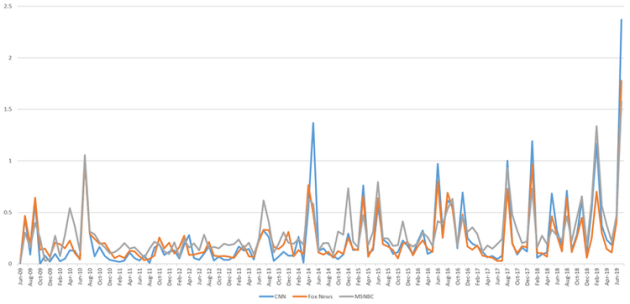
Looking back over the past decade, the timeline below shows the percentage of airtime by month on CNN, MSNBC and Fox News that mentioned “racism” or “racist” using data from the Internet Archive’s Television News Archiveprocessed by the GDELT Project.

From September 2010 to May 2013 there was a marked silent period in which mentions of racism largely disappeared from all three news channels. The acquittal of George Zimmerman in the killing of Trayvon Martin in July 2013 appears to have restarted the national conversation around race. This week’s remarks by Trump appear to have sparked the most attention to the topic of the past decade.

Notably, there does not appear to be any meaningful change in mentions of racism between Obama and Trump’s presidencies.

In contrast, coverage of anti-Semitism does appear to have increased sharply during Trump’s term. The timeline below shows coverage over the past decade that mentioned the words “anti-Semitism” or “anti-Semitic” or “antisemitism” or “antisemitic.”

The topic attracted almost no attention during Obama’s presidency, but has received several bursts of coverage since Trump’s July 2016 “Star of David” Clinton tweet first prompted accusations of anti-Semitism. Interestingly, Rep. Omar’s anti-Semitic tweets in March 2019 received far less attention, with Fox News covering them more than CNN and MSNBC combined.

In each case, the story faded within a week. Looking at the broader topic of discrimination, the timeline below shows coverage mentioning “discrimination” or “discriminatory” or “discriminated” or “discriminating.”

Beginning July 2015, the month after Trump declared his candidacy, coverage of discrimination largely disappeared from all three channels and has remained far below Obama-era levels through the present. It is unclear what may be driving this shift, since anti-Semitism coverage has increased, but coverage of racism remains unchanged.

One possibility is that the stations have devoted so much of their airtime to Trump over the past four years, with just over 9% of their total airtime mentioning his name thus far this month.

Looking more closely at the timeline above, the fact that Trump’s media profile has been steadily shrinking could also help explain his attack on the four Democrats. Trump has a long history of adopting controversial and media-genic stances in periods of declining media coverage as a way to boost attention.

Putting this all together, it is likely that just as Omar’s anti-Semitic remarks this past March faded from interest within a week, so too will the media move on from Trump’s remarks this week.

RealClear Media Fellow Kalev Leetaru is a senior fellow at the George Washington University Center for Cyber & Homeland Security. His past roles include fellow in residence at Georgetown University’s Edmund A. Walsh School of Foreign Service and member of the World Economic Forum’s Global Agenda Council on the Future of Government.

Source: Media Coverage of Anti-Semitism, Racism Rise in Trump Era

Most UK news coverage of Muslims is negative, major study finds

Not unique to the UK, both in terms of coverage and which outlets have greater negative focus:

Most coverage of Muslims in British news outlets has a negative slant, according to a major analysis by the Muslim Council of Britain, which concludes that news stories in the mainstream media are contributing to Islamophobia.

The study found the Mail on Sunday had the most negative coverage of Islam, with 78% of its stories featuring Muslims having negative themes – above an already-high industry average of 59%.

The New Statesman, Observer and Guardian were the least likely to portray Muslims in a negative light, according to the analysis of 11,000 articles and news broadcasts during the final three months of last year.

The findings come amid growing scrutiny of Islamophobia in the Conservative party and whether its roots lie in rightwing media coverage. A YouGov poll of Tory members by the campaign group Hope Not Hate found that 60% believe “Islam is generally a threat to western civilisation” and more than half believe “Islam is generally a threat to the British way of life”.

Source: Most UK news coverage of Muslims is negative, major study finds

Trump Is Right That “Much Can Be Learned” From Australia’s Immigration Policies.

Some valid points about the risks of normalizing xenophobic discourse, rather than having more neutral wording to describe issues:

Australia’s asylum policies—which see asylum-seekers languishing for years under inhumane conditions in offshore detention centers in Papua New Guinea and Nauru—are already a source of great shame for many Australians. Widely condemned by human rights groups and the United Nations, the policies contravene various human rights charters, including the 1951 Refugee Convention and even the Convention Against Torture. A U.N. report called on Australia to close the offshore centers, finding “inadequate mental health services, serious safety concerns and instances of assault, sexual abuse, self-harm and suspicious deaths; and about reports that harsh conditions compelled some asylum seekers to return to their country of origin despite the risks that they face there.” Just last week, a former detainee who spent six years on Manus Island begged the U.N. Human Rights Council to hold Australia to account, calling the centers—not just the circumstances they were fleeing—a humanitarian crisis.

But when Donald Trump—the U.S. president whose administration separates children from their families to deter asylum-seekers—says there is much to be learned from Australia’s immigration policies, it’s a fresh reminder of just how bad things have become.

On his way to a working dinner with newly reelected Prime Minister Scott Morrison at the G-20 summit in Japan last week, Trump tweeted out four Australian government flyers, noting that “much can be learned” from them:

It’s not the first time Trump has praised Australia’s hard-line policies: In 2017, then–Prime Minister Malcolm Turnbull was attempting to convince Trump to uphold a deal negotiated under the Obama administration for the U.S. to resettle detained asylum-seekers who had been attempting to reach Australia. When Turnbull explained Australia’s policy of not accepting those who seek asylum via boat, Trump reportedly told him, “We should do that too. You are worse than I am.”

Trump is reportedly a fan of Turnbull’s successor, Morrison, repeatedly comparing his recent surprise upset to his own (and, of course, declaring that he saw it coming). It’s not clear where Trump saw the Morrison posters, but they seem to represent a friendly little tip from one tough-on-borders leader to another, just as the image of a drowned Salvadoran migrant father and daughter made headlines around the globe.

The lesson Trump presumably wants to draw from these posters is how better to deter people from seeking asylum—something those people have every right to do under international law. As Trump said when he saw the viral image from the U.S. border, “A very very dangerous journey. And by the way many other things happened. Women being raped; women being raped in numbers nobody believed.” The Australian government often justifies its cruelty as a deterrent: to discourage refugees from making the “very very dangerous journey” by sea by making it clear that they will never be settled in Australia, and will suffer greatly if they try to be. It’s for their own good, the government says while simultaneously stoking fears of a flood of boats making their way to Australia if they weaken their system even slightly—punishment in the name of protection.

As Kon Karapanagiotidis—founder and CEO of the Asylum Seeker Resource Centre and one of the most outspoken refugee advocates in Australia—laid out in a reply to Trump’s tweet, there is a swath of horrors to learn from Australia, if abject cruelty and maximum suffering are what you’re aiming for.

The most obvious thing for the U.S. to learn from Australia is not to go down this path. This should be obvious enough, from the list Karapanagiotidis shared, from the conditions these human beings live under with no end in sight.

But there is an especially acute lesson to take away from this about not allowing cruelty to become normalized. Just like in the United States, this has been an incremental slide for Australia. Many of the asylum-seekers who try to reach Australia attempt to come by boat via Southeast Asia. Mandatory detention of these migrants for the assessment of “unlawful arrivals,” implemented in the early ’90s by a Labor government with a 273-day limit, soon became offshore detention. The 2000s conservative coalition government implemented the “Pacific Solution,” interning asylum-seekers on nearby island nations instead. Temporary detention soon became seemingly permanent, with a later coalition government declaring that no asylum-seeker who arrives by boat will ever be allowed to live in Australia, regardless of the legitimacy of her claim. (The only options for detainees are to return to their home countries, something they are often pressured to do, or wait for a resettlement deal to be negotiated.) The system has become increasingly secretive, with the media unable to access the camps, and those working within them facing jail time if they leak information.

It’s not too late for the U.S. to avoid this path. As Jason Wilson wrote in the Guardian just a few days before Trump drew the comparison, “Australia’s camps are now baked into its national politics. … The longer that they are in place in the US, Italy and elsewhere, the more likely it is that in those countries, too, they will become permanent features of the political landscape.”

At first, the U.S. left seemed to be doing a good job at this—something Australia could learn from. The left rallied fiercely against the Trump administration family separation policy when it first came out that children were being kept in detention facilities, forcing Trump to sign a June 2018 executive order putting an end to the practice. At the time, the hearteningly effective use of protest made me sad about Australia’s own failure to mobilize effectively or early enough against its now-ingrained inhumane policies.

However, after Trump signed the executive order, returning many traumatized children to their families, that outrage seemed to simmer out—despite hundreds of children remaining in detention. Recent weeks have seen the issue reenter the public consciousness, with the discovery that many more children were separated than first thought, and an inspection of a Clint, Texas, detainment center revealing appalling conditions. There has been a renewed push, led by Rep. Alexandria Ocasio-Cortez, to again label these kinds of camps “concentration camps,” which, accurate or not, has reenergized opposition to them and turned the facilities into a central issue for 2020 Democratic candidates. But outrage fatigue is real, and the second rarely matches the first. Australia may be beyond the capacity to feel outrage at this point, with reports of a mental health crisis—dozens of detainee suicide attempts and acts of self-harm since the unexpected reelection of Australia’s conservative government in May—barely moving the needle.

There are also lessons for the U.S. media to be taken from Australia. It is essential that journalists keep reporting on and scrutinizing the horrific conditions in these detention facilities and keep finding ways to get the message across. But perhaps most importantly, they need to fight any efforts to impose laws or policies banning access to the centers for journalists and advocates, as the Australian government did in 2015, passing the draconian Australian Border Force Act, which made it a criminal offense for whistleblowers to reveal anything that happens in the detention centers to the media. Journalists have little access themselves, with the Pacific nations that house Australia’s detention centers refusing almost all journalist visa requests—something that Australia is believed to have had a hand in. For the most part, all the Australian public now gets from inside these camps are rare leaked recordings and the Twitter feeds of prominent detainees. Australian journalists and advocates fought this law, and I don’t mean to demean or question their efforts here. But it’s important for the U.S. media to take heed. Images and reports have proved incredibly potent in swaying public opinion, and so, from Trump’s perspective, a lesson here might be to implement something similar.

There are lessons, too, for Democrats to learn from Australia’s major left party, the Labor Party, not to bow to public pressure to be “strong” and “tough” on border control. Despite recent efforts to provide some relief, in the form of a bill allowing for the temporary transfer of detainees to Australia for medical or psychiatric treatment passed in Parliament with the support of Labor and a number of independents, Labor has proved spineless on the issue, with mandatory offshore detention now more or less a bipartisan policy.

Many in the party may oppose the practice, but overall, Labor is afraid to differentiate itself from the right, lest it be labeled weak on national security—something the coalition has attempted to do in the wake of Labor showing the smallest ounce of compassion in helping pass the medical transfer bill. Democrats need to decide how they intend to fight this system, rather than just try to alleviate some of the suffering it creates. Some argue that billions in emergency funding for the southern border only props up the system, advancing a fundamentally inhumane set of policies.

Trump’s desire to “learn” from a horrific policy that has been repeatedly slammed by the U.N. Human Rights Council is hardly surprising. But for once, he’s right—in a sense. There are many lessons to be learned from Australia. The most important? Take note of them before a system becomes seemingly too ingrained to do much about it.

Source: Trump Is Right That “Much Can Be Learned” From Australia’s Immigration Policies.

Macpherson: Quebec’s Fox News, only bigger

Of note, and the consequent implications:

For their shrill populism, the Québecor media have been called Quebec’s Fox News. But in terms of their influence on this province’s politics, they’re much bigger than that.

Last weekend, in the annual Quebec journalism awards, Québecor’s newspapers, television channels and digital media were shut out.

But its flagship daily Le Journal de Montréal boasted of survey results suggesting that on all platforms, the three Québecor dailies were read at least once a week by more than half of Quebecers over the age of 14.

And Québecor’s TVA network bragged that its newscasts and LCN all-news channel led the television ratings in their respective categories.

This market domination by the Québecor media, and their resulting influence on public opinion, help explain poll results published this week suggesting that Quebec is the only province where a majority supports legislation like Bill 21.

The Legault government’s proposed anti-hijab-and-kippah-and-turban bill is supposed to settle, after more than a decade, the issue of accommodating minority religions. As the Bouchard-Taylor provincial commission on the subject reported in 2008, that issue was largely created by sensationalist and often inaccurate reporting by Québecor. And it’s mainly Québecor that has kept the issue alive.

In December 2017, TVA reported that a Montreal mosque had female construction workers removed from a work site outside during Friday prayers. The report was quickly debunked, but it wasn’t until a year later that TVA grudgingly admitted it was false and apologized.

Instead of editorials, Québecor’s dailies have columnists who circulate among its “convergent” platforms defending the supremacy of what one of them, Mathieu Bock-Côté, calls Quebec’s “historic French-speaking majority” — that is, ethnic French-Canadians — against the province’s minorities and other enemies of the true people.

Last January, another Le Journal columnist, Denise Bombardier, called minorities who complain of their treatment in the province “enemies … of French-speaking Quebec.” And she issued a call to “extinguish these hotbeds of intolerance,” even though she acknowledged it might be used by the “hotheaded and violently prejudiced.”

Le Journal’s columnists have clout. The non-binding 2017 National Assembly motion against the public use of English, in the form of the bilingual “bonjour-hi” greeting in businesses, resulted from a campaign spearheaded by one of them, Sophie Durocher.

Another, Richard Martineau, is obsessed with “Islamism” and has been accused of Islamophobia, which he denies.

In 2017, TVA’s rival Radio-Canada reported that in the previous 10 years, Martineau had written about 700 columns directly or indirectly concerning Islam.

A UQAM sociologist, Rachad Antonius, told Radio-Canada he had concluded from a study of Le Journal’s news coverage and columns on Islam that their cumulative effect fostered distrust of Muslims.

But if “Islamists” are a Martineau dog whistle, they may not be his only one. A cheerleader for Bill 21, he predicted that Prime Minister Justin Trudeau will come under pressure to challenge the legislation from “followers of multiculturalism who live in Hampstead or Côte-Saint-Luc,” Montreal suburbs widely identified with their Jewish residents.

Québecor’s domination of the marketplace puts pressure on other media to follow its lead, in both news coverage and opinion. And its position may get even stronger, as its competitors get weaker.

The same day that Le Journal boasted of its readership, its main competitor, La Presse, published another plea for reader donations.

From 250,000 paying subscribers when it was still charging for its journalism, the number of its financial supporters willing to donate money to keep reading La Presse has shrunk to a total of 23,500 donors for the past four months.

This was after Le Journal reported last week that La Presse and another of Québecor’s competitor, Quebec City’s daily Le Soleil, are in serious financial trouble, and have asked the Legault government for help.

It said the government is “particularly pessimistic” about the future of Capitales Médias, which owns Le Soleil and five small regional dailies. And it said that, despite La Presse’s campaign to raise $5 million in donations, it could be broke within a year.

Source: Macpherson: Quebec’s Fox News, only bigger