Who Votes in Toronto Municipal Elections? – Maytree Study

Summary of the results of the Maytree study by Ryerson University Professor Myer Siemiatycki on Toronto municipal voting:

Toronto has a poor record of voter participation in civic elections. In 42 of Toronto’s 44 wards less than half of all eligible voters cast a ballot in recent city elections. The turnout improves only when elections are hotly contested. While areas with lower voter turnout typically have high concentrations of immigrant and visible minority populations, there is minimal correlation between voting and an area’s average income, and no correlation to an area’s proportion of tenants and homeowners.

These are some of the key findings of Who Votes in Toronto Municipal Elections?, the first such study on voter turnout over the past three municipal elections in 2003, 2006 and 2010. Conducted for Maytree by Ryerson University Professor Myer Siemiatycki and geographic analyst Sean Marshall, the study explored the connection between municipal voting behaviour and some of Toronto’s prime demographic characteristics like immigrant status, visible minority identity, income and home ownership.

There is some good news

While the poor turnout is cause for concern, the study shows there is nothing inevitable or pre-determined about who votes in municipal elections. Thorncliffe Park is a prime example of what can be achieved if a more diverse political leadership results in deeper community engagement. With a large concentration of immigrants and visible minorities, this inner city area is one of Toronto’s highest voting neighbourhoods.

Why voter turnout matters

There are many reasons to take the democratic deficit arising out of poor voter turnout seriously. It threatens the legitimacy and confidence of local government and risks local officials being out of touch with public needs and concerns. It can lead to areas or communities within the city being marginalized from public decision-making.
Who Votes in Toronto Municipal Elections?

Maytree New Ryerson-Maytree initiative set to advance the inclusion of immigrants and visible minorities » Maytree

Should provide further leadership on diversity and inclusion issues:

The initiative will be housed at the Ted Rogers School of Management’s Diversity Institute at Ryerson University and led by Ratna Omidvar as its founding Executive Director who will be relocating to Ryerson. It builds on the long-standing relationship between Maytree and Ryerson, including its research partnerships on the DiverseCity and DiversityLeads projects.

Under Ratna’s leadership, the Ryerson Maytree Global Diversity Exchange will develop a program of academic and applied research, identify evidence-based leading practices and promote policy and solutions that strengthen the case for diversity and inclusion.

In addition, it will become the new home for a suite of successful Maytree programs: Cities of Migration, DiverseCity onBoard, the Flight and Freedom book project and hireimmigrants.

Cities of Migration and DiverseCity onBoard have had impact both in Canada and abroad. Flight and Freedom, due for publication in 2015, will tell the stories of Canadians who have fled their home countries, often under threatening conditions, to find their way to Canada. The book will highlight the contributions they have made to their new country. Hireimmigrants has a solid track record of working with Canadian employers to enhance their skills in attracting, employing and retaining skilled immigrants.

Maytree New Ryerson-Maytree initiative set to advance the inclusion of immigrants and visible minorities » Maytree.

Maytree Flight and Freedom: Stories of Escape to Canada

Maytree’s newest project, writing a collection of refugee stories:

What does escape look like up close? Why do people choose Canada? And once they land in a safe country, what happens next?

In Flight and Freedom, Maytree’s Ratna Omidvar and Dana Wagner draw on 30 astonishing interviews with refugees to Canada to document their extraordinary journeys of flight, and to transform a misunderstood group into familiar, human stories.

Each of the 30 stories documents an escape that is sometimes harrowing and always remarkable. The narrative then turns to contemporary lives and careers, and the impact of refugees-turned-Canadians in the communities they call home, from Halifax to Vancouver.

Stories focus on Canadians who arrived as refugees from notable conflicts around the world, from the War of 1812 to the ongoing War in Afghanistan. Beyond conflict zones, other stories profile people from persecuted groups like gay men and women. At the time of escape, some refugees were children, others were parents, and others got out alone. Notwithstanding the diverse events of a story, the single overriding imperative for all characters can be summed up in one sentence: “We have to run.”

Closing the book is a question: Would they get in to Canada today? Peter Showler, lawyer and former chairperson of the federal Immigration and Refugee Board, answers the hypothetical question by analyzing how the cases would be handled under Canada’s new refugee system.

You can sign up for updates (book out in 2015) at the link below:

Maytree Flight and Freedom: Stories of Escape to Canada » Maytree.

Maytree Lessons for and from Toronto » Maytree

open-uri20140701-27920-t13my

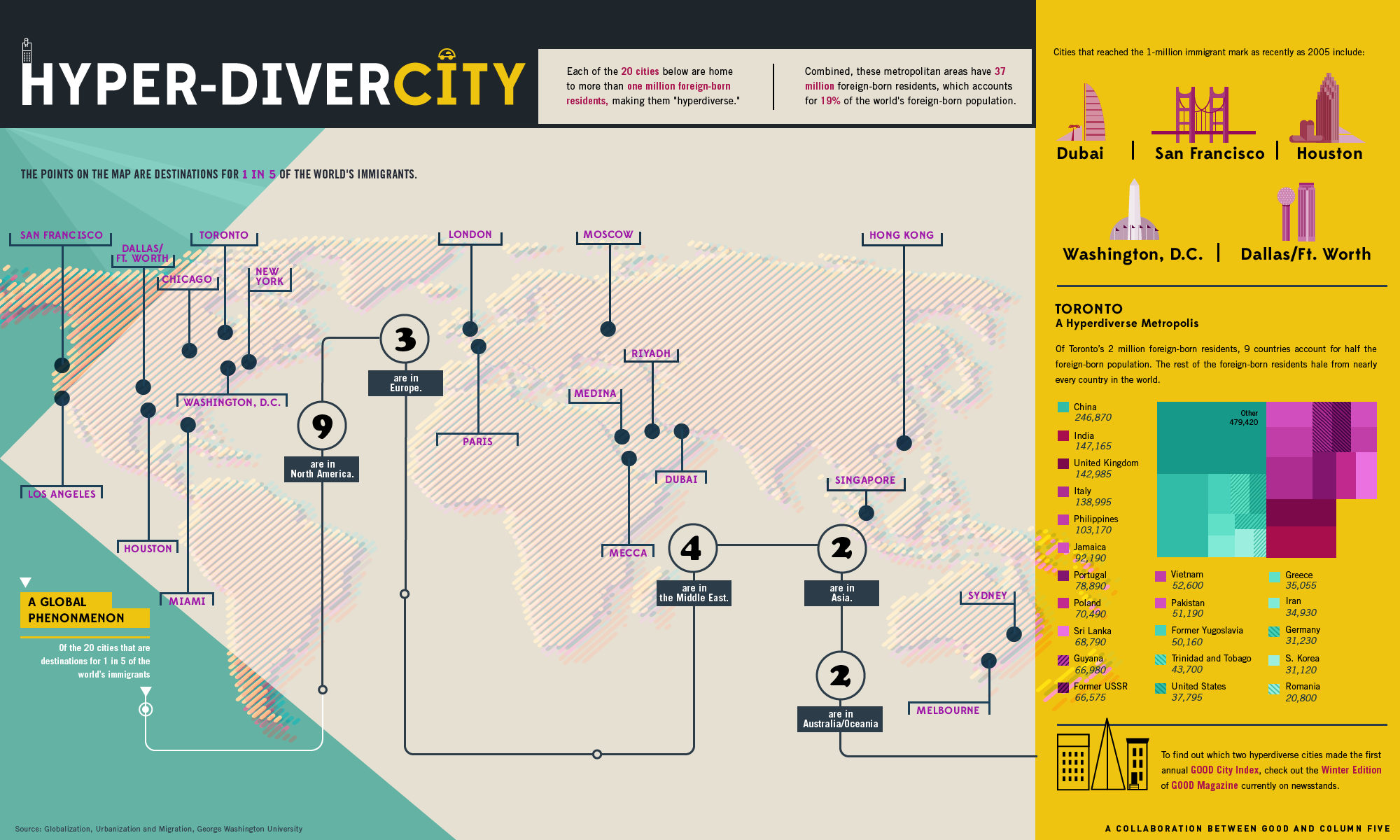
Graphic from Good Magazine

Ratna Omidvar’s report of the recent Cities of Migration Berlin conference. Worth reading:

For all the self-criticism that we Torontonians like to inflict on ourselves, we secretly know that our city is admired all over the world as a place that works well with its diversity. But lest we feel too smug, let’s remember that world leaders don’t keep their titles without continuous learning and innovation. They should, in the words of Hamburg Mayor Olaf Scholz, “Oppose the idea that there’s nothing to change any more.”

At the international Cities of Migration conference in Berlin convened by Maytree in June, practitioners, policy makers and private sector leaders shared lessons on good practice in immigrant inclusion from their own cities: Helsinki, Nashville, Tokyo, Lisbon, Auckland, Sao Paulo, Athens, and many more. From this global hub in Berlin come many ideas for and a few from Toronto.

One of the founding principles of Maytree’s Cities of Migration project is that good ideas can travel. That a smart policy working in Seattle can be tweaked to also work in Halifax. That a successful initiative from San Francisco can be replicated in London. This is because cities are often better placed to address immediate needs that are local in nature, such as employment, home ownership, success in school, and neighbourhood inclusion. As Khalid Koser of the Geneva Centre for Security Policy said in his keynote, “While states are building walls, cities are building bridges.”

Maytree Lessons for and from Toronto » Maytree.

Permanent Resident Voting: A Movement on the Rise – But does it make sense?

I am not a fan of allowing Permanent Residents to vote although I understand the rationale of supporters.

We have enough problems encouraging citizens to vote and it remains to be seen whether Permanent Residents would have significantly greater interest in voting.

More significantly, there are relatively few differences between citizens and Permanent Residents in terms of rights, social programs and other benefits (and responsibilities) and to a certain extent, if Permanent Residents can vote, this may reduce the incentive to become citizens.

Of course, in the context of the new citizenship act making citizenship harder to acquire, this may increase pressure to allow municipal voting. The old argument about Canadian citizenship being relatively easy to acquire in a relatively short period of time applies less and less:

Finally, we must connect with and support groups who are currently engaging other critical advocacy for newcomers. Earlier this year, the city of Hamilton proclaimed itself a sanctuary city – in other words, the city committed to ensure that every resident, regardless of immigration status, has access to city services. It is no coincidence that a similar proclamation in Toronto preceded the successful motion on permanent resident voting. City Vote must situate itself within the broader movement to ensure newcomers have equal rights and opportunities in Canada.

Thankfully, the campaign has a history of strong partnerships within this larger newcomer-serving community. Thorncliffe Neighbourhood Office, a multi-service community hub in central Toronto, incubated the campaign in 2008 and helped it grow. Maytree has been supporting policy development and hosting forums on the issue since 2007. Groups as large as the Canadian Civil Liberties Association and as small as warden Woods Community Centre have offered their time, energy and support. The foundation for growth is solid and diverse.

Permanent Resident Voting: A Movement on the Rise.

Why Syrian refugees will thrive in Canada

Good piece by Ratna Omidvar and Dana Wagner of Maytree on the overall success and contribution by refugees, and advocating for quicker intake of the 1,300 Syrian refugees that Government has pledged to accept. They note that most refugees get jobs, learn either English or French, their new communities will support them, and they will give back.

Why Syrian refugees will thrive in Canada – The Globe and Mail.

Maytree Survey Research Reveals Canada’s Attitudes towards Citizenship

While over two years old, this survey, conducted by Maytree, the Institute for Canadian Citizenship, the CBC and Royal Bank, is nevertheless interesting, as it indicates that in general Canadian citizenship policies are working and little appetite for change.

As the Government moves forward with revision to the Act, it will be interesting whether the debate reflects these findings or not.

Maytree New Survey Research Reveals Canada’s Attitudes towards Citizenship » Maytree.

Ensuring the electoral and civic involvement of Canada’s immigrant communities

Good piece by Ratna Omidvar of Maytree on some of the challenges in political involvement of ethnic communities. While much of the focus to date has been on electoral representation, more qualified assessment of “back room” involvement and roles and influence of elected representatives (e.g., looking at the current federal and provincial governments, ethnic community parliamentarians largely have secondary roles)l.

Ensuring the electoral and civic involvement of Canada’s immigrant communities.