For minister Sean Fraser, immigration and housing are more than just numbers games

Of note. The blatant hypocrisy of Minister Fraser of proposing to make the citizenship oath self-administered while stating:

“On Canada Day, new citizens from nine different countries took their oaths at a Blue Jays game. I had my daughter with me—a seven-year-old hugging a bunch of new Canadians, pure joy on their faces. Thousands of people were cheering. The near-universal reaction was to welcome.”

Oblivious to the contradiction… as well as immigration levels, his old portfolio, and housing availability and affordability, his new portfolio:

On the off chance you overhear a Canadian bragging, it’s usually to say that this is the greatest country in the world. It might violate our national modesty policy to add that we’re now also one of the most desirable, but the data’s there: in 2022, we welcomed close to a million newcomers (a record) and, a year prior, unseated the U.S. as the number-one destination for international workers. People want to come to Canada, and Canada really wants them here.

In June, staring down the ongoing labour shortage, the federal government announced a revamped federal express-entry system, complete with shiny new expedited pathways to permanent residency for U.S. H-1B visa holders and immigrants with sought-after expertise in fields like health care, tech and, crucially, the trades. Prior to a surprise cabinet shuffle by the Prime Minister in late July, the man responsible for delivering on the government’s ambitious target—500,000 immigrants annually by 2025—was Sean Fraser, then the minister of immigration, refugees and citizenship.

Fraser, a trained lawyer and loyal Nova Scotian, spent his whole life watching talent flee his home province for more promising opportunities elsewhere. His old office is facing a backlog 800,000 applications deep—not to mention newly urgent questions about Canada’s affordability, thanks in part to our bonkers real estate market. Those same questions follow Fraser into his new role as minister of housing, infrastructure and communities. When Maclean’s spoke with him in the weeks leading up to his new appointment, Fraser was convinced that Canada is the place to be, warts and all.

According to Statistics Canada’s “population clock,” Canada hit 40 million people just before 3 p.m. EST on Friday, June 16. Where were you when you heard the news?

I think I saw it on social media at some point; I wasn’t tracking it. My mind is on whether people get reunited with families and whether businesses can access workers.

So no plaque? No balloons?

I hate to disappoint. We did have a cake for my two-year-old’s birthday yesterday. He’s getting too big too quickly.

You’re 39; I’m 35. I don’t know about you, but I’ve cited the 30 million–ish factoid as long as I’ve been alive. Is it hard to wrap your head around this new milestone?

Looking back at my earliest citizenship ceremonies, my speeches often included something like, “There’s not one way to be Canadian, but 38 million different ways.” I’ve had to shift that. But Canada’s been ascending the ranks of countries people most want to move to for economic opportunities. The U.S. and Germany used to take the top two spots. It’s not a race, though.

Immigration may not be a race, but your office is banking on many, many more people becoming permanent residents. Like, 500,000 more, every year.

People have to be careful when trying to understand those numbers. It’s not uncommon for half of the “new” permanent residents in the annual count to have already been here as temporary ones—some are temporary foreign workers or international students. Last year, we added 437,000 permanent residents. We’re looking at a gradual increase to 500,000 by 2025.

More than ever, the immigration conversation centres on labour—or how Canada will replace the huge wave of retiring workers. You recently introduced a category-specific entry strategy, with preference given to workers in specific industries, like health care. How does this approach differ from the old one?

We need to respond to the skills gaps resulting from the changing economy and retiring workers. (For what it’s worth, 50 years ago, there were seven workers for every retiree in this country. In Atlantic Canada, where I am, it’s now closer to two.) The federal express-entry system scores applicants based on factors like education and language skills. The new parameters also take the highest-scoring applicants in in-demand sectors—more doctors, more homebuilders and more tech workers.

Back in June, you unveiled the country’s first-ever tech talent strategy—its actual name—to create a steady pipeline of American-dwelling H-1B visa holders to Canada. Are you attempting a reverse brain-drain?

The move wasn’t driven by little-brother syndrome. It was a real-time response to layoffs at some U.S. tech giants. If you’re on an H-1B visa and you lose your job, you either have to find a new one or leave within 60 days. Some of those workers might want to stay in the North American market. We’d be happy to have them.

You’re also courting digital nomads—people whose jobs allow them to work from anywhere in the world. What’s your elevator pitch when people ask, “Why work from Canada when you could work from home?”

Come here for up to six months to test drive Canada while still working for a foreign employer. If you receive a valid job offer from a company here, you can apply for a work permit. The real value proposition, though, is the chance to become one of us. Don’t underestimate how powerful that is. People born to Canadian parents sometimes take our daily rewards for granted: being able to go to the doctor when you get sick and earning a meaningful income if you work hard and have skills to offer.

Bringing people to Canada en masse isn’t a success unto itself; they need to be able to thrive when they get here. Many citizens and permanent residents are without family doctors, they’re being crushed by housing prices—even groceries. It’s not actually as simple as “hard work pays off” anymore.

You have to look at the counterfactual if you’re going to say it’ll be more difficult for newcomers and citizens to thrive in this country if you add more people.

That’s not what I’m saying.

When I was an MP candidate in 2015, the biggest controversies in my province were the closures of River John Elementary School and the mental health unit at Aberdeen Hospital, one of the largest regional hospitals in northern Nova Scotia. One psychiatrist left and it became too unsafe to operate the entire unit. Look at a local machine shop that hires foreign workers, and you’ll realize that the job of every tradesperson on the floor can depend on a linchpin employee. Before we get into what we need to do to accommodate those arriving in Canada, we should recognize the drastic consequences our communities will suffer if we adopt a negative approach toward newcomers. So, with that giant preamble out of the way—

I’m going to interrupt you here. I realize that, with these new targets, you’re specifically looking for, say, construction professionals to build the houses people need to live in, which will increase overall affordability.

I can tell you that, 365 days a year, I will choose the problem of having to rapidly build more houses because so many people want to move to my community over losing schools and hospitals because so many people are leaving.

Fair, but it’s not an either-or. Righting the housing market will take time. Immigrants are arriving now in a system that already has massive cracks in it.

We’ve woken up to the fact that we need to use our immigration policies to help solve some of our social challenges rather than exacerbate them. Yes, we’re bringing in homebuilders, but we’ve also got new regional strategies, like the new Rural and Northern Immigration Pilot, which would spread people out more evenly, so they don’t all land in Ontario.

And the settlement services?

Generally speaking, there’s federally funded language training and employment assistance. Other services will go as far as to help you open a bank account or sign your kids up for soccer. There is no silver bullet, but the good news is, when you look at the children of newcomers, their outcomes are more or less on par with kids whose parents were born here.

I appreciate that this is a highly complex long game, but in Toronto, where I live, city officials have been dealing with a 500 per cent increase in the number of asylum seekers in the shelter system. I can’t count how many stories I’ve read about trained doctors driving Ubers. Immigration detainees, some of whom may not present a meaningful risk to public safety, are languishing in provincial jails. This is also Canada.

These issues need to be addressed. We’re not used to receiving this many asylum claims or irregular border crossings, which was a real challenge at Roxham Road. One of the men who delivered food for my son’s birthday was a dentist trying to get qualified to practise in Nova Scotia. It frustrates me. Each of those problems requires a unique solution. We’re also going to do what, I think, most serves Canada’s long-term interests: embrace ambitious immigration in targeted areas to meet the needs of the economy.

Do you ever think that having an impenetrable gratitude mindset stops Canadians from grappling with serious systemic issues?

I’m not going to tell you that Canada is perfect—not by a long shot. When I speak at citizenship ceremonies, I often talk about the Charter values that bind us, but also the times that we fell short of them. We just passed the 100th anniversary of the Chinese Exclusion Act, which prevented Chinese people from coming here—many of whom already had loved ones here who helped to build Canada. Still, many countries can’t openly confront their challenges because they’re not a liberal democracy. We are. Looking at the other side of the coin, there’s a lot to be grateful for.

Apparently, your office now uses “advanced analytics” to lower processing times. Is AI deciding who gets in and who stays out?

Let me be clear: an officer, a human being, makes the final decisions in all cases. I will add that, during the pandemic, we digitized most of our paper files. We didn’t raise a “Mission accomplished!” banner, but people were excited.

Isn’t technology great?

Yeah, when it works.

Where does the Fraser clan hail from?

We fled Scotland during the Highland Clearances 250 years ago and washed up on the shores of Nova Scotia 10 minutes from New Glasgow, where I live now. My parents are in Merigomish, which has a couple hundred people, eight of whom are related to me. It’s the kind of place where we come out of the woods to go hunting, to put things in perspective.

I also heard you play the bagpipes—a part of your heritage.

Thanks to my grandfather. He was born in Canada but very much a classic grumpy old Scotsman. Come hell or high water, I was going to play the pipes.

Have you really mastered any tunes? If you’re not good at the bagpipes, uh…

They’re beautiful when somebody’s playing them well. I can play most of the traditional tunes, like “Sleepy Maggie.” I once played a New Year’s Eve show with an AC/DC tribute band. I did the bagpipe part of “It’s a Long Way to the Top.”

Now for a bit of Maclean’s history: we used to have an award called Parliamentarians of the Year. In 2021, you were a finalist for Best Orator, alongside Alain Therrien of the Bloc Québécois and Pierre Poilievre. You won.

I enjoyed the back-and-forth that I had with Pierre. I wouldn’t be surprised if, for a while, I took more questions from him than any other member of the House of Commons. Anyway, it’s nice to be recognized for your contributions.

Speaking of, at a televised event back in May, you were introduced as “Mr. Sexy” by Hedy Fry, a fellow Liberal MP. Is this an official title? Is there some kind of internal ranking everyday Canadians aren’t aware of?

God bless Hedy—I think she made that up on the spot. So no official award. My friends are having more fun with that than they ought to. I fear it may stick.

Did the Prime Minister get express entry into this competition?

When you’re up close, the guy looks like a movie star. I hope that, whatever his appearance, people will remember his government for the problems it solved and the people it helped.

Well, most of us would rather be more valued for our brains than our looks.

That’s right.

Are there any citizenship ceremonies that stand out to you as especially poignant?

On Canada Day, new citizens from nine different countries took their oaths at a Blue Jays game. I had my daughter with me—a seven-year-old hugging a bunch of new Canadians, pure joy on their faces. Thousands of people were cheering. The near-universal reaction was to welcome.

Source: For minister Sean Fraser, immigration and housing are more than just numbers games

Indigenous peoples: In Canada, justice is not blind

The high numbers regarding indigenous incarceration rates are shocking. Comparable to Black incarceration rates in the USA:

While admissions of white adults to Canadian prisons declined through the last decade, Indigenous incarceration rates were surging: Up 112 per cent for women. Already, 36 per cent of the women and 25 per cent of men sentenced to provincial and territorial custody in Canada are Indigenous—a group that makes up just four per cent of the national population.

This helps explain why prison guard jobs are among the fastest-growing public occupation on the Prairies. And why criminologists have begun quietly referring to Canada’s prisons and jails as the country’s “new residential schools.”

In the past decade, the federal government passed more than 30 new crime laws, hiking punishment for a wide range of crimes, limiting parole opportunities and also broadening the grounds used to send young offenders to jail. At the same time, it has been ignoring calls to reform biased correctional admissions tests, bail and other laws disproportionately impacting Indigenous offenders. Instead, it appears to be incarcerating as many Indigenous people as possible, for as long as legally possible, with far-reaching consequences for Indigenous families.

But the problem isn’t just new laws. Although police “carding” in Toronto has put street checks, which disproportionately target minority populations, under the microscope, neither is racial profiling alone to blame. At every step, discriminatory practices and a biased system work against an Indigenous accused, from the moment a person is first identified by police, to their appearance before a judge, to their hearing before a parole board. The evidence is unambiguous: If you happen to be Indigenous, justice in Canada is not blind.

“What we are doing is using our criminal justice system to defend ourselves from the consequence of our own racism,” says Toronto criminal lawyer John Struthers, who cut his legal teeth as a Crown attorney in remote, northern communities. Rather than treat trauma, addictions, he says, “we keep the doors closed.”

Source: Cover preview: In Canada, justice is not blind – Macleans.ca

Why don’t we have more female judges? – Macleans.ca

Irwin Cotler’s efforts to get more information on judicial appointments (see earlier Tories chastised for lack of racial diversity in judicial appointmentsRacial Diversity Gap in the CourtroomForget MacKay, a woman’s place is on the bench):

The justice minister’s office explains that in the case of Cotler’s most recent question, there simply wasn’t enough time to do what would have had to have been done to answer Cotler’s questions.

In the order-paper question that Mr. Cotler tabled last December, Q-836, he was asking the department to go back through 21 years of information, a great deal of which would require a manual search of the paper records. The department only has 45 days to answer order-paper questions and there was just not enough time.

It does seem like a rather large project.

Cotler and Liberal MP Sean Casey today released a statement calling for greater diversity on the bench and the questions raised by last year’s controversy—whatever Peter MacKay said or didn’t say—still seem worthwhile. While Ontario publishes information on applicants for judicial publications, we have no such data for federal appointments. At what rate are women applying to be federal judges? How has that rate changed over time? And how has the rate of appointment of women changed over time? Those don’t seem like questions for which it would be unreasonable to expect answers to be somehow procured.

I don’t think this is true.

When I compiled a list of women and visible minorities in provincial legislatures, it only took me a week or so to go through names and photos of provincial legislature members. Going through judicial appointments should not be that time consuming (only an average 69 per year between 2006-12).

Why don’t we have more female judges? – Macleans.ca.

Direct link to the table for 2006-12 appointments:

breakdown (pdf)

Winnipeg rises to a challenge – Macleans – Wells

Aboriginal - Black comparisonPaul Wells on the impressive open response to the Macleans story on racism in Winnipeg. All too rare in Canadian politics:

“Ignorance, hatred, intolerance, racism exists everywhere,” Bowman said. “Winnipeg has a responsibility right now to turn this ship around and change the way we all relate: Aboriginal and non-Aboriginal, Canadians alike, from coast to coast to coast.”

Already this was surprising. Bowman was not demanding Maclean’s apologize, or indeed anyone. “We are here together to face this head-on as one community,” he said.  He was careful to note what nobody would deny: that racism exists everywhere, not only in Winnipeg, and that the city is full of people who work hard to combat racism and its effects. But neither he nor the other speakers sought any bogus refuge in the fact that Maclean’s isn’t published locally or that it used nasty words in its article.

Mercredi also emphasized that racism is a big problem that ignores municipal borders, but added: “I want to thank Maclean’s magazine for the story that they did. And to challenge them to follow up with other stories of where individuals and groups have combatted racism in their particular communities and cities and have made a difference in race relations in their communities.”

I suspect we’ll be taking up Mercredi’s challenge over the next few weeks. It was, on the whole, an inspiring and morally serious response from officials who know very well that slogans won’t begin to heal the wounds Nancy Macdonald and Scott Gilmore document this week.

It’s so common to find public officials shifting blame instead of lifting burdens. That’s not the path Brian Bowman and his colleagues chose today. It was heartening.

Winnipeg rises to a challenge – Macleans.ca.

And the report of the press conference:

Winnipeg leaders vow to face racism head-on In response to this week’s Maclean’s cover, Brian Bowman, backed by indigenous leaders, promised to change Winnipeg’s reputation

Richer, smarter, taller: A measure of Canada from the OECD

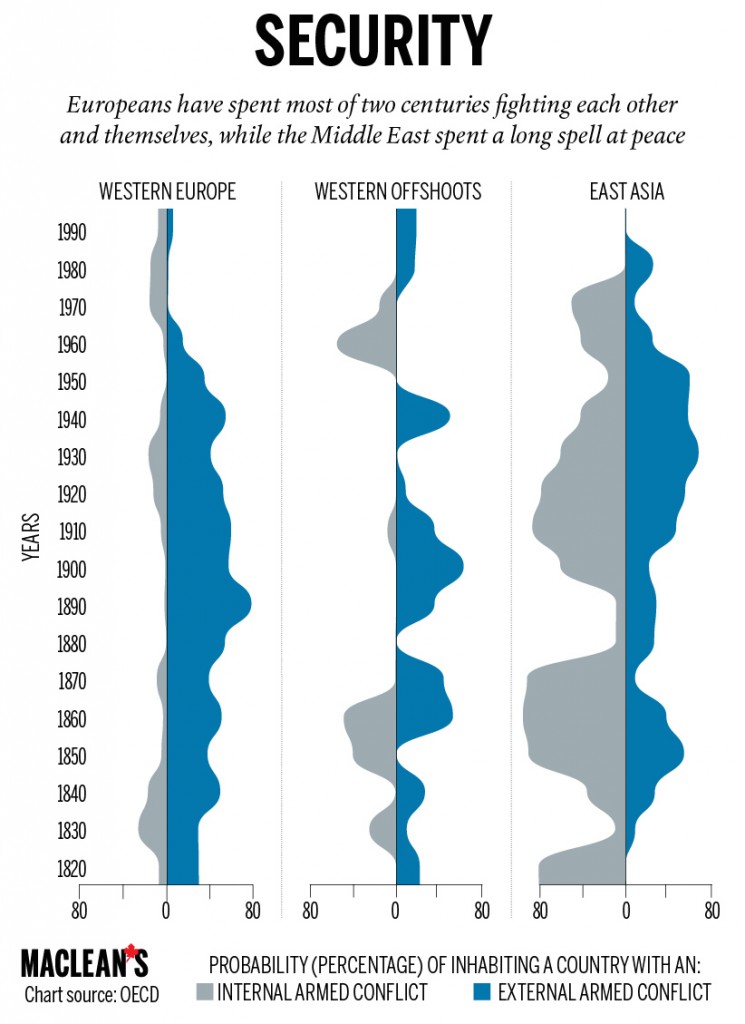
OECD-11-745x1024 - ConflictsInteresting long-term study by the OECD on the last 200 years. Not quite as captivating as the Rosling videos (200-years-that-changed-the-world-bbc), but some of the graphics are clever and well-done:

In 1820, the OECD says, Canada’s GDP per capita stood at $904—behind Western European nations, but not bad for a colonial backwater that was governed from an ocean away. That mark doubled to $1,816 by 1880, doubled again by 1920, and surpassed the colonial powers by mid-century. Meanwhile, Canadians always stood taller than even the richest nations. We averaged heights of more than 170 cm in 1820, a mark the OECD attributes to the “abundant food supply” afforded to settlers in our corner of the New World. That’s 11 cm taller than the average Mexican. The Swedes and Dutch have since surpassed Canada, but we’re still taller, on average, than Americans and every non-European country. We’ve also steadily grown older. Fifty-eight years might seem like a short life now, but in the 1920s that average Canadian life expectancy was among the world’s longest. These days, our 80-year average is only slightly behind the Japanese at 82.

It’s not all good news for Canadians. We’re among the highest per-capita emissions belchers in the world, trailing only the United States and Australia. No one else comes close. Most European countries are reducing their emissions per capita, and Russia’s world-leading numbers plummeted after the Soviet Union’s collapse.

The OECD report also tells magnificent and tragic stories about the rest of the world. It charts a massive global spike in education levels. It explains how much longer human beings live now than just a few decades ago, even if war- and disease-ravaged African nations are the glaring exception. It maps the spread of women’s suffrage, a basic political right almost unheard of in 1913 but now the global rule—except in Saudi Arabia. As the world fights for a better lot in life, the OECD makes one thing clear: the average Canadian has always had more money in their pocket, a better view in a crowd, and more schooling than most of humanity.

Richer, smarter, taller: A measure of Canada from the OECD.

Why its time for Canada to grow up – Increasing immigration

Pretty shallow argumentation, with no evidence apart from asserting it will be so.

No mention of inequality issues and that some communities are struggling more than others that the NHS and various studies make clear.

While overall Canada’s success at integration is almost unique in the world, simply assuming we could scale up immigration, integration, citizenship and multiculturalism by 50 percent a year is naive at best.

It would not be hard. Now at 34 million people, we would only need an annual growth rate of 1.3 per cent to reach that target. Assuming our fertility rates remain low, this means an additional 186,000 migrants annually, bringing our total immigration numbers to 444,000 per year. This may sound like a lot, but we could absorb them easily. By comparison to most cities around the world, Canadian urban areas are sprawling and empty. Even if we doubled our immigration numbers, the lineup at Tim Hortons would stay the same. It would only increase our workforce by one per cent per year, a number that our economy could easily engage, especially if we continue to recruit and favour skilled and educated migrants.

More immigrants mean more minds, more hands and more tax dollars. There is a misconception that new arrivals are a net drain on our economy. In fact, they are more entrepreneurial and work longer hours than average Canadians. The added muscle would make us smarter, stronger and louder.

While my bias is towards more pro-immigration rhetoric than the anti-immigration crowd, this has to be grounded in reality, and recognition that our absorptive capacity cannot be increasing by wishing it was so.

Why its time for Canada to grow up – Macleans.ca.

In New York, the Prime Minister talks about winning immigrant votes

The “fourth sister” of Canadian politics to use Tom Flanagan’s phrase.

Most of the analysis I have seen (2011 Canada Election Study and related articles) have a similar nuanced understanding of the Conservative Party’s success, but all acknowledge the “showing up” aspect of the outreach by Jason Kenney as having an impact on some communities.

Healthy for Canadian democracy that all parties actively engage new Canadians:

Harper emphasizes his ability to position his party as closer to new Canadians in terms of policy ideas on the economy and crime, and in terms of underlying social attitudes. But how to disentangle those factors from his undeniable success in the past two elections in simply presenting himself as a more resolute, confidence-inspiring leader?

And then there’s this further point the Prime Minister also made today, after he proposed the inherent attraction of Conservative thinking to immigrants: “But we began our appeal first and foremost by showing up, by making sure we’re present at their events, by making sure they have a home in our political party.”

There can be little doubt he’s right that making personal connections, on some level emotional ones, matters greatly. Again, Kenney is widely credited with getting out among various immigrant groups. But isn’t Justin Trudeau proving a huge draw among similar communities? In Trudeau’s case, though, it’s less often a matter of making sure to be present at somebody else’s event, than drawing throngs to his own.

Listening to Harper today, there could be no doubt he’s betting heavily on the immigrant vote when it comes to his re-election chances next fall. No wonder. It’s a major part of what brought him to office. The question is whether his assertion of a deep bond between Conservatives and immigrants, based on enduring ideas and attitudes, is accurate—or if, like so much of our electoral politics, it turns out that this strategic swath of votes responds more to a given leader’s persona than anything else.

In New York, the Prime Minister talks about winning immigrant votes.

Statistics Canada rewrote our story on Statistics Canada – Macleans.ca

This is quite funny, but not for the lack of judgement it showed in trying to “correct” the spin of a story. Worth reading as most points are editorial rather than substantive in nature.

A short letter to the editor focussing on substance would have been more effective:

Problems like these are pretty common in big organizations, where it’s not unheard of for IT departments to start updating computer systems without telling anyone for updates to systems to be made without a full understanding of their impact and for senior managers to have no idea how their computer systems work, causing mass panic and confusion.

Statistics Canada rewrote our story on Statistics Canada – Macleans.ca.

Editorial: Canada is leading the pack in mixed unions

Citizenship Fraud.021Further to my earlier post on the StatsCan study (Metro Vancouver has highest ratio of mixed couples in Canada), the Macleans editorial on what it may mean (I developed the chart above based on the study):

A couple of trends suggest the overall growth rate will move up in future, regardless of ethnicities involved. First, mixed unions tend to track the percentage of visible minorities in the greater Canadian populace. With visible minorities predicted to account for up to a third of the population by 2031, further growth will no doubt occur as the dating pool changes. Mixed unions are more common within younger age groups, as well, suggesting a gradual progression through society. Higher education is also correlated with mixed unions, as is urban living. Vancouver boasts the highest percentage of mixed unions, at nearly 10 per cent, followed by Toronto, Victoria, Ottawa and Calgary. As the number of mixed unions grows, so, too, will the offspring from these relationships. Whatever taboos may have existed for these children in the past, they’re being erased by sheer numbers.

Putting Canada’s record in global context is complicated by different definitions and the availability of data, but we appear to stand out for several reasons. European figures define mixed unions as between two people with different citizenship, a far lower standard of tolerance. Even so, the figures show no strong trend, with most countries no higher than Canada, despite a much broader definition of what “mixed” means. American research tends to focus solely on marriages, ignoring the prevalence of common-law relationships. When all couples are considered, Canadian figures are substantially above those in the U.S.

As for public attitudes, last year, a Gallup Poll announced that American approval of black-white marriage hit an all-time high of 87 per cent, up from four per cent in 1958. Yet Canadian sociologist Reginald Bibby points out that Canadian acceptance rates have long outstripped those in the U.S. A 2007 poll, for example, showed 92 per cent of Canadians approved of mixed marriages at a time when U.S. figures were 77 per cent. “There is probably no better index of racial and cultural integration than intermarriage,” Bibby writes. And Canada leads the pack in both performance and perspective.

Editorial: Canada is leading the pack in mixed unions.

Court loss on refugee health cuts may still be Conservative win

I am not sure that it is as much of a win as Patriquin suggests, given that most commentary on both the left and right, has been against the Government (online comments and Sun Media excepted).

It’s like anything, the bumper sticker slogan works (in either direction) until human examples come out, making the issue more complex than the slogan or stereotype, sometimes changing public opinion:

It’s a stretch to say the Conservatives built laws specifically to fail in court, but their failure doesn’t hurt the brand nearly as much as some might think. Rather, the Conservative operative would say that the party has instead garnered crucial talking points for the coming election. By thwarting Conservative laws, the various courts—whose judges are as unelected as your local senator, remember—have essentially shown themselves to be the liberal and Liberal friend to every pot-smoking, drug-injecting, prostitute-loving, refugee-coddling softie out there. Each judicial decision against the Conservatives reaffirms a collective belief, and reinforces a handy stereotype.

In the most recent Federal Court case regarding refugees, the government isn’t quite clear on what constitutes a “bogus” claim. I asked, and the ministry sent a list of rejected, abandoned and withdrawn claims so far in 2014. The inference, I guess, is that every denied or dropped claim is inherently bogus. The number of refugee claimants doesn’t suggest a surge in abuse: as this chart shows, there were roughly 34,000 accepted refugee claimants in 2011, down from 2003’s 25-year high of 42,400.

In the end, though, it doesn’t much matter, because Prime Minister Stephen Harper and the Conservatives scored a double whammy. Having spent years making the case that Canada’s refugee system is replete with “bogus” claims, they can now claim the courts are in favour of immigrant hoards leeching off the Canadian dream. Even in loss they win.

Court loss on refugee health cuts may still be Conservative win.