Inside the progressive think tank that really runs Canada [Canada2020]

Good long read by Anne Kingston:

To study Canada 2020, it’s useful to have some grid paper to better map its myriad interconnections, many which reveal the two degrees of separation that define Canadian politics. Three of its co-founders—Smith, Tim Barber and Eugene Lang, all well-connected Liberals—were also principals in the Ottawa-based Bluesky Strategy Group, a firm whose services include lobbying and media relations (Lang left Bluesky and Canada 2020 in 2013). Pitfield, the fourth named co-founder, has impeccable Liberal bona fides: the son of Senator Michael Pitfield, clerk of the Privy Council when Pierre Trudeau was PM; a lifelong friend of Justin Trudeau, helping him write the stirring 2000 eulogy to his father that paved his way to political office. Pitfield, who also worked for the Canada China Business Council founded by billionaire Paul ­Desmarais, is married to Anna Gainey, elected president of the Liberal Party of Canada in 2014; he ran digital strategy for Trudeau’s leadership bid and also for the 2015 federal Liberal campaign.

Connections between Canada 2020, the Liberal Party and Bluesky can look like a Venn diagram on steroids. Bluesky and Canada 2020 are based at 35 O’Connor St., where the party rented space for a temporary “volunteer hub” during the election. Pitfield intersects with the Liberals professionally via his company Data Sciences Inc., which has an exclusive agreement to manage the party’s digital engagement; two Data Sciences staffers sit on the Liberal Party’s board of directors.

Where there is Liberal news, there’s often a Canada 2020 connection. Take the recent controversy over Rana Sarkar, named Canada’s consul general to San Francisco at a salary twice the listed compensation. Media focused on his friendship with Gerald Butts, Trudeau’s senior adviser. But Sarkar has deep Canada 2020 links, too: he was named to its advisory board in 2015, is the author of a chapter in one of its “policy road maps,” and has participated in its speaker series. The bottom line: to understand this big-L Liberal moment in Canadian politics, you have to understand Canada 2020.

When asked about the organization’s genesis, co-founder Tim Barber points to an Oct. 2003 New York Times Magazine story, “Notion Building,” about the Center for American Progress (CAP), which had recently been founded by John Podesta. Bill Clinton’s former White House chief of staff (and later an Obama adviser) wanted to take on the right with an enterprise that could book liberal thinkers on cable TV, create an “edgy’’ website, and recruit scholars to research and promote new progressive policy ideas. CAP wasn’t an organ of the Democratic Party, Podesta insisted, though history points to it being just that.

Podesta hates the term “think tank,” Barber says. “I do too. It’s way too passive and conjures days gone by. His view was that there’s an opportunity for organizations to put as much time into marketing and communicating big ideas as coming up with those big ideas.”

Source: Inside the progressive think tank that really runs Canada – Macleans.ca
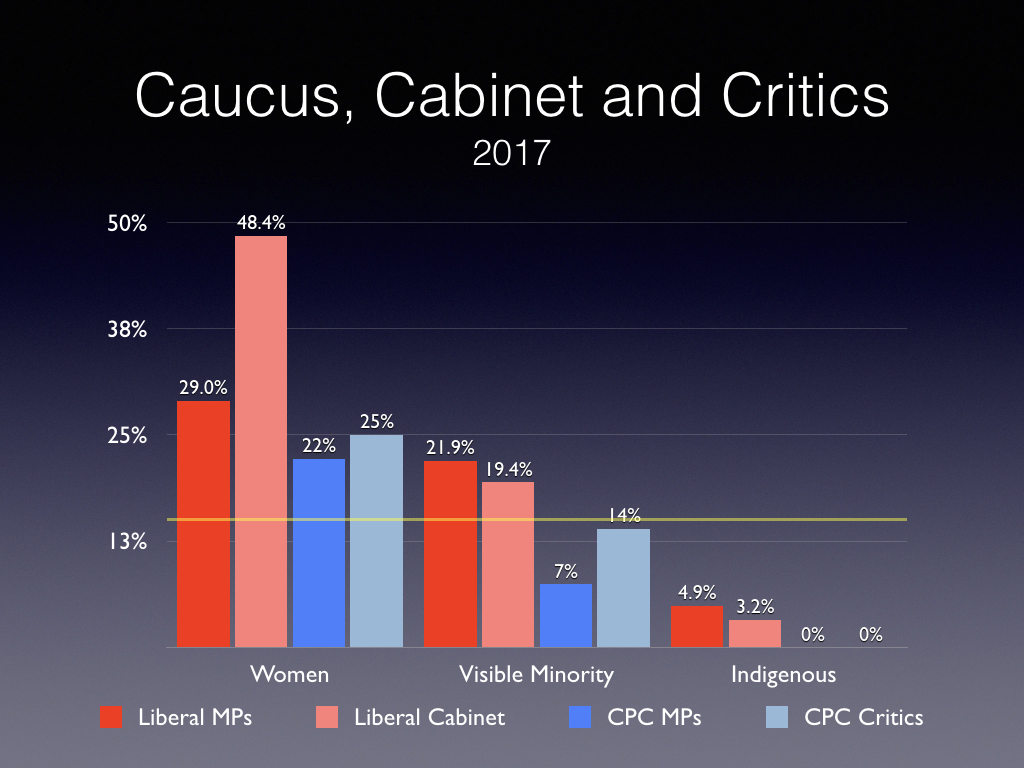
Caucus, Cabinet and Official Opposition Critic Diversity

Following the Cabinet shuffle and the appointment of the Conservative shadow cabinet, I did a quick update to my chart showing overall caucus diversity alongside Cabinet and critic diversity.

As many observers have noted in commenting on the new Conservative critics, they may have a “women problem” in terms of the number of MPs  and its translation to the more visible positions (note: the numbers are slightly better when other leadership positions are included – three of the seven are women).

Visible minority Conservative MPs are however well represented.

A response to Candice Malcolm’s Losing True North – Policy Options

For those interested, please find below the links for Candice Malcolm’s summary of her book, Losing True North: Justin Trudeau’s Assault on Canadian Citizenship, and my critique A response to Candice Malcolm’s Losing True North – Policy Options.

My conclusion:

As other reviewers have noted, there is a need for a strong conservative perspective in citizenship, immigration and multiculturalism policies to inform debates, discussion and policy choices. Otherwise, governments risk not considering the impact of their preferred approach. But this conservative perspective should be rigorous and evidence-based, enriched by anecdotes, and not merely a polemic. The same of course applies to liberals.

While it may be cathartic for her and other Conservative party members and supporters to criticize the Liberal government’s changes in this manner, it does not help the Conservative Party in its reflections on the lessons of the 2015 election. Even though Jason Kenny spent most of his weekends in ridings with large populations of new Canadians, the Liberals were victorious in 30 of the 33 ridings where visible minorities are the majority. Furthermore, her book does little to advance our understanding and knowledge of the challenges in ensuring the ongoing success of the Canadian model of the immigrant-to-citizen process.

Michael Den Tandt on the Brexit and Canada: Two crucial lessons for Liberals

Good commentary by Den Tandt on some of the lessons for the Liberal government, not to mention the Conservative opposition and the observations regarding Jason Kenney and Tony Clement’s support for Brexit:

Dear Prime Minister David Cameron, Jeremy Corbyn, Boris Johnson, Nigel Farage and the rest: Thank you, so very much. You’ve done the twin causes of stability and unity in your former Dominion of Canada ever so much good.

For what Canadian provincial or federal leader now, witnessing the catastrophic cock-up of your Brexit referendum, will do other than duck for cover next time there’s talk of a plebiscite here to dramatically restructure anything more important than a yard sale?

It was curious, bizarre even, to see senior federal Conservatives emerge on social media early Friday, as the “victory” for the Leave side in the Brexit vote became clear, to beat the drum for St. George. “Congratulations to the British people for choosing hope over fear,” enthused former minister-of-everything Jason Kenney, “by embracing a confident, sovereign future, open to the world!” Tony Clement, erstwhile Treasury Board president, called it a “magnificent exercise in democracy,” before slipping in a renewed call for a referendum on Canadian electoral reform.

Or, here’s another thought: The Liberals could shelve electoral reform and focus on more important stuff, this term, such as jobs.

Democracy is, indeed, magnificent. That’s why the Scots are now ramping up at breakneck speed for a do-over of their own 2014 referendum on independence from Britain, which post-Brexit surveys suggest will now swing in favour, because the Scots wish overwhelmingly to remain European.

Ireland, only recently at peace, now faces renewed turmoil at the prospect of a hard border separating Northern Ireland, still part of the United Kingdom, from the Republic of Ireland, soon to be Europe’s Westernmost outpost. Irish union, as the United Kingdom comes apart at the seams, is not out of the question. Hope over fear, indeed.

This is assuming, of course, that the UK leaves the European Union at all. Though it seems wildly improbable to imagine the referendum, 51.9 per cent for Leave, 48.1 per cent for Remain, being set aside, it is in theory possible, as long as Article 50 of the Lisbon Treaty, which governs an EU member state’s withdrawal, is not invoked.

…All of which brings us back to Canada. Brexit is xenophobic; Brexit is anti-immigrant; Brexit is nostalgic, insular, anti-international and anti-globalization; Brexit is, most of all, an expression of English ethnic nationalism.The federal Conservatives under Stephen Harper, with Kenney himself in the lead, founded their 2011 majority on openness to ethnic pluralism. They undid much of that good work in 2015 with their niqab debate and “barbaric cultural practices” tip line. That any Conservative, Kenney most of all, should have failed to connect these dots is astonishing. Perhaps that’s why Canadian Conservative Brexit cheerleaders have also gone eerily quiet since those initial outpourings of joy.

But it’s not just the Tories who can watch and learn. There are now two threads connecting populist, anti-internationalist, xenophobic movements worldwide. The first is income inequality and poverty among the rural working class, which in England voted as a block for Brexit. The second is the fear of Islamism, manifested in suspicion of immigrants and refugees, which fueled the Leave campaign.

Fixing inequality, Prime Minister Justin Trudeau’s Liberals say, is their job one. But they face a looming economic catastrophe in the resource sector, which can only be addressed through pipeline development and freer trade. Working people need decent-paying jobs. From where will these come in Canada, if ideological and mostly urban anti-pipeline advocates, together with anti-globalization tub thumpers, are left to own the debate, as they do now? The Liberals need to build the case for pipelines and for liberalized trade, while they still have an audience for such.

As for Islamism, the Syrian civil war and ISIL continue to threaten Southern Europe and by extension the West. Until ISIL is destroyed and its territory taken away, there will be no end to the northward flow of refugees, and no political stability in Europe. Canada can do more and should do more to help Europe in this fight — while there remains a Europe to help.

Source: Michael Den Tandt on the Brexit and Canada: Two crucial lessons for Liberals | National Post

Liberals to repeal citizenship law Bill C-24: immigration minister – “coming days”

Whether in the form of “tweaks”, “significant” or “radical” changes (the Minister has used all three terms), likely that the changes will be more substantive than mere tweaks.

But overall, messaging is a reversal of the previous government’s approach of making citizenship “harder to get and easier to lose.”

The extent to which this undermines some of the needed integrity measures introduced by the Conservatives – more rigorous knowledge and language testing, physical residency requirements etc – remains to be seen, although the Minister in Committee did state the importance of language knowledge to integration.

These changes happen in the context of a significant decline in the number of persons applying for citizenship: from an average of around 200,000 in past years, to about 130,000 in the last three years.

Will be hosting a citizenship workshop at Metropolis next week in Toronto and should the Minister literally announce this within days, we will have a good discussion regarding the changes (I will post my deck next week, essentially an updated version of Citizenship – Canadian Ethnic Studies 24 Oct 2015 with more recent data:

Immigration Minister John McCallum says the government will announce significant changes to the Citizenship Act in the coming days.

Mr. McCallum said Tuesday that the Liberals will soon follow through on their election pledge to repeal the Conservatives’ controversial Bill C-24, which gave the government the power to revoke Canadian citizenship from dual citizens convicted of terrorism, treason or espionage.

Asked when the changes will be unveiled, Mr. McCallum told The Globe and Mail to expect an announcement “in coming days, but not very many days.”

During last year’s election campaign, the Liberal platform committed to “repeal the unfair elements of Bill C-24 that create second-class citizens and the elements that make it more difficult for hard-working immigrants to become Canadian citizens.”

Mr. McCallum said the government’s announcement will make it impossible to revoke citizenship.

“A Canadian is a Canadian is a Canadian,” Mr. McCallum said, repeating a line used by Prime Minister Justin Trudeau during a heated election debate last September. “We would not revoke people’s citizenship. … That will certainly be a part of it [the announcement],” the Immigration Minister added.

Mr. McCallum said the government will also remove barriers to citizenship posed by Bill C-24.

“We believe that it’s better to make it easier rather than harder for people to become citizens.”

However, he did not say which specific barriers would be addressed.

Source: Liberals to repeal citizenship law Bill C-24: immigration minister – The Globe and Mail

Meet Sir Michael Barber, the political delivery man: Wells

Good profile of the delivery guru, advising the Government.

Given the ambitious nature of the Government’s platform, and the likely need to make some difficult choices given fiscal and other realities, will be interesting four years hence to see what worked and what did not:

Since he left the Blair government, Barber has honed these ideas into what he calls “deliverology,” the art of ensuring governments meet their goals. He’s become a global consultant spreading the gospel of deliverology to governments as far-flung as Australia, the Punjab, the U.S. state of Maryland, and to Ontario under the province’s former Liberal premier Dalton McGuinty. When a large number of McGuinty-era Ontario staffers moved to Ottawa to work for the Trudeau Liberals, Michael Barber could not be far behind.

And so it came to pass that, during a three-day retreat for Trudeau’s cabinet in St. Andrews, N.B., in late January, Barber was in the room with the ministers for almost the entire time. Trudeau has appointed Matthew Mendelsohn, the former director of an Ontario think tank, as a senior public servant responsible for “results and delivery.” Mendelsohn’s job is modelled on the position Barber held with Blair.

Perhaps it is no surprise that Barber, the object of such ardent affection and attention from the new Trudeau crew, is equally impressed with this young Canadian government. “What they were saying was, ‘We know that often, including in the Blair case, it took a whole term for a new government to learn the disciplines of delivery and then get it right in the second term,’ ” Barber told Maclean’s. “ ‘But we want to get it right the first time.’ ”

The obstacles facing any new government are well-known. First, the usual constant barrage of unforeseen events. Second, the pressure to come up with new ideas rather than checking to see how the old plans are working out. Tony Blair was a sucker for a new idea. In his new book How to Run a Government, Barber calls Blair’s first-term administrative style “government by spasm.”

The alternative to spasm is an attempt to install a routine. A new government asks itself a series of basic questions. “One is: What are the priorities?” Barber asks. “The second is: If you succeeded in delivering a given priority, how would you know? What would success look like in 2019, at the end of this mandate?” The third question is, “How would you know at any given moment you’re making progress toward your goals?” This leads a delivery-oriented government to develop a set of indicators—usually publicly available and thus, if they’re heading in the wrong direction, acutely uncomfortable for the government. How many kilometres of roads have been paved to date, how many megatonnes of carbon went into the atmosphere, that sort of thing.

“It’s not tremendously exciting, but it’s really important, getting the priorities, the definitions of success, the trajectories, the data, the routines to monitor progress, and then the ability to solve problems as they arise,” Barber said. “Because however good you are at planning, you’re not going to get it right. The real world never works out exactly as you anticipate. So having routines to correct and adjust the plan all the time is important.”

One element that helped bring Barber and Trudeau together is a common sense that ambition should not be a bad word in government. “There are times when doing little seems to work, and underpromising and overdelivering seems a good option,” Barber said. “But that’s certainly not the analysis of the Trudeau government, and certainly not the prospectus that they put to the Canadian people during the election. They said, ‘Actually, Canada needs big change, we want to build an inclusive, diverse Canada, we want some renewal of faith in democratic institutions, we want to reduce climate change, we need a big infrastructure upgrade.’ These are big challenges.”

Source: Meet Sir Michael Barber, the political delivery man

MPs lobby to ease language rules for immigrants [citizenship]

More coverage on the issue of language assessment for citizenship applicants. Will see if this gets attention when Parliament resumes next week:

One critic said if McCallum agrees with the MPs to make the changes it’s a “retrograde” step.

Martin Collacott said the real goal is likely to boost the pool of Liberal voters, since the only key rights citizens have that permanent residents lack is the right to vote, obtain a passport, and obtain jobs that require a high-level security clearance.

“They’re more concerned with getting votes and not so concerned that they (new Canadians) will integrate socially and economically,” said Collacott, a former senior Canadian diplomat who writes on immigration and refugee issues for the Fraser Institute.

Griffith said says the MPs are sincerely reflecting the views of some constituents.

“Of course there is probably a political element there, of making sure they retain the ethnic vote they gained during the election, but I think they’re probably hearing those comments,” said Griffith, author of the 2015 book called Multiculturalism in Canada: Evidence and Anecdote.

Griffith said he hopes McCallum doesn’t give in to the pressure and go back to the old system, which fell short of requiring citizens to speak basic English or French.

“If you really want to help people succeed, and if you really want an inclusive society, it means they have to participate in one of the official languages,” he said.

An alternative view was expressed in 2014 by the Canadian Bar Association, which opposed the tougher requirements.

“Many immigrants over the last century came to Canada and worked in areas that did not require them to read or write in English or French but have paid taxes, attended religious institutions, volunteered in their communities, raised children and have little or no ties to their country of birth,” the statement said. “They may lack the ability to complete a knowledge test in English or French, but still possess the language skills needed to be a long-term, contributing member of Canadian society.”

Successful citizenship applicants now have to prove they have an “adequate knowledge” of one of the languages, which is defined as someone “can understand someone speaking English or French and they can understand you,” according to the Citizenship and Immigration website. It lists several tests that it accepts as proof.

The government spells out four criteria applicants must provide evidence that they’ve reached level 4 of the “Canadian Language Benchmarks” system, which has 12 levels of proficiency, with one being the least fluent and 12 being an “advanced level of proficiency.”

To reach level four they must, according to the department, be able to:

• take part in short, everyday conversations about common topics.

• understand simple instructions, questions and directions.

• use basic grammar, including simple structures and tenses.

• show that you know enough common words and phrases to answer questions and express yourself.”

Canada has had a legislated requirement since 1947 that new citizens have an “adequate knowledge” of English or French, and until the mid-1990s that ability was assessed in oral citizenship tests done by citizenship judges.

Then the Liberal government, which at the time was engaged in an austerity program to slash the deficit, came up with a standardized, and much cheaper to administer, citizenship test.

The test involved 20 multiple choice questions testing knowledge in areas such as citizens’ rights and duties, and Canadian history, geography and the economy. It was assumed that passing the test would mean the applicant also had a reasonable grasp of the language.

But a successful applicant required only a 60-per-cent score to pass, resulting in 95 per cent of participants making the grade, according to a 2012 analysis by Montreal academic Mireille Paquet.

One of the problems with the tests, according to Griffith, is that they were uniform. That meant consultants could provide “cheat sheets” to help people who couldn’t function in English or French memorize the questions and visually recognize the correct answers.

The Conservatives made their first move in 2010 to make the test more challenging, bumping the passing grade to 75 per cent and offering different versions of the test in order to discourage cheating.

Then, in 2014, the new legislation came in requiring that applicants get third-party certification that they reached the level 4 proficiency.

Source: MPs lobby to ease language rules for immigrants

ICYMI: So how are those ‘sunny ways’ working out so far? Flumian

Maryantonett Flumian, president of the Institute on Governance and one of my former deputies, on the new government’s steps to dates and some of the deeper challenges.

Hard to argue with her formulation of one of her broader questions:

As it contemplates new engagement strategies, the government confronts a broader question — how governance needs to evolve in the digital age, when ubiquitous information and the instantaneous ability to collect it have challenged the position of many traditional intermediaries, governments included. Governments have already ventured into the twitterverse, with mixed results.

But for the most part it has yet to confront a host of issues. For example, what are the benefits and risks of massive “virtual” engagement in policy making? What are the best techniques? What happens to so-called ‘message control’? What frameworks might guide interaction between the public service, citizens and the media?

The governance challenges of the digital age don’t stop there. In an age of near-frictionless connectivity, why do citizens have to deal with multiple government silos to address various aspects of the same issue — whether it’s a disability, a business start-up, or becoming a senior? And given the ever-expanding applications for data, why do governments continue to sit on vast stores of information they can’t begin to fully use in the name of “confidentiality”?

Here again, the government is off to an encouraging start. In his (no longer secret!) mandate letters to ministers, the prime minister charged several of his colleagues with working toward single-window service. The government also has committed to a policy of open data by default. Some traditionalists have cautioned that it may come to regret such a commitment, but among other considerations, it’s far from clear that a generation accustomed to the digital sharing of information is invested in the information-hoarding ethic of an earlier age.

So how are those ‘sunny ways’ working out so far?

Open government push requires ‘cultural shift’ in public service, federal documents warn

Sound analysis of the challenge:

The Liberals’ promise to pry open government requires nothing less than “cultural change” within the public service, warn documents obtained by the Star.

Treasury Board President Scott Brison was told in November that there are significant hurdles to the Liberals’ campaign pledge to reform access to information laws, make government information open by default, and more effectively communicate with the public.

Documents prepared for Brison describe a federal culture of “limited disclosure, insular policy making,” which takes into account the “federal view only.”

To implement the Liberals’ ambitious democratic reform agenda, that culture will need to shift to one of “proactive release, engagement and connectivity, (and) broad leadership on open government.”

It’s not clear exactly how the government intends to change the culture of some 257,000 employees in the core public service. But Prime Minister Justin Trudeau has already made clear he wants to end the era of the federal government deciding and acting on issues unilaterally, putting an emphasis on meeting with provincial premiers and, on Friday, the mayors of Canada’s largest cities.

“The government holds a largely untapped wealth of mostly unclassified information of interest to Canadians,” read the documents, obtained under access to information laws. “This information is not sufficiently leveraged to fuel the digital economy, spur innovation, and give Canadian business a competitive edge.”

Trudeau made openness and accountability a key plank in his party’s election platform. The idea is to make government information “open by default,” unlike the current system where citizens need to resort to access to information requests that can take months or even years to process.

But releasing more information about government operations, the documents warn, carries with it the risk of public relations headaches for the new government.

In an interview Tuesday, Brison acknowledged that risk.

“(But) you can’t expect Canadians to trust us if we can’t trust them,” Brison said.

“The other thing to keep in mind is we will make better decisions when we engage Canadians in the decision-making process. The old days where governments would be covetous and secretive (with) information to try and make a decision because government thought they were smarter than citizens, are over.”

When it comes to changing the public services culture, Brison suggested the Liberals need to lead by example – and the leadership starts with the prime minister.

“(Trudeau) is absolutely committed to this throughout government,” Brison said.

“For most Canadians, the transparency bus has left the station. You try to explain to a millennial why a lot of this information isn’t rendered public, and you lose them.”

But it’s not just the culture of secrecy and risk aversion preventing information from getting to Canadians. The documents note Canada’s dated privacy and access to information acts are falling out of sync with technological development.

The Access to Information Act, for instance, has not been substantially changed since the early 1980s when most government business was conducted on paper.

Source: Open government push requires ‘cultural shift’ in public service, federal documents warn | Toronto Star

Trudeau plans repeal of Tory union, citizenship laws as Parliament returns

These sources suggest a simple full repeal of C-24 rather than a more surgical approach on C-24. Broader than platform and mandate letter commitments:

So the economy will be the priority. But government sources suggest it won’t be the sole preoccupation in the first two weeks as the new government looks to put a positive stamp on these early days in power.

Among the measures expected to be dealt with through new legislation:

  • Repealing the Conservative’s Bill C-24, which allows the government to strip Canadian citizenship from dual citizens who are convicted of terrorism-related offences.

  • Repealing two other Conservative laws that the Liberals argue weaken the rights of trade unions. They are Bill C-377, which requires unions to disclose how they spend members’ dues, as well as Bill C-525, which makes it harder for unions to organize in federally-regulated workplaces.

  • Introducing parliamentary oversight for Canada’s national security agencies, though the commitment to repeal parts of the previous government’s anti-terrorism law, Bill C-51, is expected to come later.

Source: Trudeau plans repeal of Tory union, citizenship laws as Parliament returns – Politics – CBC News