ICYMI – New immigration quotas: Too low and no long-range plan: Saunders

Saunders critiques the modest increase in levels against the perspective of his Maximum Canada:

Two shocking facts about the Liberals’ new immigration targets: First, they’re not high. Not by any measure. And second, they’re not well-planned.

Immigration Minister Ahmed Hussen’s announcement of a gradual increase in immigration numbers drew the usual mix of alarmist and exultant headlines: More than a million newcomers by 2020! Saved from the devastation of an aging population! But Mr. Hussen was proceeding with the sort of tiptoe-step caution that has come to characterize his government. His plan is to raise skilled and family immigration by far less than 1950s, 1980s or 2000s increases, while letting refugee numbers fall back to their usual tiny slice of the immigration pie (after a 2016 peak caused by the Syrian emergency). It’s not out of line with the immigration and population-growth thinking of every Tory and Liberal government of the past half century.

Indeed, the initial response from the Conservatives, via immigration critic Michelle Rempel, was not to criticize the numbers as too high but to predict that the Liberals will be incapable of meeting their economic-immigrant targets and filling the labour shortages that both parties complain about. The NDP response, also reasonable, was that more of those immigrants need to be less-skilled, because that’s also where our economy needs people.

Both Mr. Hussen’s proposal and the opposition responses are based on the most short-term vision of immigration: filling jobs now and meeting demographic challenges a decade from now. What is missing is the longer view of a larger, more sustainably populated Canada – one that concentrates rather than sprawls, one that uses population growth for ecological efficiency rather than waste. (This also happens to be the subject of my new book, Maximum Canada). We can hope that some such plan is in the works.

In the meantime, it’s best to think of Mr. Hussen’s targets as a temporary holding pattern. Since the late 1980s, Canadian immigration rates have remained fairly consistent, hovering around 0.8 per cent of the population each year (that is, around eight immigrants per 1,000 people). Rates declined somewhat in the 1990s – not out of policy desire (Prime Minister Jean Chrétien wanted that rate to increase to 1 per cent annually), but because the economy was poor, and when that happens, immigrants don’t come. Then they rose again at the turn of the century, and have held at around 0.8.

Canada’s new level of 300,000 makes for an immigration rate of 8.3 per thousand. Mr. Hussen’s gradual increase, to 340,000 per year by 2020, would be a far smaller increase than we saw in one year alone under Brian Mulroney (who raised it by 50,000 in 1986-7) and identical to the one-year rise we experienced in 2000. It would give Canada a rate of 9 immigrants per 1,000 citizens.

That’s not high by Canadian standards, and it sure isn’t by world standards: It’s less than the 2015 immigration rates in Britain (9.7), the Netherlands (9.9), Sweden (13.7) or Switzerland (18.5). This is not mass immigration by any stretch. We tried that a century ago: If we were to have the immigration rate of 1913, we’d have to take in 1.75 million immigrants a year. Nobody is returning to those times.

But we’re stuck with a way of thinking about immigrants that’s often rooted in the previous century.

Canadians, and often their government, still think of immigrants as units of labour to be plugged into factories and labs. But the typical immigrant to Canada today is not an employee; she’s someone setting out to employ people, or at least manage them.

Six out of 10 male immigrants and five out of 10 female immigrants today arrive with university degrees – twice the rate of Canadian-born people. More than half of them own a house within four years of arriving – despite the very high costs of housing in the big cities and their suburbs where immigrants settle.

In other words, we should no longer think of immigrants as sources of (or competition for) jobs, but as primary sources of new economic activity.

On the other hand, we remain mired in another legacy of 20th-century thought: that immigrants will find their way into the middle class on their own.

Children of immigrants do succeed, to an enormous degree. But the first generation tends to get lost, its members often unable to realize their potential as creators of employment. A generation ago, immigrants saw their incomes converge with Canadian averages within 15 years. Today, immigrants are 1.5 times more likely than average Canadians to live in poverty, and twice as likely to earn less than $30,000 a year, after 15 years. Only 24 per cent of immigrants with professional degrees ever get work in that field. We waste talented people.

We need to invest ahead of population growth, so it delivers benefits rather than trapping people in isolation and low incomes. We should not talk about population growth without a significant new cross-government, cross-jurisdiction program to plan and invest for it.

via New immigration quotas: Too low and no long-range plan – The Globe and Mail
2018 Immigration Plan: Higher Levels and a Multi-Year Plan Will Benefit Canada’s Economy

Conference Board reaction to the Government announcement with a good summary. :

On the heels of the Government of Canada’s announcement that it will welcome some 310,000 immigrants in 2018 and is introducing a multi-year levels plan for just the second time in history, the Conference Board’s Craig Alexander offers the following insights:

“Canada’s decision to increase immigration will help sustain long-term economic growth in light of its rapidly aging population and low birth rate. Introducing a multi-year levels plan will improve the ability of governments, employers, immigrant-serving organizations, and other important stakeholders to successfully integrate newcomers into Canada’s economy and society.”
—Craig Alexander, Senior Vice-President and Chief Economist, The Conference Board of Canada.

Insights

  • Canada’s 2018 immigration target of 310,000 represents a 19 per cent increase compared with its newcomer intake between 2006-2015.
  • The immigration target will be 330,000 in 2019, and 340,000 in 2020.
  • Canada’s intake is the highest since 1913 and will represent about 0.90 per cent of the population by 2020 which is also high by historical standards. Unlike the past, however, Canada can no longer count on natural increase (births minus deaths) to grow its labour force.
  • Population aging is one of the biggest economic and fiscal challenges facing Canada.
  • An October 2017 report by the Conference Board shows that immigration is a strong driver of Canada’s economy. Today, 75 per cent of population growth is due to immigration. Canada’s population growth will come entirely from immigration as the number of deaths is forecast to outpace births by the early 2030s.
  • In the absence of immigration, economic growth and government revenues would slow, and Canada would struggle to fund vital social programs. Health care, for example, will only become more expensive to deliver as an older population requires more services.
  • Canada is introducing a multi-year levels plan for just the second time in its history. The plan will allow stakeholders to make informed decisions as they seek to integrate newcomers into the economy and society. For instance, city planners can more accurately project how many newcomers will be arriving over multiple years and what sorts of infrastructure investments are required to successfully absorb a larger population.
  • Canada first introduced a multi-year levels plan for the period between 1982-1984 but the onset of a recession effected the federal government’s ability to continue with the plan.
  • Opinion polls show that public support for immigration remains high. To maintain this support, it is essential that newcomers are equipped with the tools that they need to benefit the Canadian economy and complement domestic workers.

Source: 2018 Immigration Plan: Higher Levels and a Multi-Year Plan Will Benefit Canada’s Economy

Canada to admit nearly 1 million immigrants over next 3 years

Good overview with some of the preliminary political reaction. Will be interesting to see how this plays out, but the Conservative focus on integration issues and border controls suggests that the increase itself is not a concern:

Canada will welcome nearly one million immigrants over the next three years, according to the multi-year strategy tabled by the Liberal government today in what it calls “the most ambitious immigration levels in recent history.”

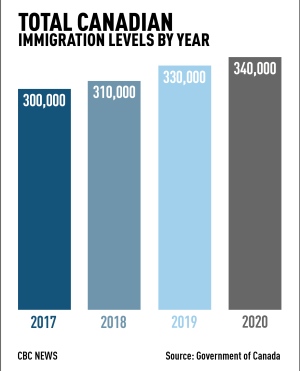
Canadian immigration levels by year

The number of economic migrants, family reunifications and refugees will climb to 310,000 in 2018, up from 300,000 this year. That number will rise to 330,000 in 2019 then 340,000 in 2020.

The targets for economic migrants, refugees and family members was tabled in the House of Commons Wednesday afternoon.

Hussen said the new targets will bring Canada’s immigration to nearly one per cent of the population by 2020, which will help offset an aging demographic. He called it a historic and responsible plan and “the most ambitious” in recent history.

“Our government believes that newcomers play a vital role in our society,” Hussen said. “Five million Canadians are set to retire by 2035 and we have fewer people working to support seniors and retirees.”

In 1971 there were 6.6 people of working age for each senior, Hussen said, but by 2012 that ratio had gone to 4.2 to 1 and projections show it will be at 2 to 1 by 2036, when almost 100 per cent of population growth will be a result of immigration; it stands at about 75 per cent today.

Hussen said immigration drives innovation and strengthens the economy, rejecting some claims that newcomers drain Canada’s resources and become a burden on society.

He said the government is also working to reduce backlogs and speed up the processing of applications in order to reunite families and speed up citizenship applications.

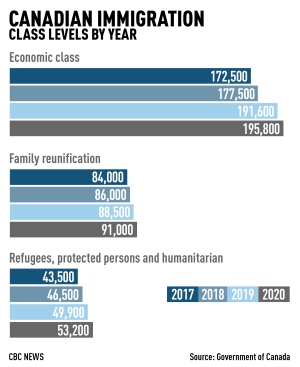
Canadian immigration class levels by year

The federal government’s own Advisory Council on Economic Growth had recommended upping levels to reach 450,000 newcomers annually by 2021. Hussen said the government is taking a more gradual approach to ensure successful integration.

“At arriving at these numbers we listened very carefully to all stakeholders who told us they want to see an increase but they also want to make sure that each and every newcomer that we bring to Canada — bringing a newcomer to Canada is half of the job. We have to make sure that people are able to be given the tools that they need to succeed once they get here,” he said.

Focus on integration: Rempel

Conservative immigration critic Michelle Rempel was critical of the plan, suggesting the government needs to do a better job of integrating newcomers.

“It is not enough for this government to table the number of people that they are bringing to this country. Frankly the Liberals need to stop using numbers of refugees, amount of money spent, feel-good tweets and photo ops for metrics of success in Canada’s immigration system.”

She said the Liberals need to bring Canada’s immigration system “back to order” by closing the loophole in the Safe Third Country Agreement that has seen migrants cross into Canada at unofficial border crossings only to claim refugee status.

She also said the immigration system should focus on helping immigrants integrate through language efficiency and through mental health support plans for people who are victims of trauma.

Dory Jade, the CEO of the Canadian Association of Professional Immigration Consultants, welcomed the news although he suggested the numbers should be higher.

“Canada will greatly prosper and grow once the 350,000 threshold has been crossed,” he said. “Nevertheless, we are witnessing a very positive trend.”

The Canadian Council of Refugees also welcomed the news, but wanted more, saying the share for refugees was only increased slightly from 13 per cent this year to 14 per cent in each of the next three years.

Calls for longer-range forecast

In past, there has been a one-year figure for how many immigrants will be permitted into the country, but provinces and stakeholders have called for longer-range forecasts.

A statement from Ontario’s Immigration Minister Laura Albanese, before the announcement, said the province supports the introduction of multi-year levels plans “to provide more predictability to the immigration system and inform program planning.”

“Significant variation in year-to-year immigration levels can dramatically impact the requirement for provincial year-to-year resources. A longer term outlook would help in planning for appropriate service levels and use of resources.”

The statement said Ontario supports growth in immigration levels, particularly in economic immigration categories to support the growing economy.

Diversity drives innovation

During the government’s consultation period, the Canadian Immigrant Settlement Sector Alliance presented “Vision 2020,” what it called a “bold” three-year plan to address growing demographic shifts underway in the country, calling for increased numbers in the economic, family and refugee categories.

It recommended a target of 350,000 people in 2018, which climbs to 400,000 in 2019 and 450,000 by 2020.

Chris Friesen, the organization’s director of settlement services, said it’s time for a white paper or royal commission on immigration to develop a comprehensive approach to future immigration.

“Nothing is going to impact this country [more] besides increased automation and technology than immigration will and this impact will grow in response to [the] declining birth rate, aging population and accelerated retirements,” he told CBC News.

Source: Canada to admit nearly 1 million immigrants over next 3 years – Politics – CBC News

Justin Trudeau rolls the dice on immigration

Cam Clark’s take on the multiculturalism-year immigration levels planned increases:

Justin Trudeau’s Liberal government is doing something no Canadian government has done for decades: It is gambling on a lot more immigration.

There should be no doubt that it is a gamble. On the day that U.S. President Donald Trump was responding to a terrorist attack in New York by blaming the immigration system, exploiting resentment there, the Liberals were saying Canada needs more immigrants. And don’t think that’s because it’s a slam-dunk political winner with new Canadians: Polls show first-generation immigrants are not much keener on expanded immigration than those born here.

Mr. Trudeau’s government is making a statement that it is going in a different direction. In fact, that’s the statement that Immigration Minister Ahmed Hussen made. “We are emphatically and unapologetically taking the opposite approach,” he said at a press conference in Toronto.

The numbers that the Liberals are shooting for are nowhere near the massive, 450,000-a-year level proposed by the Liberal-appointed Advisory Council on Economic Growth headed by McKinsey and Co. guru Dominic Barton and backed by some big-business voices and the Conference Board of Canada. Mr. Barton had suggested more newcomers could foster economic growth and mitigate the aging of Canadian society. But that would be a huge expansion, and for politicians, that’s not just a gamble but going all in.

Yet Mr. Hussen’s numbers are still large increases. Under Stephen Harper’s Conservatives, there were typically about 260,000 immigrants each year. The Liberals have increased the target to 300,000 this year, and will keep increasing to 340,000 by 2020 – that’s a 30-per-cent increase over a typical Conservative year, and a 21-per-cent increase over the Conservative 2010 high mark. When compared with the size of the population, the Liberals are planning a rate of immigration not seen since Brian Mulroney was in power.

Immigration levels dropped substantially for two years under Jean Chrétien, and levels have fluctuated from year to year, but no government since Mr. Mulroney’s has made any sustained, substantive change to immigration rates – the number of immigrants as a percentage of the population. The Liberals plan to move the rate upward significantly.

It’s a plan to keep increasing immigration steadily. Mr. Hussen even revived the Liberal target of increasing immigration to 1 per cent of the Canadian population – a promise made by Mr. Chrétien in 1993 but ignored once he was in power.

Politically, it’s not the specific number that matters. The government has done polls that show that most Canadians don’t have the foggiest notion how many immigrants come to Canada. But Canadians still have opinions on whether there are too many immigrants, or too few.

A survey commissioned in March by the Association for Canadian Studies found that 38.4 per cent of Canadians think there are too many immigrants, while just 10.4 per cent said there are too few. But a lot, 41.1 per cent, said that the number’s about right. Perhaps that’s one reason recent governments haven’t risked changing things much.

Jack Jedwab, the association’s president, said the number of people who think there are too many immigrants is generally pretty stable, between 30 per cent and 40 per cent; it’s near the high end of the range now. (The March survey was conducted by web panel that used a sample of 2,559 people.)

People born outside of Canada are a little less likely to think there’s too much immigration, but not much. There is a substantial political divide: People who consider themselves on the right are far more likely to think there are too many immigrants than people on the left.

That may be one reason Mr. Trudeau’s Liberals are willing to take a political gamble on immigration. It emphasizes a difference that plays better with left-leaning voters. And it represents a contrast with Mr. Trump. But it’s still a gamble.

Even Mr. Trump is calling for a “merit-based” immigration system, which sounds similar to Canada’s “high-skilled” class, rather than the United States’s current visa lotteries. He won’t end immigration; the Trump culture war is mostly about Mexicans and Muslims, and he has portrayed both as dangerous.

In Canada, Mr. Jedwab said, the resentment of immigration was once driven by economics – the sentiment that immigrants take Canadian jobs or cost the treasury – but now, it is clearly driven by perceived security concerns and fears immigrants are changing Canadian culture and values.

No wonder then, that Mr. Hussen emphasized the economic reasons for expanding immigration, noting, for example, that there will be fewer workers to support retirees in coming years. His plan also includes more family reunification, asylum-seekers and resettled refugees. People like the notion of hard-working economic immigrants, but not everyone is as positive about the rest. That’s probably a very big reason why governments have not signalled a sustained change in immigration levels for a quarter century. Until now, they didn’t want to take a risk.

Source: Justin Trudeau rolls the dice on immigration – The Globe and Mail

Link to government background info: Backgrounder2018-2020 Immigration Levels Plan

Minister says 300,000 new immigrants a year is Canada’s ‘new normal’ – Home | The House | CBC Radio

Setting the stage for the 2018 levels announcement. Not much suspense in that the number will be higher; some suspense as to whether the government will announce a multi-year plan as long talked about. Some political risks in doing so as steady increase may provoke some reaction, and possible political benefits to the government’s brand.:

Canada’s immigration minister says Canada will welcome at least as many immigrants next year as it is in 2017.

The government’s plan for annual immigration levels, which was set at 300,000 for this year, is expected to be tabled in the House of Commons next week.

Immigration minister Ahmed Hussen told The House that the government will not go below that level next year.

“Three hundred thousand is now our new normal,” he said, while not closing the door to a higher number for 2018.

“As a government we went from 260,000 to 300,000 because of the need to meet the demands of Canadian families who wanted to reunite with their loved ones,” Hussen continued. “But also employers who are asking us to allow them to continue to use immigration more and more as a way to meet their growth needs.”

Hussen added that he’s been in the process of consultations since April to put together the immigration outlook that’s coming soon, and that those consultations focused on the numbers Canada should bring in and what the right mix immigration, in terms of the different classes, should be.

He said the “vast majority” of immigrants coming in will be from the economic class because that’s where the greatest need is.

This will be followed closely by family class immigrants and then refugees, Hussen said.

Statistics Canada census numbers released Wednesday revealed the number of immigrants in Canada has reached its highest rate in a century.

Source: Minister says 300,000 new immigrants a year is Canada’s ‘new normal’ – Home | The House | CBC Radio

Grubel: Curb immigration to let housing catch up to demand

Herbert Grubel takes the contrarian view regarding immigration levels, proposing an over 80 percent cut to some 50,000 annually. His characterization that Parliament could “easily” do this for a five-year period, as well as the political dynamics at play (no political party support for such a dramatic reduction), is naive at best.

As there is ongoing need to discuss what levels of immigration are  appropriate, it is useful to have contrarian views.

And it is also a useful reminder that quality of life issues in our largest cities need to be part of discussion.

But a more sensible contrarian view would be to propose a more modest reduction, rather than one that will understandably be dismissed out of hand:

Such unpleasant overcrowding of the Joffre Lakes Park is typical of all recreational facilities in the Lower Mainland. It also afflicts the region’s roads, bridges, public transit, hospitals, schools, universities and water supply, and, most importantly, Vancouver’s housing market.

What causes these problems? The simple answer is that for these facilities demand exceeds supply, but for the design of remedial policies, the fundamental, but also more difficult question, is why is there this excess demand?

Currently, the most popular answer is a shortage of investment in housing and infrastructure. Governments for some time have adopted policies to remedy this situation. The very existence and growth of the excess demand is clear evidence that these policies are inadequate and are likely to remain so. The relief from recently announced increases in publicly subsidized housing will quickly be overwhelmed by the torrent of additional demand for it.

Popular are also policies designed to reduce demand. They’re focused on the housing market and involve taxes on foreign buyers, raising the cost of mortgages and reducing regulation. These policies at best have had only transitory effects on demand for housing. More investment in infrastructure has been promised by all parties at every election, but obviously has failed to eliminate the problems.

However, there is one simple way to reduce demand. Lower immigration from the present rate, which sees about 250 new immigrant families settle every week of the year in Greater Vancouver. This rate of increase has brought the total population of B.C. from 2.2 million in 1972 to 4.8 million in 2017. The projection that it will reach six million in 2037 strongly suggests future worsening of excess demand.

Parliament could easily reduce the number of immigrants temporarily from the present, national 300,000 per year to 50,000. While in place for perhaps five years, the construction of housing and investment in infrastructure can catch up with demand. Thereafter, the number can be raised again to a level equal to the economy’s absorptive capacity marked by the sustainably matched demand and supply in housing and of infrastructure services.

Canadians really face no costs resulting from such a temporary reduction in the number of immigrants. Politicians proposing this policy run the risk of electoral losses from some powerful interest groups, but these could easily be exceeded by the gain in votes from suffering Canadians who benefit from it and who let the politicians know about their preferences.

Source: Opinion: Curb immigration to let housing catch up to demand | Vancouver Sun

Catching up

The main story over the past few weeks has of course been the US presidential election and Trump winning the presidency. Far too much commentary both before and after to follow, with the full consequences to be seen once Trump selects his Cabinet and other senior appointments, and his initial acts in office (the appointment of Steve Bannon of Breitbart as chief strategist is hardly encouraging).

As chance would have it, we were visiting the Dachau concentration camp near Munich on voting day. While my knowledge of the Holocaust is generally quite good from books, film and Holocaust centres, along with my time as Canadian head of delegation to the International Holocaust Remembrance Alliance, nothing can bring the horror and scale of horror than visiting an actual site.

In the film Denial (well worth seeing), about Deborah Lipstadt’s legal battle against Holocaust denier David Irving, her lawyer takes time during his visit to Auschwitz to pace the  the camp, as he needs to come to grips with its scale  as part of his preparation of his strategy for the case.

But one of the more interesting moments in the current context was our guide’s discussion of the rise of Hitler and how both the political leadership and institutions failed to prevent his rise. While always aware of the perils of Godwin’s Law, there are some uncomfortable parallels with the rise of Trump, reinforced with Republican control of both houses of congress, and the related authoritarian and undemocratic tendencies among some.

Of course, one of the stories making the rounds is the degree to which Americans vowing to move to Canada will actually do so. Some articles that provide a good selection of immigration experts and lawyers essentially say unlikely (Don’t expect to just pack up and move to Canada, Americans told, Americans eye move to Canada, but immigration not so easy, and in the New York Times, As Americans Look North to Flee Donald Trump, Canada Peers Back in Worry, where I am quoted).

Other news items that I have been following include:

Immigration levels for 2017: Interesting, in contrast to the expectations of much higher immigration levels based on comments by the Minister and the recommendations of the Barton committee of 450,000 per year, the end result was more modest: a new baseline of 300,000, and increase of about 15 percent compared to the previous government. Moreover, there is some rebalancing towards the economic stream (58 percent compared to 54 percent in 2016, but still lower than the 63 percent under the Conservatives).

citizenship-data-slides-033There have been a number of articles pro or against a “big Canada” of 100 million by 2100. I am more convinced by the critical pieces, particularly those by Munir Sheikh, How can immigration improve our standard of living? and Tony Keller A supersized Canada is so 20th century.

Diversity of appointments: With the 41 judicial appointments and 28 Senate appointments in 2016, we can see that the government is largely living up to its commitment to improve diversity (56.1 percent women, 4.9 percent visibility minorities, 7.3 percent Indigenous with respect to judges; 57.1 percent women, 21.4 percent visibility minorities, 7.1 Indigenous with respect to Senators), with the government committing to diversity reporting.

Citizenship judge appointments: It appears that, along with other GiC appointments, there have been delays in appointing citizenship judges, with the result that the number of judges available has dropped to 13 from 26 in place September 2015. As C-24 largely reduced the role of judges to presiding over citizenship ceremonies, this likely has less impact than stated in the article, Waiting to become Canadian: Citizenship ceremonies delayed by judge shortage,
compared to the fee increase and other changes  I have flagged (The impact of citizenship fees on naturalization – Policy Options).

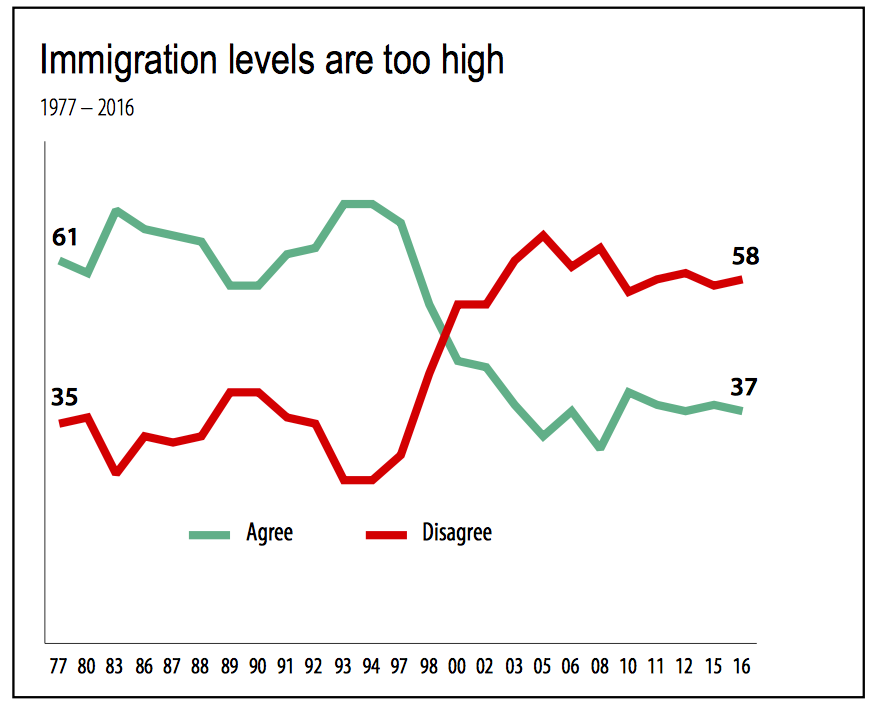
Support for immigration and multiculturalism: A series of somewhat contradictory polls and interpretations, starting with Angus Reid, CBC-Angus Reid Institute poll: Canadians want minorities to do more to ‘fit in’, where roughly two-thirds of Canadians believe immigrants should adopt Canadian values while a similar two-thirds believe immigration levels are just about right. Environics Institute’s Focus Canada – Fall 2016 Canadian public opinion about immigration and citizenship 20 year tracking of support for immigration shows little recent change:

Environics Focus Canada 2016

Environics Focus Canada 2016

Nick Nanos’s survey of What makes Canadians proud of their country? has the following results:

“Asked an open-ended question about what made them proud to be Canadians, the top unprompted response was our commitment to equality/equity/social justice (25.2 per cent), followed by our reputation as peacekeepers (19.4 per cent), multiculturalism (12.0 per cent) and respect for others (11.3 per cent).”

All of which helps explain the divergence of positions among Conservative leadership candidates, ranging from those openly playing identity politics (Blaney, Leitch) to those with inclusive approaches (Chong, Obrai, Raitt).

Candice Malcolm continued her obsessive coverage of Minister Monsef (see Jason Ling’s Some Folks Really Want to Deport Maryam Monsef) and the question of birthplace and possible misrepresentation by her mother in her immigration and citizenship applications. Malcolm legitimately asks whether the government is treating her case differently than other such cases, given a number of revocations in what appear to be comparable cases (Lawyers lose battle for moratorium on contentious part of citizenship law).

However, unless I have missed it, Malcolm has remained silent on whether she supports the C-24 changes that removed the previous right to recourse to the Federal Court, without providing any right to a hearing, unlike Farzana Hassan, who objects to the “unfairness of the law” while still questioning Monsef’s story (Monsef shouldn’t be above the law).

Advisory group’s economic blueprint calls for dramatic increase in immigration, foreign investment, infrastructure bank

The focus on immigration of note. 450,000 would be about 1.3 percent (current level for 2016 is 305,000).

The upcoming immigration levels plan, expected next month, will provide an indication whether or not the government will support this recommendation and if so, to what extent, as there appears to be a lively debate within the government.

Equally significant will be the mix of economic, family and refugee classes. The report’s recommendation essentially means that any increase should be with respect to the economic class of immigrants, not family or refugee class:

A group of external advisers to Finance Minister Bill Morneau will call on the government this week to dramatically increase the level of immigration and foreign investment coming in to Canada to stimulate a sluggish economy in future years.

Their recommendations include increasing immigration by 50 per cent to 450,000 people annually over five years while easing the process for high-skilled and entrepreneurial foreigners to come here; building a new department to entice foreign direct investment into Canada; and creating an arm’s length infrastructure bank. The recommendations were confirmed by several senior sources who spoke with The Globe and Mail.

…The 14-member Advisory Council on Economic Growth, chaired by Dominic Barton, global managing director of the consultancy McKinsey & Co., will deliver its first three recommendations to Mr. Morneau in Ottawa on Thursday. The council, which includes venture capitalists, institutional investors, business executives and academics, plans to present up to 20 ideas in the coming months intended to help Canada boost economic growth beyond forecast levels of less than 2 per cent annually through 2030.

The minister is expected to announce plans to act on at least one of the recommendations in his fall fiscal update, sources said. “My sense is [the government is] keen to receive these recommendations as soon as possible,” said one source close to the council. “That probably tells you they want to do something.”

…Expanding and improving the immigration process would address a key concern raised by fast-growing Canadian tech companies. Many say visa approval times for foreigners with high-level executive experience or in-demand skills can drag on for up to a year, and that coveted recruits who would otherwise move to Canada are not willing to put their lives on hold for so long when they have multiple opportunities. As a result, many tech firms say they have either lost out on key hires, or been forced to have such people work for them outside Canada.

“The current immigration process is overwhelmingly convoluted – even Kafkaesque,” said Tobi Lutke, CEO of Ottawa-based retail software firm Shopify, Inc., which is hiring hundreds of people this year and has lost recruits because of immigration delays. “The people we need to bring to Canada are not building widgets that Canadians otherwise would. The people we are recruiting … are the teachers that help us scale [up]. If we want to build the best companies in the world here, we need to allow the best people in the world to move here.”

Such thinking has guided panel members, who believe that increasing immigration and making it easier for skilled foreigners to move to Canada can increase the pool of people with the training, ambition and drive to create substantial economic value and help support Canada’s aging population. For example, a recent study by the National Foundation for American Policy said more than half of Silicon Valley startups valued at $1-billion (U.S.) or more were founded by immigrants.

The panel is calling for employers in technology and other expanding sectors to be exempt from the time-consuming process of proving no Canadian could do a job they want to offer to foreigners for senior positions or specialized roles, such as data science or digital marketing. Foreign students who have studied in Canada should have an easier time immigrating, the council also believes.

….The council and government officials are anticipating some resistance to the recommendations.

Immigration Minister John McCallum and Innovation Minister Navdeep Bains say they support more immigration, but acknowledge facing some opposition from within the government. Several recent polls – including one conducted for Mr. McCallum’s department – found little support for increased immigration.

Mr. McCallum said in an interview on Tuesday that he is not prepared to go as high as 450,000. But he suggested the number will rise from current levels of 300,000 when the government releases its 2017 immigration targets by Nov. 1. “This is a somewhat controversial issue, especially when you talk about numbers that high,” he said. The minister said no final decisions have been made.

Source: Advisory group’s economic blueprint calls for dramatic increase in immigration, foreign investment, infrastructure bank – The Globe and Mail

Canadians want to boost immigration, McCallum says after consultations

Will be interesting to see whether the Liberal government increases levels further or, as suggested in previous Globe article (Looming season of immigration politics puts Liberals, Tories on edge), shows more caution given possible public concern (IRCC’s public consultations may have drawn more from immigration advocates than those with concerns):

The Liberal government will announce Canada’s new immigration targets in November and the minister in charge said most people are telling him to boost the number of immigrants.

Speaking with reporters following a cabinet meeting on Parliament Hill, Immigration Minister John McCallum summarized the results of his recent cross-country consultations on Canadian immigration.

“I have been hearing a lot of input, and all the hundreds of people I’ve spoken to across the country, most of them, almost all of them, have advocated [for] more immigrants, whether for demographic reasons or for job-shortage reasons,” Mr. McCallum said. “But we as a government will not decide our proposal until November.”

 Canada’s 2016 immigration-levels plan aims to bring in about 300,000 permanent residents this year. That includes targets of 80,000 under family reunification, between 51,000 and 57,000 refugees and protected persons, and between 151,200 and 162,400 economic immigrants.

Canada’s immigration levels have been roughly constant over the past two decades. Between 1994 and 2014, the yearly immigration levels represented either 0.7 per cent or 0.8 per cent of the population.

In 2014, Canada accepted 260,404 immigrants, representing 0.7 per cent of the population.

Mr. McCallum said he has received a “huge amount of input” on the topic of immigration over the summer.

Mr. McCallum’s assessment of public opinion is at odds with the results of a recent Nanos Research survey conducted for The Globe and Mail that was released on Sept. 1.

That survey of 1,000 Canadians found that 39 per cent said the government should accept fewer immigrants in 2017 than the previous year. Thirty-seven per cent said Canada should accept the same amount in 2017, while only 16 per cent said the target should be increased.

Source: Canadians want to boost immigration, McCallum says after consultations – The Globe and Mail

John McCallum wants to ‘substantially increase’ immigration to fill Canada’s labour needs

Does suggest that the on-line consultations exercise, launched this summer, was more cosmetic than substantive.

I find the call for increased immigration levels has a bit of “field of dreams” quality, rather than being evidence-based:

If Immigration Minister John McCallum gets his way, Canada will significantly increase immigration beyond its current record level as a way to fill the country’s labour needs.

Pointing to an aging population and looming labour shortages, McCallum made the pitch in Manila during a speech to the Canadian Chamber of Commerce in the Philippines on Friday.

“So why not substantially increase the number of immigrants coming to Canada? And that is, I think, I hope, what we are about to do,” McCallum said, according to a transcript of his remarks obtained by CBC News.

Earlier in the week, McCallum was in Beijing, where he sought to open more offices where Chinese can apply for visas, in the hope of attracting more high-skilled workers.

The Trudeau government is already seeking to admit between 280,000 and 305,000 new permanent residents in 2016 — a record increase from the 260,000 to 285,000 newcomers the previous Conservative government had planned to welcome by the end of 2015.

Key to the Liberal government’s larger plan to promote innovation and grow the economy is McCallum’s three-year immigration plan, which he plans to unveil this fall.

McCallum said no final decision on immigration has been made and that he has to get his cabinet colleagues on board with his new plan and convince Canadians it’s the right thing to do.

“But the direction in which I would like to go is to increase substantially the number of immigrants,” McCallum said Friday.

Reducing ‘barriers’ to immigration

The express entry system launched under the previous Conservative government promised transformative changes to Canada’s economic immigration policy.

McCallum will ease some of the rules to make it easier for international students to come to Canada and become permanent residents.

He is also going to eliminate what is known as a labour market impact assessment (LMIA) —  a document all employers need to hire foreign nationals over Canadian workers.

Businesses have said it is the biggest flaw with express entry, a requirement the previous government borrowed from the temporary foreign worker program.

The Liberal government also tasked a parliamentary committee with a review of the controversial foreign worker program, but Parliament adjourned before the report was tabled. It will now be made public in the fall.

“So we’re going to make it easier for international students, we’re going to reduce some of the barriers in our immigration system … we don’t think that every immigrant needs to go through what we call a labour market impact assessment process. We think it can be simplified. We think there are some rules which are no longer necessary,” McCallum said.

“Now, we have to convince Canadians of this. But I think it’s a good idea.”

Source: John McCallum wants to ‘substantially increase’ immigration to fill Canada’s labour needs – Politics – CBC News